Portugal would pretty much be our paradise on earth… if they only used English as their native tongue. I’m only kidding about that; it’s our problem, not theirs, and Portuguese is a beautiful language. But the truth is, the only part of this whole experience we would describe as difficult is learning Portuguese. We’re retired, for goodness sake. We’re not supposed to have to work at anything!
But work we do. We are not only taking lessons from a tutor and playing around with some software training (via a very effective online program called “Memrise,”)  , but also every time we go out, we read all the street signs and advertisements aloud and debate what we think they’re saying. When we go into any given store, we look at tons of products and attempt to decipher their purpose. Sometimes we see products unique to Portugal and can’t help but be impressed at their ingenuity.
For example, I want to buy this tube of mofo repellent before we go back to the states. There aren’t very many bad mofo’s in Portugal, but it’ll be nice to have a tube of Stop Mofo if I wander into a bad area of Portland or Seattle.
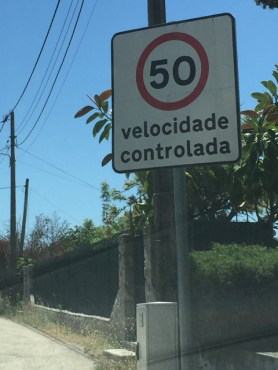 Some translations are easier than others. For instance, the sign to the left is obviously telling people to control their velociraptors. We were surprised to learn that dinosaurs are apparently still alive and well here in Portugal. In fact, not only are there signs pointing to where you can find them, as seen below, but they even have dental clinics dedicated solely to the care of their dinosaur teeth. The top sign must mean, “lots of dinosaurs,” and of course it’s easy to translate the one below it to “dental clinic,” obviously intended for the dinosaurs mentioned above.
So you see, it’s not all just about memorization. Sometimes you have to connect the dots and use your brain power to figure this stuff out. And as you can tell, our brain power isn’t suffering from any dementia yet, boy howdy.
 Otherwise, how are our Portuguese lessons going, you ask? Well, it’s progressing, we answer. We have been inching our way toward a little more understanding of things. We are catching more words spoken by passersby. As already illustrated, we can obviously translate more signs than ever (although accompanying illustrations are always appreciated). And of course the more Portuguese we throw around at strangers, the more we can confuse them as to what the hell we’re trying to say.
There are days when we think we’re never going to learn enough. And then there are other days when we feel like we’re getting a handle on it, like when we can finally translate the stop signs on the streets. There aren’t nearly as many of them here as in the US, mostly due to the prevalence of round-abouts, or as I like to call them, “scream generators.”  Carolyn still hasn’t gotten used to cars racing up to the roundabout just as we’re passing in front of them. So far, they’ve always stopped in time, but we don’t know if that’s due to Carolyn’s screams or whether they all understand they have to give way to anyone coming from the left.
We did finally figure out that the letters on the red signs not only spell STOP, but they mean that too. It was confusing for a long time because the Portuguese word for stop is “pare,” and we couldn’t find out what “stop” meant in Portuguese. In the end, we figured they didn’t want English speakers to use paring knives while driving, so they went with the English version to cut down on the emergency room visits.
Otherwise, we can provide an example of our progress by showing you an entry from our training book. We can actually read the below and mostly understand what it’s saying:
O Pedro levanta-se as 7:00, toma um duche, vesta-se e as 7:45 senta-se para comer. Ele toma o pequeno-almoco sempre em casa. Come sempre pao com manteiga e doce a bebe café com leite sem acucar. O Pedro e economist e entre as 9:00 e as 13:00 trabalha numa empresa no centro da cidade. As 13:15 almoco com os colegas num restaurante perto do trabalho. As tercas e quintas, as 18:00, tem aulas de ingles numa escola de linguas. A noite chega e casa e prepara o jantar. Janta as 20:00 e deita-se sempre as 22:00. Ao sabado de manha, o Pedro vai as compras e a tarde limpa a casa. Ao sabado a noite, ele sai com os amigos e deita-se tarde. Ao domingo, ele so se levanta as 11 horas e almoca em casa dos pais.
Now, if you don’t speak Portuguese, you’re probably wondering what all that means. Well, he says, hitching up his pants with Trumpian confidence while speaking in boastful tones not unlike Don Knotts at his best (albeit in a lower timbre). It has something to do with Pedro the economist who goes to work and is struggling with the ideas of eating his children and having spiders in his pants. He’s also a bit upset when he goes out to eat, because perky college students always serve him almonds instead of meatballs. So he just licks the arugula and refuses to tip. But they don’t tip very much in Portugal anyway, so despite his worrying about getting shot due to his stinginess, he makes it home safely with almonds in his shoes.
The paragraph actually doesn’t make a lot of sense to us, because there are very few guns in Portugal, so his worries are very misplaced. We just don’t think Pedro is all that smart. But hey, if your claim to fame is to have a one paragraph biography in a language textbook, how smart can you be?
The interesting thing about the Portuguese language is that if a Portuguese speaker were to speak that paragraph aloud, here’s what the entire thing would sound like:
OPedrolecon shh shh prajant sh sh sh rrrrr-limdos-doshpais.
All uttered in approximately three seconds. And we’re supposed to understand that.
It’s not really a long term problem though. Because as soon as we give them our best I’m-not-even-going-to-pretend-I-understood-one-word-of-that look, they translate everything they just said into about ten English words.
I’m not making that up. Once, our attorney was talking with a banker on our behalf. They went back and forth for fifteen minutes in Portuguese. When they were done, I asked what was said. He told me, “She says that you have to turn in the form and wait five days.” That was it? He shrugged and said, “pretty much.”
So they either use a lot of words to communicate individual ideas, or they were talking smack about me, knowing I couldn’t understand. Maybe I have to buy some of the Stop Mofo paste for here after all.
 posed to Portugal’s amazingly inexpensive yet delicious wine, the beautiful (albeit rainy, at least during our visit) streets of Lisbon, and some cramped living quarters, especially in the steep stairway of our rented apartment.
 bra just minutes away from a sandy beach that stretches beyond sight. We pass by a medieval castle every time we drive into town. And while we have had some of the same May rain we did a year ago, it quickly gives way to 75-80 degree days, which is perfect weather for the beach or our ever-warming pool. I describe it thusly because it’s still too damn cold to swim in. I’ve jumped in a couple of times for an immediate cool-down. But it’s straight to the ladder after the cold water wreaks its bodily-shrinkage-havoc.
 e hillside, reminiscent of a seaside town in Greece. And the wine is still as inexpensive as it was a year ago.


 She was more than a little nervous, although the pedestrians of Lisbon should have been more so. Just kiddin’. She’s a good driver, but the tiny streets, confusing street lights, and chaotic traffic are not for the faint of heart. Needless to say, we made it home in one piece. Although it took us a bottle of vodka to recover from the trauma.



 Like most Americans, Carolyn and I had been indoctrinated into the horror stories about socialized medicine, often juxtaposed with friend-of-a-friend anecdotes about how much better American medicine was than anywhere else in the world.

 but this is also in addition to our paying the most per capita in the world. Let me repeat that: We spend more on health care per person than any other country in the world. Surely that has to buy us something?
 We gave her our particulars. Not once did she ask why we wanted to see a doctor. I found that refreshing. What business is it of anyone besides the doctor anyway? But in the U.S., you’re usually forced to offer up a detailed description of all the bumps on your private parts, when you last went pee and what color the urine was, plus your shoe size, all to a receptionist who takes ten minutes to find the right color yellow to fill in the little box with the accurate rendering of the color of your pee.
 After about twenty minutes (See! Five minutes off!), he appeared, and waved us in to his office… us as in both of us. I was a little confused at first, because the only other time I’ve been allowed into a medical office with my wife was when she was giving birth, or we were receiving very bad news. However, as he showed us to our chairs, it occurred to me that it was quite smart to do so. There was no need for a nurse to be on hand with a male doctor and a lone female patient. Her husband was right by her side. Cost savings right there, kaching!
 The temperature has been hovering around 21 degrees celsius (or for you luddites, about 70 degrees) the last few weeks. Not quite beach-going weather, but since it’s April, and we still have Oregonian blood coursing through our veins, and the beach is just about a ten minute drive away… it was time to get beachy! So we threw on our crocs, tossed the





 Over time, I couldn’t understand why some people would just keep talking in Portuguese after hearing us say that. The one who confused me the most was a Brazilian delivery driver who called on the phone to let us know they’d be here at 7:00. It took us over five minutes to figure only that out on the phone; I don’t think he spoke a word of English. Upon delivering the goods, he said to me a couple of times, “Nao fala Portuguese,” and then he would bust out laughing. Not in an unkindly way, but he obviously got a kick out of something.





 I recently complimented a young Portuguese man on his excellent English. He credited his skills to the Indiana Jones movies and the Cartoon Network. After I told him of our efforts to learn Portuguese, he told me, with some degree of sympathy, that Portuguese is ranked the sixth most difficult language in the world to learn.

 It seems that they forgot that tightening the washers on a water heater provides excellent assistance in preventing the actual water from moving into places other than inside the pipes.