
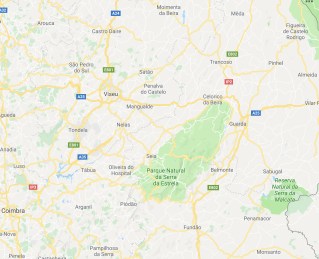
One of the main purposes of our move to Europe was to use Portugal/Lisbon as a launchpad for exploring the rest of Europe. But what we have discovered in the meantime is that Portugal is a place full of wondrous things to see all by itself.
Northern Portugal features scenic beauty, historic villages, the highest point in Portugal, and castles galore. We came to see as much as we could, and we certainly did that. Seven days of driving put over 1,000 miles (1,600 km, or .0041866 of the distance to the moon) on our little trooper of a  car, Marco the Polo.
But the real difficult part of the whole trip was cataloging and organizing all the pictures. While the castles became something of a blur to our memories, each one had its own unique characteristics that made it worth viewing. After figuring out which of the over 1,000 pictures we had was what, I then had to organize, label, cull, and somehow put them in the blog while still being entertaining.
O meu Deus!
So I organized, labeled, culled, and put a bunch of them in the blog. I’m not sure about the entertainment part, but if you’re interested in scenery you probably have never seen before, at least there’s that!
We used the city of Viseu, with a population of about 100,000 (100,000 in metric), as our launchpad for visiting the surrounding area. While we didn’t find Viseu all that interesting on its own (it did have a ginormous seven-story mall with a skating rink on the top floor and an indoor fountain that spouted all the way to the top), it did serve as an excellent point from which to see everything we saw up there.
The hotel we stayed at, The Pousada De Viseu, was interesting in that it was a converted hospital, and quite beautiful inside.


We had a few hiccups upon check in: they wanted to charge extra because I had the audacity to bring my wife. A good old fashioned American-style pitching of a fit cured them of that notion. Also, the electronic room keys only worked after ten or twenty attempts, but otherwise it was a very nice place.


Above are some photos as we traveled in and around Viseu. They had a nice little stream running through town, part of which had hot springs, but the only access to the hot springs was in a hotel/spa.
Of course, being on the road for a week means eating out a lot. However, a breakfast buffet was included with the hotel (and it was pretty good!) and we tend not to eat out very fancily as we travel. We’d rather spend time driving and seeing more sites than sit down for a typical three-hour Portuguese meal.
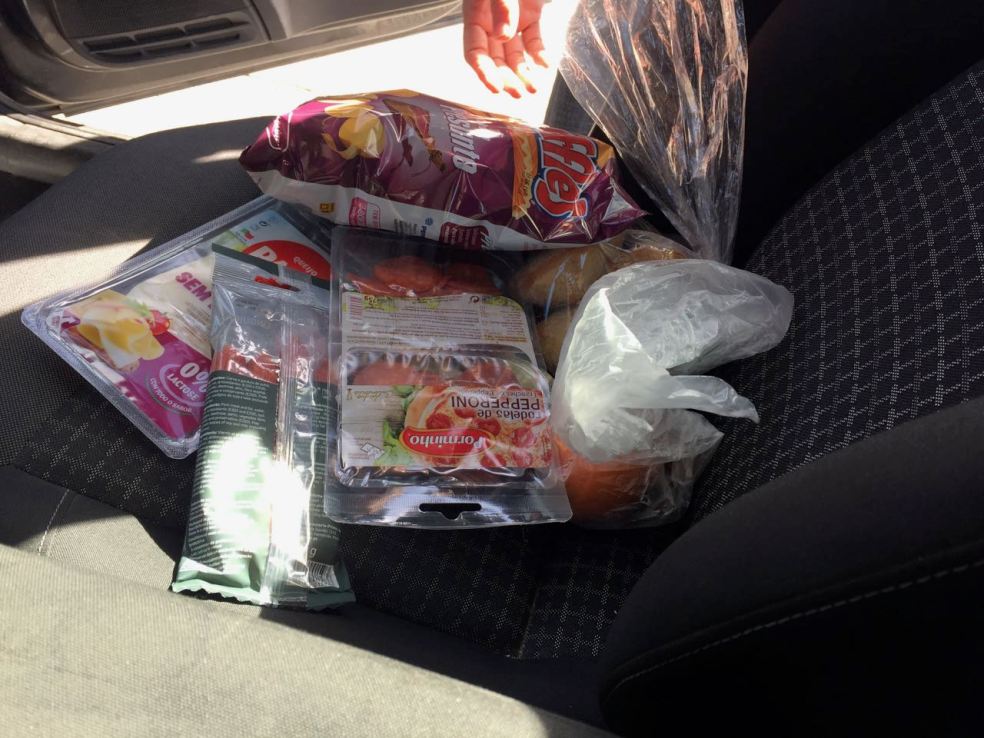 As a result, our lunches often looked like this… a bunch of flotsam and jetsam purchased at a grocery store.
 Which is fine except that sometimes you end up with a really crumby wife.
 I did have a tasty turkey burger in White Castle. What? White Castle you say?
For those who know that chain of American hamburger restaurants, you might not have known their reach extended all the way to Portugal. The reason you wouldn’t have known that is because it’s not true. 
Actually, the whole town is named White Castle. And it has nothing to do with the hamburger chain. But, when in White Castle, one must eat a burger I guess.
One would of course expect Castelo Branco (which literally translates to White Castle, in case your Portuguese is rusty) to have a castle, right? Well, it does, but after seeing about a dozen of them throughout that area, we have to place Castelo Branco’s castle pretty much last on the list.
 This is about as good as it got in terms of Castle-ish scenery.
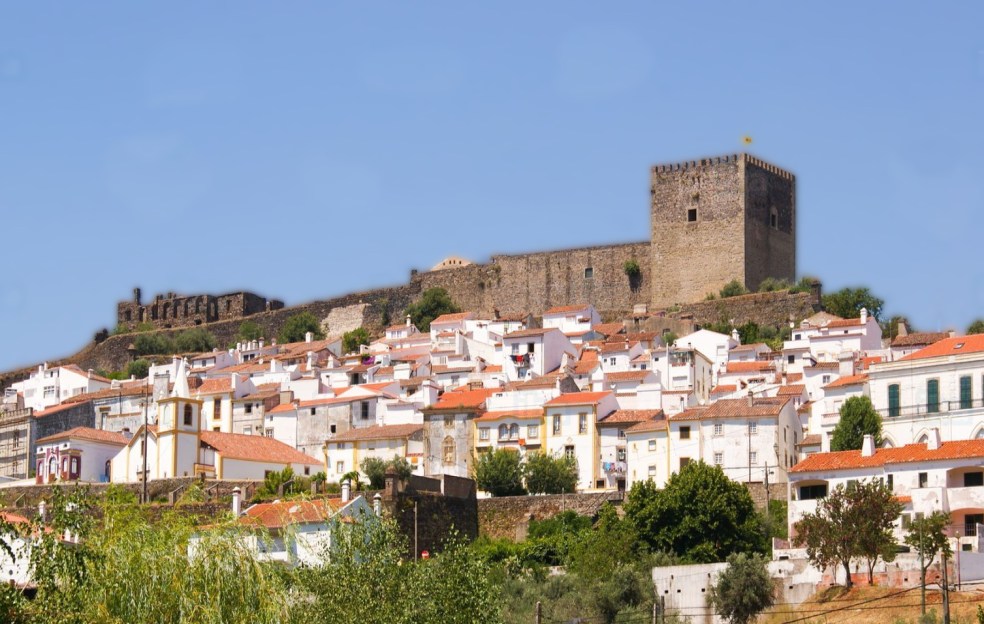 The above photo makes it look interesting from the outside, but in truth it was pretty barren and didn’t offer much to see, other that the typically great views of the countryside from the castle walls.


But now that we have the least interesting castle out of the way, we can get to the other ones, which ranged from “cool” to “this is freakin’ awesome.”
We’ll start with marvelous Marialva.
Marialva dates back to Roman times, being reconstructed during the time of Trajan and Hadrian. According to the 2011 census, the village itself boasted a population of 255, making it quite the bustling metropolis. It isn’t often we get to visit a town and thereby increase its population by almost a full percent.
Construction of the castle is dated back to around 1179. I wonder how many things we build today will be around almost 1,000 years later?
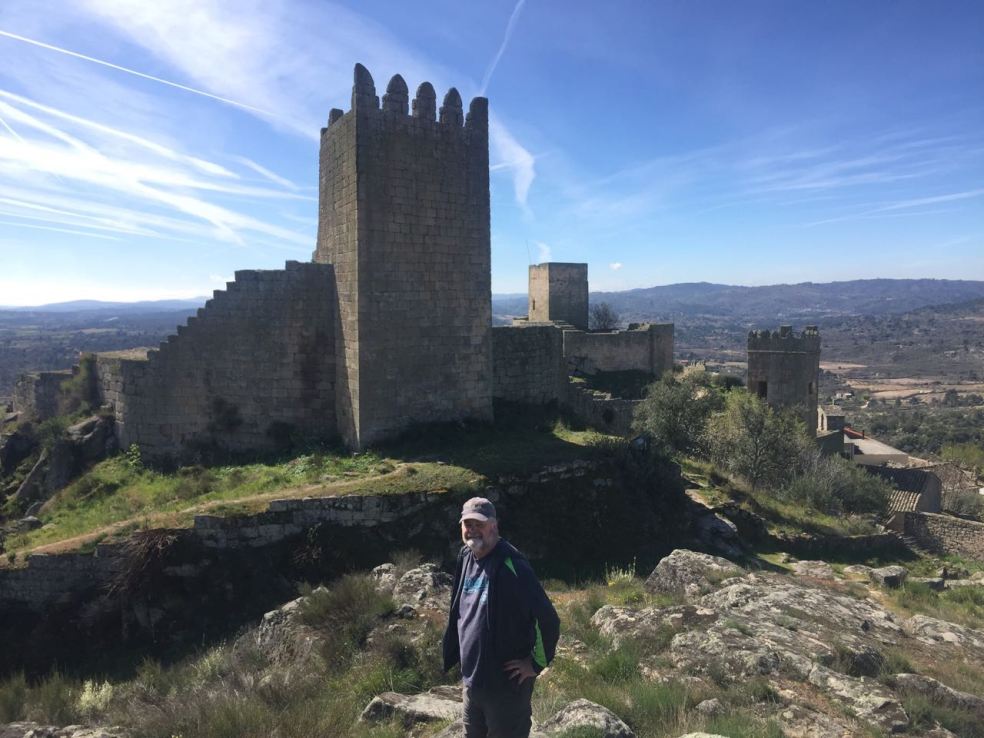
 They have a suggested trail of the most important historic towns and castles, and while we didn’t follow those instructions, our route throughout the area looked an awful lot like that Family Circus-esque trip as well.
Below is a slide show of some of the pictures we took. It’s a cute little town with a cute little castle. And of course… we love castles!
 Usually you get a great view from atop the castle walls. But it can be even better when you climb up above the castle itself!
 Oh, well.
 Carnaval is a festive season that occurs before Lent, and the festa-loving Portuguese go all out in their celebrations.
 Okay, so maybe Photoshop is the only thing that made us King and Queen. But we enjoyed ourselves anyway, even if we’re just the peasants.
 Moving back to reality, the crowds were plentiful as the parade made its way down the Sesimbra boardwalk, which fronts the ocean.
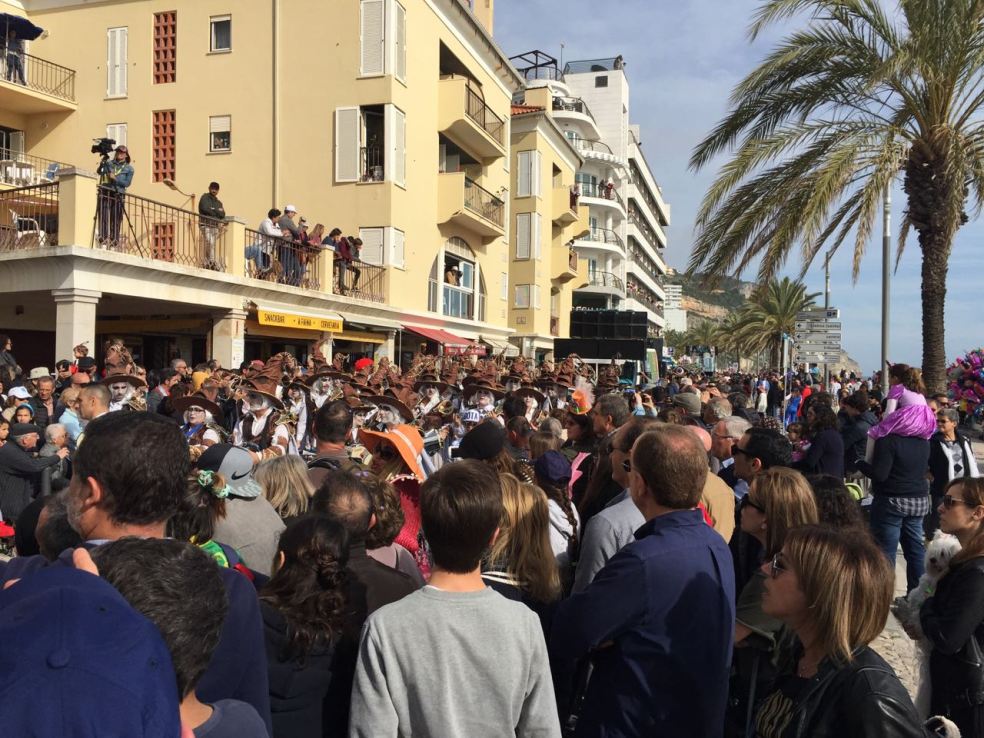 They even lined the balconies above, like in New Orleans. No one’s throwing beads here though!
 This clever float had these poor souls hanging on for dear life.
 Okay, so it was the clever use of a mirror. Kind of like real-live Photoshop!
 At the beginning of the parade route.
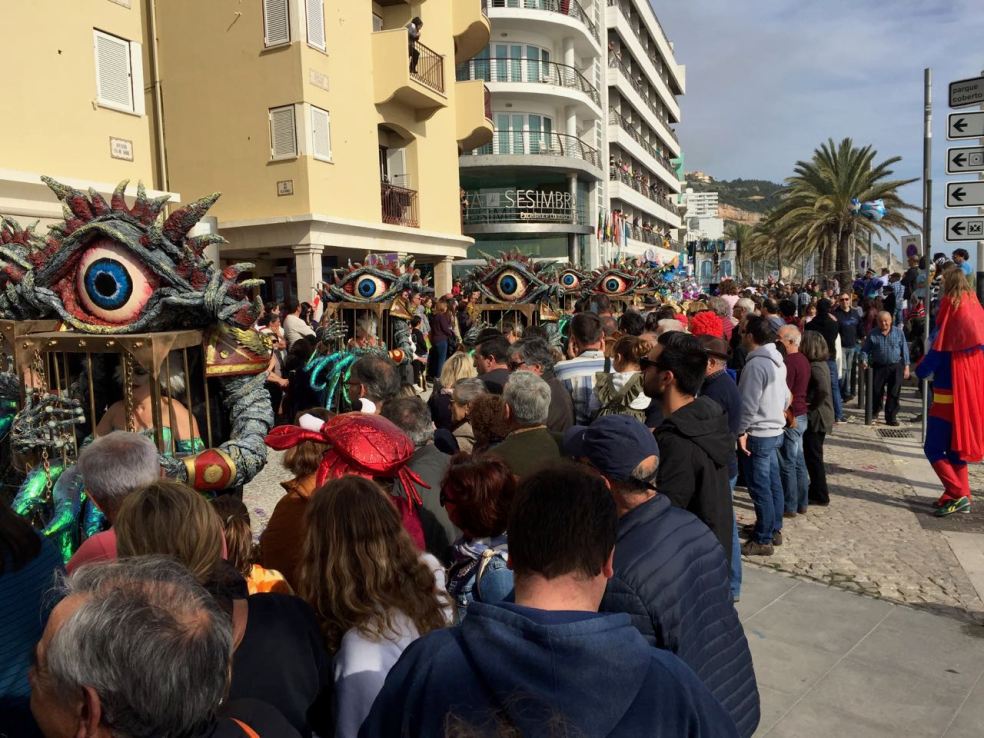 The eyes have it!
 When people hear the word “Carnaval,” they often think of racy outfits like these.
 But in Portugal, this is what you get. Ha!
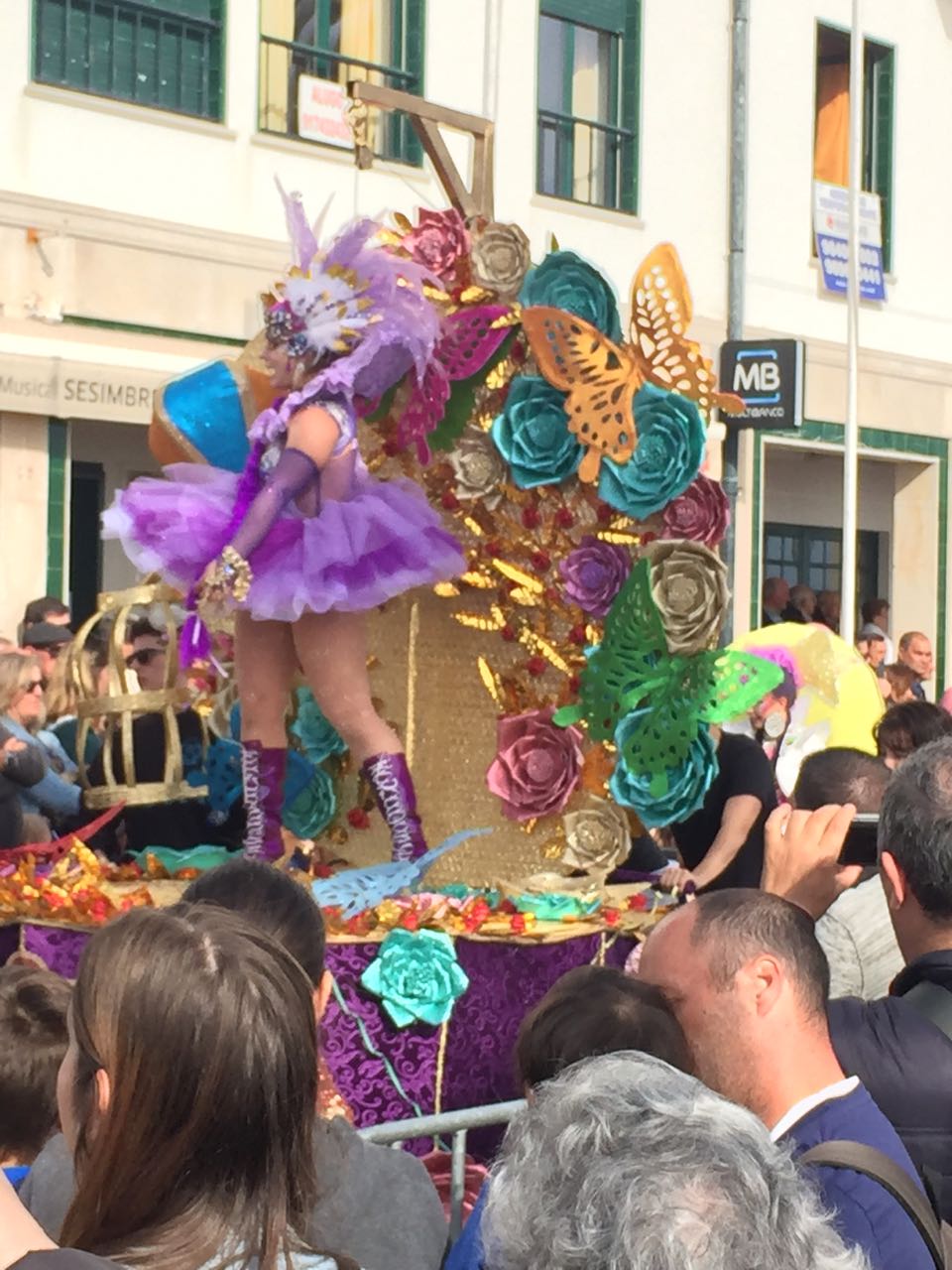 People dress up just as colorfully, but generally it’s a lot more PG than R-rated.
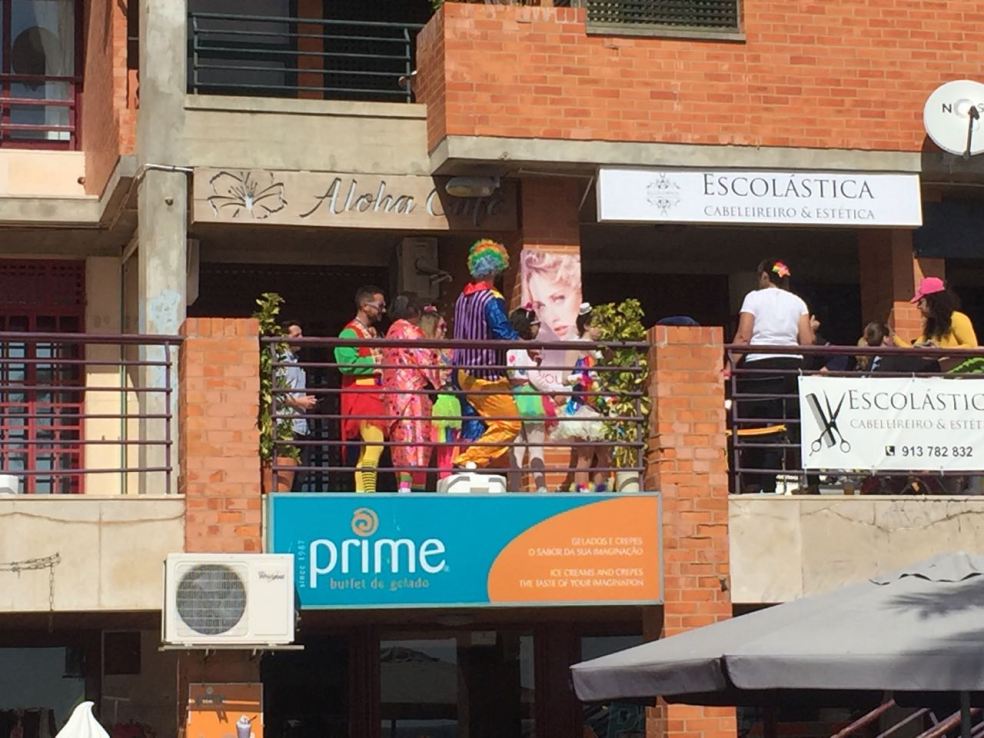 It’s party time everywhere you look!
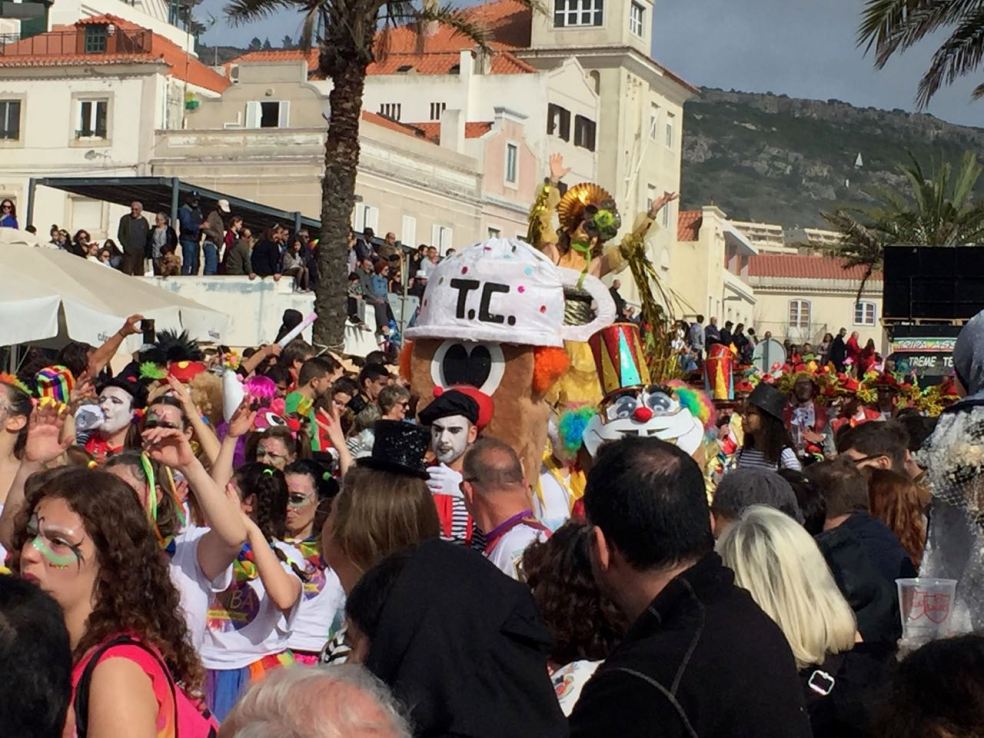 They even had mimes. Mimes! Who does mimes anymore? The Portuguese, that’s who!


 Pipocas means popcorn. We think it’s a cute word.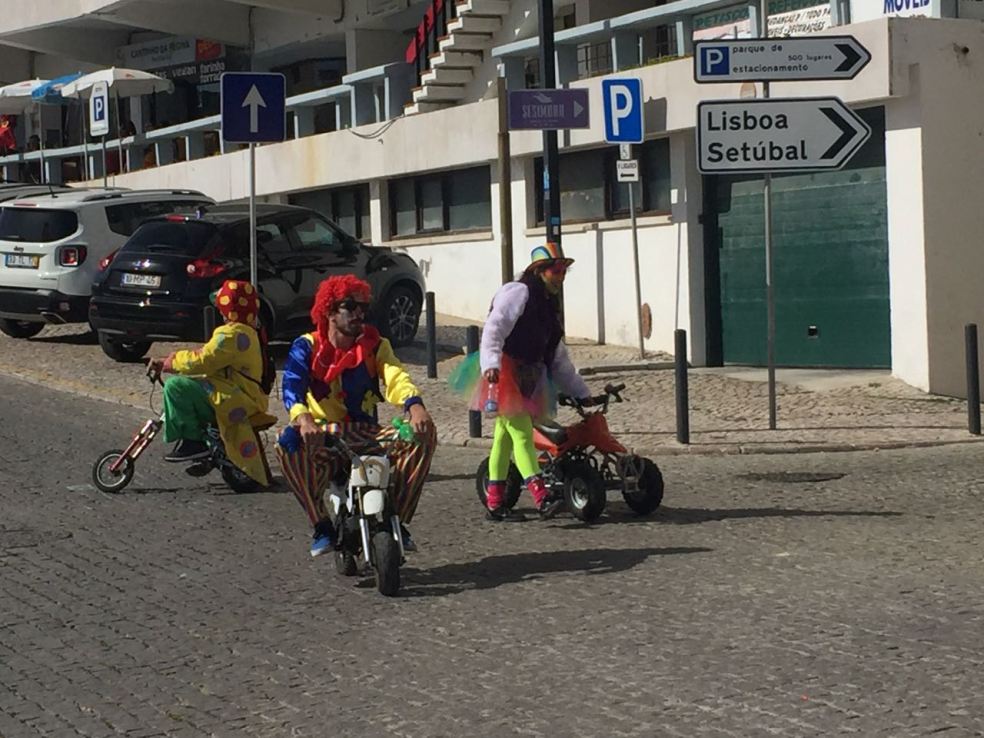


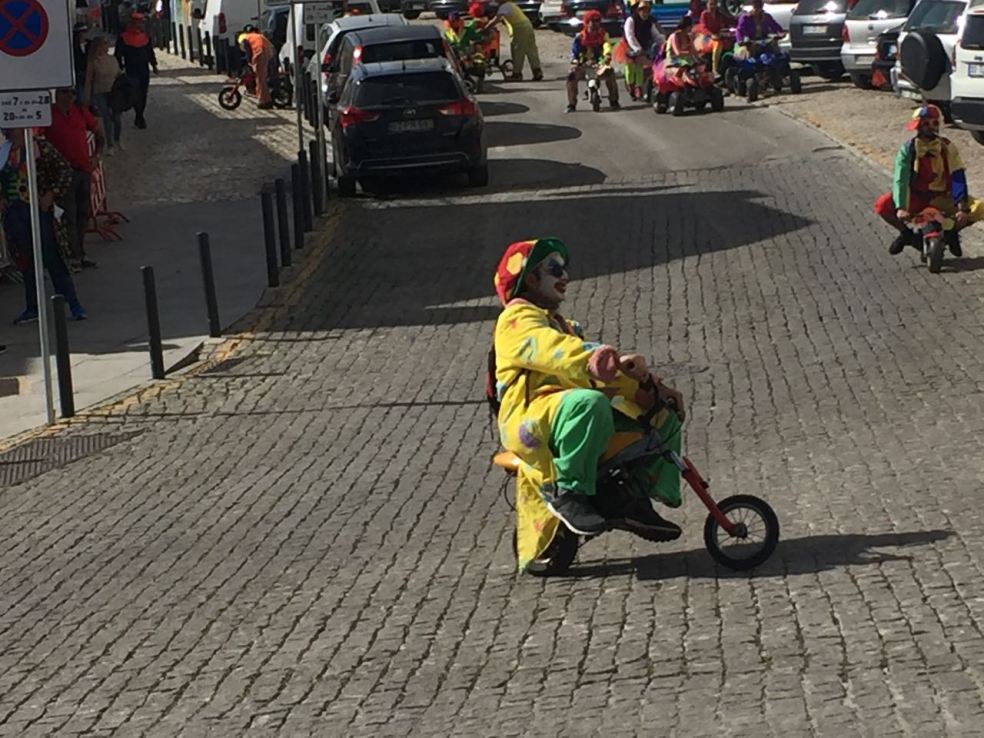 The thing I love most about Carnaval here, especially on Clown Day, is that almost everyone participates, From one to ninety-one, people are dressed up as clowns. It’s especially nice that even teenagers participate and have the same kind of playful fun.
 On top of the hill you can make out the outline of “Our Castelo.” The Portuguese don’t think much about their castles and the like, because they’re so used to them. But we still love our castles!
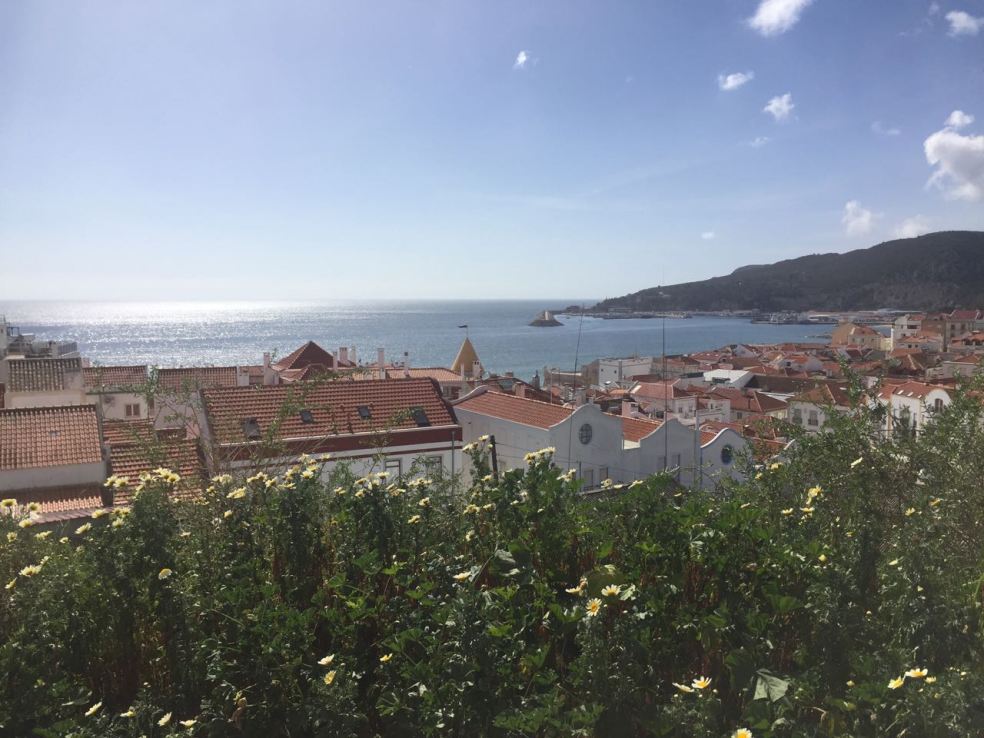 The March weather was kind, in the sixties (upper teens celsius). Just a lot of beautiful blue like it is so often in Sesimbra!
 Even in our Aquasize class everyone got into the spirit of things. In the above picture we’re the ones in back, me with the big red nose. Below, we’re on the left hand side. We always occupy the deepest in the pool on account of our differences in height. 🙂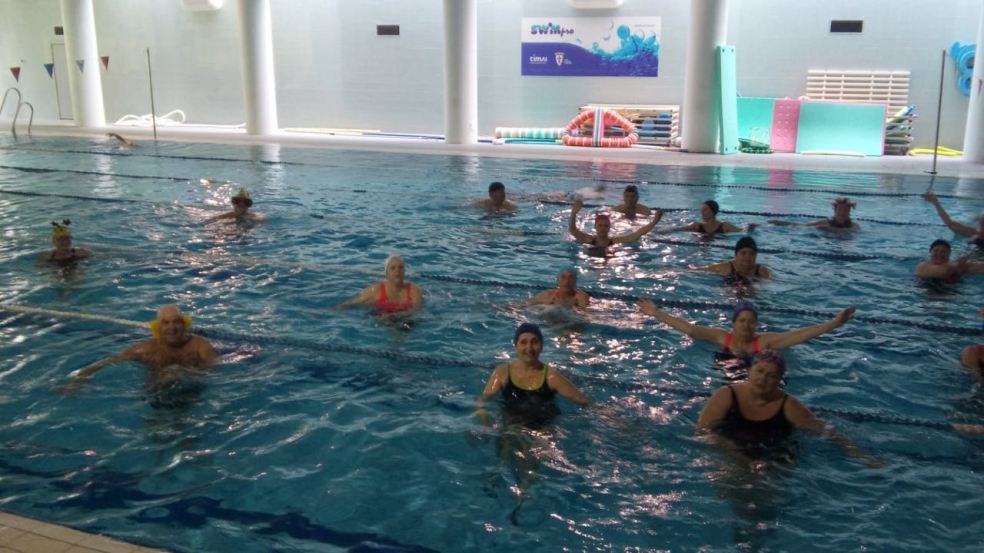
 There we are with our instructor, Patricia. She’s an awesome teacher. She makes it easy to enjoy exercise!
 Did you know that “mafra” means “worm” in Portuguese? No?
 Mafra’s headliner is the cleverly named Palace of Mafra, construction of which began in 1717. It wasn’t fully completed until 1755, which was just in time to allow the Portuguese to watch the beginnings of the American revolution on TV. It was used as a secondary residence for the royal family, which tells you something about the enormous resources they used to spend back then just to pamper royalty. The thing is huge. The whole complex covers over 400,000 square feet (for you Europeans: 37,790 m²) with about 1,200 rooms (1,200), more than 4,700 (4,700) doors and windows, and 156 (holy hell there are a lot of stairs in this house!) stairways.
 Since it was Carolyn’s birthday, she got to have the solo pic with Fiona the owl, who kindly donned that particular coat of feathers in order to match Carolyn’s scarf.
 We paid eight euros for this picture, but we wouldn’t have gotten the other snapshots without the investment. She looks like a natural with a wild creature, doesn’t she? And I think Carolyn does too! Fiona is a European Eagle Owl, one of the largest breeds in the world. Carolyn is an American– wait, I better not make a joke here or I could get into trouble.
 As soon as they let me in the picture Fiona turned her head in a fit of jealousy. In all seriousness, multiple breeds of birds, including owls, have exhibited homosexual behavior. We now know Fiona is one of them. There goes the neighborhood!
 They had five separate birds on display, three of which were owls. This bird clearly isn’t an owl because its head is on straight. It’s a falcon. While it’s not a Peregrine falcon, a little piece of trivia about the Peregrines is that they have been recorded diving at speeds of 200 miles per hour (320 km/h), making them the fastest-moving creatures on Earth. So the next time some punk first grader tries to tell you cheetahs are the fastest animal, correct the little know-it-all brat and let him know that only refers to running speeds.
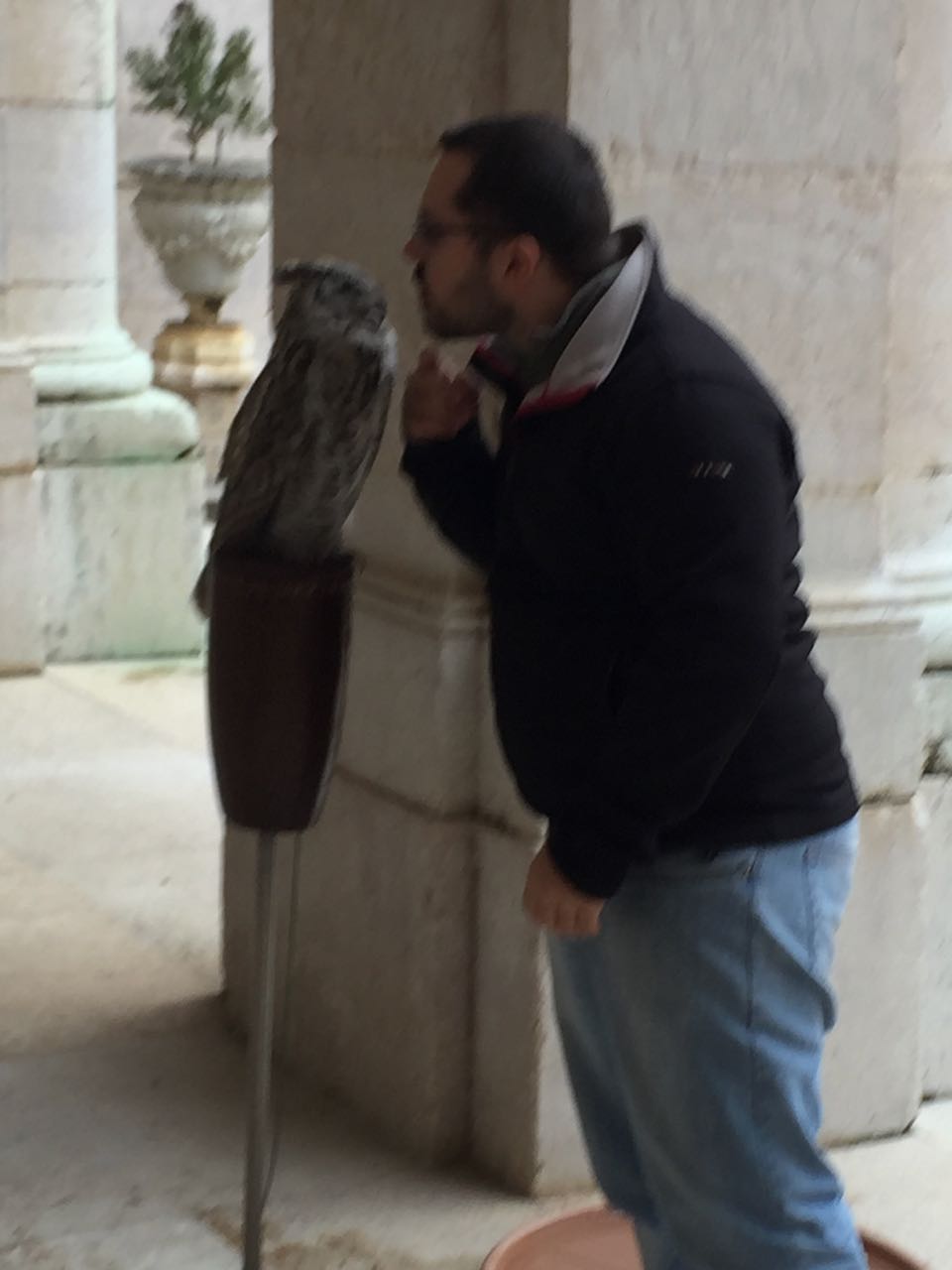 The handler goes in for a kiss. He’s been on the job since he replaced the previous handler, Carlos “No Lips” Johnson.
 Owls are the third coolest birds ever invented, just after the hummingbird and the one that’s always being flipped but is otherwise invisible. This is a Pretty Good Horned Owl. In the wild they’re called Great Horned Owls.
 Carolyn carefully holds her owl while the handler keeps it from eating off her nose by slipping a fiver under his feathers.
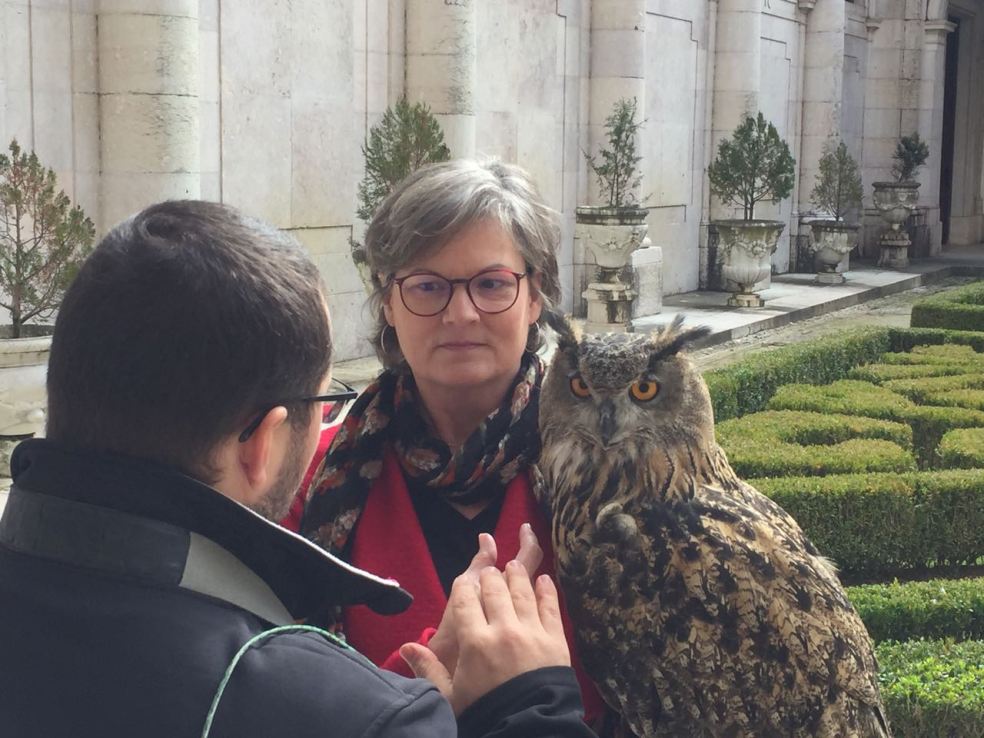 Here he provides instructions on how to abort the mission if the owl begins chewing on her face. But I don’t think Mr. Owl would do that to someone who looks as smart as him!
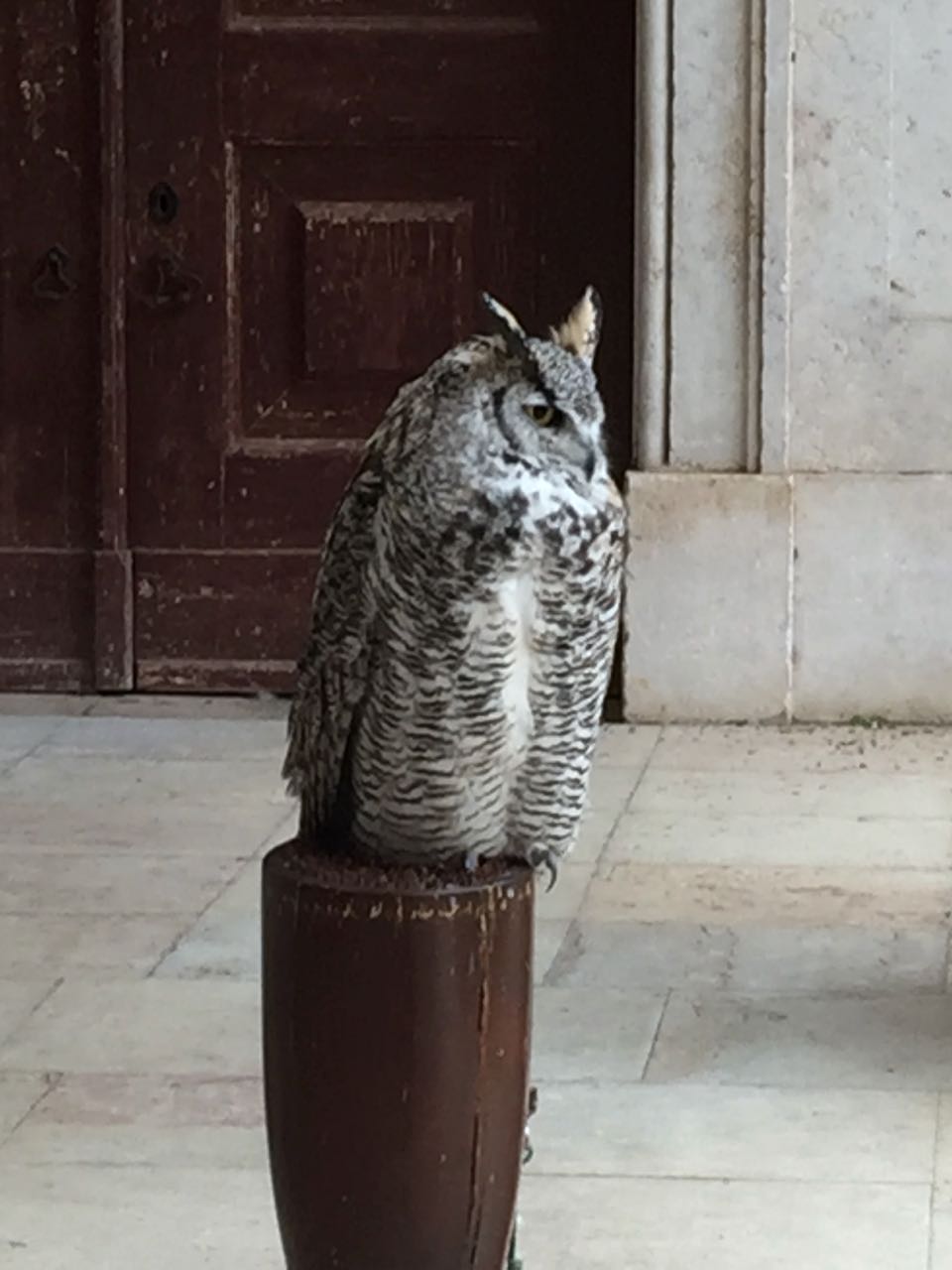 Owl I want for Christmas is an owl in my yard, an owl in my yard, an owl in my yard.
 The falcon is preparing for lift off. He wouldn’t have gotten far, since he’s tethered. They do let them fly around without the tether after the tourists are gone… the falcons are particularly notorious for frequenting tetherless bars.
 In the foreground is a red-tailed hawk. In the background is the photobombing falcon.
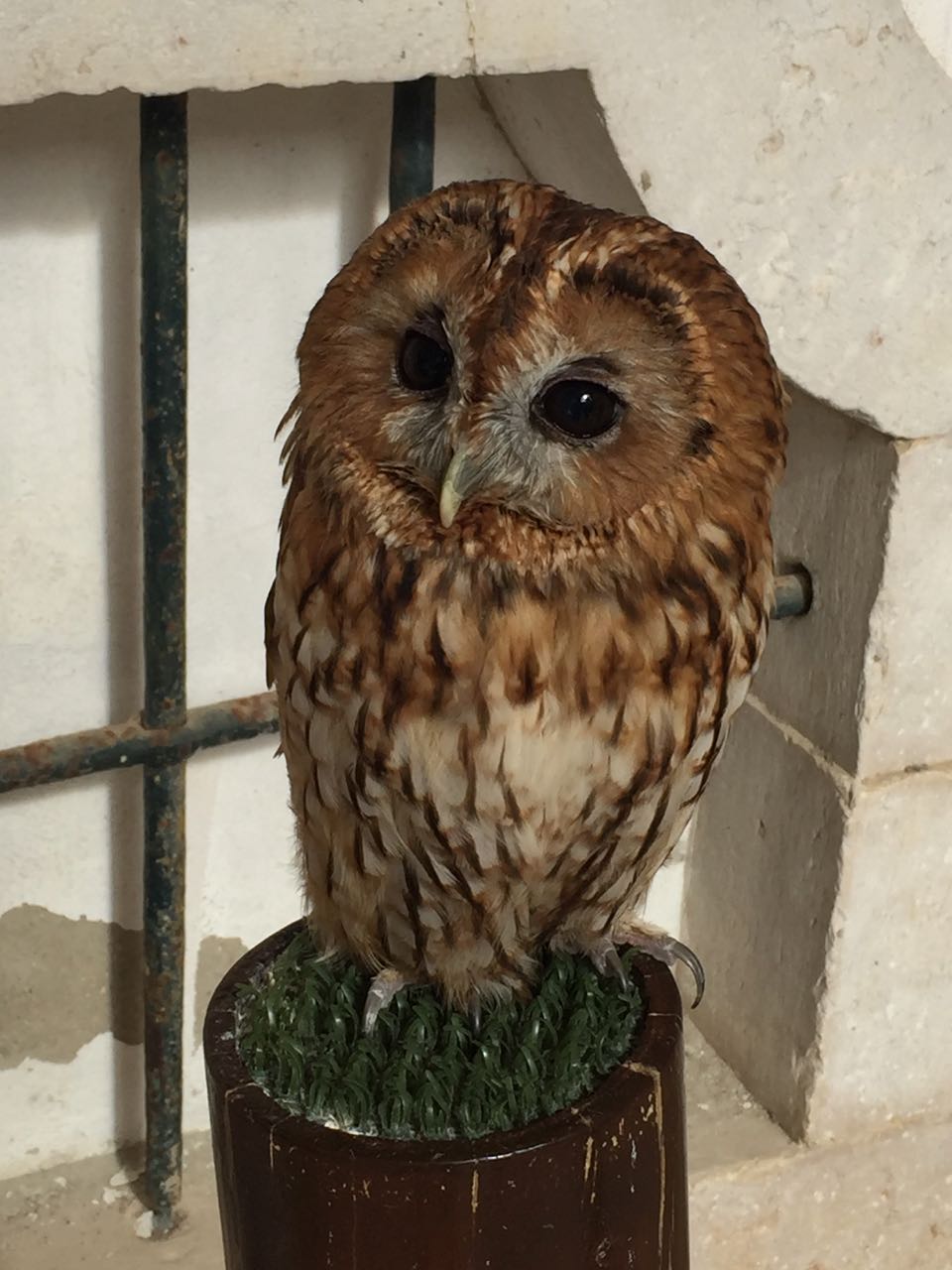 This little Tawny Owl cutie was my favorite. Can a meat-eating stone-cold killer of a raptor get any cuter than this?
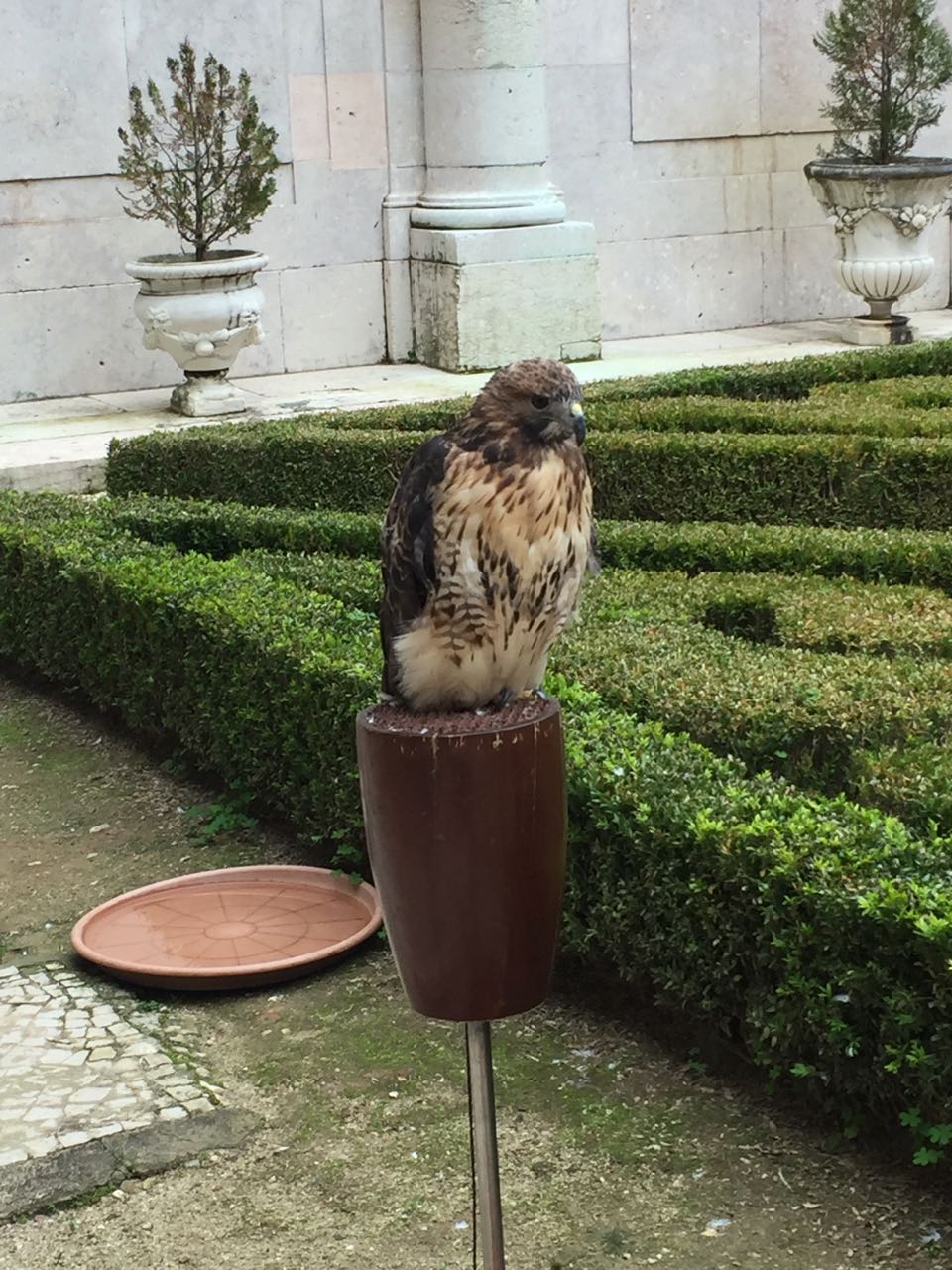 It’s not a great job, but hey, it pays the bills.
 Once in a while I take a photo that almost makes it look like I know what I’m doing.
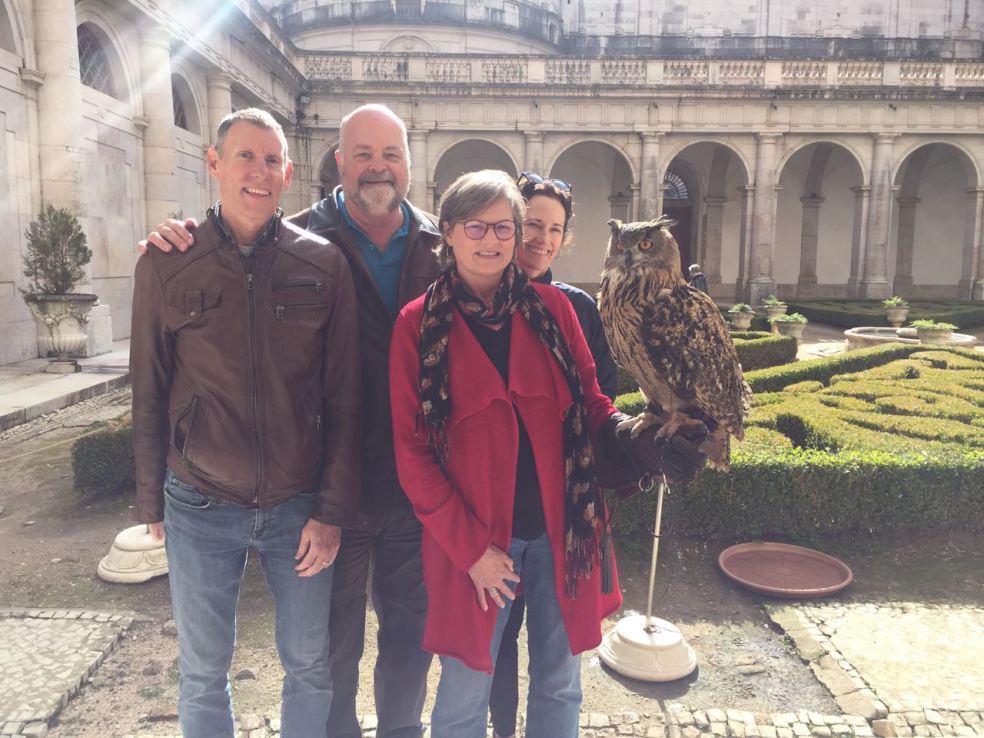 The group hug with an owl. Actually, we eschewed the group hug precisely because we didn’t want to get chewed.
 This is the garden where the birds are kept. I tried walking through the maze but got lost.
 Once inside the palace, we quickly found out why the royals were in such good physical shape. It takes twenty minutes to walk from the bedroom to the bathroom!


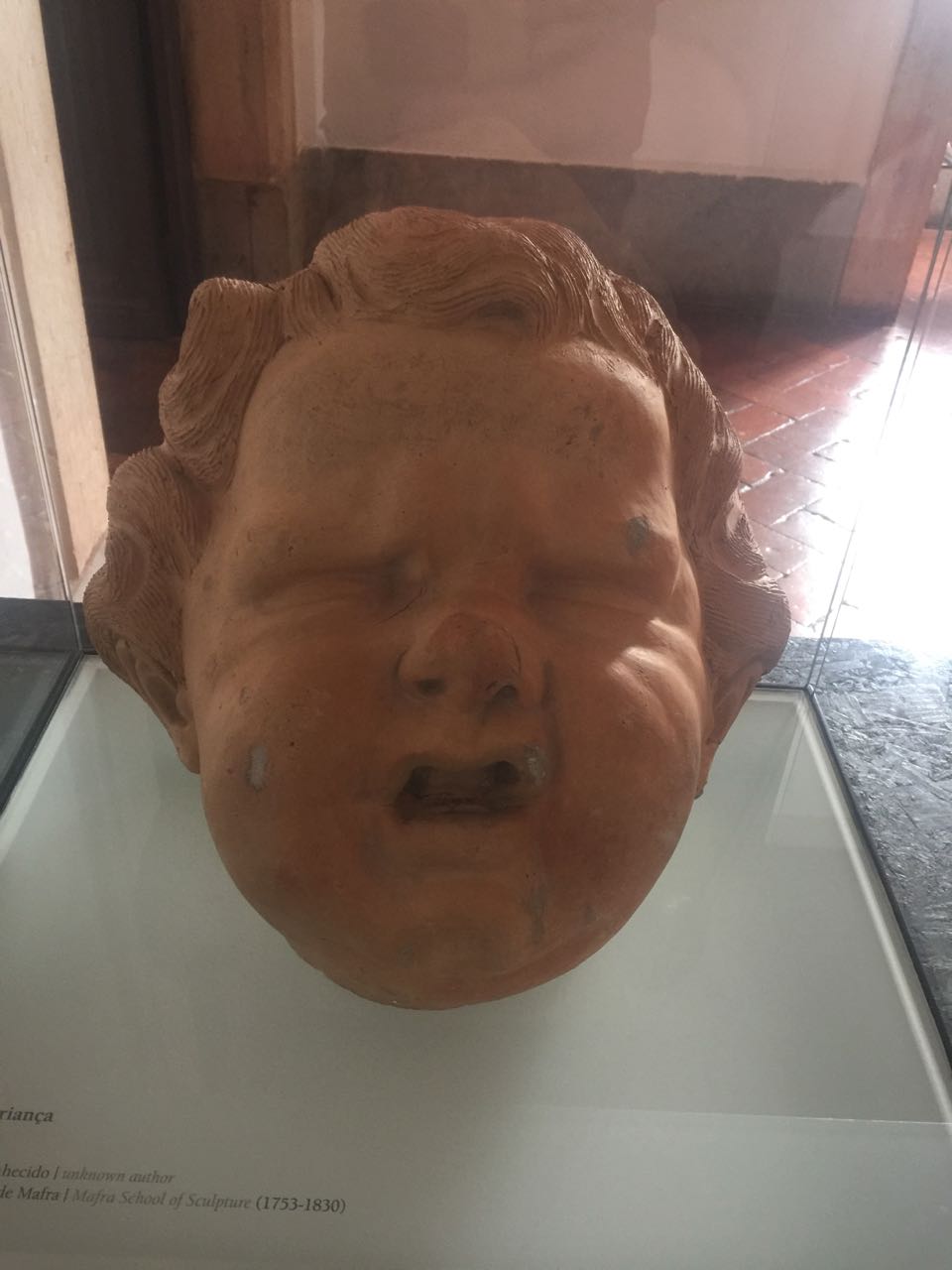 Apparently they did.
 This is a row of statues that are smaller versions of larger statues on the property. Conversely, the big statues are larger versions of these.
 I took a picture of this informational plaque because the library was so impressive and it contains more thorough information than I could otherwise provide (plus of course a welcome lack of bad jokes). If you read all the way to the bottom, you can see why I didn’t steal any of the books from the place. Going to hell for stealing a book seems like pretty harsh punishment, but this was before anyone thought of the three strikes rule.
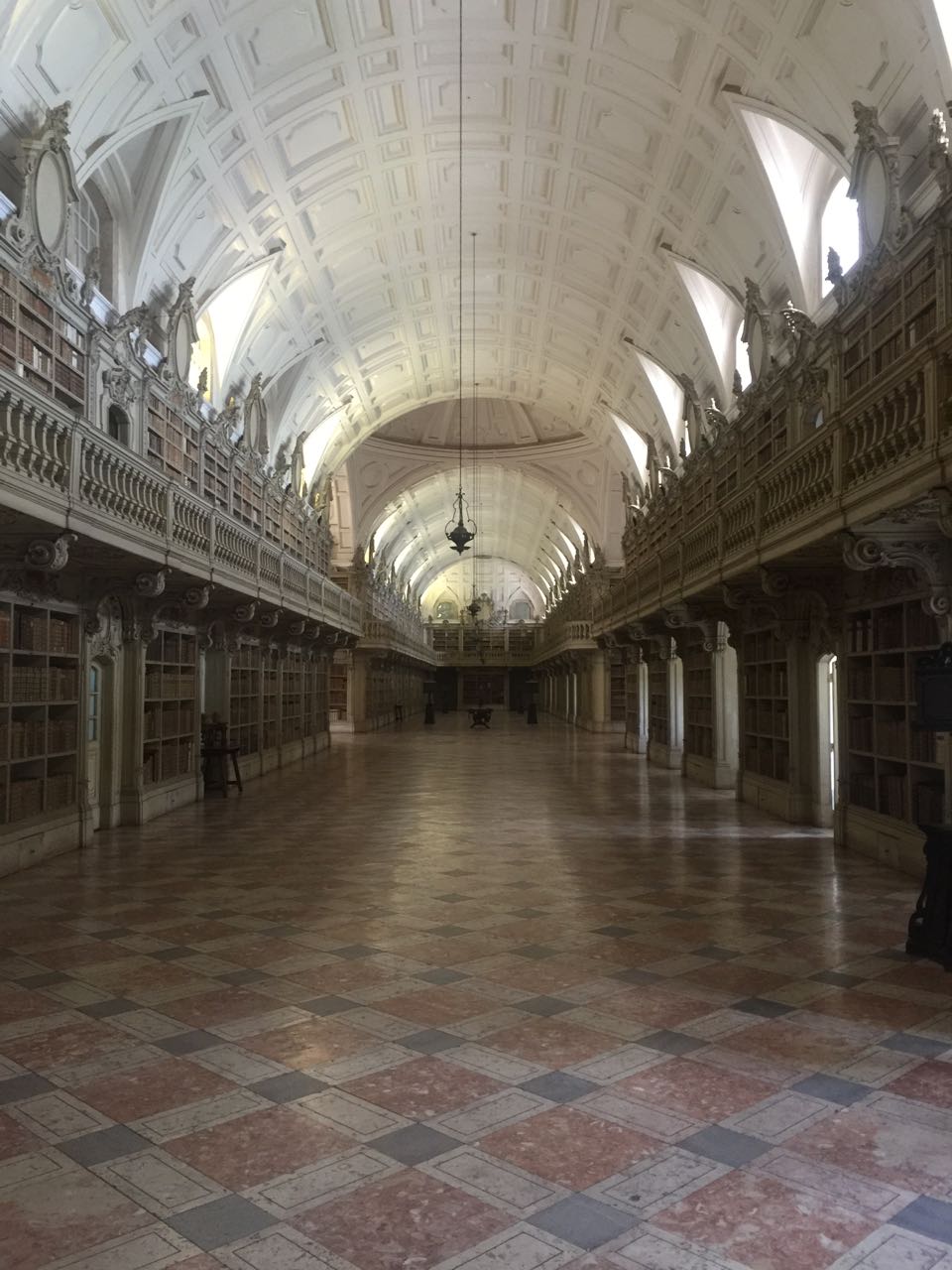 In this library, if you’re too noisy and someone shushes you, the “sssshhh!” reverberates around the room for fifteen minutes.
 Sandy is either taking a picture of the ceiling or protecting himself from owl droppings.
 Okay, maybe it was the ceiling.
 From ceiling to floor, there was artful decor.
 I couldn’t stop stairing at this tree. Get it? Stairing? Oh, jeez, quit rolling your eyes (they may stick like that!) and just go on to the next picture.
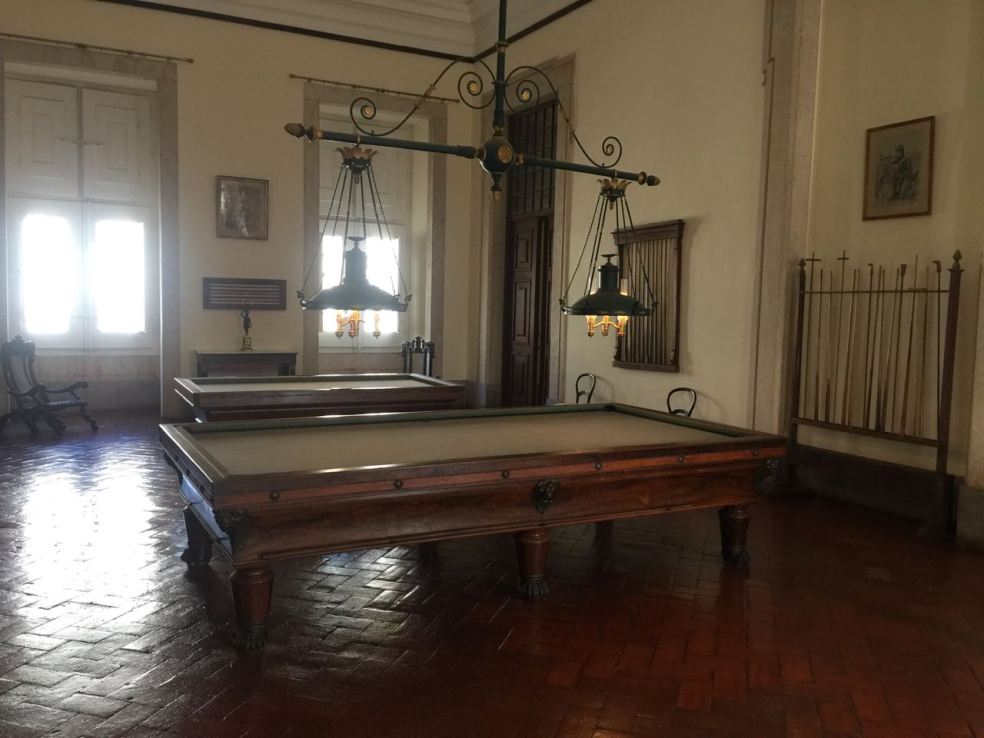 This billiard table is so large you need a bazooka to shoot a ball from one end to the other.
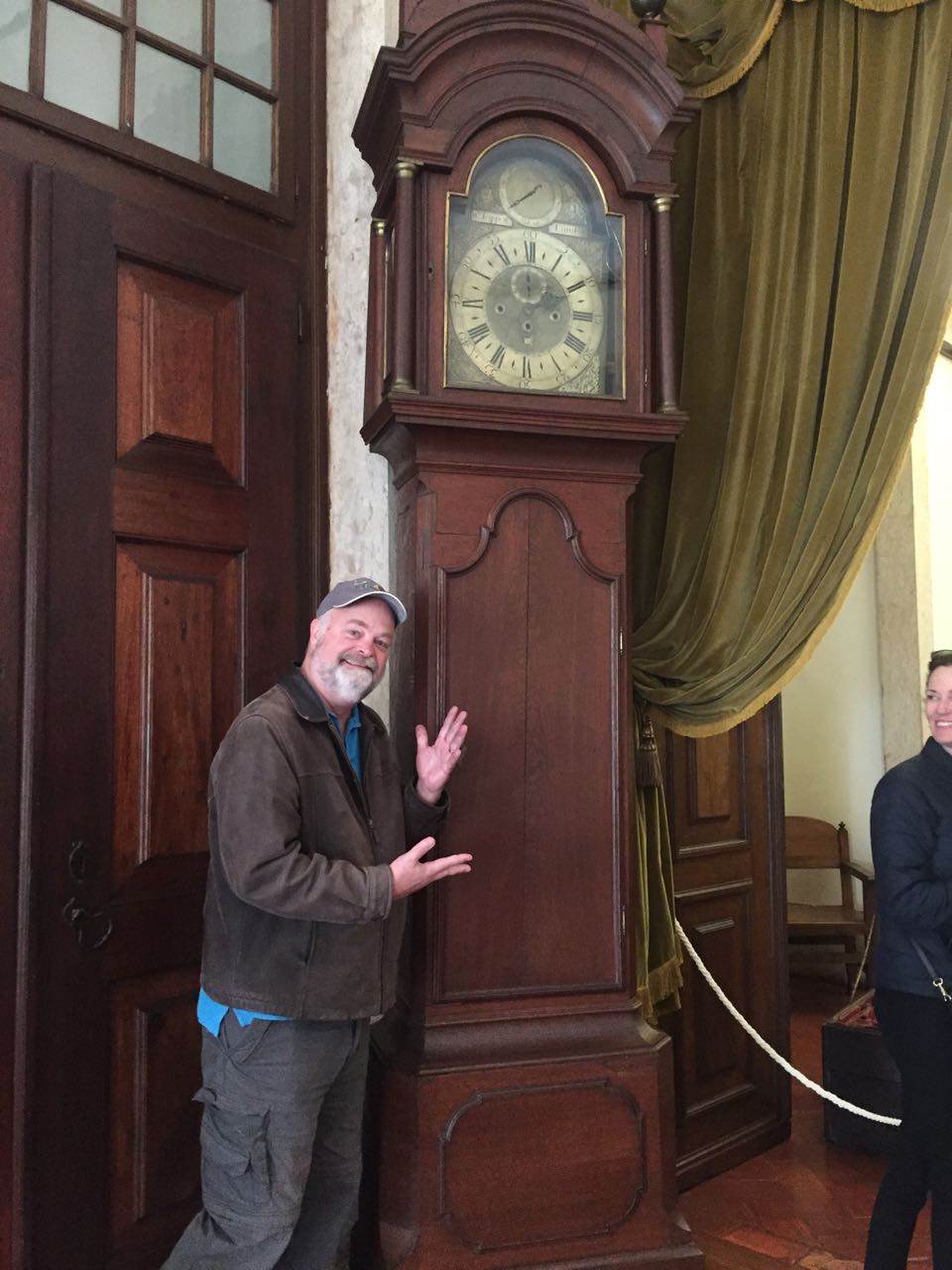 As you can tell this grandfather is huge, er, grandfather clock that is. Between that, the billiard table, and the mile-high ceilings, either the royals were giants or the architect was in the process of switching to metric.

 This is the infirmary, which might seem bleak to our modern eyes, but in the context of the times, wasn’t too bad of a place. Every cot had its own little room, and there is a chapel up front in case you need to communicate with heaven real quick like.
 As we’ve seen before around Europe, they were awfully good at creating pictures that look like real sculptures. But to prove how slowly humanity sometimes progresses, it took hundreds of years to go from this to Jaws 3D.
 They were also very good at making large paintings of tourists looking at other large paintings.
 Her carriage awaits.
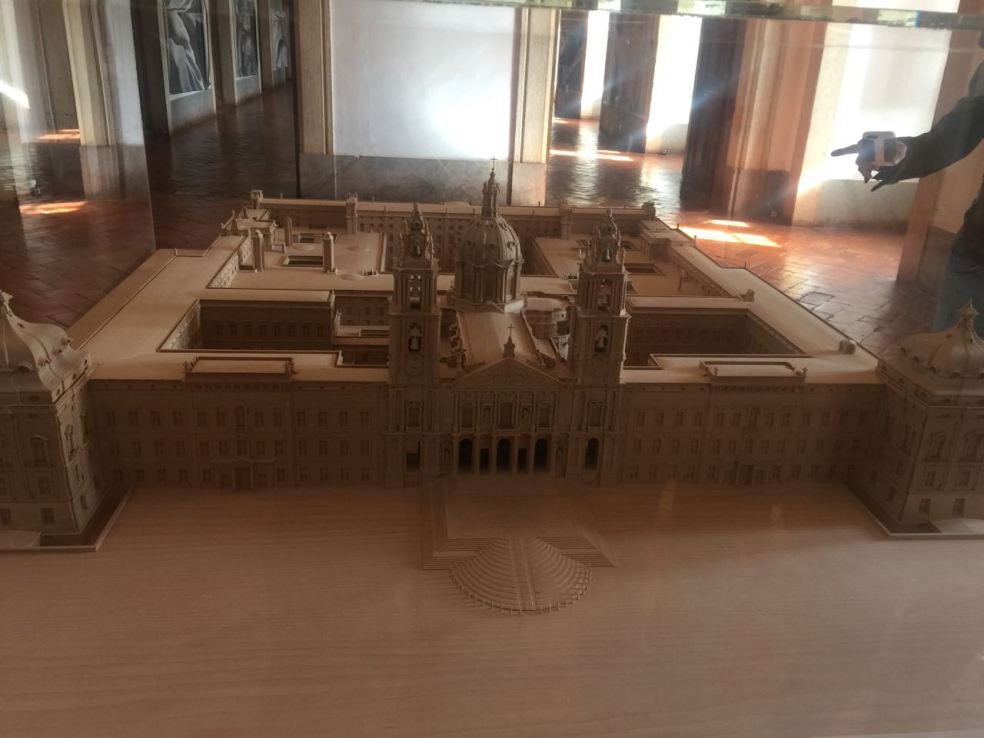 This is a model of the palace complex, which features a big ol’ basilica front and center. Because it’s all attached, the royals could just walk down the hall and watch a service without ever leaving the palace. You could also huck some gnarly spitballs onto the crowd below because, you know, you were a royal and everything.
 Here’s our happy group expressing their delight after a visit to what is one of the largest palaces we’ve ever seen. It was well worth the visit. If you come visit us, we’ll put it on the agenda. We’ll go owly to beat the crowds, unless you come in the winter, because there ain’t no crowds. There were times we had all 3,000 meters of a hallways all to ourselves. We lamented forgetting our bowling balls.
 The Palace of Mafra.
 During lunch, Angella kindly provided the answer to my question as to what the difference was between ordering squid with or without ink.
 At the beach in nearby Ericeira.
 We finished up our trek by stopping to some of the great nearby sea views (as if we don’t live five minute’s walk from very similar views. But somehow, they never get old). It was a wonderful and relaxing way to wrap up a delightful visit to the town of Mafra.
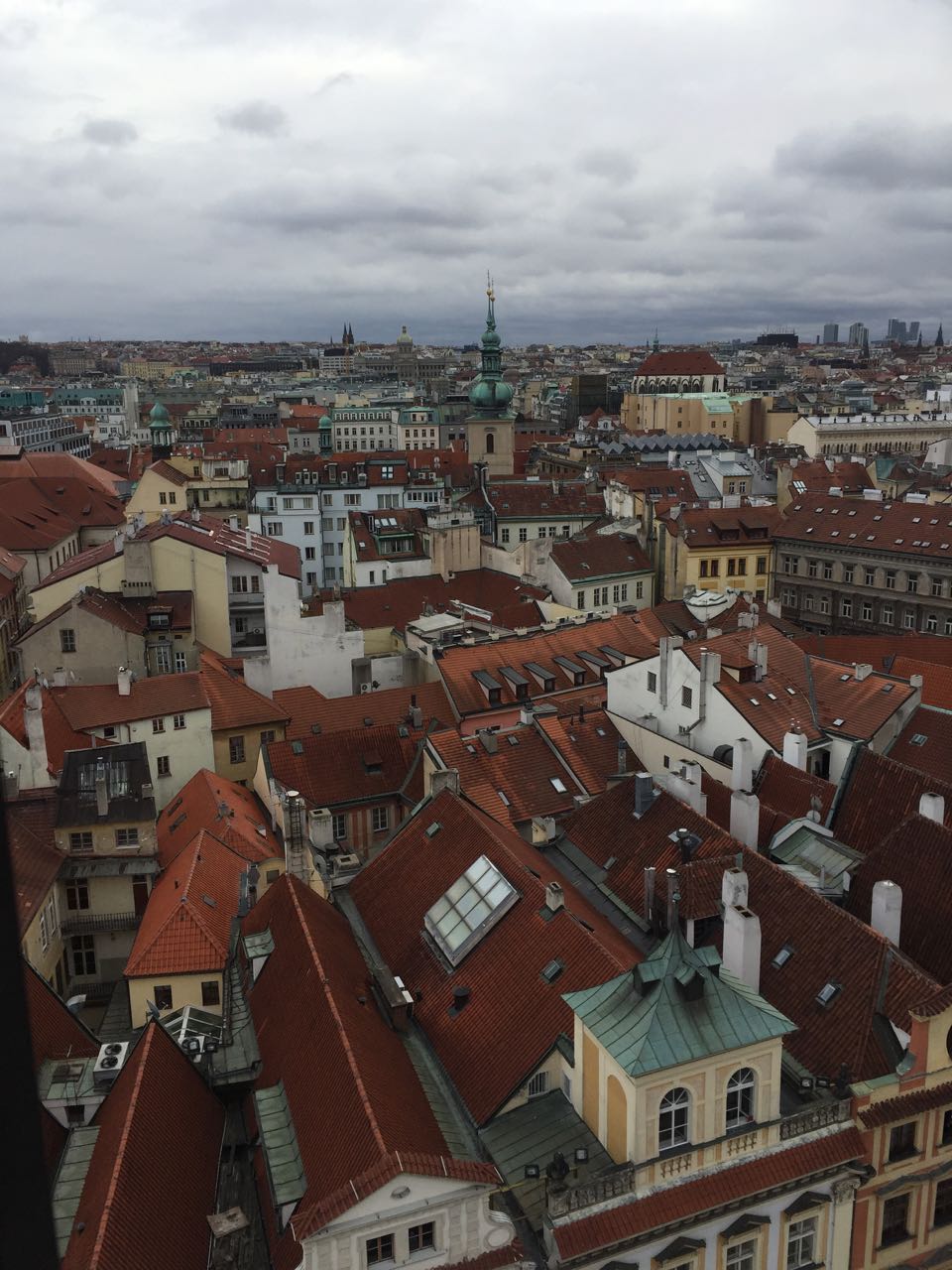
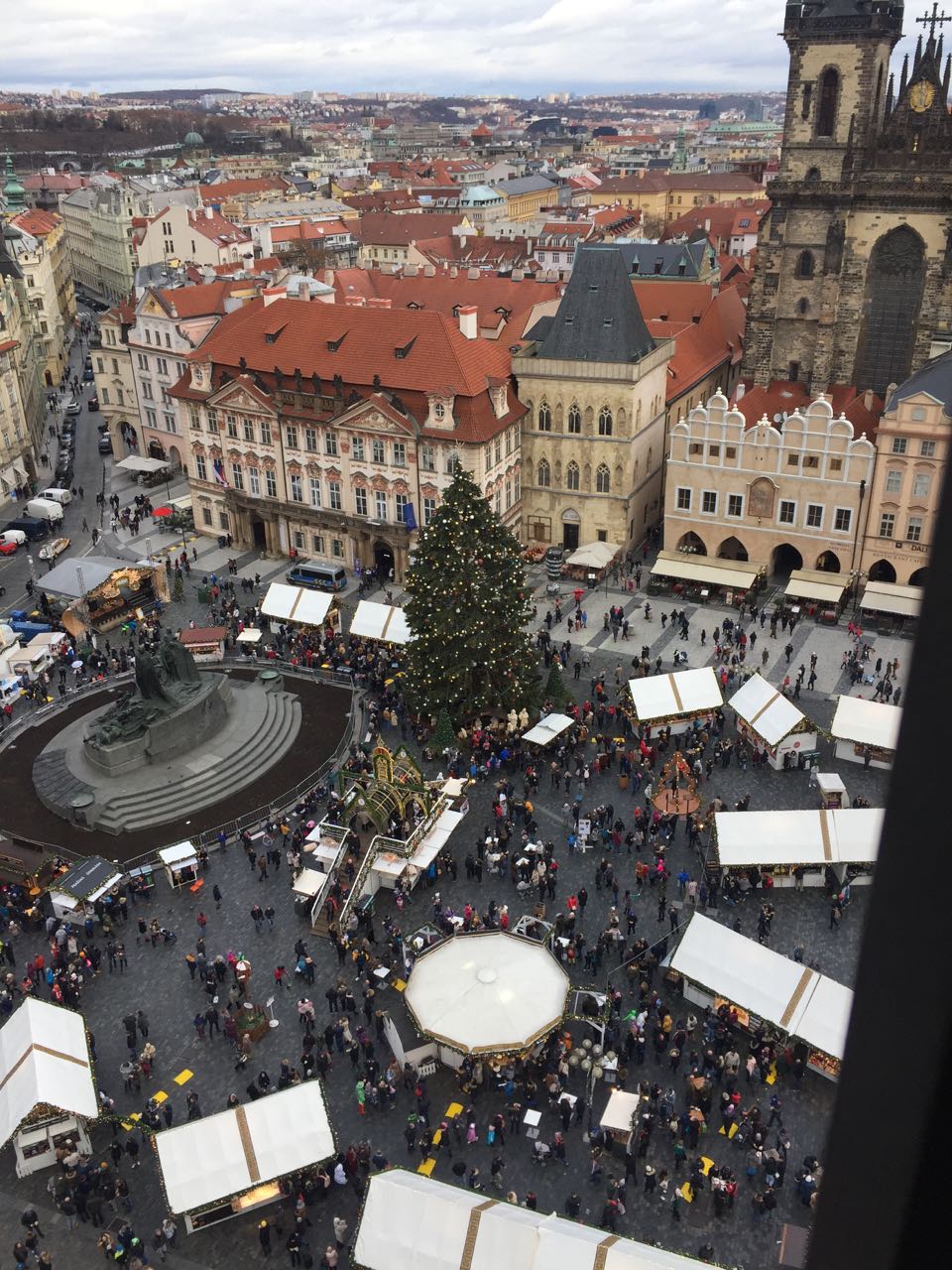
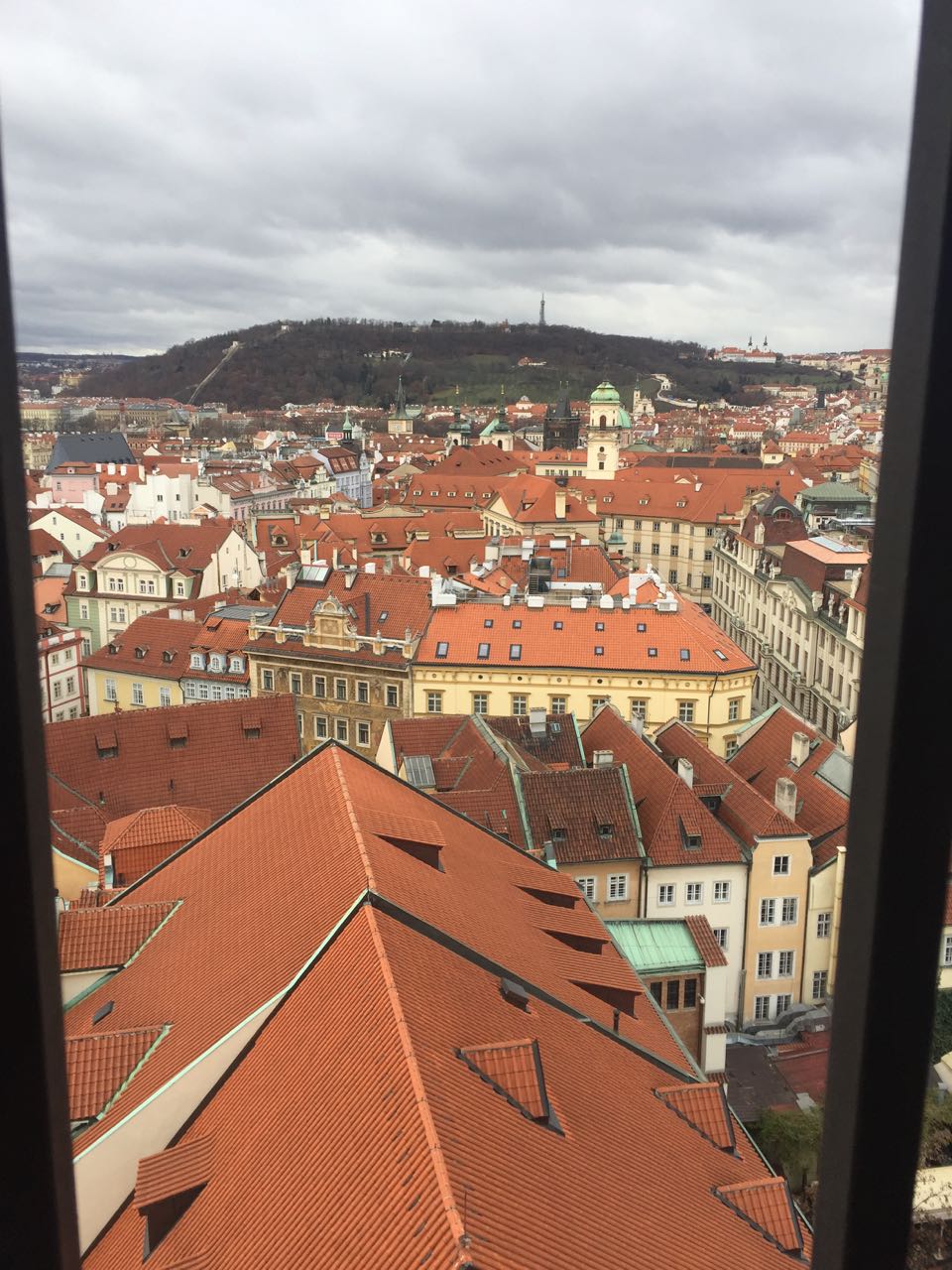
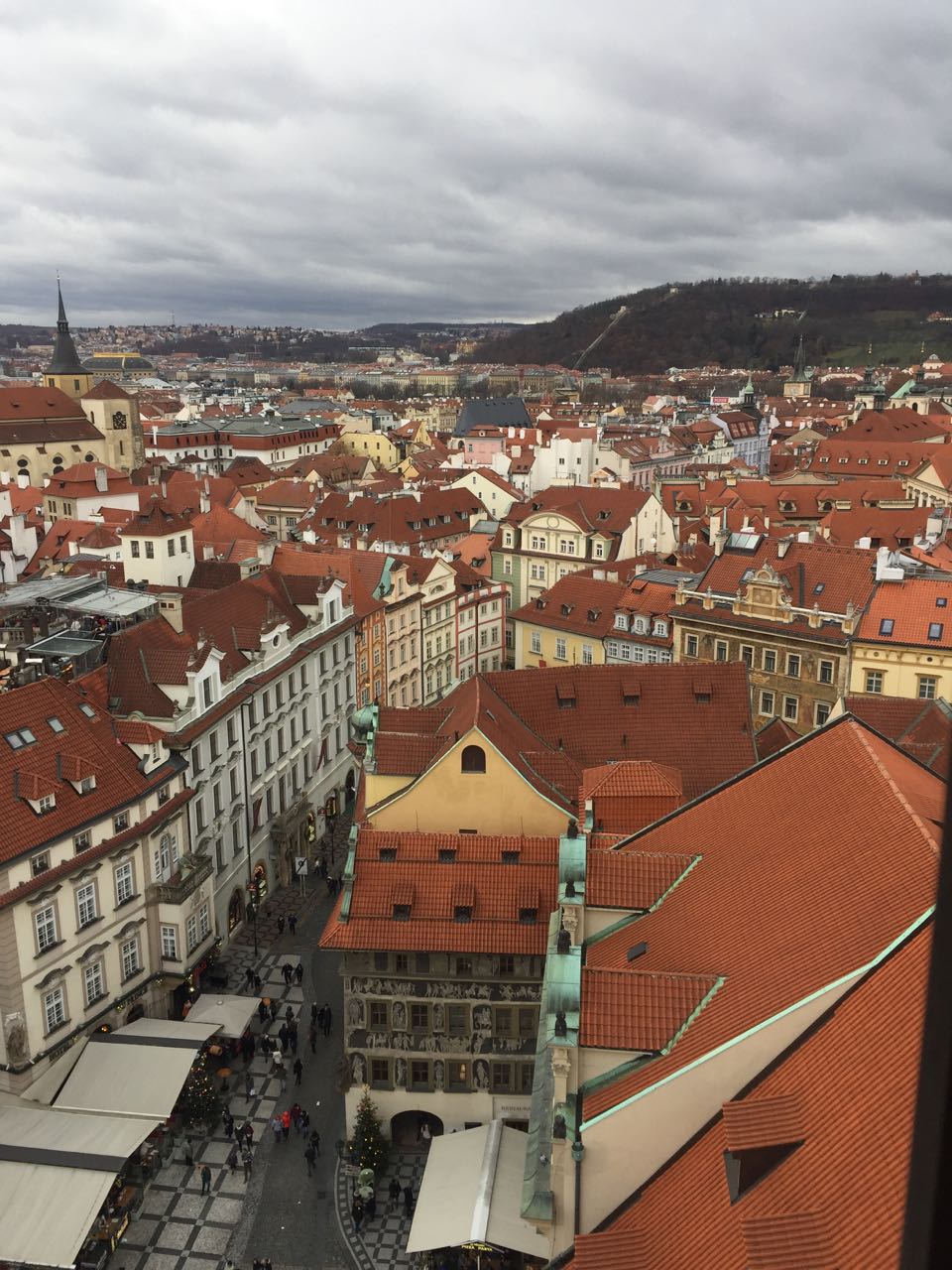
 There’s nothing like seeing a city from above. All the flaws and imperfections disappear, leaving only a panorama of color and beauty.
 Speaking of old… um, anyway, since it was December, things were a little brisk up there, but I snuggled Carolyn up to me with one hand and took photos with the other. I accomplished this particular photo by setting the phone timer to a 3 second delay and then artfully tossing it in front of us. By the 15th try I had the perfect shot, plus a very beat up iPhone. Well, okay, maybe a kind stranger took the shot for us, but I like my story better.
 “Rapunzel, Rapunzel, let down your hair!” Okay, if we had to wait for Carolyn’s hair to grow long enough to escape we’d be long dead. So we settled for, “Elevator, elevator, move up the shaft!”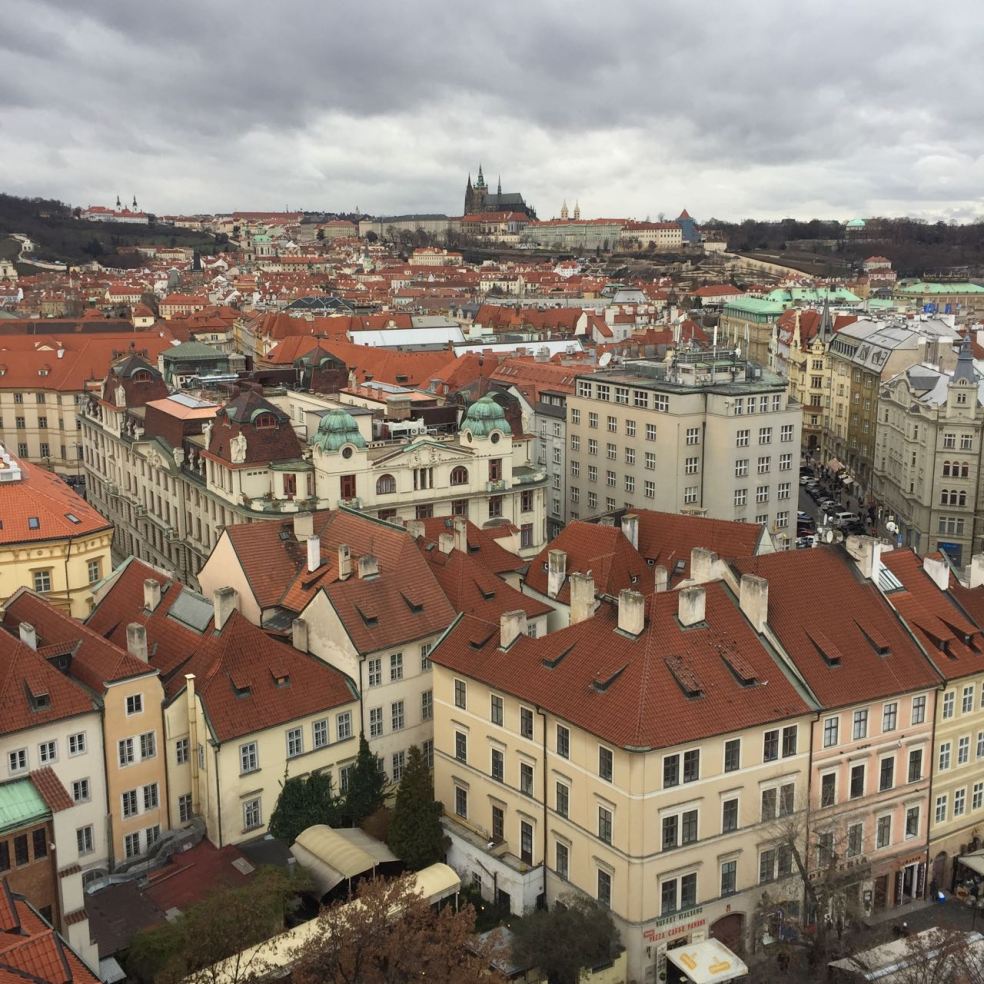





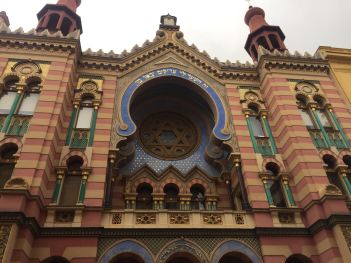 The one that was larger and a bit more interesting was the Jerusalem Synagogue, the front of which is pictured here. In the balcony they had interesting displays with stories of the history of Jews in Prague. It is a sad, solemn thing to go through. We should never forget how easy it is for groups of people to hate other groups of people, usually for no reason whatsoever. Anyone who calls for people to belittle, hate, ostracize, or instill fear about any other group of people should be ridden out of town on a rail. Unfortunately, there is a little too much of that coming back, even in Europe, although that call for fear and bigotry is more marginalized than it is in the US.
 We got a kick out of these bathroom signs. I give kudos to them for not only making sure everyone understands which gender is supposed to use which room, but doing so without a hint of embarrassment or shame over body parts.
 Czechs drink more beer per capita than anyone, so it’s only appropriate that they insist you either get hammered by beer, or an actual hammer. Otherwise, Praguians (Praguesters? Praguemen? Praguetonians?) generally enjoy a meaty cuisine with lots of sausage and potatoes, not too different from their German neighbors.
 And so we usher you to the exit, with memories of Prague still dancing in our heads, and the results of drinking too much beer still interfering with our dancing.
 Arguably the single biggest must-see in Prague is the Prague Castle, which dates all the way back to the 9th century.


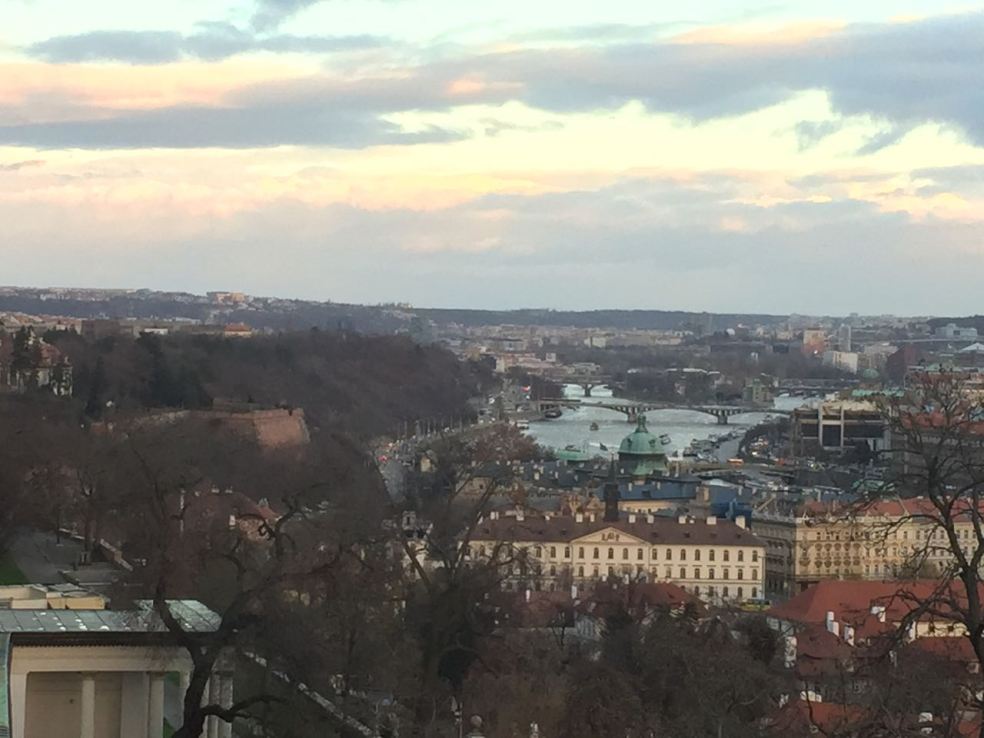 Once you climb the multitudinous stairs to get to the complex, you’re treated to a wonderful view of Prague.
 We were fortunate enough to go there in the afternoon and stay into the night, which meant we were also treated to wonderful evening views.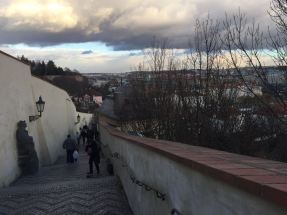
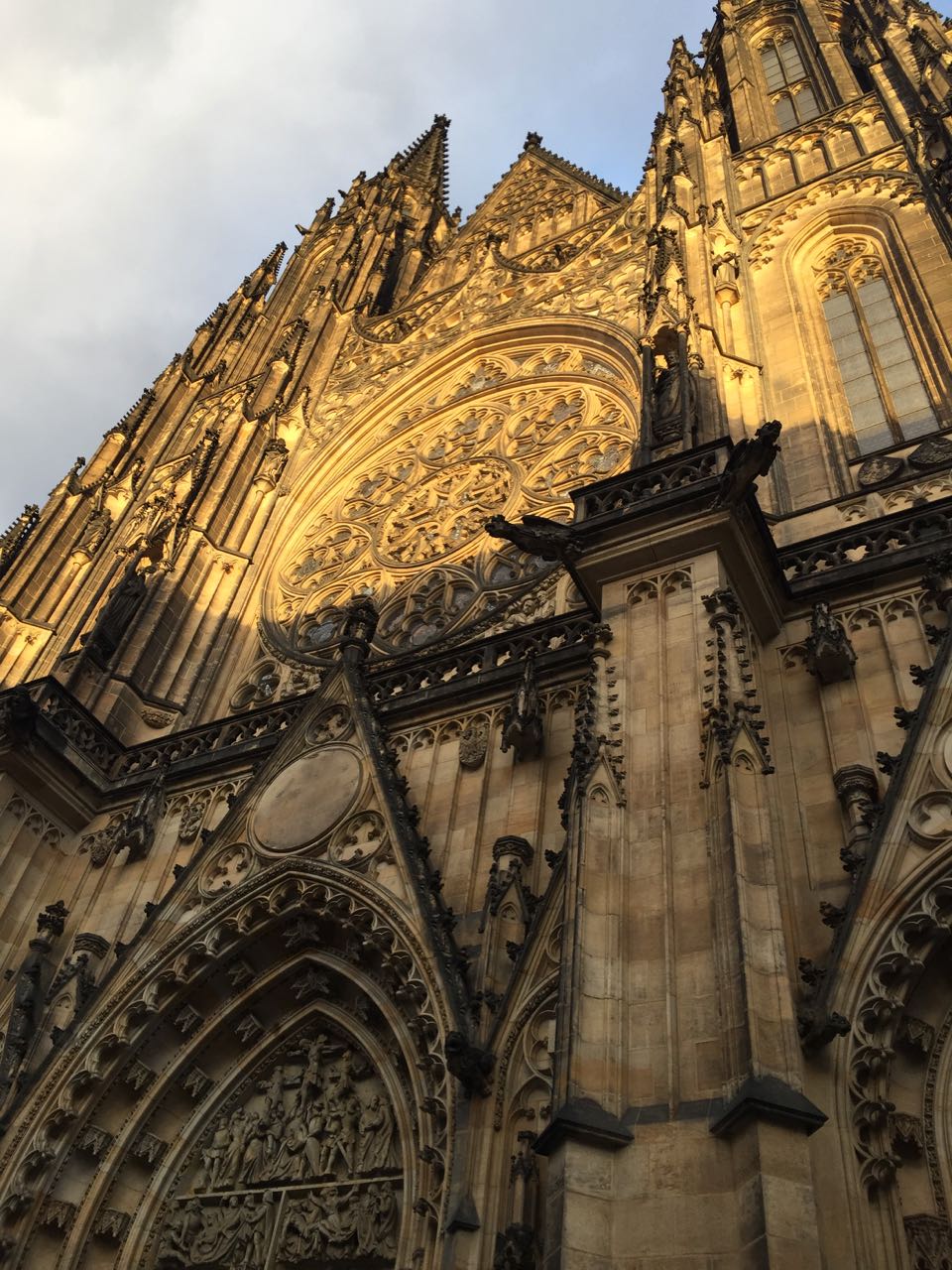 Inside the castle complex is St. Vitus Cathedral, construction of which began in 1344.
 The outside of St. Vitus is both imposing and gothically beautiful. It is easily one of the most impressive churches we’ve seen since we’ve been here.
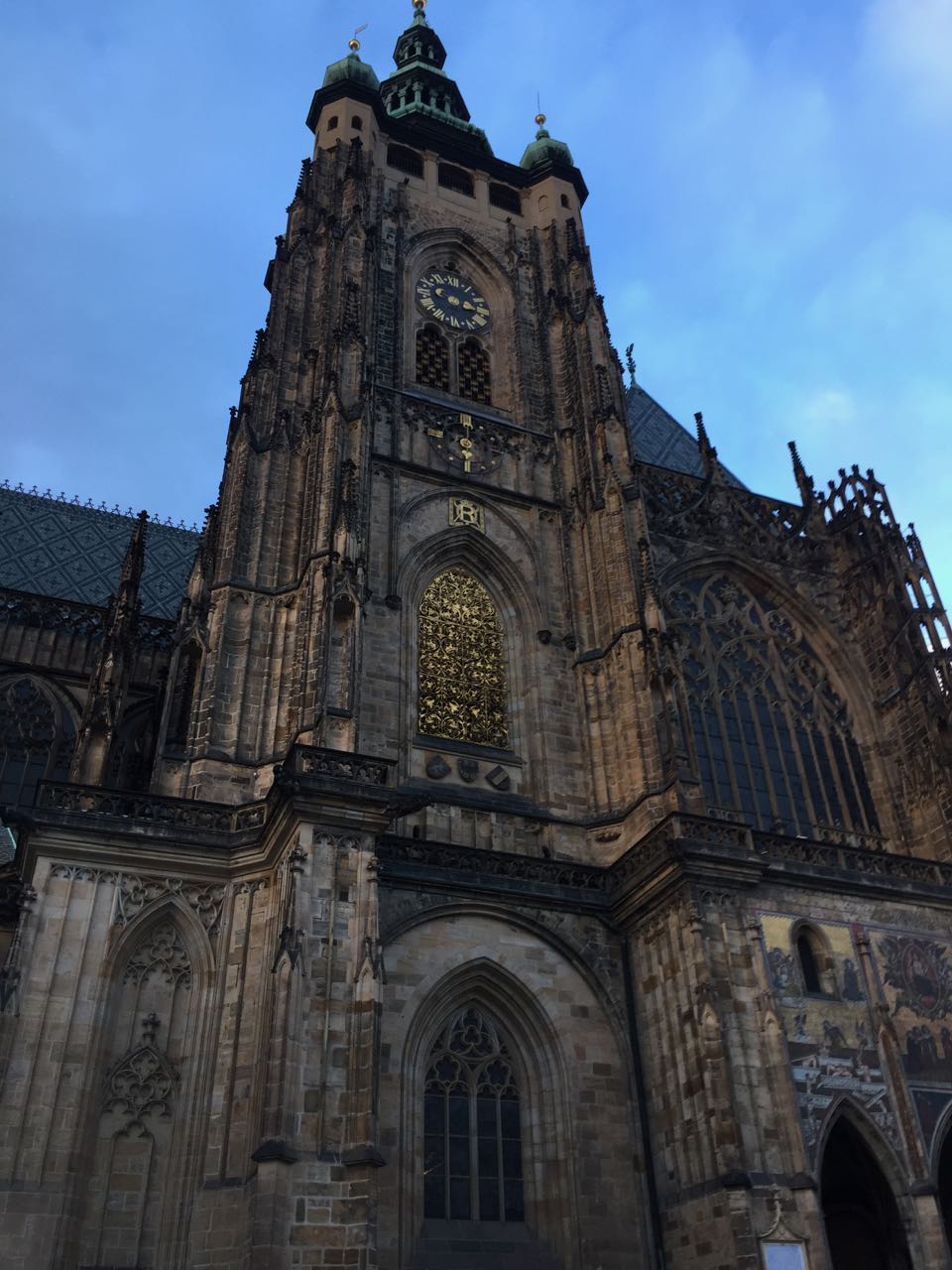 When buying tickets to see whatever you want to see, you’re presented with three choices, or “circuits.” We chose Circuit B after doing rock, paper, scissors. Turned out to be the right one, especially with our limited time budget.
 Amazingly enough, the construction of the Cathedral wasn’t completed until 1929, almost 600 years from when it began.
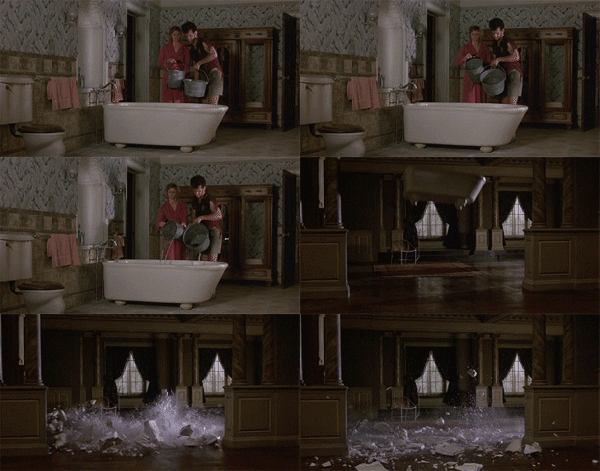 If this had been the focus of The Money Pit, when the foreman was asked when it was going to be finished, instead of “two weeks, two weeks,” he might have said “two centuries, two centuries.”
 There was a lot of controversy over art like this, with critics complaining that the kids would just sit around inside and stare at it instead of going outside to play like they did back when they were kids. The controversy abated once television was invented.
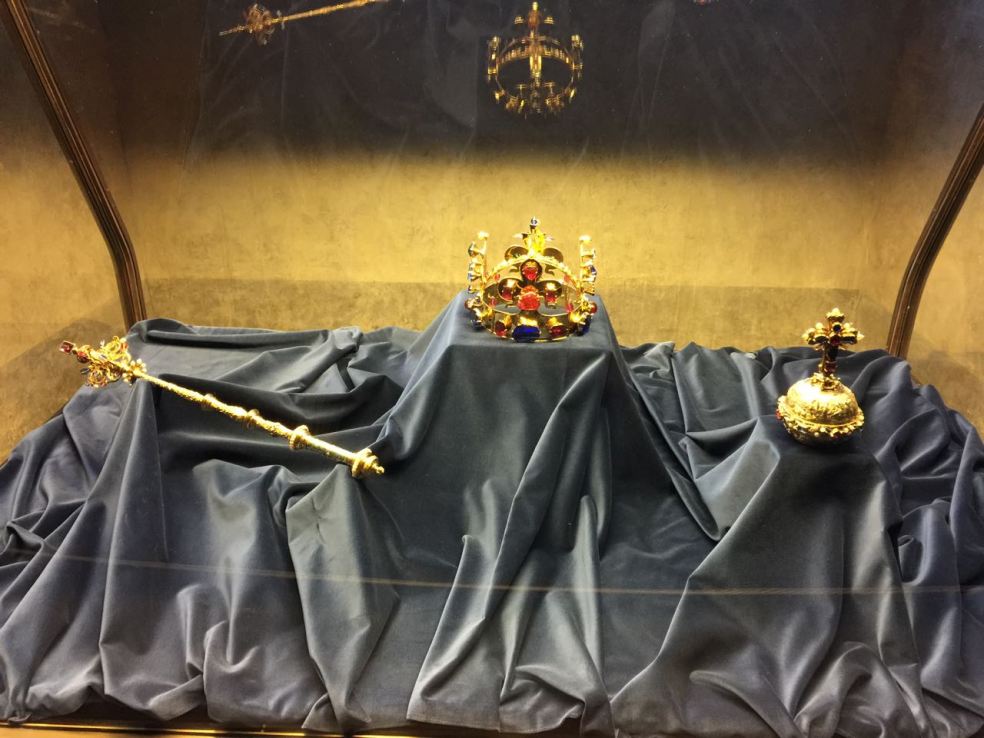 The Czech Crown Jewels. Or more accurately, reproductions of them, not that anyone could tell. The crown was made for Charles IV in 1347, making it the fourth oldest crown in Europe, just after one in Queen Elizabeth II’s mouth.
 This is one of the souvenir shops on an alley called “The Golden Lane,” so-named because goldsmiths used to work there. Apparently one of the job requirements of a goldsmith was to be not much more than five feet tall.
 While the Golden Lane wasn’t particularly impressive, they did have dozens of suits of armor on display as part of the attraction. It’s hard to imagine walking around in one of those things, especially on a hot day. And they hadn’t even invented anti-perspirant yet. And how do you take a leak?
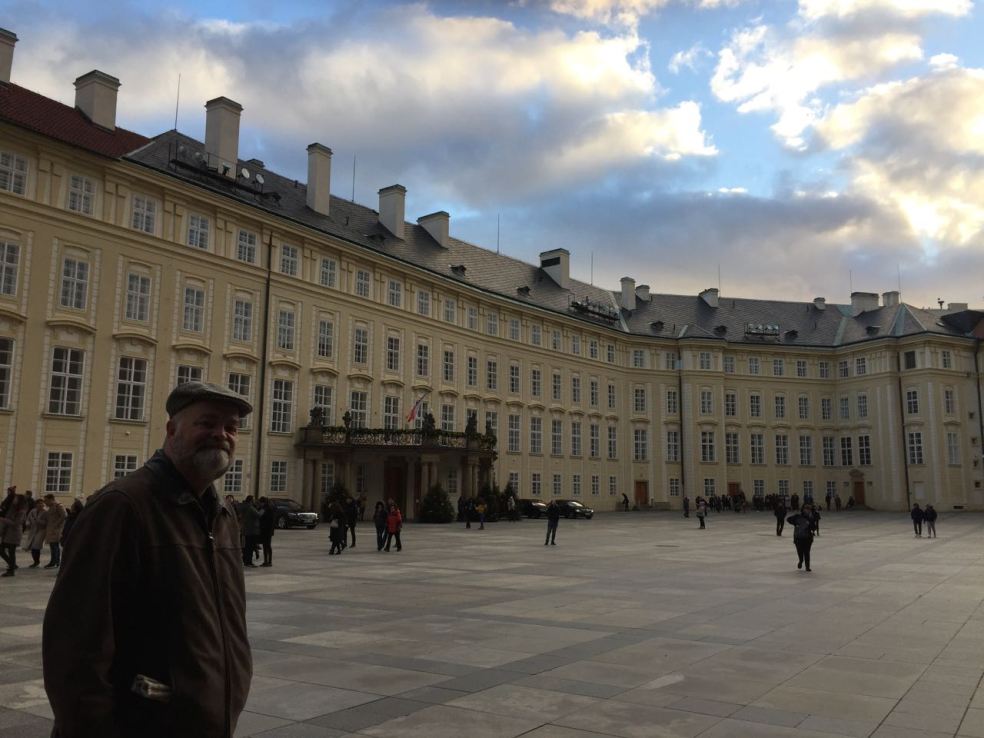 On the grounds is the Rosenberg Palace, which was originally named the Renaissance palace. We peeked inside but most reviews are fairly blah on the place, so we used our limited time for other, more interesting things.
 I can’t remember what this is, although I know it’s a building.
 The changing of the guard. All thoughts of stealing the fake crown jewels abated once I saw their fierce weaponry.
 Another view of Prague from the castle.
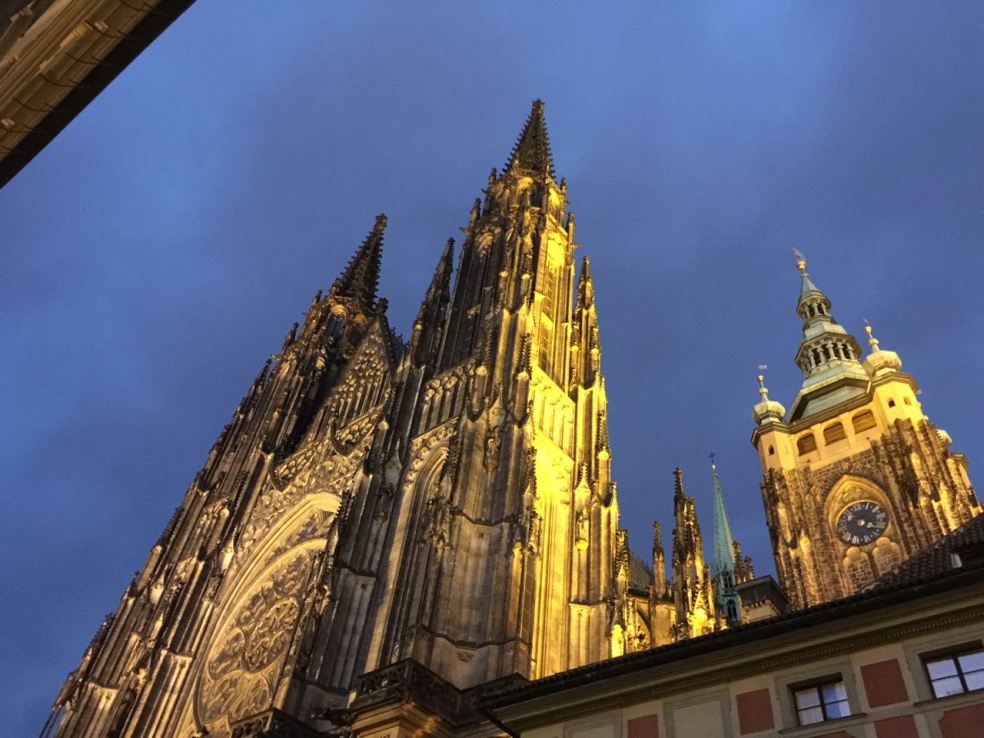 When the sun goes down and the lights come up, the church looks like something from an old horror movie.
 In the end, the castle was certainly a sight to behold. With a little extemporaneous planning we were actually able to see everything we wanted to see without spending the entire day there.
 When I organize the pictures I’ve taken after a trip, I try to put similarly-themed images together. When the organizational dust had settled this time, I discovered I had one folder full of nothing but Prague buildings.
 When we first ventured out of our hotel room, we walked along the Vltava river until we came to the most famous bridge in Prague: Charles Bridge.
 After taking selfies in front of the famous bridge, we trudged through the nasty weather on our way toward the city center, and noticed there were in fact a number of bridges over the river. Eventually we came to one in particular which was really crowded with tourists.
 Oh, that’s the Charles Bridge. Oops. We don’t even know the name of the not-so-famous bridge we were so gleefully snapping pictures of, but what the heck. A rose by any other name…
 The Charles Bridge is pedestrians-only. During the busy season, it’s just one big sea of pedestrians.
 As with any sea, there are occasional buoys –er, boys, floating about.
 As well as some gulls, –er, girls, too.
 Like any proper famous bridge, the Chuckie Bridge has a famous spot you can touch for luck. I figure any bridge that keeps me from touching the water beneath is plenty lucky already. Plus I have a hard time believing that touching something that a hundred thousand people before you have already put their germs on will bring you any kind of good luck. Or maybe they’re just referring to the fact that you’re damn lucky if you don’t catch something from it.
 The construction of the Charles Bridge started in 1357 and finished in the beginning of the 15th century. It was originally and cleverly called Stone Bridge, or also, and just as cleverly, Prague Bridge. But it has been known as “Charles Bridge” since 1870 (King Charles IV began the thing), which, while not the cleverest of names, certainly is much more clever than the first two.

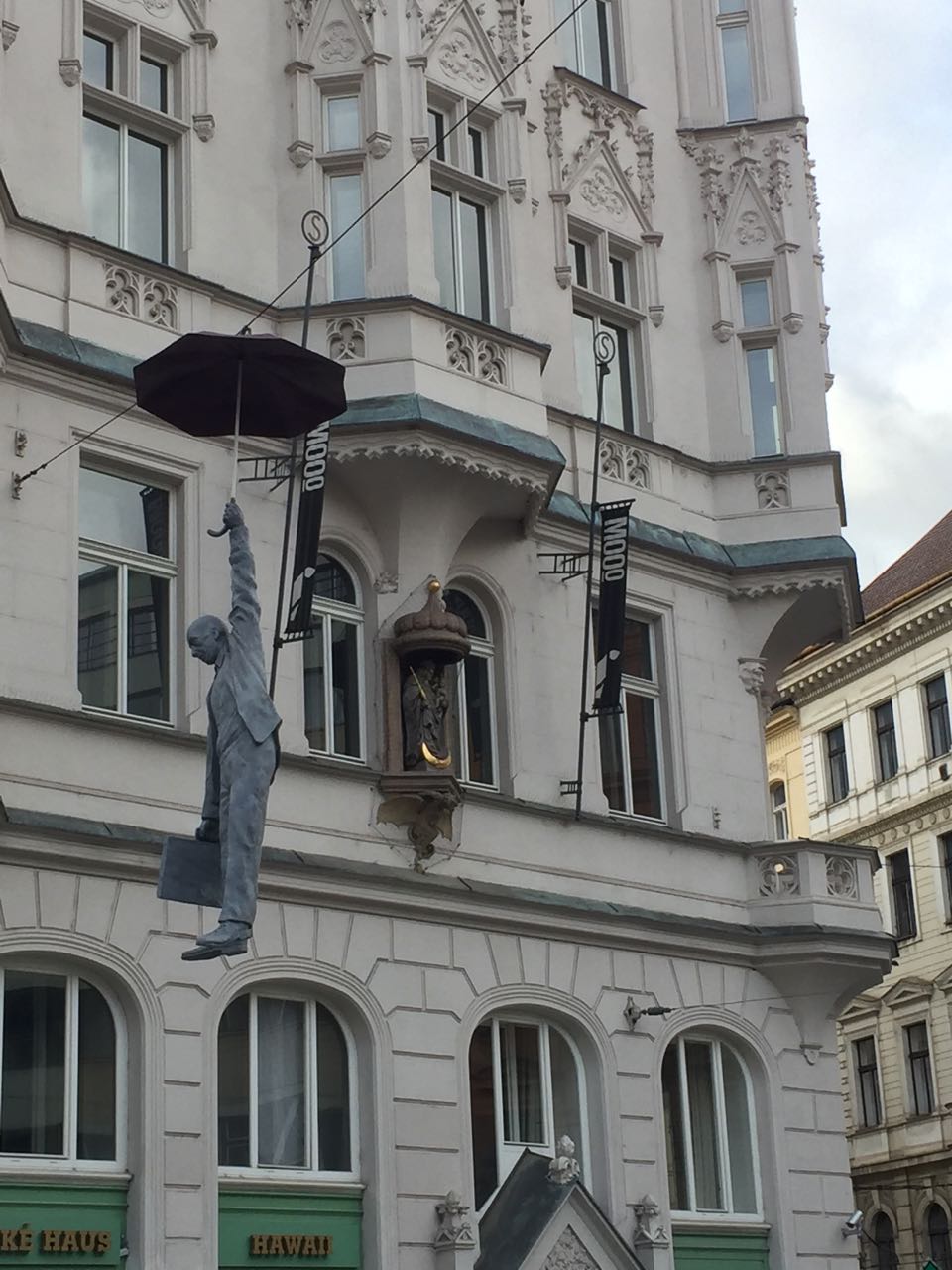 The statue above is of a guy doing a Mary Poppins over the street. It’s a piece of art that serves the purpose of reminding you to look up while walking around Prague, because if there doesn’t happen to be any floating statues above you, there’s likely to be some amazing architecture instead.
 … like this gorilla made out of colored pencils. It’s the lead decor for a stationary store. Great. Now we have to Google “statues made out of pencils” everywhere we go.
 Not content with making gorillas out of pencils, the Praguesters enjoy creating delightful artwork out of their food too. I’m sure it tastes a lot better than taking a bite out of a Van Gogh.
 Here I’m tickling the chin of Louis de Funes, who is a famous French actor. But he was apparently so short he only got small roles. Ha ha! Maybe he’s there to show us how fleeting or regional fame can be, because I’m willing to bet no American reading this has ever heard of him, even though one of the films he was in was nominated for a Golden Globe in 1974. Of course, I personally have no idea who or what has ever won a Golden Globe. Until now. But it was the movie, not him. Which I don’t remember anymore. So I guess my comment is still correct. Wait, what was I talking about?
 They also have a famous piece of artwork of a bunch of sitting seagulls on the Vltava River, which is the river that runs through Prague. Oh. Carolyn just chimed in and said this isn’t artwork, these are real live birds. My bad. I think they’re waiting in line because, being birds and therefore stupid, believed a rumor that this is the line to get into the new Star Wars land in Disneyland. Stupid birds. We all know that line starts in Sacramento.
 You don’t have to be well-read to visit Prague, but it pays to be, well, red. These exotic old cars trundle about Prague carrying shivering tourists, because even when it was close to freezing, they had no tops. Sheesh. We only go around topless in these big cities during the summer.
 There is a mildly humorous story associated with this picture in front of a church. Unfortunately, we don’t have the funny photo to go with it, so you’ll have to settle for the story. As I stood up there to strike a pose, some people came out of the church and stood near me, pausing before going down the steps. Carolyn was trying to maneuver me into better position, so she was waving her hand and telling me to go this way and that and stop and whatnot. A gentleman standing in front of me thought she was telling him what to do, and lo and behold, he obeyed her commands, moving this way and that, and then dutifully standing still for the shot. I stood behind him chuckling, and even Carolyn didn’t realize at first that’s what was happening. Finally the man’s wife yanked him to the side with a laugh. After all that, we didn’t even get any pictures better than the above.
 So we finish this first Prague Blog entry with a Door of the Day for Carolyn. But this was just a taste of what Prague had to offer. It is a truly magnificent city, perhaps mostly because it was pretty much the only major city in Europe that wasn’t extensively bombed during World War II, so the old great buildings still stand in all their original splendor.
 In February of 1945 the US and England dropped almost 1,500 tons of high explosives bombs and over 1,100 tons of incendiary bombs on Dresden, creating a hellacious firestorm and pretty much destroying the entire inner city. The bombing remains controversial to this day.
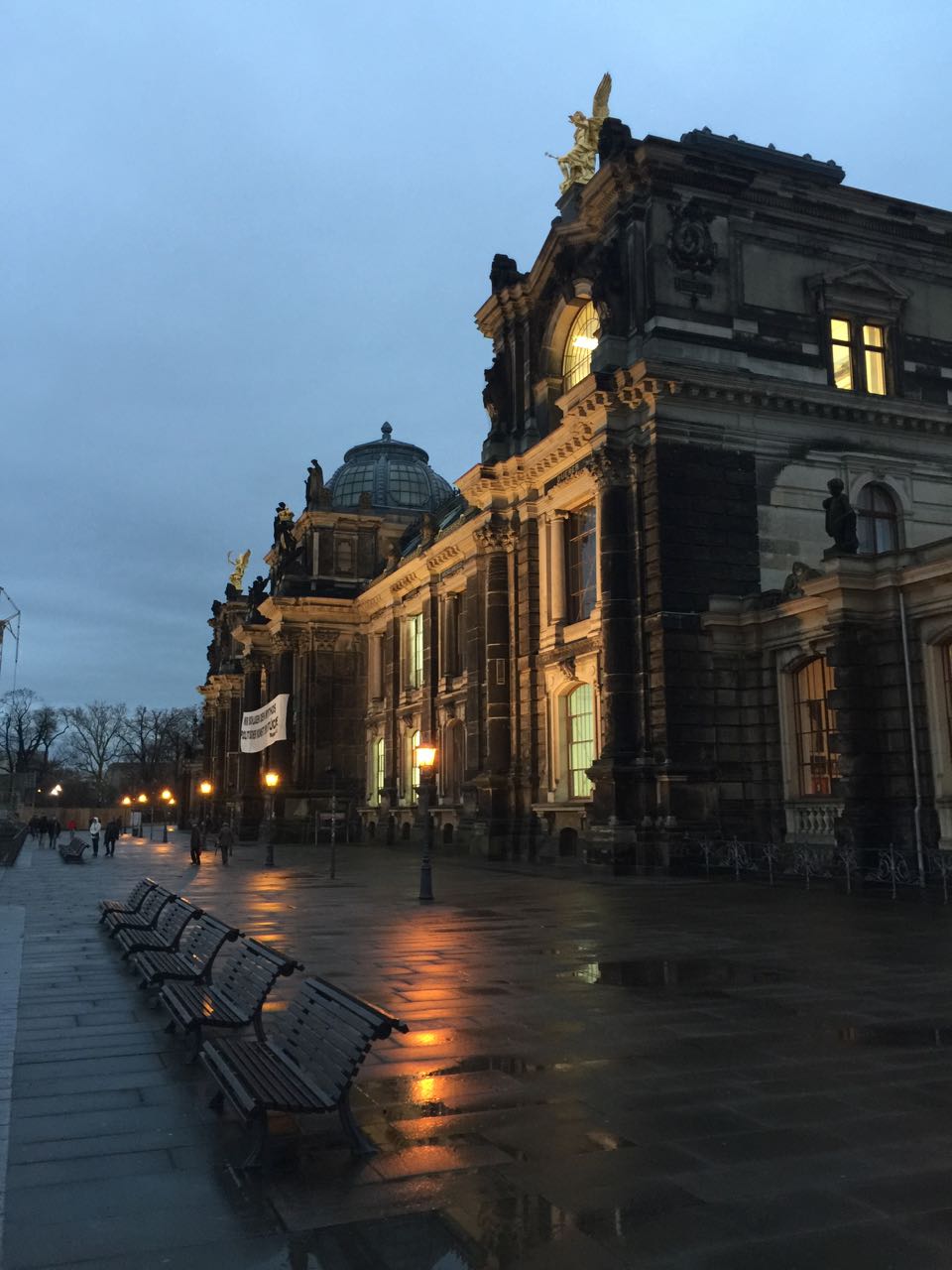 This is an area called Brühl’s Terrace in the inner city. It is a popular location for taking walks, people watching, and debating with your travel companions as to how you pronounce the ü. I argued for Ooh-dot-dot.
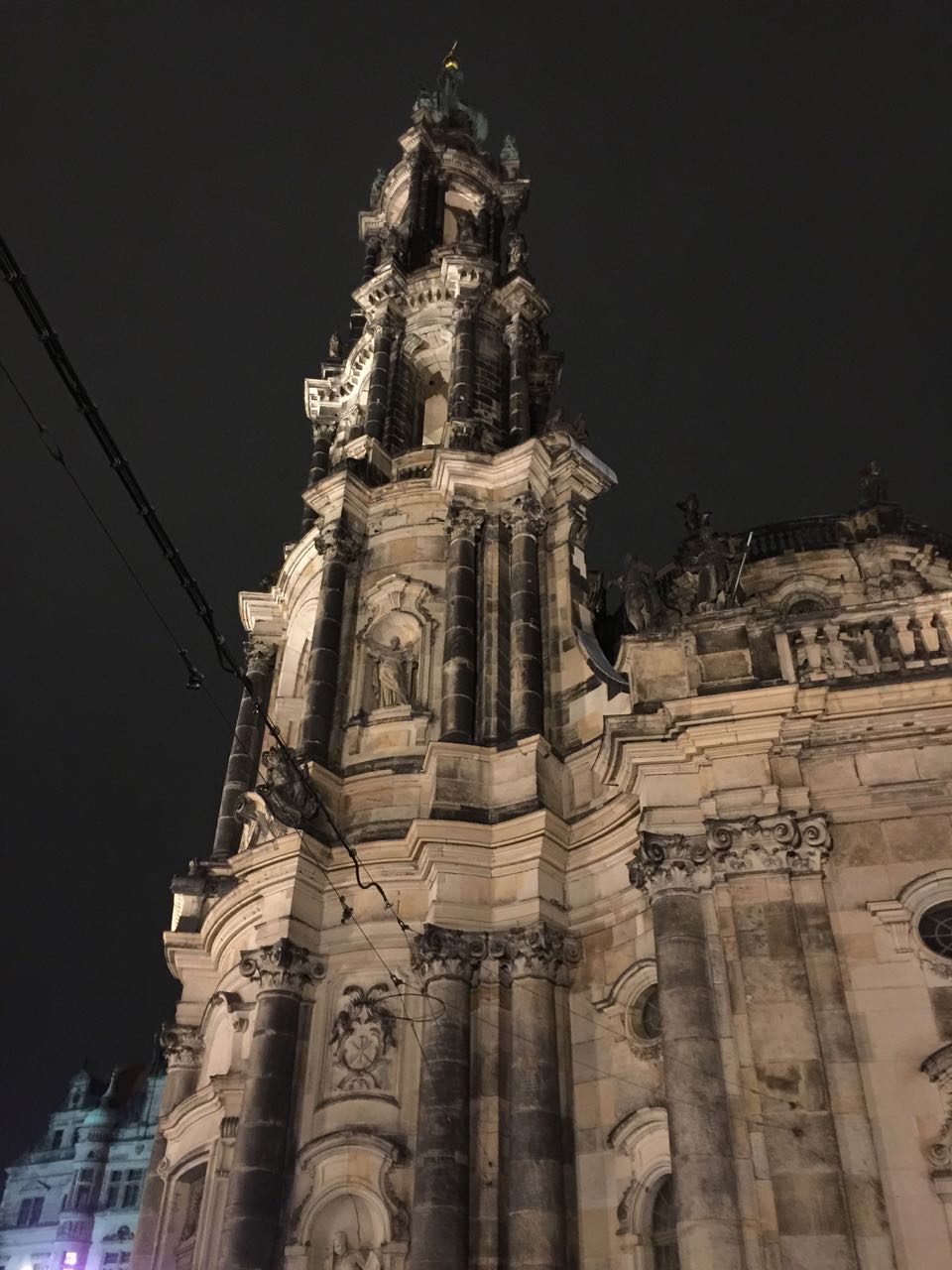 This is Catholic Church of the Royal Court of Saxony, aka The Dresden Cathedral. The church was badly damaged during the bombing (which will be a common theme here). The East German government restored much of it, and after reunification it was restored more fully. It was originally completed in 1751.
 Not to be outdone by the Catholics, the Lutherans have the Frauenkirche of Dresden, which is now one of the most important churches in Germany. It was mostly destroyed by the firestorm as well. It remains an important symbol because the Communists wanted to turn it into a parking lot. The Germans simply wouldn’t allow that, but the church wasn’t fully rebuilt until after the German reunification.
 The Semperoper is the opera house of the Saxon State Opera, and was originally built in 1841. Only an empty shell was left after the Dresden firestorm. Exactly 40 years later, on February 13th, 1985, the opera’s reconstruction was completed. Of course, I’m not sure anyone bothered to ask who listens to opera anymore, but it’s an impressive building nonetheless.
 When we saw this building with that big slogan, I didn’t know if was some propaganda relic from East Germany’s past or an advertisement for a pub. I translated it with Google Translate, and this is what it apparently says: “A life without joy is like a long journey without a guesthouse.”
 We couldn’t tell the date of construction of apartments like this, but the blocky style is certainly reminiscent of the Communist approach to architecture, i.e. bo-ring…
 I’m pretty sure this was built after the reunification because it actually has some artistic design to it. I don’t think it’s an atomic plant, however. We didn’t think so because we didn’t grow a third eye or anything after walking by it. Yet anyway.
 The inner city of Dresden at night.
 This is a Christmas tree in the Wiener Platz, which is an important transportation hub of Dresden, especially for sausages. Otherwise, why would they call it Wiener Platz? Duh!
 This monument, dubbed “The Golden Horseman,” is a statue of Augustus the Strong (1670-1733) and is covered with gold leaf. Augustus’ great physical strength earned him the nickname by breaking horseshoes with his bare hands (!) and engaging in fox tossing by holding the end of his sling with just one finger while two of the strongest men in his court held the other end.
 Carolyn freezing in front of the Katholische Hofkirche.
 A wide angle view of the inner city square.
 A view of the Frauenkirche of Dresden as seen through the Fürstenzug on Augustusstraße (talk about a mouthful!). The Fürstenzug (Procession of Princes) is a large mural of a mounted procession of the rulers of Saxony, and is one of the largest porcelain tile artworks in the world.
 It was originally painted between 1871 and 1876 to celebrate the 800th anniversary of the Wettin Dynasty, Saxony’s ruling family. In order to make the work weatherproof, it was replaced with approximately 23,000 Meissen porcelain tiles between 1904 and 1907. Apparently those are the things to use for construction if you anticipate a fire bombing, because the damage to it was minimal.
 According to Google Translate, that sign says, “A tribe of horses whose career extends to our days in the gray past, he went on to say with our people.” Apparently any kind of writing on walls is essentially graffiti, which is almost always unintelligible.
 The view across the river Elbe.
 More inner city Dresden. The whole area is easily walked in less than an hour, but only can be fully appreciated with a day or two of exploration.
 I thought it a good idea to reach out between nations and hug a Pole.
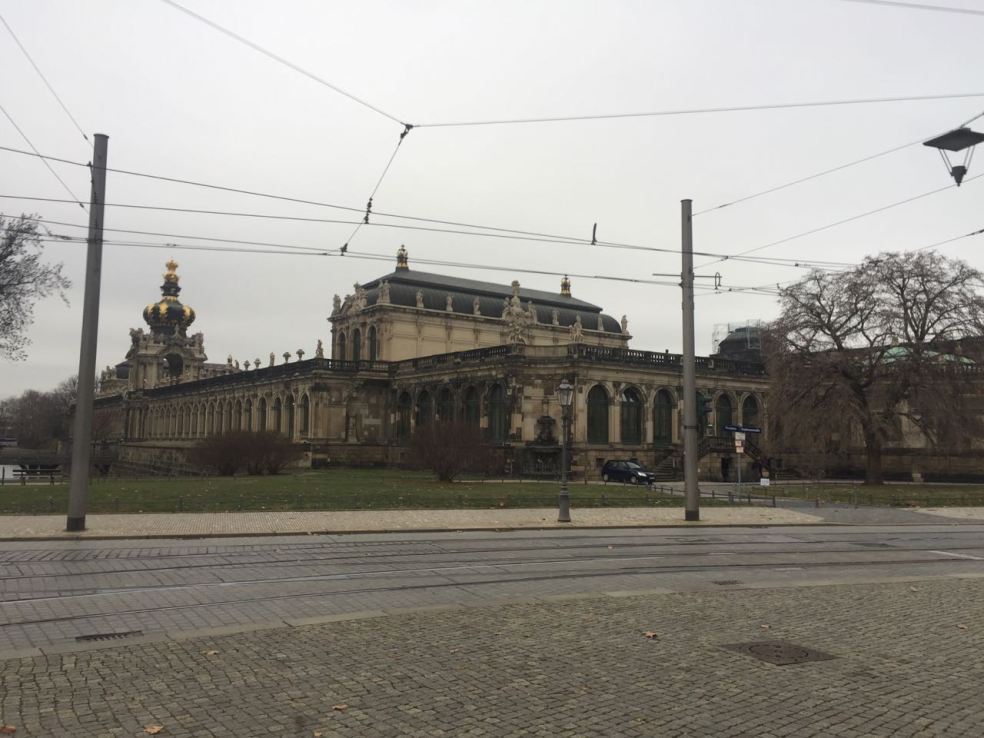 This is the outside of the Zwinger, which is a palace in Dresden. Zwinger is actually a term for what is essentially a killing ground: an open area between two defensive walls that was used for defensive purposes during the Middle Ages.
 This Zwinger was eventually walled in, and is now a museum complex that contains the Gemäldegalerie Alte Meister (Old Masters Picture Gallery), the Dresden Porcelain Collection (Dresdener Porzellansammlung) and the Mathematisch-Physikalischer Salon (Royal Cabinet of Mathematical and Physical Instruments).
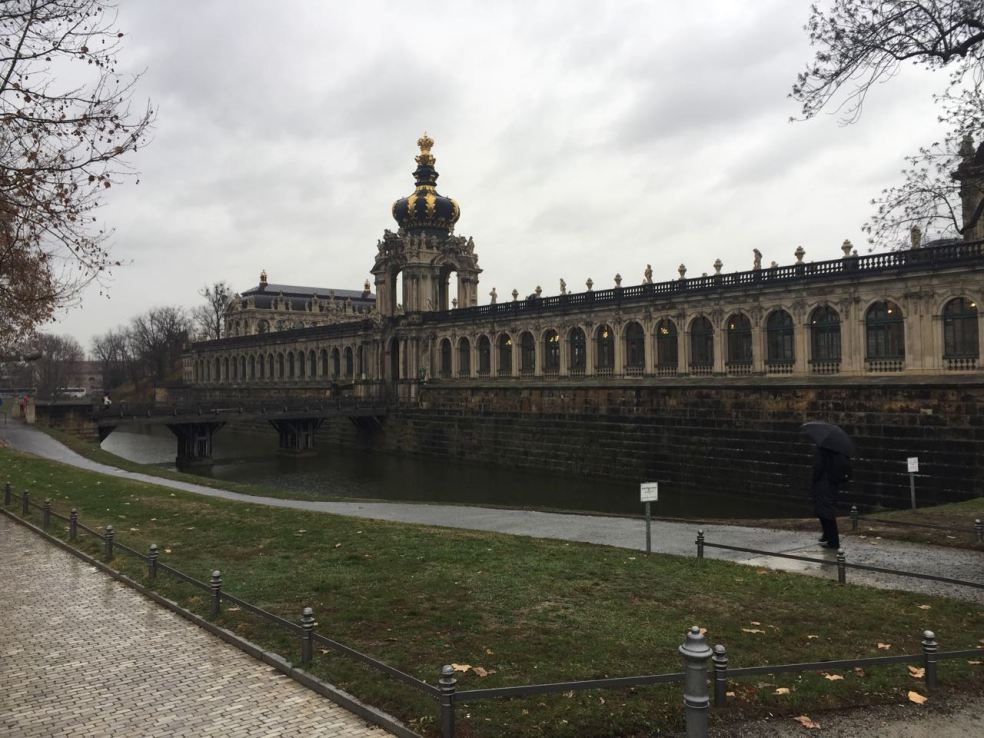 It was of course largely destroyed in the bombing, but like much of the rest of inner city Dresden, has been rebuilt to its former glory.
 We also went into a museum called “The Green Vault” that houses the largest collection of treasures in Europe. It was founded by Augustus the Strong, and so I would’ve expected some broken horseshoes or a video of fox tossing, but no.

 We were flummoxed when we found out our train to Prague was delayed by about half an hour. I’d read that German trains are on time 99% of the time! What the hell’s going on here?


 So that’s Dresden. It only gets one entry because the area wasn’t huge and there was only so much to see. Plus we already covered the Christmas markets in a previous blog, and that was some of the reason we went there.
 Not every visit to a new city has to be filled with sights unique to the area. Museums of every kind abound in most cities, and many of them are just as interesting as the museums you might want to visit in your hometown, especially when you have a hankering to see some dinosaur bones.
 The Guinness World Record Certificate confirms that this is the tallest mounted dinosaur skeleton in the world. That’s just his big toe, I think. It kinda looks like a wooden Dutch shoe, doesn’t it?
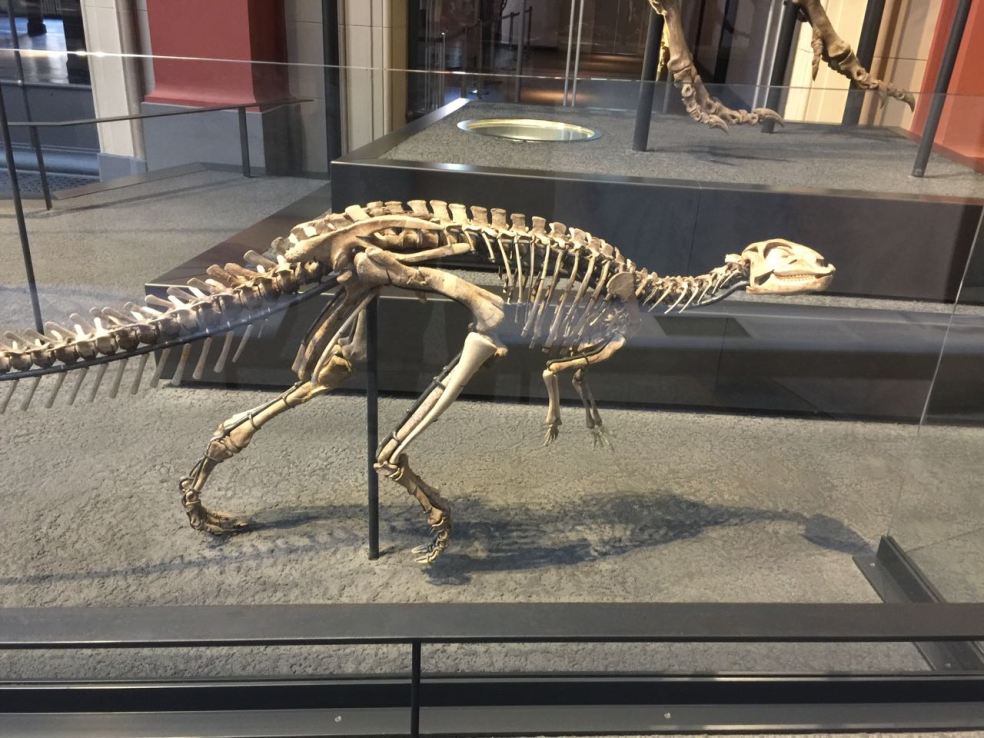 No, this isn’t the tallest one. This was the dinosaur version of “it tastes like chicken.”
 This is the dinosaur version of
  Speaking of caring for pets, the guy who made the Arc Encounter in Kentucky thinks Noah put two of these in a boat. (As well as I guess two each of the other 700 plus species of dinosaur we’ve found so far.) And then sailed with them for over a year.
 Is it any wonder that someone invented dragons after coming across a dinosaur skull like this?
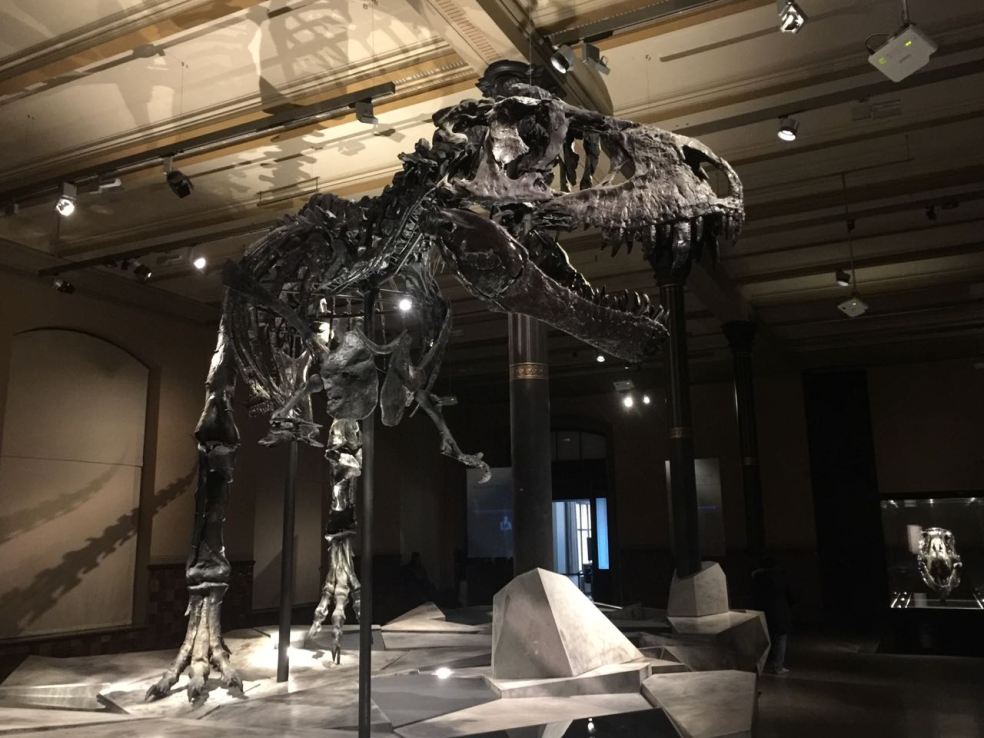 A battle between a Tyrannosaurus Rex and a dragon would have been epic. My money would be on the dragon, because the Tyrannosaurus Rex was around before flame throwers were invented and so hadn’t evolved any defenses. Duh.
 The Tyrannosaurus Rex had the strongest bite in history. This was problematic for them when they tried kissing, which may be why we don’t see any more little Tyrannosauruses running around.
 It’s pretty obvious we’ve evolved only so far.
 Okay, so we stand taller. But some of us actually believe that dinosaurs were on Noah’s Ark, so I’m not sure where that’s gotten us.
 This exhibit proves that it only takes two macaws to lift a cheetah from the ground. It’s a well known fact that they do that and then dash the hapless cats onto the rocks for a fine feast of flattened feline. At least I think that’s what the plaque in German said.
 This guy got so hammered the next morning he woke up in a jar.
 These two walked into a prohibited room and were never heard from again.
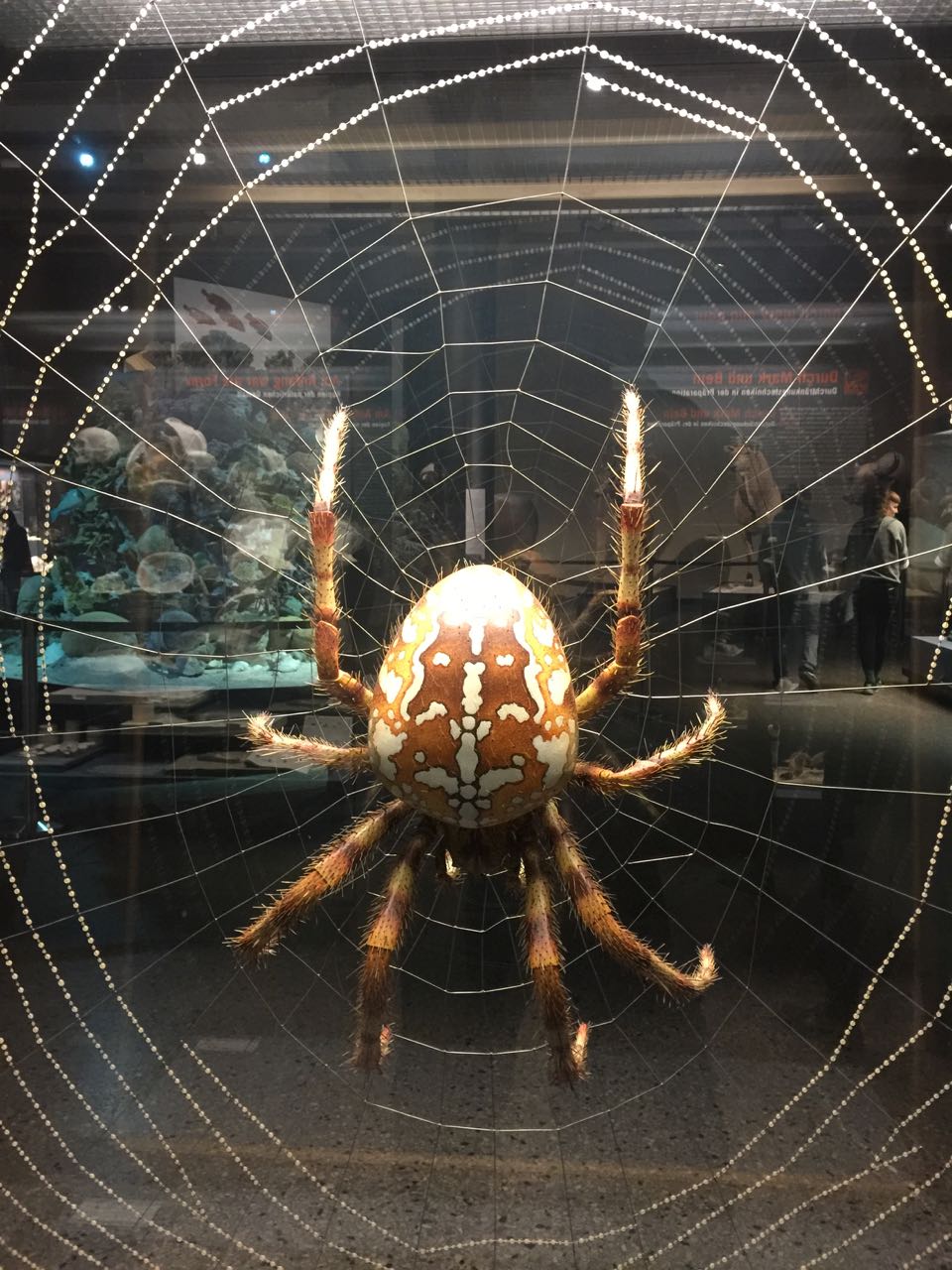 I steered Carolyn clear of the view of this cute little (well, three feet worth of little) arachnid because I felt had she seen it, the ensuing scream might have set off all sorts of alarms and we might have found ourselves surrounded by German police officers with automatic weapons. Crisis averted.

 Written on the building is “Dem deutschen Volke,” which means “To the German people.” This building was made particularly famous (or perhaps notorious) when in 1933 it was set on fire, allowing the Nazis to use it as a pretext to arrest and kill anybody they felt like arresting and killing.


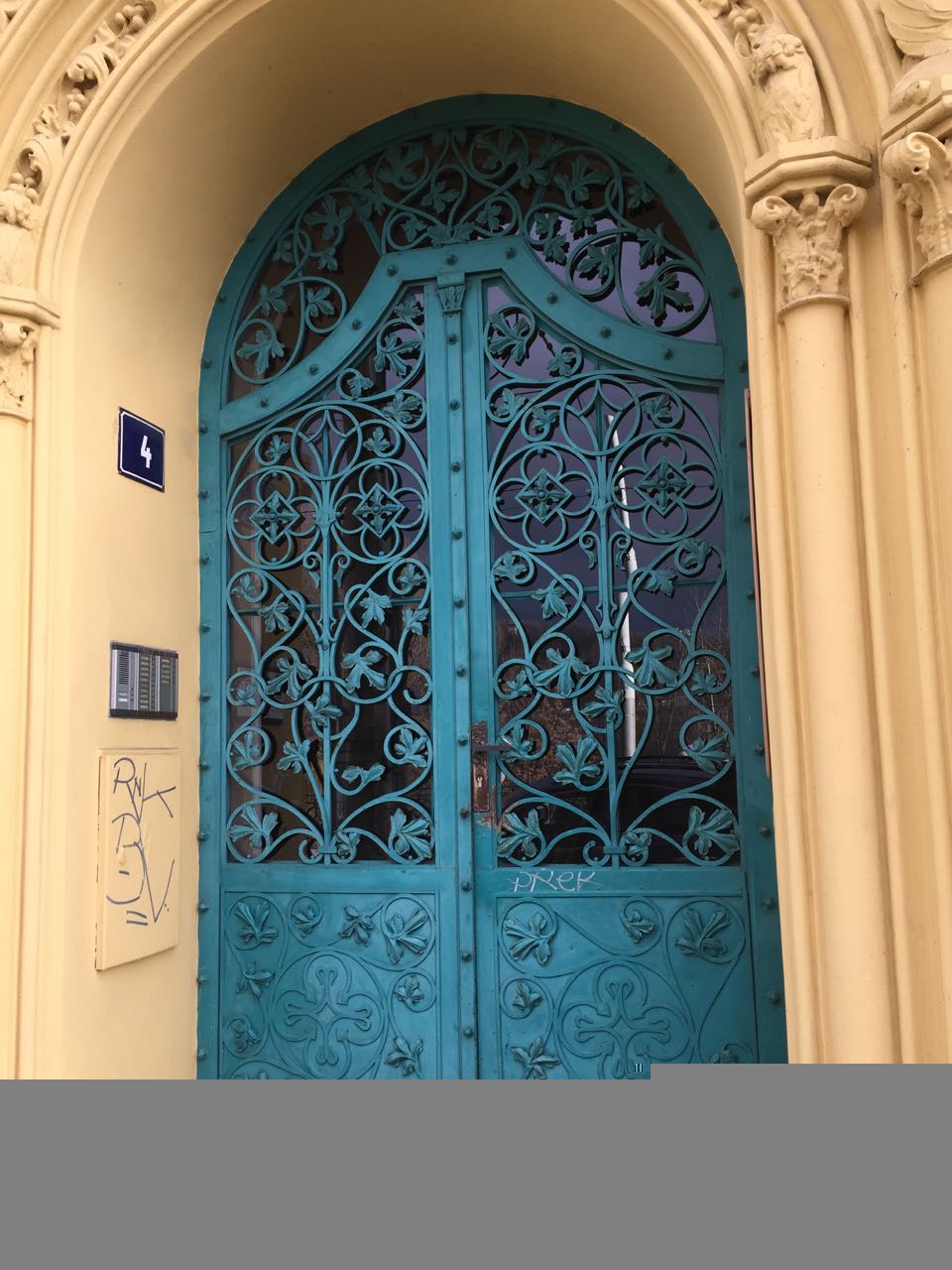 And we’ll finish up this entry with a Door of the Day.
 Regardless of that genius idea, it just goes to prove that just about anything can be a thing. So now I’m thinking of opening a store with nothing but platypuses in them. Statues of platypuses.
 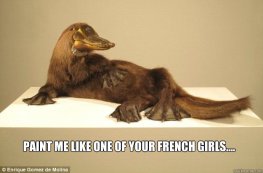 Chocolate-shaped platypuses. Sheets and blankets with images of platypuses cavorting around, topped with a pillow-shaped platypus. And of course two pairs of panties, one with a red platypus and one with a green one.
 Okay, is it the best, or the worscht? We had to give them points for their clever name, and as a result this became the first meal we had in Germany. It was the best bestworscht we’d ever had up to that point, but I’m still not sure if that’s a good thing.
 The Germans are so thoughtful that they put farting stations around town. So apparently this is where you fart, and that little device either sucks up the fumes, or gives you a stink-o-rating. I’m not sure which because the numbers on the device were in metric. I tried to convince Carolyn to give it a go, but she was too shy. I wasn’t shy, but alas, I wasn’t gassy either.
 I’m pretty sure this sign on a pharmacy window translates to: “Well, you were my friend, but so long brave wart!”
 Again, the Germans are so efficient (as well as hyper aware that if you have “germ” in your country’s name, you need to work extra hard to prevent the spread of more of them) that they even have a place for you to “dak,” which I’m sure is the German word for the sound you make when you sneeze, and then they offer a polite “gesundheit” ahead of time. I tried to take advantage of the offer, but I’m not allergic enough to Christmas trees. I coughed, but nothing happened. Bummer.
 Germany also has strict truth-in-advertising laws, so if your Pelchen is crap, well, you’re gonna have to call it krappelchen. This is a river in Dresden, btw.
 By the same token, if your shampoo is bad, there’s no hiding behind fancy marketing.
 “He’d step over ten naked women to get at a pint.” A sign we got a kick out of in an Irish pub we went to, because of course you always have to go to an Irish pub if you’re visiting Prague, where this was. Never did see the ten naked women though.
 As with most big cities, there is graffiti. I’ve always wondered the words mean, and in fact have found it interesting that for the most part, they use pretty much the same lingo, which is just as unintelligible in Europe as it is in the states. Except this one. I guess boobs are universal.
 This is the Berlin Cathedral (“Berliner Dom”). It was built on a site that had various churches on it since the 1400s. The current building was finished in 1905. It at least gives the Germans something to crow about.
 In 1944, an Allied combustible bomb dropped into the dome. The resulting fire could not be extinguished, and so da dome dum-dum-DUM-dummed. In 1975, reconstruction began, restoring it to its former glory.
 A climb to the top of the dome reveals some impressive views of Berlin.
 A climb to the bottom reveals some rather cryptic things.
 They always have fences around tombs because so many people are dying to get in.
 The original church on the site was built in the 1890s. It was badly damaged in a bombing raid in 1943. The present building, which consists of a church with an attached foyer and a separate belfry with an attached chapel, was built between 1959 and 1963. The damaged spire of the old church has been retained and its ground floor has been made into a memorial hall. (per Wikipedia)
 Either this tower is needed to relieve all the gasses from too much bestworscht, or maybe the lack of a huge offgassing tower is what really blew up the dome of the church.
 As you can tell from this photo, this particular building goes all the way to the top.
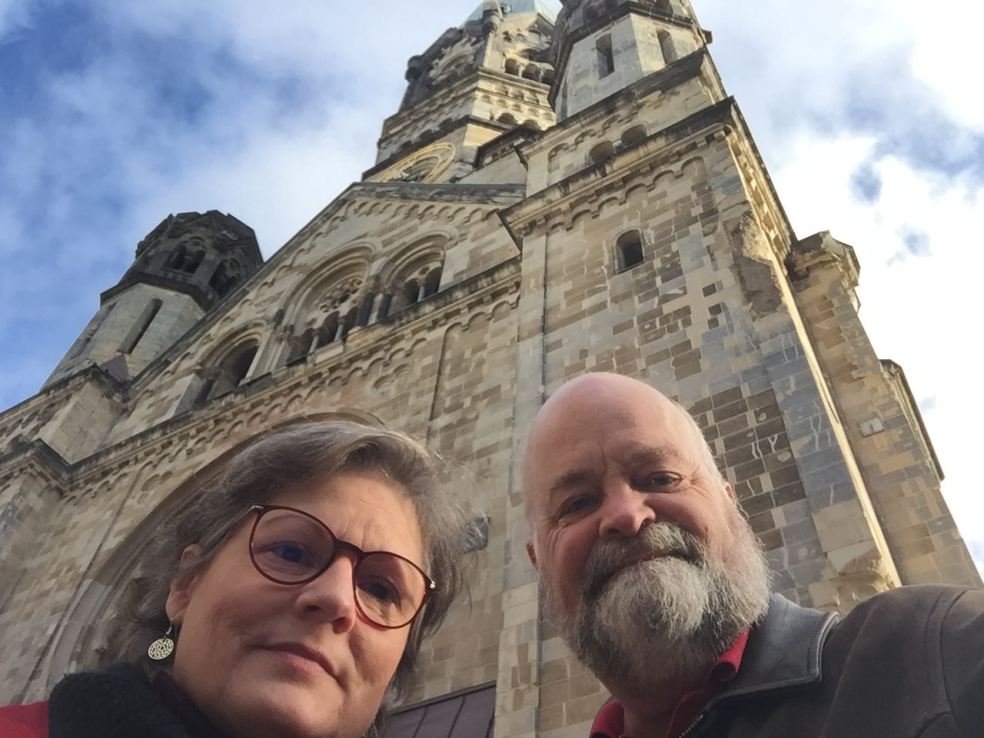 The Memorial Church today is a famous landmark of western Berlin, and is nicknamed by Berliners “der hohle Zahn”, meaning “the hollow tooth”. After all the food we ate, I think we both ended up with hollow teeth ourselves.
 I found an unwrapped wife under the Christmas tree, and so decided to take her home. I did almost opt for the blue present instead, but ultimately stuck with the red one. After that comment, she’ll be shopping for the red Ampelmann panties for sure. Ha!
 As with many of the Christmas markets, this one was built in and around the grounds of a famous building, in this case the Kaiser Wilhelm Memorial Church. But you already knew that because you’re taking notes, right?
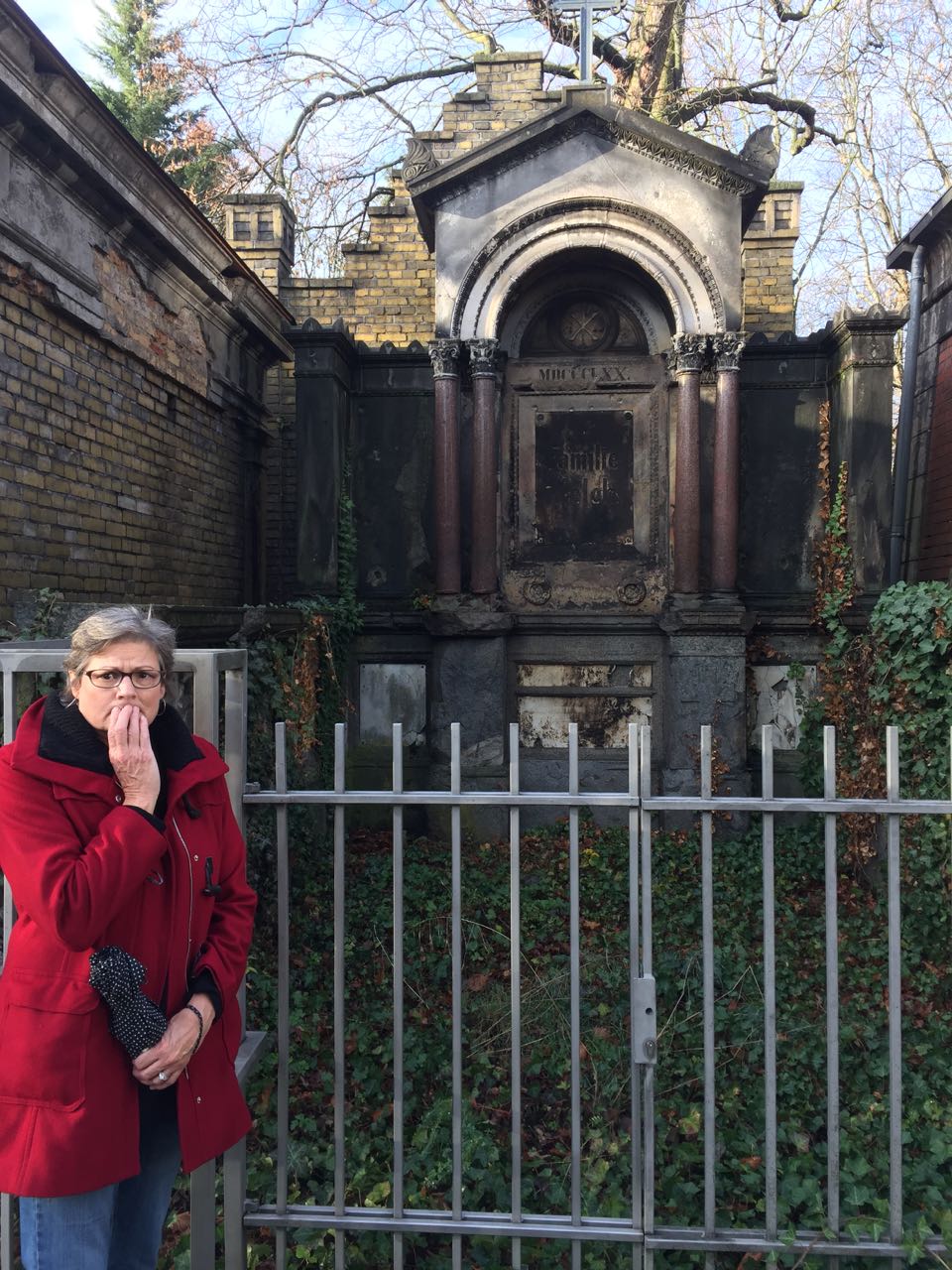 We close this blog entry with a very grave photo.
