
 Many world travelers surely list the Vermont State House in Montpelier, Vermont as first or second on their sightseeing bucket list. Okay, maybe not in the top two, or ten, or hundred, but the Vermont State House in Montpelier, Vermont is definitely something you’d want to look at if you were standing right in front of it.
While I have been to Vermont, I’ve never been to Montpelier, so for the time being I had to settle for the ancient Greek building that inspired the Vermont State House in Montpelier, Vermont: The Temple of Hephaestus.
The temple resides in an area called the Ancient Agora of Athens. The Agora’s original purpose was as a gathering place or for commercial endeavors, as well as of course housing a reasonably cool temple.
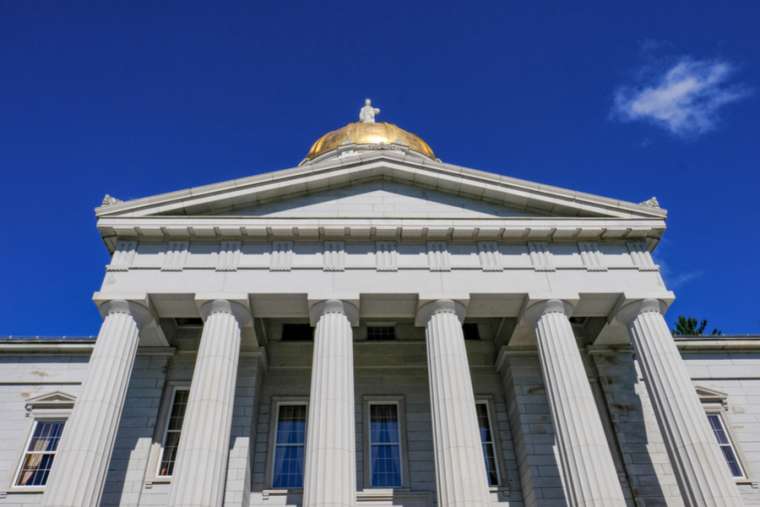 (This is the Vermont State House in Montpelier, Vermont, just in case you were wondering.)
The Agora (which is the Portuguese word for “now,” so we felt right at home) was just a block or two from our hotel. Actually, in Greek, the word “agora” means “gathering place” or “assembly.” So we gathered and assembled there just like two ancient Grecians.


The Temple of Hephaestus has largely been preserved in its original state despite the fact that Hephaestus was the patron god of metal working, craftsmanship, and fire. Which means I would’ve thought he would have burnt the place to the ground after he was notified that he was about to lose his god status.
 Fortunately, he disappeared without much of a whimper, as most gods do, leaving this impressive building in his ashes, –er wake.
 As you can see, this is a container for offerings to the dead. As you can also see, the dead already scooped everything up. Greedy bastards, those dead people.
 This building known as the Stoa of Attalos (we’re still in the Agora, or as I like to say, “O Aqui e Agora,” which means “The here and now” in Portuguese, which has absolutely nothing to do with anything except the word “agora” and my desire to show off my still-very-limited Portuguese skills). “Stoa” means portico or covered walkway. “Portico” is where you have to go after you’ve drunk too much port. “Walkway” is a word that turns into “runway” just by adding some planes. Accordingly, “Covered Runway” is just not a term you hear anymore, not after that one disaster anyway.
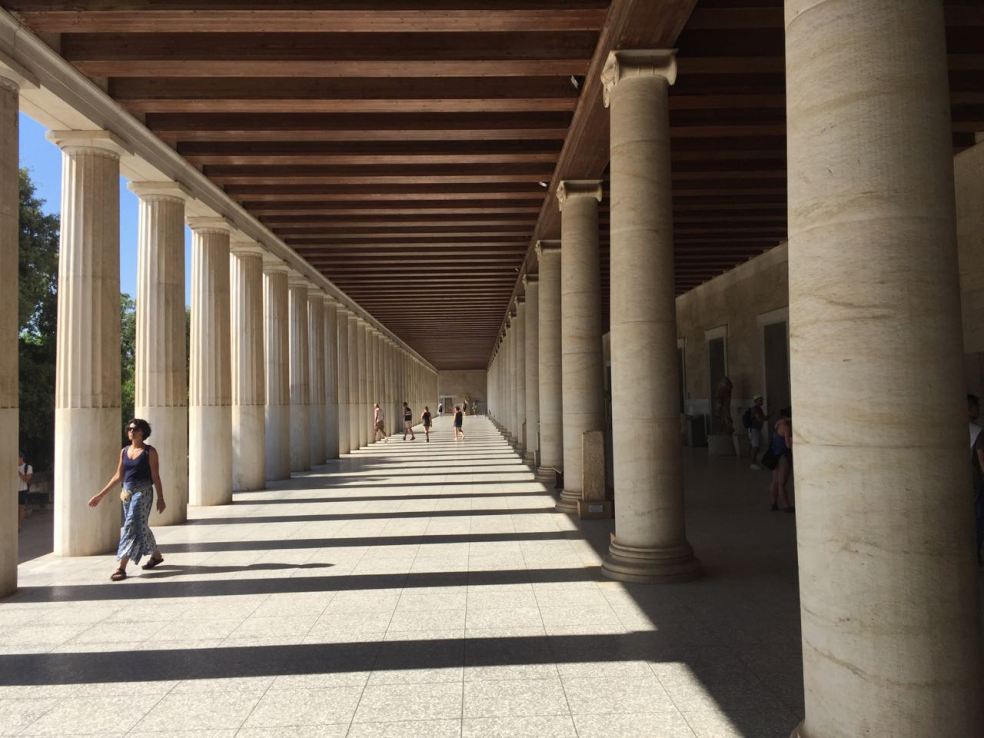 This photo provides some perspective. Ha! Anyway, it was built by King Attalos II of Pergamon, who ruled between 159 BC and 138 BC. The building as it stands today looks a helluva lot newer than that, mostly because it was reconstructed in the 1950’s by American and Greek architects.
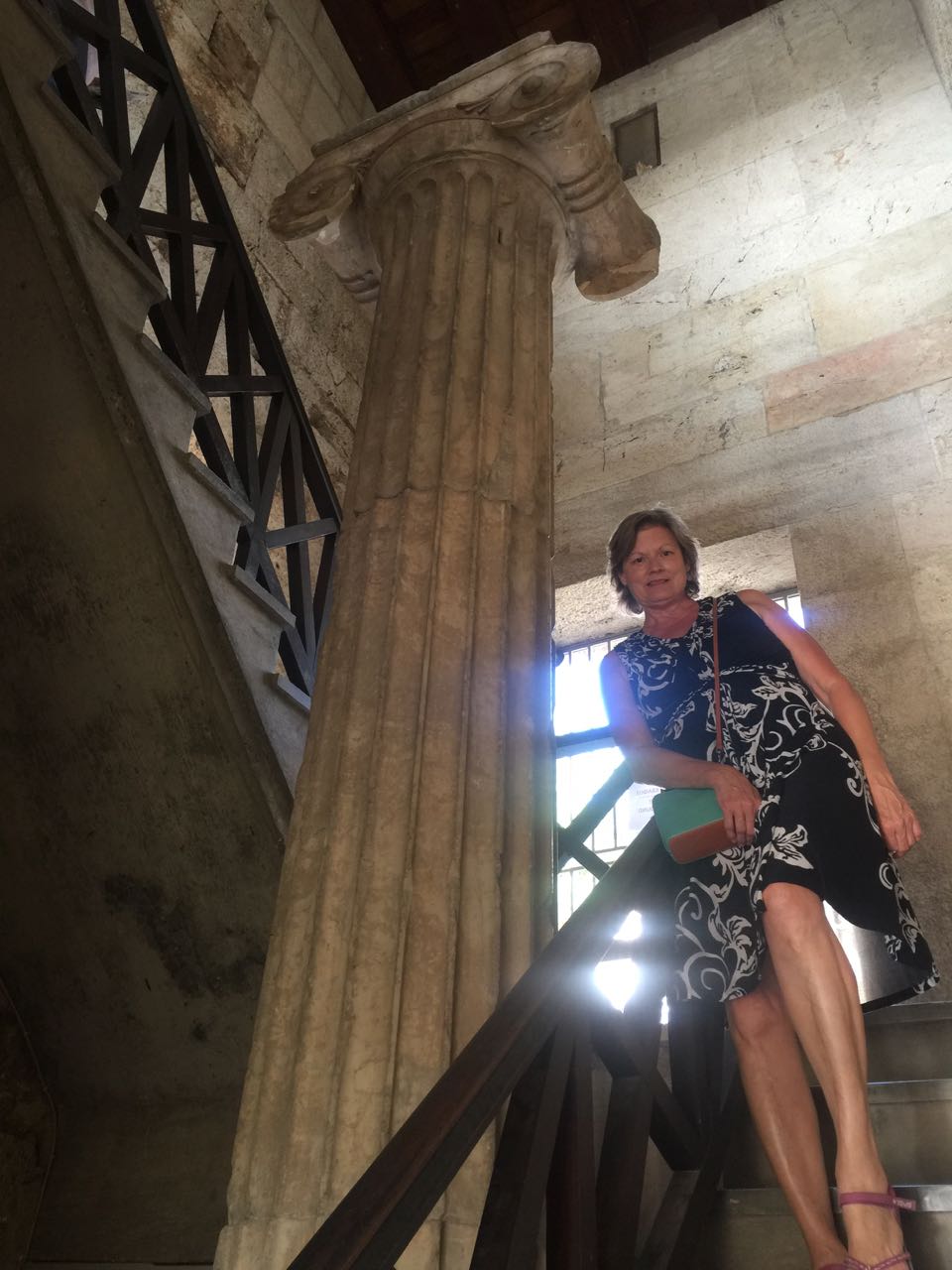 The Stoa of Attalos has a museum inside it and a second floor (or first floor in European). This photo gives you an idea as to the sleek beauty of those gams– I mean columns.
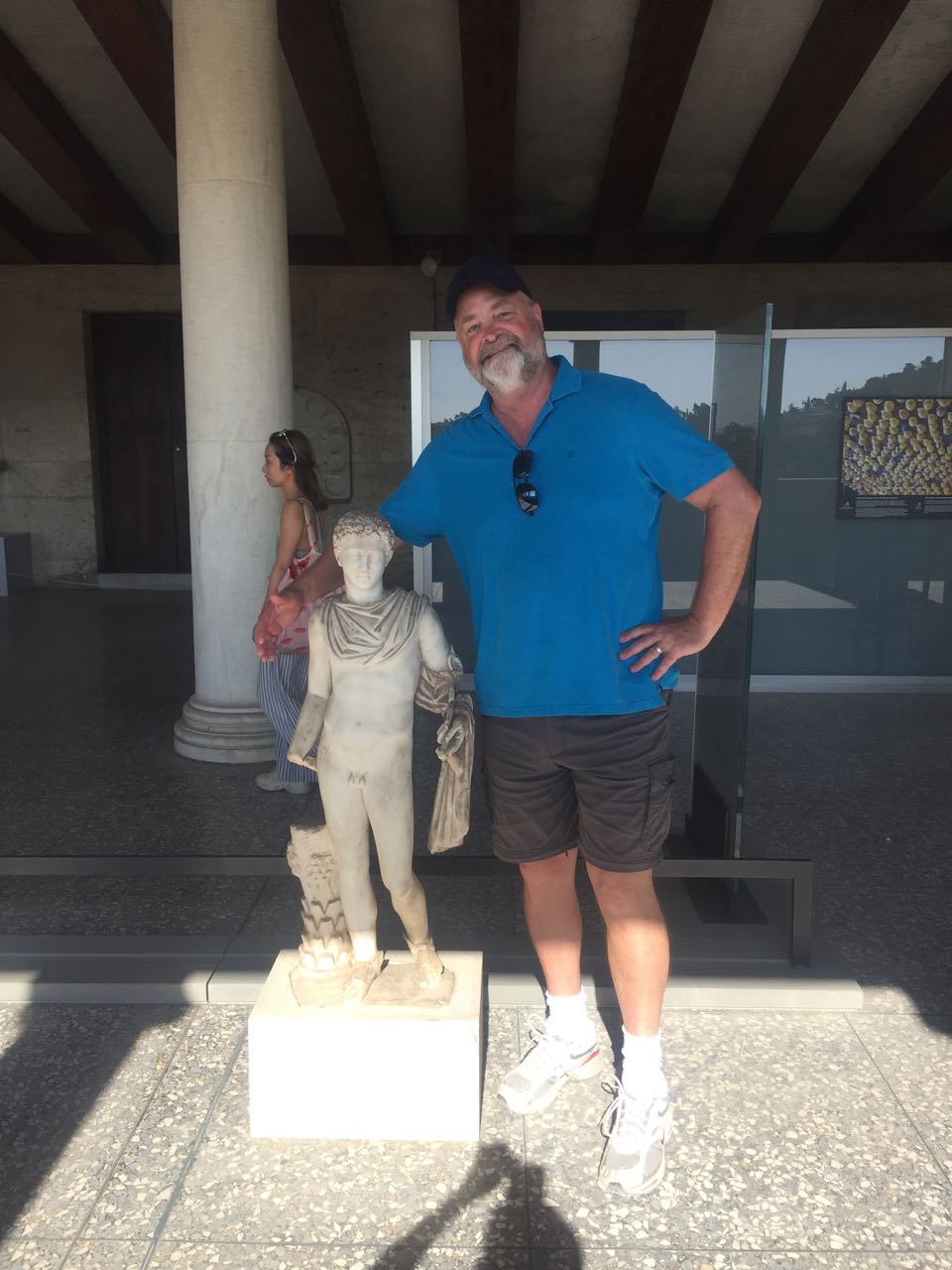 Everyone knows our species has gotten a little larger over the millennia, but few people know just how big a difference there is. And they say JRR Tolkien just made up the hobbits. This ancient life-sized sculpture begs to differ. This statue does explain a lot of the doors we’ve encountered.
 Carolyn’s got this guy’s gnome-ber.


A lot of the statues on display lost their heads. We couldn’t make heads nor tails out of the reason. I guess they all simply had it up to here. It was neck and neck to pick the two most beautiful, but one was shoulders above the rest.
If I only had a brain…
 We thought it appropriate to deface the photos out of respect for the defaced.
 One example of the wares displayed in the museum. This vase demonstrates the mad jigsaw puzzle skills many archeologists find beneficial to their work. They have a hard time without the box top, however.


Some more museum pieces.
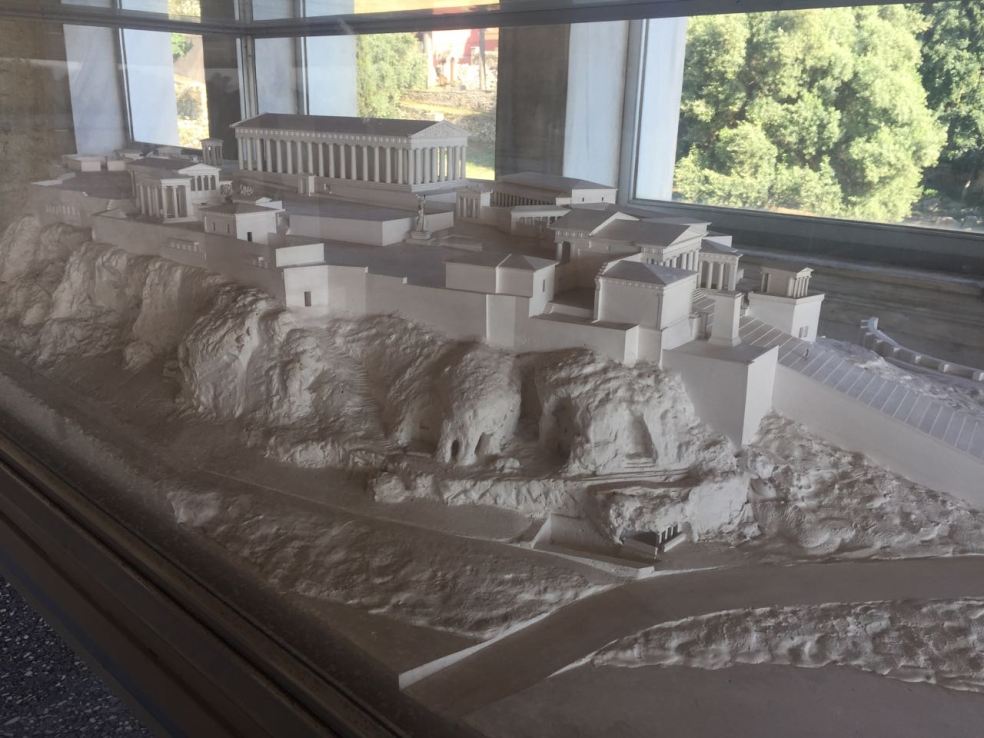 This is what the whole Agora area would’ve looked like back then. At least if you were either color blind or the whole thing froze over in a freak world-ending ice storm.
 Moving on from the Agora, this is the neighboring Library of Hadrian, who was the Roman emperor from 117 to 138, and is now the patron saint of overdue book fines. His own fines were not forgiven by his successor Antoninus, so it’s now up to $82,423,122 with interest. I mean, there ain’t no Italian named Tony who’s gonna forget about yer debts, y’know?
All that made me ponder… do you realize there is a whole generation of people growing up who have no idea what an overdue book fine is?
 Hadrian is known for being both personally generous as well as extremely cruel. He must’ve been generous to the right historian’s forebears because he made it onto the “Top Five Good Emperors List” (if he wouldn’t have been so cruel, he might’ve made the “Top Five Very Good Emperors List”… but alas). He also traveled a great deal outside of Italy, unlike most of his predecessors. When he passed by, the people would shout, “Yo Hadrian!”
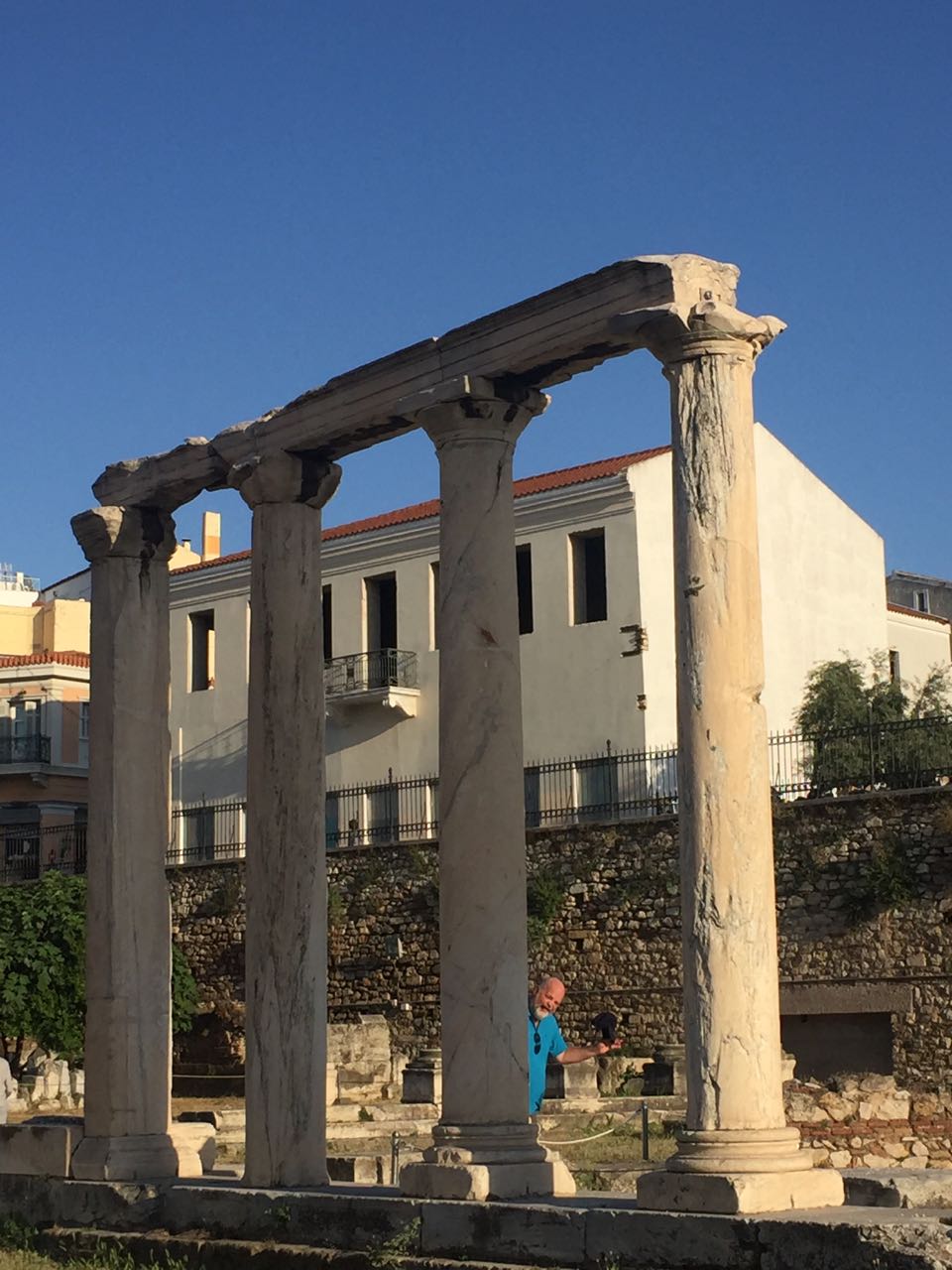 Another set of ruins in Athens is the Dipylon Ruins. So of course I had to act like a dip. Actually, the entire area is known as Kerameikos, or Ceramicus in the Latinized version.
 It’s a large area that resides both within and outside the ancient city walls. Since it was the potter’s part of the city, Ceramicus is what led to the world “ceramic.” True story.
I look kind of potted here myself.
 I always look closely at walls in ruins, being continually amazed at the preciseness of their construction and alignment and the fact that they’re still that way even after thousands of years.
 The Dipylon (The Thrasian Gates) was the most important gateway in the Athenian city walls. It was the main entrance to the city, and was at the time the largest gateway in the world.
Since then, that honor has been taken over by the Buland Darwaza in India. We’ve never been to India.Yet.


Ceramicus was also the site of an important cemetery. There are still numerous funerary sculptures along the ancient road that led in and out of the city. They called it the “street of tombs,” reminding everyone that they, too, will one day be worm food. Today, America has replaced that with the “Street of Dreams,” reminding everyone that they, too, will never live in a house with eight big screen TVs, a five-car garage, and an underwater bar in the pool.
 We simply stumbled across Ceramicus while taking a walk outside our hotel to places unknown. You never know what you’re going to find when you explore an ancient city!
 Like almost every place in Athens, feral cats were plentiful. Some were even friendly. This one decided to share some of its fleas with Carolyn.


Overgrown
Pristine thorns
Sheep shorn
Tinkling below
Roofless walls
Rooks overlook
I told you so
Babbles the brook
“Ruins” by Samuel Menashe
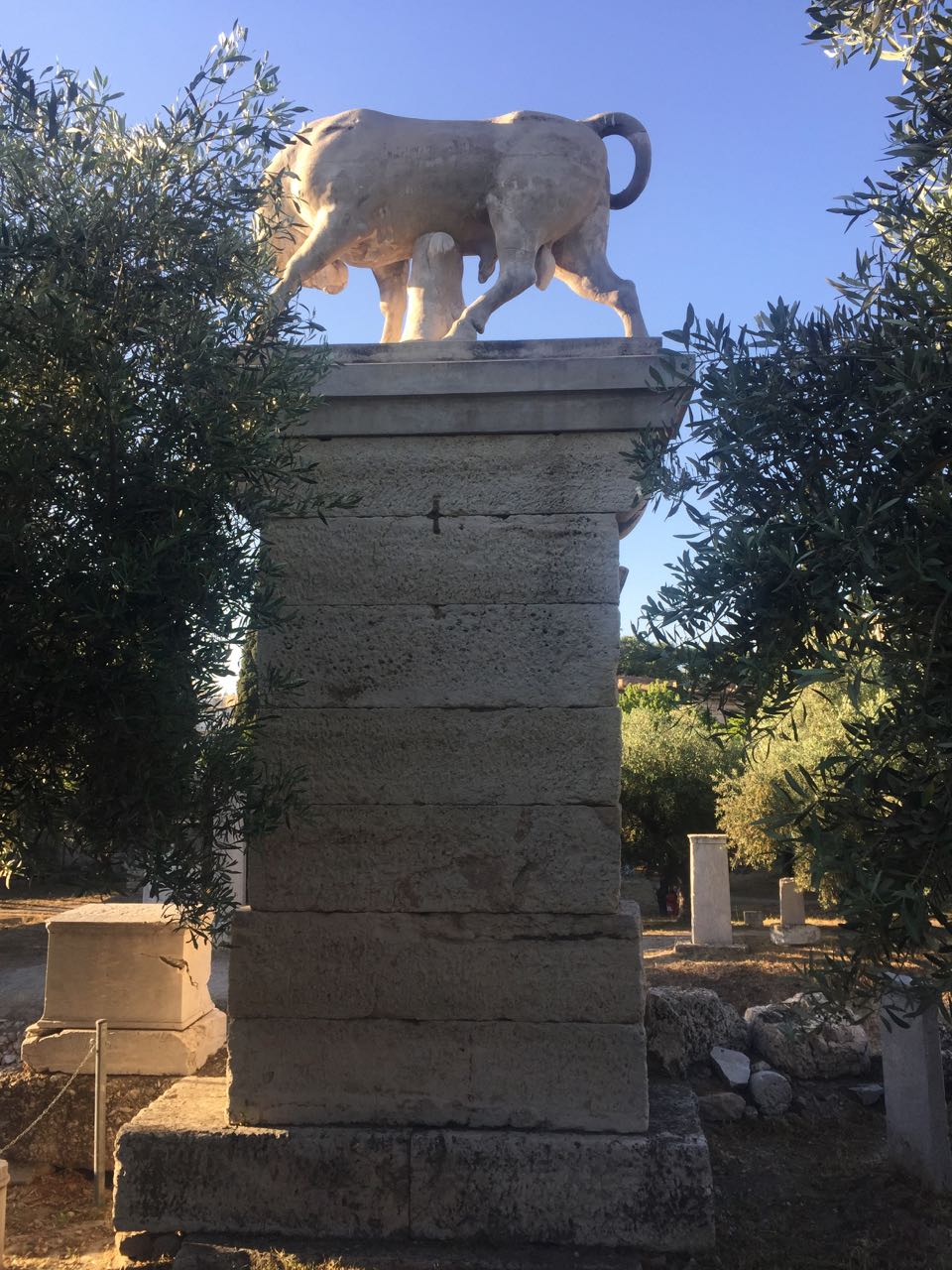 And that ain’t no bull.
Well, it is, actually, but that line sounded better that way.
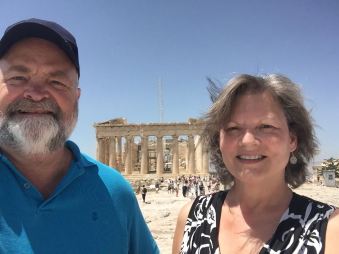 While in Athens, we learned that “Acropolis” is actually a Greek word meaning the highest point in a city. In other words, there were acropolises all over the place in Greece… it’s just that this particular one became famous and known as THE one.

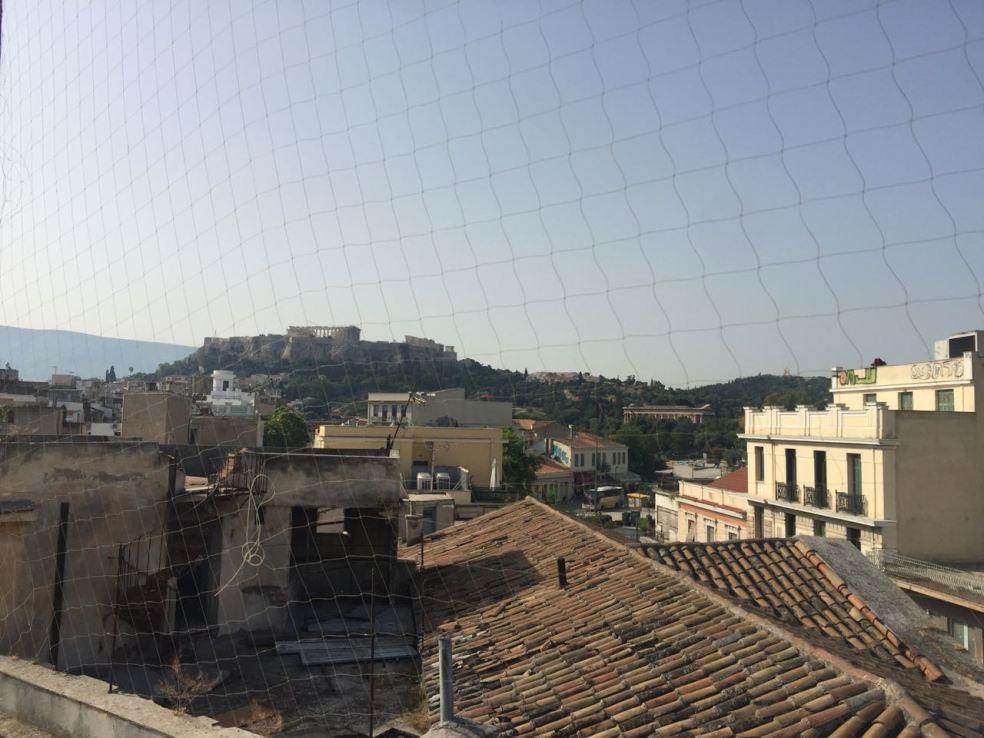 And this was our view from the rooftop breakfast buffet at our hotel. The netting was smartly placed there to keep the birds out of the buffet, except of course the ones we were eating.
 And here she is, the mother of all acropolises.
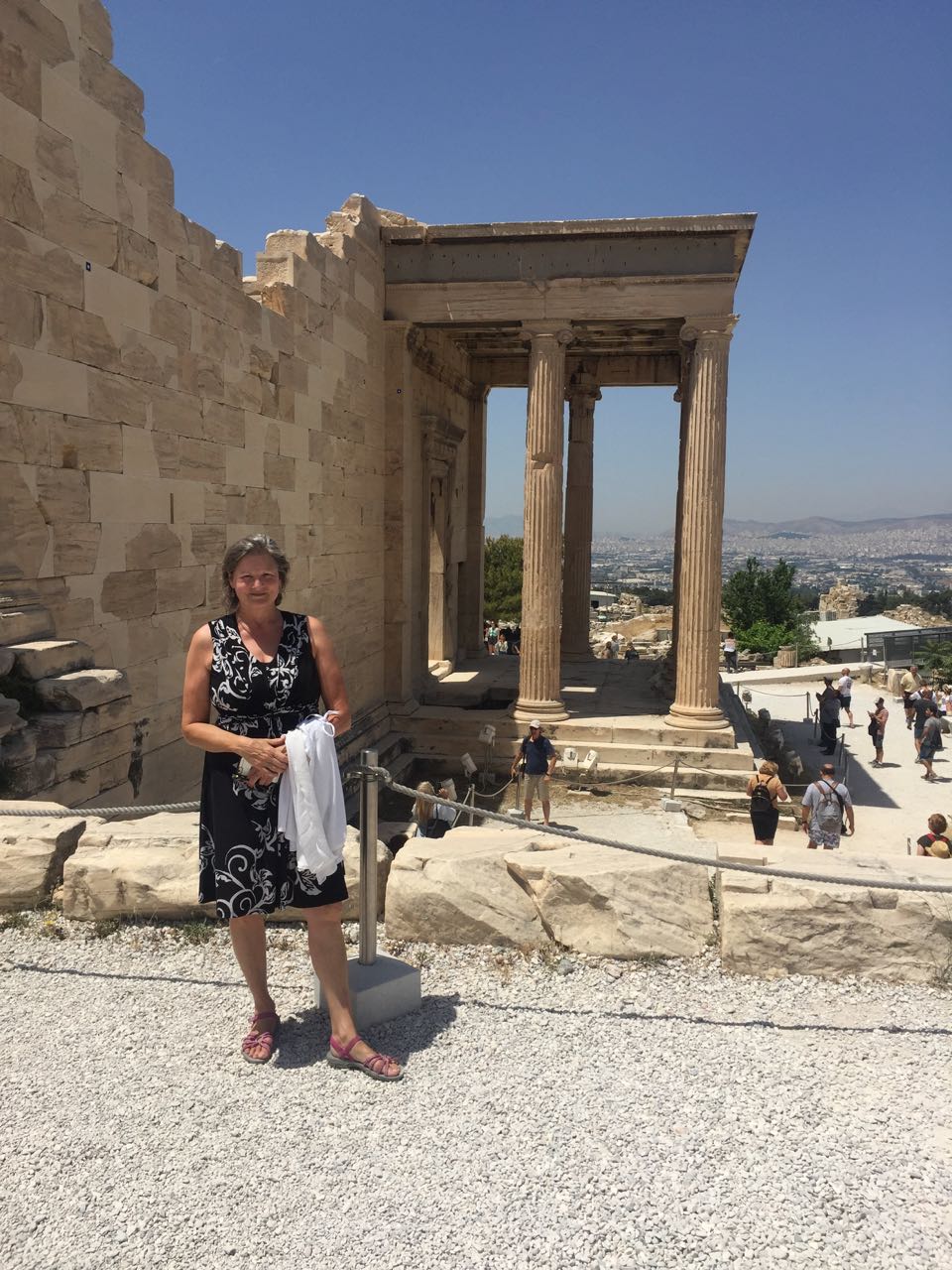 Speaking of mothers, here’s Carolyn in front of the Erechtheion, which is a temple dedicated to both Athena and Poseidon. It was built between 421 and 406 BC.
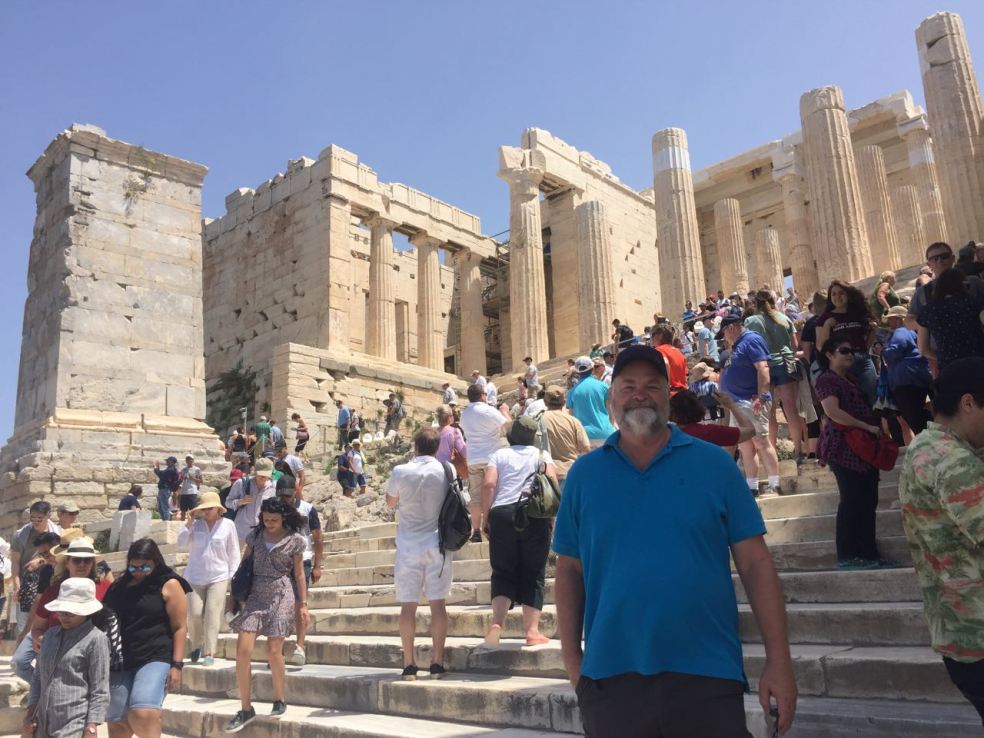 These are the stairs leading up to the complex. It’s hard to keep the names of all the buildings straight, but I’ll do my best as we wander around the place.
 I think this is the Erechtheion again. If not, it’s some old Greek building.
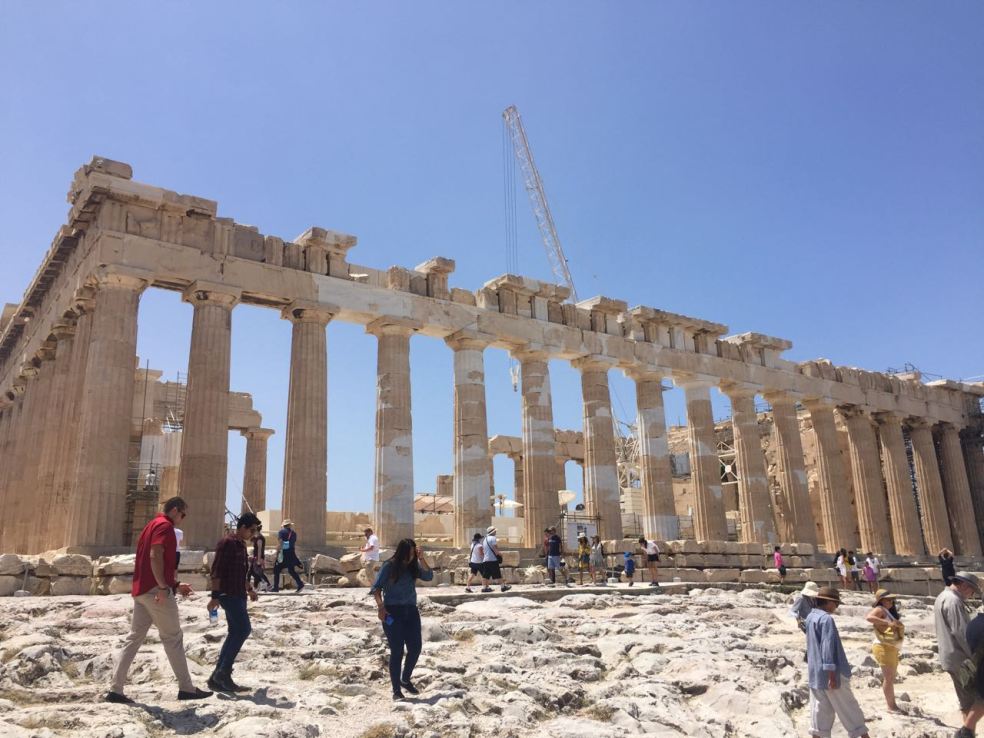 The Parthenon, the most famous of the Acropolis buildings, was dedicated to the goddess Athena, the patron of Athens and the goddess of war.
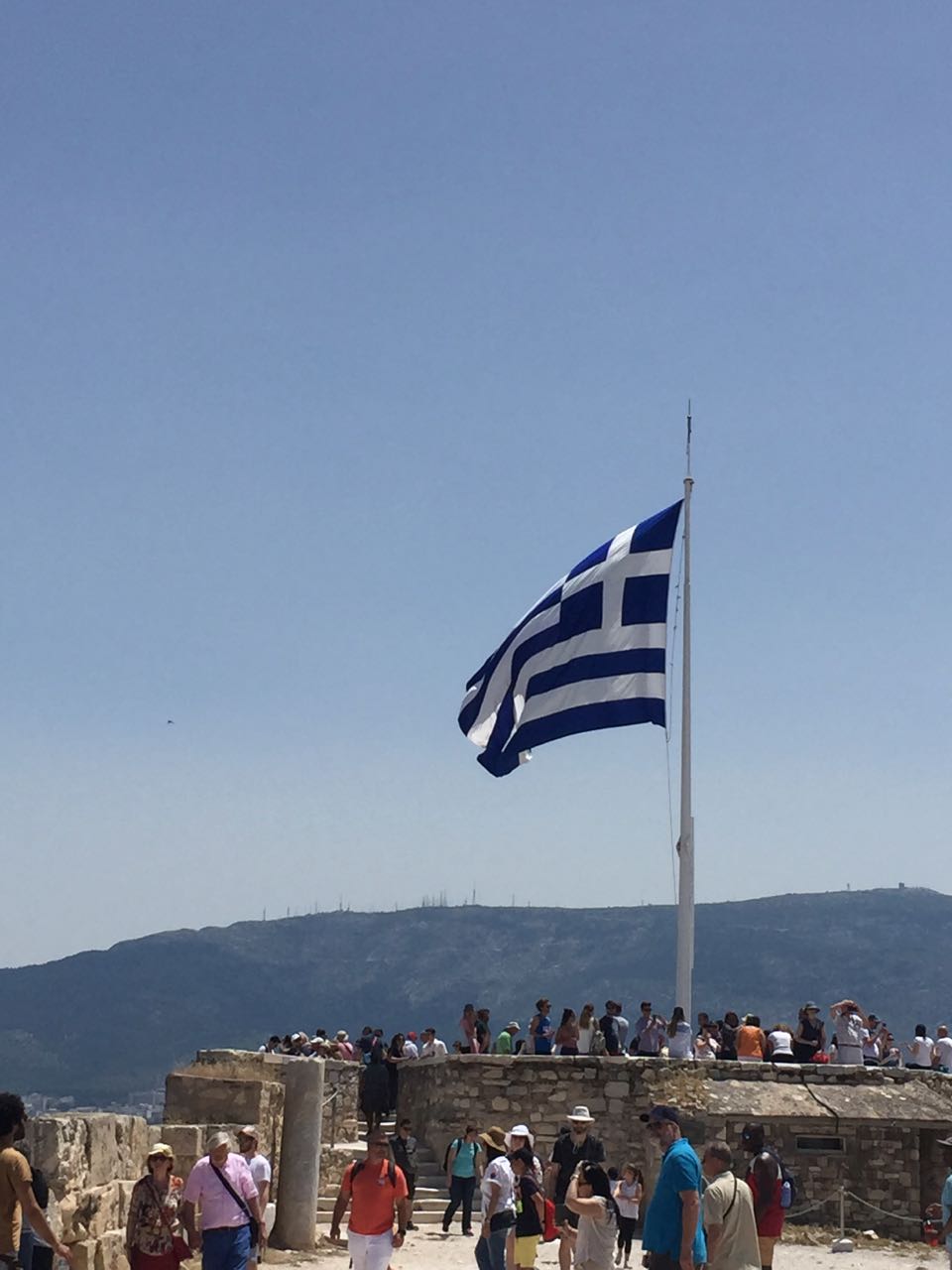 The Greek flag flies proudly over the area.
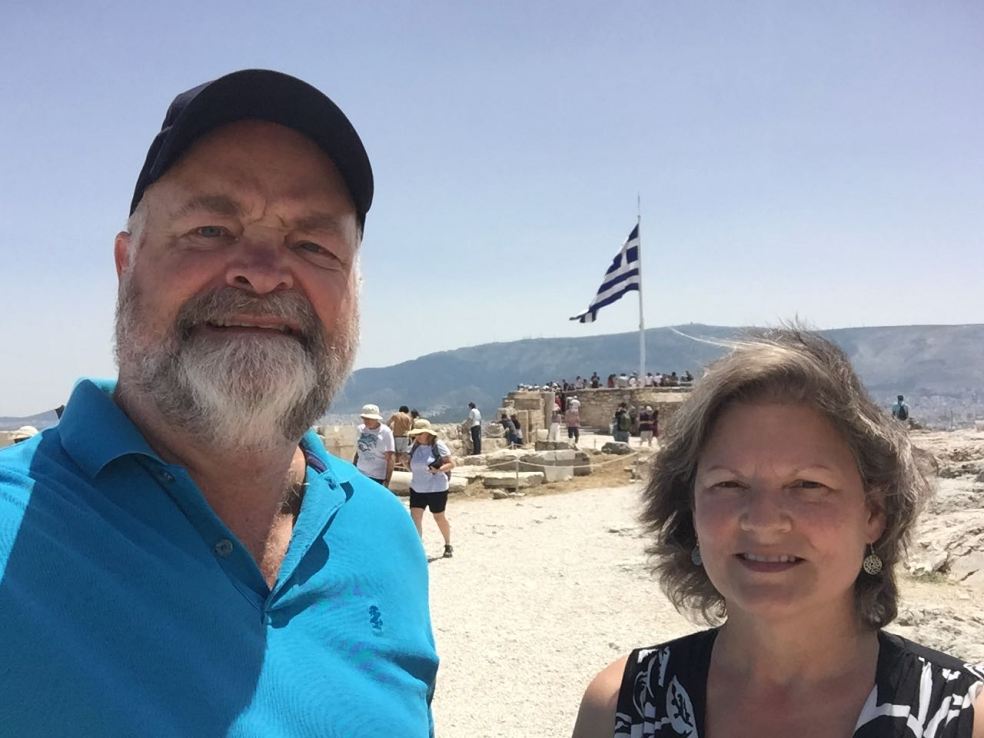 So of course we had to selfie-ize it.
 This is the back side of the ruins. Which is kind of cool… like seeing the backside of a waterfall.
 A view from atop. The theatre-looking-thingy to the right is the Theatre of Dionysus, which we’ll cover more of below.
 There are plenty of hills and stairs you have to climb to get up there; if you walk from the base of the whole hill it’s a fair trudge. They didn’t have wheelchairs back then so you’re a bit SOL if you’re confined to one.
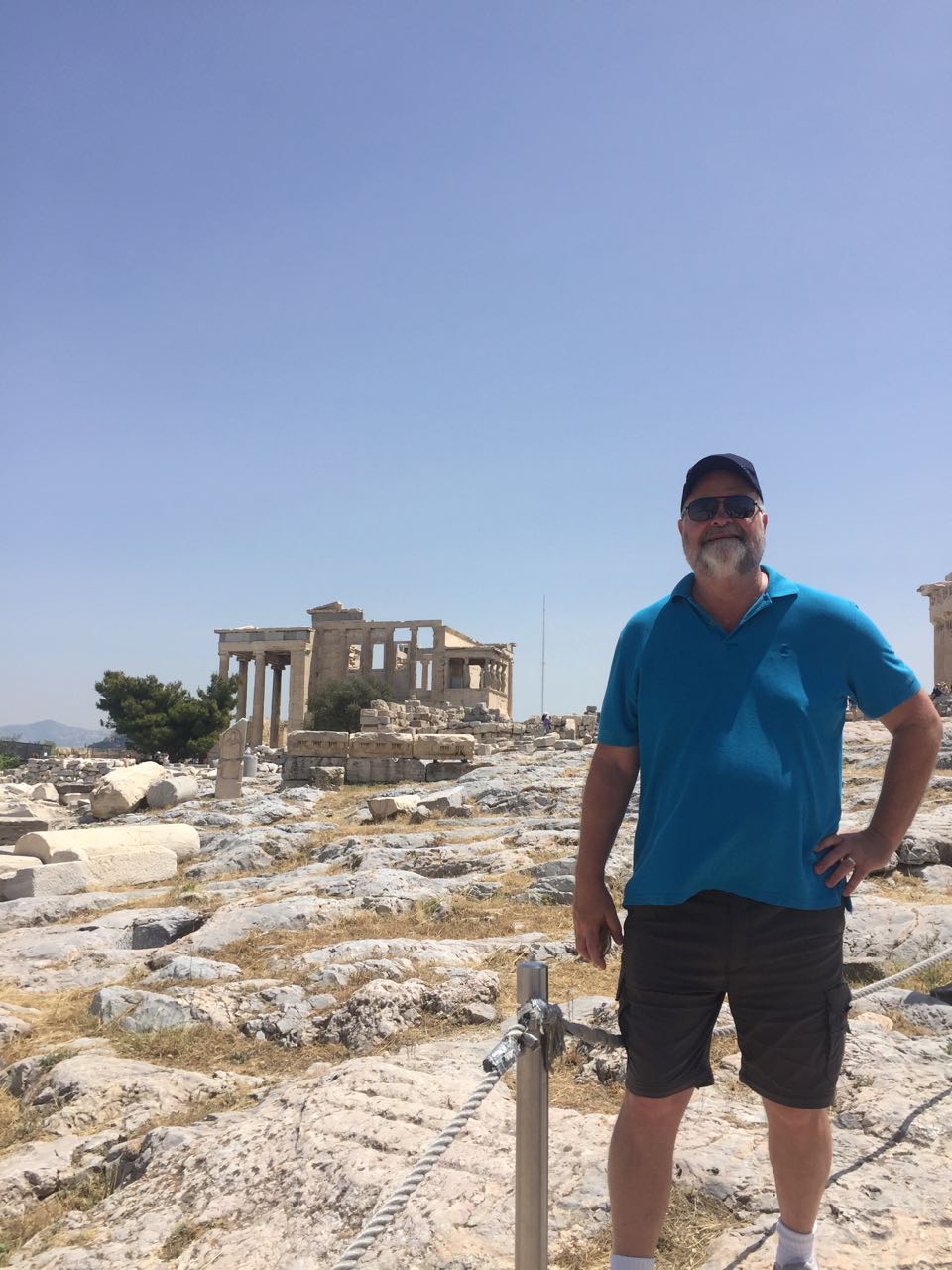 I’m pretty sure that’s the Erechtheion again on the left. That’s the world’s worst tour guide on the right.
 But then they throw me an easy pitch to hit. The Parthenon! The Parthenon! Boy, it’s awesome being an expert.
 Those who know me best are the least surprised to know there’s a sign there telling us not to touch anything.
 The construction of the Parthenon began in 447 BC when the Athenian Empire was at the peak of its power. It is considered one of the world’s greatest cultural monuments… just behind Trump Tower.
 I have no idea what the one on the left was used for since it appears to be all of one piece with no lid. Come to think of it, I have no idea about any of them… why are there rocks laid out that way? This is surely one of the eternal mysteries of the Acropolis.
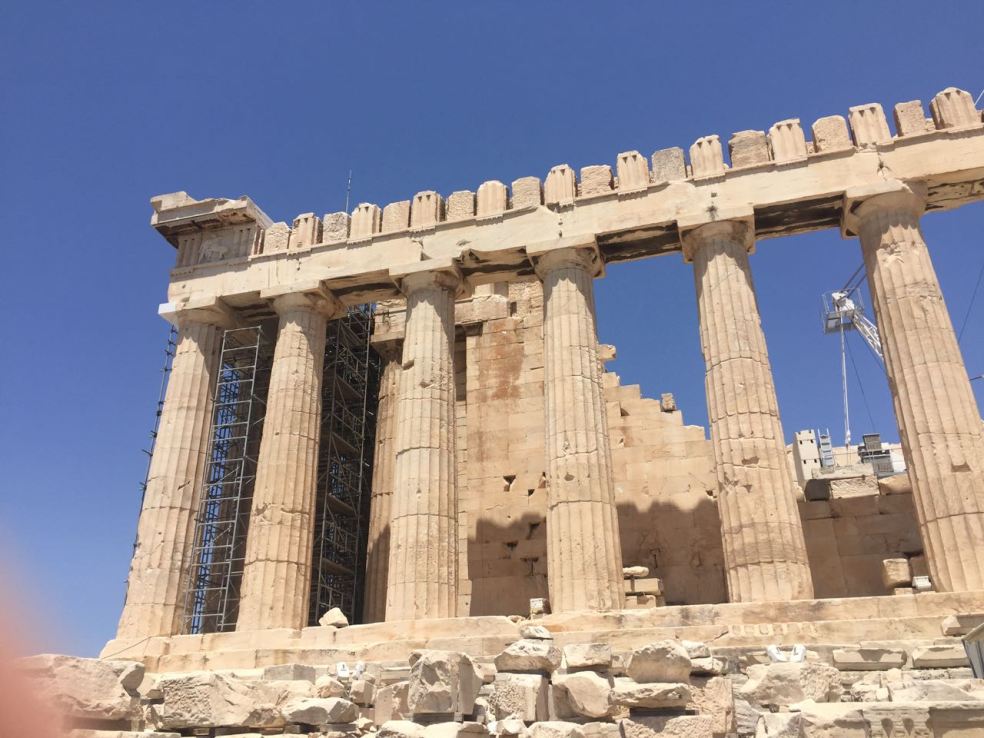 They obviously had to have ladders built into it so they could wash the windows.
 The origin of the Parthenon’s name refers to “unmarried women’s apartments.” In other words, this was where all the single chicks hung out.
 And this may have been the wall they threw themselves off of when their love went unrequited.
 We ended up with about 78 pictures of the Acropolis from afar. We’ll only show you a few more before you start thinking of it as the Acrapolis.
 No, the man in the red shorts is not taking a dump. That’s not a toilet, sheesh! Get your mind out of the gutter. As for me, I’m urinating on the stairs. But in the gutter!
 The Theatre of Dionysus is thought to be the world’s first theatre. Dionysus was the god of grape harvesting, wine, fertility, ritual madness (whatever that is), religious ecstasy, and theatre. Whatever else he was, Dionysus was certainly a party animal.
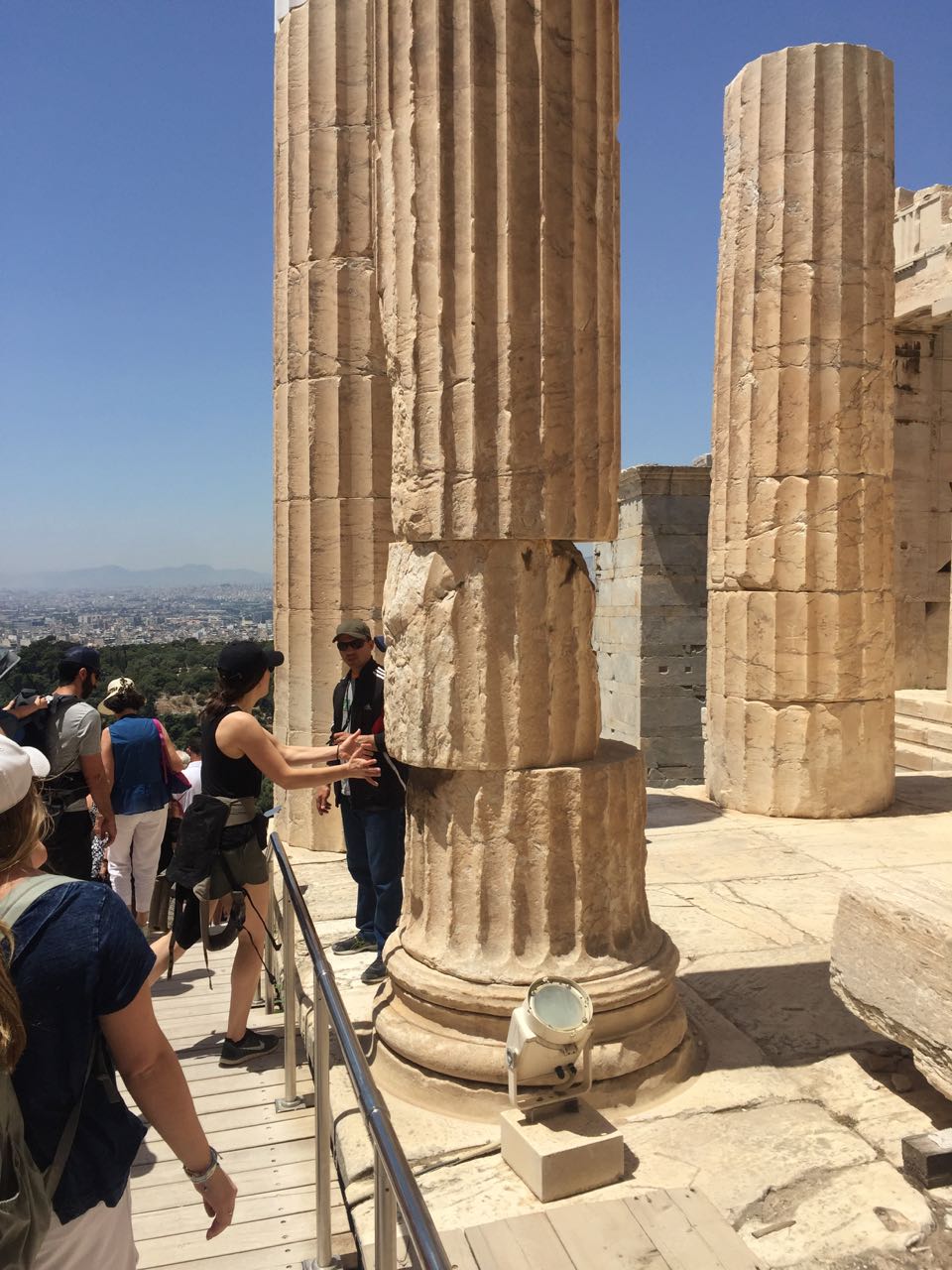 I think this is where Samson first tried pulling the pillars down, except that it was right after his first haircut, which left him with a mullet, and so of course even God said, “Oh hell no.”
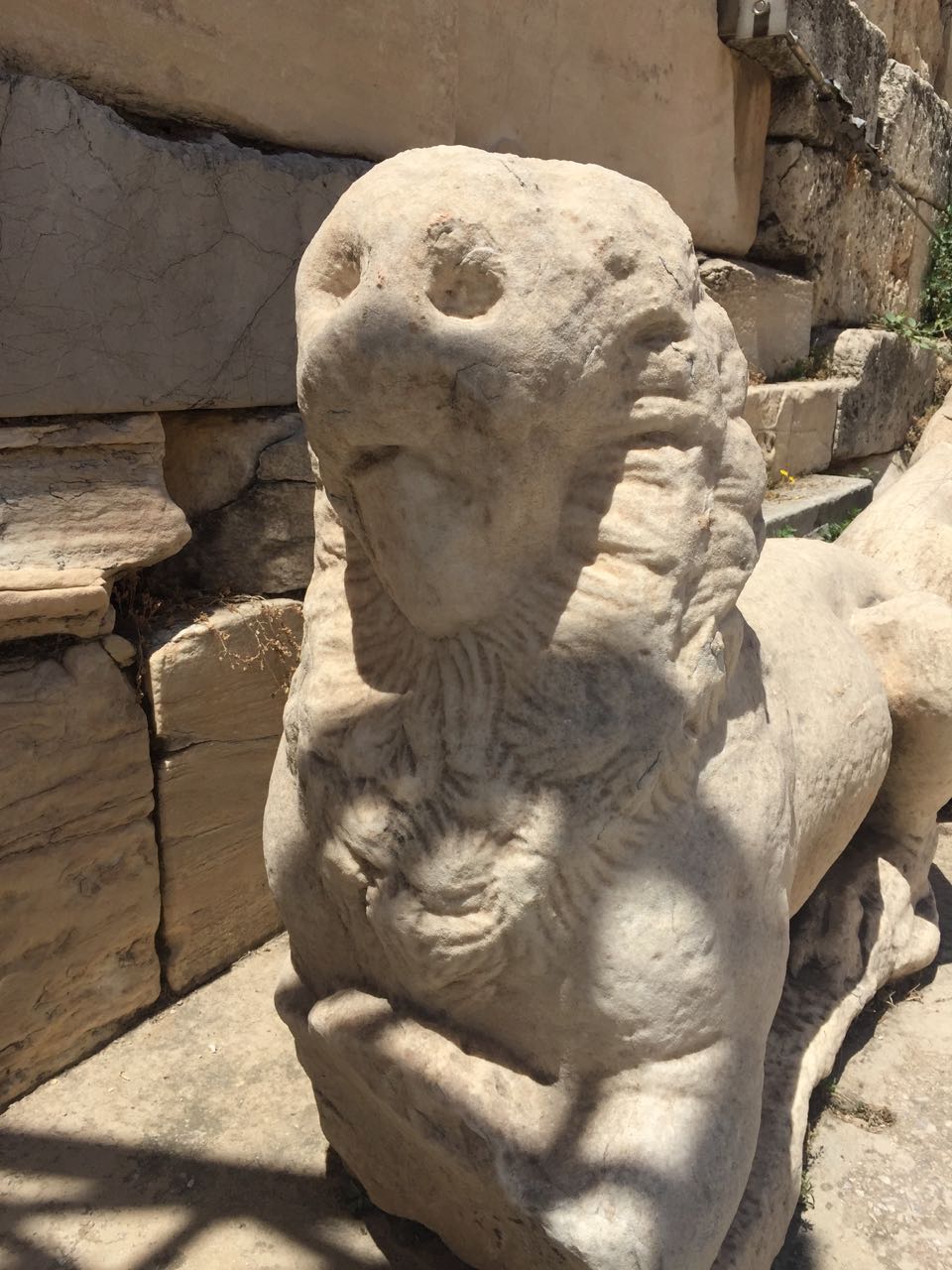 I’m really hoping this is the result of wind erosion. I’d hate to think their sculptors were that bad.
 Today’s Greeks are such wimps. Your forebears erected that whole thing before they even invented pencil and paper! Today you wienies need an entire frickin’ crane just to fix it up a little! Oh how far have you backslid? No wonder you needed to be bailed out by the EU!
 Yeah, we have hundreds of photos of the Parthenon, but this is one of the gooder ones.
 They say if you kiss your mate in front of the Parthenon, you will end up in a blog. OMG, they were right! Of course, whenever I see pictures like this of me I always wonder why I still put shampoo on my head every morning in the shower.
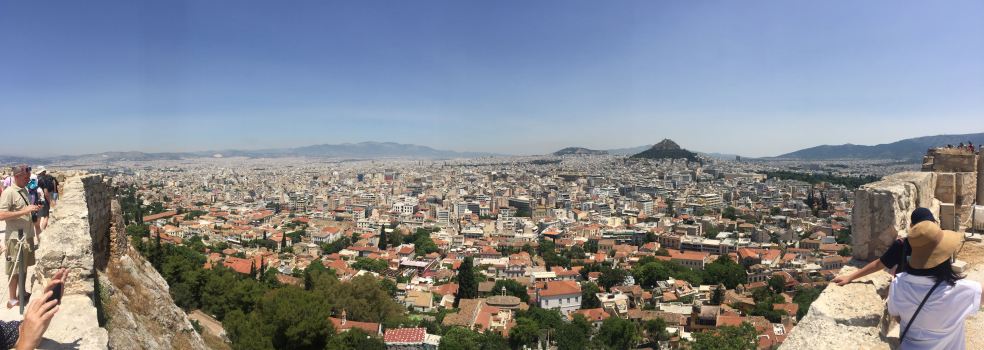 The one thing Athens has going for it is an interesting view from the Acropolis. It’s just a vast sea of houses, with very few buildings poking above the rest. It sprawls just about as far as the eye can see.
 In Rome we learned that the thinking towards restoration work has changed over the last century. Instead of replacing things to make it look new, they do everything they can to protect what’s there. It looked to us that they were working very hard to do just that, although many of the stones were obviously newer.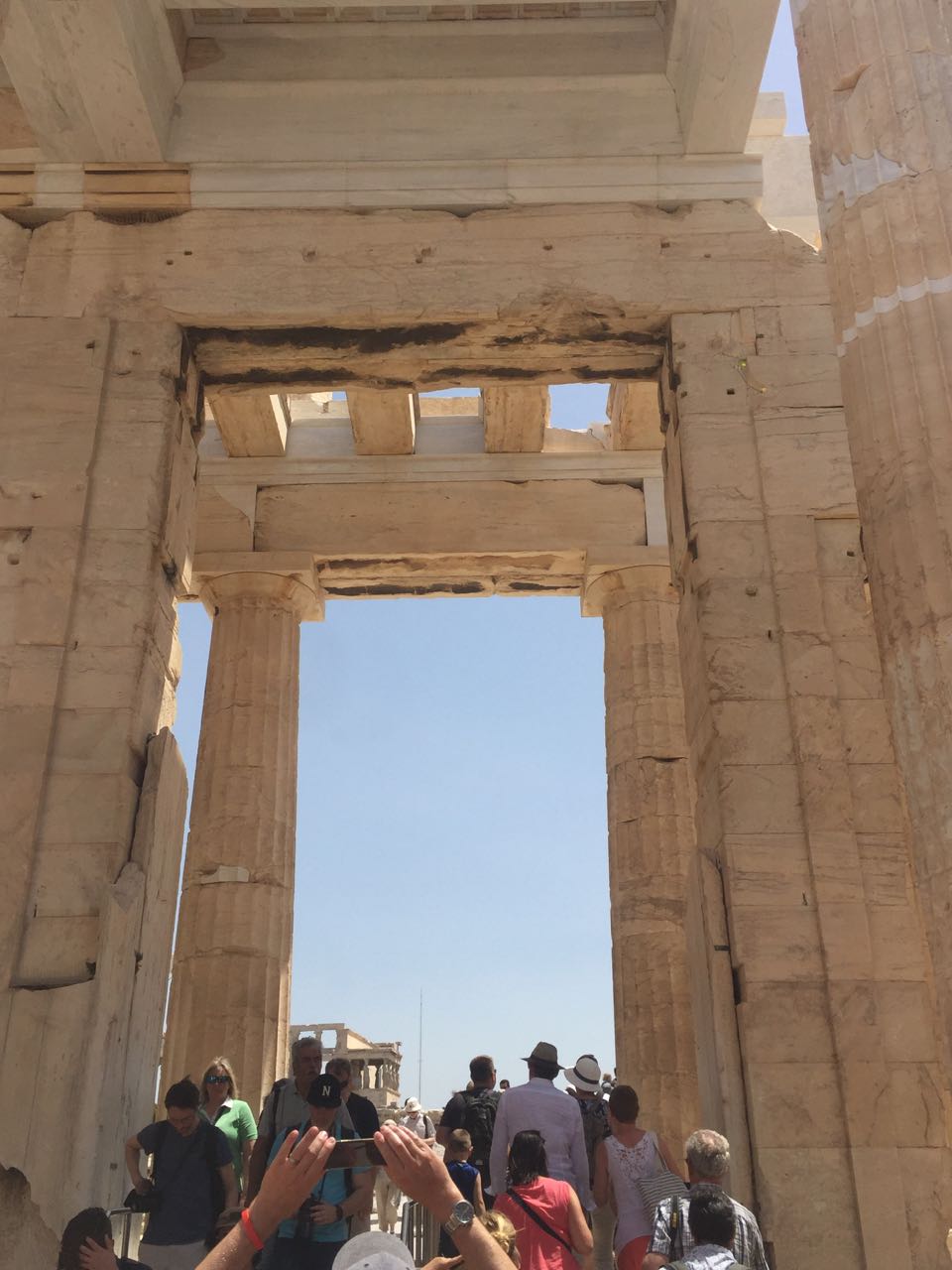
 I mean, how the heck did they get those blocks on top of the columns? What you don’t ever hear about is how many times someone knocked over one of them, sending them all tumbling like dominoes and forcing the construction to start over all over again. Probably because they were executed.
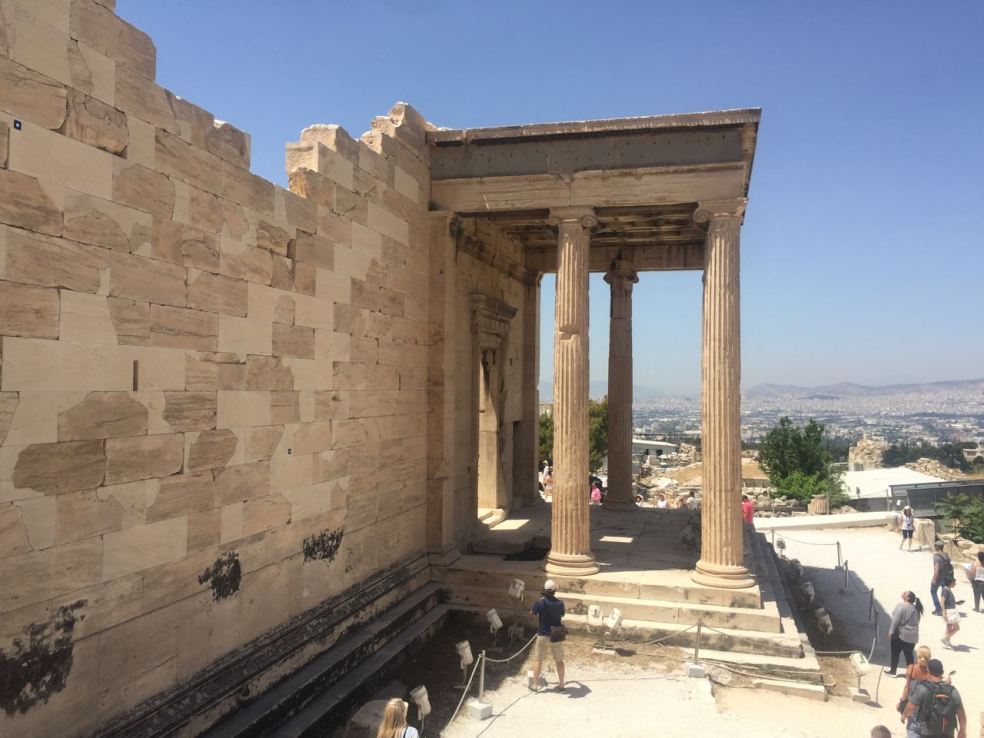 In addition to the Parthenon, the other various monuments which make up the Acropolis include the Temples of Athena and Nike, the Erechtheion and the Propylaea. This is one of those four.
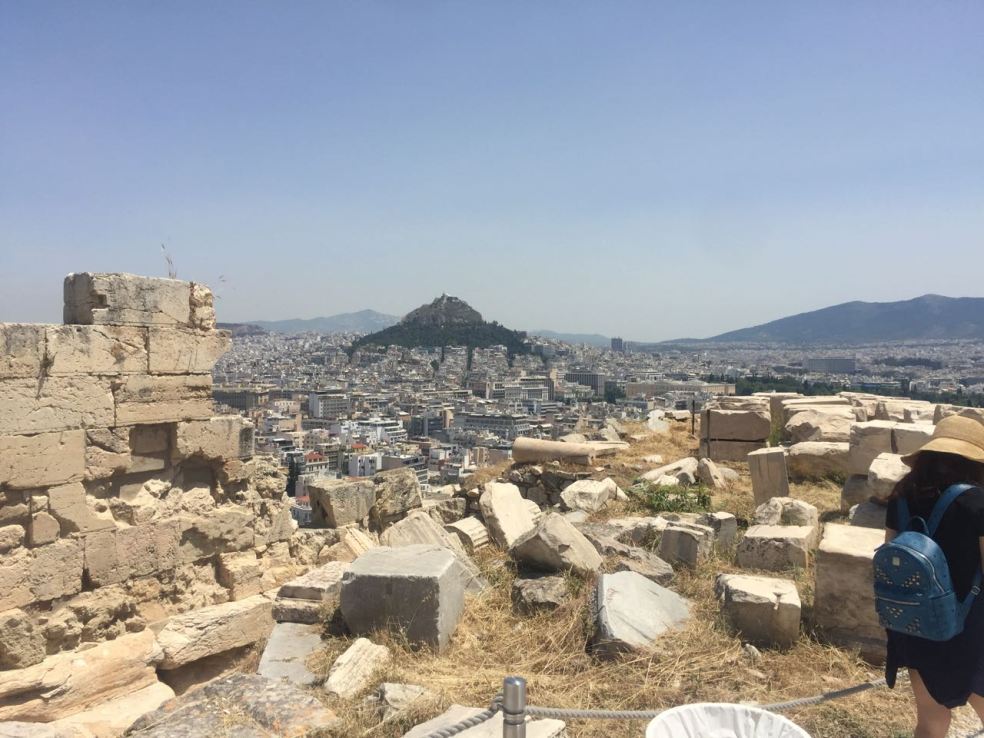 In the distance is Lykavittos Hill, the highest hill in Athens. You can get to the top via Funicular. That word alone makes it sound like it would be a blast, but we didn’t get over there.
 The crowds were pervasive, but it wasn’t too bad. We’re glad we didn’t come in the dead of summer… not only due to the larger crowds but there ain’t no shade and it can be hot up there! In fact, Athens holds the record for the highest temperature ever recorded in Europe, at a blistering 48°C (118.4°F).
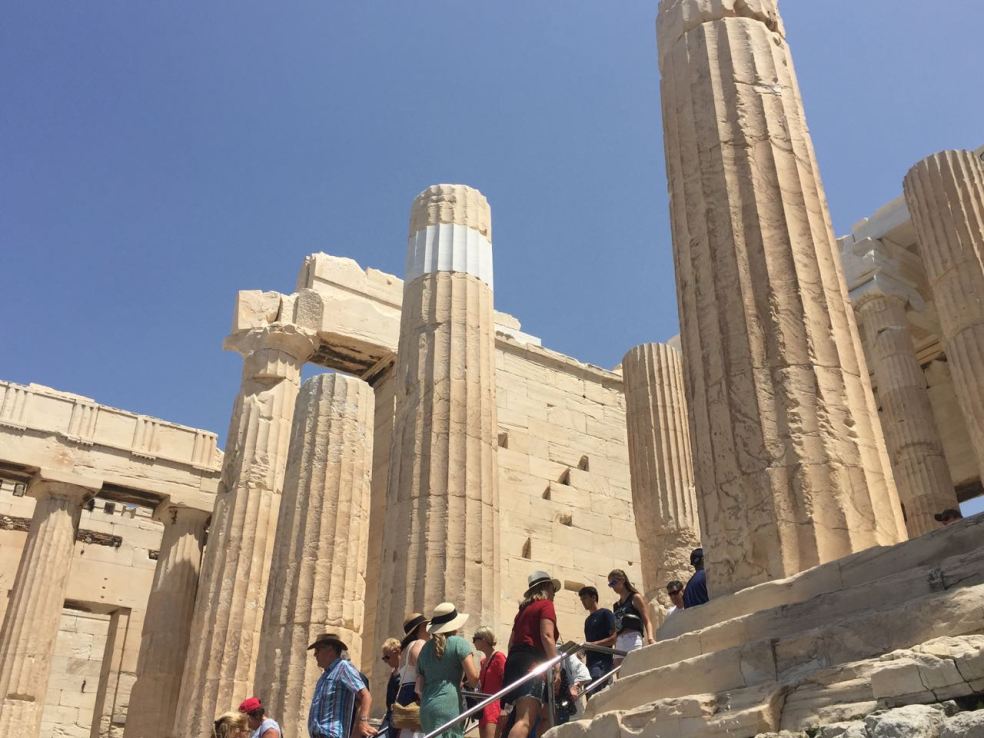 The world’s first spreadsheet.
 I don’t believe I will ever cease to be amazed as to how they got those stones up there, perfectly straight and aligned, without the aid of any machinery.
 And then they were able to put even larger stones on top… and here they are still standing almost 2,500 years later. Mind blown.
 Just follow the sea of tourists to the Parthenon. I only follow the one in front.
 This sign is in both Greek and English (one of the things that makes me grateful for having been born into an empire… with apologies to the Indians, Africans, Puerto Ricans, Hawaiians, Eskimos, Mexicans, and everyone else the US conquered or enslaved). It describes the restoration work, some of which is noted as being that of a “rescue nature,” which is why some of the columns have white areas. When it’s either that or to have the whole thing tumbling down, I’ll take the mismatched colors any day.
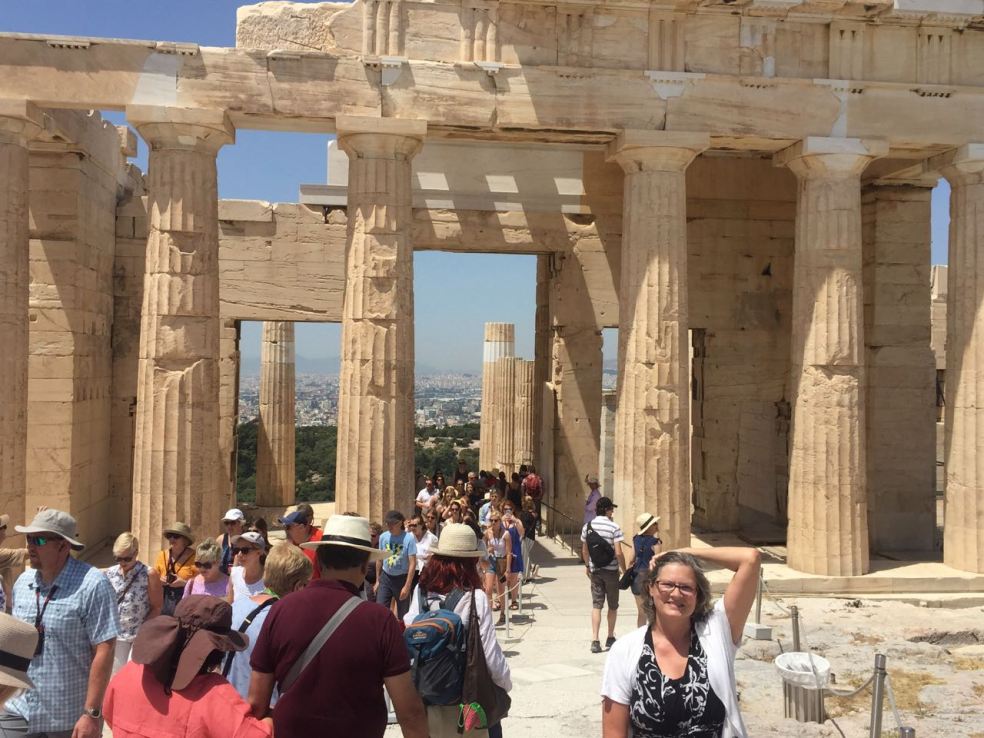 Carolyn’s obviously fearful that the columns may come tumbling down anyway.
 So we had to get another selfie in before it all collapsed.
 I think this is the Old Temple of Athena. It’s surprisingly hard to figure out what’s what even with the internet. They didn’t have a whole lot of signs about, or if they did, we neglected to take pictures of them. Oh, well, a Greek ruin by any other name…
 The guy in red was the first one to see the aliens landing.
 Until you get up there, you don’t realize how massive the stone is leading up to the Acropolis, and how they built so expertly atop it.
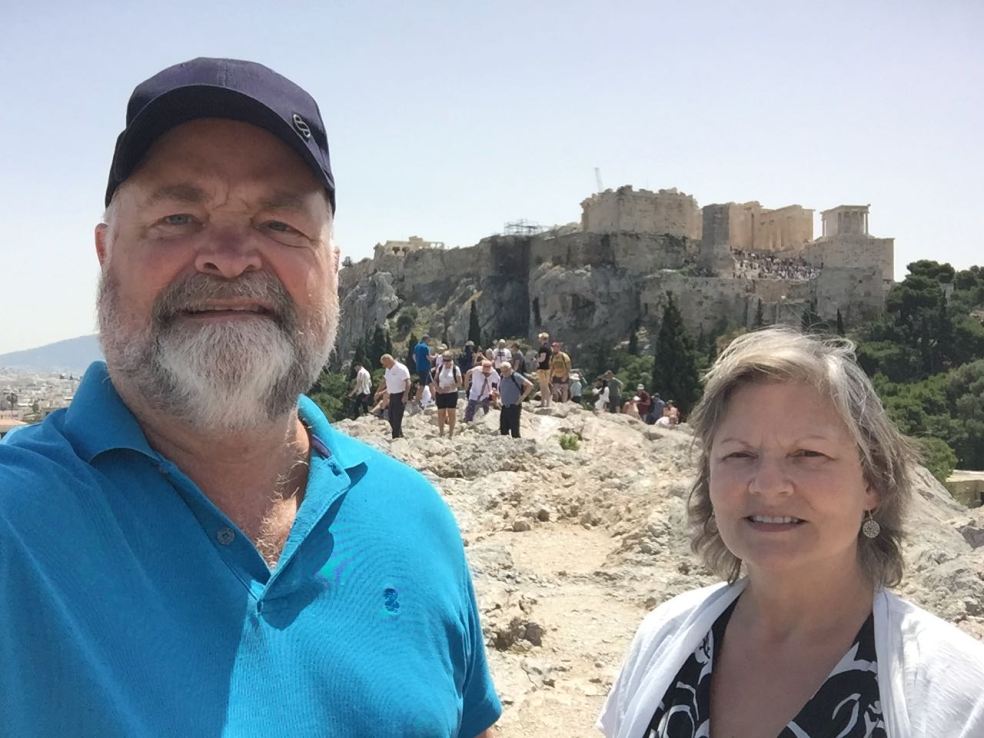 Here you can see better how it was just one big hunk-a hunk-a… um rock. Not burnin’ love. Thangyouberrymuch.
 I had forgotten that we’re already famous, so I quickly donned sunglasses to fool the paparazzi.
 A last photo… but wait! Is this why everyone is calling me a dickhead?
 After moving to Portugal, we realized that our bucket list had grown to the point where it is now better described as a bathtub list. There are just too many different places to visit in Europe! In Portuguese, we’ve learned to describe it thusly: “É um lugar muito diversificado.” Which means “It is a very diversified place.”
 After landing in Greece, we found out that Greeks have a very hard time with spelling in the English language.

 Speaking of translating, after seeing their alphabet there’s no wonder why the phrase, “It’s all Greek to me” was popularized. We’re just glad not to have to learn a new alphabet in Portugal. Although, I do have to say it’s pretty easy to see why this Greek word here is “men:” the second-to-the-last-letter is a pair of boobs. So I think the word translates literally to: “likes boobs.” I guess Greek is easier to learn than I thought!
 Our initial impressions were undoubtedly affected by our cab ride. Our driver wasn’t of Greek descent, which is neither here nor there except for three things: he didn’t speak English (and probably not Greek either), he didn’t know where our hotel was, and he had no idea how to get there even after being provided with an address and a map via my phone. He also had no other electronics in his car (which was held together with duct tape) other than the taxi meter.
 Not only was he driving like a madman, he could barely keep his eyes open! I spent the entire freeway part of the journey with my own eyes focused solely onto the rearview mirror, ready to bop him on the head if his actually closed. As it was, I would occasionally make a loud noise just to make sure he stayed awake; coughs, burps, farts, whatever it took. Carolyn thought I must’ve eaten something onerous, but I didn’t want to tell her why I was doing what I was doing so she wouldn’t freak out. Once in a while I wondered if he steered the cab so close to other cars’ bumpers while going over 140 km an hour just to keep himself awake, which freaked us both out plenty as it was.


 A typical restaurant scene with lots of outdoor tables. The area around the Acropolis had no shortage of places to eat, most of them fronted by a charmer encouraging anyone and everyone to come eat the best food in the city.

 Near our hotel the local Walmart displays its wares. Actually, it was a street filled with second-hand items. You name it, you surely could find it. Even a second hand, I’m sure.
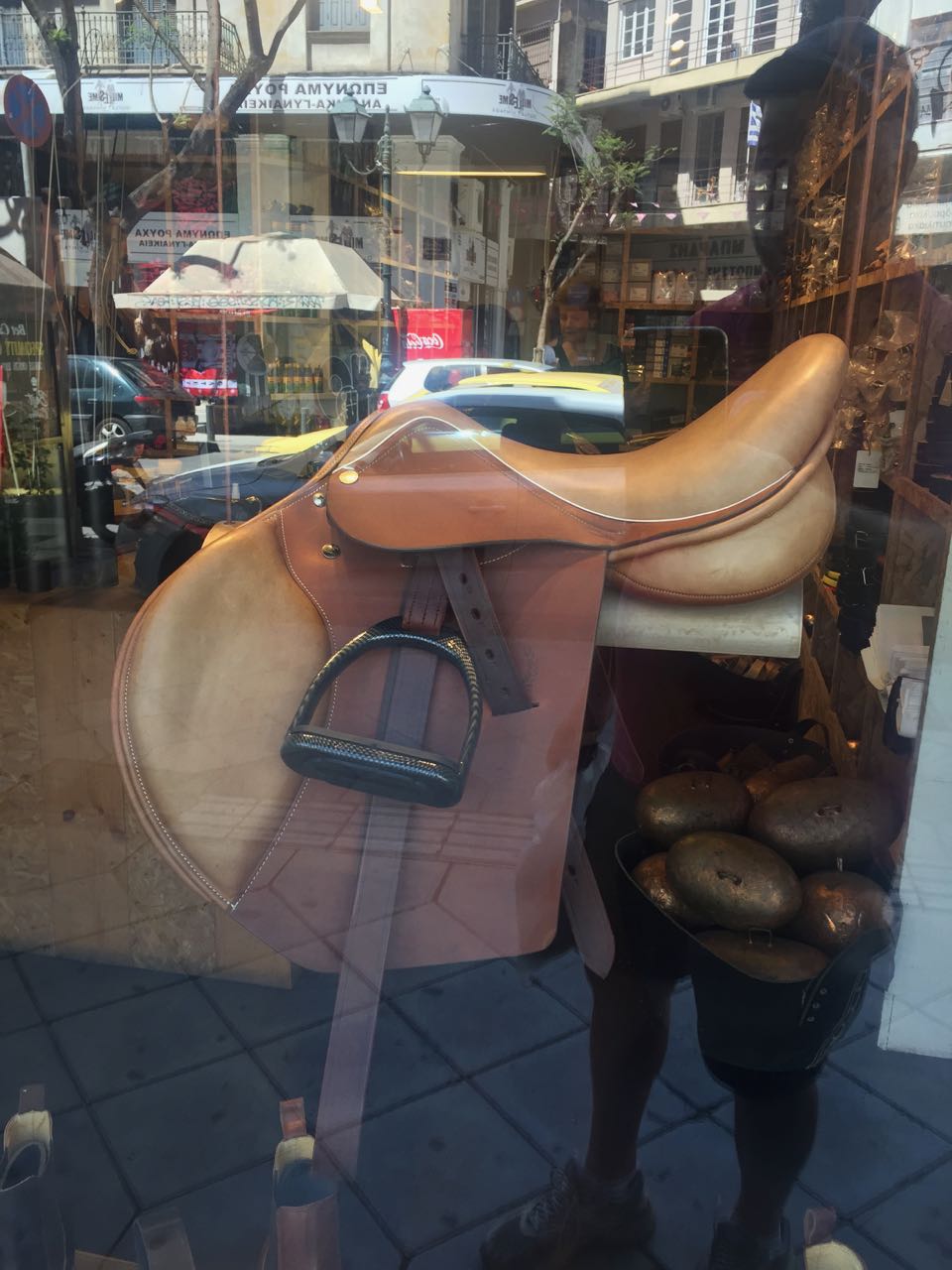 After lunch, it was time for us to get back in the saddle.
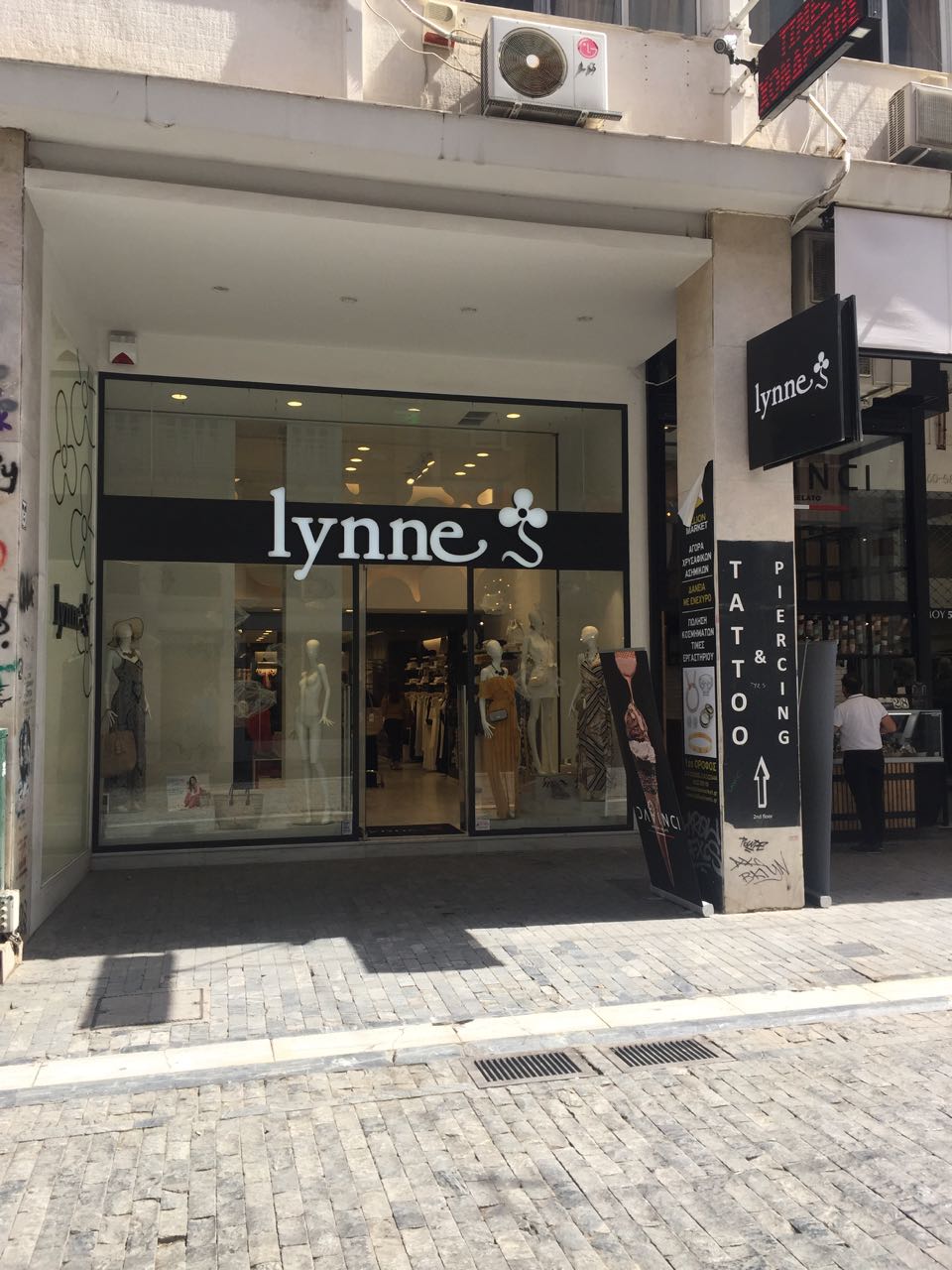 Speaking of saddles, my horse-loving sister had this store named after her. I’ll give you three guesses as to what her name is.
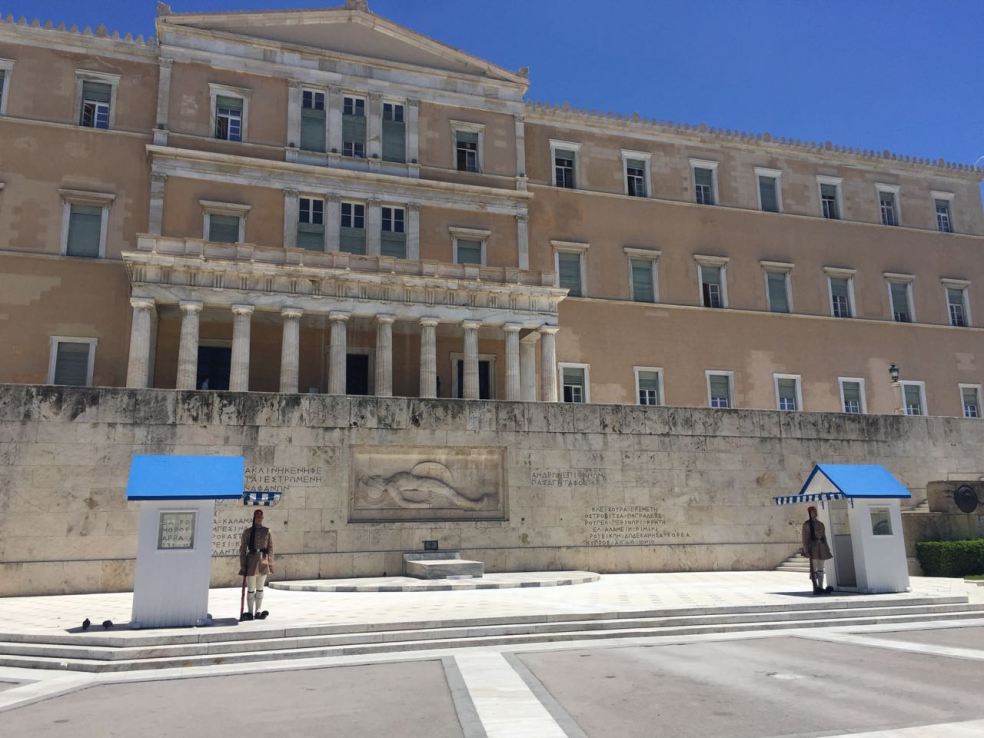 This is a government building protected by two Buckingham-Palace-esque guards. They have a rather funny routine with the changing of the guard, complete with synchronized leg kicks that wouldn’t serve them well at all in any kind of real battle, unless the enemy were turned around with their backs to them, bent over.
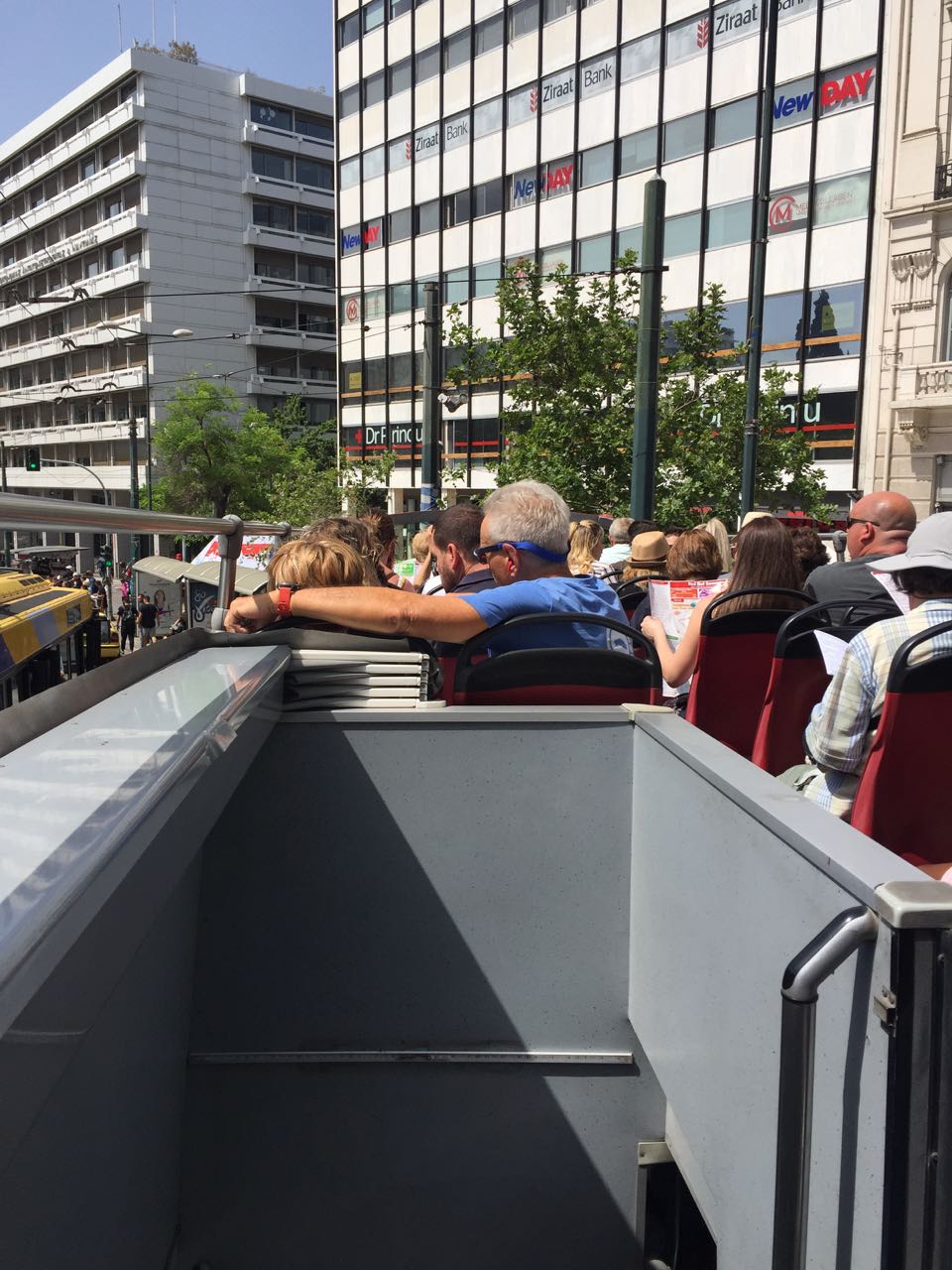 We took a Hop On-Hop Off bus just to see more of Athens than we would have on foot. It was a good way to go, except that Athens really doesn’t have that much interesting to see aside from the Acropolis and grey-haired men wearing blue shirts.
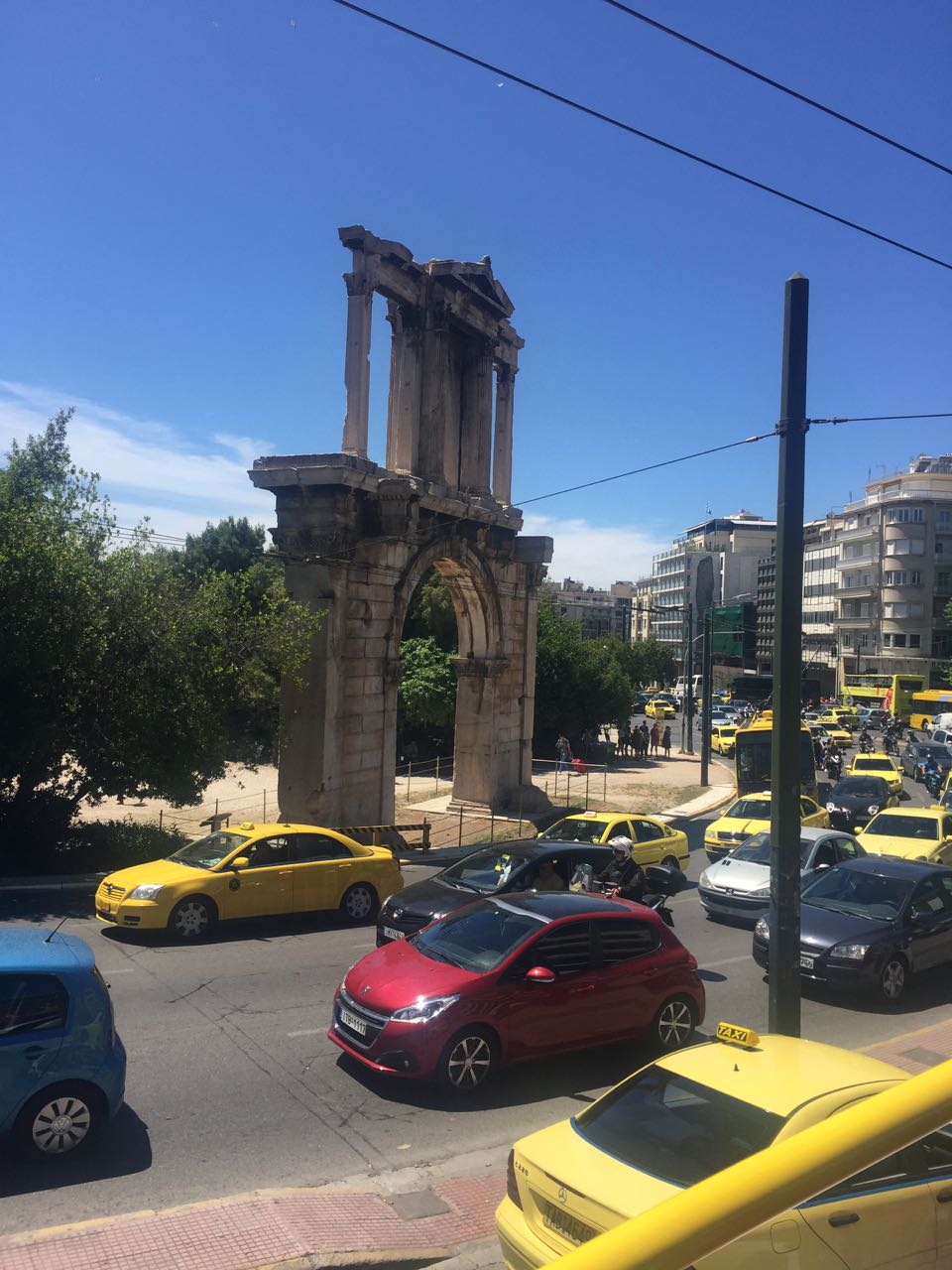 Of course there are some ruins here and there. This is Hadrian’s Arch. Built in about 131 AD, it is one of many Roman ruins scattered throughout the city.
 Speaking of ruins… don’t think for a minute Europeans aren’t very well versed on American politics. Someone captured one of the prevailing sentiments pretty well.
 This may be a response to the above, I dunno. Like most European cities, graffiti is prevalent, and sometimes, like the above, even in English. We were so grateful for this one in particular being in English because otherwise we would have never understood it and wouldn’t have known what we were supposed to be doing.
 Unfortunately, along with the graffiti there were other unsightly areas. Athens wasn’t a pigsty, but it surely doesn’t rank high on any “cleanest cities in the world” list. Which made me wonder… and yes, thanks to the internet, there is actually a cleanest cities in the world list. The top five: #1 Calgary, Canada (Woo hoo! You go Canucks!).
 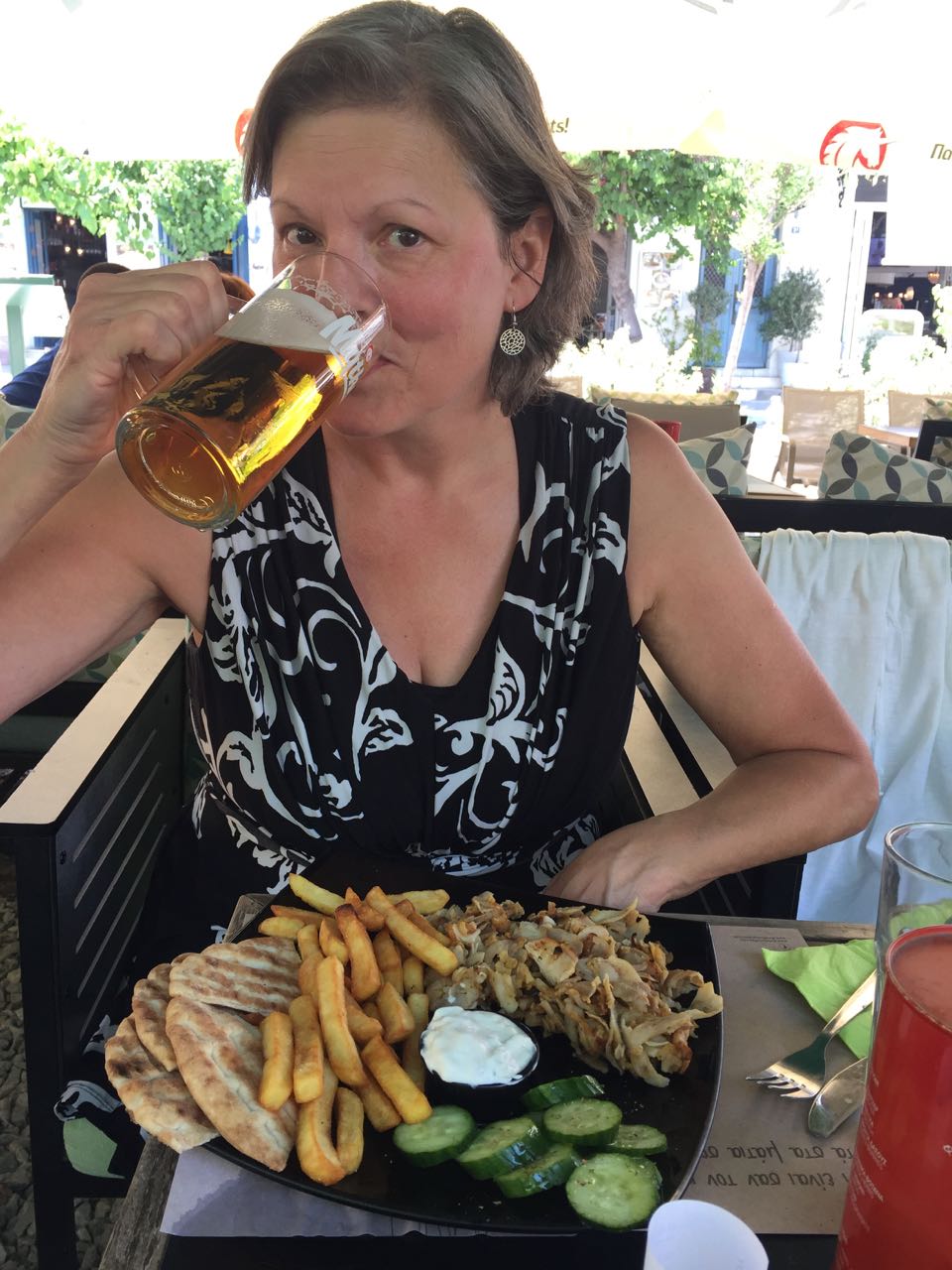 After a long day of sightseeing, there’s nothing like a cold beer to cool you down. Mythos beer was the most common we saw, and it was good! Also, the gyros in Greece are pretty much the same as the gyros you get from the fast food restaurants in the mall, so yeah, you’re eating authentic ethnic when you pass up that Taco Bell for the gyros.
 We came away from Athens thinking about two kinds of animals: cats and turtles. Wild cats were everywhere, and once in a while, usually near some ruins, you’d come across a turtle. This guy was crossing the road where he might have had to put the strength of his shell to a mighty test under the wheel of a car, so we put him back in the grass. Like most turtles, he didn’t even thank us.
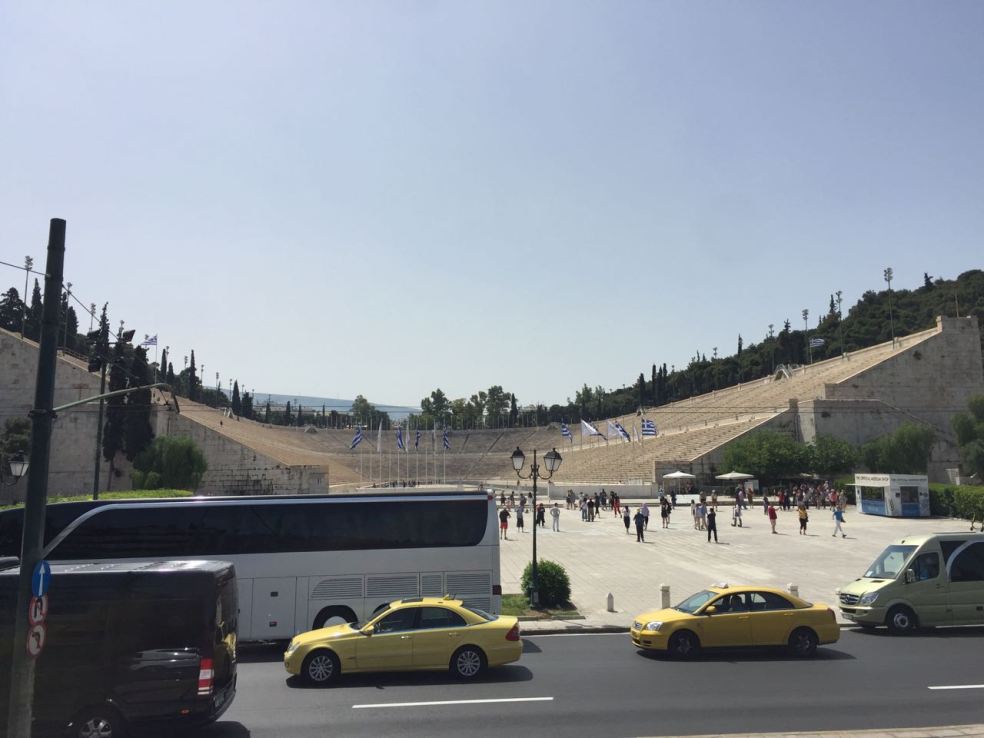 This is the Panathenaic Stadium, completed in 144 AD. It is the only stadium in the world built entirely of marble. Back then it could hold up to 50,000 spectators: a lot less if the home team had a losing season, but a lot more during the first Olympics because the athletes were all naked. Two thousand years later, all we have close to that is beach volleyball and Speedos.
 The world’s first running statue. We caught this freeze frame as he was bursting through the park on his way across the street.
 Fresh fruit and produce are often artfully displayed, although I’d hate to be the one picking a cherry from the bottom, sending them tumbling in a veritable cherries jubilee.
 This Aphrodite is artfully displayed as well. Plus she’s 50% off. What a bargain!
 And so Aphrodite made it to the street next to the second hand stores, where she found a row of third and fourth hand stores. By the time it gets to fifth hand, we think it gets put into the small stairwells.
 I have no idea what this sign says, but since they have a picture of Bogie and Bacall, it must be a classy joint.
 I think the middle store is selling vitamins based on the sign, but with all the ladders it could also be a hardware store. Either way, it’s probably a good place to get some iron supplements.
 Next up: the Acropolis.
 One of the great things about living abroad is the opportunity it gives one to meet and make friends with people all over the world.
 We recently joined a group called the “Sesimbra International Community,” which is simply a collection of people living in our area who are originally from outside Portugal. The only other commonality is that everyone speaks English (and most of them Portuguese, along with at least one, two, or three or more other languages). Recently, we got together for a potluck. To represent typical American fare, Carolyn made a casserole, and I made a cherry pie. Yes, we could have been as American as apple pie, but cherries are in season, Besides, I like cherry pie better, and aside from the pitting, it’s easier to make. And neither George Washington or I had to chop down a cherry tree to do it.
 We were delighted to find the following nationalities represented (and I hope I didn’t miss anyone): Italian, Mexican, French, Portuguese, British, Australian, and Slovenian.
 Everyone enjoyed the lunch and all the conversation. We were the only two Americans there, which made it that much more delightful for us, even if I sometimes have to strain through the accents. I’ve never been very good at understanding accents, but I think it’s improving, if for no other reason that almost everyone we speak to has one sort or another.
 Like in so many social interactions in the U.S. today, politics tends to come up in most conversations. What I almost always hear is that everyone is pretty puzzled by what’s going on there today, especially because America has long been a country well regarded by most Europeans.


 Chapter seven of seven. Hoo boy! Writing the blog about our trip may have taken me longer than the trip itself!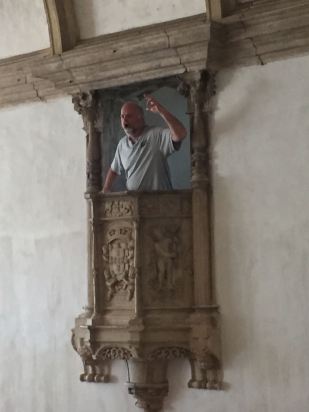
 In fact, legend has it that the song made famous in the movie Annie was first written here to make the people who couldn’t be squeezed in feel hopeful that there might be room the next day: “The sun will come out, Tomar-oh, bet your bottom escudo that in Tomar-oh, it’ll be fun! Tomar-oh, Tomar-oh! I love ya Tomar-oh! You’re only a day away!”
 I so wanted to show all of our individual pictures and make corny jokes or pithy comments on all of them, but there’s too damn many photos for that. I think Tomar set a personal record for us in terms of photos taken; we were there for quite a while. Of course, I had to share a few separately because they’re just too ripe for the pickin’. For instance in the above I’m sitting right next to a kitchen and I’m pretty sure those holes had something to do with cooking, but it sure doesn’t look like it. It reminded us of the public toilets in the Roman Colosseum and a story of sponges we have since tried very hard to forget. Still, based on looks alone, the phrase, “this food tastes like shit!” can’t help but come to mind.
 This is just to give you a sample of the many glorious pictures you’ll see if you have the time to watch the slide show. We were quite impressed with the entire shebang.
 And so without further ado, I present the slide show of photos. Wait, where is everyone?


 Here are some panoramic shots from atop the mountain. The temperature was almost exactly 32 degrees, or in the much more sensible measurement of celsius: zero. It was easily the coldest we’ve been since we’ve been to Portugal, except for that time I got locked in a walk-in freezer after thinking it was the men’s room.
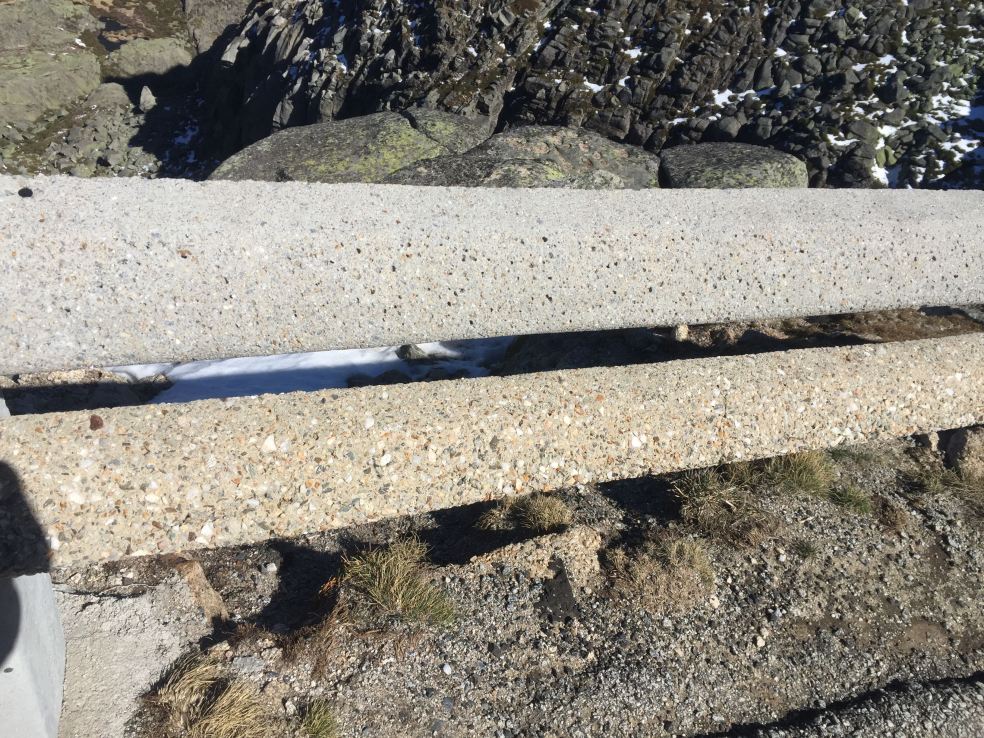 We drove up one side of the mountain and down another, and both were slightly harrowing, made all the more so after we noticed many of the guard rails were made of stone. I’m not sure I’d trust the stone not to break in a thousand little pieces if rammed with any amount of force, meaning we’d break into yet another thousand pieces when we hit the ground two million meters below.
 But as you can see, we made it safe, sound, and chilly.
 road led by this massive wall, the other side of which was crawling with crazed zombie Mexicans just like in World War Z. Oh wait, those weren’t Mexicans, those were Spaniards! Good thing Portugal already built a huge wall! Actually, it is the non-water side of a dam. At least we hoped it would stay non-watery.
 At the top, they have about five different stores, each offering various cold weather gear, cheeses and meats. Because nothing says “keeping warm” like cheese and meat.
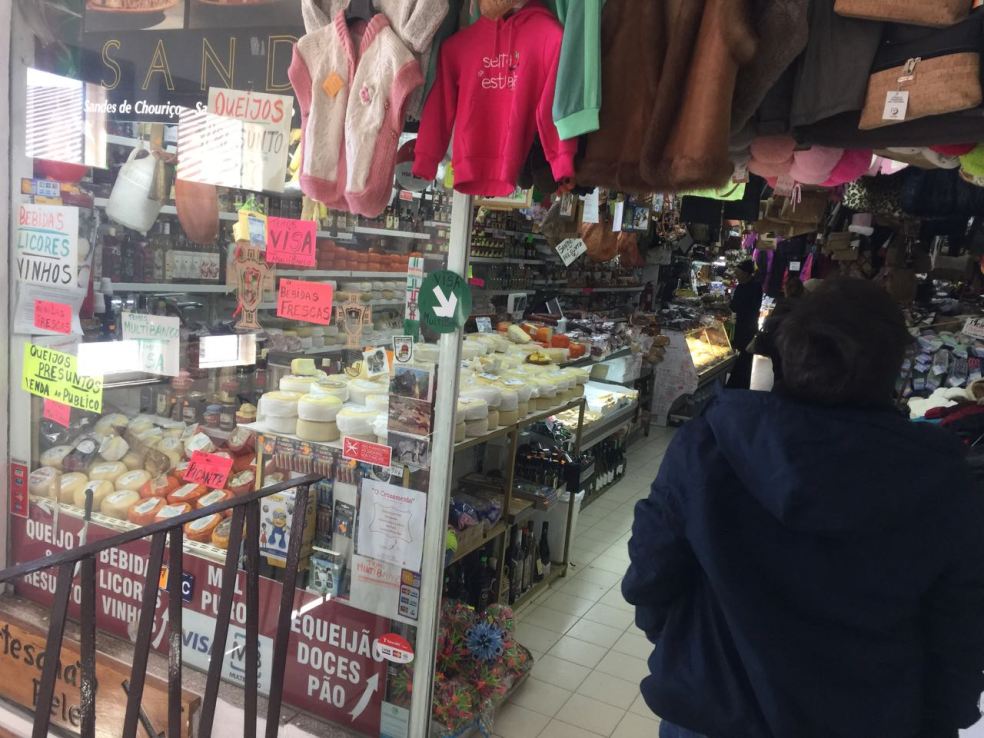 The funny thing was, each of them offered almost exactly the same thing, even though some of them were side-by-side and even shared the same entrance.
 They each had display cases filled with aromatic cheese and meats, always with a friendly offer of some samples, and each of them had snow gear and souvenirs, apparently all purchased from the same very talented distributor salesperson.
 It was like being in a strip mall with five 7-11’s in a row.
 On the plus side, you could try on a hat exactly like this in five different stores!
 During our explorations, we took a small detour on a road with no idea as to where it led. It ended up being a pretty hairy drive, with drops off the side that would’ve turned our VW Polo, Marco, into a pancake… covered with raspberry syrup from our bodies, if you know what I mean. But we survived, with the added bonus of confirming that the sweat glands in our hands work just fine, thank you.
 As you surely must know by now because of all the Portuguese lessons you’re taking in preparation for your visit to us in Portugal, “Manteiga” means “butter.”
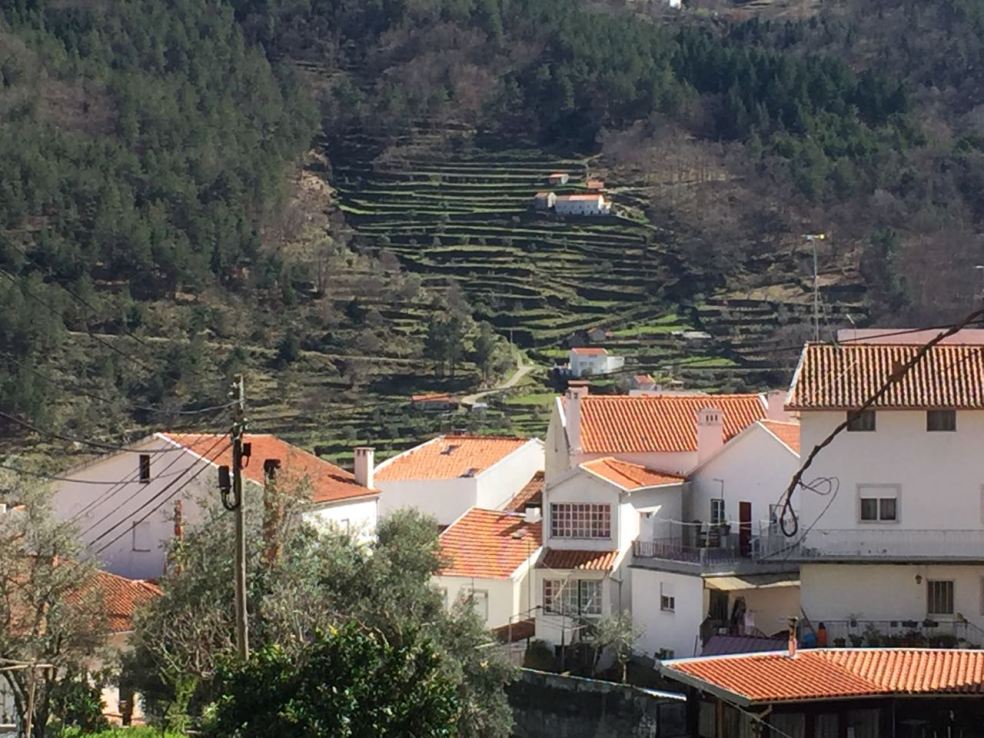 Accordingly, I assume those are terraces are where they grow buttercups. Because buttercups are what they make butter out of, right? Carolyn says “no way.” I say “whey.” She says, “I curd of told you that.” I say, “Tit for tat!”
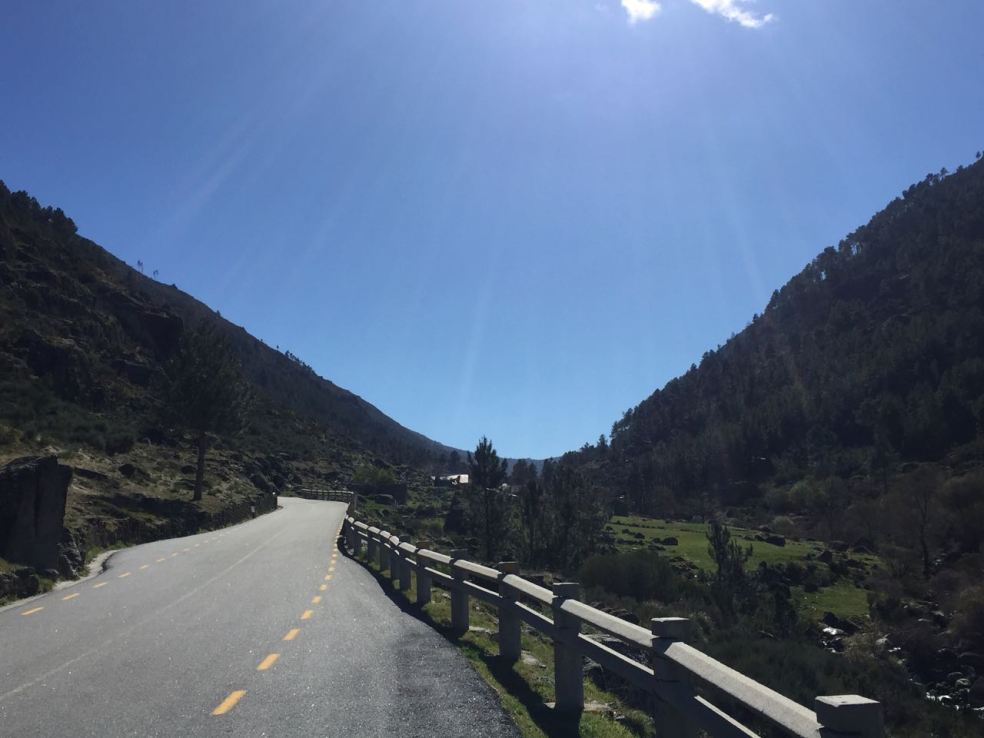 You don’t want to have butterfingers when you’re driving on the roads leading to the town. You’d turn into butter squash pretty quickly.
 I think this is a butter stream where they churn all the butter, kind of like Willy Wonka did with his chocolate rivers. Or maybe they were churning margarine, it was hard to tell because at that point in its production butter is clear, as we all know.
 Despite the fact that butter can be a little fattening, it was a charming village. We had some pizza there, because everyone knows when you go into a Portuguese town named “Butters” you have to have pizza. The crust was, of course, buttery. We were going to have pepperoni, but we decided on da udder one.
 A picturesque view of a butter farm. You can tell by all the buttercups and milkweed.
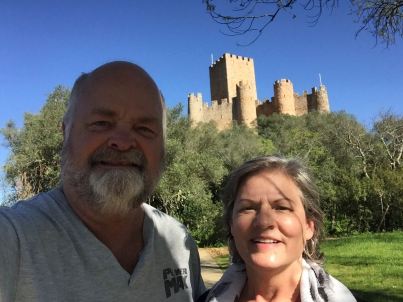 Ha ha! It’s not really part thirteen, it just feels like it.
 Unfortunately, it wasn’t quite as cool as the pictures make it look. But I guess you could say that about most models and movie stars too.
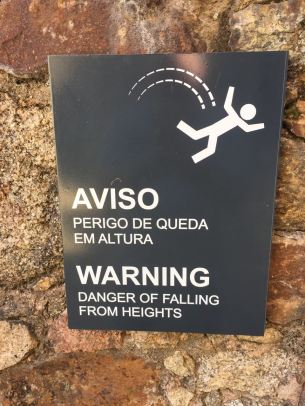 But, intrepid explorer that I am, when I saw this bilingual sign (which means I could completely understand it despite the lack of French), I had to have some fun with it.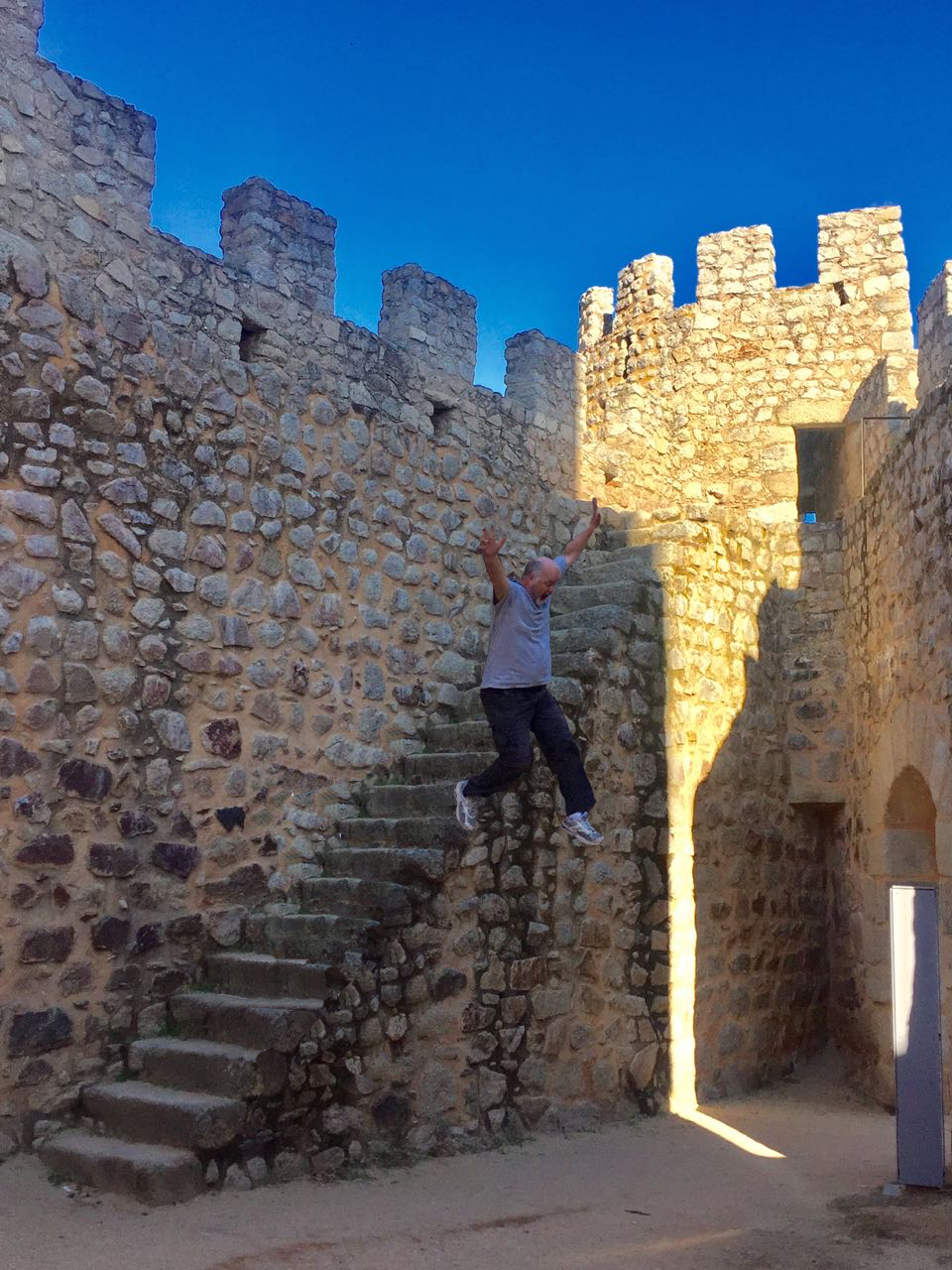


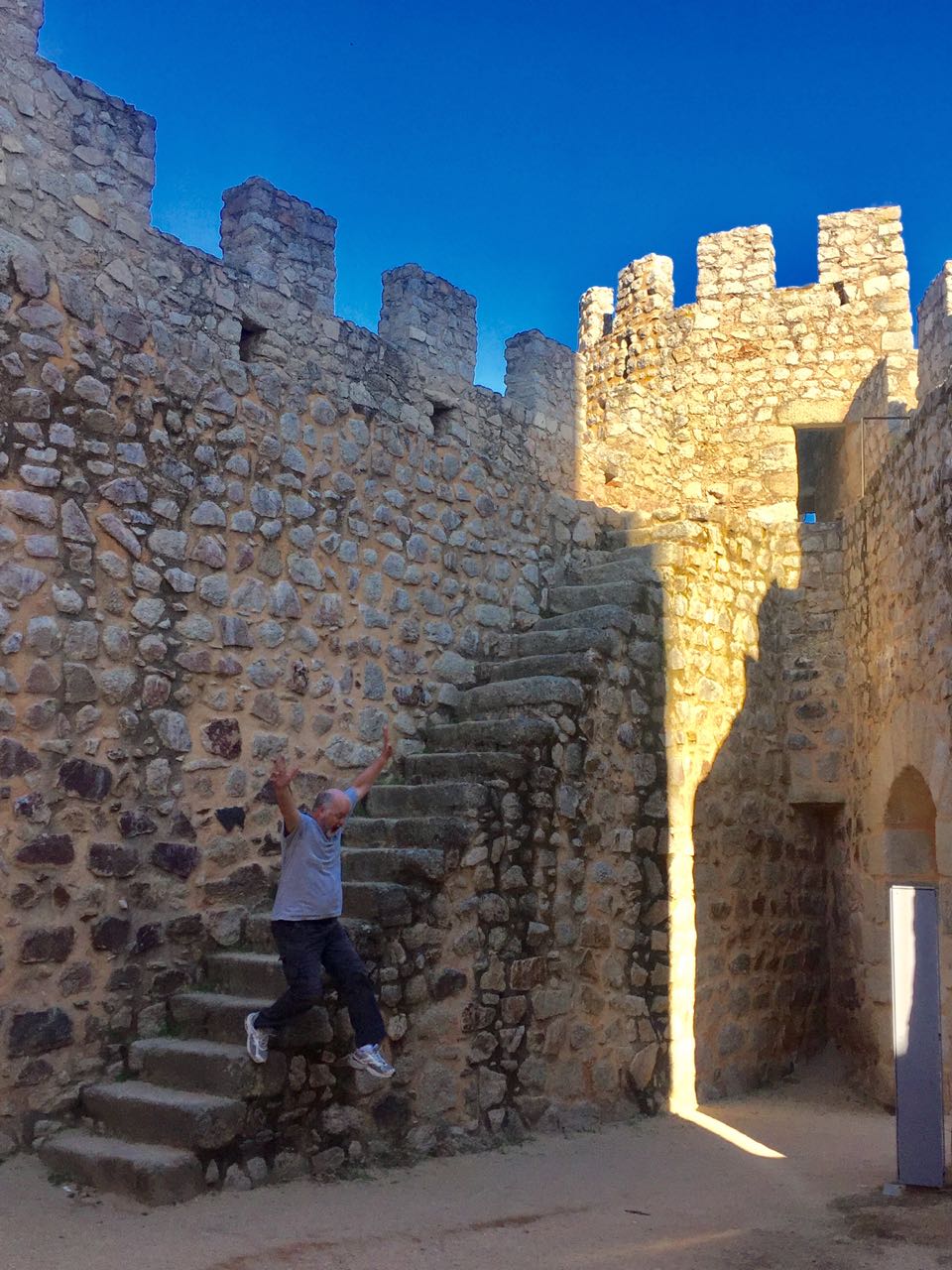 This is the un-Photoshopped version that caused my gruesome injuries, as well as the destruction of my favorite pants.
 So the first thing you gotta do before you go to the castle is pass inspection by these fearsome army men. Actually, they’re the aforementioned soldiers who are still attacking visitors. Okay, best one out of three: there’s an army base not far from the castle and they were there to escort some dignitaries (besides Carolyn) to the castle for sightseeing. They were kind enough to pose for a picture in exchange for not shooting me.
 You have to walk the plank to a large cruise ship which takes you to the castle for a few euros.
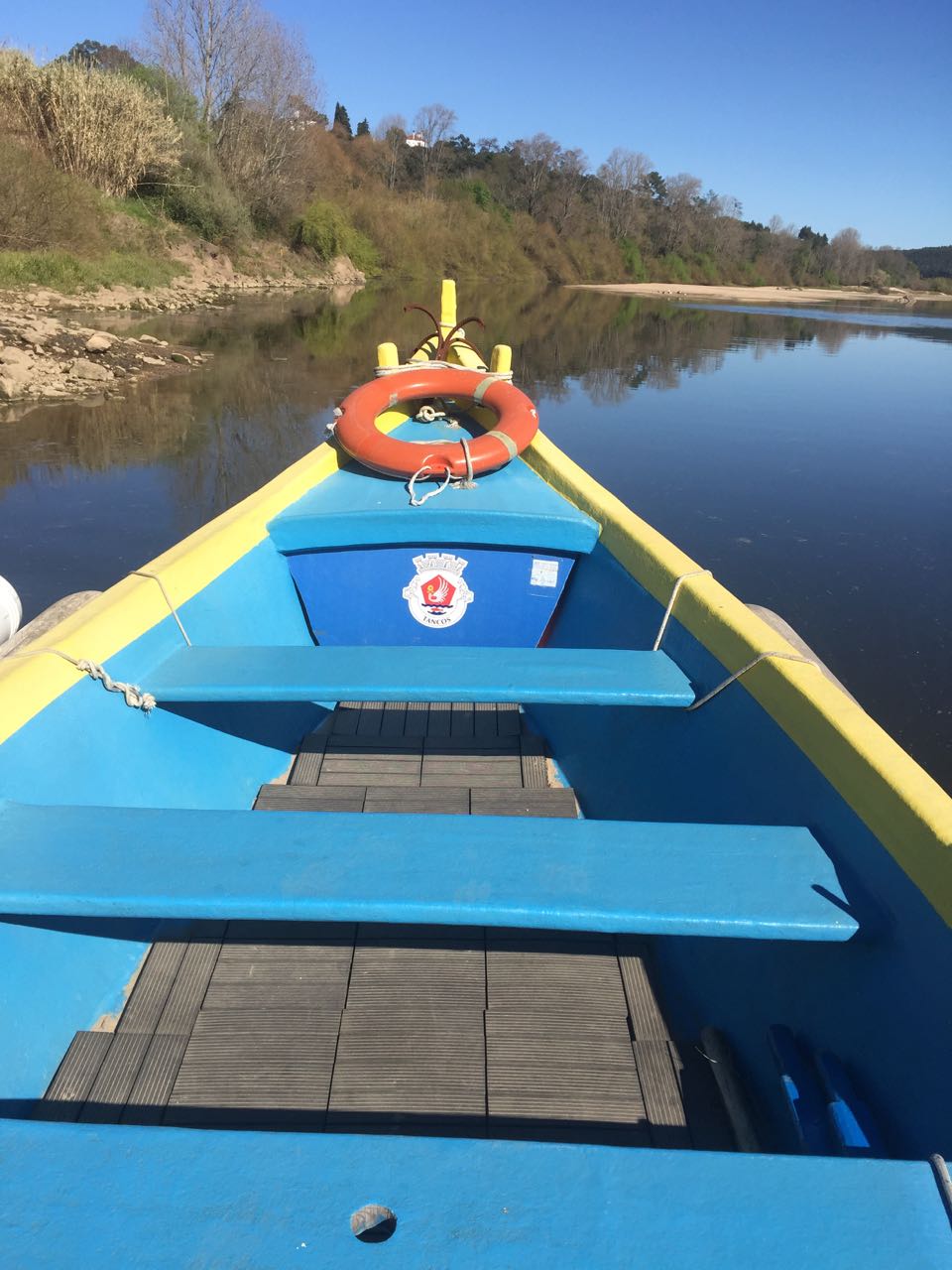 This is the bow of the ship. There wasn’t enough room to do the “Titanic” scene, unfortunately. Our hearts will still go on.
 This is the cheerful and garrulous Captain of the ship. Just kidding. He was none of those things. But he was quite adept at steering a small boat for a couple hundred meters.
 Once you land, they like to see if you’ll take these steps to nowhere, and if you do, everyone laughs hysterically.
 If you take the correct path, you get to walk under a bridge of cactus. My speculation is they might have once served as a eco-friendly defensive tactic way back when, which means those cacti probably weren’t there in 1129 when it was conquered by Portuguese forces. Indeed, none of the historical writings mention any kind of massive sticker shock.
 Once in the castle, you can look down and see where the boat docks, as well as our trusty Marco the Polo. Not sure if you can tell which one it is in that sea of cars, but it’s the dark one.
 But here’s what I found interesting. They take you in a boat to the castle, but this is the size of the river channel you would otherwise need to cross to get there.
 And here’s how wide it is right next to the castle.
 In fact, here’s a little crossing you could take without even getting wet! All they have to do is build a walkable path beyond and voila! No more boat needed! I’m guessing they keep the boat because it’s sort of a nice story that you have to take a boat to the castle.
 But that means when you’re all done with your visit you have to wait at the dock for the boat to return. He gave us about twenty minutes to look through the castle. We got back to the dock in nineteen. Despite that, he was already on his way back to the original dock when we got there, so we had to wait some more. Oh, well, we’re retired. We can wait. I decided not to even give him a dirty look when we returned because I didn’t want to be dragged out to the middle of the river and keelhauled.


 This is one of the main drags. Not the guy in the picture, he never poses in drag. Publicly anyway.
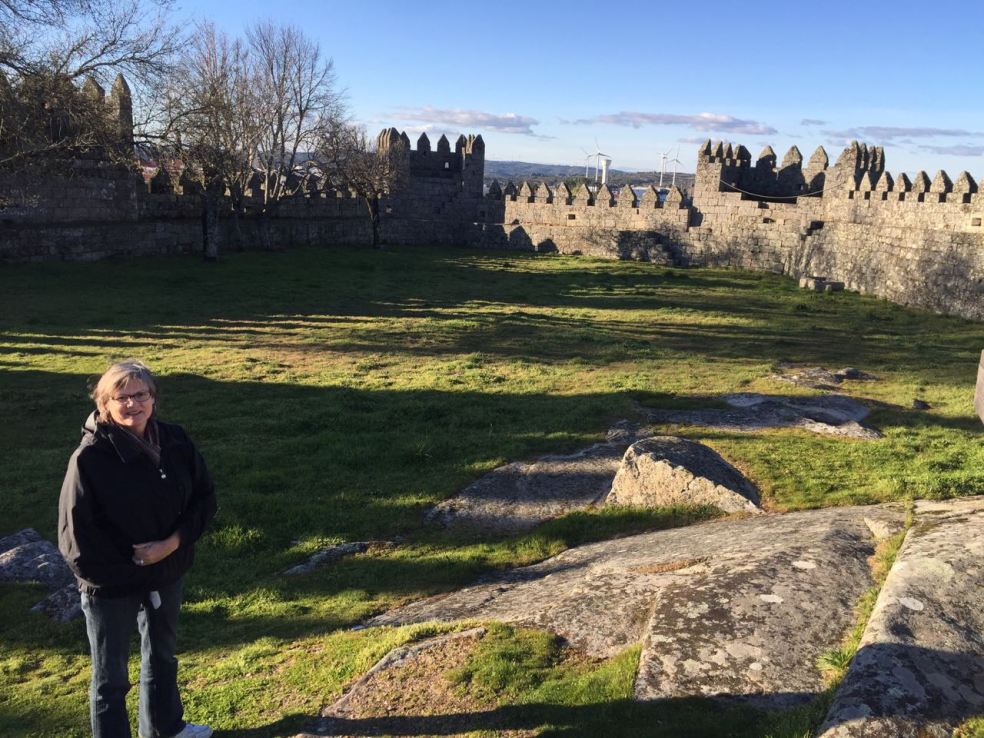 The castle was mostly grass and walls. In the old days, that area would have been filled with wooden structures and smelly people. Now there’s only one. Wooden structure, I mean.
 One of the reasons we love castles is because they’re almost always built on top of hills, where we can gaze over the landscape and be on the lookout for invading Mexicans. Oh, wait, that’s only in the U.S.
 You’re always on your own when it comes to safety. You have to pay extra for guard rails, except you can’t pay anyone, and there are no portable guard rails. Just be sure to wear New Balance shoes.
 Most days we figured out where we were going to go the same morning, sometimes only after fighting over the phone and its map as we drove away from the hotel property while dodging pedestrians and going through roundabouts the wrong way.
 I mean, who wouldn’t want to come home to that?
 Or this?
 But, in the meantime, you can still see vistas like this until the internet is replaced by something else.
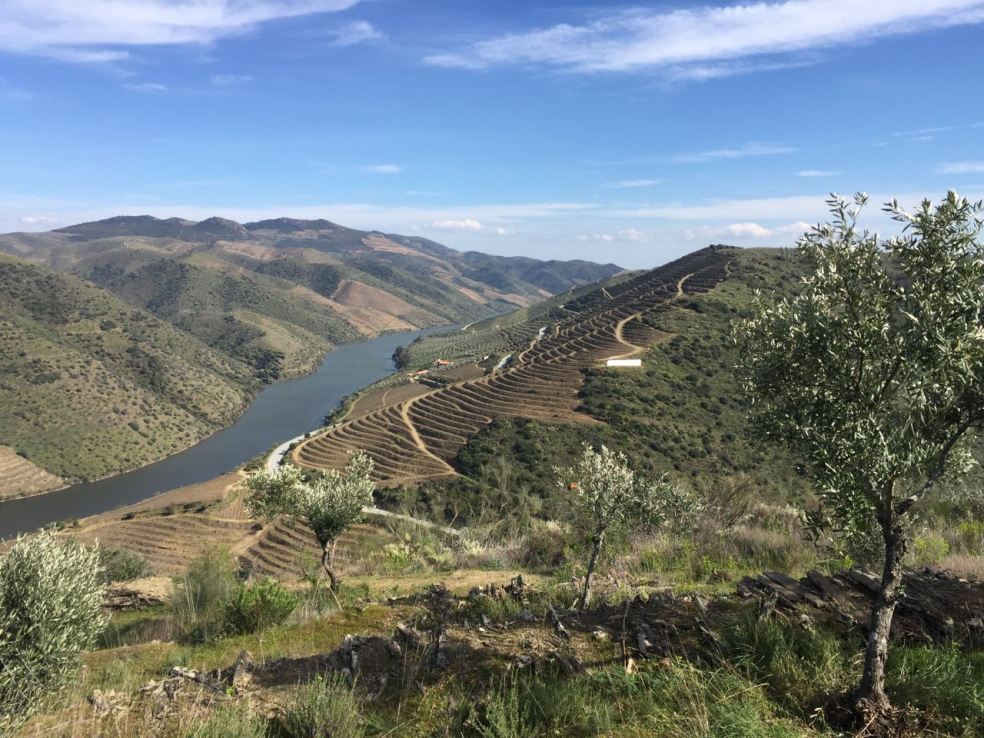 The prehistoric art in Côa Valley was discovered when they were building a dam. The whole project stopped so they could investigate the priceless art.
 Which also means we still get to gaze at the beauty of the valley.
 These are artifacts from 24,000 and 30,000 years ago. BP means “Before Present, ” and is a time scale used in archaeology. Since of course the “present” time changes (unless you’re dead, in which case you really don’t care much about any of this), the present in “BP” is generally assumed to be January 1st, 1950. That’s also the month that U.S. President Harry S. Truman ordered the development of the hydrogen bomb, which may or may not be a coincidence. It may also mean that in the future, “BP” will mean “Before Pulverization.”
 In any case, this is what little Johnny Caveman doodled while his teacher was droning on about how to kill antelopes or drag girls by their hair some such. Little did he know he’d be famous 20,000 years later.
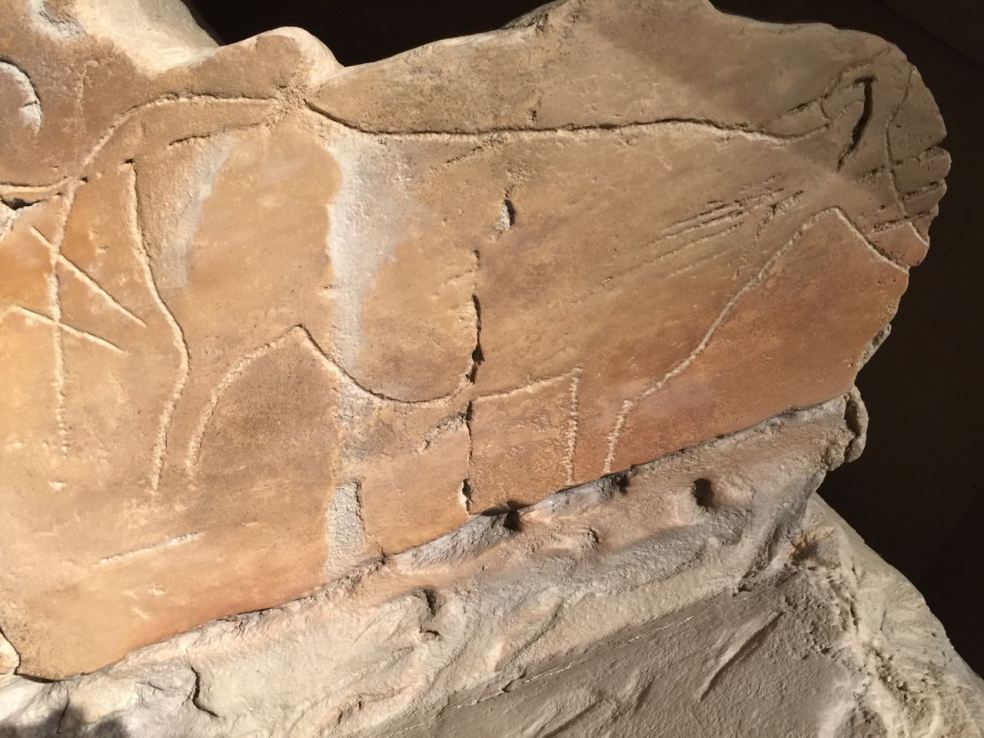 Johnny Caveman’s sister apparently tried to one-up him by drawing a picture of their pet ox. I think she has it farting.
 There was a large and modern museum where we learned all sorts of stuff about what these drawings probably meant, and how they cleverly depicted movement and things like that. Since we arrived late because, as usual, we had no plan or idea as to what we were doing, we didn’t get to take a tour down into the valley to see the actual drawings. So after we left I stopped off the side of the road and etched my own drawings into some rocks, giggling all the while at how confused archeologists will be 1,000 years from now since of course we will never otherwise find ancient cave art of a dinosaur.
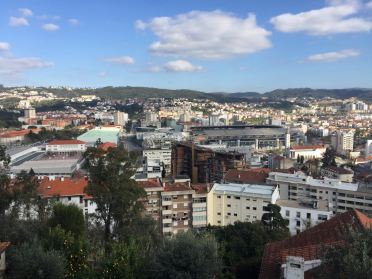 Coimbra is a university town in the middle of Portugal that deserves its own entry in this blog, even though we only spent part of one day there.


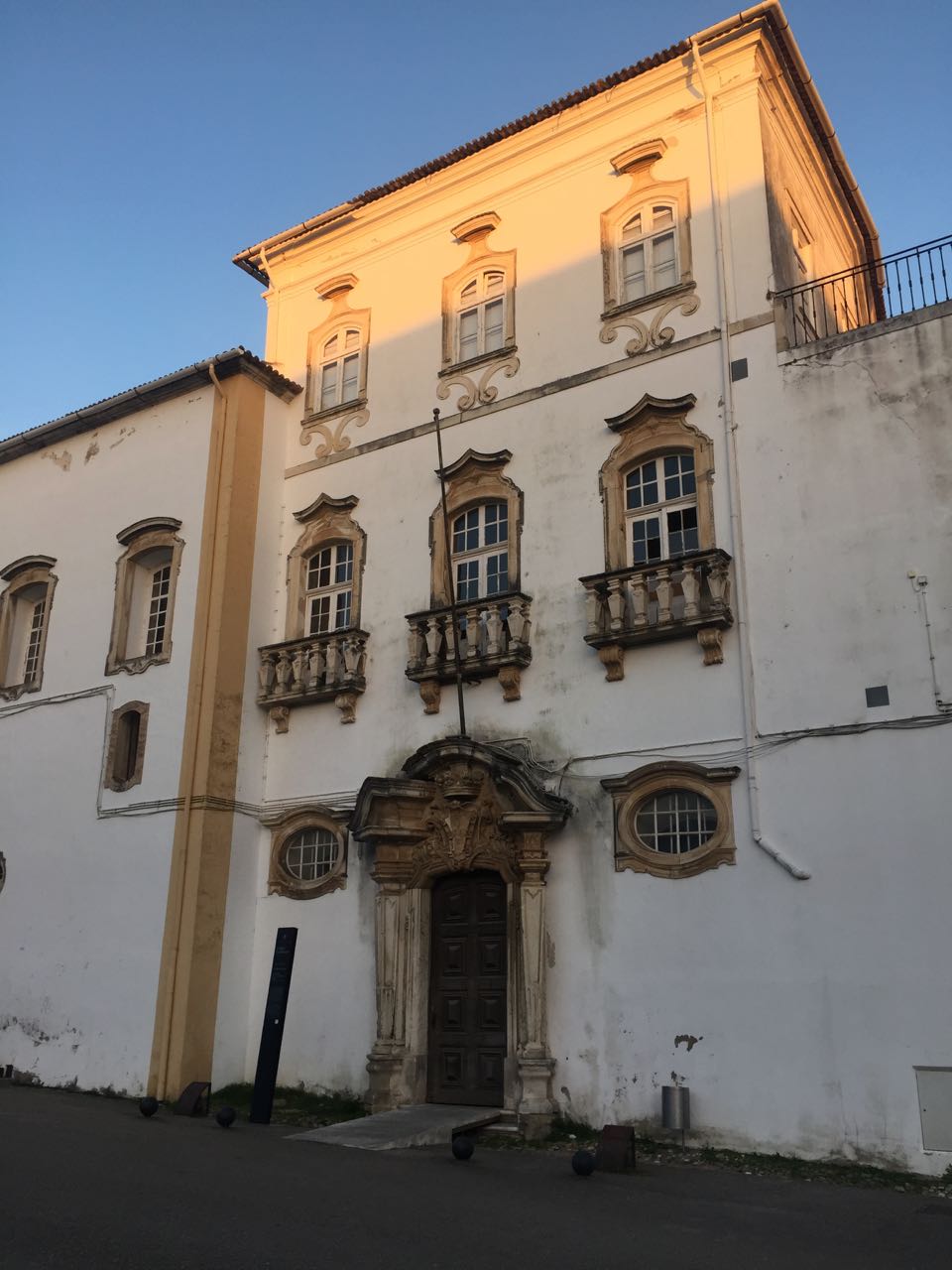
 This is a panoramic shot of the main square in the university. The buildings here offer three very interesting tours of some cool historical stuff, as you’ll see below.
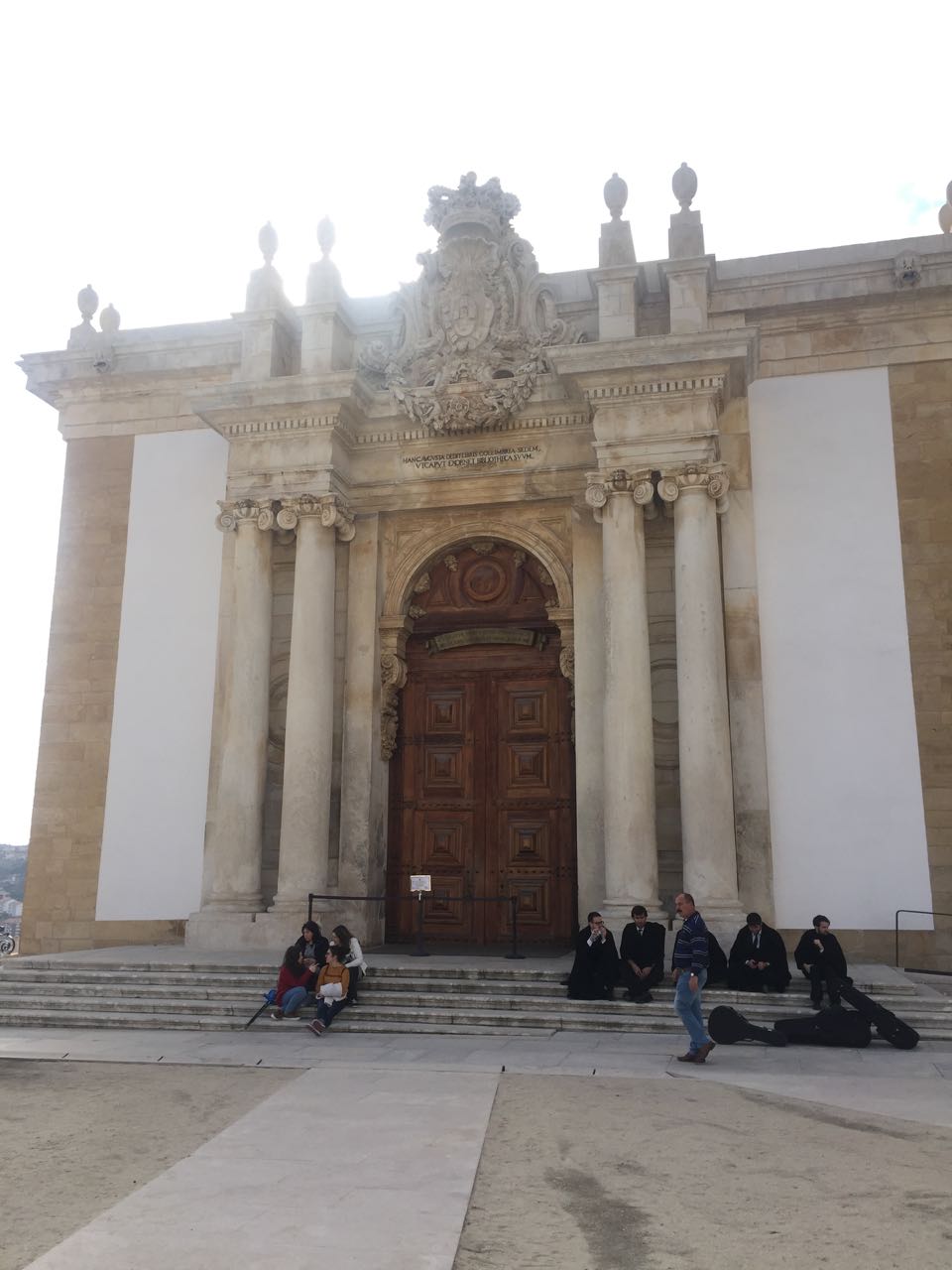 This is the front entrance (used as an exit) of an amazingly decorated old library, which you’ll see the inside of below. Note the smartly dressed cape-and-tie students.
 This is a church on the University grounds. You walk past it to get to the science museum, the inside of which you’ll see below.
 This is a statue of King Jo
 We’re not from New Jersey and we speak a little Portuguese, so we don’t call him King Johnny da Turd. We call him King Jo
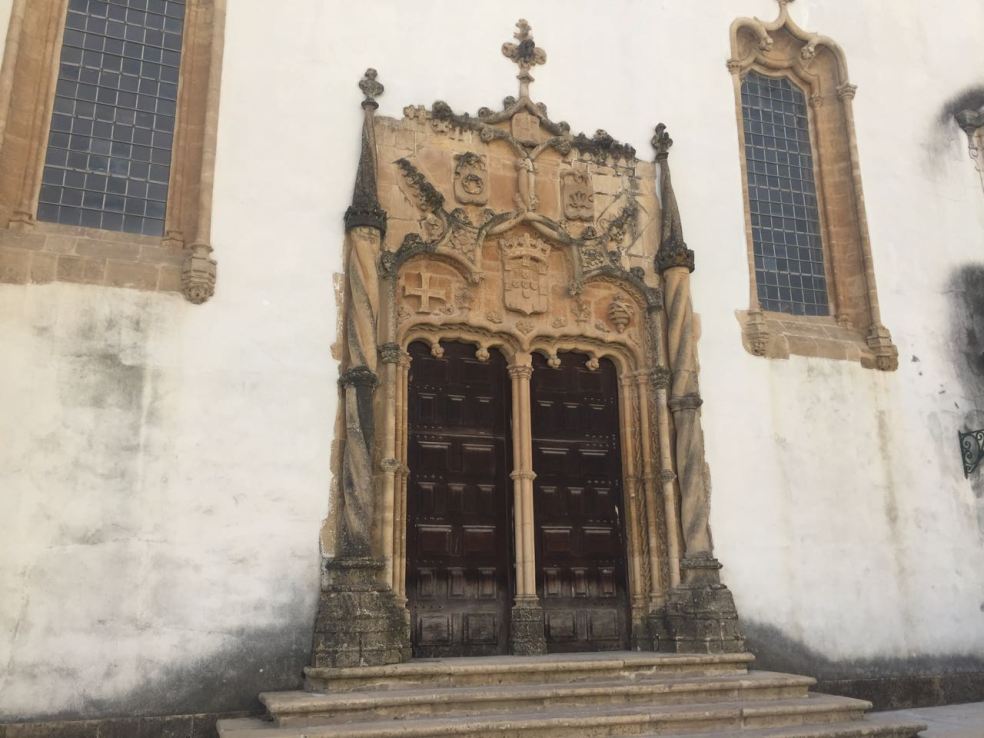 We’ll call this the Door of the Day since I can’t remember where it was exactly. Looks a little holy-ish though.
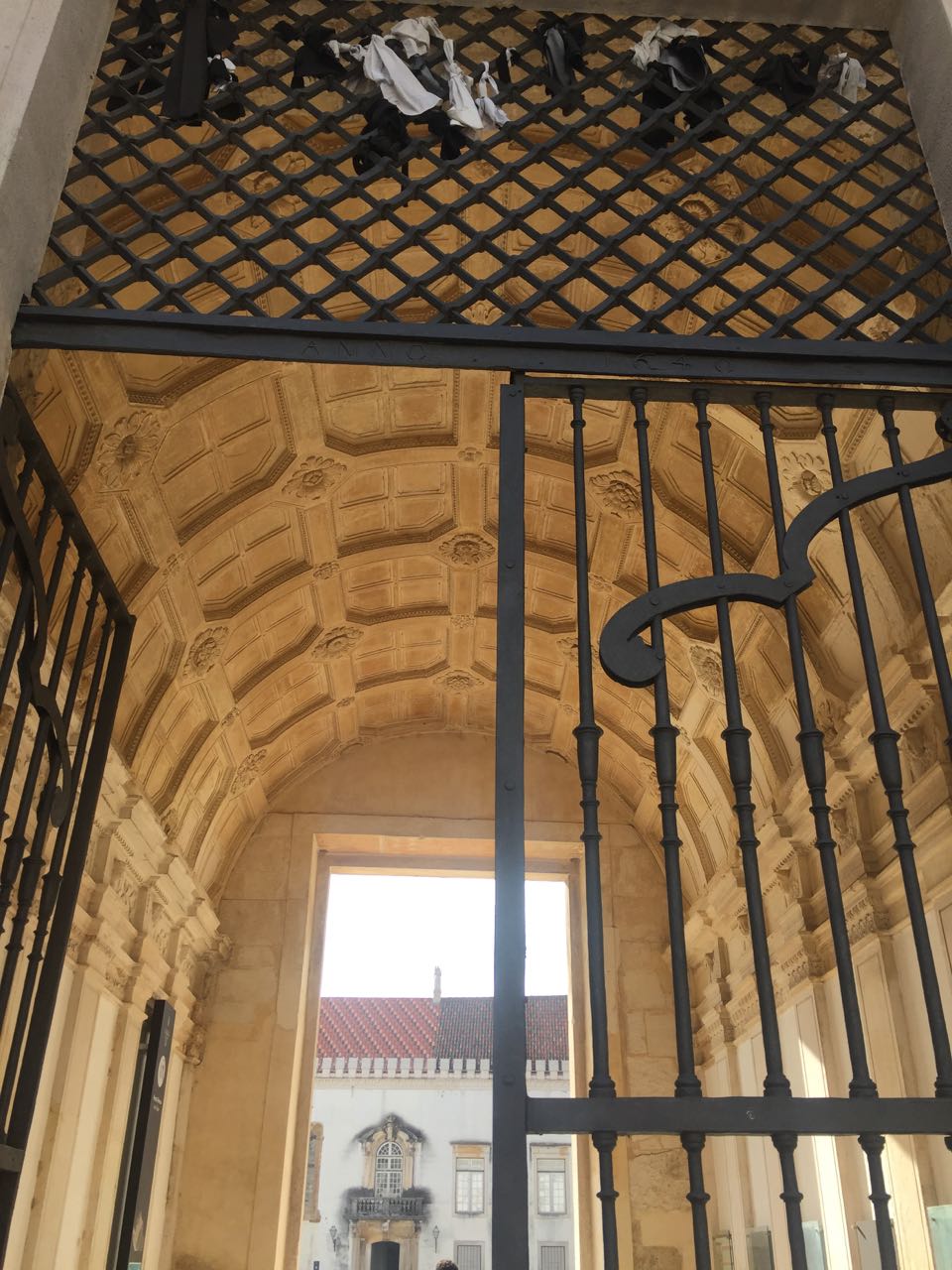 You walk through this to get into the historical inner square of the University. I’m guessing the clothing at the top is the result of college dares, hazing, or perhaps it’s actually the underwear of the workers who were installing the grate but kept falling off, except for their underwear which tended to get snagged on the grate. Then no one wanted to move any of it because, you know, it’s men’s underwear, which should never be touched by anyone but the owner, their wives, or their mothers, and even then only with a lot of mental griping as to why men are so stinky.
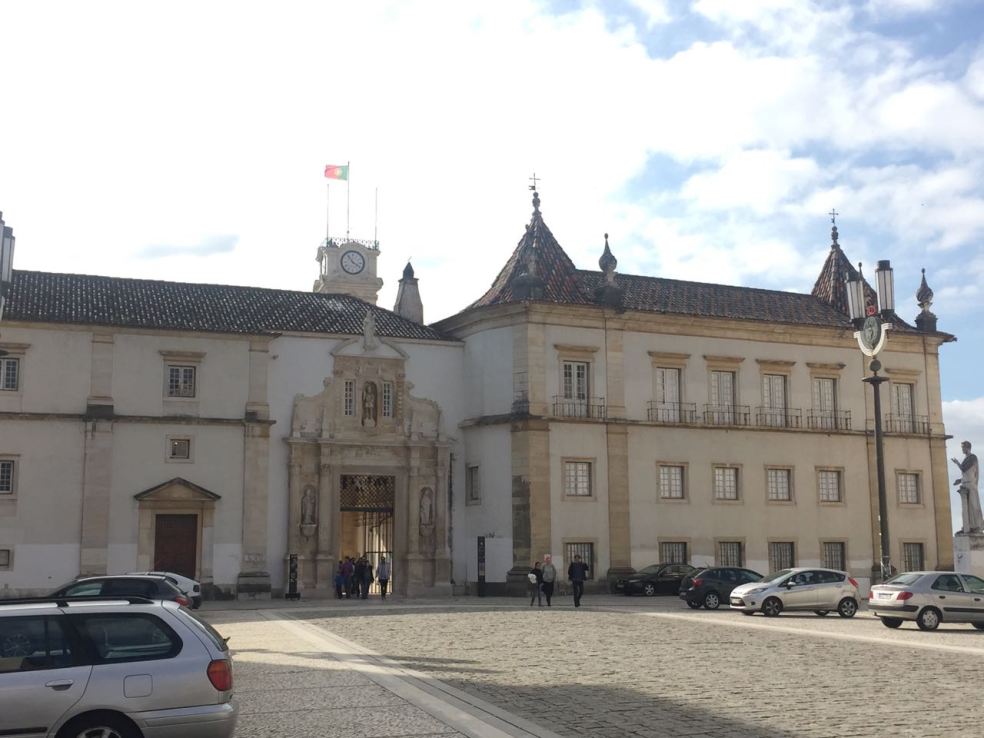 That’s where the door is from the previous photo in case you were thinking I made all that up.
 You can walk down these stairs to go into the library, unless you have no legs, then you have to roll.
 This is the central square. It was all once a royal palace. In fact, the first one in Portugal.
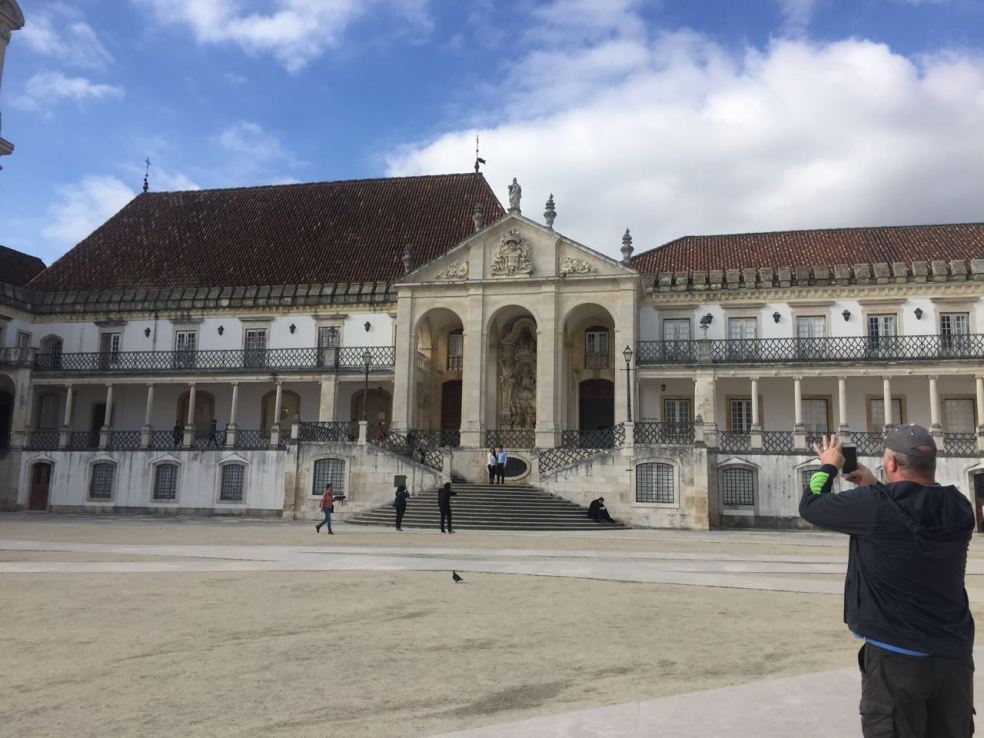 This is the Via Latina, erected in the 18th century. My high school Spanish would translate that as “The Road of a Latin Woman” (even though “via” is more of an Italian word), but I’m guessing that’s not what it really means, especially since we’re not in Spain or Italy… or Kansas.
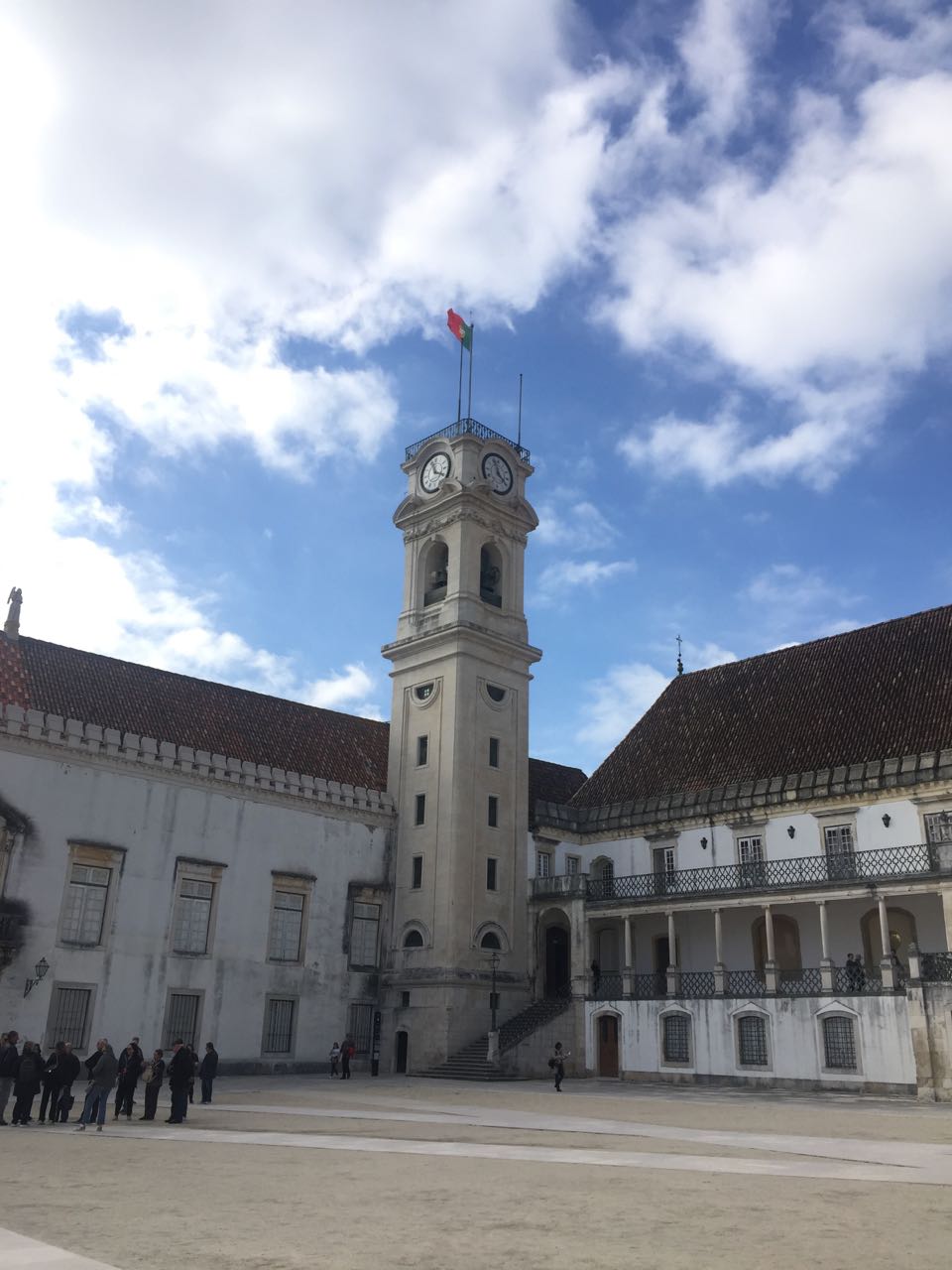 This is simply called “The Tower.” And of course they would have built a phallic building right next to a Via Latina. Anyway, it was built in the early 1700s, and has bells that still chime plus a staircase all the way to the top. We didn’t bother going up because we’ve walked up plenty of ancient spiral staircases over the last few years, and we’re two years older than we were two years ago, as you probably are as well.
 This is a picture of a red car. An old building just happens to be behind it. In all seriousness, red cars are a little bit of an exception in Portugal. It’s something I noticed when we first got here: almost all the cars are either grey, silver, white, or black. Dunno why.
 A view from the square, overlooking the Mondego River, which is the longest river located exclusively in Portuguese territory. It begins its journey from the Serra da Estrela mountains, which we visited and you can read about later.
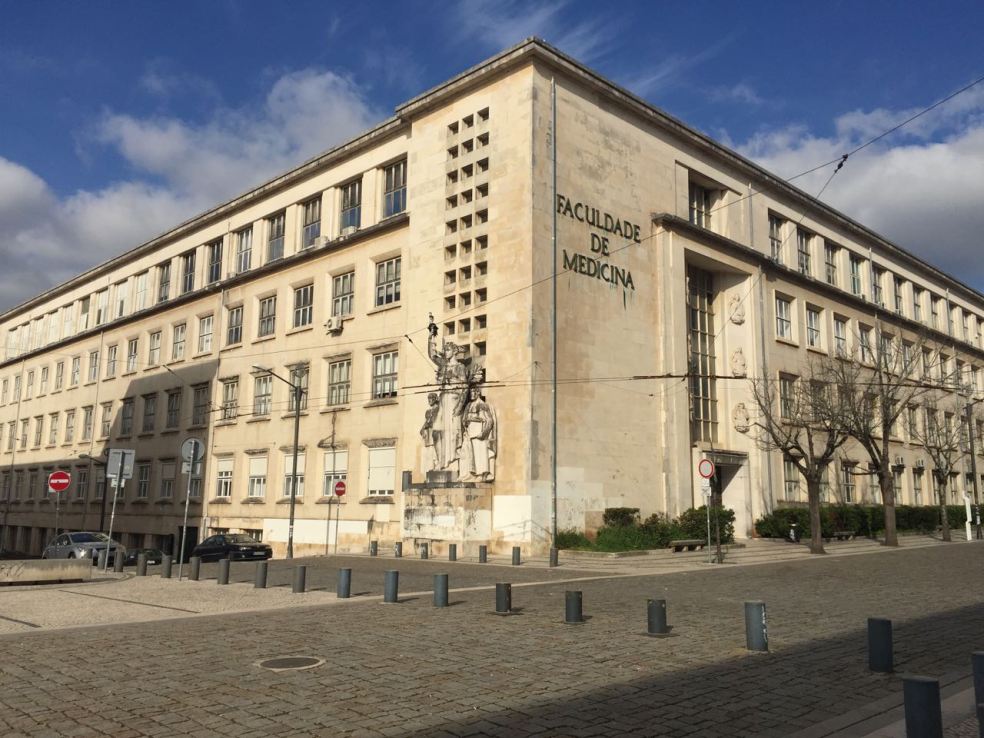 Unlike a lot of university buildings I’ve seen, this one does a very good job of being labeled. It means Faculty of Medicine, in case your mental faculties are waning.
 The first part of the three-part tour was into the Biblioteca Joanina. They didn’t allow photography in the library itself, so I had to steal a couple of pictures off the internet. I wanted to do that because it truly is an amazing place. We just stood and gawked in awe at the number of old books and the grandeur of the rooms.
 It was built in the 18th century, and is now a priceless National Monument.
 The floor below the Biblioteca Joanina is a depository of many other old books, some of which are gigantic in size.
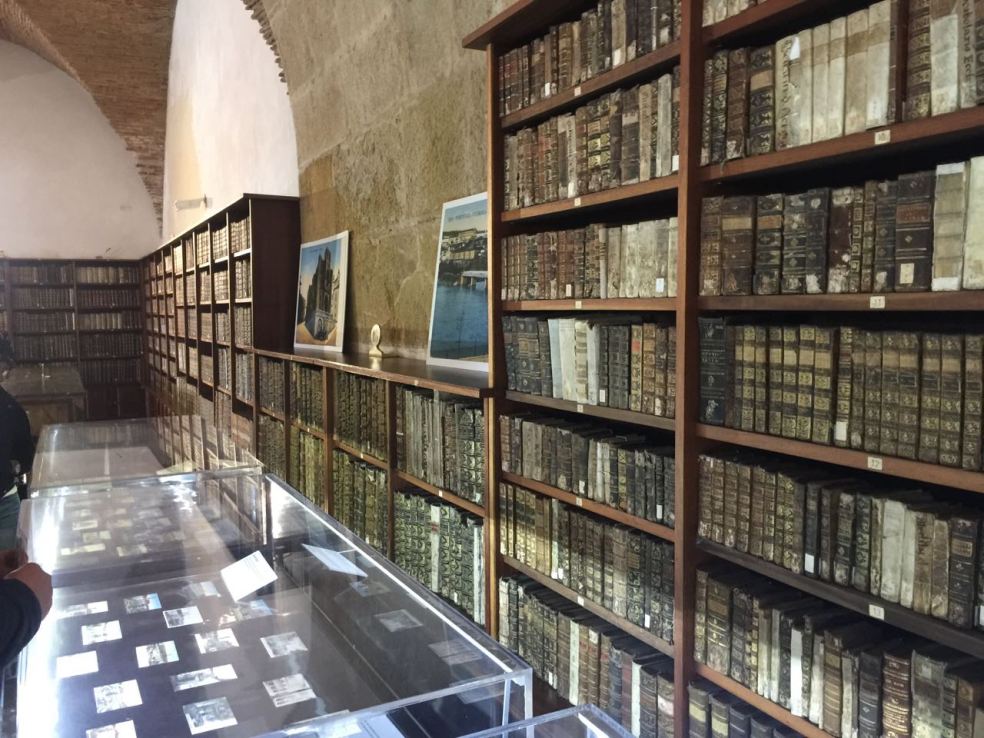
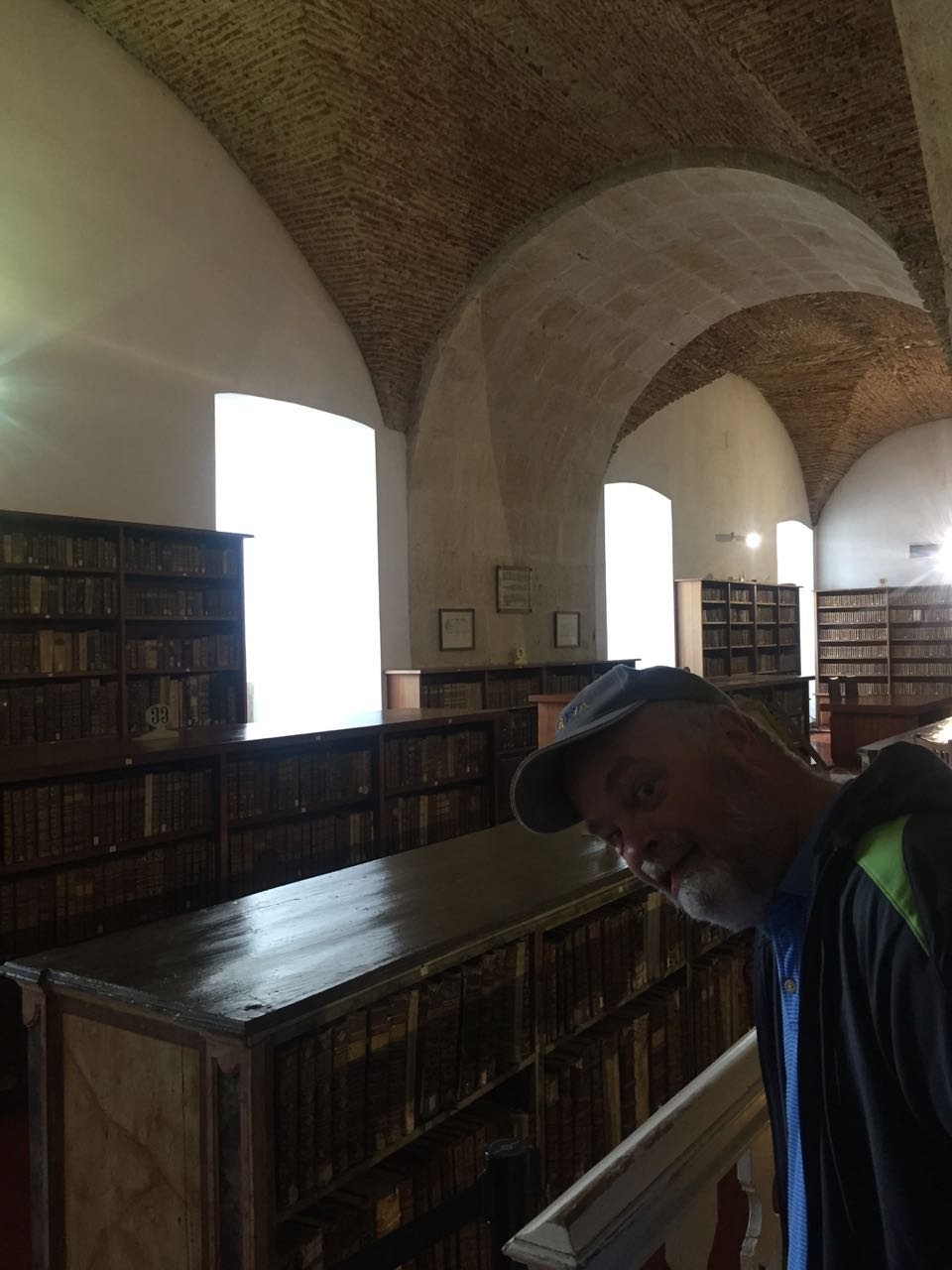 “Ssssh!”
 Inside the complex is a small chapel, as usual, ornately decorated.
 This is a courtyard near The Tower. I’m guessing it’s called The Courtyard.
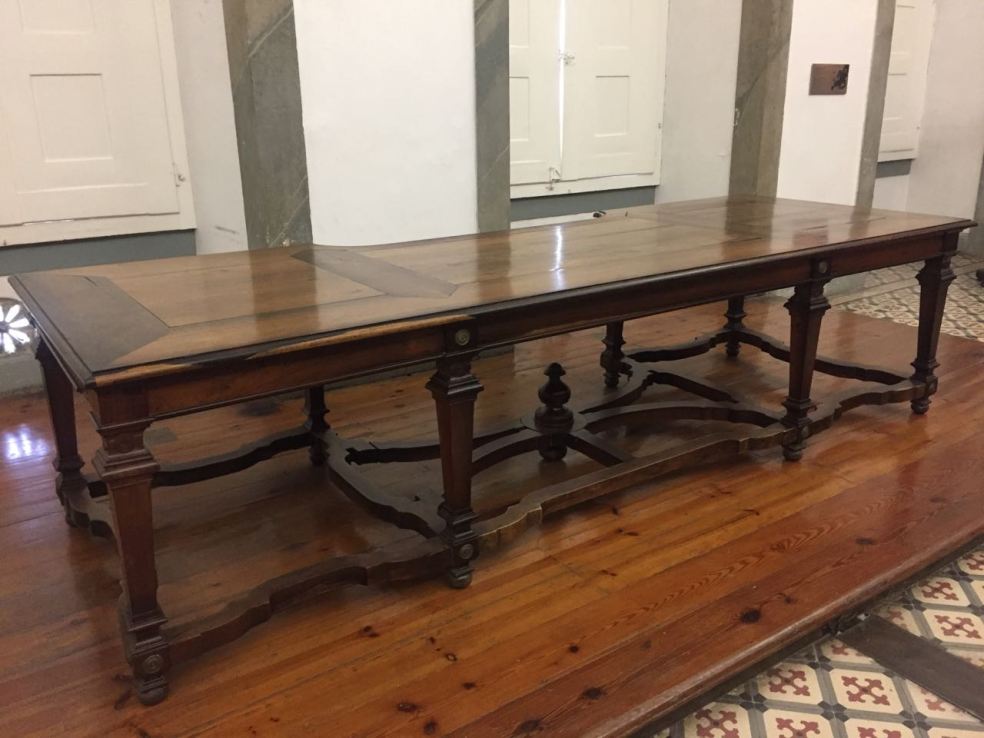 We wanted this table for our dining room, but apparently it’s not for sale. Bummer. When I tried to explain to them that “priceless” means there’s no price and so therefore it’s free, they just looked at me funny, as the Portuguese often do.
 It isn’t every day we find a door customized to fit my large American bulk.
 They apparently hadn’t learned about blueprints yet.


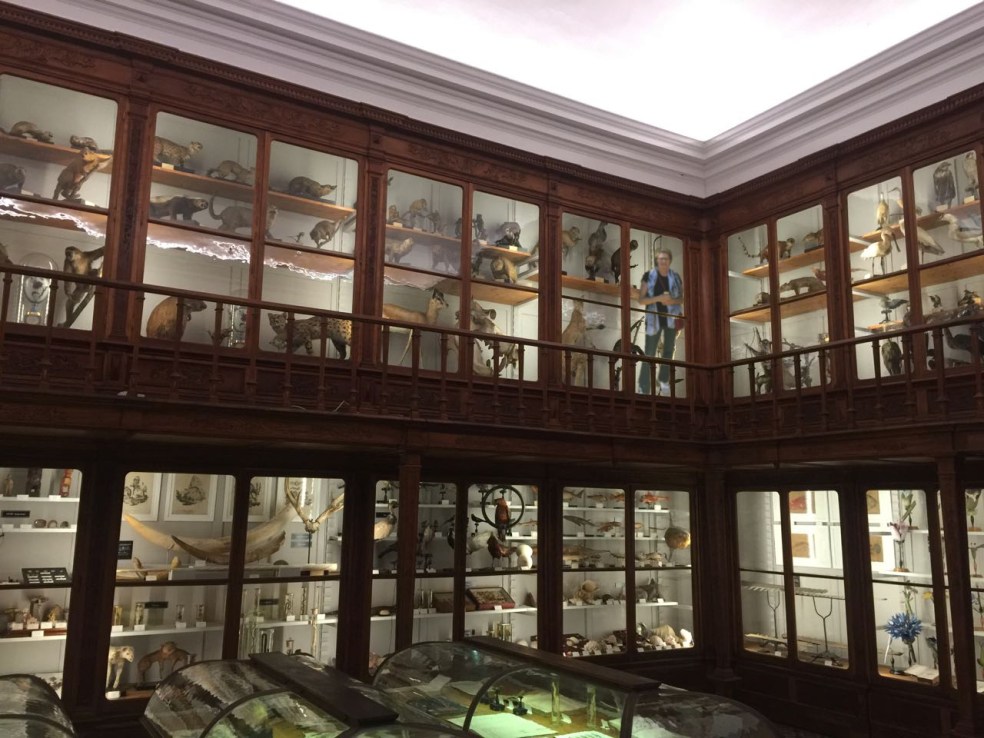 Once again, Carolyn found herself trapped inside a display case in a museum.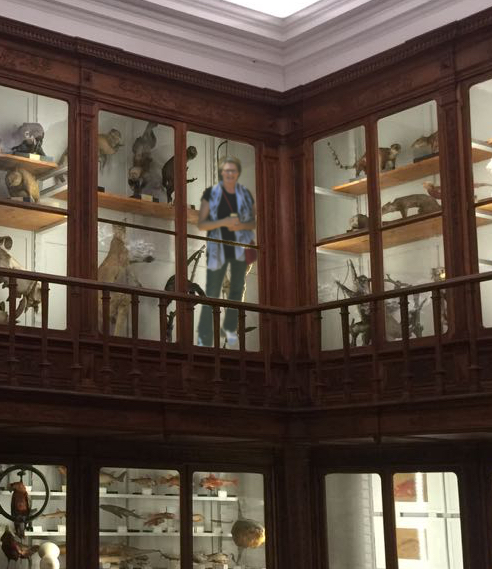
 This is a whale of a picture. I wrote that on porpoise.
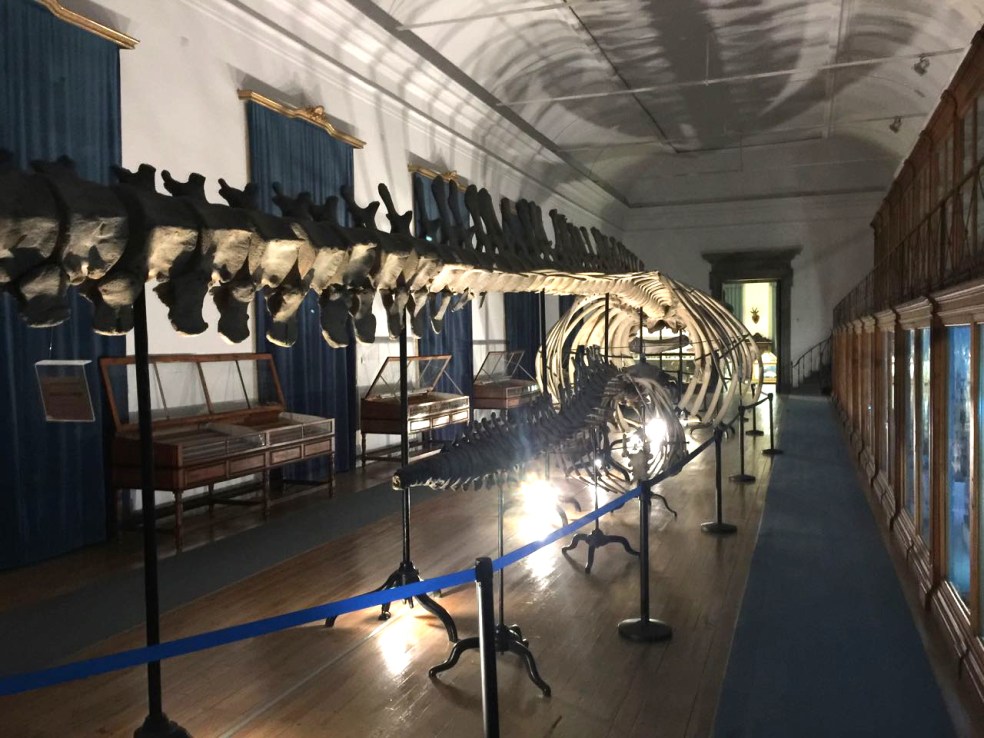 Whales are so ginormous, it’s almost hard to fathom. Get it? Fathom? Ha ha! No? Anyway, I found it interesting that recently scientists
  Fierce pussies aren’t afraid to use their teeth and claws.
 Even in death, these animals can’t get away from their herd mentality. Oh deer!
 This room contained all sorts of old scientific instruments. Don’t know how they sounded in an orchestra, though.
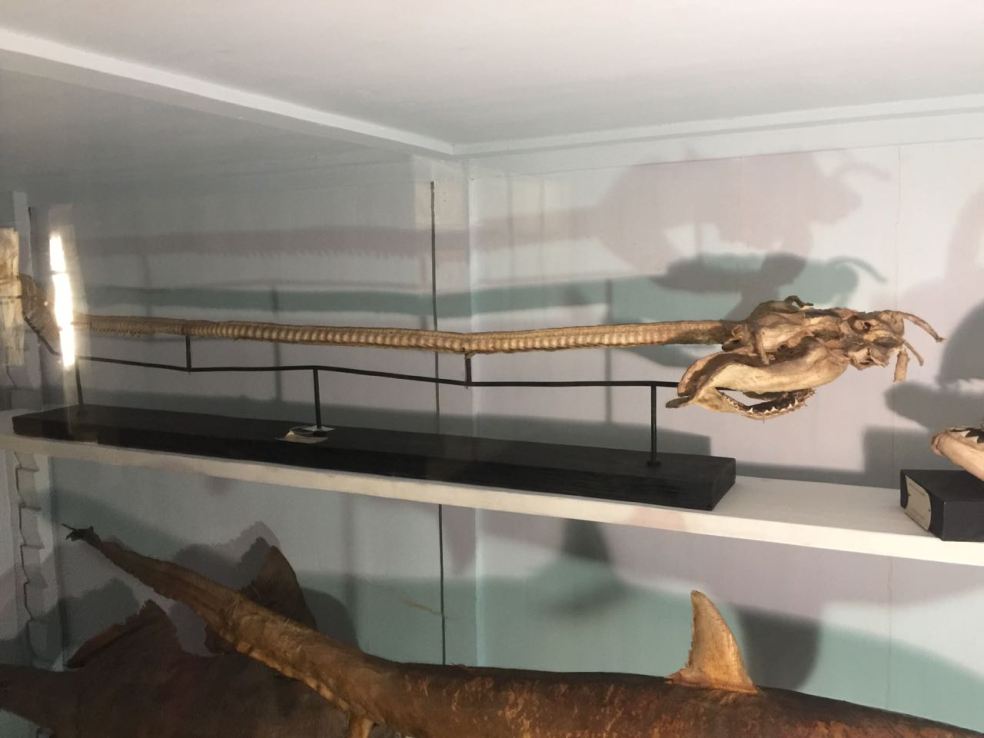 If that isn’t one of the weirdest skeletons ever, I don’t know what is.
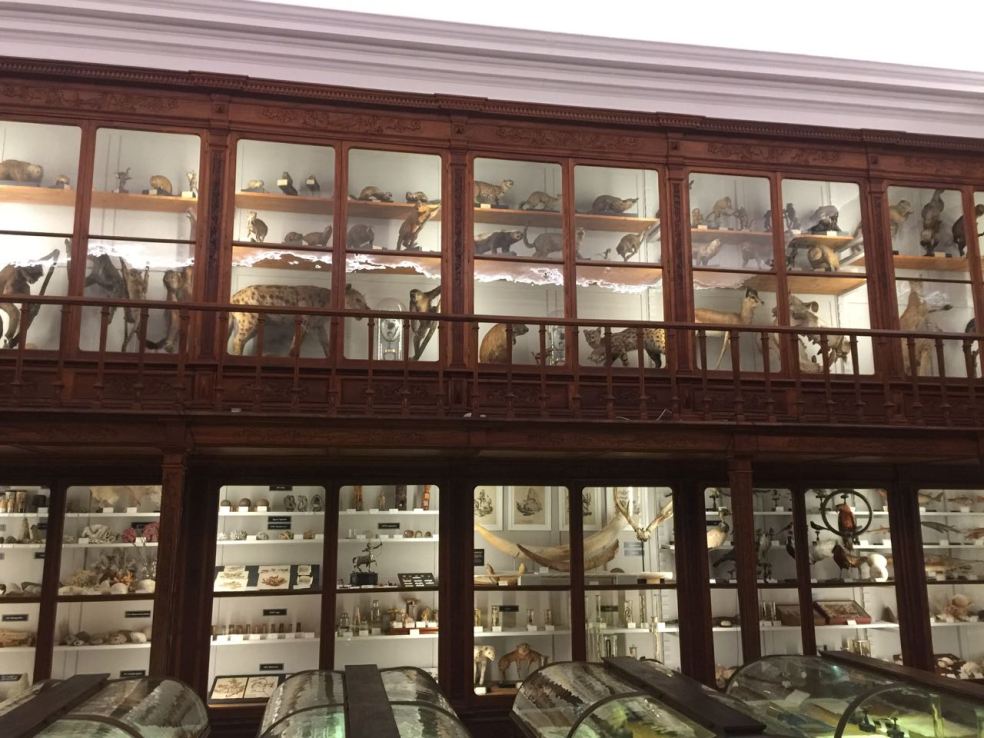 Lots of old taxidermy, although today they call it Uberdermy.
 These skulls demonstrate why I avoid being bitten by animals with big teeth.
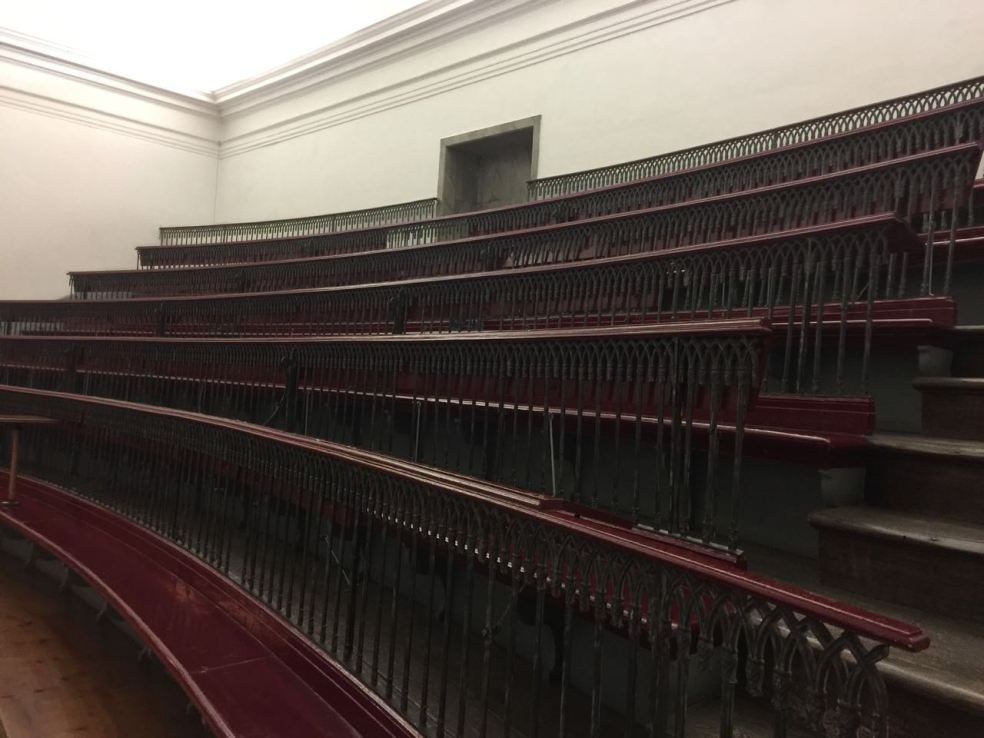 The museum used to be a place of learning with seats designed to keep you wide awake because they were so uncomfortable.
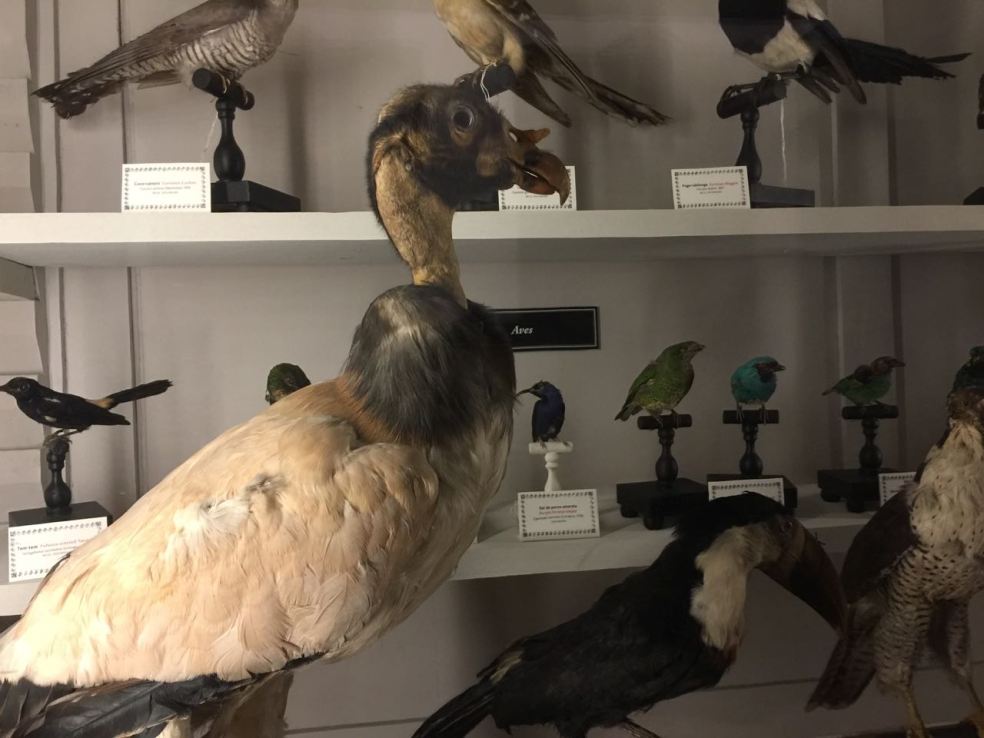 When you’re dead, he’ll pick your bones.
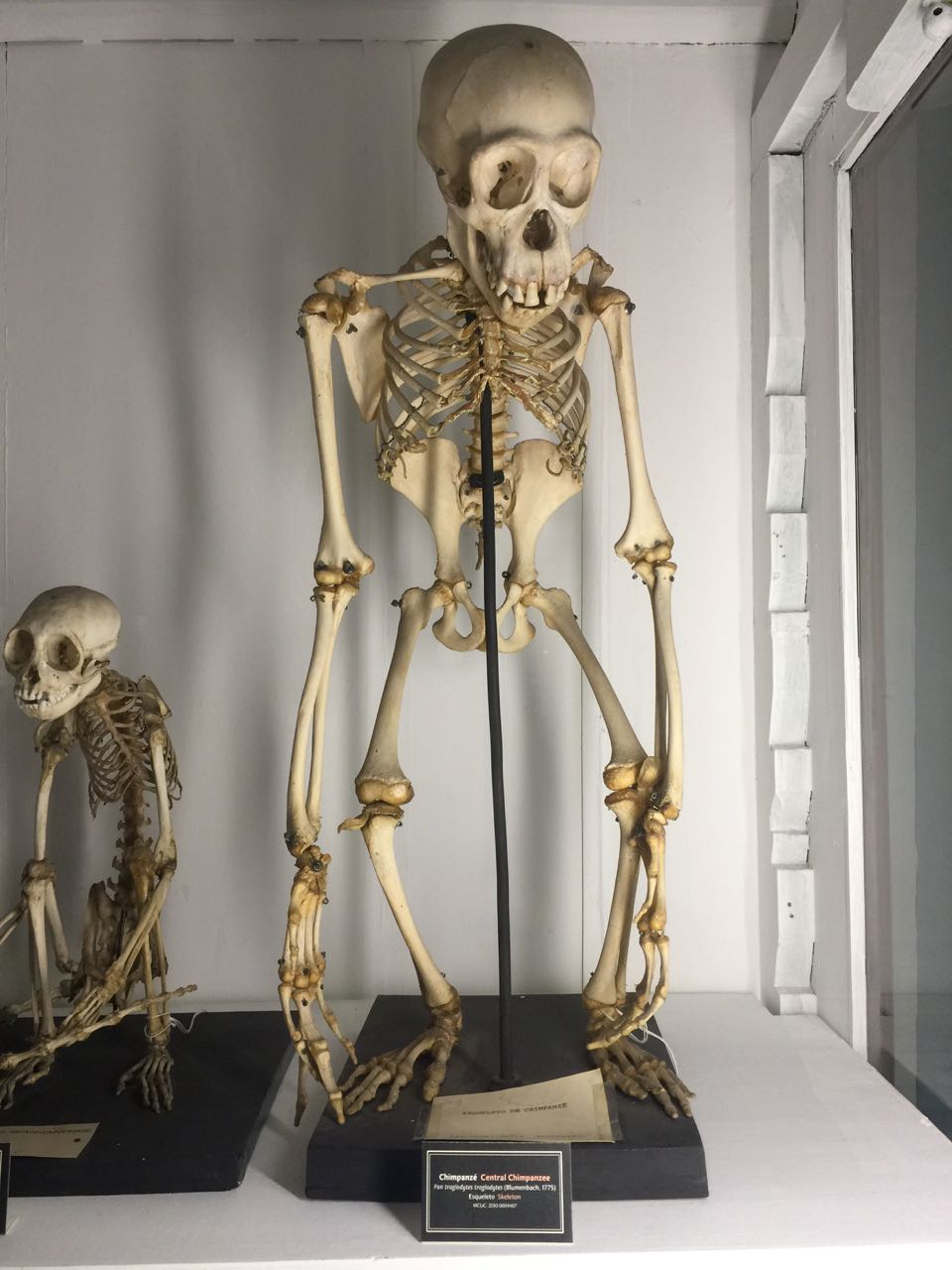 Guess he picked these clean too. But seriously, those are freaky long arms. As humans evolved from the apes, I think the friction from the ground is what shortened our arms. However, they definitely had an easier time clipping their toenails, so I’m not sure this whole evolution thing is all that smart.
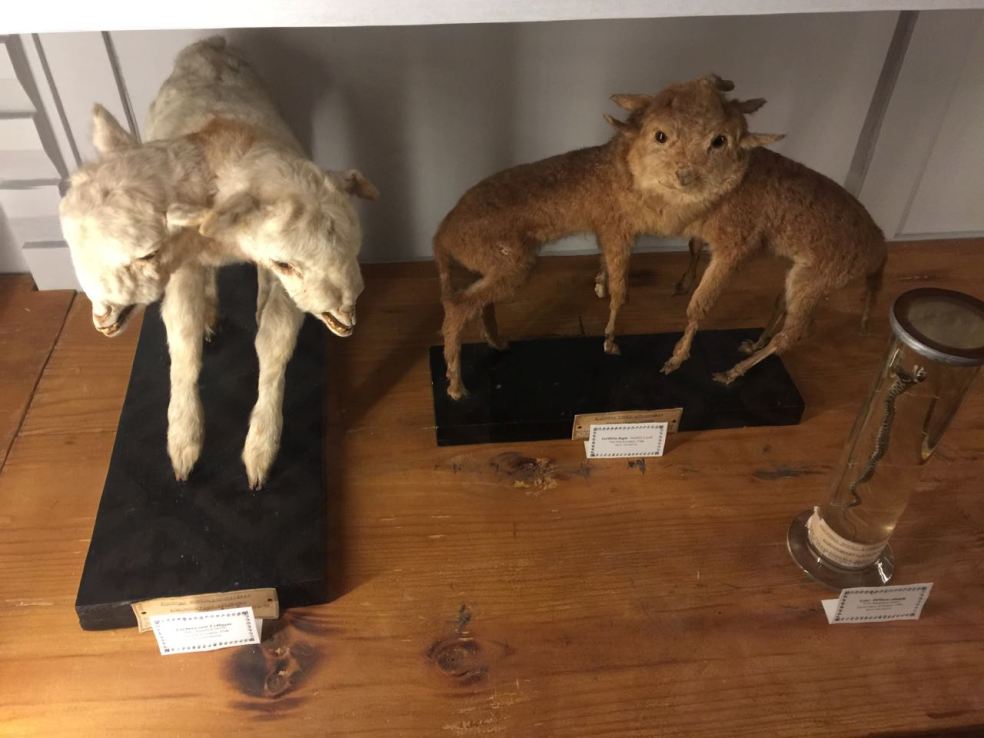 Not all genetic accidents lead to adaptations in species, otherwise we’d have two-headed animals all over the place. On the other hand, if a human developed that way and one head was a right-winger and the other a left-winger, it sure would be entertaining to watch them argue! Or what if one was religious and the other an atheist? The religious one would go nuts worrying that his other head would land them both in hell! That might be quite an issue for conjoined twins!
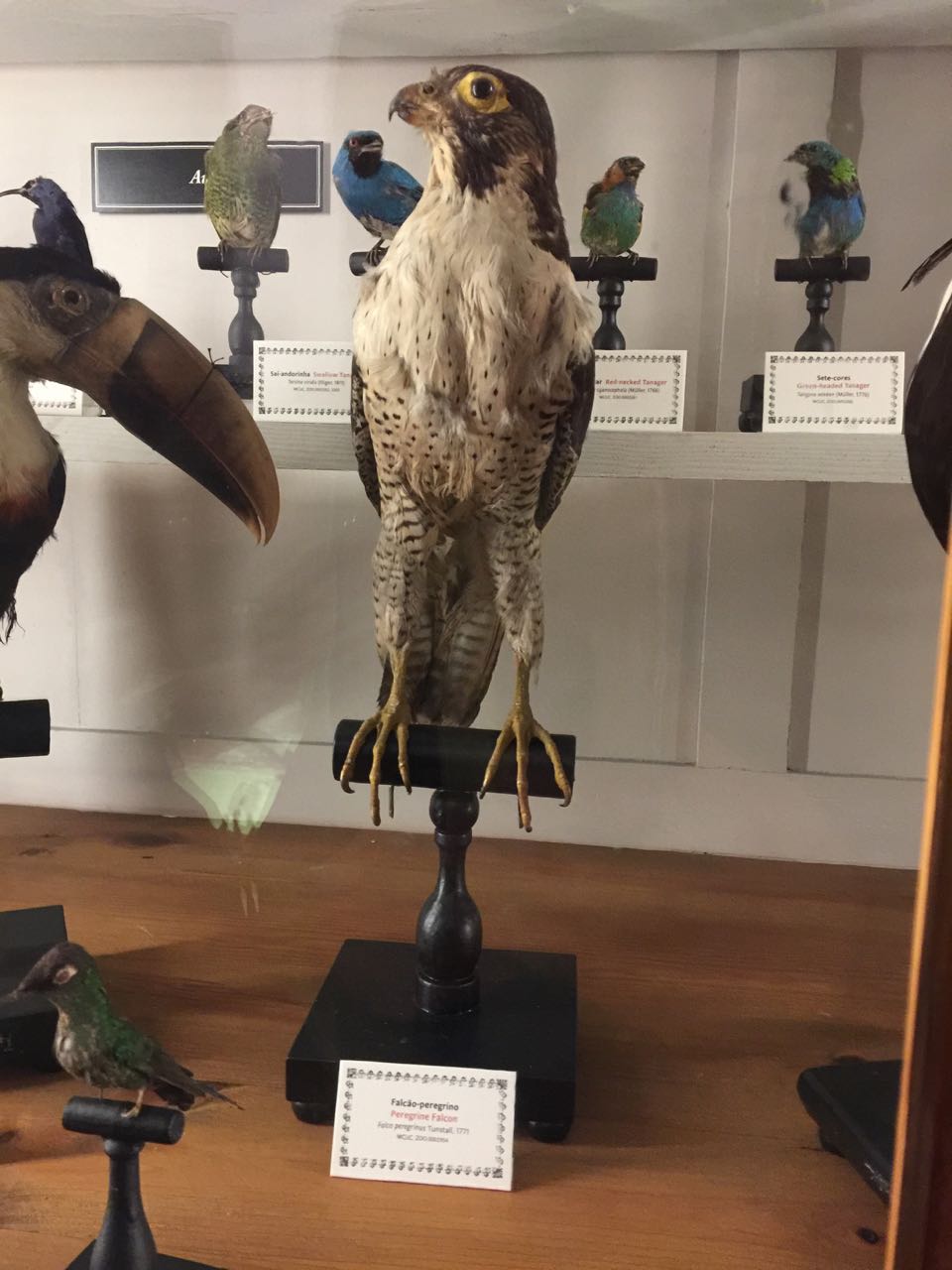 P
P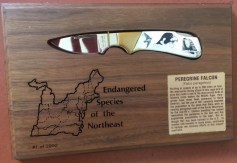 eregrine Falcons are near and dear to me because I developed a limited edition scrimshaw knife set back in the early ’80s which highlighted their status as an endangered species. Their decline was largely due to the extensive use of DDT, something my very conservative boss at the time scoffed at; he thought DDT was awesome. Fortunately, they didn’t listen to knuckle-headed anti-environmental conservatives like him back then, and so the cessation of the use of DDT allowed this magnificent animal to recover enough to be taken off the endangered species list in 1999. Maybe my little collector’s item helped with that!
 Here’s another table we wanted to buy as well. But again, not for sale. Haven’t the Portuguese heard about free enterprise? Sheesh!
 Monsanto is a name that, for some, conjures up the horrors of genetic engineering, bullying corporate practices, and poisons that can melt your skin clean off. That company is now owned by Bayer, which means they can sell you a pain reliever to take care of the pain they just caused. Aren’t huge corporations wonderful?
 In the 12th century, King Afonso I of Portugal took Monsanto back from the Moors. Unfortunately, the medieval castle was largely destroyed in the nineteenth century because of an explosion in the ammunition depot of the castle. Fortunately there’s enough left to make the steep hike above the village plenty rewarding, including of course some awesome views of the countryside.
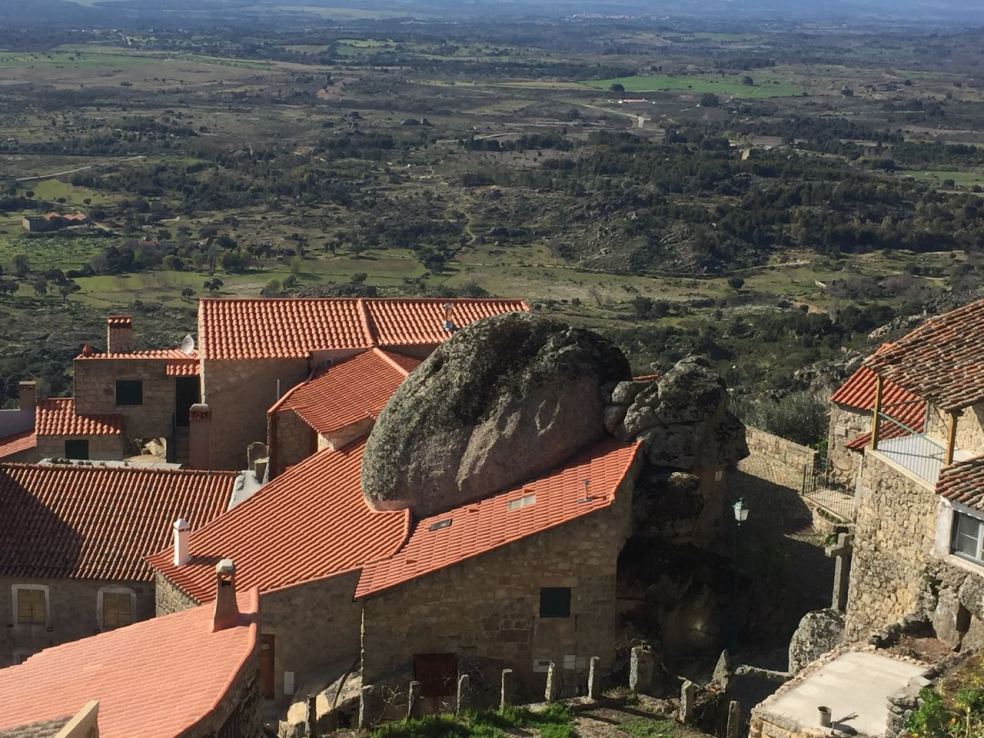 Granite abounds in the area, and some of the rocks are absolutely gigantic. They are so prevalent that some of the houses were built right around large boulders, as you can see here. Clearly, this house rocks!
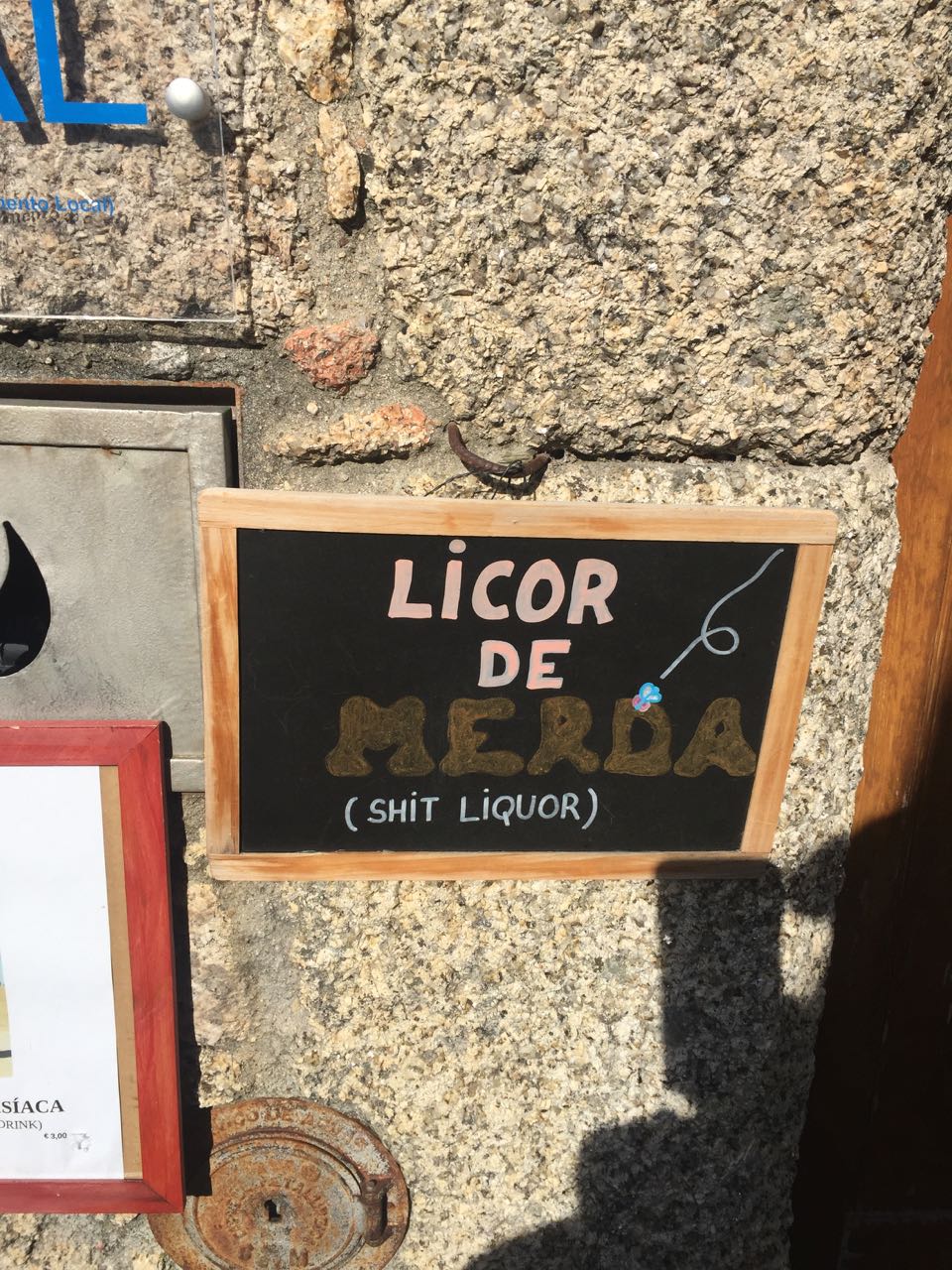 The Portuguese are honest to a fault, even when it comes to their marketing. In this case, this was the sign on the outside of a little bar in the village. I decided not to try it because, well, I just don’t like the taste of shit, even if there’s alcohol involved. Unless I’ve already had a bunch of alcohol, then of course I’ll try anything and even think it tastes good, even if it’s that shit, or anything shitty. Except for actual shit. That’s always gross.
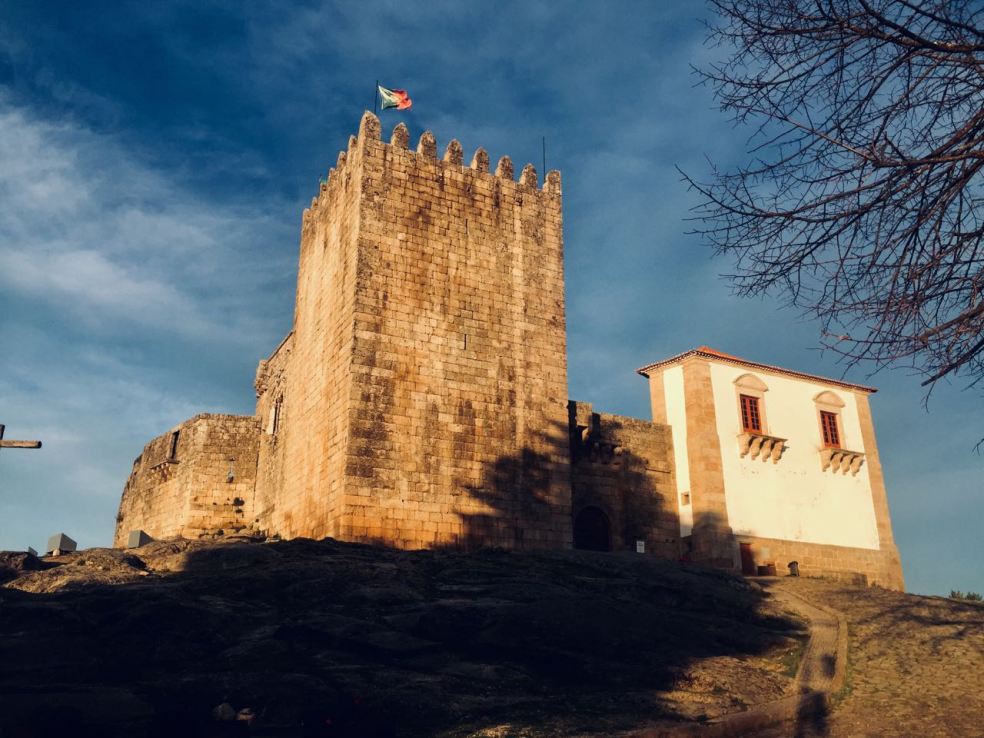 Belmonte is a castle we stopped by after we were somewhere else and saw on a map it was only about 20 minutes away. Unfortunately, by the time we got there, the inside was closed. Still, it didn’t look like we missed much compared to some of the other castles we saw, so we settled for a few photos and made our way back to our hotel.


 “Where is everybody?”
 It’s a little known fact that the ancient Portuguese invented recycling, and here’s the proof. I promise I didn’t Photoshop those in. They literally had recycling bins in an ancient castle. Who knew?
 The picture of a little kid with glasses was installed in 1350 to instill fear in potential attackers that they might be going up against nerds. Even then, barbarians knew the nerds were the ones who invented all the coolest stuff, especially when it came to armaments.
 This exhibit demonstrates why the Neanderthals went extinct: they tried building things with bricks made out of paper. Stupid Neanderthals.
 Oh, well.
