Carolyn’s Cup Runneth Over…

It was just over 9 years ago that my ex-husband walked out of our home, and the life I had known for 25 years went up in smoke.  At times the pain of that experience took my breath away. I felt I was suffocating.  If you told me then where I would be now, I would never have believed it.

IMG_4707I said “I do” almost four years ago to the wonderful amazing man I now call my husband. He is kind, generous, funny, and smart.  He keeps me grounded, showers me with grace and love, and has helped heal wounds so deep I feared they would never heal.  I am blessed, I am loved, and I am accepted for who I am. What more can love give?
Well, not only am I married to the greatest guy on earth, but I get to live in one of the most beautiful places on earth!  Because of Kevin, I am now retired at 56, living in a foreign country, learning a new language, and experiencing things I only ever dared to dream about.  I see this for the amazing gift that it is, and I am grateful every day.
Sure, I miss family and friends back home, and am anxiously awaiting the first visit, but this is a small price to pay for such a privilege.  Great things in life require sacrifice, but in the end the rewards are more than worth it.  If I could make a wish for everyone I know, it would be that they too will take a chance, and dare to dream of such a life.  The adventure starts with a dream. So dream people, dream!
To Kev I say, I love you more than words can ever express.  My heart is bursting, and I grow more in love with you day by day.  I love life with you, and the adventures we share make it always fresh, and more than amazing!  My cup runneth over!

Watching our language

Portugal would pretty much be our paradise on earth… if they only used English as their native tongue. I’m only kidding about that; it’s our problem, not theirs, and Portuguese is a beautiful language. But the truth is, the only part of this whole experience we would describe as difficult is learning Portuguese. We’re retired, for goodness sake. We’re not supposed to have to work at anything!

But work we do. We are not only taking lessons from a tutor and playing around with some software training (via a very effective online program called “Memrise,”) IMG_4942, but also every time we go out, we read all the street signs and advertisements aloud and debate what we think they’re saying. When we go into any given store, we look at tons of products and attempt to decipher their purpose. Sometimes we see products unique to Portugal and can’t help but be impressed at their ingenuity.

For example, I want to buy this tube of mofo repellent before we go back to the states. There aren’t very many bad mofo’s in Portugal, but it’ll be nice to have a tube of Stop Mofo if I wander into a bad area of Portland or Seattle.

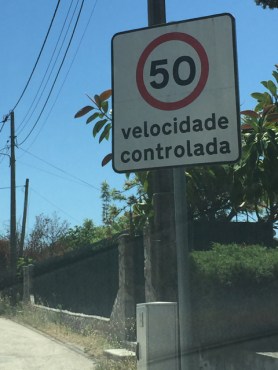
IMG_4975Some translations are easier than others. For instance, the sign to the left is obviously telling people to control their velociraptors. We were surprised to learn that dinosaurs are apparently still alive and well here in Portugal. In fact, not only are there signs pointing to where you can find them, as seen below, but they even have dental clinics dedicated solely to the care of their dinosaur teeth. The top sign must mean, “lots of dinosaurs,” and of course it’s easy to translate the one below it to “dental clinic,” obviously intended for the dinosaurs mentioned above.

So you see, it’s not all just about memorization. Sometimes you have to connect the dots and use your brain power to figure this stuff out. And as you can tell, our brain power isn’t suffering from any dementia yet, boy howdy.

IMG_4976Otherwise, how are our Portuguese lessons going, you ask? Well, it’s progressing, we answer. We have been inching our way toward a little more understanding of things. We are catching more words spoken by passersby. As already illustrated, we can obviously translate more signs than ever (although accompanying illustrations are always appreciated). And of course the more Portuguese we throw around at strangers, the more we can confuse them as to what the hell we’re trying to say.

There are days when we think we’re never going to learn enough. And then there are other days when we feel like we’re getting a handle on it, like when we can finally translate the stop signs on the streets. There aren’t nearly as many of them here as in the US, mostly due to the prevalence of round-abouts, or as I like to call them, “scream generators.” funny-traffic-signs-stop-signsCarolyn still hasn’t gotten used to cars racing up to the roundabout just as we’re passing in front of them. So far, they’ve always stopped in time, but we don’t know if that’s due to Carolyn’s screams or whether they all understand they have to give way to anyone coming from the left.

We did finally figure out that the letters on the red signs not only spell STOP, but they mean that too. It was confusing for a long time because the Portuguese word for stop is “pare,” and we couldn’t find out what “stop” meant in Portuguese. In the end, we figured they didn’t want English speakers to use paring knives while driving, so they went with the English version to cut down on the emergency room visits.

Otherwise, we can provide an example of our progress by showing you an entry from our training book. We can actually read the below and mostly understand what it’s saying:

O Pedro levanta-se as 7:00, toma um duche, vesta-se e as 7:45 senta-se para comer. Ele toma o pequeno-almoco sempre em casa. Come sempre pao com manteiga e doce a bebe café com leite sem acucar. O Pedro e economist e entre as 9:00 e as 13:00 trabalha numa empresa no centro da cidade. As 13:15 almoco com os colegas num restaurante perto do trabalho. As tercas e quintas, as 18:00, tem aulas de ingles numa escola de linguas. A noite chega e casa e prepara o jantar. Janta as 20:00 e deita-se sempre as 22:00. Ao sabado de manha, o Pedro vai as compras e a tarde limpa a casa. Ao sabado a noite, ele sai com os amigos e deita-se tarde. Ao domingo, ele so se levanta as 11 horas e almoca em casa dos pais.

Now, if you don’t speak Portuguese, you’re probably wondering what all that means. Well, he says, hitching up his pants with Trumpian confidence while speaking in boastful tones not unlike Don Knotts at his best (albeit in a lower timbre). It has something to do with Pedro the economist who goes to work and is struggling with the ideas of eating his children and having spiders in his pants. He’s also a bit upset when he goes out to eat, because perky college students always serve him almonds instead of meatballs. So he just licks the arugula and refuses to tip. But they don’t tip very much in Portugal anyway, so despite his worrying about getting shot due to his stinginess, he makes it home safely with almonds in his shoes.

The paragraph actually doesn’t make a lot of sense to us, because there are very few guns in Portugal, so his worries are very misplaced. We just don’t think Pedro is all that smart. But hey, if your claim to fame is to have a one paragraph biography in a language textbook, how smart can you be?

The interesting thing about the Portuguese language is that if a Portuguese speaker were to speak that paragraph aloud, here’s what the entire thing would sound like:

OPedrolecon shh shh prajant sh sh sh rrrrr-limdos-doshpais.

All uttered in approximately three seconds. And we’re supposed to understand that.

It’s not really a long term problem though. Because as soon as we give them our best I’m-not-even-going-to-pretend-I-understood-one-word-of-that look, they translate everything they just said into about ten English words.

I’m not making that up. Once, our attorney was talking with a banker on our behalf. They went back and forth for fifteen minutes in Portuguese. When they were done, I asked what was said. He told me, “She says that you have to turn in the form and wait five days.” That was it? He shrugged and said, “pretty much.”

So they either use a lot of words to communicate individual ideas, or they were talking smack about me, knowing I couldn’t understand. Maybe I have to buy some of the Stop Mofo paste for here after all.


Even the weeds are beautiful in Portugal

A year ago this week we landed in Lisbon, where we were first exIMG_2531posed to Portugal’s amazingly inexpensive yet delicious wine, the beautiful (albeit rainy, at least during our visit) streets of Lisbon, and some cramped living quarters, especially in the steep stairway of our rented apartment.

One year later, we are very much enjoying the inexpensive wine (with a bit of a taste for their “green wine,” or “vinho verde”), we’ve driven the winding streets of Lisbon and the surrounding area to the point where we hardly use the GPS anymore, and the apartment we purchased for short-term rentals has its own narrow stairway (although not as narrow as the one we rented in Belem, shown at the right).

We couldn’t be happier with our choice of Portugal. We were fortunate enough to find a house in SesimIMG_2554bra just minutes away from a sandy beach that stretches beyond sight. We pass by a medieval castle every time we drive into town. And while we have had some of the same May rain we did a year ago, it quickly gives way to 75-80 degree days, which is perfect weather for the beach or our ever-warming pool. I describe it thusly because it’s still too damn cold to swim in. I’ve jumped in a couple of times for an immediate cool-down. But it’s straight to the ladder after the cold water wreaks its bodily-shrinkage-havoc.

A quick drive into Sesimbra town brings us into a delightfully touristy area of shops in front of another nice beach. Condos and other buildings are built into thIMG_2595e hillside, reminiscent of a seaside town in Greece. And the wine is still as inexpensive as it was a year ago.

In addition, the area surrounding our home has a seemingly inexhaustible supply of nature’s beauty. We enjoy taking walks whereby in the first five minutes we are treated to a 220 degree vista of the Atlantic ocean. We can see the Cabo Espichel lighthouse from the upper floor of our house, and can even walk to it if we don’t mind a two hour round-trip hike.

While taking a walk recently, I decided to photograph the various weeds and flowers that lined the way. Yes, even the weeds are beautiful in Portugal!


IMG_4880
I also wandered off the street to explore a path that led toward the ocean. At the end of the path was a pile of rocks.


IMG_4875
To my left was an incredible shoreline, where the ocean meets the cliffs.


IMG_4878
Ahead of me was a great expanse of ocean. Surrounding me was nothing but silence.
IMG_4881
I walked around the pile of rocks and found, to my amazement, that it was actually the back side of a bench. Someone had taken the time to build this seat hundreds of meters from the road. It simply faces the sea, serving as a place of contentment and reflection.
IMG_4873
I walked home, counting myself incredibly fortunate to live in a place with such beauty, populated by innately decent and kind people, and all with a life partner who has even more of those attributes than what I admire in this country.
IMG_4250
Even if she is a little goofy sometimes…

Out for a Walkabout… Turned Right Instead of Left

Before you get a gander at the views I experienced when I turned right instead of left at the mailbox, here’s an image of Carolyn driving for the first time, from the narrow streets of Alfama all the way to our home in Sesimbra. IMG_4788She was more than a little nervous, although the pedestrians of Lisbon should have been more so. Just kiddin’. She’s a good driver, but the tiny streets, confusing street lights, and chaotic traffic are not for the faint of heart. Needless to say, we made it home in one piece. Although it took us a bottle of vodka to recover from the trauma.

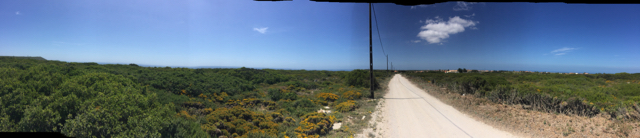
The two panoramic views below give you an idea of the landscape surrounding our house. The top one is my attempt to show that, since we’re on a peninsula, we can see the Atlantic in about an 180 degree arc. It didn’t come out that great, but in person, I just stood at gawked at it for a good five minutes, which is about how long it took me to walk to the spot in the first place.

IMG_4796

IMG_4810

IMG_4798
Cabo Espichel is within walking distance, although it’s a decent hike.

IMG_4800IMG_4802


I’m not sure what this device is, but I could have sworn I heard a high-pitched, nasally voice saying, “Phone home! Phone home!”

IMG_4804IMG_4808

Otherwise, just more gorgeous scenery of the coast. I’m enjoying my walks here, to be sure. The weather is perfect for walking, the occasional human being I encounter is always nice and polite, if not a bit shy, and most of the walk is completely quiet.

We’ve named our home, “Casa do Paraíso,” which means “House of Paradise.” That’s truly the way it feels…

Our First Experience With Socialized Medicine

SickoLike most Americans, Carolyn and I had been indoctrinated into the horror stories about socialized medicine, often juxtaposed with friend-of-a-friend anecdotes about how much better American medicine was than anywhere else in the world.

So when her lower back started hurting like hell for a couple of days, and then her abdomen started swelling, and then little caterpillar thingies started crawling out of her pores (just kiddin’), we thought it might be time to plunge into the abyss. We were a bit nervous to see what voodoo these doctors would perform, especially after an expected eighteen hour wait in a room filled to capacity with people sporting newly-dismembered limbs, or with faces populated with pustules the size of hamburger patties, and sheep.FOR USE WITH ERIK'S BLOG

We were one of the 99-plus percenters: the 99-plus percent of Americans who have never experienced anything but American-style medicine, but had an unshakable opinion about how it compares to the rest of the world regardless.

Personally, I’d revised a lot of my opinions after reading various statistics on health care. After studying the reports, I began to wonder if perhaps America’s only medical miracle was teaching people how to twist their bodies in such a way that their heads would fit neatly up their ass. For instance, the U.S. ranks 43rd in the world in life expectancy at birth (and it’s getting worse… and don’t blame it on North America, Canada beats us by three years), and has one of the worst infant mortality rates in the industrialized world, beaten out by such luminaries as Poland, Hungary, and of course Portugal. In fact, the list below the US reads like a who’s-who of third world countries.

And there’s a lot, lot more (like we probably lead the world in healthcare lawsuits as well)… US healthcare costs higher than any other countrybut this is also in addition to our paying the most per capita in the world. Let me repeat that: We spend more on health care per person than any other country in the world. Surely that has to buy us something?

If statistics won’t prove our bang for the buck, what about a great anecdote that supports the idea that whenever you go to the doctor outside the U.S., you better bring a cooler with two full day’s supply of rations as well as a couple of books and a pillow?

Kevin & Carolyn to the rescue! We were prepared to restore a little glory to Old Glory, at least as far as getting medical help was concerned.

Armed with our insurance card and a Google Map to the nearest hospital, we set out on our quest to experience the underbelly of socialized medicine.

And this was to be no lightweight example. We were really testing the system by going in on a Saturday, surely one of the busiest days of the week for hospitals.

We had no idea what to expect as we drove into the hospital parking lot. It looked clean and uncrowded. We were immediately suspicious. Do they just kill everyone and steal their cars?

The Portuguese love to use number machines to set your place in line. As an example, I recently had to go to Ikea to return a light fixture. I looked aghast at the hoards of people morosely sitting in the waiting area. It was the exact picture I had in my mind as to what to expect from a typical hospital waiting room in a country with socialized medicine. I took a number from the machine. It spat out B 096. I looked at the monitor. It was at B 032. I immediately tossed the tag into the waste bin, deciding that the fixture wasn’t as ugly as we thought.

So if Ikea was that bad… how much worse would a hospital on a Saturday be?

We ambled through the front door like lost puppies, looking for the Recepção sign. Over there! But wait! There was no line, and only one employee behind the counter. We were probably in the wrong place. Maybe Recepção really meant “Reciepts,” and no one needed those.

We greeted her with our standard line: “Fala Inglês?” To which she responded with the typical Portuguese response of, “A little.” She then proceeded to converse with us in better English than my high school English teacher.
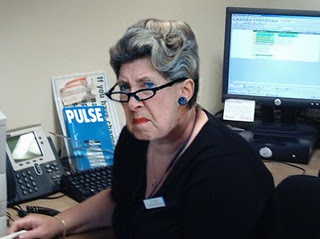
receptionistWe gave her our particulars. Not once did she ask why we wanted to see a doctor. I found that refreshing. What business is it of anyone besides the doctor anyway? But in the U.S., you’re usually forced to offer up a detailed description of all the bumps on your private parts, when you last went pee and what color the urine was, plus your shoe size, all to a receptionist who takes ten minutes to find the right color yellow to fill in the little box with the accurate rendering of the color of your pee.

Our Portuguese counterpart had no such interest in those particulars, but simply took our insurance card and our address. She then said they couldn’t bill them directly. That was fine. We didn’t care. We needed a doctor. We didn’t mind if they were going to charge us two thousand dollars for being dumb enough to be an American inside a socialized medical country. We just wanted some pills or surgery dammit!

That was it. She didn’t need to know our income level, or whether we even had a credit card, or what our shoe size was. We didn’t have to fill out eight forms about our medical history and what our great-grandparents died from. She just said, “The doctor is upstairs right now, if you’ll take a seat, he should be down to see you in, oh, maybe fifteen minutes or so. It’s hard to say.”

Now, I don’t know about you, but in the U.S., when I’ve had an appointment, the wait is usually much longer than fifteen minutes. With no appointment, into something like urgent care of the emergency room? I usually plan on an hour, or maybe a week, or more. But here we were, without an appointment, wandering into a random hospital with an undisclosed medical condition, and the doctor will be with us in fifteen minutes? I knew she had to be a serial liar.

DocAfter about twenty minutes (See! Five minutes off!), he appeared, and waved us in to his office… us as in both of us. I was a little confused at first, because the only other time I’ve been allowed into a medical office with my wife was when she was giving birth, or we were receiving very bad news. However, as he showed us to our chairs, it occurred to me that it was quite smart to do so. There was no need for a nurse to be on hand with a male doctor and a lone female patient. Her husband was right by her side. Cost savings right there, kaching!

The whole experience with the doctor reminded me of what it must have been like to go to the doctor long before insurance companies stuck their nose into everything and screwed it all up, sending costs through the roof and the quality of care below the basement. He took his time asking her questions. He prodded and poked her as he tried to figure out what the problem might be. He then sat us down and explained in detail all the things it could be, what it probably wasn’t, and what we were going to do to narrow it down further. He prescribed three medications: two of them muscle relaxants and one a pain medicine. He was pretty certain it was a pulled or irritated muscle, but just in case, he said if those things didn’t work, we should come back and see him tomorrow, Sunday.

After shaking our hands warmly, he led us back to Recepção, and explained everything to her she would need to know to finalize our process.  He shook our hands one more time, as if wishing there was something more wrong with either of us so he could spend even more time with us, and took his leave. The receptionist then told us we could make an appointment, but since we might not actually have to come in, we should just come in whenever we felt like it, that would be fine.

The charge? 65 bucks. That’s without any insurance-anything. That’s for about a half-hour of a doctor’s time in a hospital. Women pay more for their haircuts in the U.S.

We can bill our insurance company for it, but if we forget, what the heck– it’s already about the same price as most co-pays in the U.S.!

So how about the medicine you ask? Maybe that’s where they sock it to us? The grand total was fifteen bucks. No, that’s not the co-pay. That’s the entire cost of three full prescriptions.

We can be very happy getting sick in Portugal.

So I gotta tell ya. I know people hate to change their minds about things. But if you really think the U.S. has the best health care in the world… do some research. Start with the data, the internet is very handy for that. Honestly? I’m not sure you can find any data that actually supports that premise. Now throw in our lone experience in a socialized-medicine country –and one that is a little further behind technologically than many western countries besides– and boy howdy, it’s time to give that single payer health care system some thought, don’t you think?


When you’re retired, Mondays can be a beach!

Beach SunburnThe temperature has been hovering around 21 degrees celsius (or for you luddites, about 70 degrees) the last few weeks. Not quite beach-going weather, but since it’s April, and we still have Oregonian blood coursing through our veins, and the beach is just about a ten minute drive away… it was time to get beachy! So we threw on our crocs, tossed the brollies into Marco’s boot, and meandered down the road to the beach.

We were told the Atlantic is a little chilly, and we can confirm that’s true. Not the bone-chilling, frostbite-inducing ice water of the Oregon coast, but chilly nonetheless. Still, with the ease of getting there, the warm sun, and endless expanses of sand, the lack of salt water up the nose was a small price to pay, and certainly an outing worth doing, especially on a Monday.

Yes, retirement is all that.

IMG_4781
Our Corona moment was really a Radler Limao moment. (Radler Limao is one of our favorite drinks here in Portugal, although at 2% alcohol, it takes 18 of them to give you a buzz.)
IMG_4774
Not quite bikini weather.
IMG_4765
Carolyn: “You’re not going to put these pictures of me on the blog, right?”  Kevin: “Of course not.”
IMG_4769
I guess we could be working on a Monday instead. Okay, no.
IMG_4784
Mother Nature provides her own free hairdo when you visit her at the beach!


Meanwhile, our home is slowly being brought up to snuff. Still not ready for the full blog presentation; our 32 boxes from home haven’t touched down yet and we still have a couple trips to Ikea to make. That should bring it to about 18 visits, all accomplished without filing for divorce, which we believe is a new Ikea record. A couple made it to 17 last year, but then she shot him.

Just up the road from our house is our mailbox, and not far from that are the trash bins where we take our garbage. There is no charge for the latter service. I guess it’s just one of the benefits of living in a socialist-leaning society.

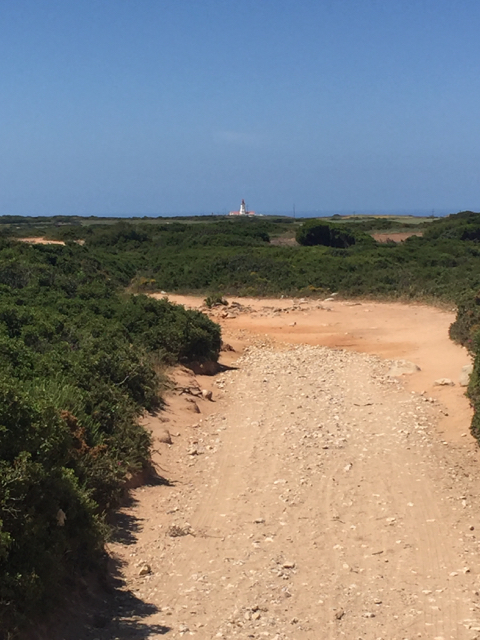
Another couple of hundred yards from there are the scenes you see below. It is utterly peaceful and completely quiet. An occasional bird, perhaps. Or maybe the motor from a passing boat on the ocean below, or some buzzing insects. But then it descends into total silence for a time, and all you’re left with is your own thoughts and an admiration of this timeless beauty.

IMG_0194
The light on the horizon near the left is the lighthouse at Cabo Espichel, as seen from our house.

And with that, we wish you a warm and safe boa noite.

Long Road Trip on Easter Sunday

Today we decided to go on a grueling road trip to see some of the sights rural Portugal has to offer. So we read up on an article from Travel & Leisure and hit the first destination on the list. Seven minutes later, we got out of the car and started snapping pictures.

The first stop was to visit an area with dinosaur footprints. We pass the sign to them every time we go into town, so we thought it was about time. Fortunately, the scenery and hike were beautiful. It’s fortunate because we couldn’t really make heads nor tails nor feet out of the supposed tracks. Right next door is Cabo Espichel, which has a lighthouse and a church built in about 1701. We had a delightful day, and when we were all done, we hopped in the car and were home in two songs!

Here are some of our pictures, in random order:

IMG_4729
There’s always some knucklebutt wanting to stand on a cliff.
IMG_4736
We can see the light from this lighthouse from our house.
IMG_4695
Turns out, dinosaurs wore shoes. Who knew?
IMG_4721
They have a fence so you don’t fall off the cliff. However, the fence only goes partway along the cliff. Either they ran out of funding or the lack of fence is to cull the herd.
IMG_4683
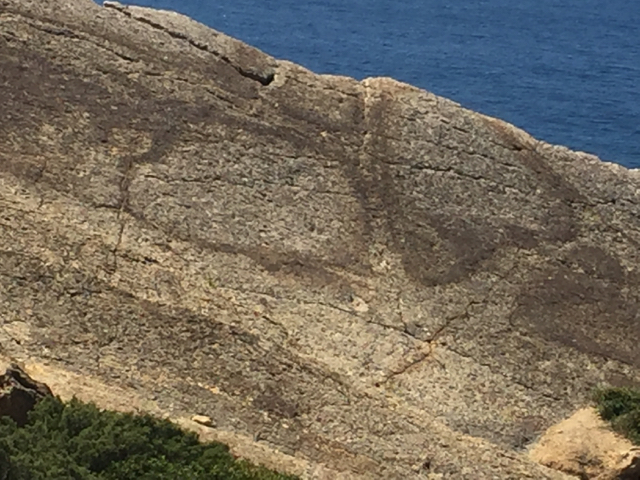
This is supposedly where there are dinosaur footprints. I have no idea which indentations they are. It was a fairly long hike to get there, if the scenery wasn’t so beautiful we might’ve been irritated at the dinosaurs for stepping so lightly.
IMG_4693
Except for this one… this guy must’ve been huuuuge!
IMG_4694
There were little trilobite-y kinds of indentations around, however. They looked more trilobite-y in person than you can see in this picture.

And here are the rest of the shots. Such gorgeous scenery right near our doorstep. We’re still swooning… and it’s the kind of scenery we’ll never get tired of. In addition, the silence in some of these areas is virtually complete. Just absolute quiet and solitude… the perfect place for retirement.

The embassy, a dash of coconut, and the apartment

For the first time since January, we stepped foot on American soil. Of course, it was the American Embassy, but still, that’s technically American soil. Actually, it felt just like Portugal, because everyone we encountered was Portuguese, the TV playing in the room where we waited for half an hour with 40 otherwise empty chairs was broadcasting in Portuguese, and it was clearly a building of Portuguese construction. Security was tight. I’ve never had to go through security nude before. Still haven’t. Just sayin’.

IMG_4631
Us in front of the embassy. It would be the only picture we would take because they confiscated nearly everything in our pockets during our visit.

We had to get our fingerprints taken (for the third time in the last year) to get our FBI background check (for the third time), because Portugal only recognizes the information provided by the FBI as long it is presented within 90 days of issue. It takes 90-120 days and possibly even longer to get the information back from the FBI in the first place. So while we did our best to schedule it so that we would have the documentation in hand in time to be presented, alas, trying to buy two properties while registering for all sorts of stuff in Portuguese and then trying to get an appointment, all within less than 90 days, has proven to be next to impossible.

So now we send the fingerprints off into the ether, not knowing when it will be returned until it actually arrives. Accordingly, we’ll be on a series of 90-day visas, hoping they don’t kick us out of the country in the meantime. That’s not likely, but we do have to give up our life of crime for a while.


The funny story involves our struggle with learning the language. One of the first things we wanted to learn was “I don’t speak Portuguese.” So we learned that the word for “speak” was “fala.”

Therefore, “Nao fala Portugues” became our most commonly expressed phrase.

keep-calm-and-speak-portuguese-4Over time, I couldn’t understand why some people would just keep talking in Portuguese after hearing us say that. The one who confused me the most was a Brazilian delivery driver who called on the phone to let us know they’d be here at 7:00. It took us over five minutes to figure only that out on the phone; I don’t think he spoke a word of English. Upon delivering the goods, he said to me a couple of times, “Nao fala Portuguese,” and then he would bust out laughing. Not in an unkindly way, but he obviously got a kick out of something.

The other day we learned what was so funny to him. The best way to explain it is to imagine this conversation in English:

“Good morning sir. Welcome to Continente. I will be very pleased to help you today. Do you by any chance have a Continente card?”

“You don’t speak English.”

That, in effect, was what we were saying. “Fala” means “you speak.” Falo (pronounced “faloo”) means, “I speak.” So the correct way to say it is, “Nao falo Portugues.” A lot of people understood we were floundering around, but some found it funny, and others just kept talking in Portuguese, perhaps to convince us that yes, they do actually speak Portuguese.nc3a3o-falo-portug

So we have left a trail of baffled and bemused Portuguese in our wake. But most of them are kind to us (unless they’re from France) and are happy to put up with our mangling of their language. At least we’re trying, which I hear earns us points.

As far as we know, we haven’t yet done what the Swedish husband of our attorney managed to do during the first year of his stay here. The word for coconut is “coco.” However, if you put a little hat on the “o,” as in: “cocô,” it is pronounced just a little differently.

So when you say it with that difference, it actually means “shit.” So he went to a bakery and ordered a “shit pie.” To this day, some thirty years later, he refuses to order a coco pie, and instead just says “coconut.” I’m sure we’ll have some more of our own cocô to deal with as we muddle on.


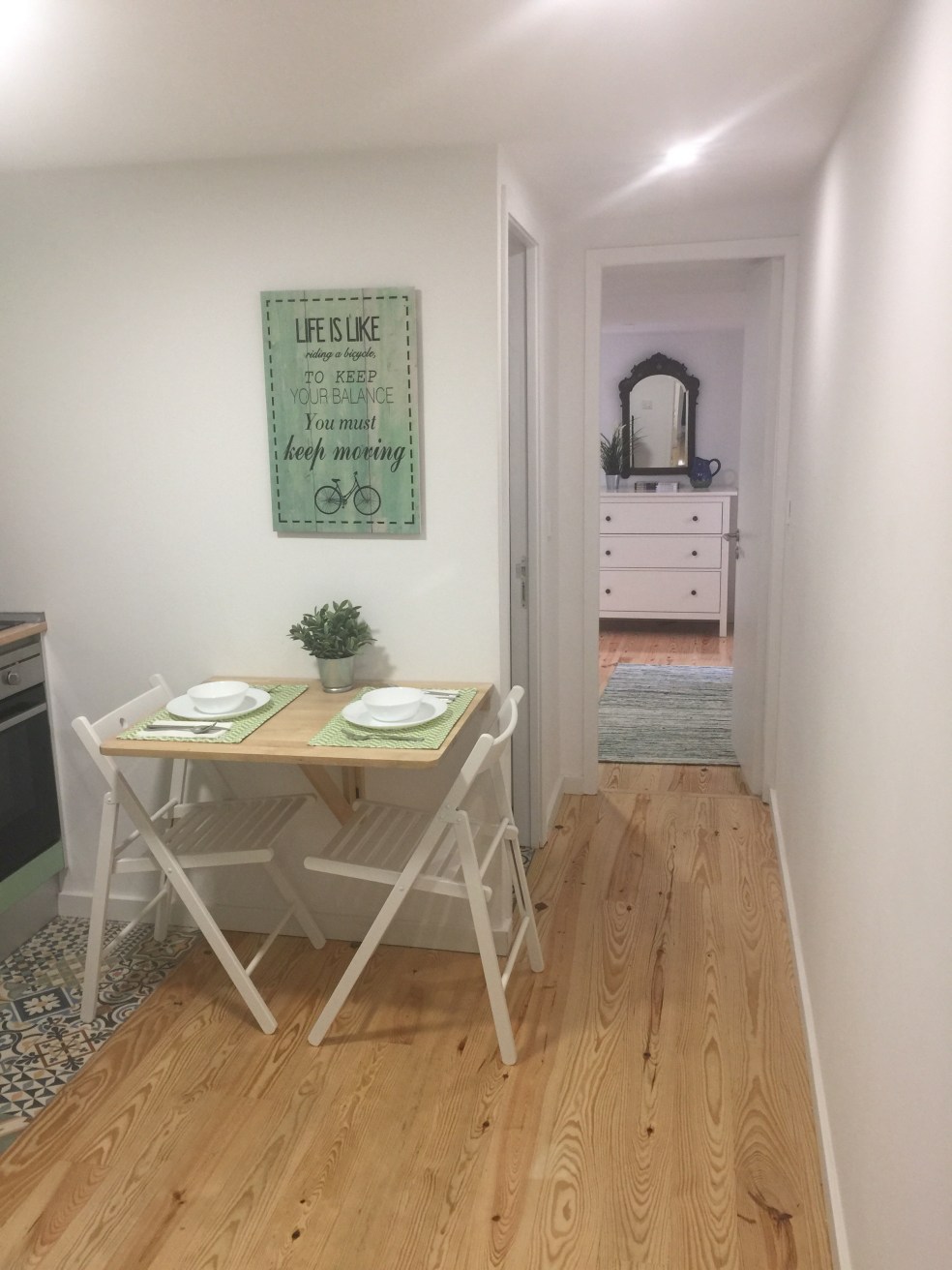
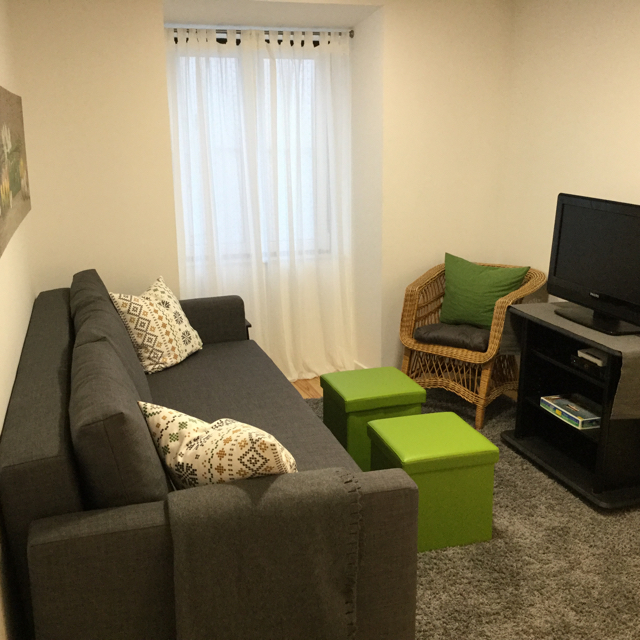
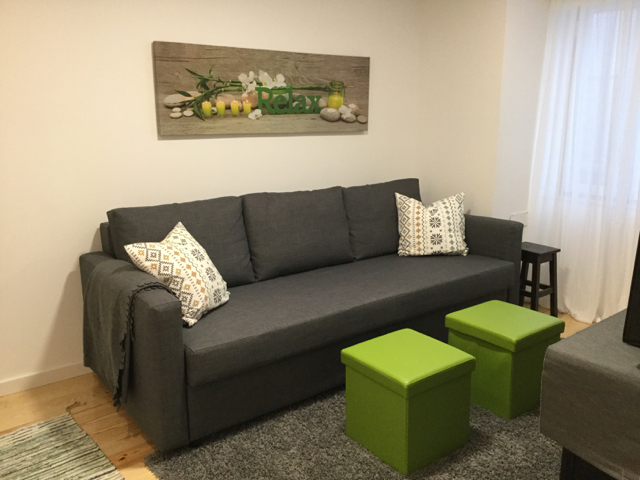
Lastly, below are pictures of the inside of our apartment in Alfama. If you do a search on “Panteão Nacional Lisboa” in Google Maps (a very cool and huge cathedral), you’ll be within roughly 50 footsteps of the apartment.

Pretty soon, it will be up on Airbnb and Booking.com and so forth. If you’re a Facebook friend of ours, or a relative, start planning for a very inexpensive way to stay in Lisbon. It’s a very cute little apartment, and of course Carolyn did her usual impressive job making it all the more so. Let us know what you think!

IMG_4552IMG_4561IMG_4571IMG_4545IMG_4547IMG_4548

IMG_0202IMG_0207IMG_0210IMG_0212

IMG_4635
Walk out the door, up the small alley and a few steps, and this view of one of the more impressive buildings in all of Lisbon greets you!

Honey We’re Home!

After over 5,300 miles, five separate living accommodations, dozens of prospective homes viewed, thousands of kilometers driven around the countryside, nine trips to Ikea, numerous interactions with the Portuguese bureaucracy, living without WiFi for over a month, fifteen arguments about whether the GPS was telling us to veer slightly right or stay straight within the three seconds allotted between the decision and running straight into the divider, countless cappuccinos and pastries (setting us back only a couple of bucks each time), and just a few batatas consumed… we are home.IMG_4614

We love our new house. It’s in the countryside, where it is amazingly quiet. Well, that is until you go outdoors, where you can hear dogs barking, birds chirping, a turkey warbling, a rooster crowing, bees buzzing, and a continuously annoyed goose honking from just up the road. But as soon as you walk back inside, the blood coursing through your ears is about the only sound you hear. Unless it’s at night when either of us can hear the other snoring. I think we’re alternating snoring nights, but I’m sure I have a few more than her.

We’re busy furnishing the house right now, so inside pix will have to come later, as well as an opinion piece about Ikea, which alternates from heavenly shopping and appreciation of its genius, to looking at the 154 pieces intended to make a nightstand and calling the manual the Instructions from Hell.

Carolyn predictably wanted to change the wall colors, so we decided, being retired and all, we’d just paint it ourselves. The bathroom ceilings were an awkward light blue, so that was the first on the agenda. I taped the walls, stirred the primer, dipped the roller, and proceeded to drip whiteness everywhere except the blue ceiling. Any primer that happened to stick to the ceiling only served to make the blue just slightly lighter in streaks. The rest of the blue more or less spat off the primer, as if taking offense to the idea that we wanted to cover it up. It was having none of that, and the thin primer was complicit.

The stuff was so thin that I spent more time trying to catch the drips than rolling more of it onto the ceiling. After only about eight rolls, we decided to bring on the calvary.

We are very fortunate in that the seller of our house was a very detailed English gentleman who left us awesome notes about everything we need to know about the house, including who painted it for him in the past. So we rang up Luis, he showed up the next day to talk about it, and the day after he’s waxing paint poetic on the walls. Best money we’ve spent so far!

IMG_4627
Luis saves us from an eternity in Hell due to all the swear words we didn’t have to utter. On the right is the old color, on the left the new.
IMG_1717
Our crack transition/realty team celebrating the purchase of our home. We couldn’t have done it without them, and in addition, we have lifelong friends in the bargain.
IMG_4535
This is us toasting our new apartment. We kinda didn’t get around to doing the same thing in the house because we have been near exhaustion getting everything taken care of. We’re working harder in retirement than when we were working! And the pay sucks!
IMG_4606
Carolyn enjoying her one-course dinner at our makeshift dining table.
IMG_4617
This is the view from my office in the attic. You can barely make out the line of the ocean there, but it’s there. If you were to take off as the crow flies and fly some 4,000 miles, you’d land in Brazil, with virtually no land in between.
IMG_4622
Carolyn has really turned the corner into becoming Portuguese. After insisting that we needed to have a clothes dryer no matter what, she’s finding out that the air drying thing really does work! It’s faster, cheaper, and very green! To the left is our very own lemon tree… I’m enjoying hot water with lemon wedges just about every morning.


IMG_4619
This is the view that greets us when we leave our little street to head toward Sesimbra. In the distance is the west side of Lisbon, which includes Cascais. In front of that is a long, beautiful stretch of beach that has been called the most beautiful in all of Europe.
IMG_4624
I had to run an errand to the local hardware store about 10 minutes away to get a part Ikea forgot to include, and when I was turning the car around, I spotted a little road and decided to see where it led. Five minutes later, I had this view of Sesimbra. We haven’t even begun to explore!


Would You Like Uma Batata With That?

SpudI recently complimented a young Portuguese man on his excellent English. He credited his skills to the Indiana Jones movies and the Cartoon Network. After I told him of our efforts to learn Portuguese, he told me, with some degree of sympathy, that Portuguese is ranked the sixth most difficult language in the world to learn.

Frankly, I’m more than happy to proclaim Portuguese the most difficult language in the universe to learn. Of course that’s a little self-serving, as it makes every word we memorize that much more exciting, like when baby has his first poo or getting a trophy for twenty-sixth place out of thirty in the first grade for taking the shortest pee break.

With a great deal of effort and hours of study, we’ve made it this far:

Me: “Hey, honey, I just memorized the word for banana!”

Her: “Oh, what is it?”

Me: “Banana”

Her: “Oh brother.”

Me: “Yeah but they pronounce it different. It’s like ba-NA-NA.”

With that, you can see why I took such pride in memorizing the word for a potato, which is “uma batata.” “Uma” means “one” or “a.” The male version, which is spelled “um,” is pronounced just like a harsh grunt, which makes sense as a masculine word. This also means if you’re going to say “a grunt,” except make the noise for grunt instead of the word, you would say “oogh oogh.”

Which also means if you politely order one Uma Thurman doll, you would say, “Uma Uma Thurman boneca por favor.” Once presented with the doll, you would say “obrigada” if you’re a woman, “obrigado” if you’re a man, and nothing if you’re a bit of a butthead.

Nouns in Portuguese have either masculine or feminine attributes assigned to them. However, certain words, like “thank you,” are dependent on whether, as the speaker, you’re male or female. To cover the doubtful areas, such as if you’re a hermaphrodite, you default to male (in case you were wondering). By the way, the “o” at the end of words is pronounced “ooh,” just because you don’t earn sixth place by being the same as everybody else. So if you’re a man saying “thank you,” it’s like being surprised at seeing an obrigad. “Obrigad-ooh!” But don’t ask me what an obrigad is, we haven’t gotten that far yet.

As far as I can tell, everything that ends with an “a” is feminine, all the rest are masculine. Interestingly, the words for “transgender” and “asexual” are masculine, apparently because they didn’t want to bother with a third option. In any case, the powers that be who were responsible for assigning the genders way back when, apparently decided “potato” would be feminine. I won’t question the reasoning because men are just as likely to be shaped like a potato as women.

However, this must serve as proof that carrots must have had a different shape long ago, as the word for carrot is “cenoura.” Since it ends with an “a,” it’s feminine. That doesn’t make much sense to me, at least in regards to the shape of today’s carrots, especially when you realize that cucumber (“pepino”) is masculine, and rightfully so. But if carrot isn’t masculine, I don’t know how we’re supposed to figure this stuff out ahead of time, unless carrots used to be in the shape of potatoes. That’s the only way I can explain it.

Since we’re currently only armed with the total vocabulary of: please, thank you, sorry, I don’t speak Portuguese, banana, and a potato, I figured we could milk this thing for all it’s worth, especially since the Portuguese people are so patient and kind, even more so to foreigners. I thought, “wouldn’t it be fun to respond to nearly every question with a vacant smile and the simple retort of: ‘Uma batata?’”

At the check-out line in the grocery stores, we’re constantly bombarded with a machine-gunning of questions that sound like, “Porbridasush-issimorrr-shtush Continent shooma-mush-shoosh?” Which we figured out means, “Do you have a Continente card?” Continente is one of the largest chains of grocery stores in Portugal. The bigger stores rival the size of most sports stadiums, and contain enough supplies for several thousand people to weather the zombie apocalypse for a couple of decades. Especially since the dried cod would easily last that long. Sure, by year twenty their diets might only consist of dried cod and Twinkees, and they’d all smell like dead fish, but at least they wouldn’t be eating brains.

We assume that with a Continente card and a large budget you can amass enough points to pick out a prize from an awards chart that starts out with a small rubber ball and goes all the way up to owning your very own continent. We’re not going to shoot for that, however. Most continents have multiple languages, and we’re only up to “a potato” in Portuguese. Besides, we haven’t applied for a Continente card yet. An address that consists of “uma batata” probably wouldn’t get very much mail.

So far it has tickled us silly to see the expressions on the clerks faces when their query as to the status of our card-carrying membership is met with the answer, “A potato.” Granted, “uma batata” alone sounds funny to our English-speaking ears, so I think that aspect of the humor is lost on them. All they’re left grasping onto is the idea that perhaps Americans really are just crazy. Maybe we should say “batata” in an English accent so they can blame it on the Brits. Of course, we’ll still be giggling in an American accent. There’s only so much one can do.

There are all sorts of scenarios I can envision with this ploy:

Cashier at McDonalds,” What would you like to order?”

Reply: “A potato.”

Ticket taker at a theatre: “Which movie would you like to see?”
Reply: “A potato.”

Irritated Cop: “May I see your license and registration please?”

Reply: “A potato.”

Inside a confessional: “Bless you my son. How long has it been since your last confession?”

Reply: “A potato.”

You get the idea. Again, “uma batata” just sounds funnier so you can substitute that for added humorousness, but much of the humor is in knowing what the inquirer is hearing.

As a result of all this spud-itity, I find myself constantly singing this song in my head: “uma batata, uma batata… it means no worries… for the rest of your days! It’s our problem-free, philosophy! I say uma batata!”

We’ll see if our ever-expanding vocabulary creates more fun for us as we pinball around Portugal, leaving baffled Portuguese in our wake. But for now, “uma batata” is providing us all sorts of entertainment in our retirement. It’s the little things that keep us happy these days.