
Category: Uncategorized

The Number One Thing We Love About Portugal
 The People
(at least when they’re not driving)
When we first talked about moving to Portugal, our main considerations were the weather, the location, the cost of living, and the safety. Much to our surprise, we’ve discovered that our favorite thing about the country is none of those.
In a previous blog I wrote that the Portuguese reminded me of Eeyore, who is completely lovable and yet oblivious to the fact. Somehow, he manages to be morose, self-deprecating, and continuously depressed, and still be totally adorable.
The Portuguese are not quite so gloomy, of course, but they love to flail themselves over their negative nature. I’ve had multiple Portuguese self-criticize their culture as pessimistic. They tend to be a little somber and reserved. They are not overtly humorous, and they’re quick to criticize their own people collectively.
But as an American who enjoys pondering the differences in cultures and wondering how they got where they are and how it all works, I actually look at the Portuguese pessimism and find it endearing.
Typically, pessimism is categorized as a negative word. But that’s just because people doing that categorizing are being pessimistic, ha! Seriously, one of the cornerstones of my personal philosophies centers around humility. The employees at the company I ran for years can attest to that. I ranted about it and built programs around it until they were begging for me to become arrogant.
 Almost every negative personal interaction I’ve seen has at least one of the combatants suffering from a lack of humility. A lack of humility can mean arrogance, or it can mean a lack of self-confidence, which often looks like arrogance. A lack of humility causes many people to decide what’s right for everyone else, and they often stop caring about contrary thoughts and ideas. A lack of humility usually results in the judging of others, and self-justifies all sorts of bad behavior.
So while pessimism might be a worrisome trait for some, it’s a flip side from the lack of humility. And if you believe, like I do, that the lack of humility is at the core of almost all bad human interactions, you tend to embrace the pessimism and love the people for it. If nothing else, I’d take it hands down over a culture of arrogance any day of the week.
 That said, not every cultural behavior here is the best. The Portuguese tend to be pretty pushy and a little bit rude in stores. I’ve had people step right in front of me while I’m standing in front of a grocery store display with nary a “desculpa” (excuse me). We’ve watched them bully to the front of the line multiple times. I’ve offered up a “desculpa” probably 20 to 1 for inadvertent contact, they usually just ignore it all and keep going.
We were told by the prior owner of our house that it might take five years for a neighbor to greet you, and another five years before they engage in a conversation. Four and-a-half years to go, and he’s right so far! They also don’t tend to greet strangers with a lot of initial and overt warmth, but they’re almost always polite. It’s rare that I’ve passed a stranger and not been the first to wish them a “bom dia,” although they almost always respond in kind with a nice, sometimes shy, smile.
 But it’s on the road where some of them can be quite aggressive or downright rude. Especially, and I kid you not, females in Peugeots. It’s a running joke and oft proven true that if someone cuts us off or tailgates us while chomping at the bit to pass, it’s probably a female in a Peugeot. We once had someone honk repeatedly at us simply for slowing down to look for a parking space. That time it wasn’t a female in a Peugeot, which actually surprised us a little.
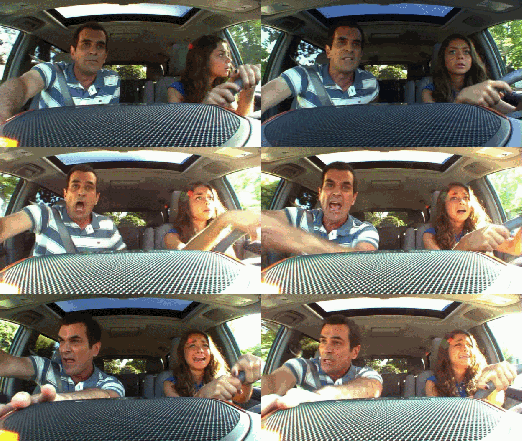 Recently, Carolyn and I were crossing a street. When we entered the street, the walk sign was green. By the time we got to the other side, it had already turned red (they apparently don’t time them the same way as they do in the states). The driver waiting for us to cross (and we weren’t walking that slow… we may be retired, but we’re not decrepit!) gave us a significant piece of his mind. Our Portuguese isn’t good enough to understand streams of invective, but we got the gist of it. Being delayed two additional seconds in a car is enough to irritate many Portuguese for some reason.
 I’ve also had high beams flashed at me even as I am passing a car on the right. Take a chill pill! For some reason, once some Portuguese get behind the wheel, all their pent up aggressions come to the fore. Even fellow Portuguese have complained about this to me.
But, the warmth is there as soon as you engage them one on one. Other than the above, we’ve found most of them to be basically decent and kind, and more than willing to assist when asked. Once you peel back that shy veneer, they’re humble, gracious, and generous. They have a basic decency about them, which I think is just one of the reasons Portugal is considered one of the safest countries in the world.
They do get a little baffled about the American sense of humor, as well as our casualness. They’re generally a little more proper than Americans, I suppose. Although I do really like the cheek-kiss greetings. They convey warmth and a willingness to share personal space.
 I’ve been asked by other Americans what the Portuguese think of Americans. Aside from the virtually universal detesting of Trump (a fact that is true of most Europeans), they love America, and they love Americans. It’s pretty funny that in Portuguese “trumpa” literally means “shit;” I’ve heard it exclaimed with vigor more than once when the subject of politics comes up. They also know more about American politics than most Americans, and all without fake news, imagine that!
The best analogy I can come up with about how they feel about the US is how you might feel about living in the same neighborhood as a very wealthy family. This family has a house so big they need hired help to keep it clean. They drive fancy cars that can go far faster than the law allows and gobble up fuel like cruise ships. They have all the toys their hearts desire, and want for nothing.
Except they’re miserable. They work too much. Their kids are on drugs. They’re constantly fighting with each other. The company he owns pays barely enough for the employees to make ends meet. They have affairs, and the man even brags to his buddies about the women he can grope because he’s rich and famous. Despite being given all the worldly possessions they’d ever want, or perhaps because of that, they appreciate very little, and act very entitled. A recent study proved that empathy weakens as wealth and privilege grow. Poorer Americans think if they could just get there they’d be different. I think the Portuguese know that’s simply not true.
I think that in the end the Portuguese look at America just like that, and while they’re quick to acknowledge that having all that stuff might be kinda cool, are pretty much just content to be living in Portugal. I know we are.
 Anyway, I never would have thought that one of the most endearing things about Portugal would’ve been its people. They fly well under the radar, so no one seems to give them a lot of consideration. But I feel right at home among them, and in all my travels, I’ve never encountered a culture that made me feel so comfortable.


Number Two of the Top Ten Things We Love About Portugal
 Location, Geography, and Flora & Fauna
Much of the reason we chose to move to Portugal was so we could use it as a launching pad for exploring Europe. You wanna quick trip to Rome? No problem! For under 200 bucks and in under three hours, we can have you twirling spaghetti and splattering tomato sauce all over your shirt like any obnoxious tourist. You wanna fly to Paris, or London, or Berlin, or drive to Spain? No problemo, señor! It’s all very quick, and comparatively inexpensive, especially when comparing it to a trip from the states.
However, now that we’re in Portugal, our desire to leave it in order to explore has been tempered, at least for the time being. We’re already in paradise… it’s hard to want to leave paradise, y’know? I’m sure we’ll get our wanderlust back into gear after a while, but with temperatures in the 80’s most days and near-continuous blue skies –not to mention some of Europe’s best beaches less than ten minutes away– it’s easy to see why we’re content to stay put for now.  Besides, we’re still settling into our house (taking our own sweet time… we are retired after all), and our tourist visa has long expired, meaning there’s a chance that if we venture outside the country we might get hung up in the famous Portuguese government bureaucracy upon our return and not be allowed back in. Don’t worry; we’re completely legal, we are just skirting on the edges of the system until we can get our one-year visas nailed down.
 But back to the beaches: I mean, how can you beat this kind of weather plus be this close to beautiful beaches? The only downside to the beaches is that the Atlantic ocean is pretty chilly. Not the deep-freeze-your-bones cold of the Pacific Ocean along Oregon’s coast, but you either need to be wearing a wetsuit, be impervious to cold , or be a kid (because they lack nerve endings) in order to withstand much time in the water. On the plus side, there are not rows of condos or hotels or tourist traps lining the beaches. You simply drive to a spot and walk on a beach that extends as far as the eye can see. With just a short hike, you can pretty much have a beach all to yourself. Carolyn and I drive down to the beach about once a week, weather permitting, just to sit and stare and listen to the waves, and wonder how the hell we got so lucky to have a life like this. Okay, luck and a lot of hard work leading up to it, but our gratitude knows no bounds.
 There are more or less two Portugals, aside from the small differences in regions. One is Lisbon, or most any Portuguese city, and the other is the countryside. Images of Portugal usually start with the “Tram 28” cable car in Lisbon, made famous for its bright yellow color, a route that takes it along some famous Lisbon sights, and the extremely crowded and uncomfortable seating. I think the Portuguese probably make a little fun of the tourists when they ride Tram 28. “Eles adoram o transporte público mais desconfortável que temos!” Which means: “They love the most uncomfortable public transit we have!”
You also certainly can’t ignore the dominance of the terra cotta roofs, which not only scream “Portugal!” but make any view over the rooftops quite striking.
 Since Lisbon is a very old city and extremely compacted, there aren’t a lot of green spaces within the city itself. Certainly there are some parks and green things here and there, especially on the outskirts. But it takes a trip into the countryside to see the real beauty of Portugal’s flora.
We’re very fortunate to live out in the country. Outside my upper-floor office window I can gaze across a sea of green, and beyond that, the ocean (on a clear day anyway). The trees aren’t tall evergreens like in Oregon, but it’s still green and lush.

A walk along the road or on the many paths that criss-cross the area between our home and the ocean reveals wildflowers in a multitude of amazing colors. I love the blues and purples that many of them feature.  Some of the fauna has a scrub brush flavor to it, but unlike some desert-like areas, the green dominates the landscape.
 As to the flora, since we live in the country, we can hear plenty of barking dogs, honking (and hissing) geese, warbling turkeys, clucking chickens, buzzing bees, and a large variety of birdsong. It’s never overbearing or annoying, especially since we know it comes with the territory. Besides, a short walk will take you to a place where the only sound you hear is your breath especially if you just walked up a big hill (okay, maybe a little one too, we aren’t getting any younger), and the wind. (Not the breaking kind. Okay, maybe a little of that too. Again, we’re not getting any younger.)
While the following isn’t something I’d normally be happy about, I do appreciate the fact that there are few large wild animals in Portugal, at least in the area where we live. Aside from the various insects, I’ve only seen an occasional jackrabbit and of course there are plenty of birds. Okay, I did stumble across a badger once… and okay, maybe it was just roadkill (it still made me jump back a couple of steps- it was fresh and looked alive!), but a badger is definitely not an animal I want to meet without tire tracks running down its back.
Badgers are not something anyone should want to meet in the wild. In fact, the Narnia High School Graduating Class of 2015 voted Bennie Badger the Most Likely to Get Sentenced to Twenty Years to Life. They are mean, low to the ground, and have claws that would turn Scarface into Noface, even despite the gunfire from his “little friend,” because badgers are impervious to bullets. They also can leap the tallest ant mound in a single bound, and can defuse an atomic bomb in under three minutes, blindfolded. They’d also take on an elephant if one walked too close, or tried to start an argument about politics. Badgers are notoriously conservative, and elephants, as we all know, are extremely liberal. So while there may be no lions or tigers or bears, oh my! badgers are at the top of my list of things to avoid in Portugal.
But other than badgers, there aren’t many animals to be afraid of. Why is that good? Well, when you walk on those paths and find yourself all alone, armed with nothing but your wits and a cell phone, you appreciate the fact that there are no bears or cougars (or even younger women) or other predators hiding in the bushes ready to pounce.  I don’t know if it’s because humanity has dominated the area for thousands of years or whether the fauna and proximity to the ocean just isn’t conducive to a lot of wildlife, but it makes me feel a little safer knowing that the only thing I have to worry about is falling to my death by accidentally stumbling over a cliff. Especially if I’m being chased by a tire-free badger.
In the end, the flora, fauna, and location of Portugal make it our país paradisíaco – paradise country!
But despite this wealth of riches, there is still one more thing… the thing we like best about Portugal!

Number Three of the Top Ten Things We Love About Portugal
 The Climate
Lisbon’s climate is defined as Subtropical-Mediterranean, and features short and very mild winters and then warm summers. They had me at Subtropical.
Its climate seems very similar to San Diego’s, often considered the city with mainland America’s best weather. The average annual temperature is about 70 degrees during the day, and 56 at night. It doesn’t get much below 50 degrees during the day even in January, and is classified as having Europe’s warmest winters. In those winters, Lisbon has about three times more sun duration than in the northern half of Europe. In August, the warmest month, it gets up to about 90, although it can certainly top 100.
While you could make a case for Hawaii’s climate being true paradise, there’s something to be said for some variation and seasonality. Instead of 80 degrees year-round, we get a reprieve during the winter, and without having to deal with snow. The reprieve also provides a built-in reminder as to why you enjoy eight months of warmth and sunshine so much.
 We’ve been able to go to the beach since April. We still have had bouts of rain, but as Oregonians, we actually think that’s pretty cool too. It just never seems to last more than three to four days, as opposed to the October-through-June drizzle of Oregon.
We’re especially fortunate to be living just outside of Sesimbra. So far we’ve seen some hot spells where Lisbon is about 4-5 degrees warmer. Plus we have a steady breeze due to both our proximity to the ocean as well as our being on a peninsula, where we’re virtually surrounded on three sides by ocean.
 Whenever there’s a hot spell, we spend a lot of time in our pool. As we do so, we constantly marvel at how fortunate we are to be living in what can only be described as a permanent vacation. Sure, since we elect not to wear full-body sunscreen armor like the folks to the right, so our skin will probably age and get crinkled faster than if we were in rainy Oregon, and what little hair I have may get sun-bleached blonde… okay, maybe just from grey to white. But our goal isn’t to create nice-looking corpses. We’re having a great time, and the climate plays a big part in that.

As you can tell, we adore the climate, and that alone would keep us here. As it happens, there are two more things that we love even more about Portugal!
Number Four of the Top Ten Things We Love About Portugal
 The Cost of Living
Portugal is not a wealthy nation, but honestly I don’t think that’s such a bad thing. To quote just one source (the Bible): “…woe to you who are rich, for you have already received your comfort” and “…the love of money is a root of all kinds of evil” which makes Portugal a shining example as to why that admonition works, even for a country.
As an aside, I think the Portuguese are the Eeyore of Europe. They have it a lot better than they think, but they tend to look at the negative side of things, just like Eeyore. And everyone loves Eeyore, he just doesn’t know it.
Of course, Portugal is by no means a poor, third-world country, but it doesn’t appear to obsess over obtaining wealth, either. The people’s needs are generally met, with very inexpensive healthcare and college education providing comfortable cornerstones. They also appear to have a “live and let live” approach, which may have something to do with not allowing money to become the primary focus of their lives.
(One caveat to that is that I’ve noticed fairly long lines in specific stores that sell lottery tickets. I guess the easy road to riches is tempting for lots of people, especially those who don’t see any other way to get them.)
In any case, in the US at least, there are many who believe that wealth is somehow a sign of God’s grace (despite the aforementioned biblical verses). That conviction keeps popping up over the eons, because, well hey, rich people enjoy being rich and everyone else wants to be. So all sorts of justifications are generated despite all the evidence to the contrary. Indeed, throughout history, the kind of wealth that’s currently concentrated in as few hands as it is in the US has never ended well.
Portugal doesn’t have loads of riches coursing throughout its economy, turning everyone frenetic in their quest to grab their piece of the pie so they can buy a bigger and nicer car, house, XBox, smart phone, computer, or $600 handbag. There is far more equal footing here than in the US. It looks to me as if almost the entire country is more or less middle class, especially by international standards. The result is a lot less lusting, a lot more inclusion, a lot less crime, and a lot more embracing of friends and family. Or maybe it just makes everything less expensive, which we certainly appreciate.
We pay $30 a month for internet services that cost us $150 back home. We paid $50 total for a half hour visit to a doctor without any insurance involved. We pay 17 cents for a 1.5 liter bottle of water. Going to the movies is about half the cost as it is in the US, plus you get to read Portuguese subtitles during the movie. Bonus! You can also get a great cup of coffee and a pastry for a couple of bucks.  The list goes on and on. When you’re coming from a wealthy country with its exorbitant costs, everything in a poorer country seems like price-paradise in comparison.
Much of today’s American political dysfunction centers around money: how to generate more, or spread more around, or restrict more from the government and so on. In Portugal, there is no similar huge divide. Certainly, everyone’s not united in every belief by any means, but because there are no perceived riches to shove past others to go after, there is simply a lot less angst.
The comparative political peace and quiet here, the basic way of life unencumbered by lust of money, and the acceptance that life should be simple, and that family, not money, should be at the center of it, really makes us love Portugal.
 I have an analogy about all that too. Let’s say you have two rooms and a group of kids. One room is stocked with candy. The other has vegetables. Now, if you ask any kid which room he or she would rather spend time in, they’ll naturally pick the one with all the candy. But if you divide them up randomly and put one group in the candy room and the other in the vegetable room, the kids who go into the room with all the candy will undoubtedly end up fighting over who gets what (not to mention gaining weight and damaging their teeth). In the other room, the kids would most likely just eat their vegetables without much of a fuss (until their friends from the other room bragged about all the candy they got to eat, I suppose). They’d be better behaved, healthier, and overall, just plain happier.
So I’m not saying most Portuguese wouldn’t want to live in a country with as much candy -er, wealth as the US, but the reality is I think they’re a lot better off, and happier, here. Except for the Eeyore thing I guess.
As for us, our goal here is to live on something between two and three thousand a month, keeping in mind we don’t have a house payment. Living on a budget like that is the only way we could afford to retire early, bridging the gap between now and when social security kicks in. It should all work as long as we don’t live to be 100, and if we continue liking Top Ramen.
 This budget includes $450 a month for health insurance, which is only a major medical plan. Since regular doctor visits are so cheap in Portugal, unless something catastrophic happens, we’ll probably never touch the policy, so it’s a bit annoying that we even have to have it. It’s only that expensive because it’s not a Portuguese plan and is something designed for expats, covering us throughout the world. We’re looking forward to obtaining our citizenship in about six years, when our overall medical costs will undoubtedly be significantly less than that because we’ll be on the Portuguese socialized medicine program, which costs nothing to belong to when you’re a citizen.
 In the meantime, a good bottle of wine here is only a couple of bucks. If worse comes to worse, we can just stay obliterated and figure everything is fine!
Number Five of the Top Ten Things We Love About Portugal
 History
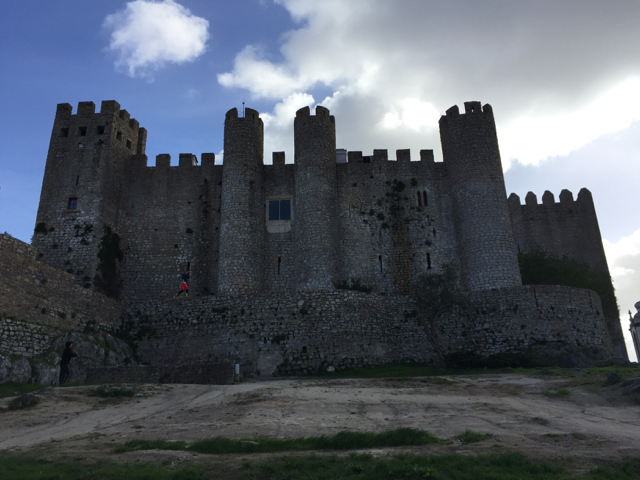
We’ve not made it a secret on this blog that both of us like castles. I don’t know if that’s because there are virtually none in our home country or if it’s because they evoke a sense of adventure: knights and dragons and damsels in distress. Or maybe they’re just the tactile evidence that European history predates American history by thousands of years. When visiting a castle, we stand on its battlement and ponder the hundreds and thousands of people who constructed it and walked upon its stones and spilled blood on them, or maybe just ketchup.
 Virtually every time we take the road into Sesimbra I’ll look up upon the hill where the castle to the right sits and marvel at it. Ten years from now will I do the same thing? I don’t know… I suppose the fascination might wear off over time. But in the meantime, I receive a rush of genuine delight every time I simply drive into town. How cool is that?
The US, with its political, social, and geographic isolation, tends to raise generations of people who sort of think world history started in 1776. But Portugal, for example, has a history that goes back over 600 years before that: it emerged as a country in 1143. And that’s just the formation of the country.  Recorded history in Europe goes back thousands of years. Humanity has left legacies scattered about the countryside, all begging to be learned about and explored.
While we were in Ireland, we visited Newgrange, which is a prehistoric monument that predates the Egyptian pyramids. Everywhere we go in Europe, we see old stuff, including castles, forts, old cathedrals, and ruins. Recently we were wandering the streets of Alfama in Lisbon and accidentally stumbled across some Roman amphitheater ruins. There was no charge to see them, and while it was well cared for, it was all tucked away, a little bit out of sight/out of mind.  These are Roman ruins, people! They’re awesome! I’d pay ten euros to see them even while I complained about being charged ten euros for seeing them!
In Rome they have bridges and water fountains that are still being used thousands of years after their initial construction. If Rome hadn’t fallen, you’d probably be reading this on your holographic device while flying to work having news downloaded directly into your brain about the latest troubles on Mars.
Much of Lisbon’s charm is that it’s an old city, and as a result, has tons of character. That said, I’ve learned over time to avoid hotels that tout their historic nature. “Historic” usually means “rooms that might be a bit too small for Hobbits.” I once stayed in a historic hotel where the bathroom was no bigger than a broom closet. I brushed my teeth with one foot in the toilet. And it wasn’t cheap!
However, a historic city is another matter. Admittedly, I wouldn’t want to commute every day through some of Lisbon’s narrowest windy streets. They weren’t designed for cars, because cars didn’t exist when they were designed. I’ve heard multiple complaints about how common it is to find your parked car with your mirrors busted off by passing cars. Most cars in Europe have side view mirrors that can be tucked in a bit, and you’re well advised to do so when parking on some of these narrow streets. But even then, it might not be enough.
But when you’re a visitor, taking in all the amazing history of the place, it’s all charming and delightful. Except when you’re walking on one of those streets and a car comes barreling toward you, oblivious to the proximity of the other cars mirrors and your presence on the street. We’ve found ourselves hugging the walls more than once, sucking in our guts, as a car trundles by.
So while Portugal is our launchpad to see much more of history throughout Europe, the country itself has a rich, storied history worth knowing and exploring.
Bring on the castles!
Number Six of the Top Ten Things We Love About Portugal
 The Food
This has to make the list if for no other reason than it’s often one of the first questions we get about living in another country: “How’s the food?” I guess that’s understandable since pretty much every human being alive enjoys eating.
It isn’t often one hears the phrase “Portuguese cuisine” when talking about worldwide culinary delights. In the US, there are tons of Chinese restaurants (like Panda Express, to name one of America’s top shelf Asian culinary experiences), Japanese (Teriyaki Express), Italian (Pizza Hut), French (any place with french fries of course), German (Hot Dog on a Stick), Mexican (Taco Bell), and Indian cuisine (Curry whatever), among others.  Ok, I know there are plenty of ethnic restaurants aside from fast food. But there are about 250,000 fast food restaurants in the US, which account for approximately 40% of the entire restaurant total (by number of locations). Unfortunately, these also account for 875% of the total calorie dispensation, a statistic I just made up, but is probably true. As an aside, I did a search on “Portuguese fast food” in Google, and got McDonalds and Burger King. Apparently there are no native Portuguese fast food chains, for which they deserve a big medal. Actually there are plenty of fast food eateries inside the many malls in Portugal, but in addition to Pizza Hut and McDonalds, they tend to feature fish, kabobs from the Middle East, or steak and eggs. I like the way they serve your food on actual plates with metal silverware.
 Okay, I got a little off track here. The point is I don’t recall ever seeing a restaurant billing itself as specializing in Portuguese cuisine. I did see one named “Port and Geese” once, but I think they served stout wine and goose. I just made that up too.
The lack of culinary famousness seems appropriate for a country like Portugal, because much of the appeal for this innocuous little place is its unassuming and out-of-the-way location and humble attitude. Whenever you see a list of countries in Europe rating things like economic indicators and the like, as often as not Portugal doesn’t even make the list. It’s one of the reasons the people here are so humble and self-deprecating. They feel like their country is not big or important enough to be paid attention to, at least any more. Hundreds of years ago they sailed the seven seas and were a world power. But no more, and they take their place at the back of the classroom with resigned acceptance.
So its no surprise that their cuisine mirrors that philosophic approach. They have no foods like souffle’, or pizza, or lutefisk, or tacos, or hamburgers, or bratwurst, or borscht, all of which immediately bring to mind a country from which it is famous.
But you don’t need something famous in order to savor the food here. While the cuisine varies somewhat in the assorted regions of the country, seafood dominates everywhere. A testimony to its deliciousness is the fact that Carolyn is a very reluctant seafood eater, but even she has enjoyed some of the dishes we’ve sampled from the sea. When we eat out with our Portuguese friends (and almost always let them order), we are often treated to a series of tapas that consist of clams, shrimp, octopus, squid, mussels and more, and they are always delectable. I’m also learning how best to barbecue rabalo (sea bass) at home. We haven’t had the courage or inclination to take one of the big flats of salted cod (“bacalhau”) home yet.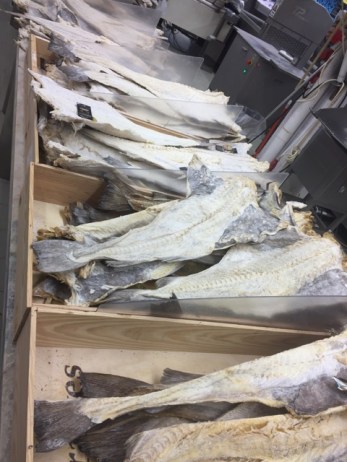 It’s a lot of work to turn that into something edible, so we’ve settled for the way we’ve (sort of) gotten used to the smell of it in the store. It hardly fazes us at all anymore, although we still get stares at the nose plugs. Sardines are also a big deal here, but those aren’t on the top of our most-favored list. Something’s fishy about those little tins.
I’ve heard multiple Portuguese comment that they eat dinner late, compared to the US: as late as 9:00 or beyond. To a person, they’ve lamented that it’s not very healthy for them, but they do it anyway. We’ve entered empty restaurants at 7:00 PM, only to leave a couple hours later with it completely full (along with our stomachs). Typically, they stay in the restaurant for 2-3 hours at a time. After the meal has been served, you have to hail the server in order to get your check. And they don’t expect tips. Sure, you round it off or leave a few euros at dinner, but that’s it. Unlike the propaganda promoted in the US, where they pretend “tips” stands for “To Insure Prompt Service,” you get just as good if not better wait service here. The tip culture has simply been fostered by American restaurants who then feel free to pay their employees next to nothing. One more thing to like about Portugal, and I think Europe in general. That said, I almost always tip 20% in the US, even though I remember when 10% was all that was expected. The only way to convert the US culture to the European system is if everyone stopped tipping, and that ain’t gonna happen.
All the big grocery stores have robust seafood and meat counters. Customers mill about in front of them after taking the obligatory ticket, waiting for their number to be shouted out. On weekends, the crowd swells to the point that it looks like they’re queuing up for tickets to a Madonna concert, who happens to be moving to Portugal herself, so I’m sure there will be a concert sometime, except without the fish.
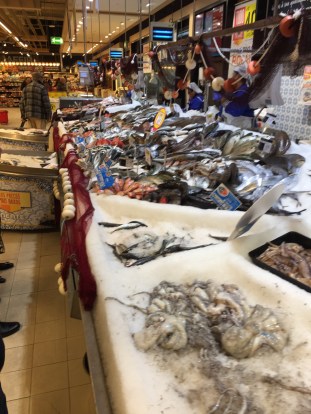 The seafood on display is varied and always interesting. Sometimes it looks like what would be found at the bottom of the tanks if an entire aquarium were suddenly emptied of water… a few hours later anyway, once all the flopping around was over. I’ve seen eels with teeth that would do a dinosaur proud, as well as stingrays, octopuses (yes, that’s the correct pluralization), and body parts of skin divers. Just kiddin’ about the skin divers, although the way the butchers wield their cleavers, I wouldn’t be surprised to see a part of a pinky amidst the meat someday.
Unlike in the US, where most meat is prepackaged for quick pick-up, the majority of meat here is delivered through a butcher’s hands. Chicken, pork, and beef are the three carne staples. They also have a lot of sausage-y things, although to be honest, they’re a little too dry and sometimes oddly flavored for our palates. Plus some of them look like they were pulled right out of a pig, left to dry, and then put in a bag.
There is little grocery space devoted to organic produce, I think because most everything is more or less organic already. There is a decided lack of mega-corporate food production, which results in healthier produce. It’s also crazily inexpensive.

Milk, orange juice, and eggs are not refrigerated in the store. We regularly buy eggs with dark shells which deliver orange yolks. We recently read that the darker the yoke, the more nutritious it is. I was going to tell a yoke right there, but decided against it.
In summary, we love the food here, even if it doesn’t have any notable international culinary famousness.
Just remember, you are what you eat.

Number Seven of the Top Ten Things We Love About Portugal
 Television & Movies
What? TV isn’t an invention unique to Portugal you say? Or did you think it was surprising that they have TV at all? I write that in jest, but before moving here I was asked more than once whether it was safe here, the presumption being that this largely ignored little country tucked into a corner of Europe must be poor and full of crime. The truth is much different. It was recently rated as the third most peaceful nation in the world, including a low homicide rate similar to Germany and Sweden, while the US’s homicide rate is most similar to Kenya, Kazakhstan, and Lebanon.
In addition, overall crime levels are 81% higher in the US than in Portugal, the rape rate is seven times higher, the violent  crime/murder rate is 105 times higher… you get the idea. And so it’s very ironic that we could ask the same question of a Portuguese wanting to move to the US, but it would be a lot more of a legitimate concern. So maybe we got out of the US to protect our lives!
Actually, the reason I list television in the top ten is all about how nice it is to be in a foreign country with a different language and still be able to be entertained in English, even if a lot of the exported entertainment involves crime solving and lots of shooting.
To be sure, this benefit for English speakers is mostly due to the size of Portugal. When we were in Spain, virtually every channel (aside from BBC news and the like) was in Spanish. The first thing we saw  when we turned on the TV was The Simpsons, dubbed in Spanish. Unless you know Spanish, there isn’t much for an American to watch. Not that watching less TV is a bad thing, but let’s face it, when it’s 9:00 PM and you don’t want to read, sometimes it’s nice just to switch on the boob tube and put your brain on pause for a while.
The truth is, Portugal is just too small a country to dub everything or produce a ton of unique content. Unedited American TV shows and movies dominate, all of them subtitled. This is true both for TV as well as in the theaters.
Another benefit to this is that we get to have our Portuguese language training enhanced by reading the subtitles while the dialog is spoken in English. It goes the other way too: the Portuguese –especially the young– learn a lot of English because of this even without any scholastic training.
When I complimented a young man on his English he told me the reason he spoke so well was due to Indiana Jones and cartoons. He said he barely needed the classroom teaching; he found himself ahead of the curve most of the time. That did answer my  curiosity as to why he greeted me with a “What’s Up Doc?” and ended our meeting with a cheery “Th-th-that’s all folks!”
The other nice thing about Portuguese TV is there are far fewer commercials than in the US. Most American half-hour TV shows deliver only 20-22 minutes of content. And movies? Ohmigod. I stopped watching network airings of movings after getting very tired of sitting through five minutes of commercials for every ten minutes of movie. In Portugal, they have much less of that. Indeed, in many cases there are no commercials in the middle of the show at all, but only as bookends.
To top all that off, the cost of internet, wireless, and a mobile telephone here is 30 euros a month. For a similar service in the US, we were paying 150 bucks: five times as much. To be sure, we had more English-speaking channels to ignore, but it clearly isn’t worth five 
 times the price. I constantly wonder why Americans put up with a “free enterprise” system that is clearly gamed for the benefit of huge corporations, and in fact is not even free enterprise anymore. Usually, you can choose from only one internet/cable provider, and they squeeze you like a python.
Meanwhile, in other countries, ostensibly “disadvantaged” with less competitive freedom (although there are four or five companies you can choose from in Portugal for these services; they all just have the same price) manage to provide similar services for a fifth of the cost. In fact, internet speeds in the US, where the internet was invented, are lagging behind many other countries, and is currently ranked 17th.
Anyway, we aren’t missing the American broadcast system. Besides, we do get to watch The Game of Thrones, Veep, Fargo, Modern Family, and Silicon Valley, to name a few, all with a 30 euro a month bill. We do have Netflix as well; no other American TV services have figured out how to broadcast here, even on Apple TV.
As far as the cinema experience, the biggest challenge, as it is with TV, is that other than dubbing, the titles are of course in Portuguese. We’re slowly learning the language, enough so that I could walk up to the ticket counter and confidently say, “Dois para Mulher Maravilhosa,” and be reasonably confident I would get two tickets to Wonder Woman. And Indeed I did. The only problem with doing that is that they will assume I  know Portuguese and rattle off a response or a question I have no hope of understanding. But we got ‘er done and it wasn’t a bad movie. But selecting a TV show or movie is quite a bit more laborious when you have to translate the titles.
We do like the fact that the movie theaters here always sell a reserved seat with your ticket, which works even if you don’t speak Portuguese because you can point on a computer screen to select your seat. Some smaller theaters in the US also sell reserved seating, but here they seem to do it in every theatre. They also have an intermission in the middle of the show. (Which they do on TV as well- only one commercial break for about three minutes during an entire movie. That’s nice!) Since American movies are no longer created with any breaks (except maybe a few uber-long flims), the films usually stop and the lights abruptly go up right in the middle of a conversation or death-defying leap.
 Despite that small problem, it is actually kinda nice to have a built-in potty break. They don’t sell three gallon cups of soda here, so ironically the need for an intermission is actually greater in the US. I think Hollywood should return to making movies with intermissions, its an old idea but it deserves new attention. After all, our bladders haven’t grown along with the size of our sodas.
Number Eight of the Top Ten Things We Love About Portugal
 Big Ideas and Little Differences
One of the things I love about exploring another country is observing and experiencing the little differences. In Portugal, it might be how you weigh and tag your produce in the grocery store before putting it in your cart. Or how you have to take a numbered ticket for almost every queue you’ll stand in. Or how everyone is basically polite, unless there’s no number for a queue, then they can get a little pushy. No wonder they instituted the ticket system!
We also like how the home construction is so cleverly simple: most homes are made of concrete covered by the famous orange tile roofs. They’ll be standing 200 years from now. Inside, at least in our house, the rooms are designed so all the water pipes are grouped in one small area. The kitchen backs up to the bathrooms and the washer is in the kitchen (which is very common here) and the septic tank is right outside on the other side of the wall, so all the pipes are positioned within just a few square meters. There is really no need for a home inspection industry here because most of them are only a concrete shell with electricity and water added, and those lines are simple, easy to find and deal with. Keepin’ it simple. We like it!
 Perhaps due to this sturdy construction style, it’s not hard to find abandoned houses in both the city and country. Unless someone tears them down, they’ll just sit there forever. Many of those derelict buildings have For Sale signs on them; I suppose someone can just come in and rebuild the walls on a foundation built during the time of Christ, and be good to go in short order.
We also like the way they accommodate special parking needs. The US of course has handicapped parking spots near most entrances. But the Portuguese take it a step further. You can find signs that essentially say, “hey, if you’re old, or pregnant, or have a bunch of little kids you’d prefer not to see splatted on someone’s bumper, you can park closer too.”  I have nothing against handicapped-only spaces, but the vast majority of the time in the US they sit empty. Adding these spots for people who are also stressed out in a parking lot is not only a great idea, it’s compassionate. I also love the Portuguese for not needing additional messaging detailing the fines in order to discourage lazy scofflaws from using those spots. As far as I can tell, the Portuguese generally respect these kinds of signs. Of course, they’ll otherwise park just about anywhere they can squeeze a car into, but that’s only because space is at such a premium.
I’ve also taken a liking to a queuing system some large grocery stores have adopted. Instead of walking up to columns of checkout counters frantically trying to figure out which one is going fastest, and then fuming when it turns out the one next to you went twice as fast, everyone gets into one longer line and then an electronic board announces the number of the next available check-out counter. I’m not sure it saves a ton of time (unless you have a knack for always picking the wrong line), but it certainly reduces the aggravation.
The country has also adopted a very clever and simple way to pay bills. Since computers aren’t as ubiquitous as the US, the expectation that everyone can just pay the bill online isn’t reasonable. Instead, when you receive a bill, they come with an “entity” number plus a nine-digit reference number. You can then go to any ATM (aka “multibanco”), which are everywhere, and plug those two numbers into the appropriate areas, along  with the amount, and voila! the bill is paid. You can do the same with your online bank account as well of course. I know there are just-as-simple ways to pay bills online in the states, but every bank there does it a little different and every merchant extracts payments differently as well, and you pretty much have to own a computer to use them. Here, everyone plays by the same rules, and even if you don’t have a computer or smart phone, you can pay your bills quickly and easily.
Now, I know any conversation about guns is always controversial, but at least consider the examples provided when a country <gasp!> restricts gun ownership. I know owning guns is a big thing for some people in the US, and indeed, I certainly understand once you go down that road, you start feeling  like you need a gun just because maybe everyone else –especially the bad guys– probably has one already. But if virtually no one has them, it really takes a lot of the angst out of walking alone anywhere, safe in the knowledge that you’re probably never going to get shot. Portugal is one of the safest countries in the world: the lack of guns surely deserves a lot of the credit. Sure, maybe the military can take over the country a lot easier here than in the US, but there are a lot of people, including myself and probably almost every Portuguese, who gladly accept that trade-off. Besides, the chances of the military trying to take over the US only to be beaten back by a bunch of folks with handguns and shotguns is about the same as someone capturing Trump kissing Obama on video. Sure, it could happen, but do you really want to invest money into a filter that would prevent your seeing that?
I’m sure at least partly due to the lack of guns, Portugal was recently ranked as the third most peaceful country in the world, while the US came in at 114th. So you gotta ask yourself, is America’s gun culture really working?
I also like the metric system. Back in the seventies, all the talk was about how the US was moving to the metric system. I don’t know who or what stood in the way of that, but if it was a who, he should be shackled and have the number 12 tattooed on his forehead. I’m just saying ten is a lot easier to divide and multiply than twelve, and by the way, tell me how many  ounces are in a cup and how many cups are in a pint and how many pints are in a quart and quarts are in a gallon, and even if you know all of that, it makes sense how?
That said, Carolyn is slower to embrace said metric system. She still looks lovingly at her old American tape measure (and I think secretly measures with it behind my back). I’ll admit, when you’re new to the system, it takes time to mentally and automatically comprehend what 40cm looks like. She can immediately picture what 36 inches, which is three feet, which is one yard, looks like (although what’s the word for three yards? Ha! Tell me that you metric haters!*). And there’s comfort in that. But I’m confident that once the adjustment is complete, the better system will be appreciated. Just like when you switch from Windows to Mac. Ha!
 I’ve already commented aplenty about universal health care being da bomb here, so suffice it to say that it’s a big idea that trumps the American system by multitudinous kilometers, both from the standpoint of international comparative statistics and our own personal experience.
Not everything is perfect here by any means. As long as human beings are involved, paradise will only be present in our fantasies. But we appreciate the big ideas and little differences that make living here the next best thing.
* Three yards.
Number Nine of the Top Ten Things We Love About Portugal
 Waste Management
Well shit. Yep, number nine is all about crap. Also known as detritus, garbage, waste, junk, filth, debris, offal, rubbish… all of that cocô. I thought about making this category number two for obvious reasons, but the German part of me said “nein!” So nine it is.
I know this seems like kind of a crappy subject to make a top ten most favorite list. But the little surprises are the things that endear us all the more to this country, so the unexpected things get a shove up the ladder, or down the chute as it were.
 After we purchased our house in Portugal, the owner provided us with a very thorough (and extremely appreciated) list of all the things we needed to know. The names and numbers of a gardener, a painter, a doctor, the septic people, where to find everything in the house, and so on.
As I perused the three neatly typed pages, I realized there was nothing listed about garbage collection. After spending some time in our apartment in the city, we learned that you simply bag up your garbage and set it outside your front door. By morning, it will have magically disappeared. But in the country, I never spied any garbage bags sitting in front of anyone’s house. So I asked the owner about this apparent omission on his list. He told me that you simply bag the garbage up and toss it into any one of the multitudinous dumpsters sitting by the side of the road all over Portugal. Well duh. Everyone in Portugal knows that. Well, now they do.
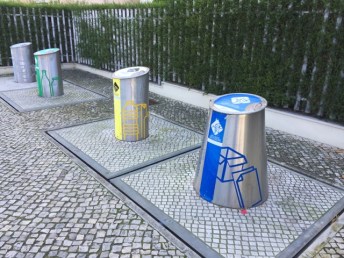
 The closest dumpster to us is just up the road, near our mailbox. Our property in Oregon had a long driveway, so I was used to hauling garbage up a road a little ways. It’s only a little bit further than that here, and well worth the extra effort anyway because there are no bills to pay afterward. We certainly cover it in taxes, but that’s completely transparent and I have to guess the whole process is actually cheaper because everyone participates and no one needs to make any money off it. I used to pay over $50 a month for garbage collection in Oregon. I doubt tax money earmarked for that here adds up to anything close to that much. Plus, they have large receptacles all over the place ready to accept recycled goods; they’re separated by cardboard, glass, and plastic, so recycling is easy for everyone, and very efficient.
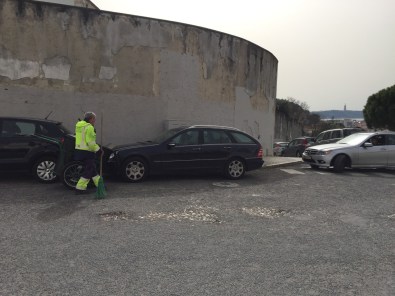 Additionally, the government employs a good number of people to sweep the streets and clean up the garbage around the city. The Portuguese are of course a vast collection of an assortment of human beings just like in every other country, except of course in Africa and Asia. Because, you know, they all look alike there. What? What’d I say? (…I’m just kiddin’, relax already). So there are always going to be occasional nitwits who toss garbage into the street, despite the ubiquitous dumpsters. Plus, the famous Portuguese sidewalk bricks often look to be held together by cigarette butts. There are more smokers here than in the states: I’m guessing the anti-smoking message here is probably ten or twenty years behind the US. But overall, the city and countryside are both relatively clean.
 I wouldn’t give them an A+, however. That grade must surely go to Singapore, where they only ban chewing gum, but the first time you throw away a cigarette butt or candy wrapper you’ll get fined $300. And the punishments go up after that. So while I’m glad Portugal doesn’t try for that grade, generally everything is cleaner than most places in the US, so it definitely gets a higher grade than most places there.
In any case, it makes my top ten because it’s so easy and efficient, and I appreciate the common sense of it all. I know free enterprise is great, but when there’s no competition anyway (we had no choice of garbage haulers in Oregon, where’s the free enterprise in that?) and it’s something every citizen must participate in (he who hath no trash, throw the first garbage bag), then having one entity to take care of it all certainly seems to work.
 I must add, however, that the one thing we don’t appreciate about waste in Portugal is that spotting dog poop on the sidewalks is pretty common. Some of it is surely deposited by the occasional stray, and we’ve seen Portuguese with plastic gloves on doing their scooping doody, but apparently the message hasn’t quite taken hold the way it has in the US. I can only add that any Portuguese who lets their dog just poop on the sidewalk ought to be damn glad he or she doesn’t live in Singapore!
Well, that’s enough shit for one day!

