
 As soon as Carolyn showed me a picture of this tiny French island with a monastery on top, I knew we’d have to visit it.
It’s one of the most striking constructions I think I’ve ever seen. It just sits out on an expanse of sand like a gigantic jagged molehill. When the tide comes in, the entire thing ends up surrounded by water. Fortunately, it’s a little sturdier than any sand castle I’ve ever built, so when the tide goes back out, there it stays, standing there as it has for nearly 1,000 years.
 To get there, you first have to catch a bus from the parking lot, which we were grateful for because it was a bit of a rainy day.
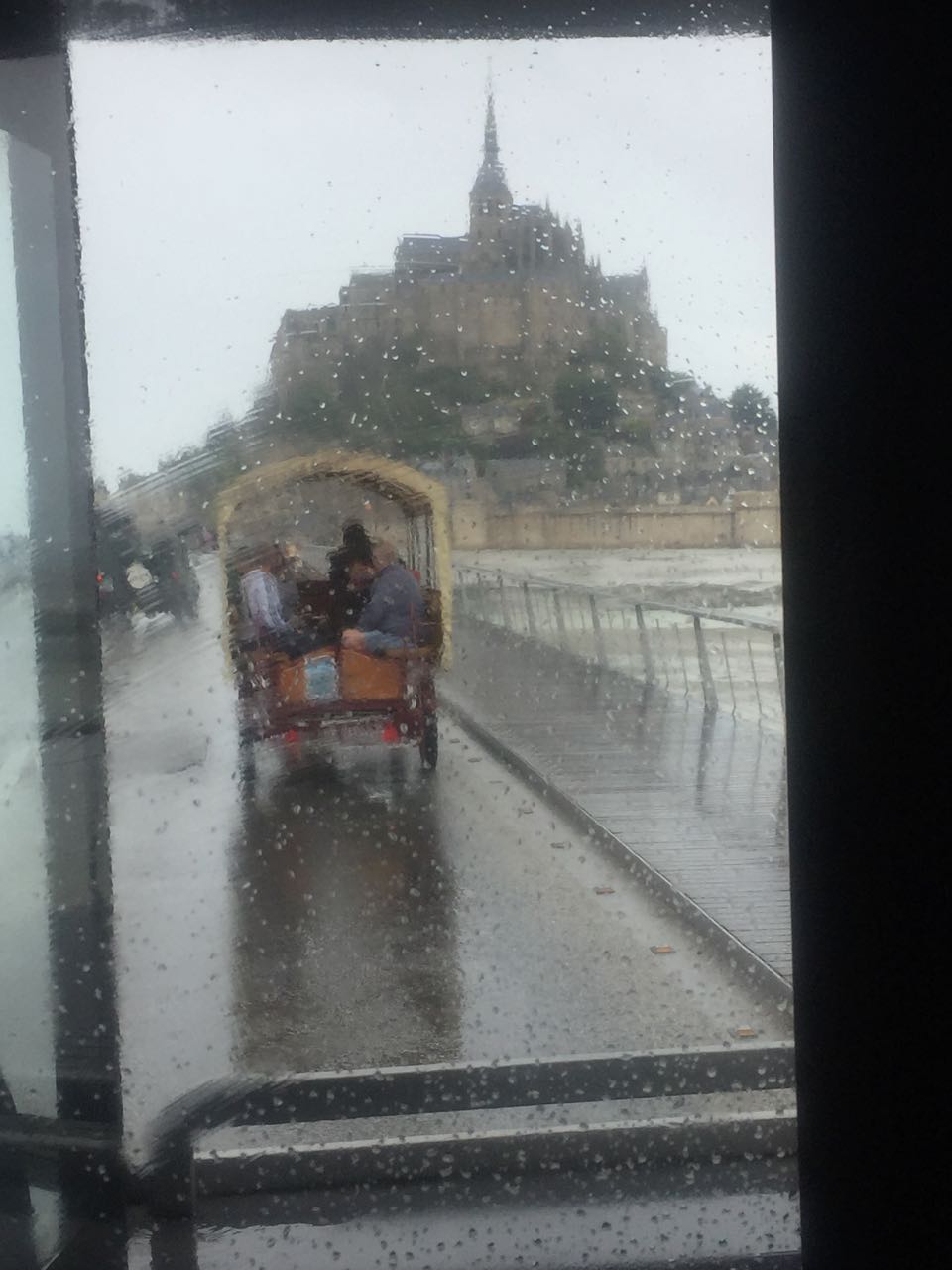 But even through the mist and the rainy windows, you can’t help but be impressed as you approach.
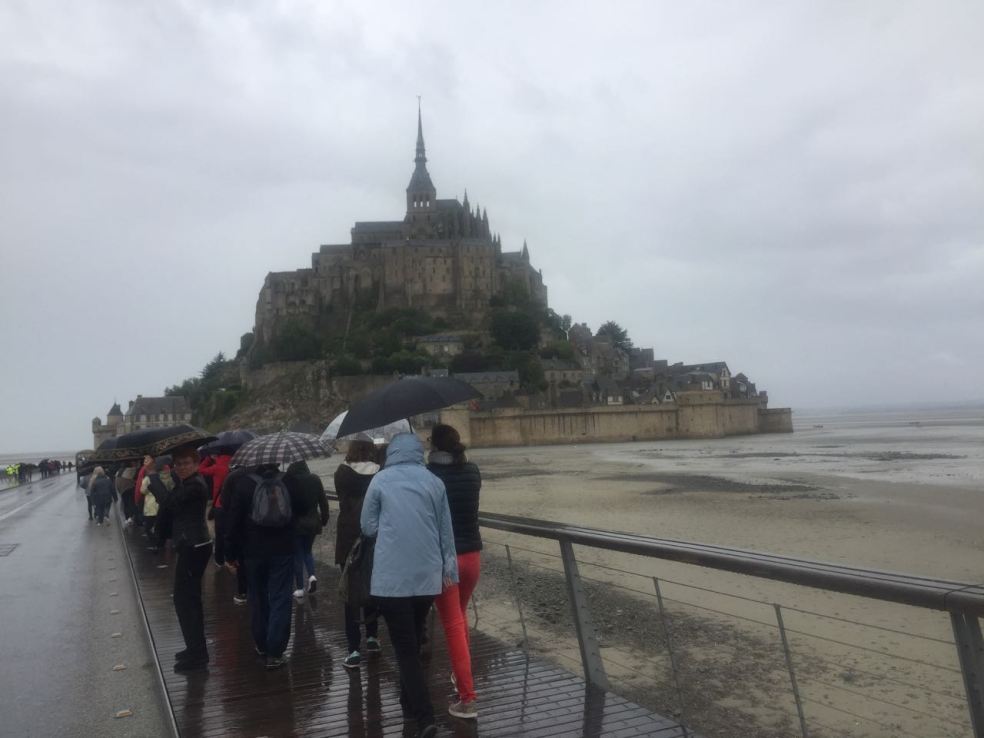 Once you get off the bus, you still have a walk on the long walkway that connects the island to the mainland.
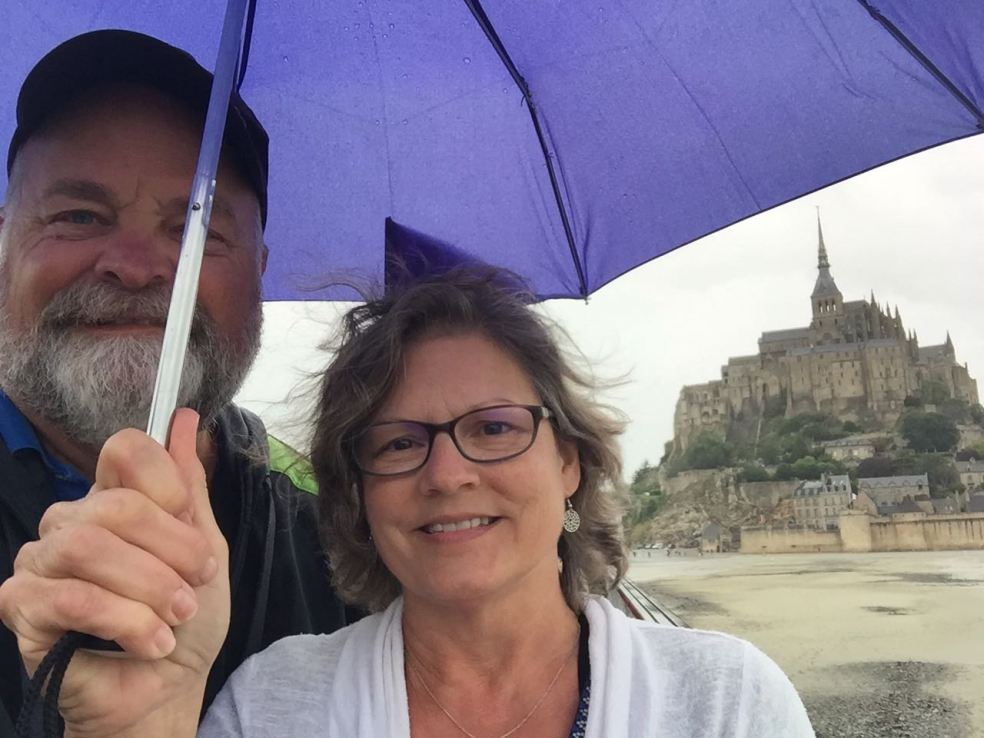 But we were smart enough to bring an umbrella, so the water didn’t dampen our spirits any.
 As you approach, the abbey looms above you like a gigantic haunted house.
 Which apparently didn’t scare the smiles off our faces.
 Upon entry into the town, you’re greeted by a cute little avenue lined with merchants hawking all sorts of touristy goods. It almost looks like something you’d see in Disneyland.


Including doors that look like they were made for Mickey Mouse.
 The island has supported strategic fortifications since ancient times.
 Since the 8th century, it has been the seat of the monastery from which it draws its name.


Once you’re in, they really don’t want to let you back out, because the island only has about 30 permanent inhabitants. But since neither of us can make or bear any children, they eventually did let us go.
 It actually was a prison for a time, sort of Alcatraz-like due to its location. I doubt the prisoners were this cheerful, generally.
 The island’s location is so strategic and defensible that when the tide came in, any attackers were stranded, drowned, or driven off. Maybe they should have called it Mont-Saint-Moses.
 These victories left the occupants, especially the king on his throne, feeling rather smug.
 The island remained unconquered during the Hundred Years’ War; in fact only a small garrison was needed to fend off a full attack by the English in 1433.
 During the Hundred Years’ War, England made numerous assaults on the island but were unable to seize it due to the abbey’s strong fortifications.
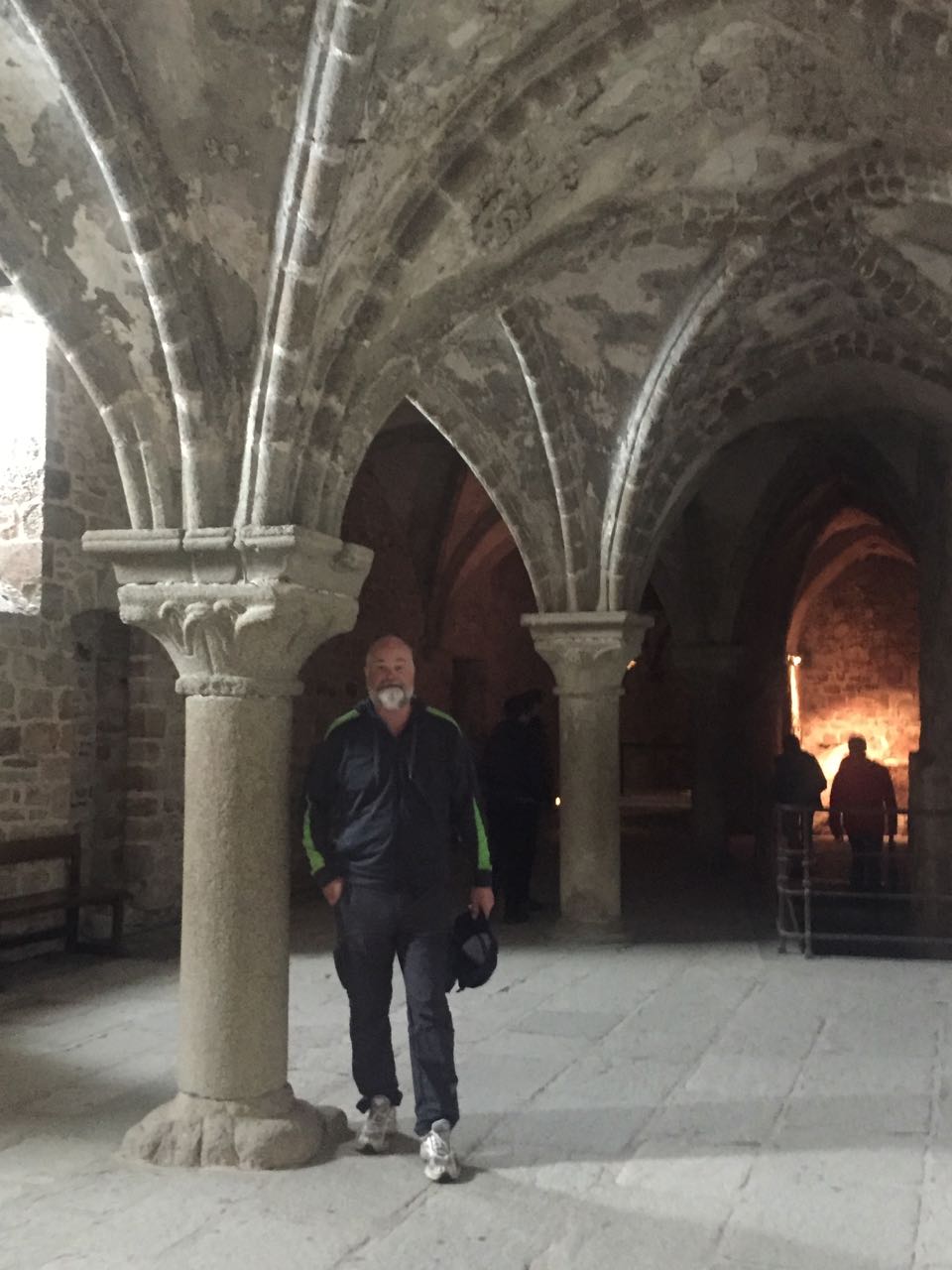 Mont-Saint-Michel is visited by more than 3 million people annually. Well, now 3 million and two. France protects over sixty of its buildings as historical monuments.
 This is either a fireplace or where they roasted their enemies for lunch.
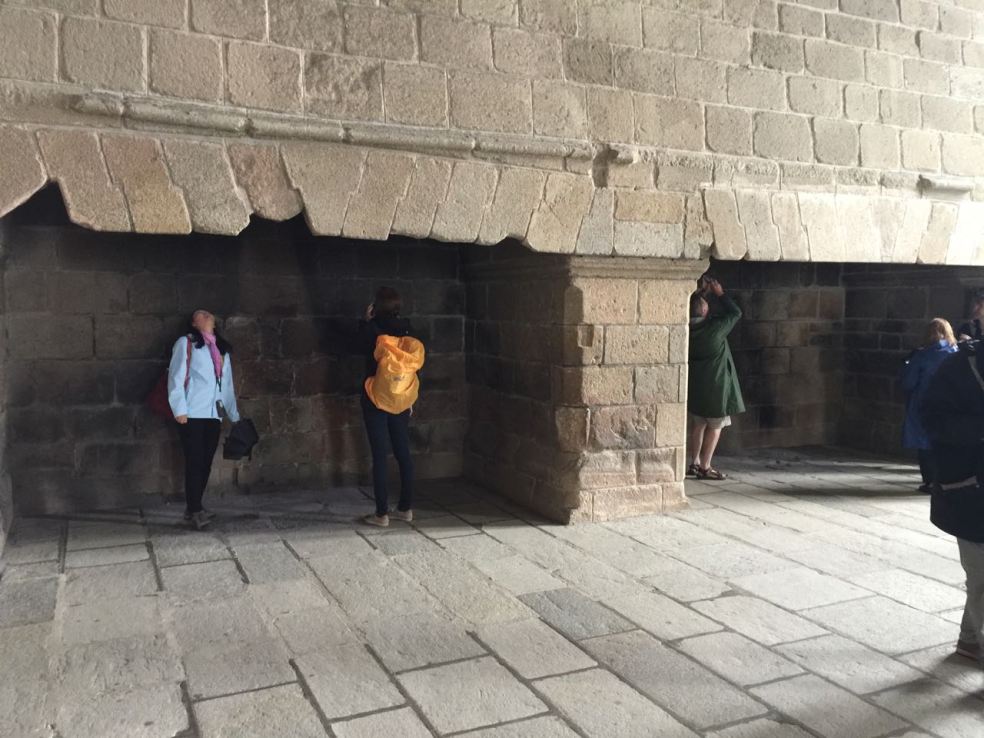 I think it might be the latter. Here, they would be preparing Asian cuisine.
 The original site was founded by an Irish hermit, who amassed a bit of a following, one that began dublin’ every year or so, ire-ronically.
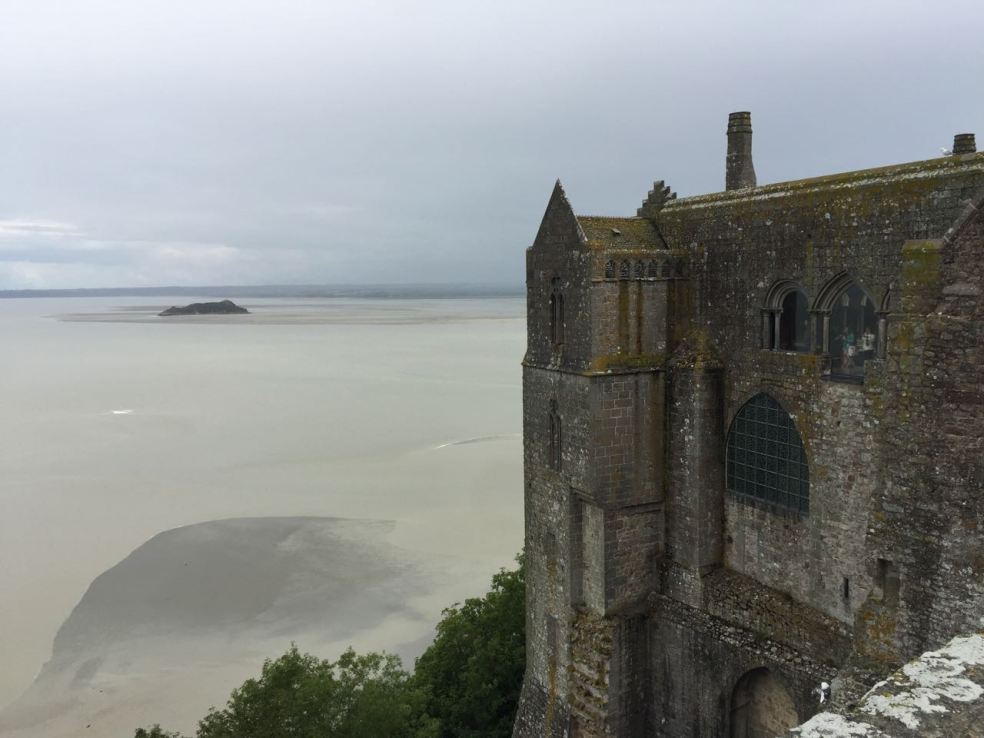 The salt marsh meadows surrounding the island were found to be ideally suited to grazing sheep. The meat that results from this diet makes agneau de pré-salé (salt meadow lamb), a local specialty. We didn’t know that then, which now makes us feel a little sheepish..

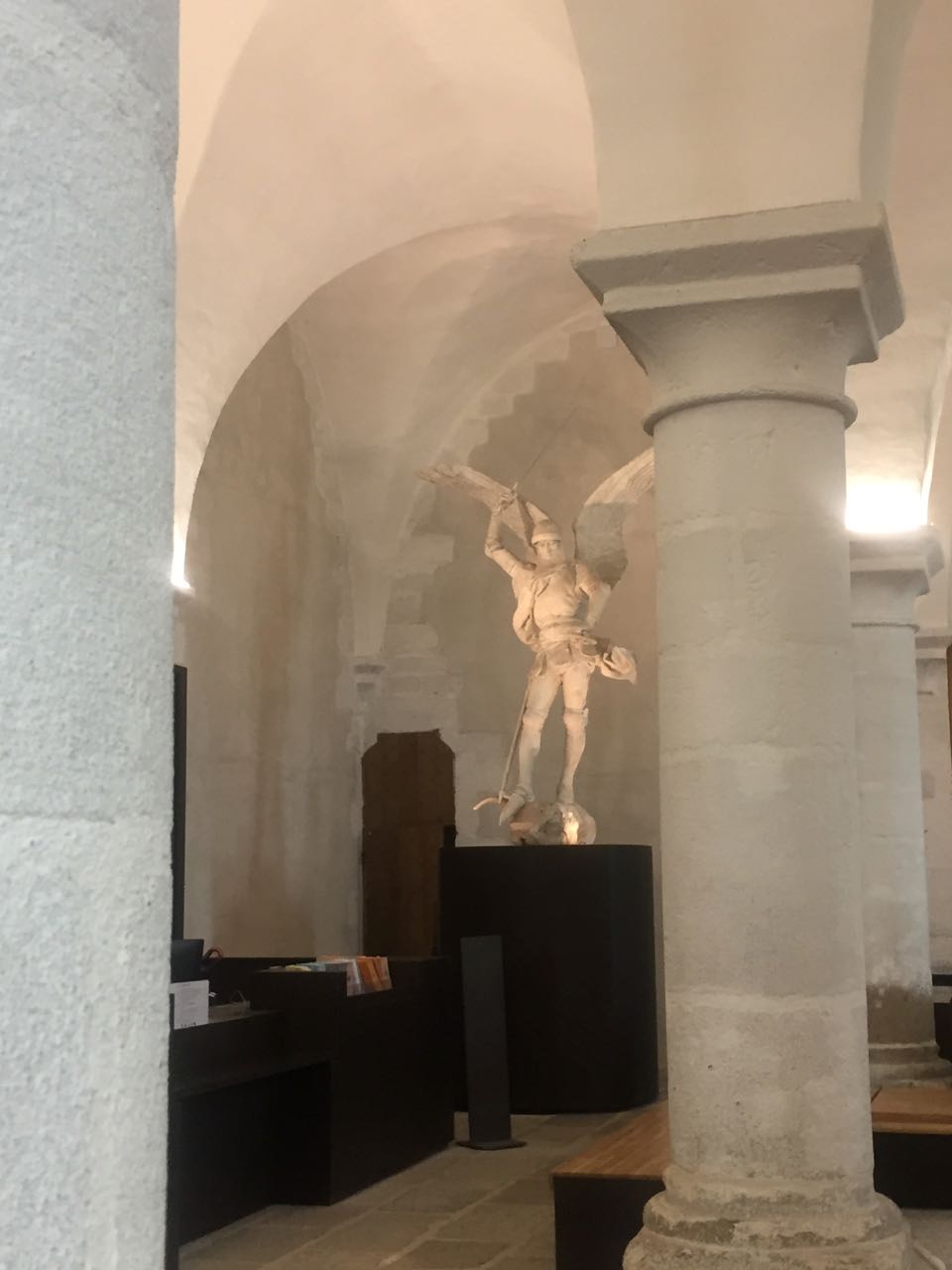 I think this might be a statue of St. Michael, but I’m just winging it. According to other people who were also winging it, the legend is that the archangel Michael appeared to the bishop of Avranches and instructed him to build a church on the rocky islet.
 In 1067 the monastery of Mont Saint-Michel gave its support to William the Conqueror in his claim to the throne of England. He rewarded that with properties and grounds on the English side of the Channel, including a small island off the southwestern coast of Cornwall which was modeled after the Mount and became a Norman priory named St Michael’s Mount of Penzance.
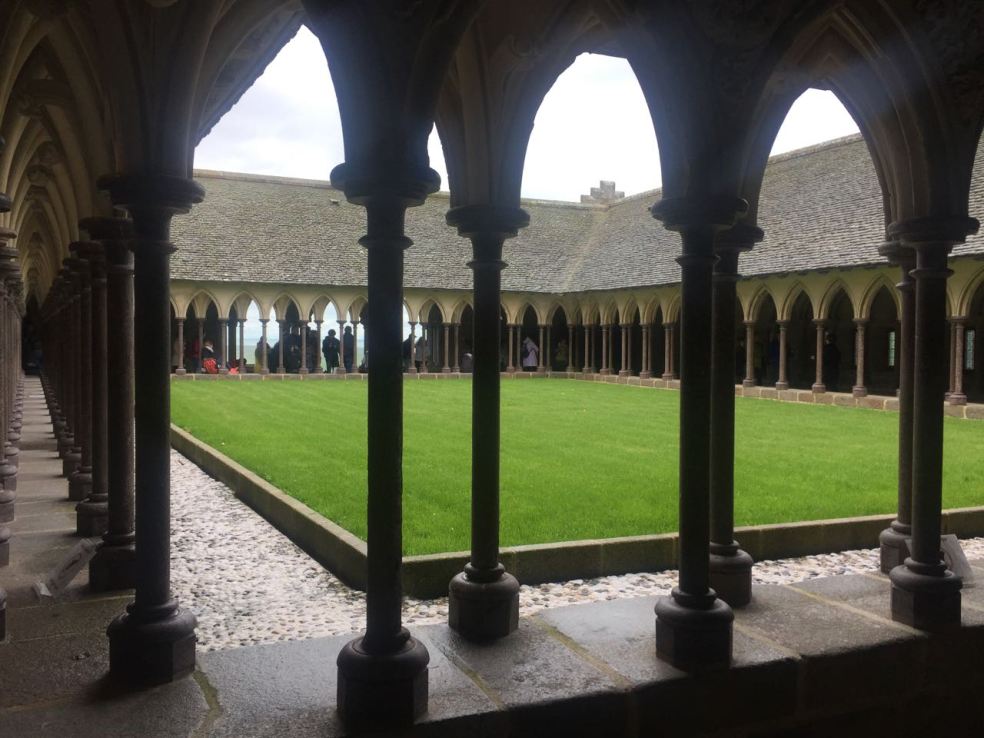 It’s nice that they put a putting green in, but I couldn’t find any flags. Or putters. Or golf balls. Silly French peoples.
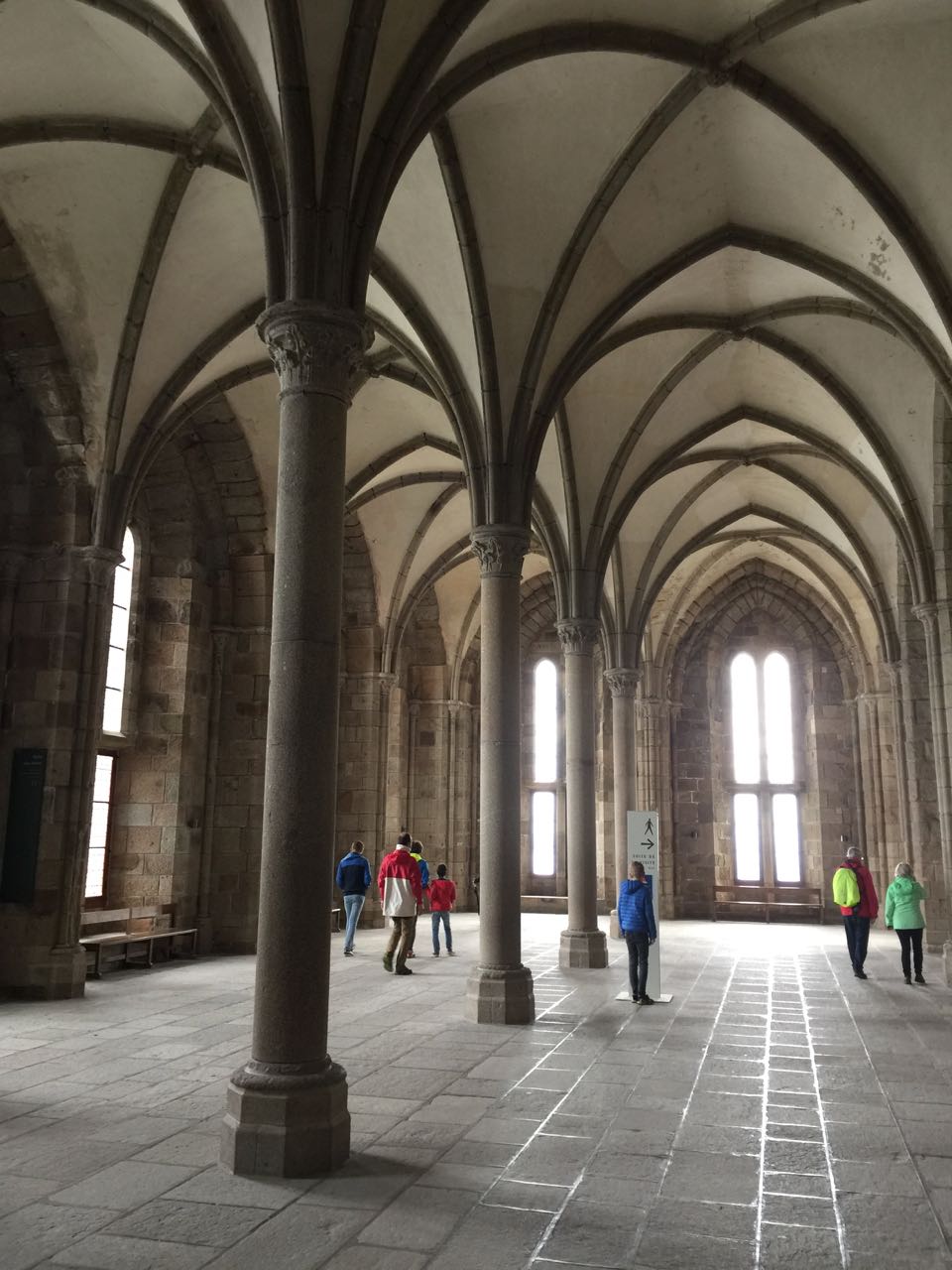 This room is called, “Crypte des gros piliers,” although the pillars didn’t seem very gross to me.
 Except they are kinda gross as hiding places.
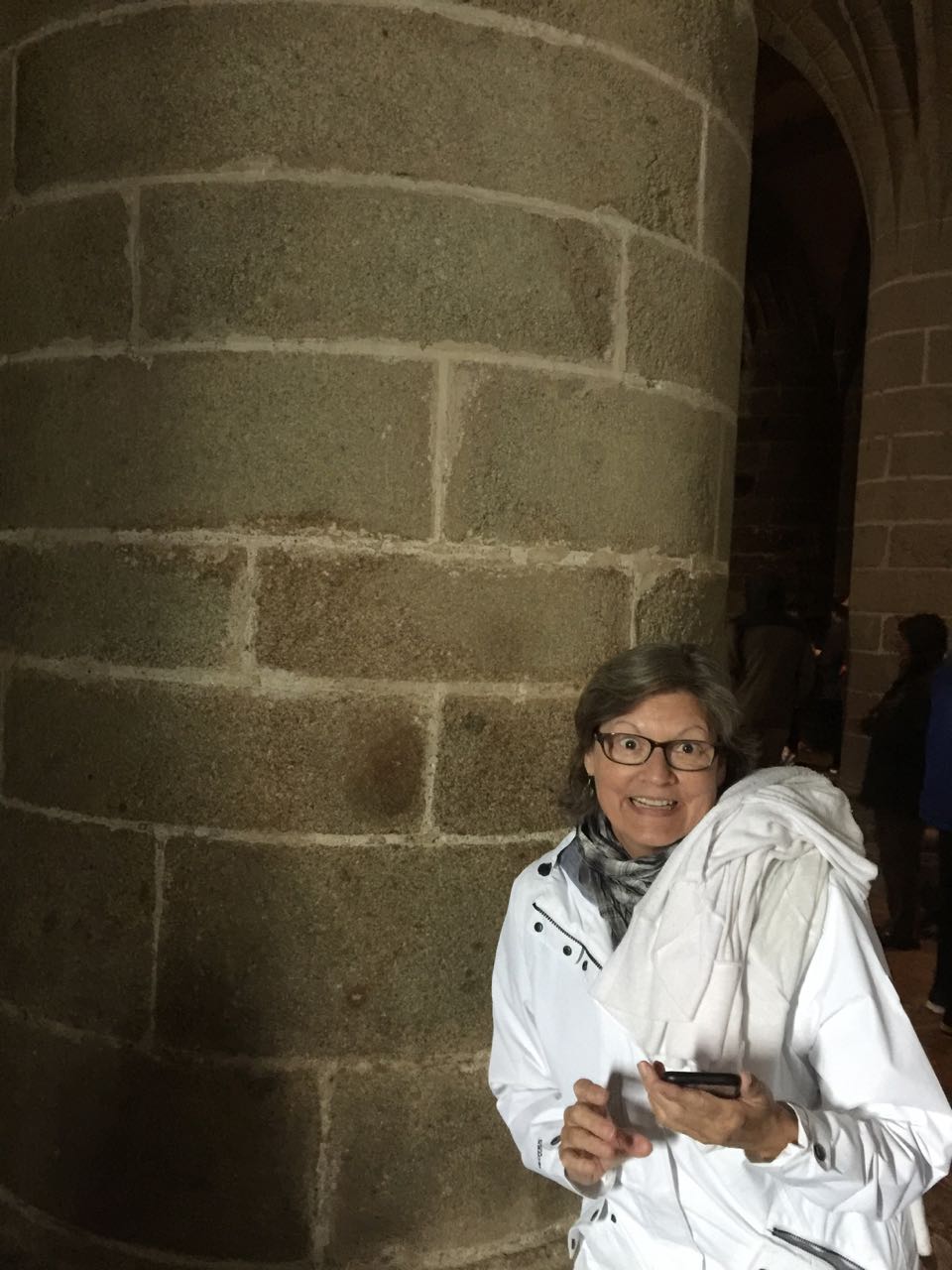 Carolyn was excited to learn that Mont Saint-Michel was the inspiration for the design of Minas Tirith in the film The Lord of the Rings: The Return of the King.
 It also served as the artistic inspiration for the Disney movie Tangled.
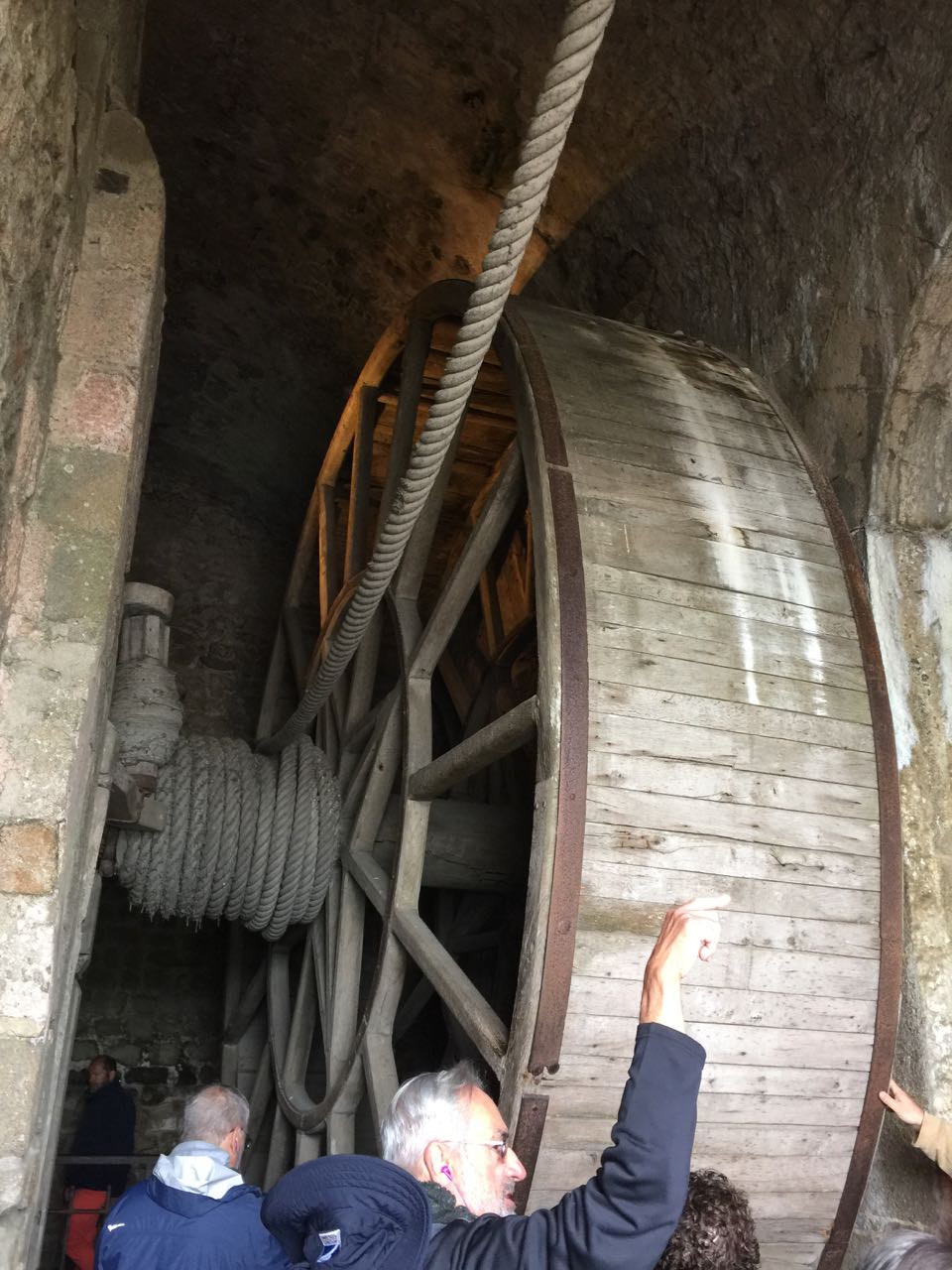 This device is cleverly called “The Wheel.” They used it to haul up supplies and VCRs so they could watch The Lord of the Rings and Tangled.
 The door of the day.
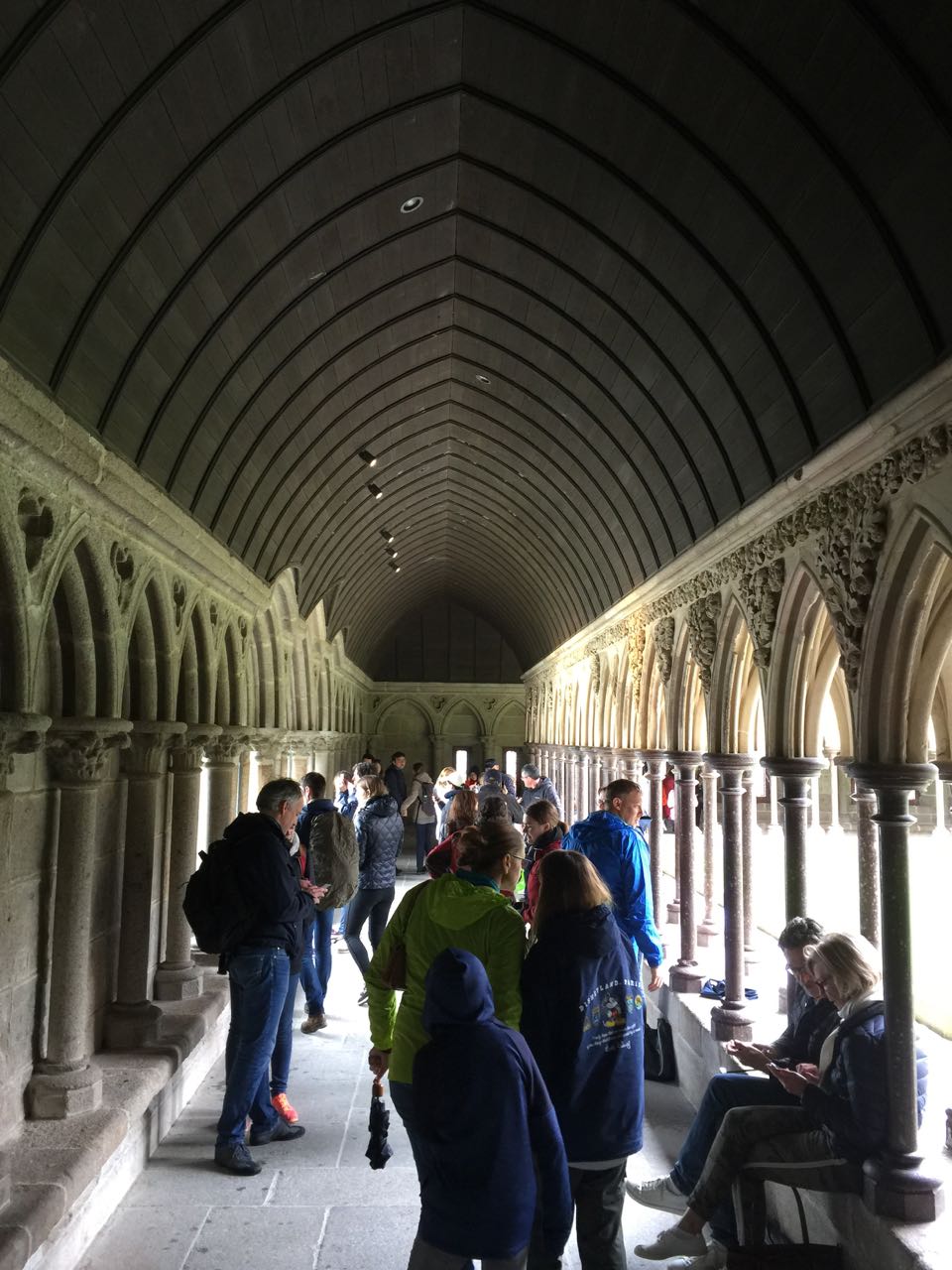 There are about fifty shops for the three million annual tourists.
 And one organ.
 Before the construction of the first monastic establishment in the 8th century, the island was called Mont Tombe. The construction of the Romanesque church of the abbey was begun in the 11th century,
 The church is at the very top of the island, signifying God being above.
 Which offers some spectacular views of any invading troops.
 This seagull is inspecting their firing range, because of course they have to practice in order to hit their targets efficiently.


Here you can see what the island looked like during various stages of development. They kind of look like unbaked chocolate chip cookies on a baking sheet, eh?
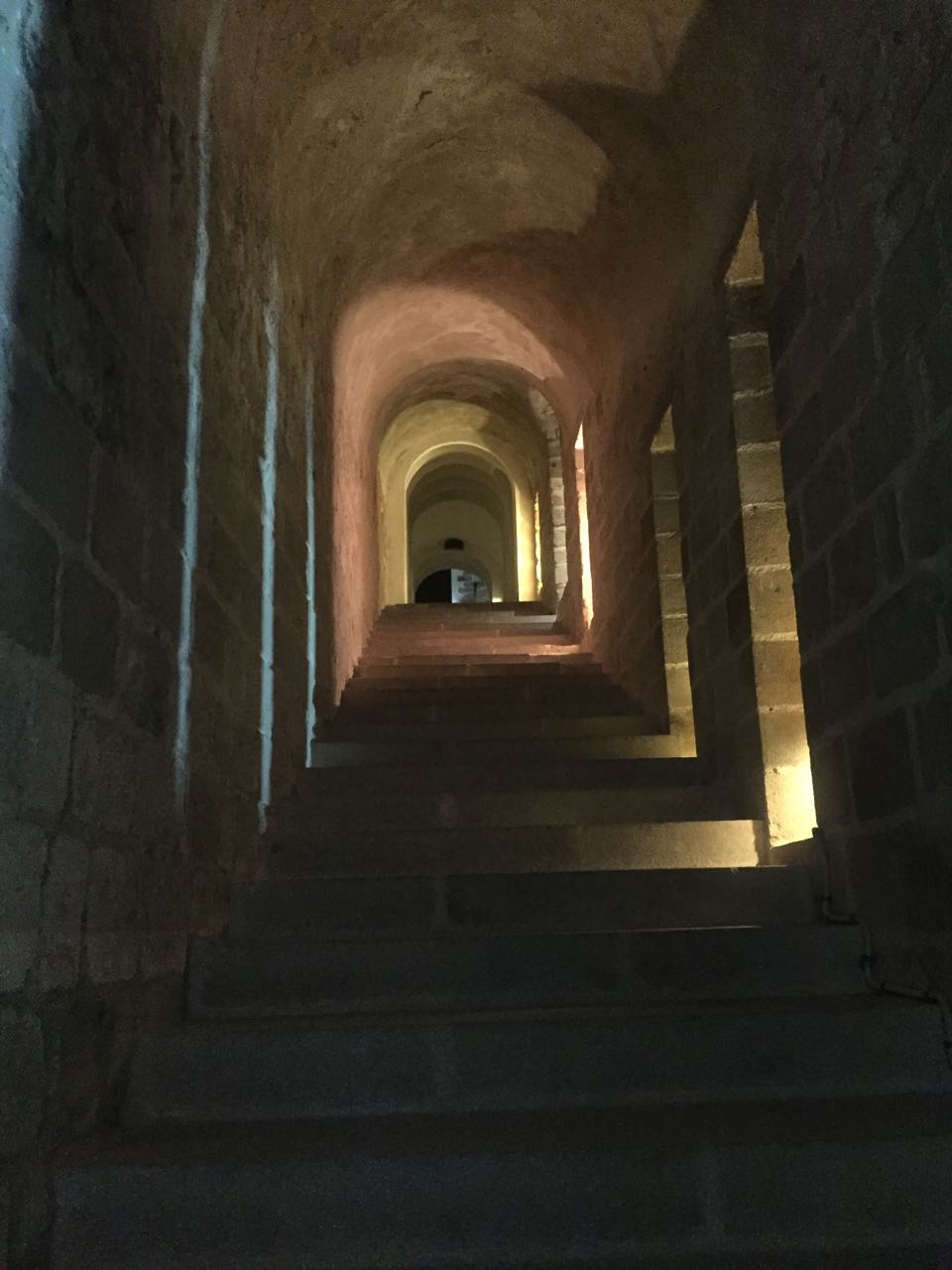
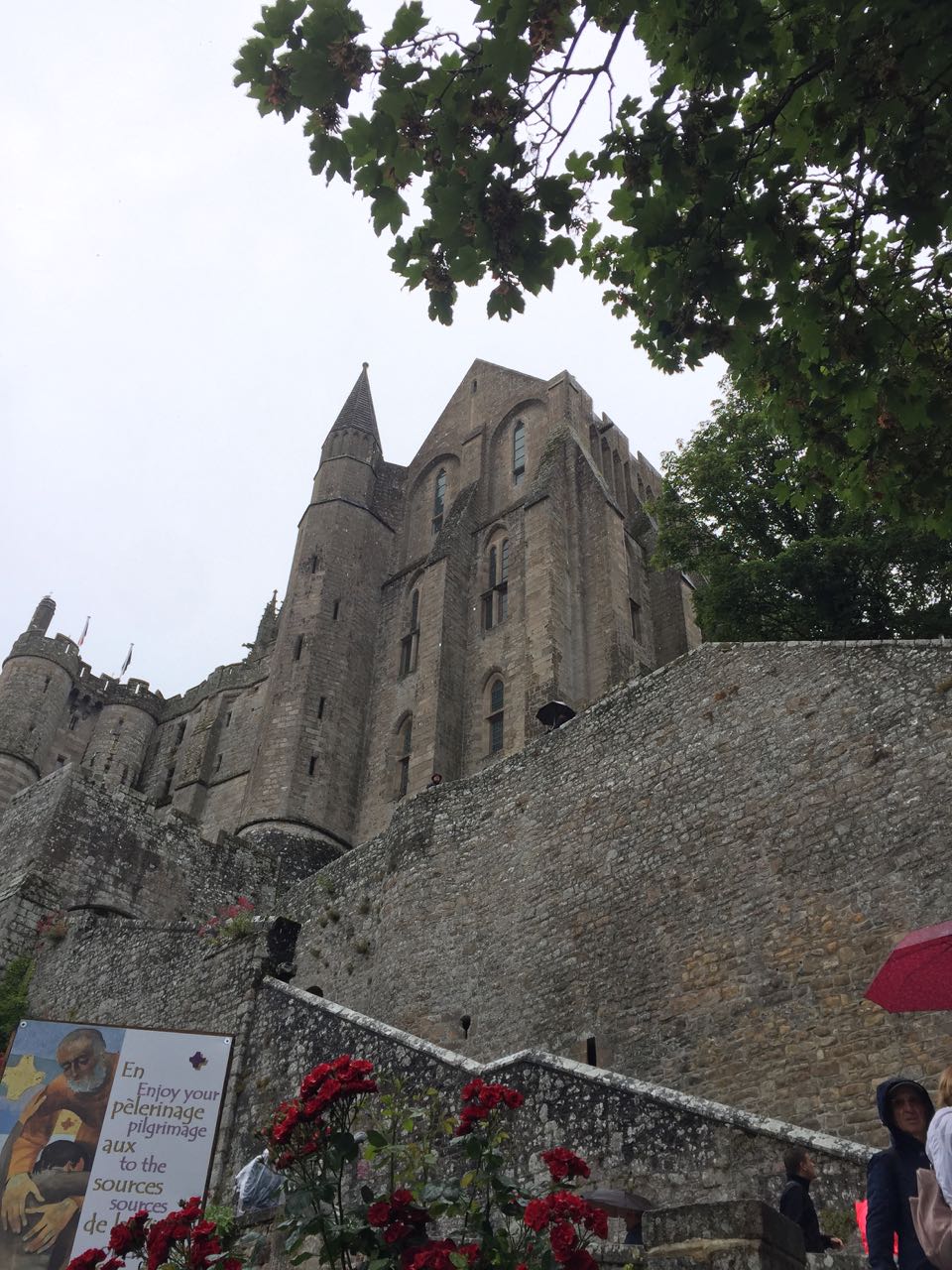 Many underground crypts and chapels had to be built to compensate for all the weight of that construction.


There’s a lot of uphill climbing to get to the top. Fortunately, this results in a lot of downhill climbing when you’re ready to leave.


And so, we knocked another Unesco Heritage Site off our bucket list. There are 1,092 of those all together. We’ve seen a relative handful so far. I wonder how many years it would take to see them all? Too much for one lifetime I’m afraid, so we’ll have to make do with what we see while we’re traveling Europe!
 On June 6, 1944, the allies used the largest armada ever assembled to invade Nazi-occupied France.

 The beach views are so iconic that when I sent a picture of one to my son Josh, who is well-versed in World War II lore, asking if he could guess where we were, he got it on the first try. I was hoping he’d still think we were in Greece, but he’s too smart for that.
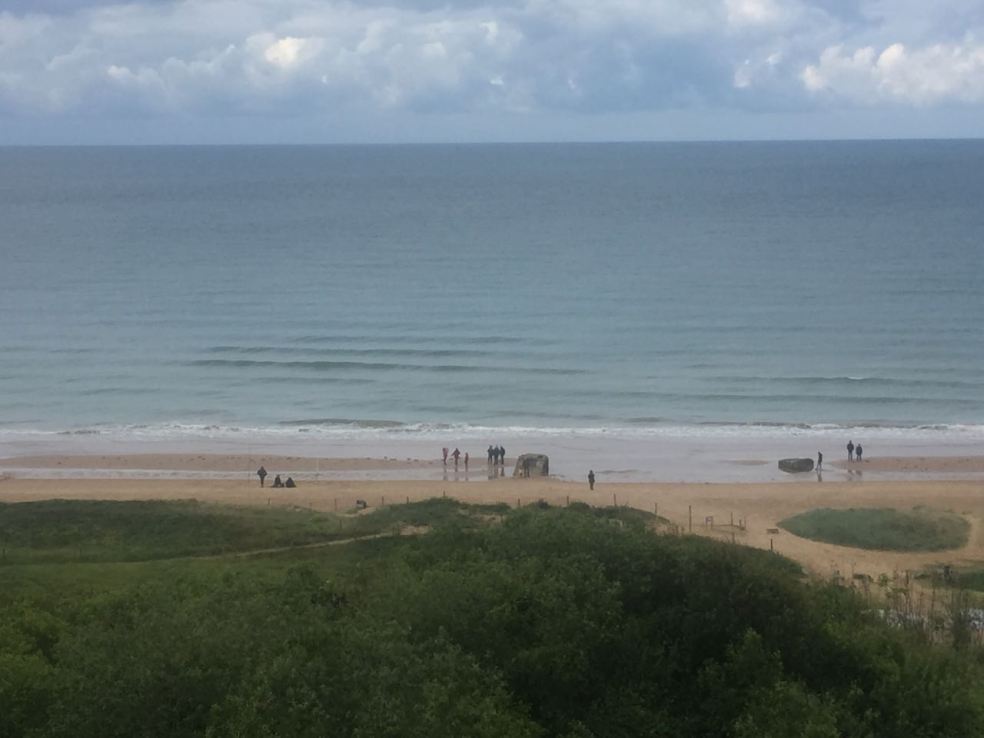 I gotta tell ya, the thing I didn’t expect was the emotional feeling of standing on the beach and looking over the water, picturing the mass of ships greeting the Germans who woke up that morning. You just can’t mentally picture that the same way on any other beach.
 It was and still is the largest seaborne invasion humanity has ever known.
 There’s an interesting monument on the beach: the Les Braves Omaha Beach Memorial.


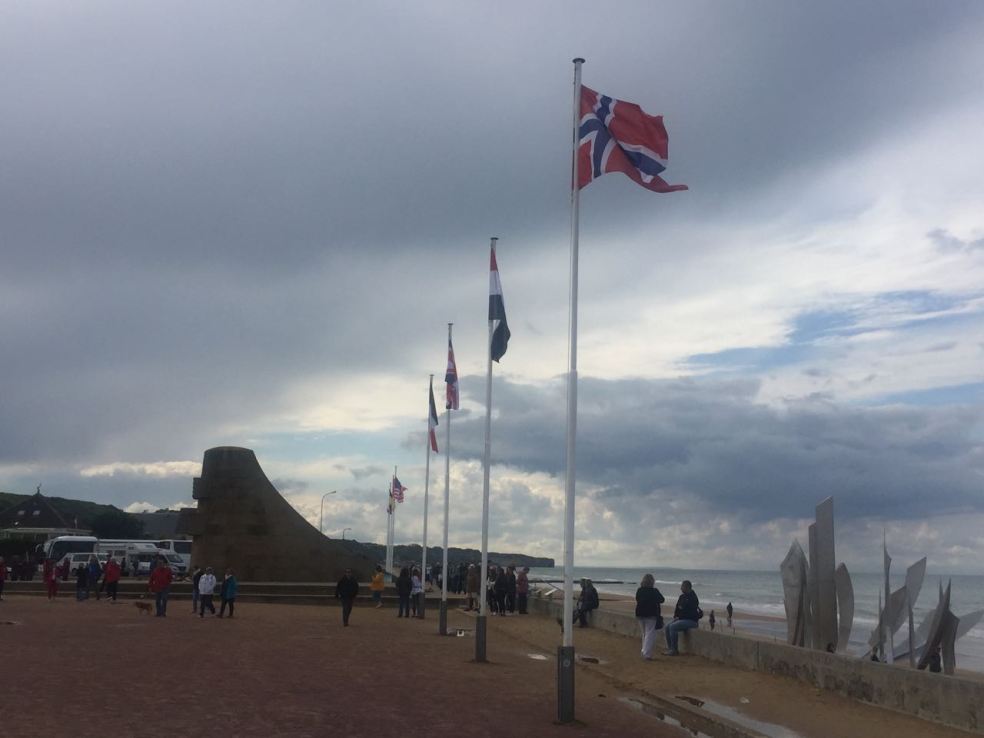 Flags of the allies stand guard over the Les Braves Omaha Beach Memorial.
 And yet another memorial, this one is called the Omaha Monument to the Allies. It says:
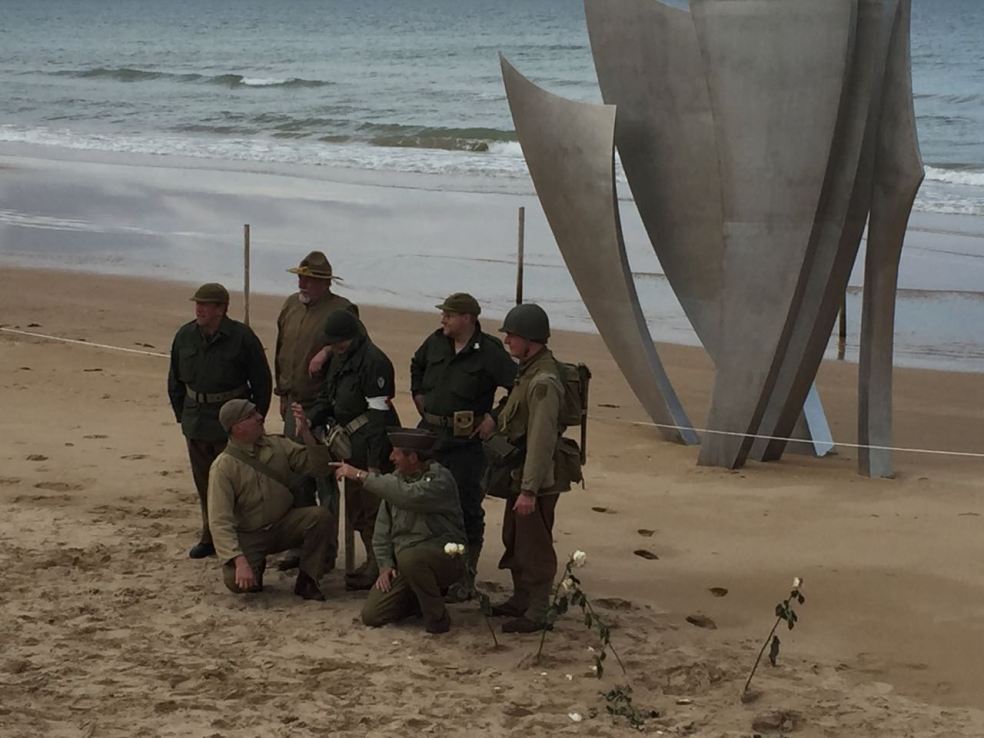 I presumed these soldiers weren’t a part of some sort of time-traveling expedition.
 Having not been there before, I don’t know if they were there for the 75th anniversary or if it’s a usual touristy thing.
 Other than this sign, and whatever leftovers we saw from the 75th anniversary celebration, it wasn’t particularly touristy otherwise. A few restaurants, but mostly the focus is on the monuments and the beach, which it should be.
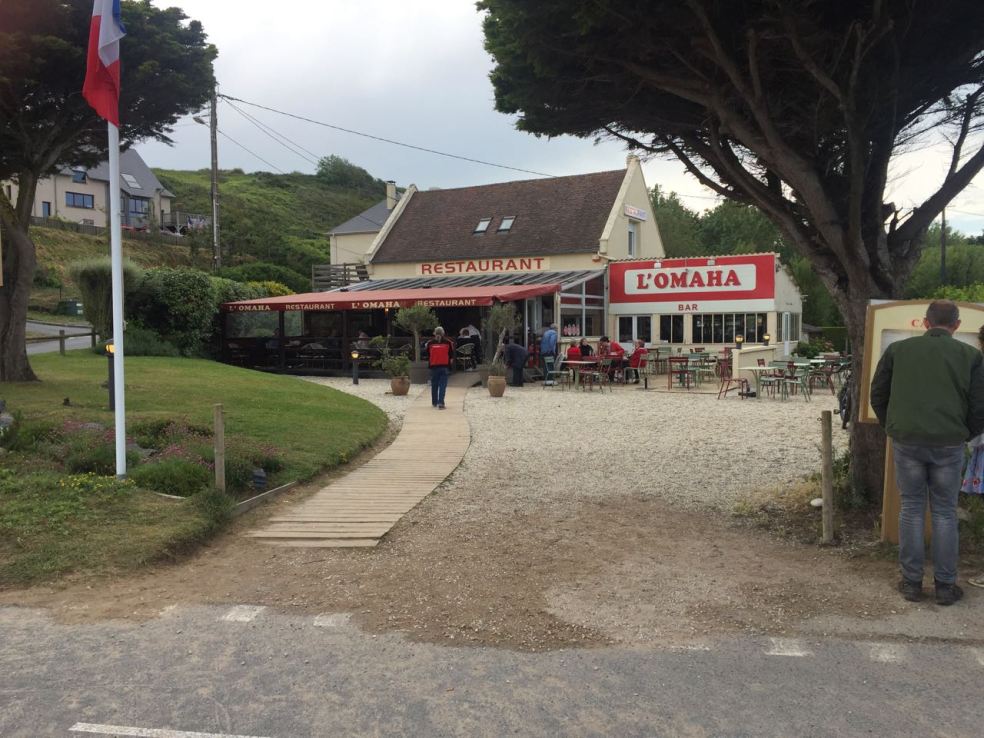 You can even eat at the L’Omaha. We checked the menu and it was overpriced, which was no surprise. What was surprising is that they didn’t offer Omaha Steaks.
 Lots of signs around the area give you an idea as to what transpired.
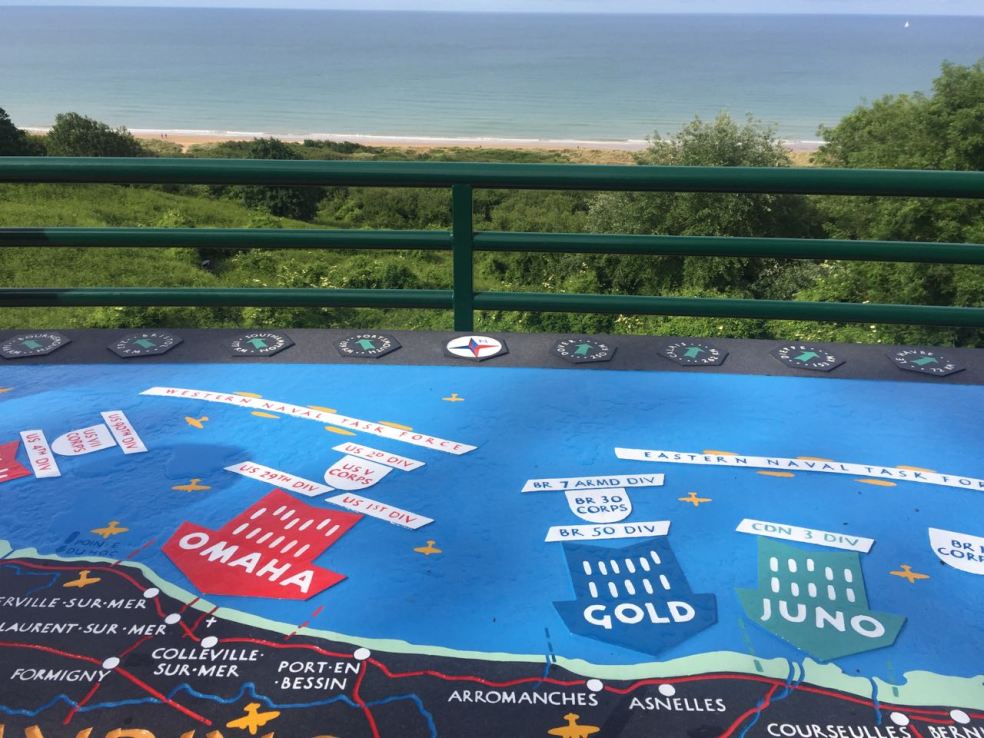 Including detailed maps of the invasion force.
 Or just a sign telling you you’ve found the right beach.


 There’s also an Overlord Museum. I assumed it was put there to commemorate me.
 We didn’t go inside because we got there a little late in the day, but they have lots of vehicles outside you can take a gander at.
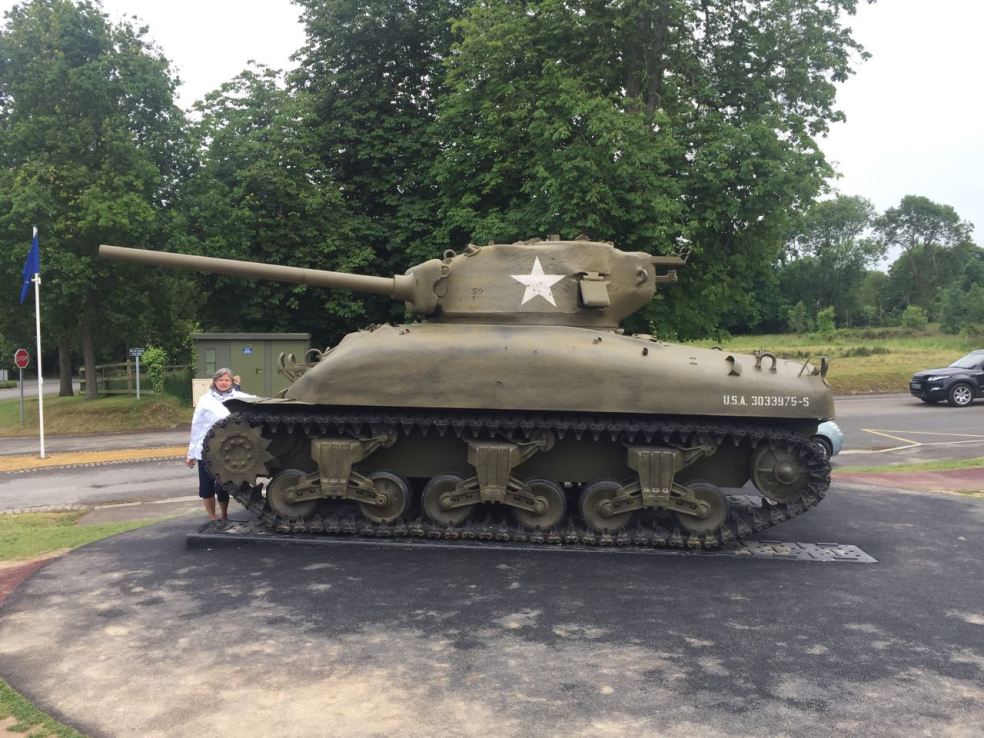 Carolyn’s tanked.
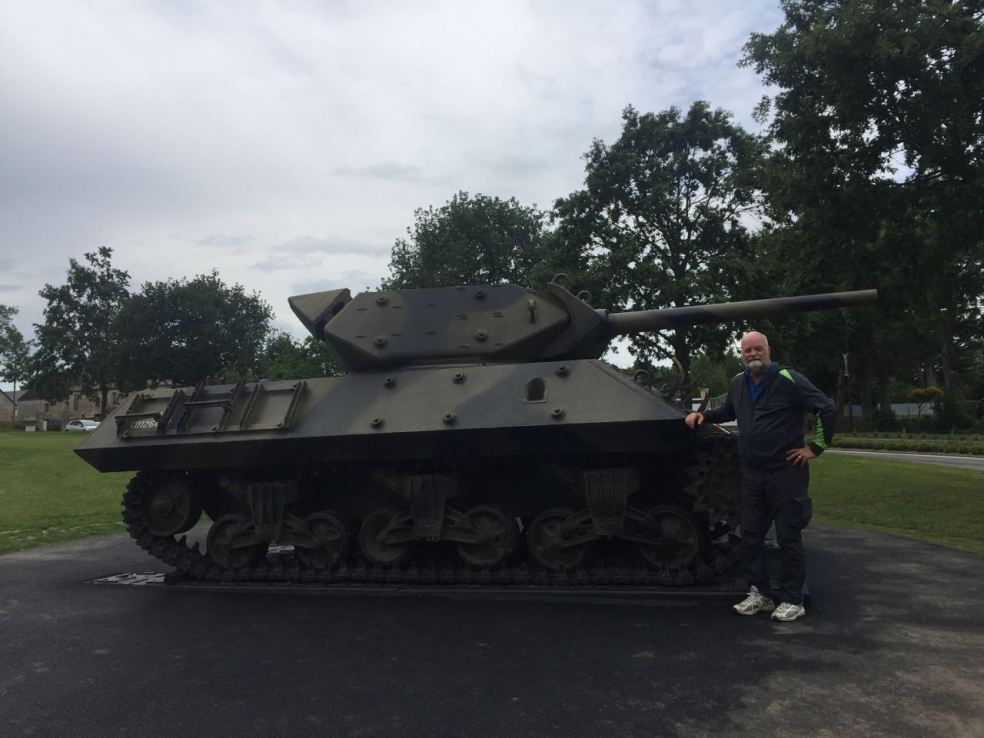 Which means I had to get tanked too.
 I’m pretty sure our car couldn’t roll over these.
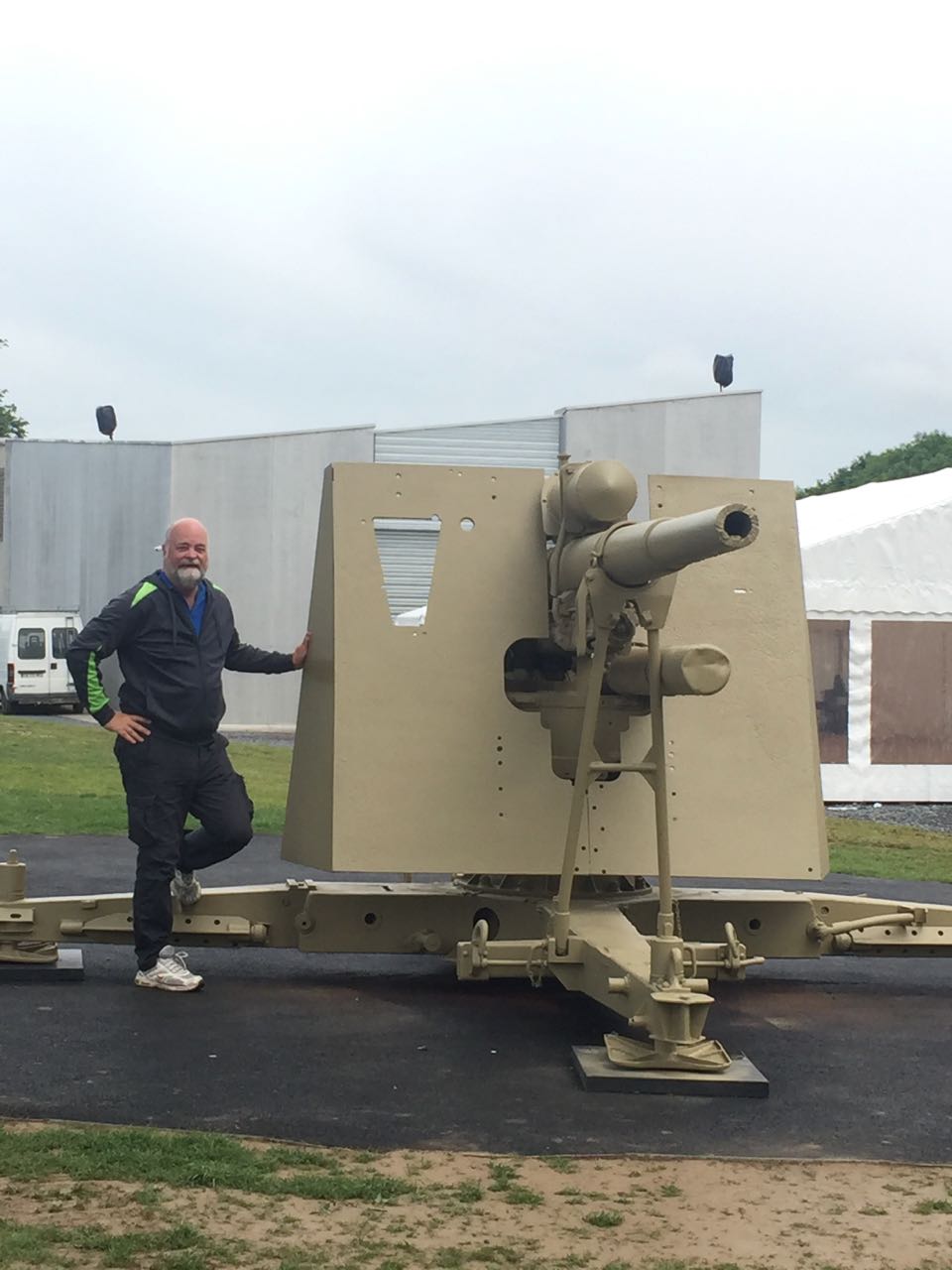 Putting the “art” in “artillery.”
 It’s all Greek –er French, to me.
 And then there’s the cemetery. It covers 172.5 acres and contains 9,388 burials.


 And not one where we felt it very appropriate to take a big smiling selfie.
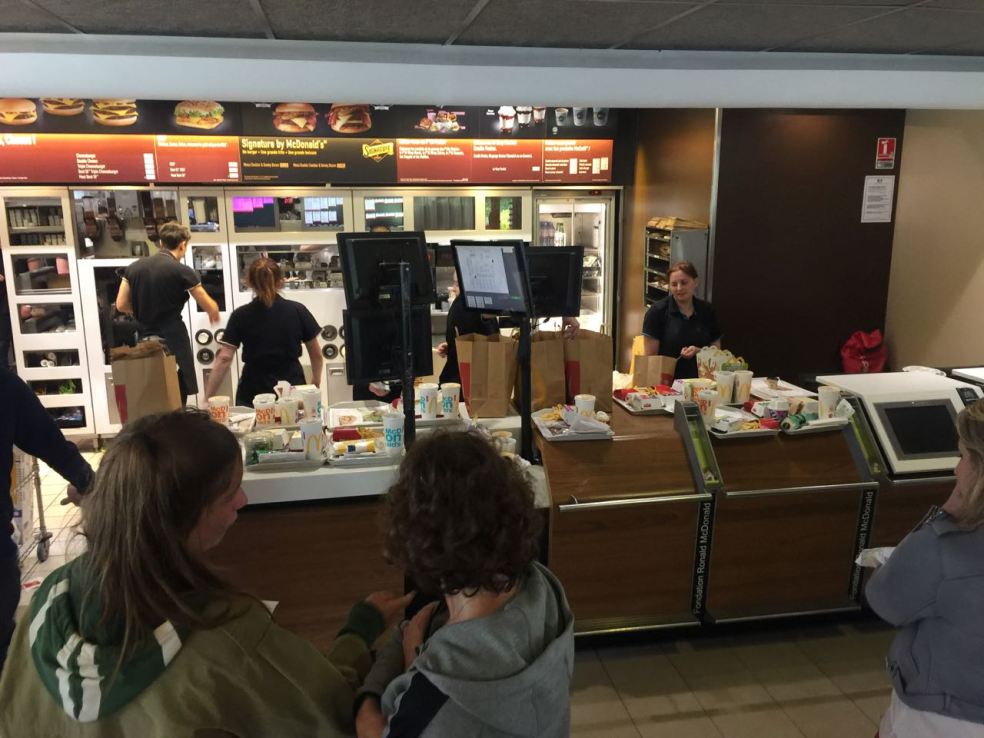 Once we left there we stopped at a -–gasp– McDonalds, just because we were in a slight rush and besides, we wanted to commemorate what the victory eventually brought the Europeans: McDonalds! Burger King! Disneyland! Heart attacks! The reason I took this picture is because the place was so busy, they were stacking food on the countertops. But it wasn’t just busy, it was haphazard. Probably these least organized McDonalds I’ve ever been to.
 Actually, it should be: Phaistos then the City of Light.
 The only problem was that it was a Saturday night and the middle of busy season and some sort of convention was in town besides, so the travel agent simply could not find anyplace for us to stay in Athens. He even looked well outside of Athens, and then he got down to one-star hotels, and then to cardboard boxes on sidewalks, all with no luck. Well, to be fair, the cardboard box people never answered the phone.
 Oh, the joys of retirement! Of course, that still meant we had to spend the night in the airport, which is why you see me in the picture above with a sleeping mask on. We actually got kicked out of a Burger King where we had hunkered down, because you can’t have indigents sleeping in your restaurant, I guess, even in an airport.
 But before we get to Paris, there’s one last place in Crete I want to share, a place called Phaistos, or faistos, according to that sign.
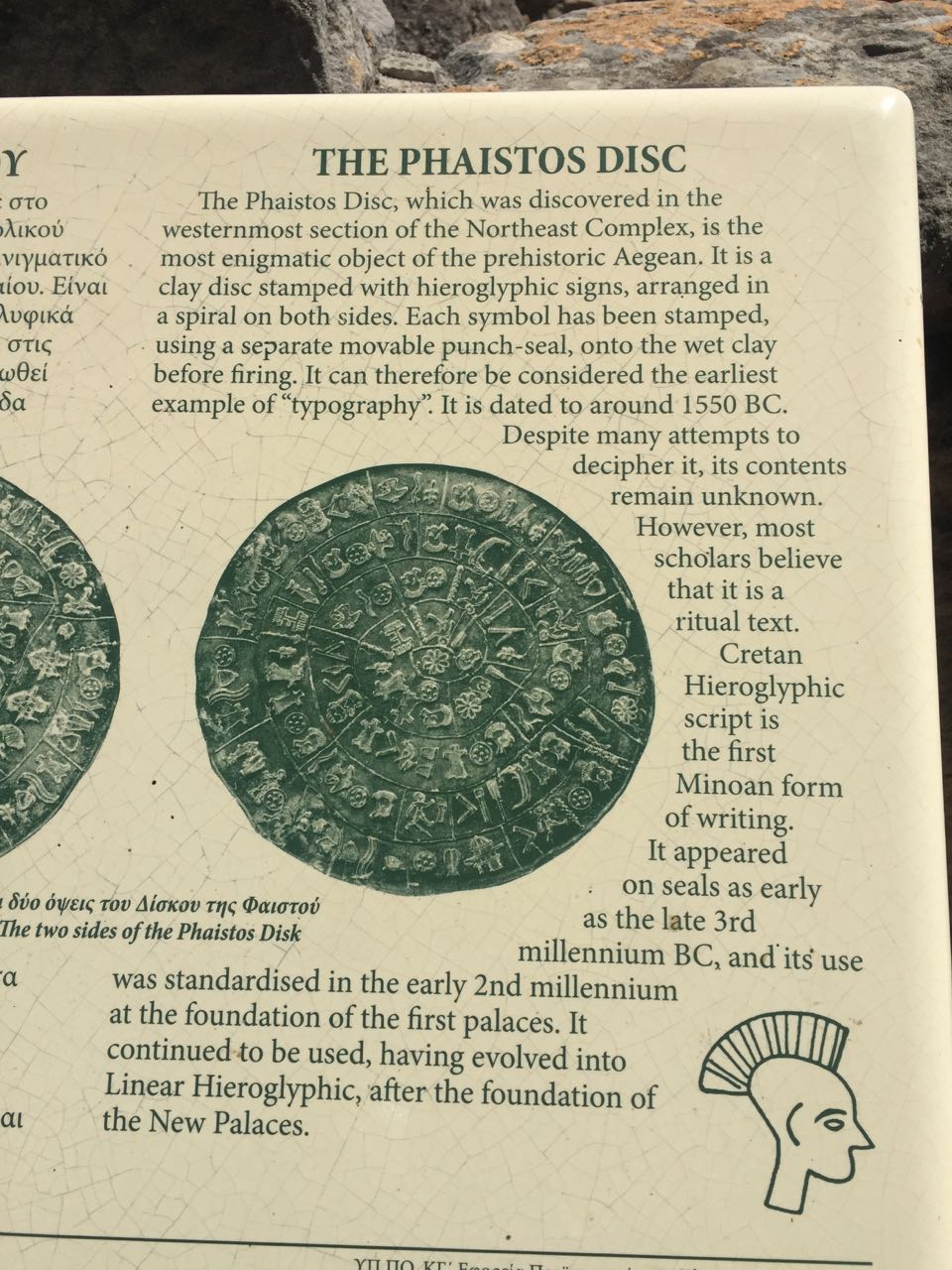 Phaistos is the place where they found the famous Phaistos disc, which may be where they got the name for it I’m thinking. Anyway, without the Phaistos disc, you may not have been able to read this blog, because they’re the ones who invented typography! Of course, I’m sure some of you may wish they hadn’t after reading some of my dumb jokes. Since the Phaistos disc has never been translated, I’m rooting for it to be a dumb dad joke.
 We hired a tour guide to show us all the particulars… oh, wait, that’s Carolyn. No wonder the tour was so cheap!
 Here’s a question for you: How many jars do you see here?


 And I thought stairs weren’t invented until the escalator.
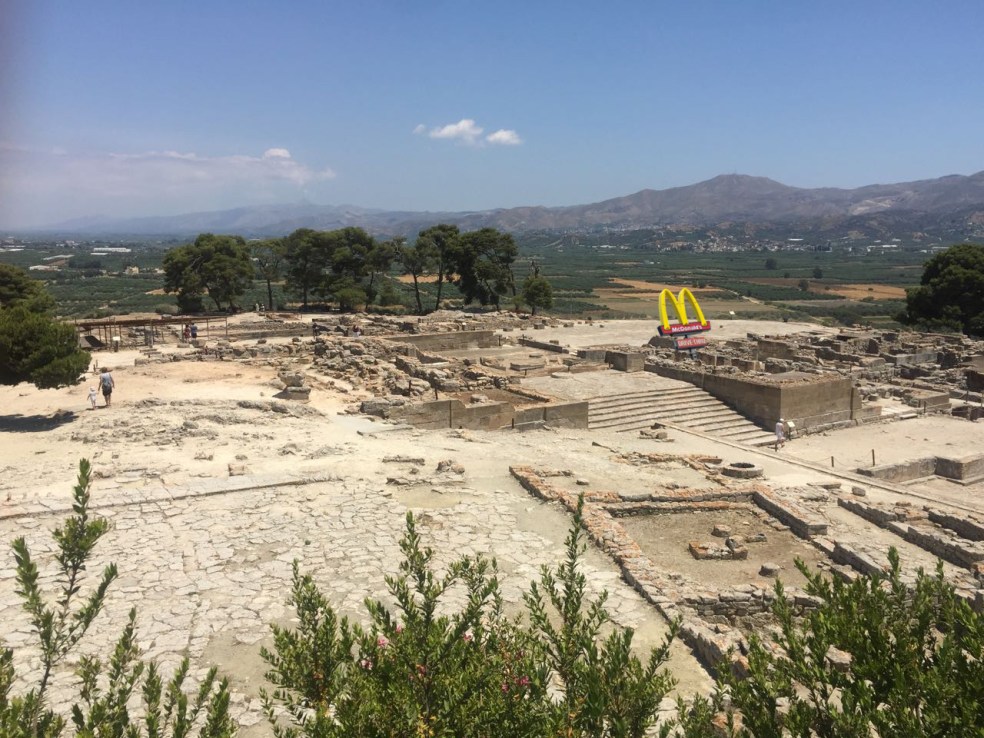 Here’s a view of some of the city from above. As you can see, the Minoans invented a lot of things we take for granted today, like fast food. It’s what ultimately led to their doom.
 Phaistos was the home of Radamanthis, the brother of the king of Minos. In Greek mythology, Minos was the first King of Crete, and the son of Zeus and Europa. Every nine years, he made King Aegeus pick seven young boys and seven young girls to be sent to the labyrinth to be eaten by the Minotaur. Sounds like a lot of bull to me.
 Phaistos is the second largest palace of Crete after Knossos.
 Just like the other palaces of Minoan Crete, the palace was destroyed three times. This was rebuilt on the ruins of the old buildings in 1700 BC.
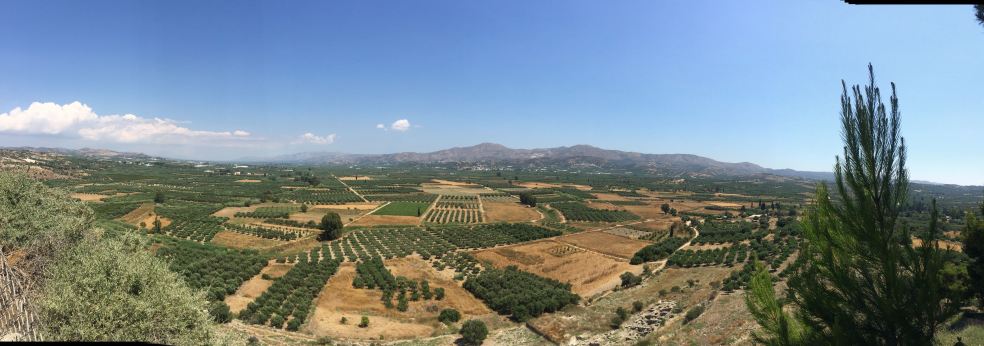 Despite its age, we were impressed at the sophistication of the layout, as well as the spectacular views afforded from its hilltop location.
 The palace continued to be used even after its destruction in 1400 BC. It gradually lost its power until nearby Gortyn finally destroyed it in 200 BC. And no, Gortyn wasn’t the name of one of the minotaurs, it was another city/state on Crete.
 This room rocks.
 Pink Floyd would be proud.
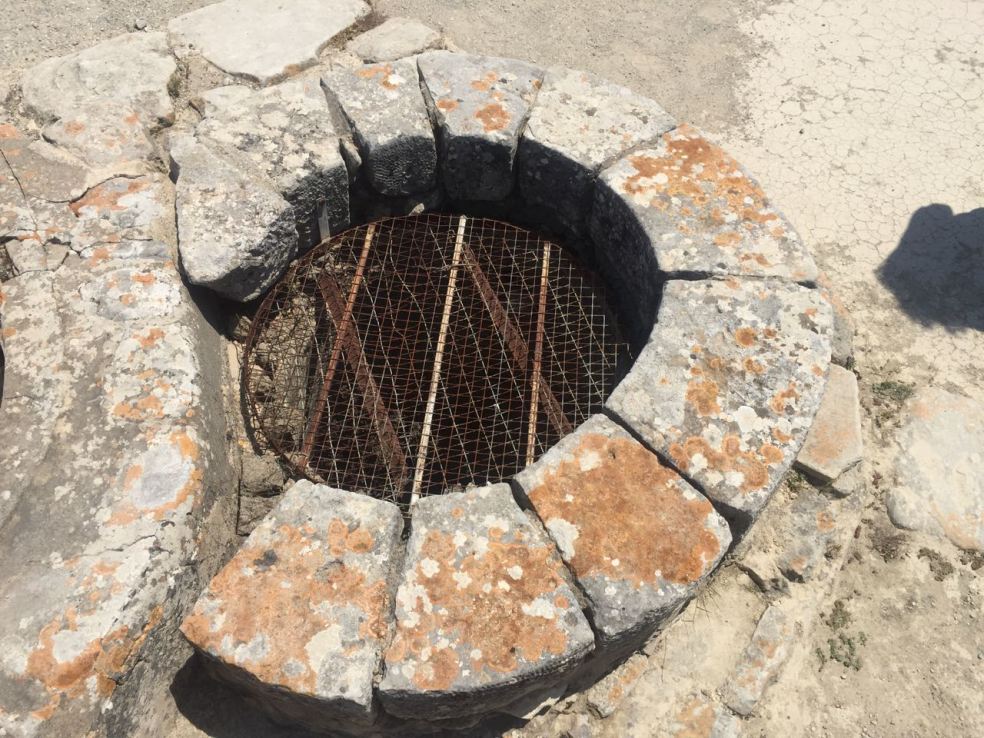 Well: that’s a deep subject.
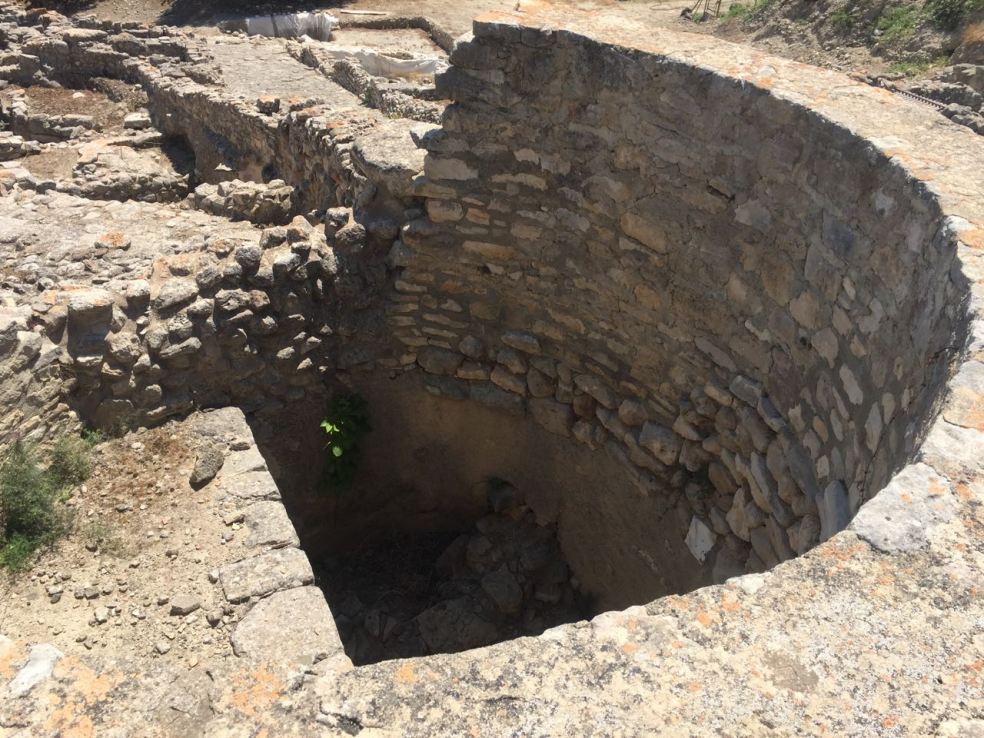
 Why is it every hole is used as a garbage can, even in such an historical area?
 In addition to the palace, they had a theater with a great view of both the palace and the panorama. There are no records as to which movies played in the theater.
 Carolyn does her best Rocky impression.
 This are the queen’s quarters. The fact that archeologists can figure stuff like that out will always impress me. I woulda thought it was the TV room.
 … A few days later, we were sleeping in an airport waiting for an early morning flight to Paris. I was embarrassed to be seen with a sleeping mask on, so I wore the sunglasses to disguise myself.

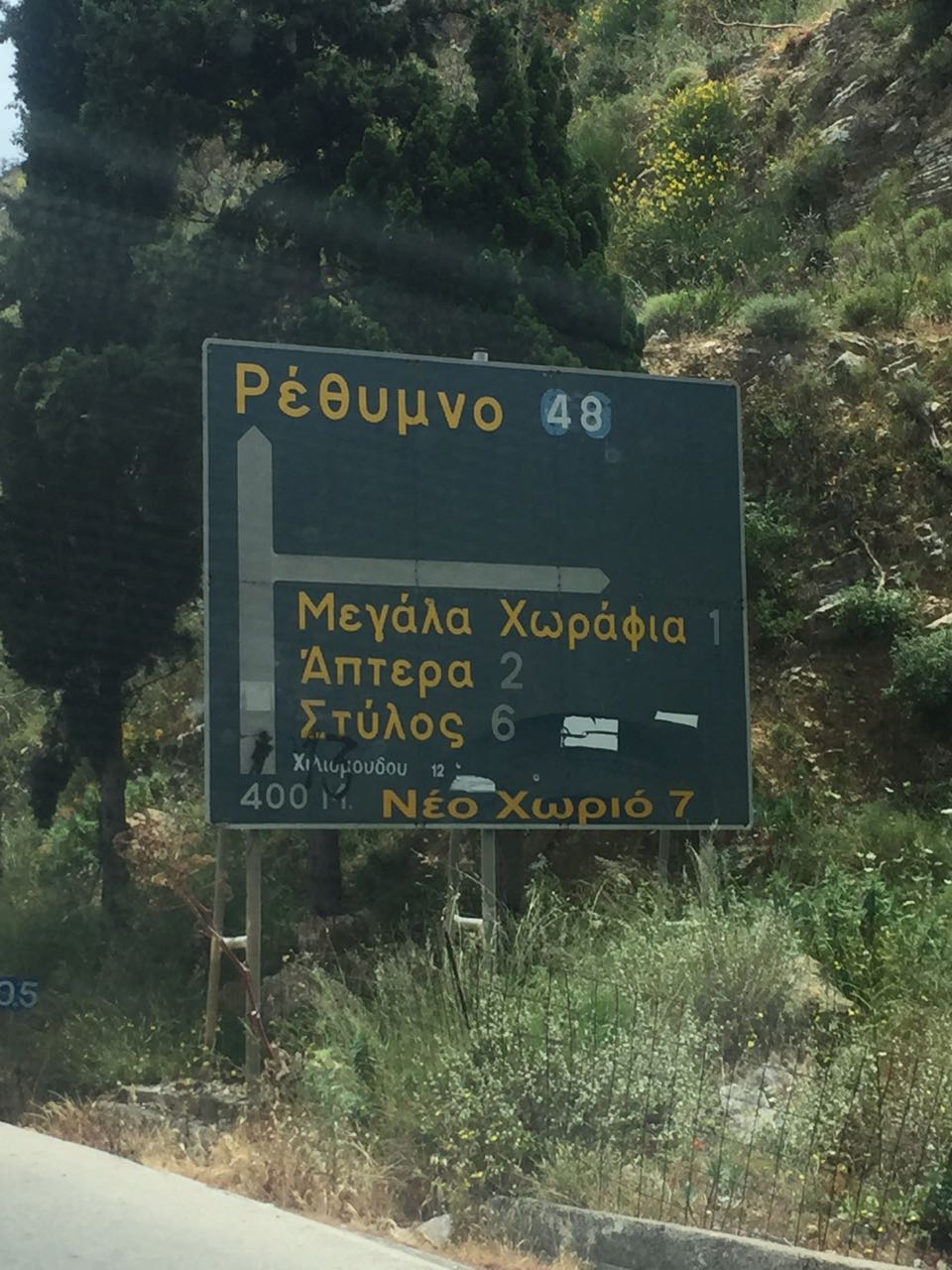 Driving in Crete was a minor challenge since we couldn’t make heads nor tails out of the signs.
 Especially the ones that were all shot up. We learned there was at least one village that became uninhabited after an all-out war between another village due to some sort of revenge feud. I’m not sure Cretans should own very many guns.
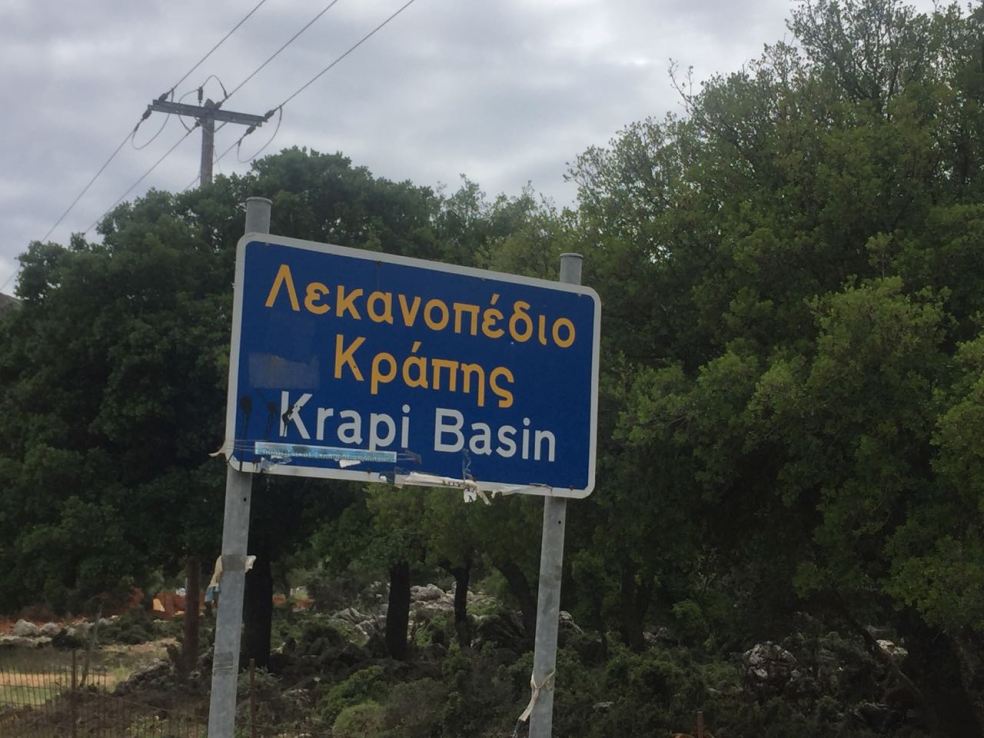 Some of the signs direct you to crappy places.
 While others direct you… everywhere.
 The many canyons and ridges make for some interesting roads.
 We occasionally ended up on dirt roads with no guardrails, often with drops up to, I don’t know, I’m estimating here, about a million meters straight down? One dirt road the GPS took us down was so narrow and dangerous we carefully backed up and went back the way we came.
 I’m not sure if this sign means be cautious about the cliff or the guy with the gun.
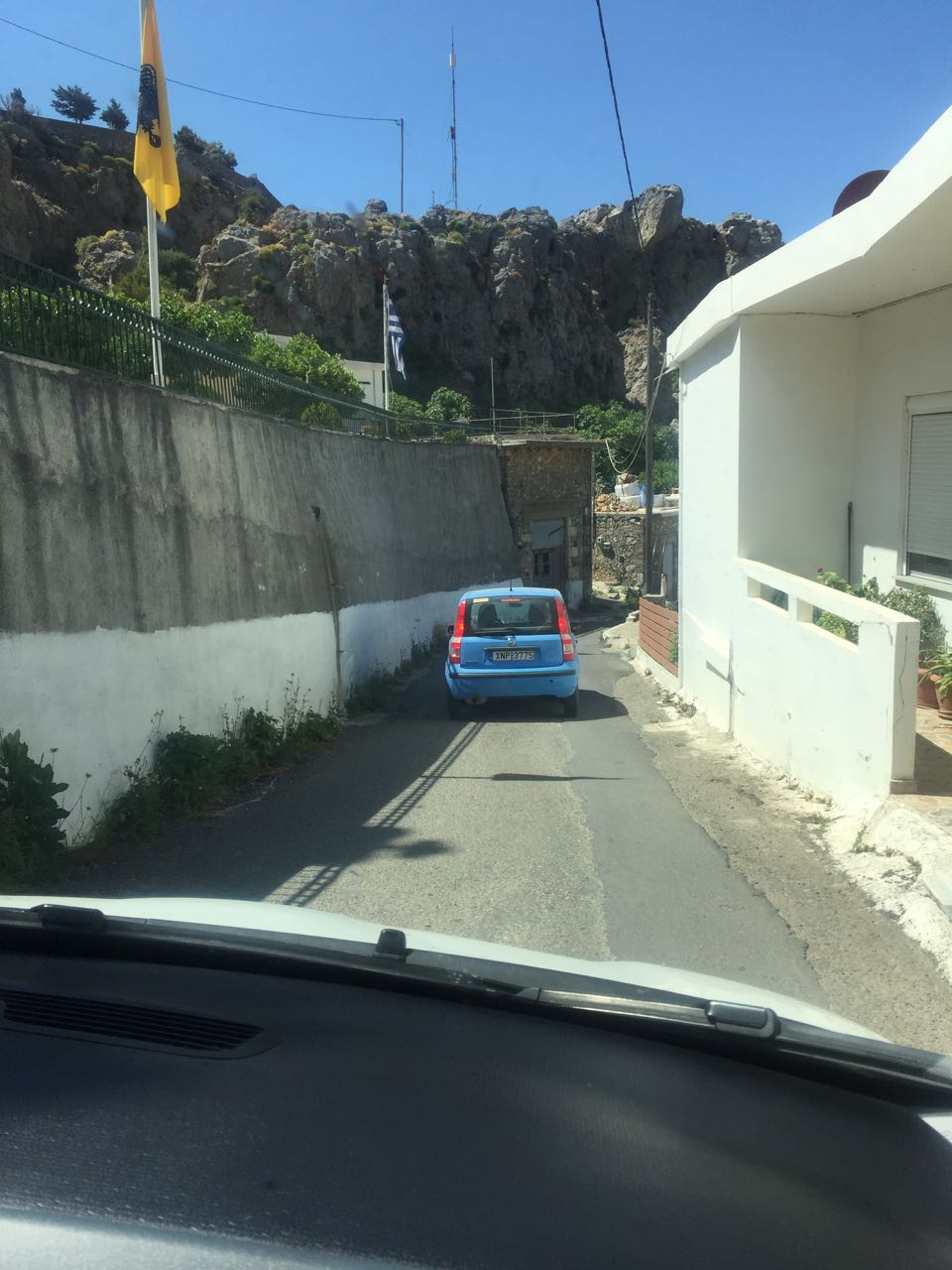 Many of the towns have two-way roads that aren’t any bigger than a one-lane. You just have to wait your turn (or sometimes back up… or maybe sacrifice your side mirrors) if you spot a car down the road.
 Even on the highways, they are a bit creative. This two-lane highway essentially functions as a three or four lane highway because everyone who isn’t passing rides the shoulder.
 I’d hate to be the guy who dented that guardrail: on the other side is a drop straight down to death. Many of the roads would have done the Road Runner cartoon proud. I could imagine something plunging off the side… and then I’d hear a long, fading whistle… and then a distant poof! as Wile E. Coyote meets his temporary doom.


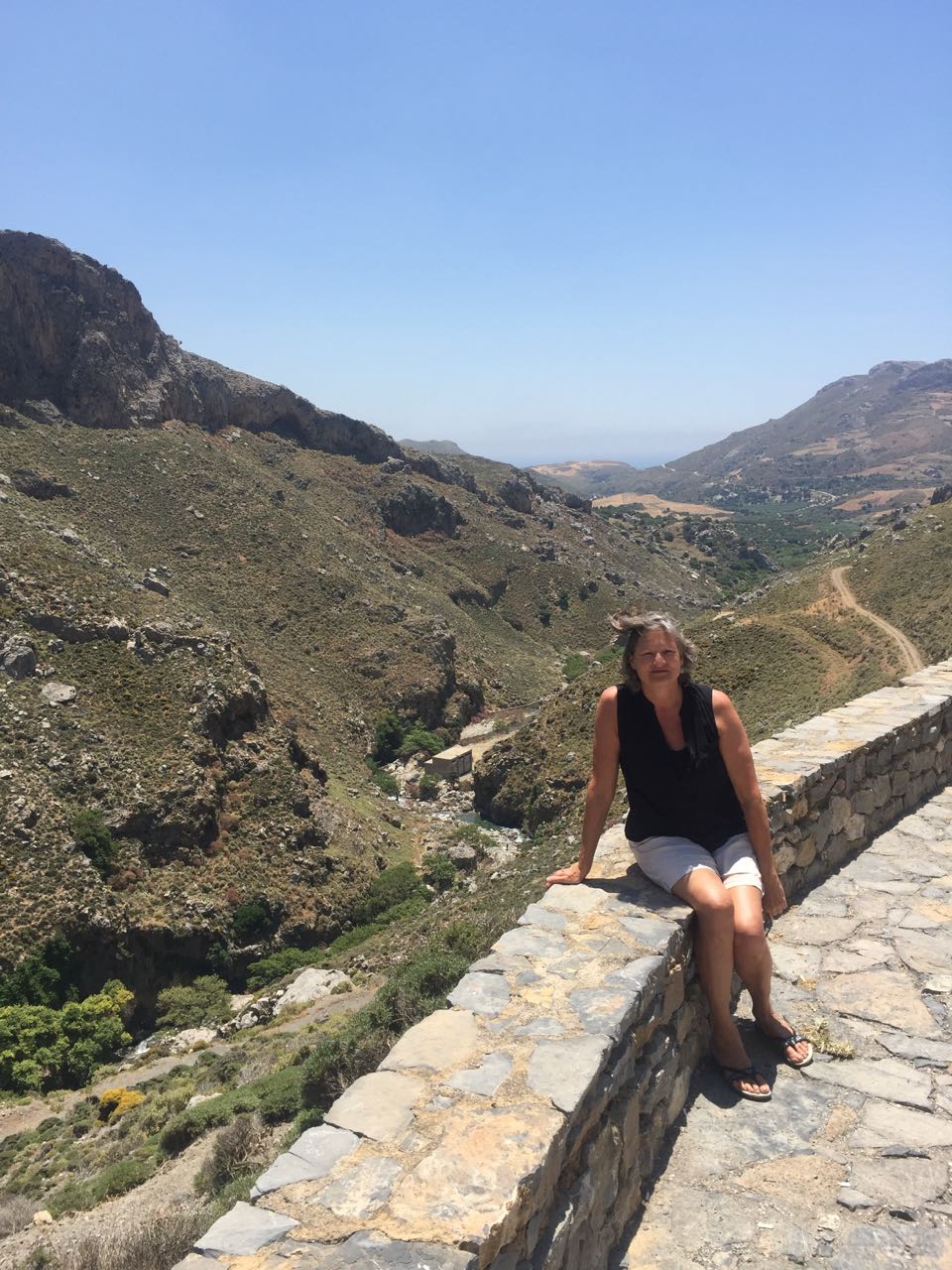 Sometimes it was better to just sit by the side of the road. But the many sightseeing areas also have huge drop offs, sometimes with no barriers. If she would’ve fallen over this one, she just would have just rolled downhill like a snowball in an avalanche instead of a straight plunge to instant death. So it’s possible she could’ve survived. I’m happy to report she didn’t test the situation.


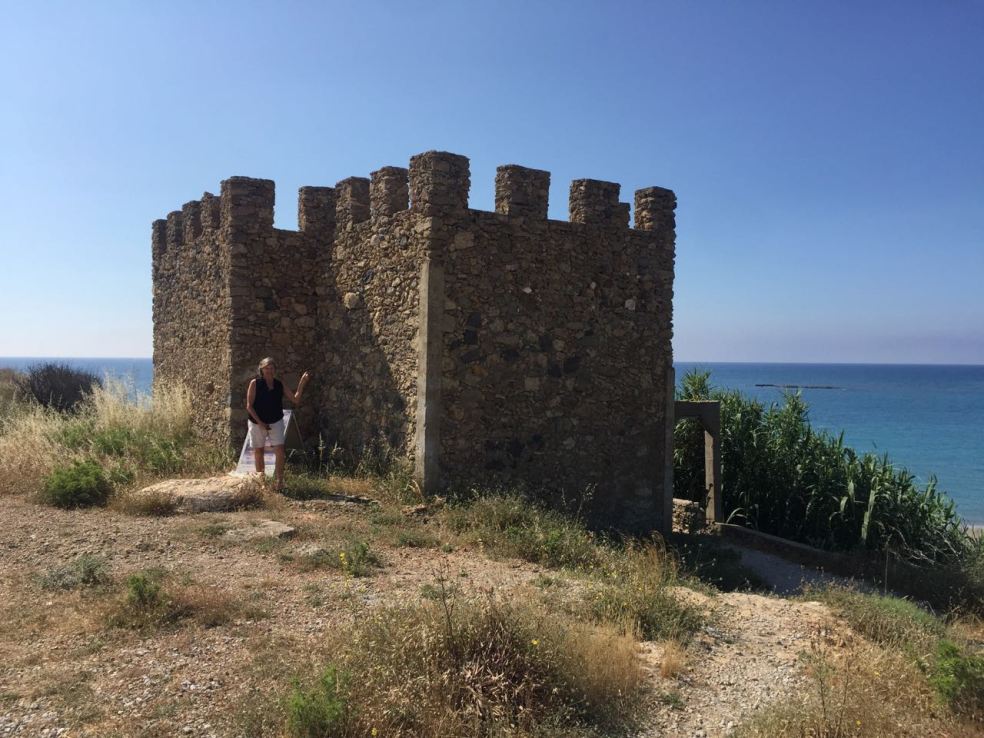 Even in ancient Crete, hobbits obviously built their own castles.
 There are two interesting beaches we wanted to see: Balos Lagoon and Elefonsi Beach. They are both quite out of the way, with lots of tiny towns and narrow roads, including this one-way tunnel.
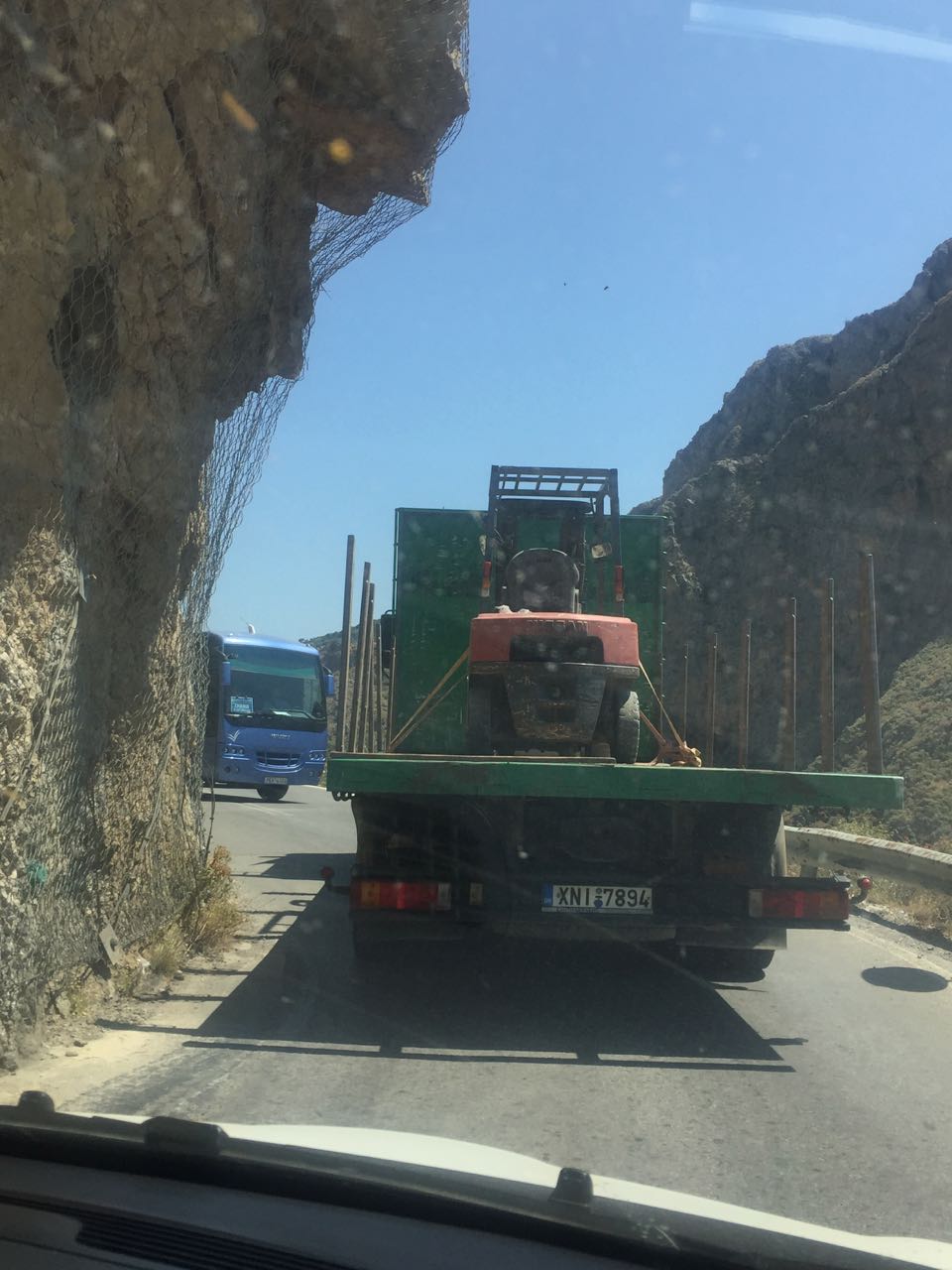 When you get behind a truck like that, you ain’t gonna pass him anytime soon.
 The road to Balos Lagoon is one of the most treacherous roads we’ve ever been on… on an island with a lot of treacherous roads.
 There are no guardrails next to a cliff called, “And we’ll never hear from you again.”
 A few natural barriers might help if you find yourself wrestling control of your vehicle with a madman. Carolyn rarely has to do that.
 Here it looks like a two-lane road, but there were long stretches were two cars couldn’t pass without one of them having its wheels halfway over the cliff.
 The goats keep a lookout to make sure everyone drives safely.
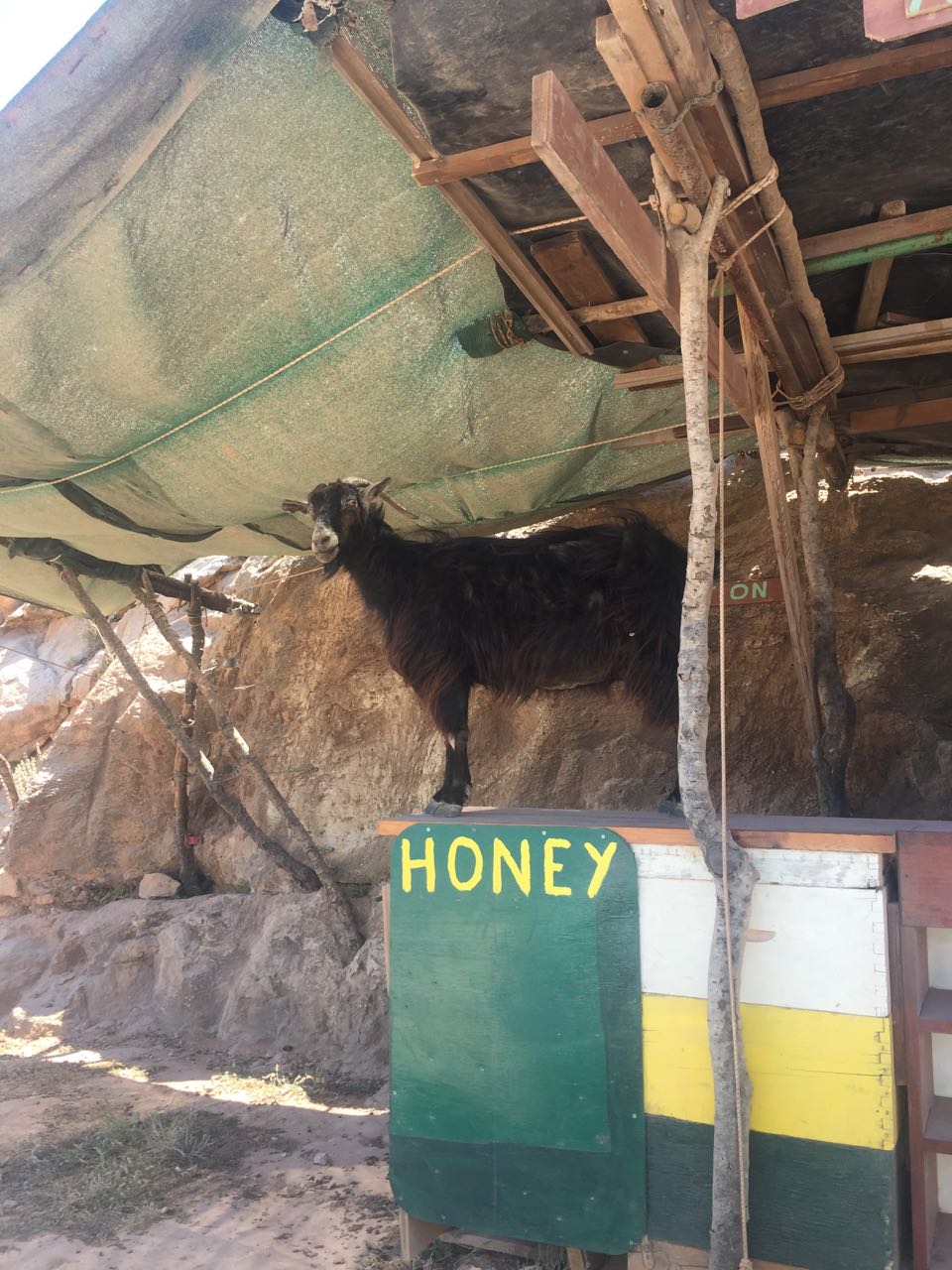 They even man (goat?) the roadside stands selling the ubiquitous Cretan honey.
 We just had to pay the occasional goat toll to be granted passage.
 There’s one lane, and then a goat lane. I guess it helps to be a little sheepish when navigating that road.
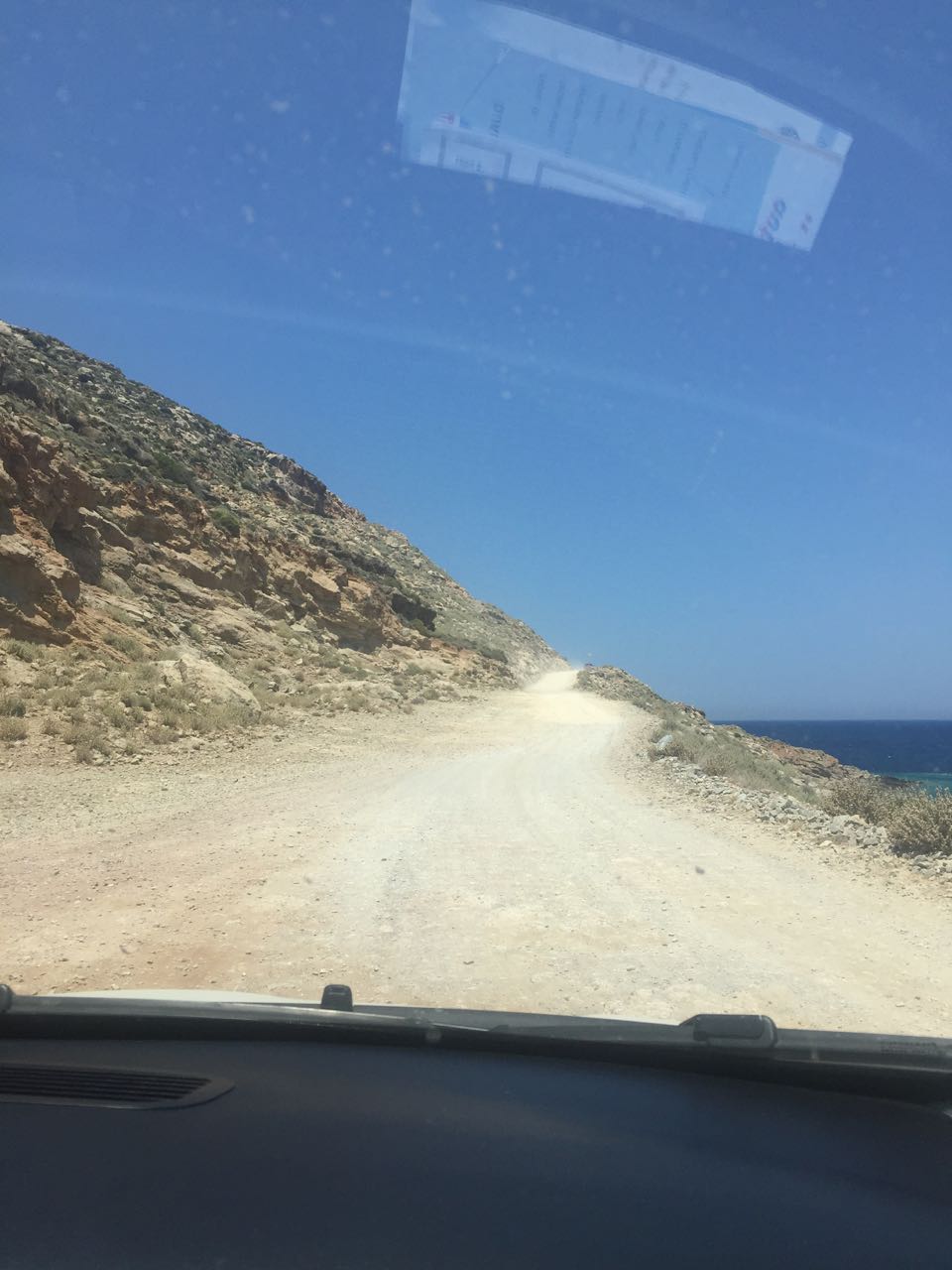 It went on for a good number of miles. I’d guess it took us about a half an hour to get all the way there.
 This gives you some idea why.
 This looks like a traffic jam, but is actually just cars parked ahead of the actual parking lot. It was our first clue that the place was gonna be packed.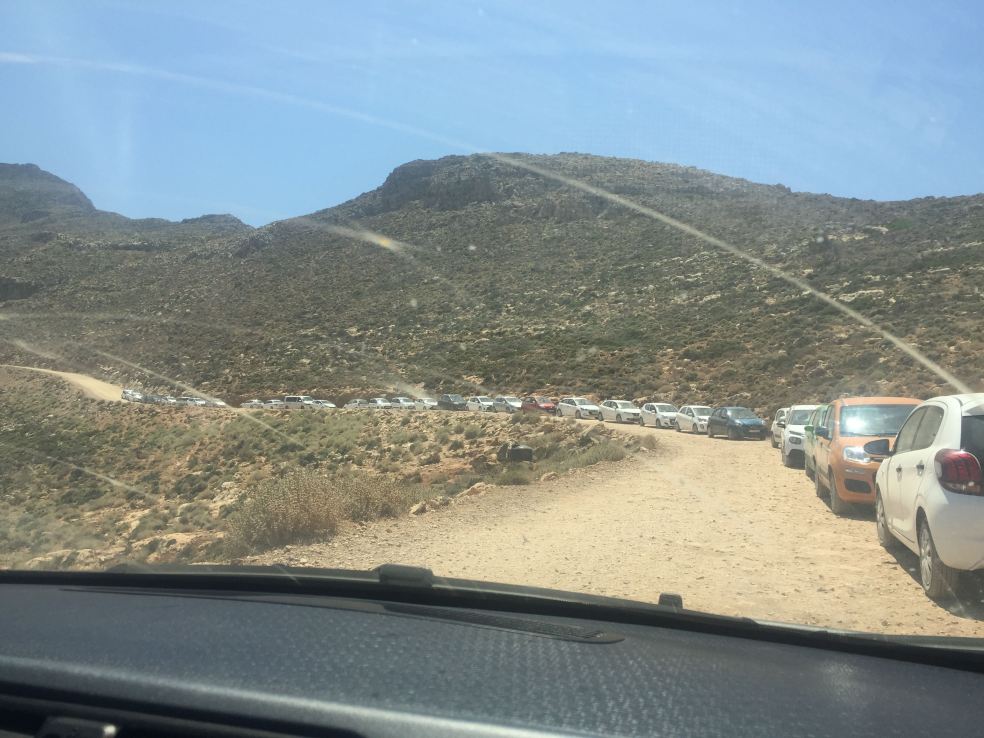
 One foot from Pancakeville.
 Upon our arrival at Balos, we were of course greeted by the Welcoming Goat.
 Now he’s off to greet the other new arrivals.
 Time for a cigarette break.
 Once in the parking lot, we discovered it was going to be a long walk just to get to the beach. So, while we didn’t have a lot of time owing to our impending flight that afternoon, these intrepid explorers made the trek.
 The path was marked for us by the considerate goats.
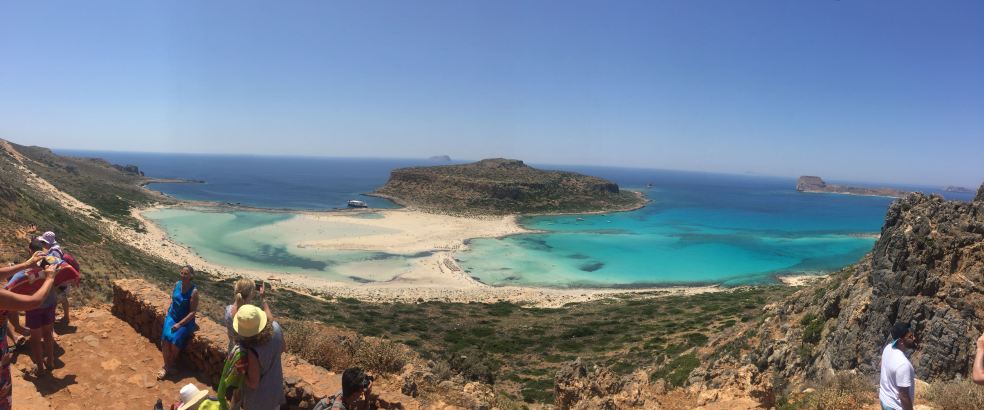 Once we crested the final hill, we were greeted with a sight that elicited oohs and ahs.
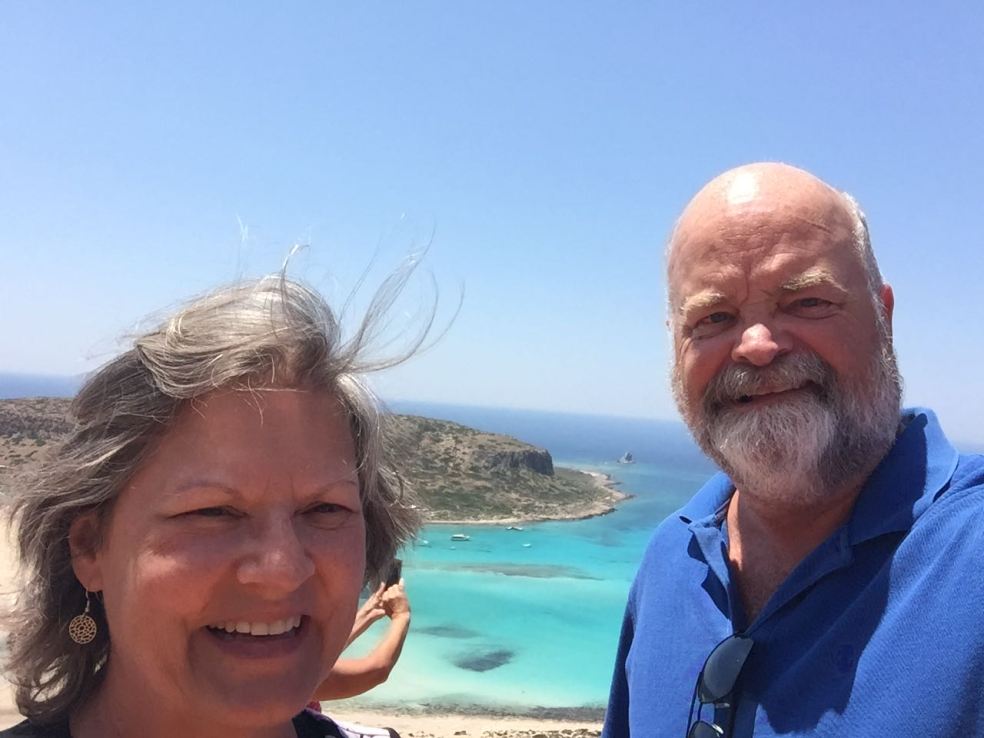 I think we’re mostly happy here that we actually made it, risking life and limb as well as a long, hot walk.
 Of course, the other thing we discovered was that the already-long walk was just to a vista of the lagoon. You have to walk all the way down there if you want to get to the beach.
 We encountered a few people returning, all of whom were desperately out of breath after making the long, arduous climb.
 So we settled for the gorgeous views of one of the most beautiful lagoons we’ve ever seen.
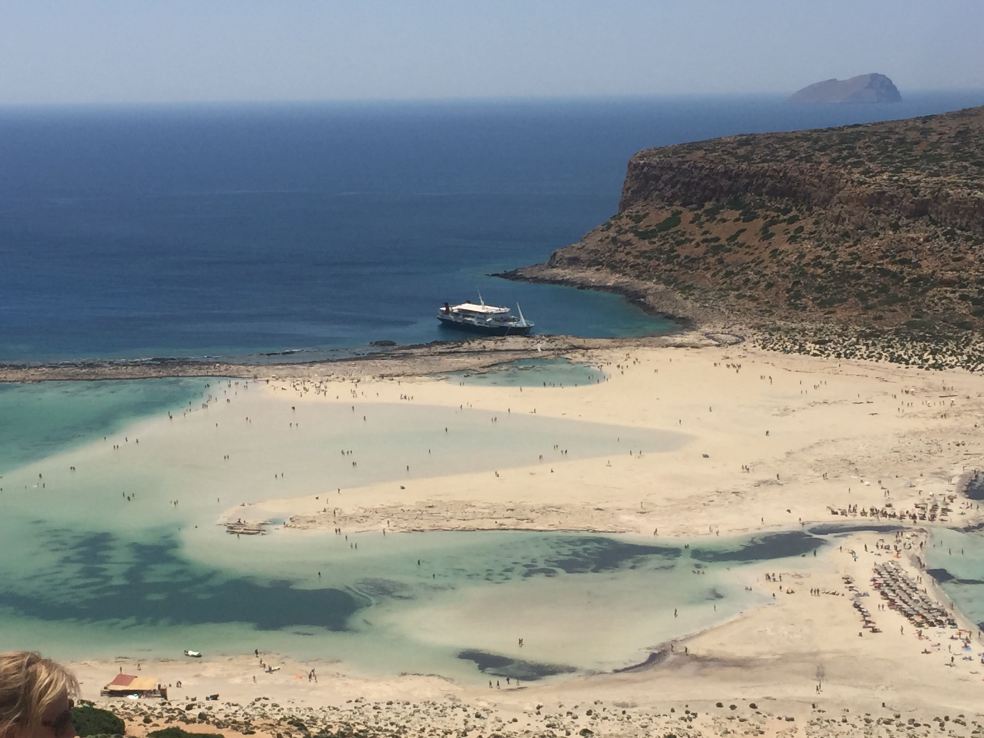 The smart people take a boat to the beach instead.
 Everyone else just admires the views and laments the fact that they’re not twenty-years-old anymore. This twenty-something is simply a wimp.
 The other beach we wanted to see is called Elefonsi Beach. Not long ago, Elafonisi Beach was a secret known only to some locals on Crete. Then, in 2014, TripAdvisor named it one of the world’s top 25 beaches, and all tourist hell broke loose.
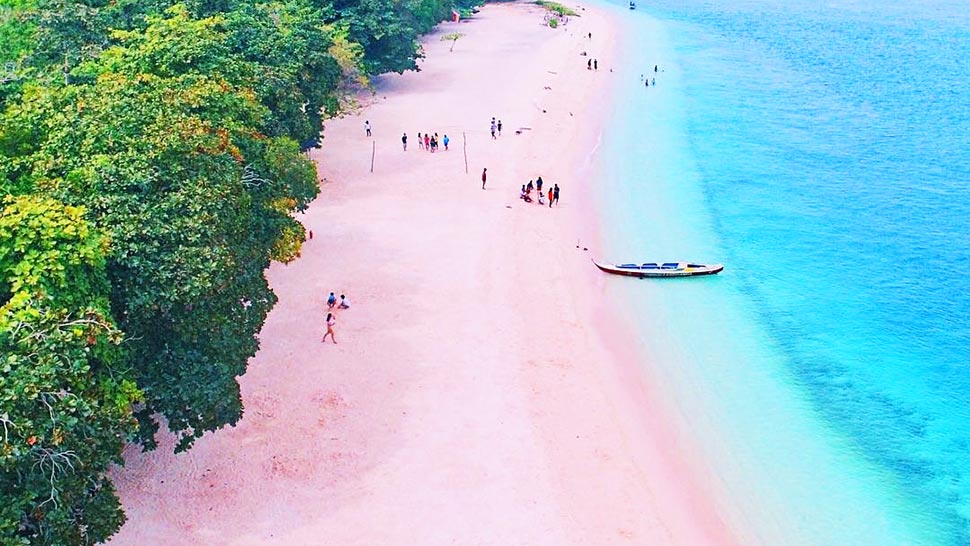 We thought we were going to see something like this beach in the Philippines.
 Instead, all we got was this.
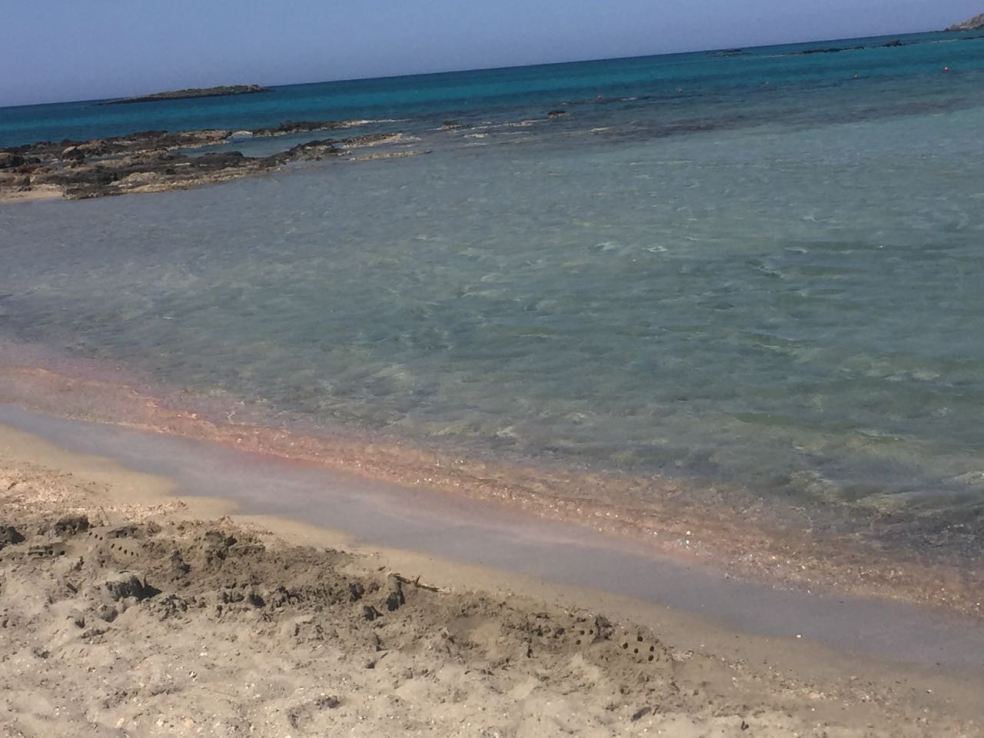 It’s really just a little tinge of red on the edge of the water. I think we were sold a bill of goods!
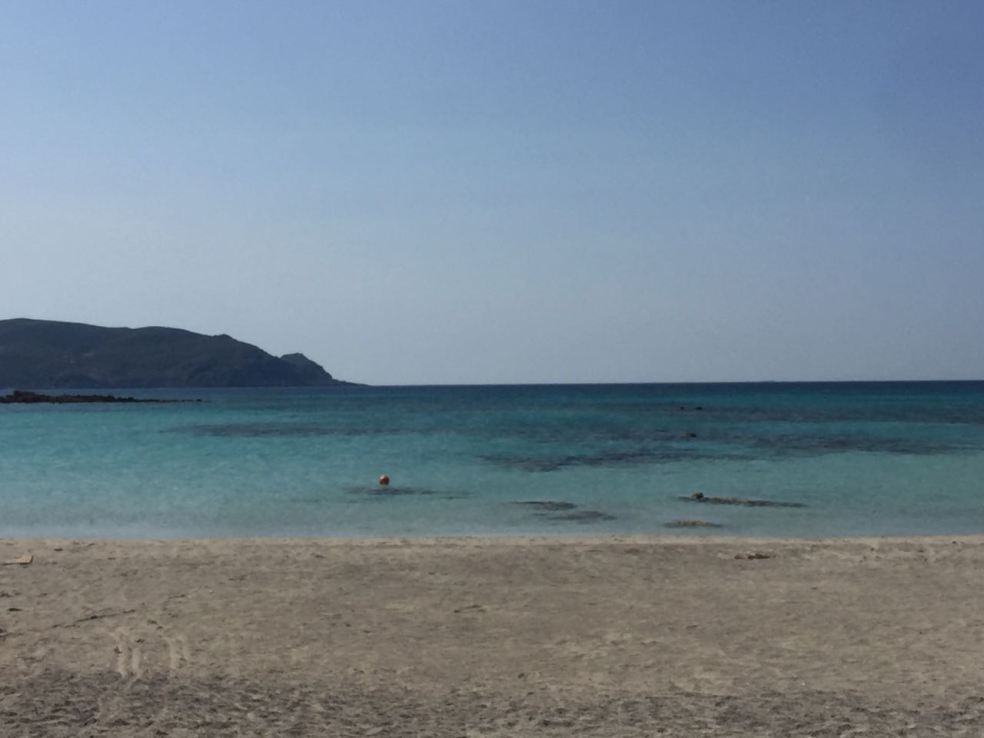 I mean, it is a nice beach and all…
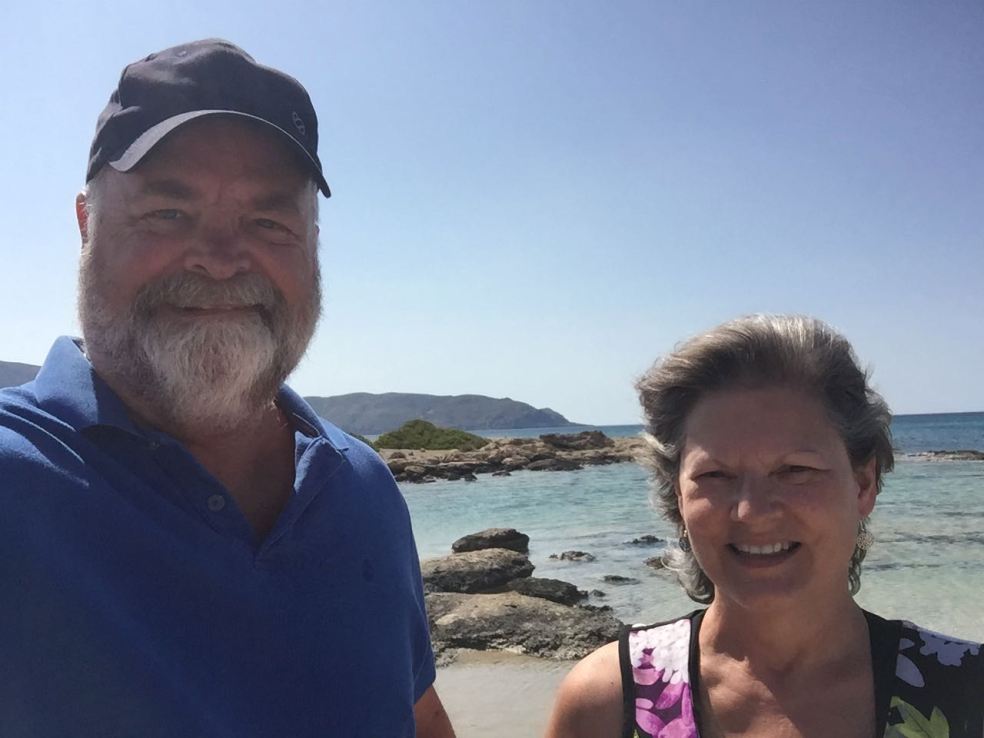 Appropriate for a selfie or two…

 And they have some nice flags.
 And truthfully, it is a pretty beach, and well worth spending a day there. We were only there to take a quick look because we didn’t want to miss our flight.
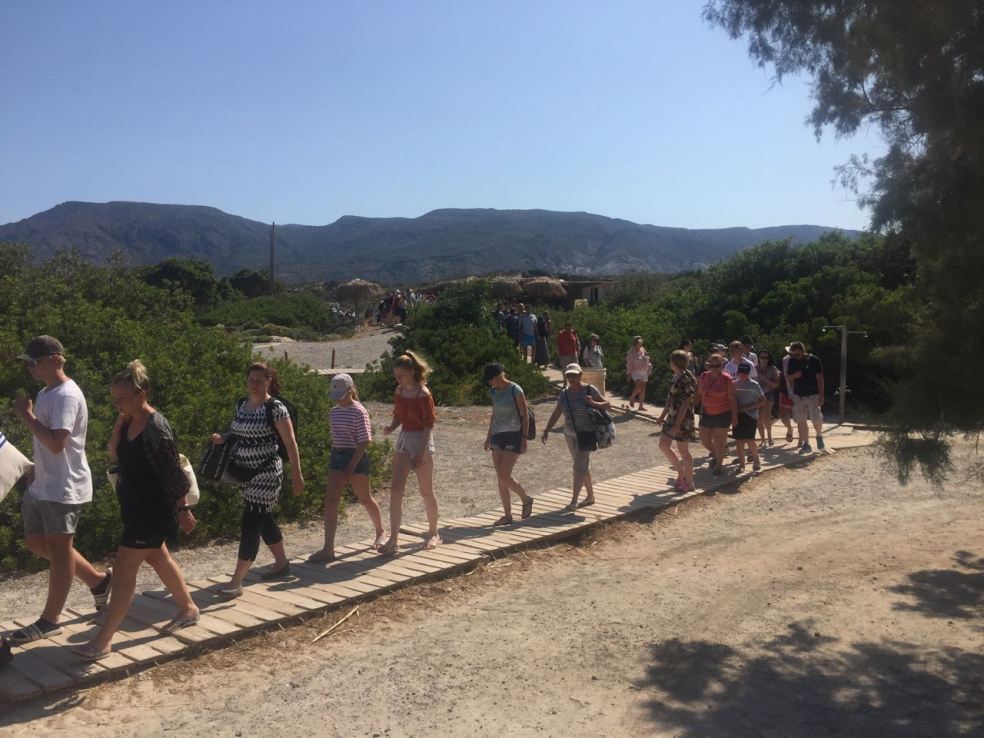 And then the busses started arriving. Thanks TripAdvisor! I’m sure the locals love that site now. Not.


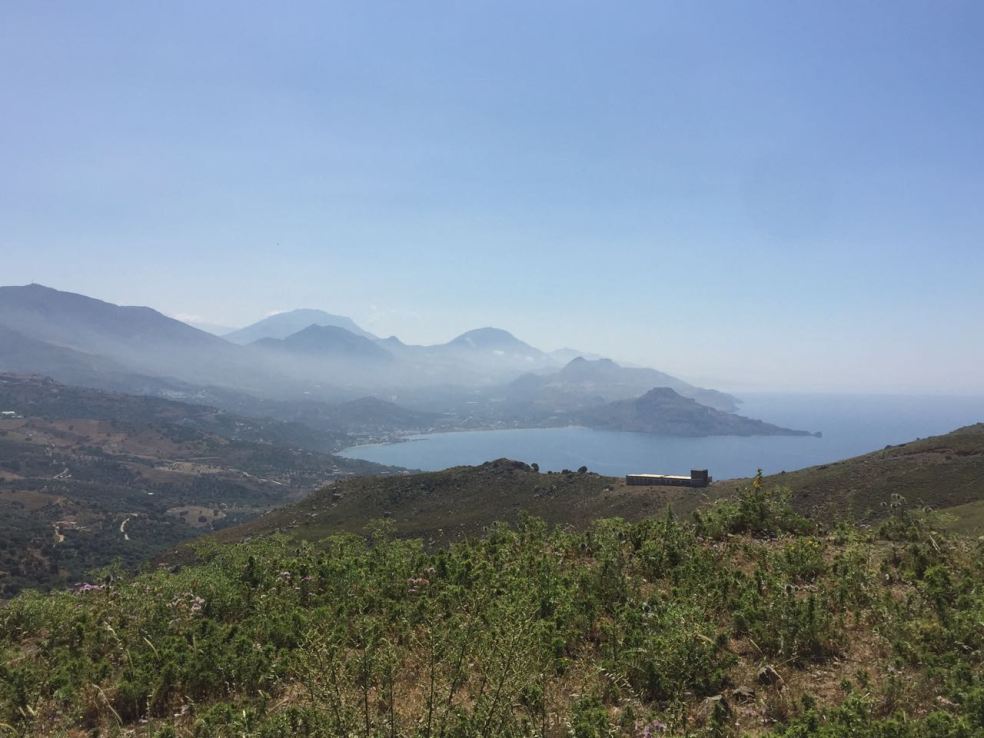
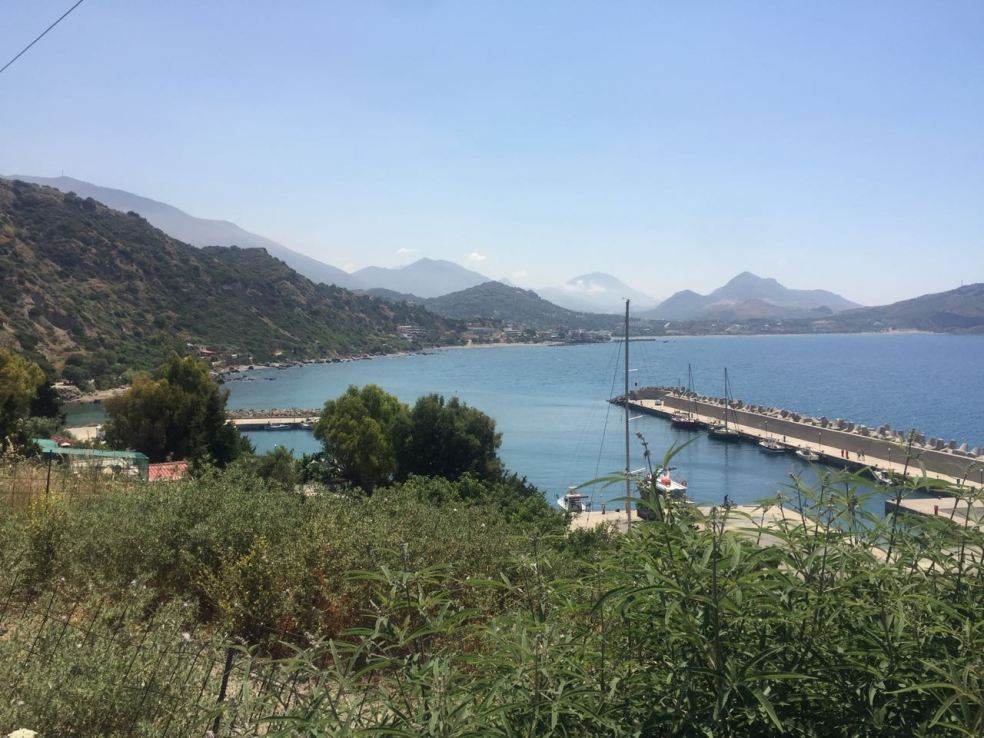
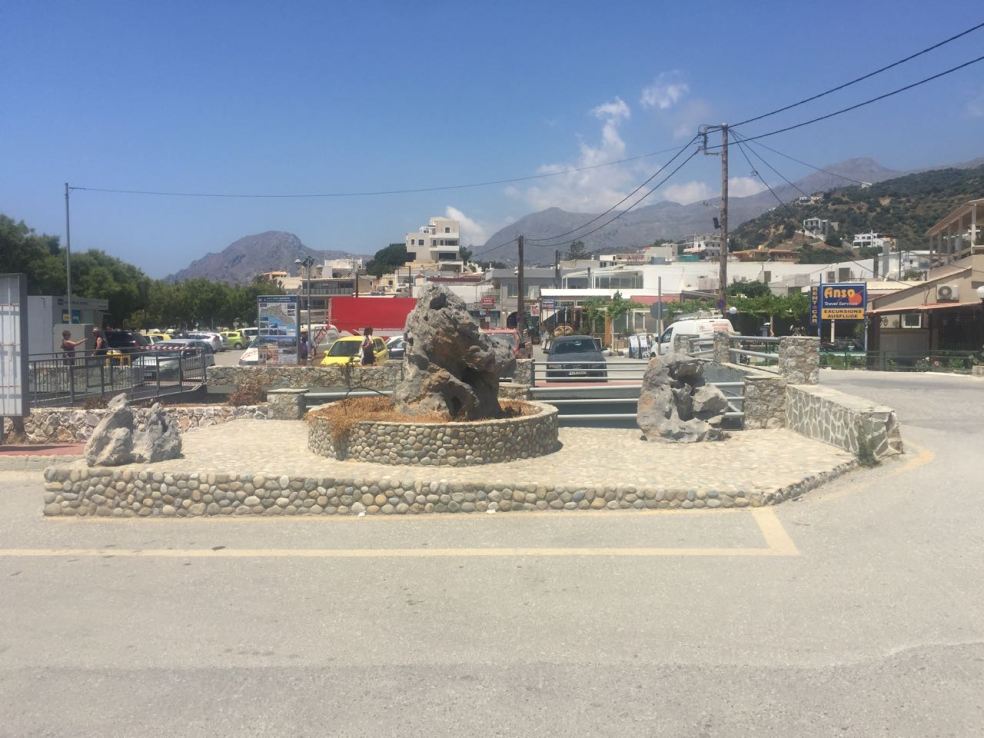

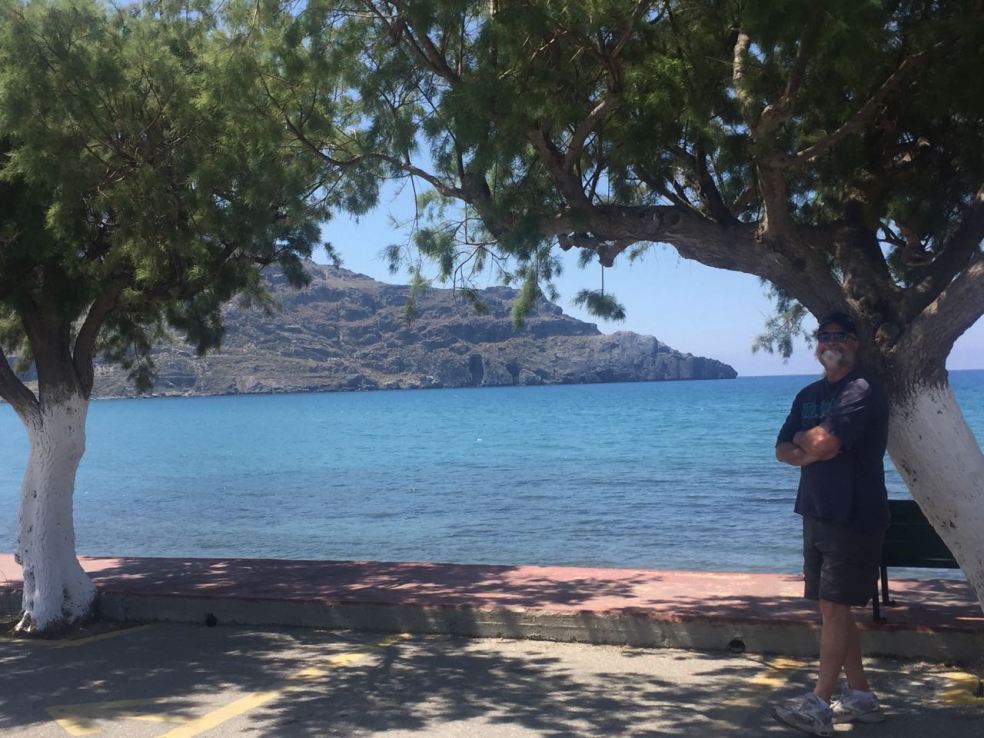
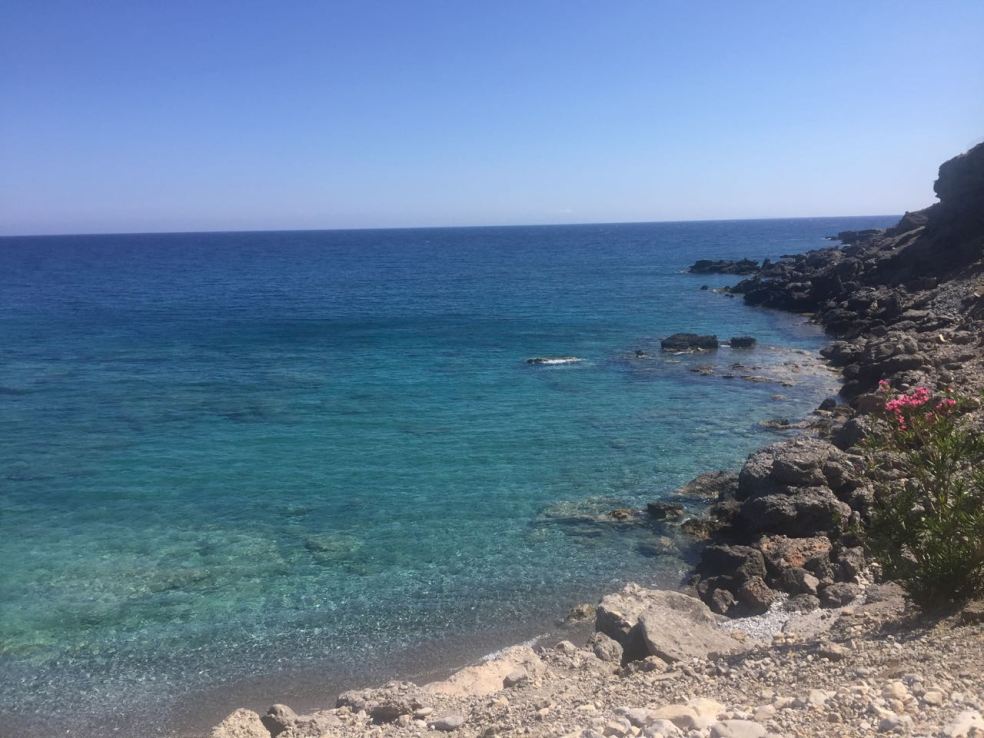


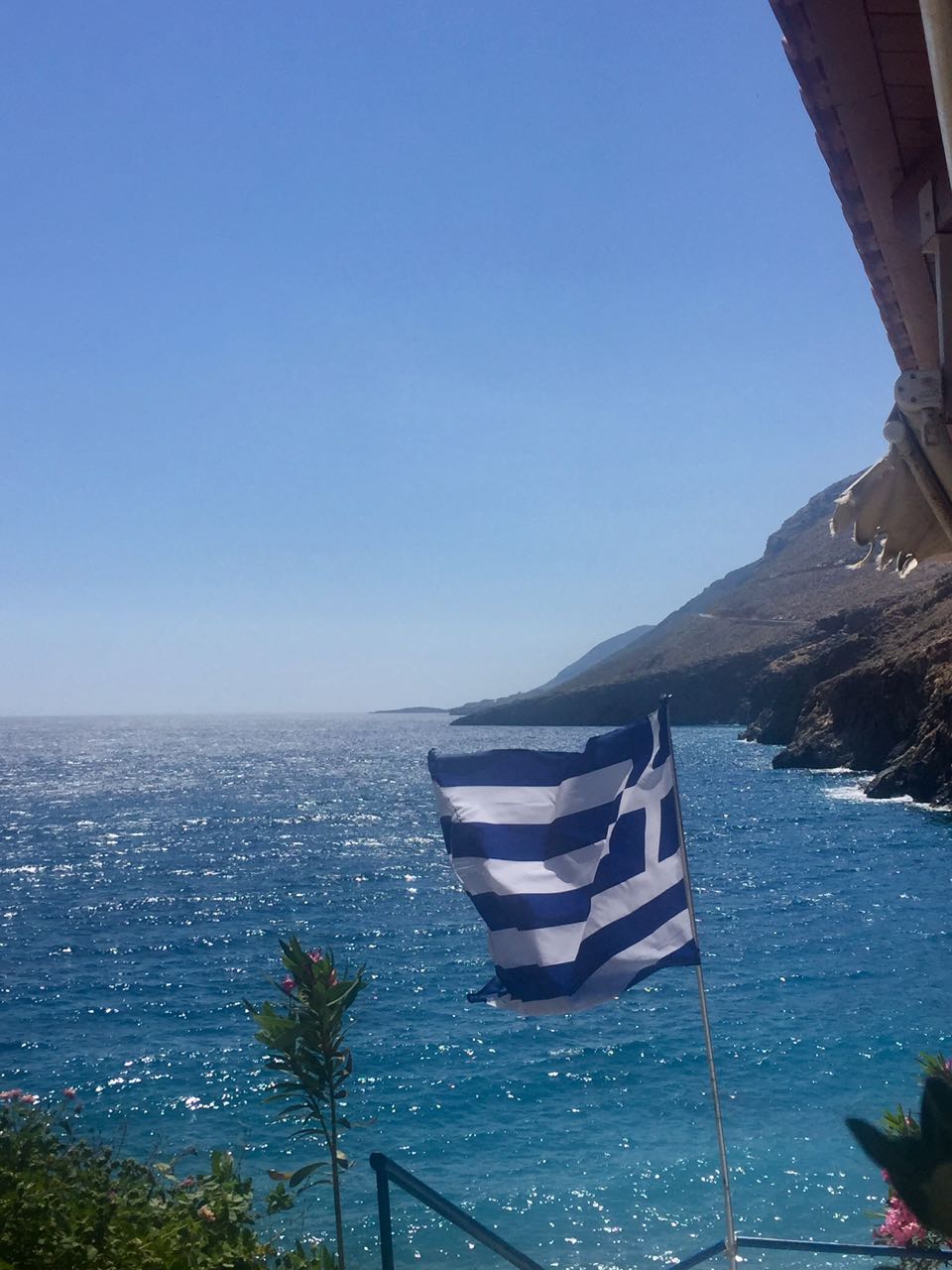


 After all that sightseeing, lunch is a welcome respite! Like the Portuguese, the Greeks are warm and gracious restaurant hosts. We had several lively conversations with our waiters.
 We gotta finish up with a kiss… because you gotta kiss-a-mo’ if they tell you to!
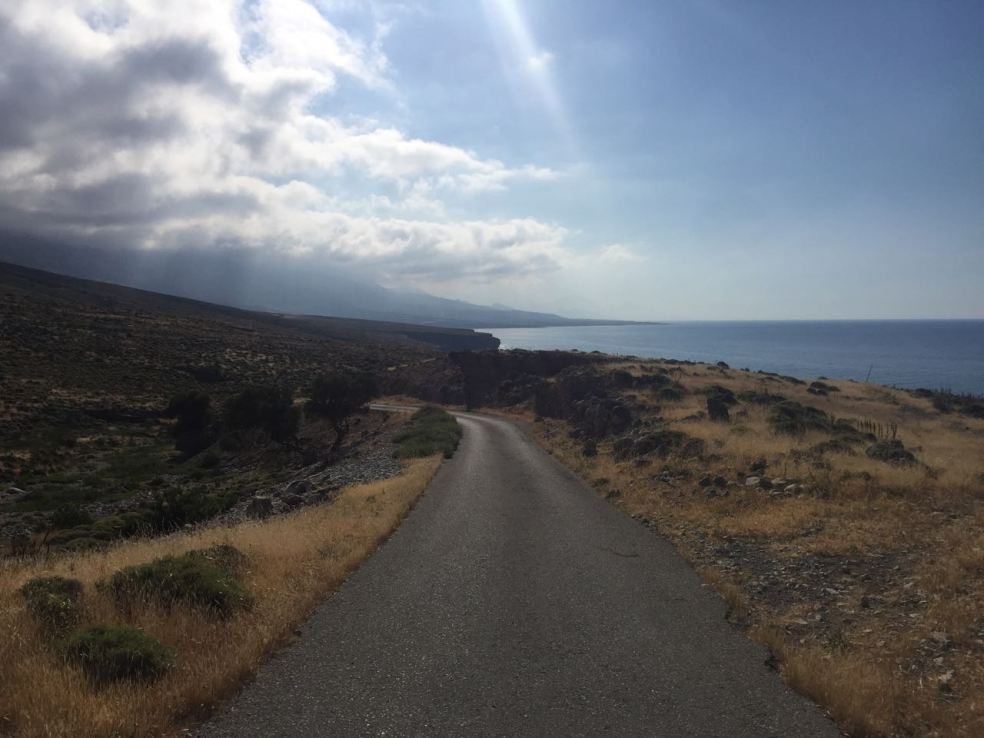 …and then we drove off into the sunset.
 Phtew! Phtew! We were hocking loogies all over the place in Crete.
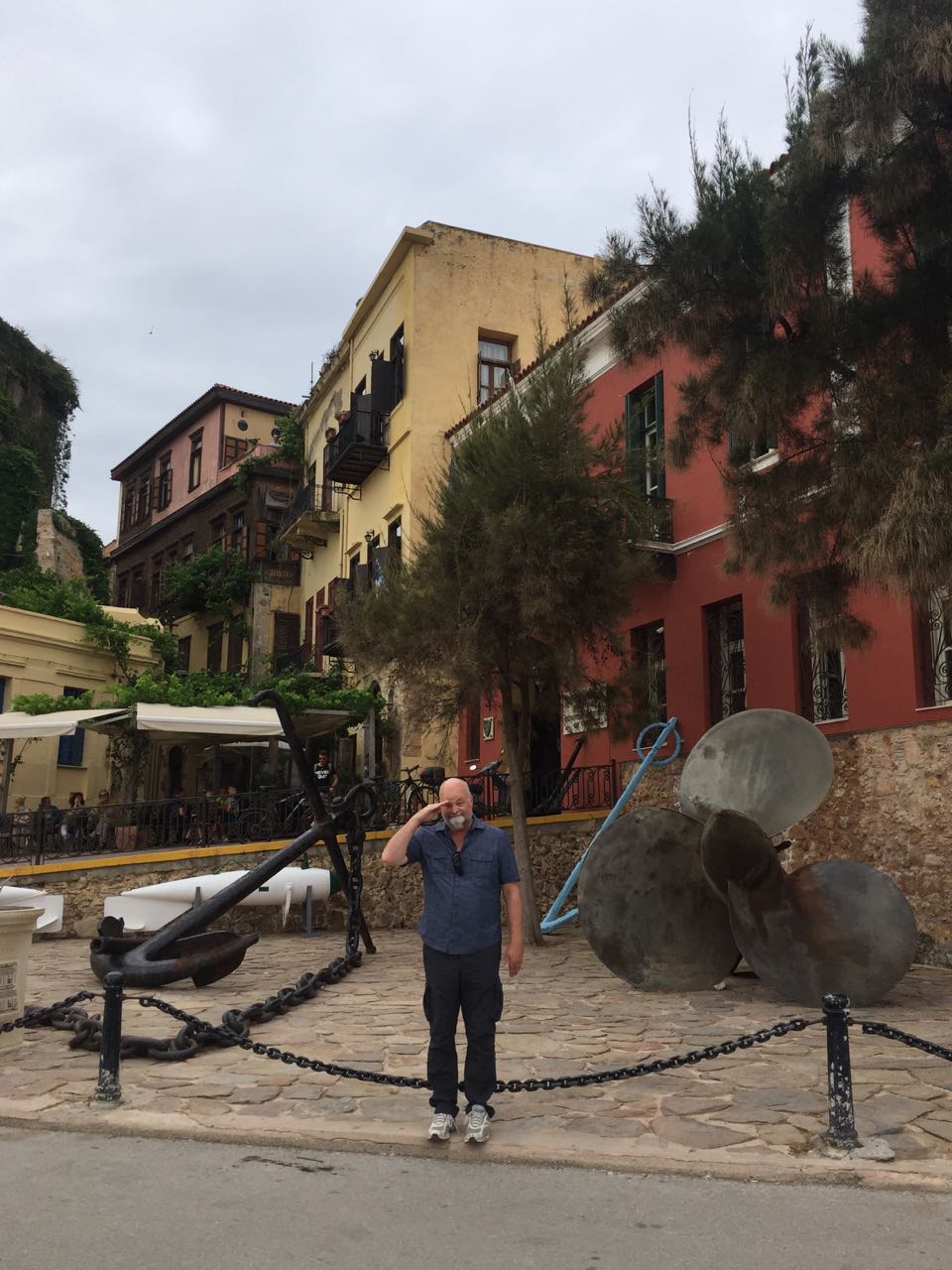 It’s a seaside town with a ring of stores and restaurants fronting the harbor. The artifacts in this picture (not the old guy) provide evidence of the town’s seafaring ways, and are one of the first sights you see when you first walk into Chania Old Town.
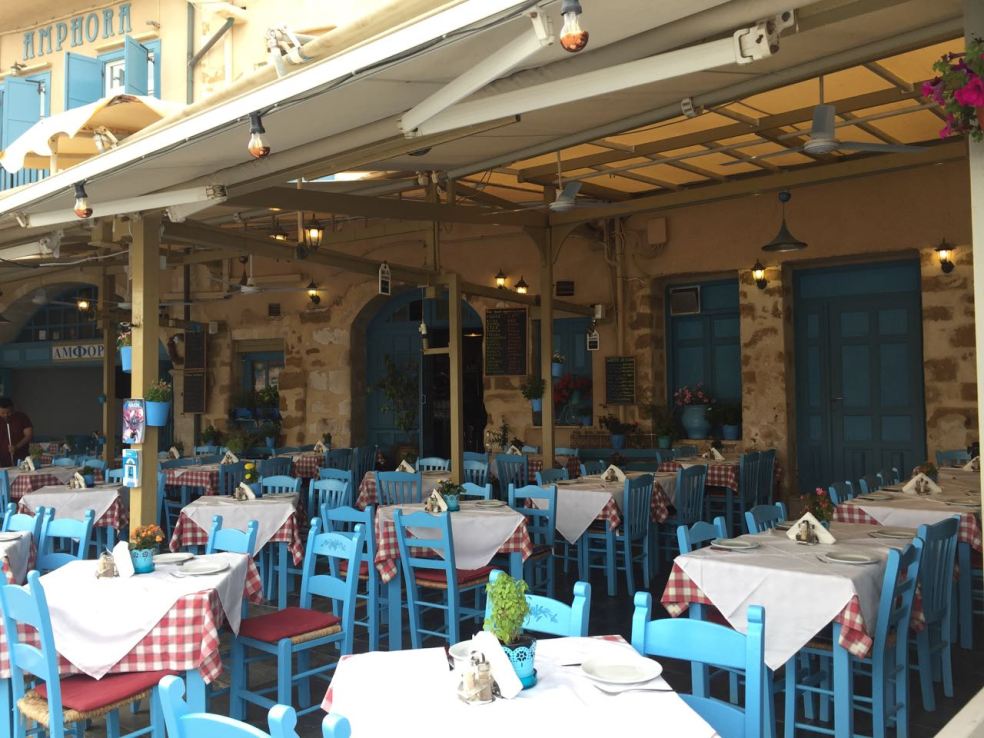 A whole slew of restaurants await for prompt seating and a great view of the harbor. Almost every one of them is fronted by a pitchman encouraging you to come sample their offerings… other than a few that feature signs saying, “We won’t bother you!” Except I noticed they sort of bothered you anyway, as if the sign gave them some sort of reverse psychology permission.
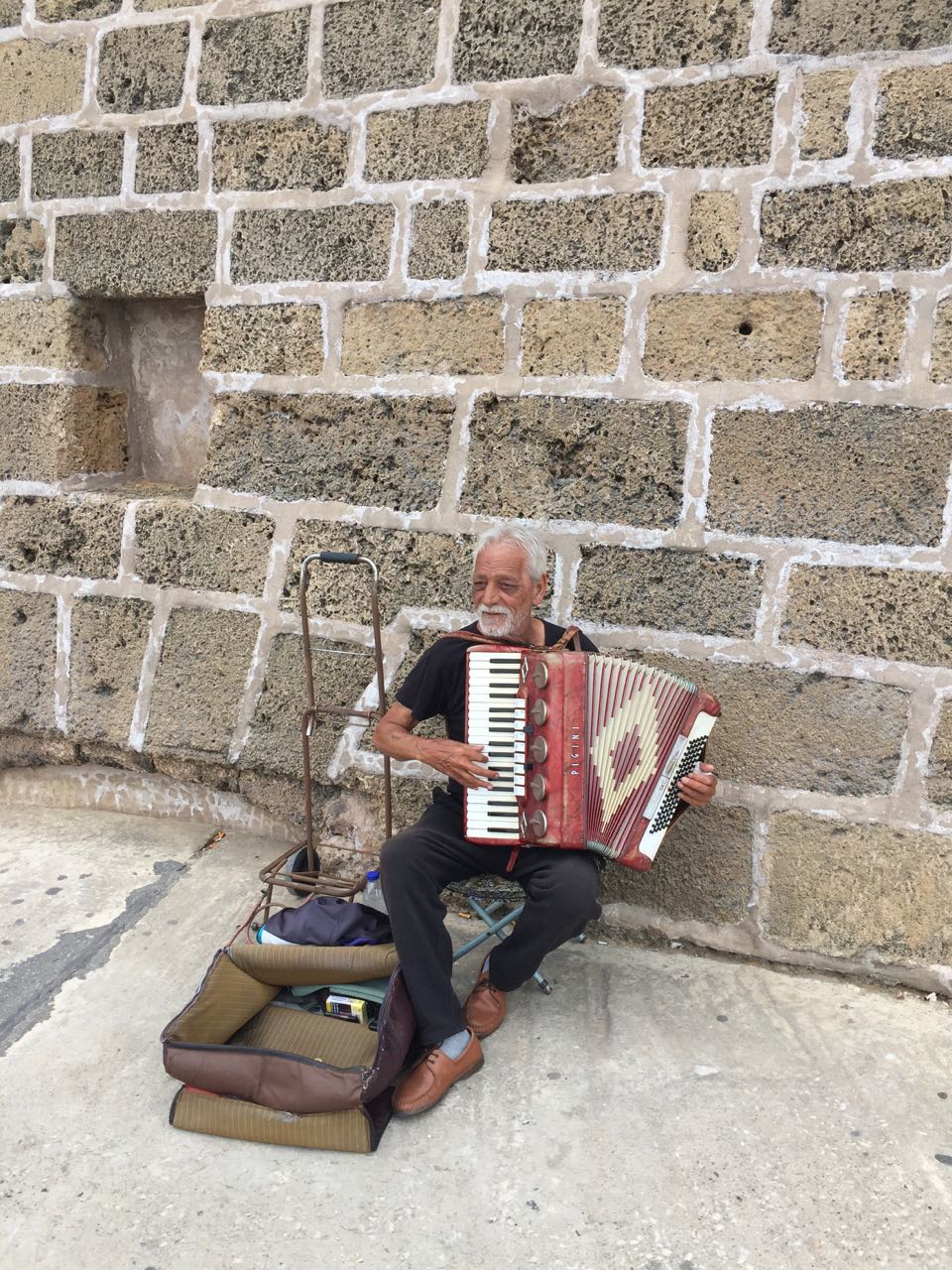 A few musicians and other street entertainers provided for a jovial entrance into old town. This guy was playing some AC/DC if I recall.
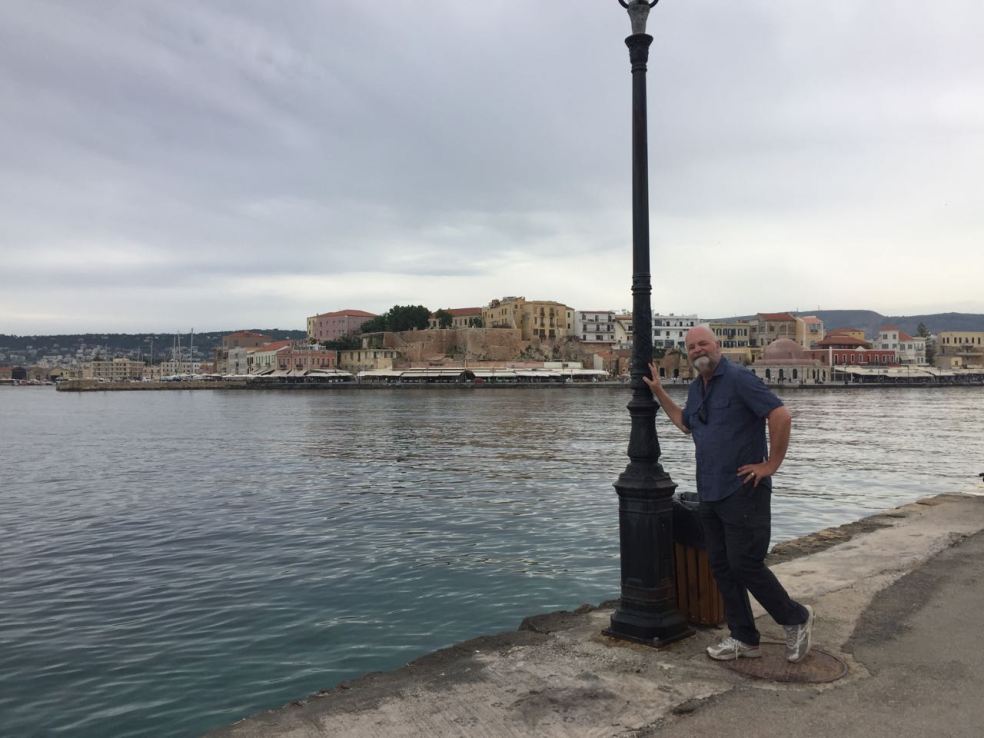 It took a bit of work, but I finally got this light pole all straightened out properly.
 So here’s Chania from the ocean view. As you can see, despite it being June, there’s snow on them thar mountains. We didn’t expect that in the middle of a Mediterranean summer.
 They really do a nice job of making things cute and clean. It was this way all around Chania Old Town. The rest of Chania was just like any other town, but they really know how to cater to tourists in the tourist area.
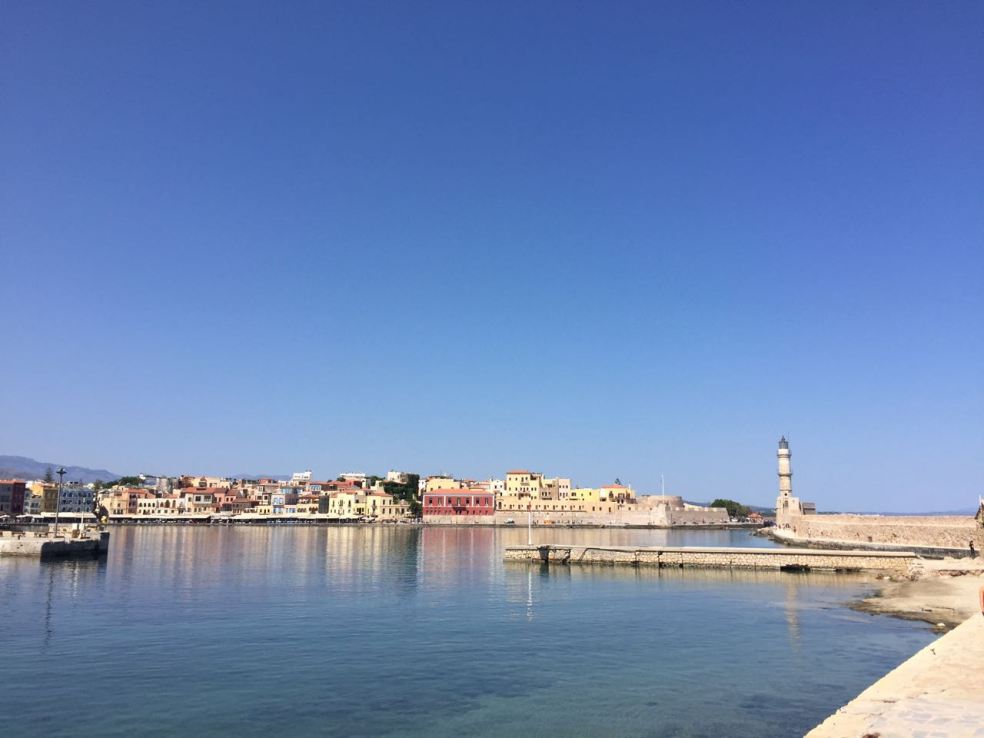 If you see many pictures of Chania, one of them is bound to be one with this lighthouse prominently featured. It’s an iconic part of Chania. It was originally a Venetian lighthouse built around the late 16th century, although it’s sometimes referred to as “Egyptian” because it was built during a time where Crete was occupied by Egyptian troops.
 Here’s a close-up, taken after a very hot fifteen minute walk around the harbor (the lighthouse is located at the end of a long protective breakwater that protects the harbor from the sea). During the Turkish occupation the lighthouse fell into disrepair. It was eventually rebuilt between 1824 and 1832, although they kept the original Venetian base. It was leaning badly due to bombings during World War II, but it was extensively renovated in 2005.


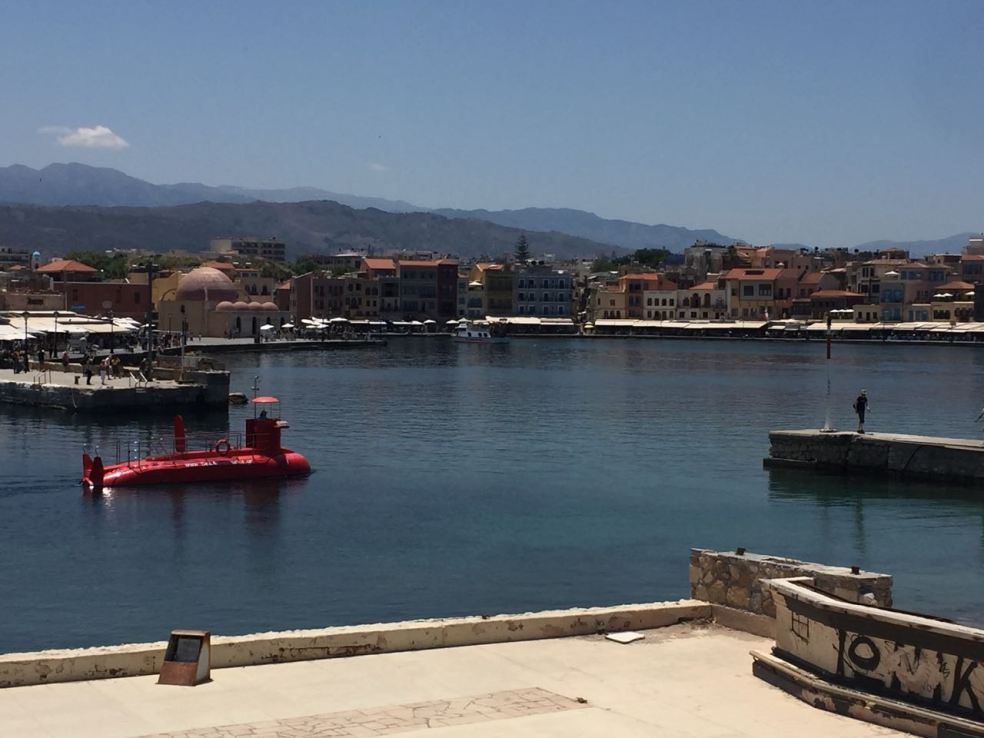 A tourist submarine is is on her way out of the harbor. We didn’t do many of the touristy things there, however; the town was charming enough all on its own…

 The Nazis bombed the hell out of Chania in 1941, especially Old Town. I think before that the town name was simply pronounced “Shania,” but the bombings rattled the residents’ fillings so much they couldn’t say the “sh” without sounding like they were hocking a loogie. I wonder if any of our Portuguese friends have ever heard the term “hocking a loogie?”
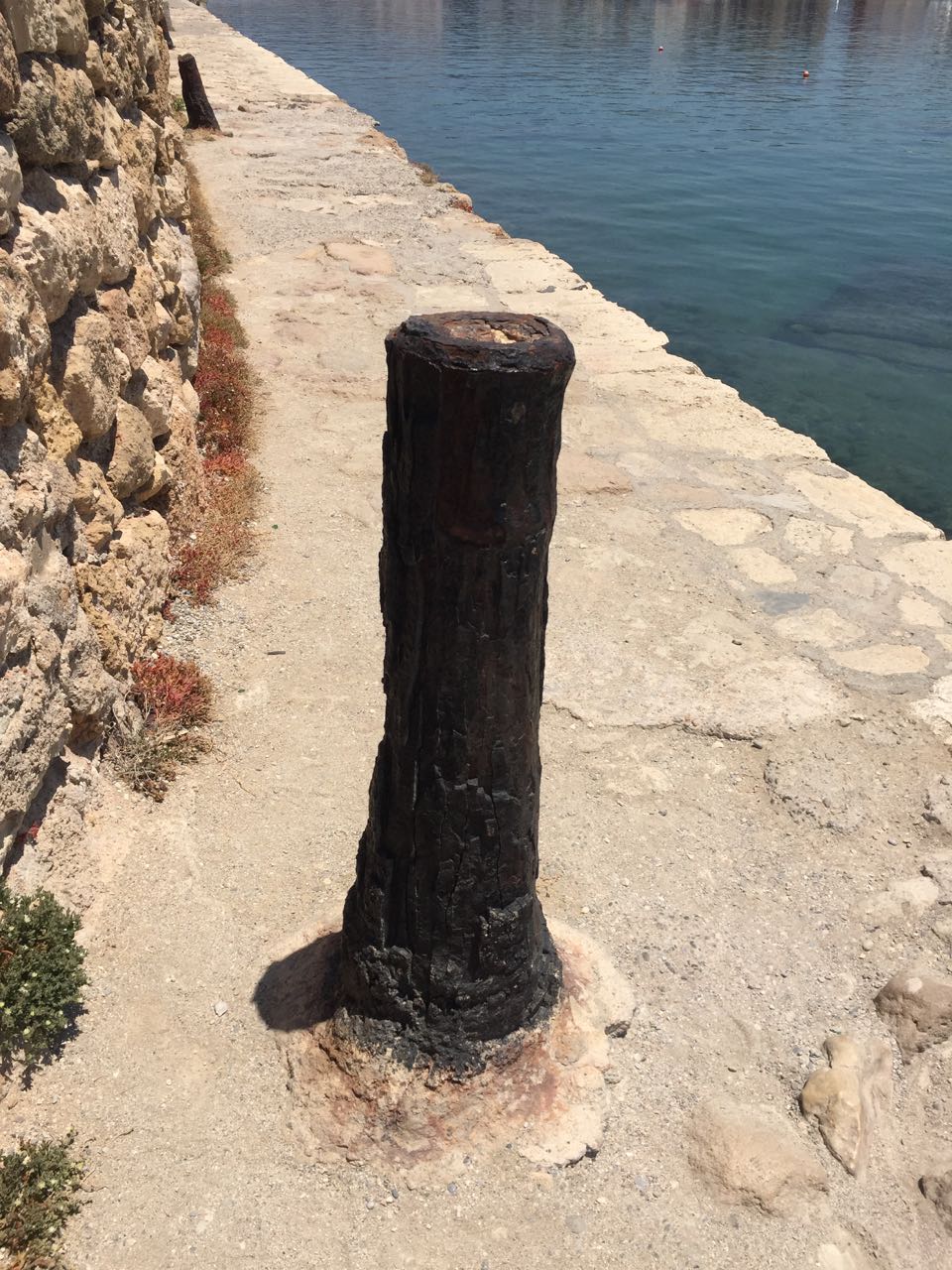 Apparently the Chanians pointed their cannons straight up to try and hit the German planes, but once they put them in cement this way, they couldn’t figure out how to put in the gunpowder and cannonball. No wonder Crete kept losing wars.
 They do much better in peacetime, as evidenced by these clean and friendly promenades leading from the harbor.
 Here’s a panoramic view of Chania from the seawall.
 Here’s a view of the seawall.
 You gotta admit it’s a pretty little town.
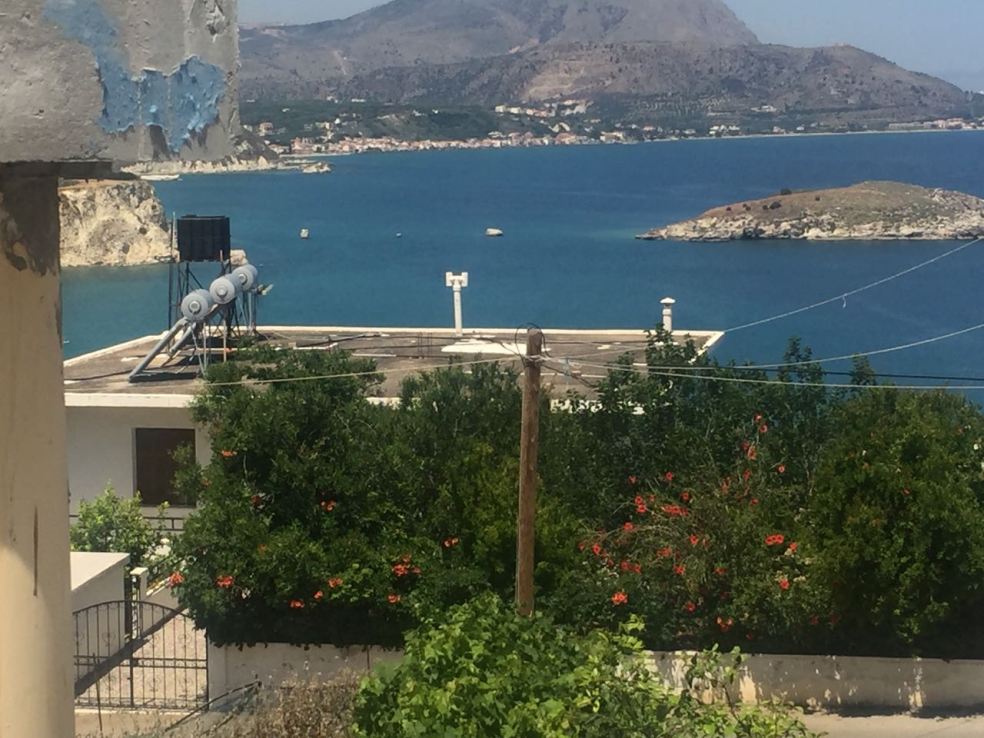 Here’s our view from the top of the hotel (really more of an Airbnb).
 And here’s what we did up there. As far as you know.
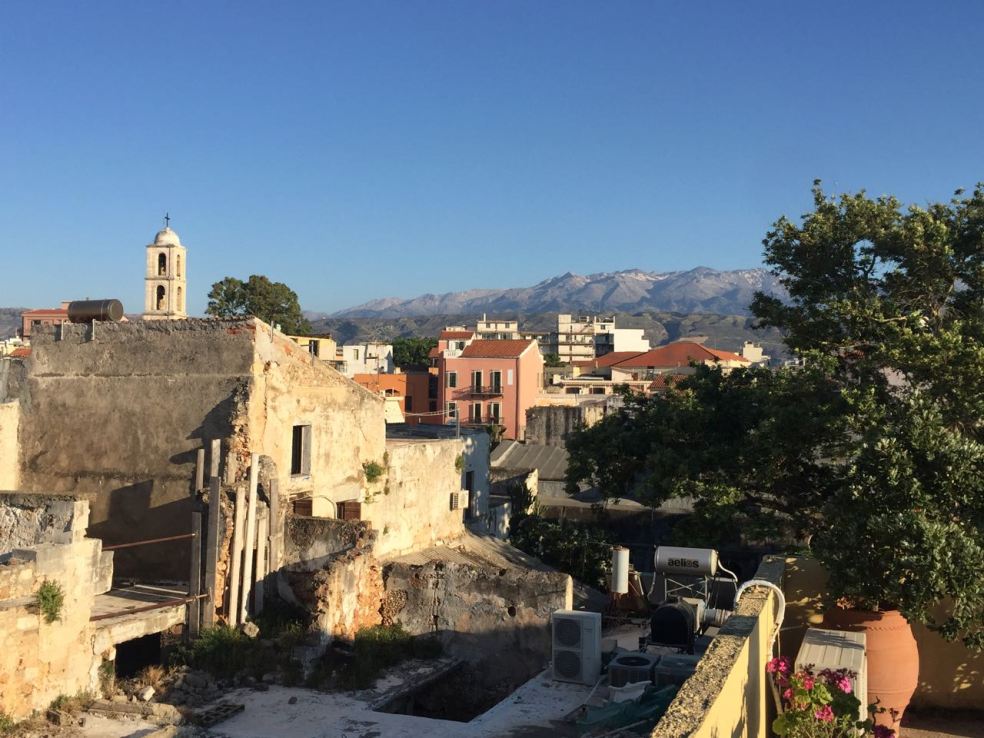 As with so many places in Europe, old meets new everywhere you go.
 And the sea meets land.
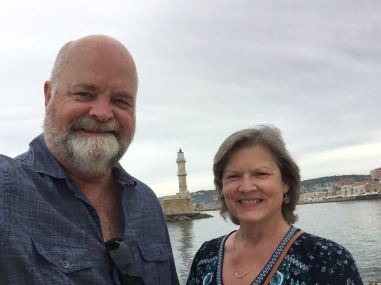
 And the man meets woman. So if you don’t think we’re happy as hell being able to do all this traveling and stuff? Of course we are! These are our expressions before we put on our happy faces for the camera!
 Horse carriages await tours around the town. We almost did that, but for no good reason we kinda missed it. Oh, well, maybe we only missed out on some horse farts.
 I thought this salad bar was a little odd, and was glad we didn’t eat at whatever restaurant it was a part of.
 Purple is one of my favorite colors. This tree (and my wife) is magnificent. I think she’d look good in purple hair, but I haven’t been able to convince her of that yet.
 I thought of my son and his wife when we saw this store offering nothing but honey and honey products, because they raise bees in the state of Washington.
 Honey is a big thing in Crete (so I’m not sure why this mannequin looks like the bees got put inside his hat). There are a ton of small shops and roadside stands around the island offering either honey, raki, or ouzo, the last two effectively being the national drinks of Crete.
 The history of Crete goes back to the 7th millennium BC, preceding the ancient Minoan civilization by more than four millennia. The Minoan civilization was the first civilization in Europe and the first, in Europe, to build a palace.
 A good view of the charming seafront.
 A panoramic view of the charming seafront.
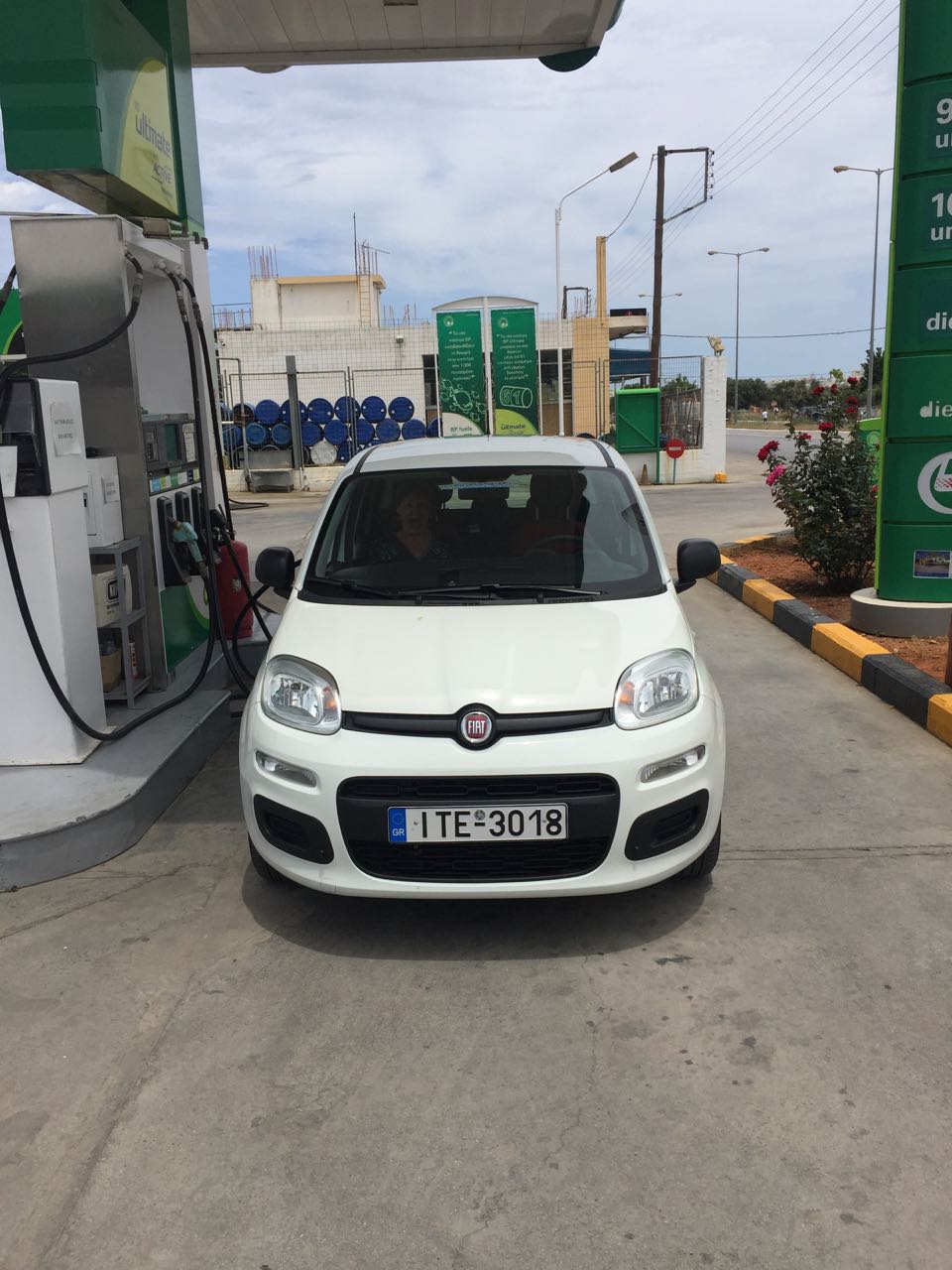 A great view of a car in a gas station.
 Anyway, finally after about a half an hour, a harried employee hustles into the small office and starts processing people. One rude man butted in line ahead of the rest of us, a circumstance much more common in Europe than in the US. I complained, but the employee just shrugged.
 Many world travelers surely list the Vermont State House in Montpelier, Vermont as first or second on their sightseeing bucket list. Okay, maybe not in the top two, or ten, or hundred, but the Vermont State House in Montpelier, Vermont is definitely something you’d want to look at if you were standing right in front of it.
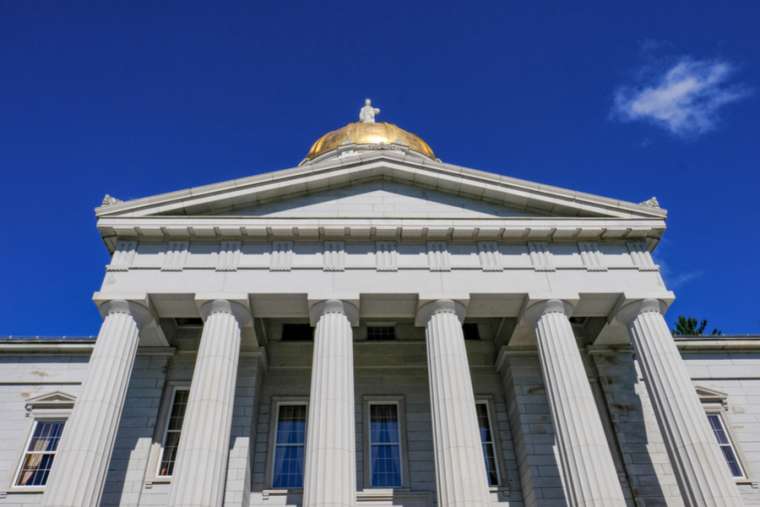 (This is the Vermont State House in Montpelier, Vermont, just in case you were wondering.)


 Fortunately, he disappeared without much of a whimper, as most gods do, leaving this impressive building in his ashes, –er wake.
 As you can see, this is a container for offerings to the dead. As you can also see, the dead already scooped everything up. Greedy bastards, those dead people.
 This building known as the Stoa of Attalos (we’re still in the Agora, or as I like to say, “O Aqui e Agora,” which means “The here and now” in Portuguese, which has absolutely nothing to do with anything except the word “agora” and my desire to show off my still-very-limited Portuguese skills). “Stoa” means portico or covered walkway. “Portico” is where you have to go after you’ve drunk too much port. “Walkway” is a word that turns into “runway” just by adding some planes. Accordingly, “Covered Runway” is just not a term you hear anymore, not after that one disaster anyway.
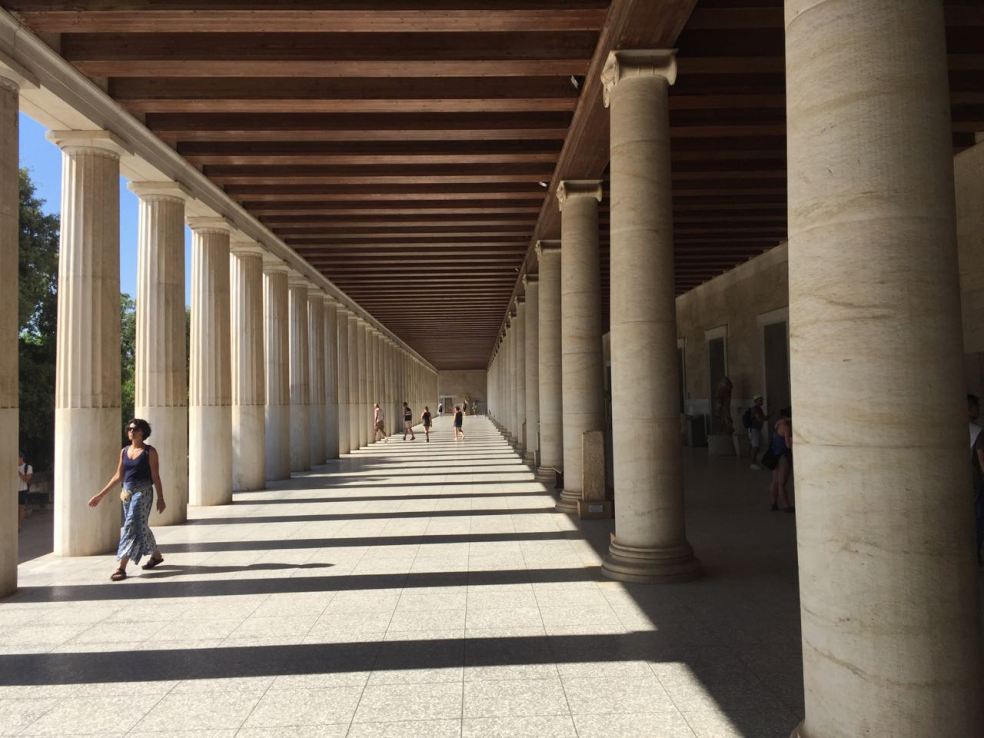 This photo provides some perspective. Ha! Anyway, i
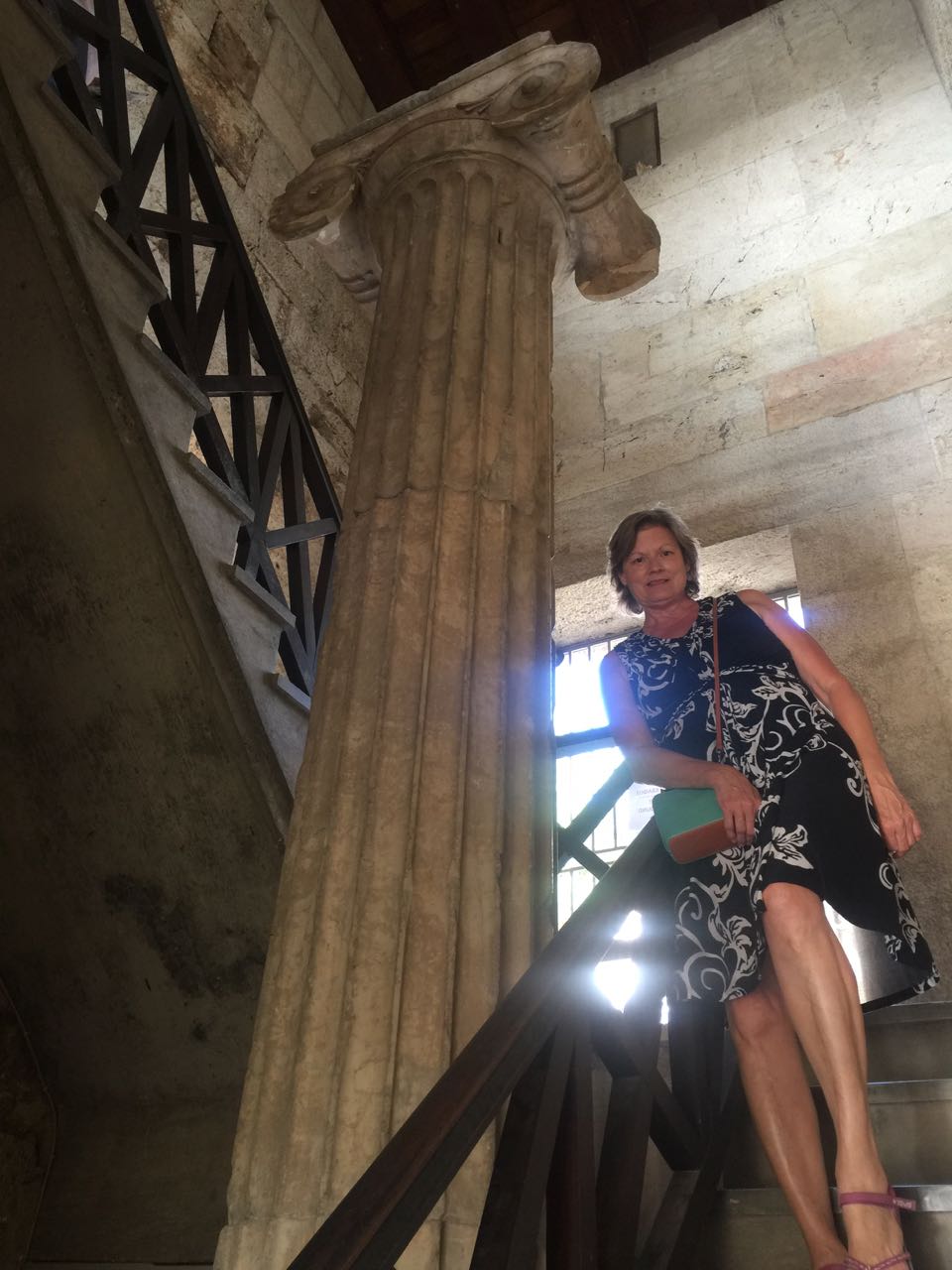 The Stoa of Attalos has a museum inside it and a second floor (or first floor in European). This photo gives you an idea as to the sleek beauty of those gams– I mean columns.
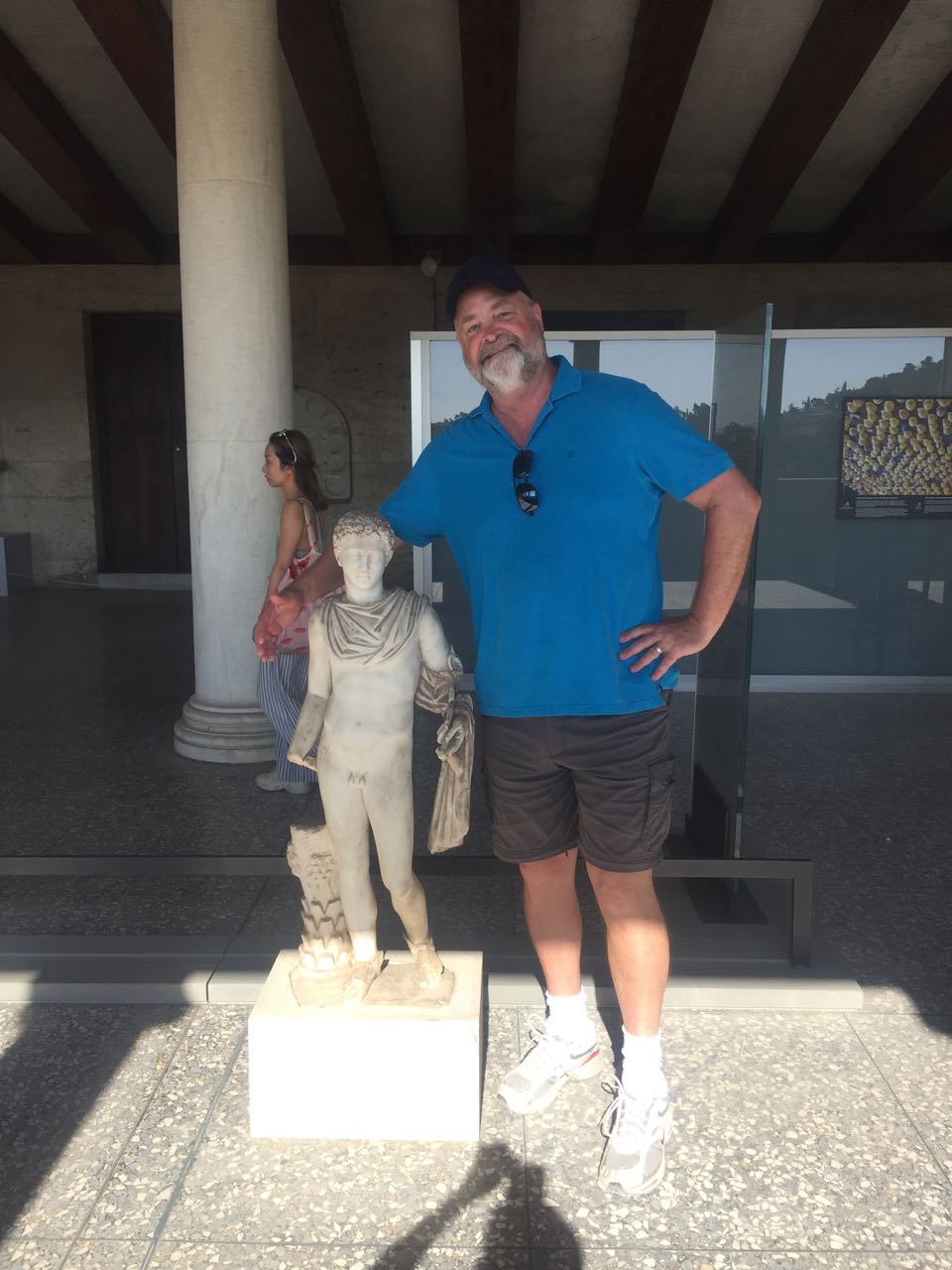 Everyone knows our species has gotten a little larger over the millennia, but few people know just how big a difference there is. And they say JRR Tolkien just made up the hobbits. This ancient life-sized sculpture begs to differ. This statue does explain a lot of the doors we’ve encountered.
 Carolyn’s got this guy’s gnome-ber.

 We thought it appropriate to deface the photos out of respect for the defaced.
 One example of the wares displayed in the museum. This vase demonstrates the mad jigsaw puzzle skills many archeologists find beneficial to their work. They have a hard time without the box top, however.


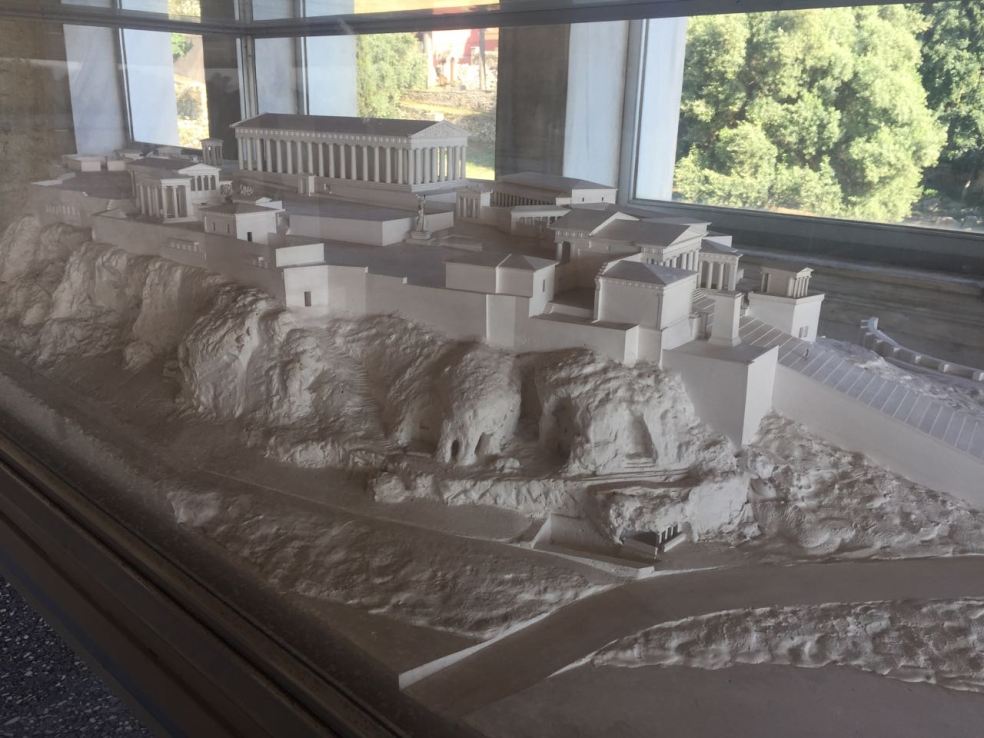 This is what the whole Agora area would’ve looked like back then. At least if you were either color blind or the whole thing froze over in a freak world-ending ice storm.
 Moving on from the Agora, this is the neighboring Library of Hadrian, who was the Roman emperor from 117 to 138, and is now the patron saint of overdue book fines. His own fines were not forgiven by his successor Antoninus, so it’s now up to $82,423,122 with interest. I mean, there ain’t no Italian named Tony who’s gonna forget about yer debts, y’know?
 Hadrian is known for being both personally generous as well as extremely cruel. He must’ve been generous to the right historian’s forebears because he made it onto the “Top Five Good Emperors List” (if he wouldn’t have been so cruel, he might’ve made the “Top Five Very Good Emperors List”… but alas). He also traveled a great deal outside of Italy, unlike most of his predecessors. When he passed by, the people would shout, “Yo Hadrian!”
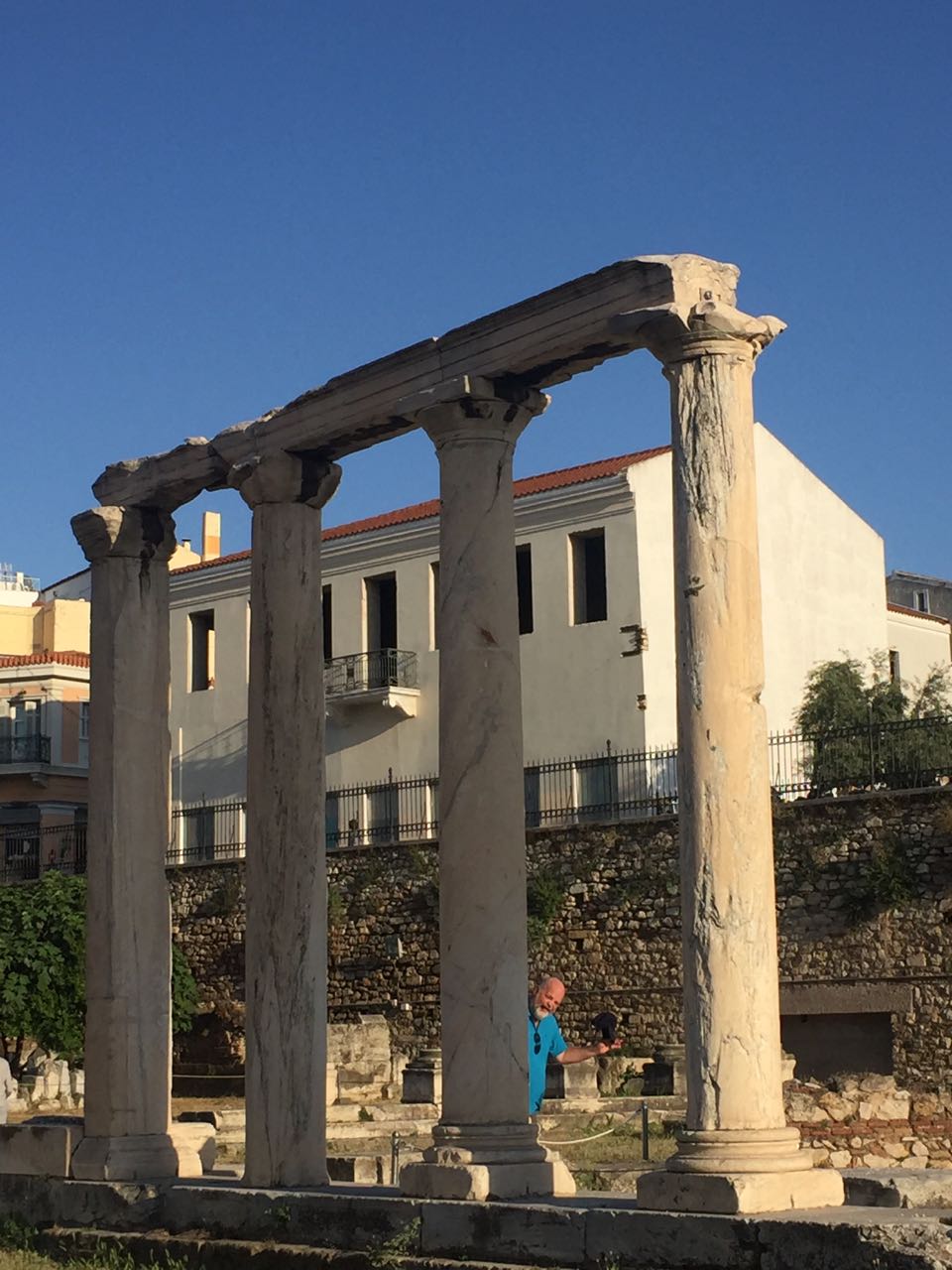 Another set of ruins in Athens is the Dipylon Ruins. So of course I had to act like a dip. Actually, the entire area is known as Kerameikos, or Ceramicus in the Latinized version.
 It’s a large area that resides both within and outside the ancient city walls. Since it was the potter’s part of the city, Ceramicus is what led to the world “ceramic.” True story.
 I always look closely at walls in ruins, being continually amazed at the preciseness of their construction and alignment and the fact that they’re still that way even after thousands of years.
 The Dipylon (The Thrasian Gates) was the most important gateway in the Athenian city walls. It was the main entrance to the city, and was at the time the largest gateway in the world.


 We simply stumbled across Ceramicus while taking a walk outside our hotel to places unknown. You never know what you’re going to find when you explore an ancient city!
 Like almost every place in Athens, feral cats were plentiful. Some were even friendly. This one decided to share some of its fleas with Carolyn.

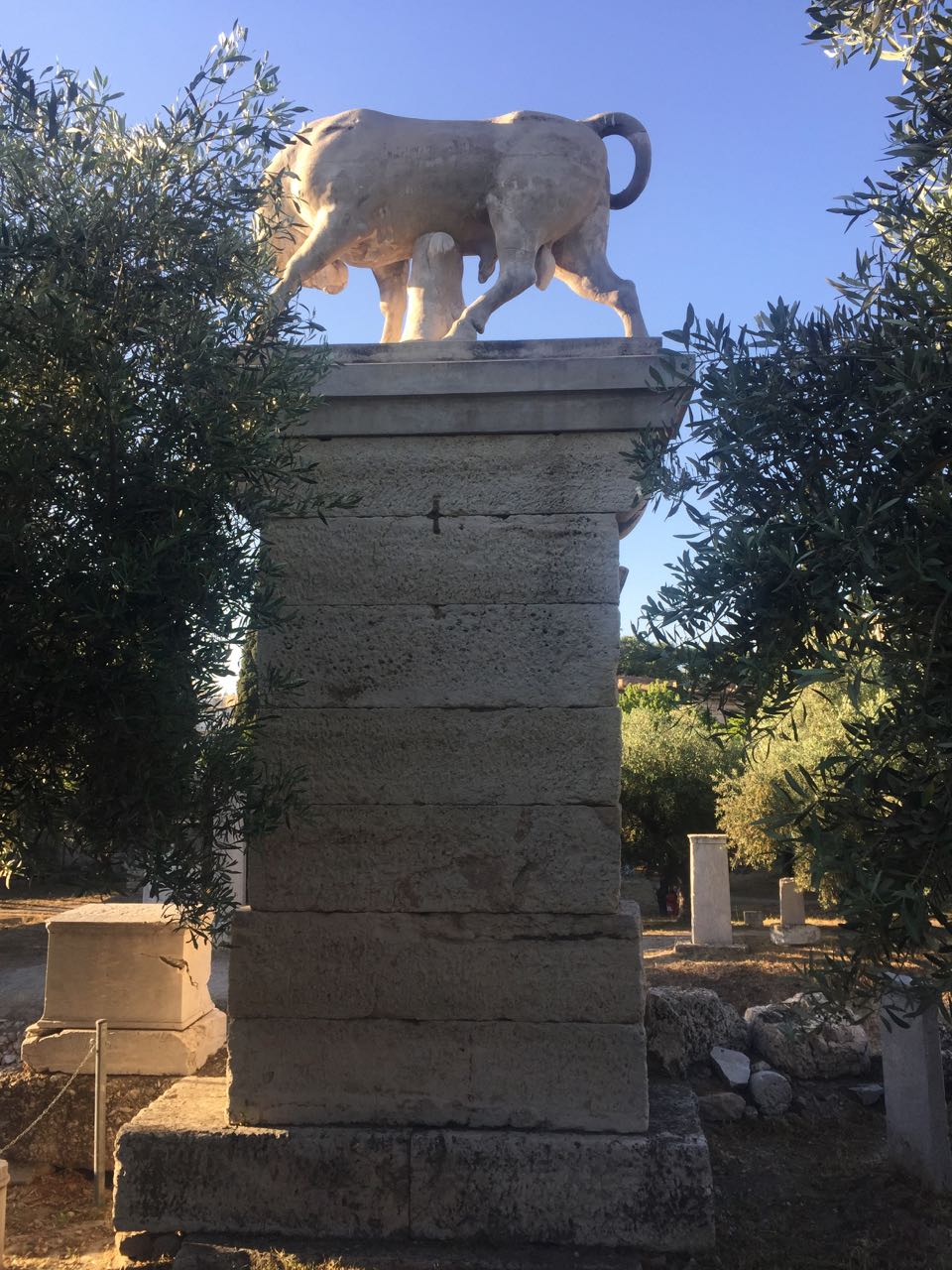 And that ain’t no bull.
 While in Athens, we learned that “Acropolis” is actually a Greek word meaning the highest point in a city. In other words, there were acropolises all over the place in Greece… it’s just that this particular one became famous and known as THE one.

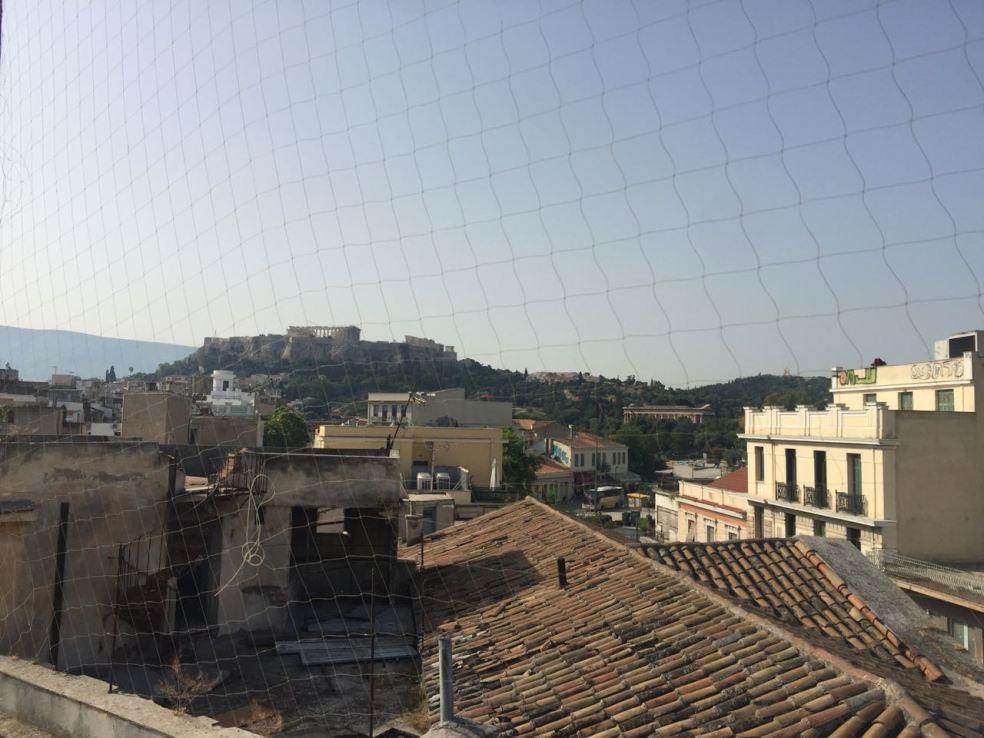 And this was our view from the rooftop breakfast buffet at our hotel. The netting was smartly placed there to keep the birds out of the buffet, except of course the ones we were eating.
 And here she is, the mother of all acropolises.
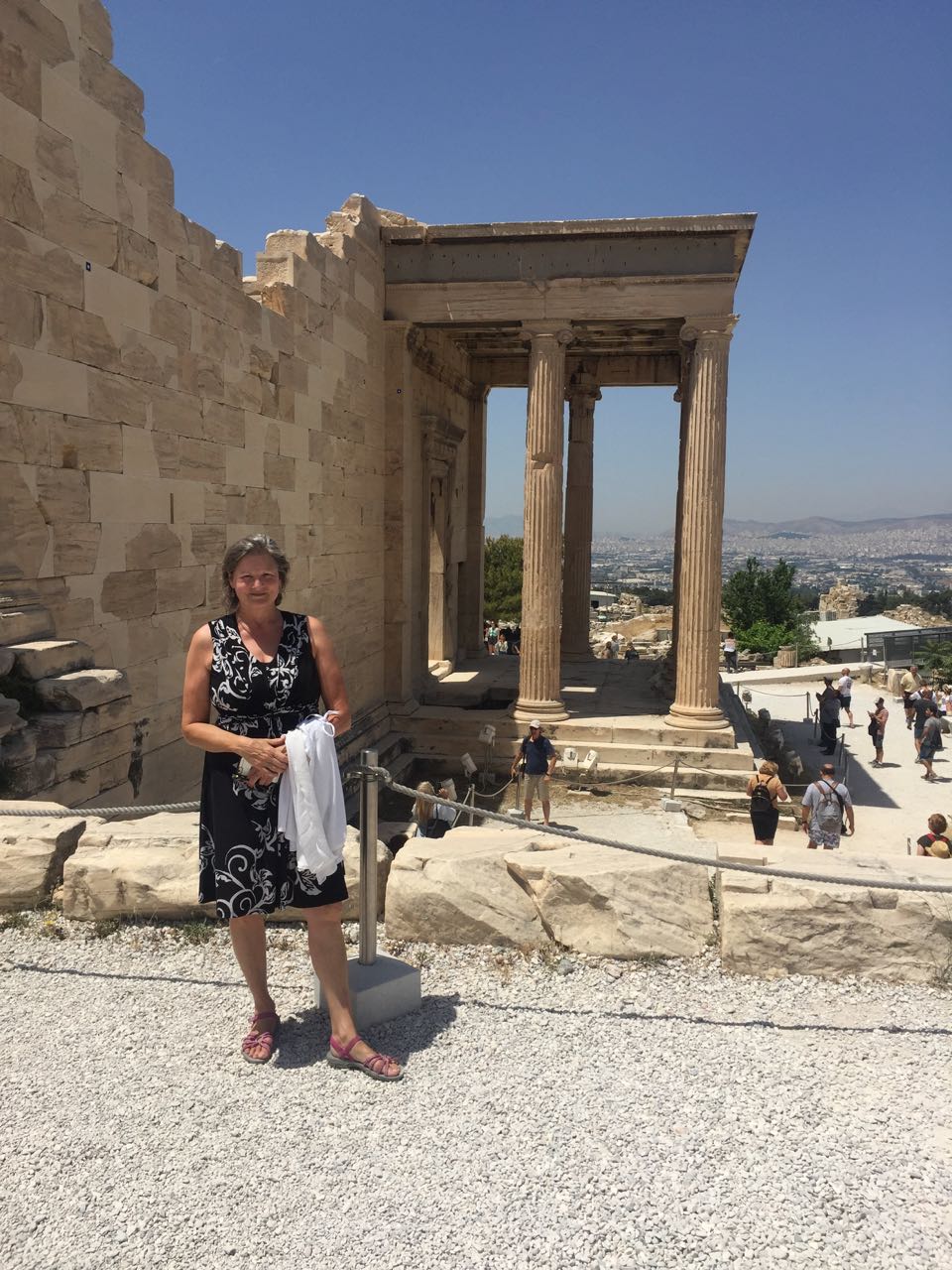 Speaking of mothers, here’s Carolyn in front of the Erechtheion, which is a temple dedicated to both Athena and Poseidon. It was built between 421 and 406 BC.
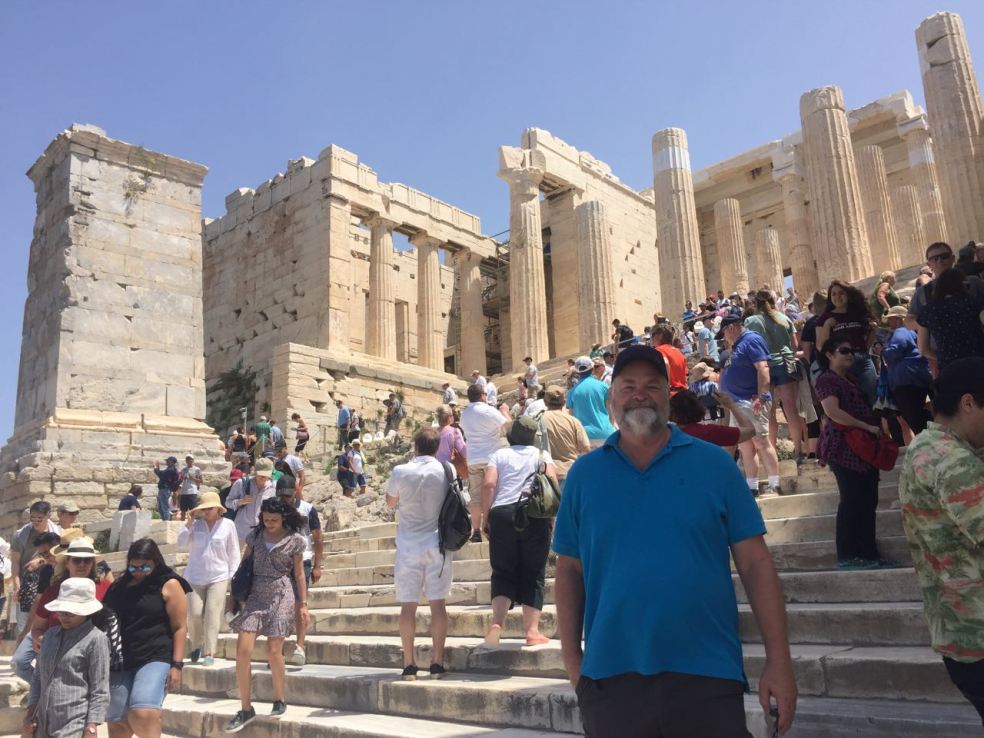 These are the stairs leading up to the complex. It’s hard to keep the names of all the buildings straight, but I’ll do my best as we wander around the place.
 I think this is the Erechtheion again. If not, it’s some old Greek building.
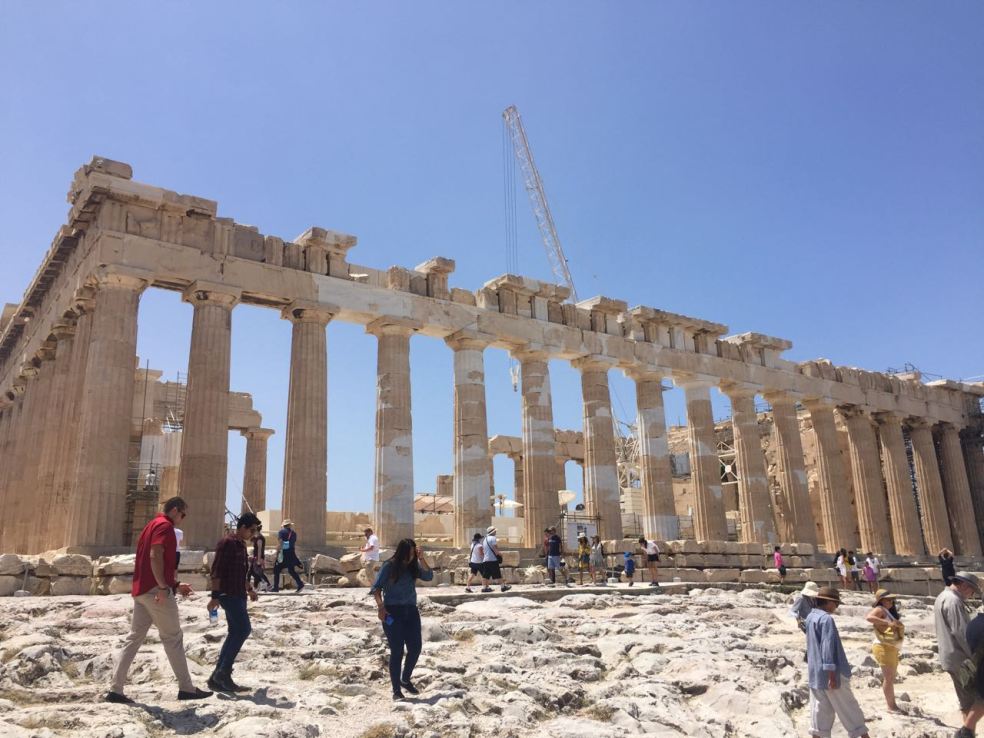 The Parthenon, the most famous of the Acropolis buildings, was dedicated to the goddess Athena, the patron of Athens and the goddess of war.
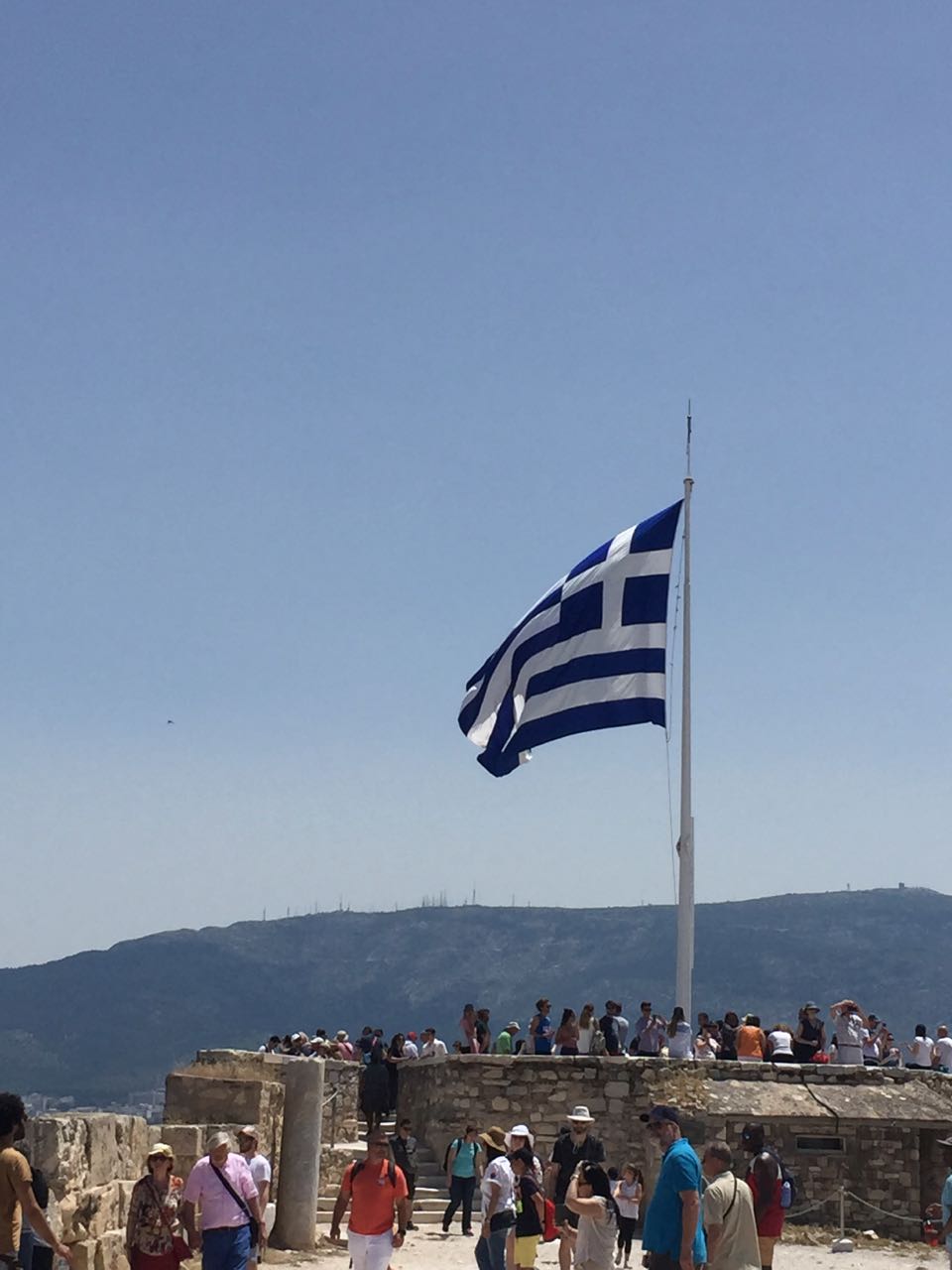 The Greek flag flies proudly over the area.
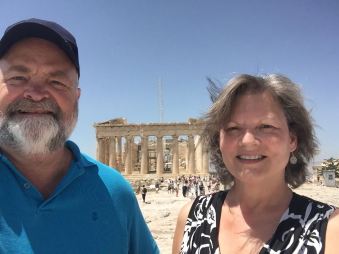
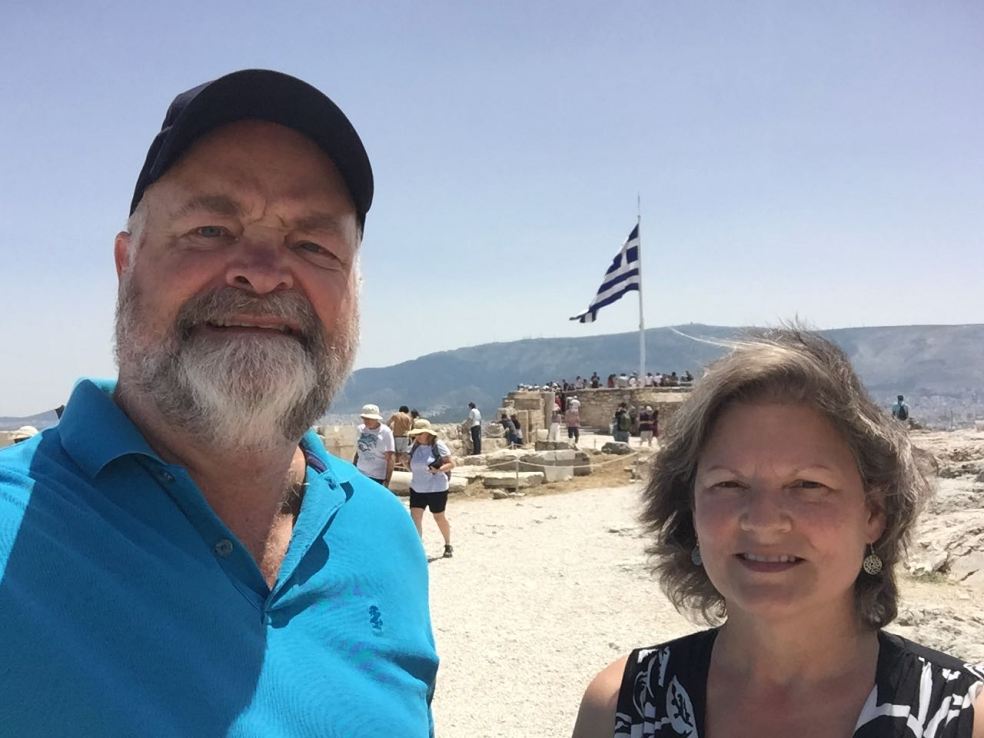 So of course we had to selfie-ize it.
 This is the back side of the ruins. Which is kind of cool… like seeing the backside of a waterfall.
 A view from atop. The theatre-looking-thingy to the right is the Theatre of Dionysus, which we’ll cover more of below.
 There are plenty of hills and stairs you have to climb to get up there; if you walk from the base of the whole hill it’s a fair trudge. They didn’t have wheelchairs back then so you’re a bit SOL if you’re confined to one.
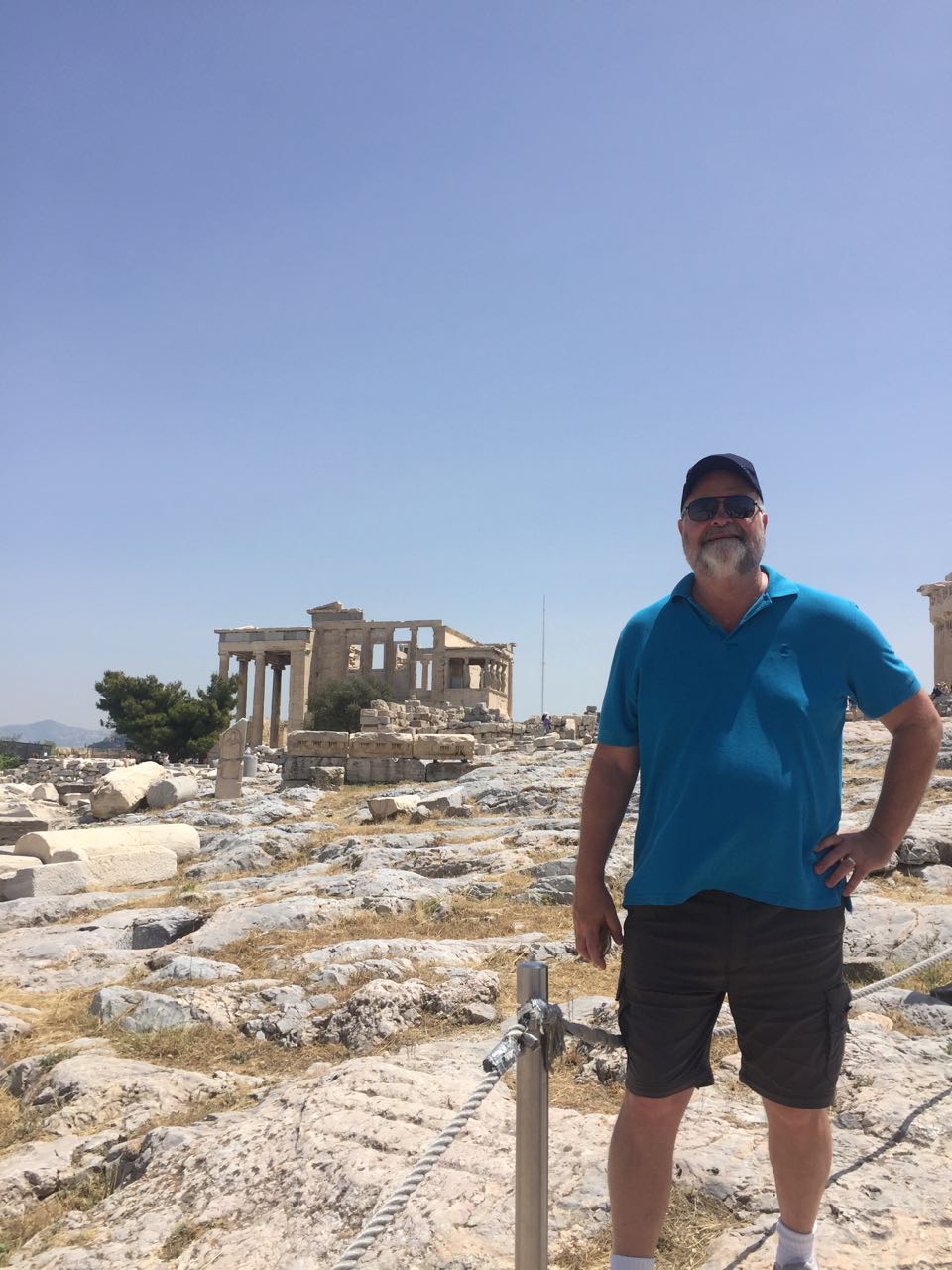 I’m pretty sure that’s the Erechtheion again on the left. That’s the world’s worst tour guide on the right.
 But then they throw me an easy pitch to hit. The Parthenon! The Parthenon! Boy, it’s awesome being an expert.
 Those who know me best are the least surprised to know there’s a sign there telling us not to touch anything.
 The construction of the Parthenon began in 447 BC when the Athenian Empire was at the peak of its power. It is considered one of the world’s greatest cultural monuments… just behind Trump Tower.
 I have no idea what the one on the left was used for since it appears to be all of one piece with no lid. Come to think of it, I have no idea about any of them… why are there rocks laid out that way? This is surely one of the eternal mysteries of the Acropolis.
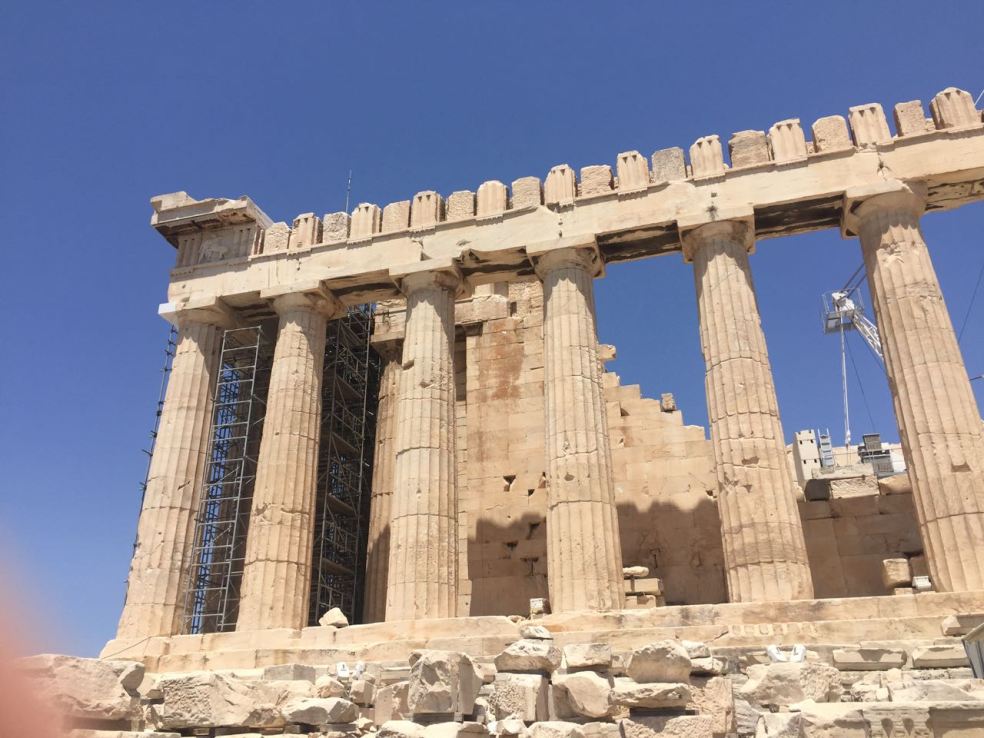 They obviously had to have ladders built into it so they could wash the windows.
 The origin of the Parthenon’s name refers to “unmarried women’s apartments.” In other words, this was where all the single chicks hung out.
 And this may have been the wall they threw themselves off of when their love went unrequited.
 We ended up with about 78 pictures of the Acropolis from afar. We’ll only show you a few more before you start thinking of it as the Acrapolis.
 No, the man in the red shorts is not taking a dump. That’s not a toilet, sheesh! Get your mind out of the gutter. As for me, I’m urinating on the stairs. But in the gutter!
 The Theatre of Dionysus is thought to be the world’s first theatre. Dionysus was the god of grape harvesting, wine, fertility, ritual madness (whatever that is), religious ecstasy, and theatre. Whatever else he was, Dionysus was certainly a party animal.
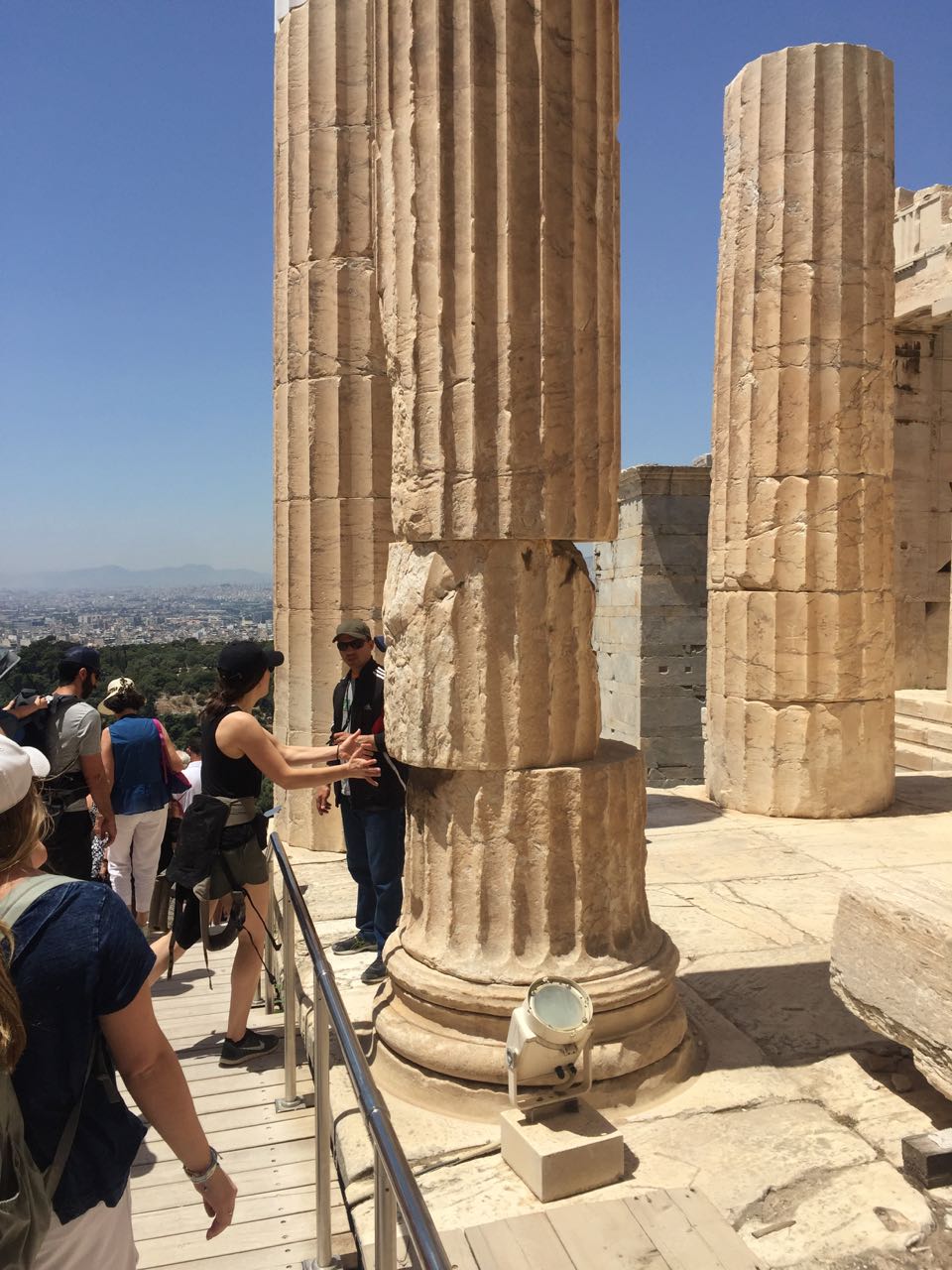 I think this is where Samson first tried pulling the pillars down, except that it was right after his first haircut, which left him with a mullet, and so of course even God said, “Oh hell no.”
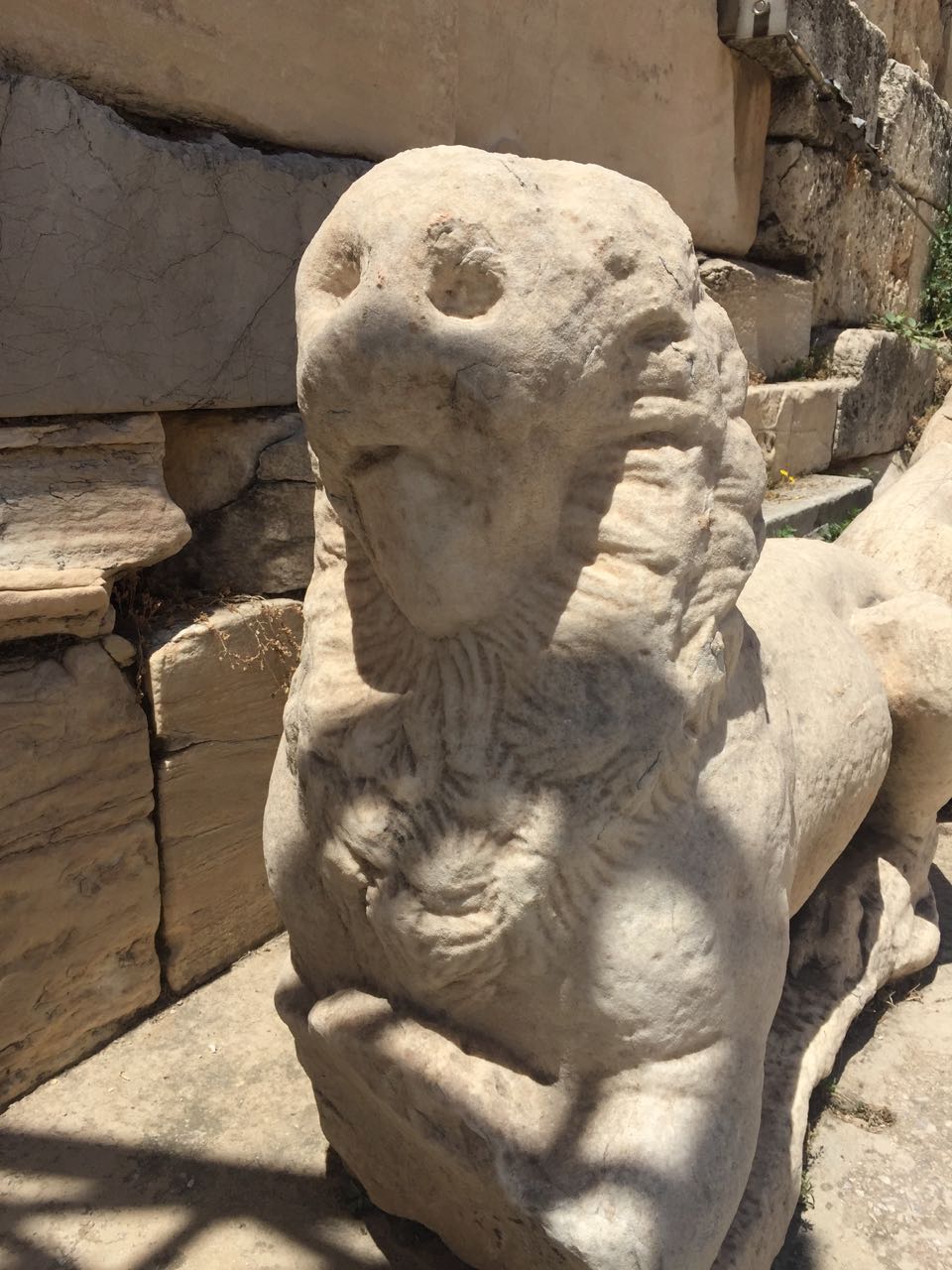 I’m really hoping this is the result of wind erosion. I’d hate to think their sculptors were that bad.
 Today’s Greeks are such wimps. Your forebears erected that whole thing before they even invented pencil and paper! Today you wienies need an entire frickin’ crane just to fix it up a little! Oh how far have you backslid? No wonder you needed to be bailed out by the EU!
 Yeah, we have hundreds of photos of the Parthenon, but this is one of the gooder ones.
 They say if you kiss your mate in front of the Parthenon, you will end up in a blog. OMG, they were right! Of course, whenever I see pictures like this of me I always wonder why I still put shampoo on my head every morning in the shower.
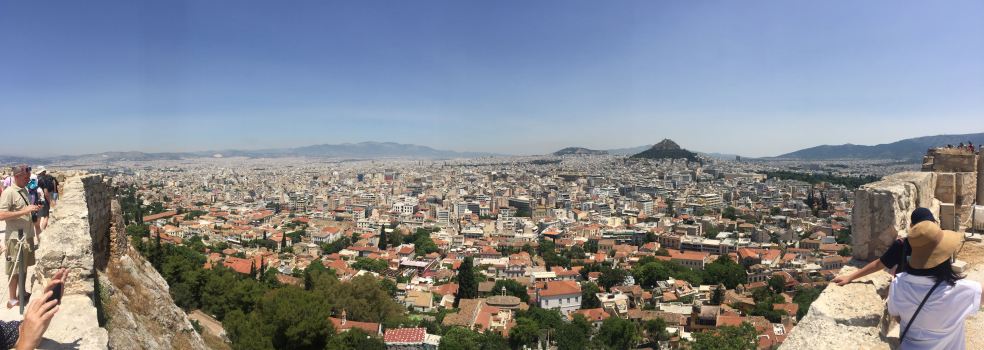 The one thing Athens has going for it is an interesting view from the Acropolis. It’s just a vast sea of houses, with very few buildings poking above the rest. It sprawls just about as far as the eye can see.
 In Rome we learned that the thinking towards restoration work has changed over the last century. Instead of replacing things to make it look new, they do everything they can to protect what’s there. It looked to us that they were working very hard to do just that, although many of the stones were obviously newer.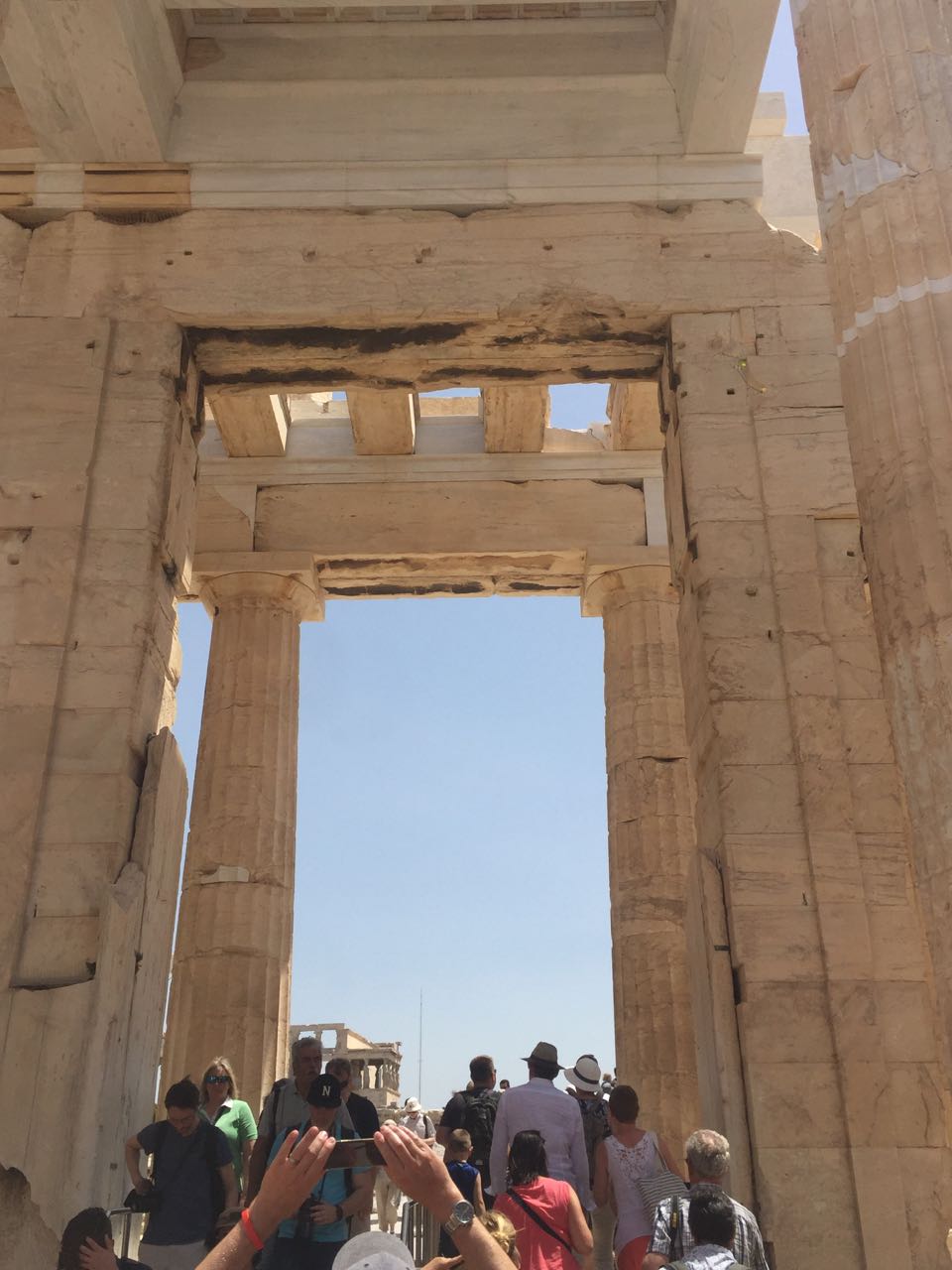
 I mean, how the heck did they get those blocks on top of the columns? What you don’t ever hear about is how many times someone knocked over one of them, sending them all tumbling like dominoes and forcing the construction to start over all over again. Probably because they were executed.
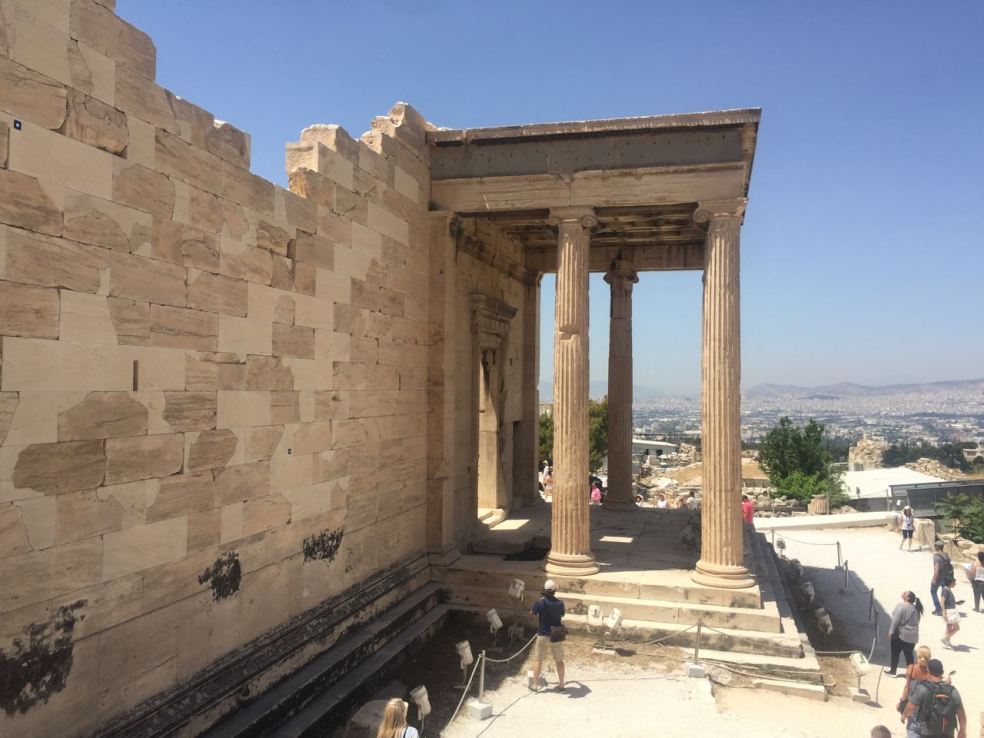 In addition to the Parthenon, the other various monuments which make up the Acropolis include the Temples of Athena and Nike, the Erechtheion and the Propylaea. This is one of those four.
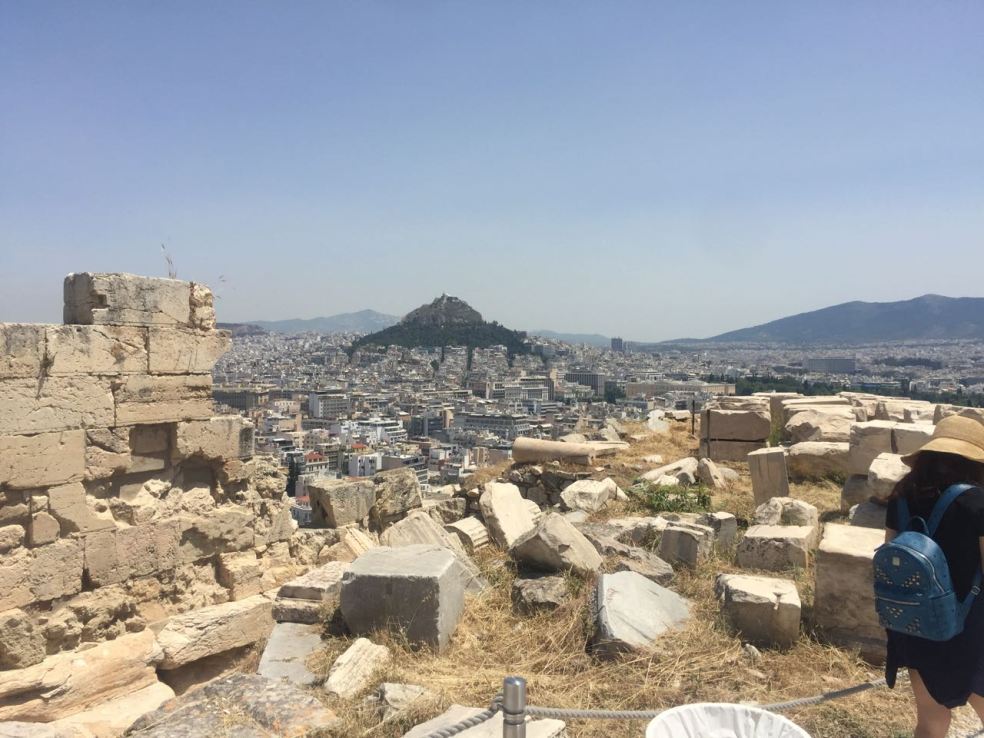 In the distance is Lykavittos Hill, the highest hill in Athens. You can get to the top via Funicular. That word alone makes it sound like it would be a blast, but we didn’t get over there.
 The crowds were pervasive, but it wasn’t too bad. We’re glad we didn’t come in the dead of summer… not only due to the larger crowds but there ain’t no shade and it can be hot up there! In fact, Athens holds the record for the highest temperature ever recorded in Europe, at a blistering 48°C (118.4°F).
 The world’s first spreadsheet.
 I don’t believe I will ever cease to be amazed as to how they got those stones up there, perfectly straight and aligned, without the aid of any machinery.
 And then they were able to put even larger stones on top… and here they are still standing almost 2,500 years later. Mind blown.
 Just follow the sea of tourists to the Parthenon. I only follow the one in front.
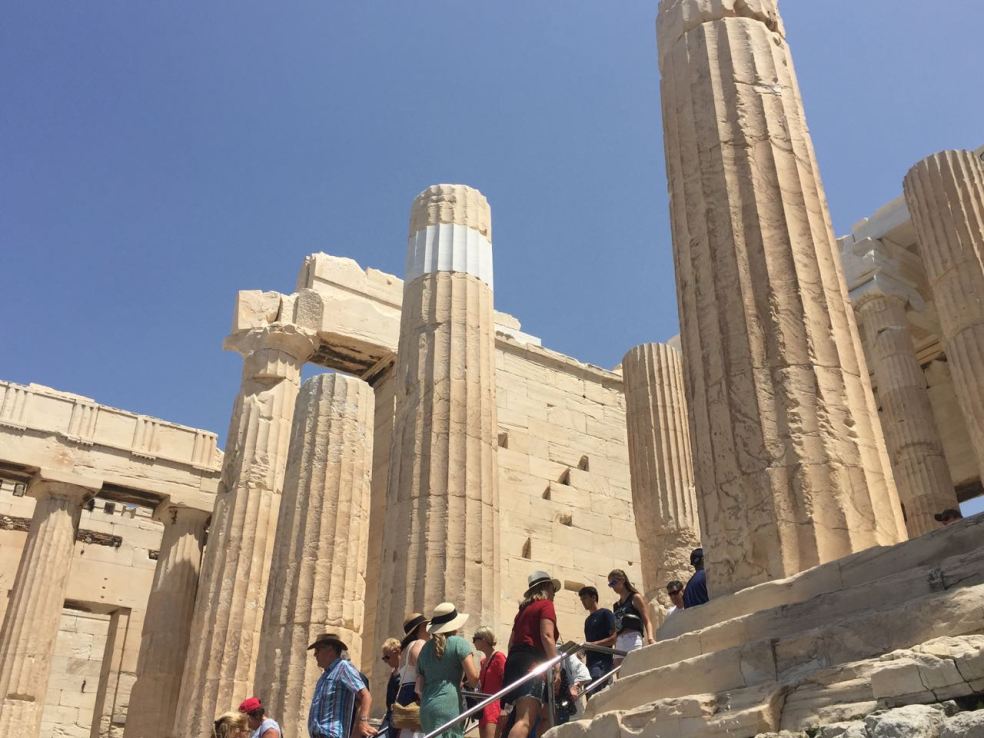
 This sign is in both Greek and English (one of the things that makes me grateful for having been born into an empire… with apologies to the Indians, Africans, Puerto Ricans, Hawaiians, Eskimos, Mexicans, and everyone else the US conquered or enslaved). It describes the restoration work, some of which is noted as being that of a “rescue nature,” which is why some of the columns have white areas. When it’s either that or to have the whole thing tumbling down, I’ll take the mismatched colors any day.
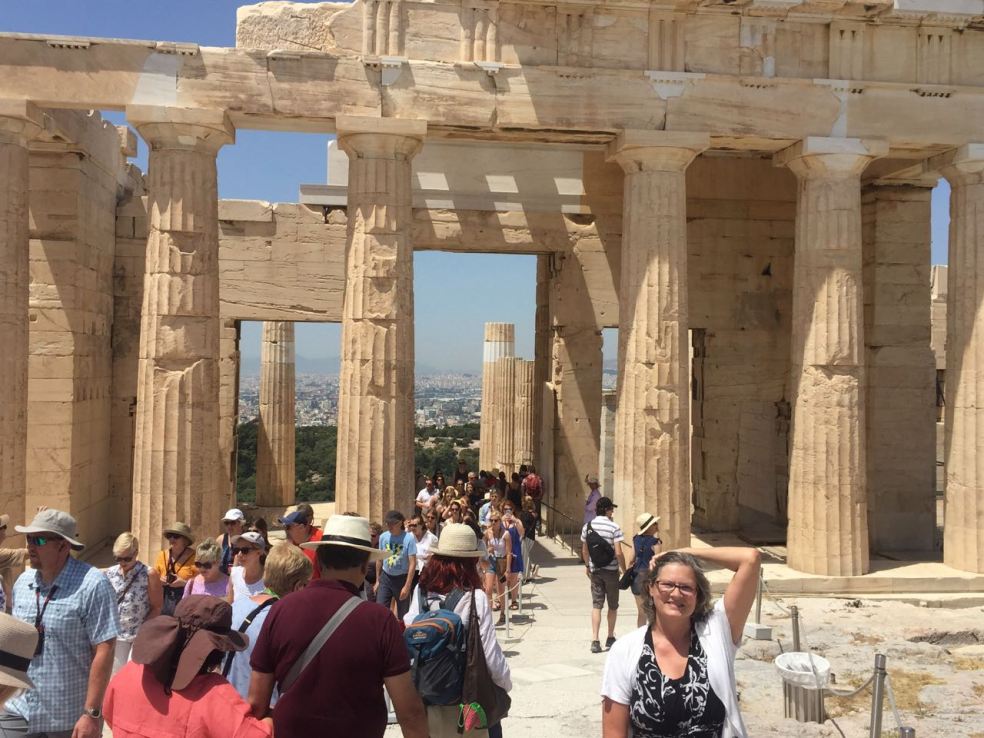 Carolyn’s obviously fearful that the columns may come tumbling down anyway.
 So we had to get another selfie in before it all collapsed.
 I think this is the Old Temple of Athena. It’s surprisingly hard to figure out what’s what even with the internet. They didn’t have a whole lot of signs about, or if they did, we neglected to take pictures of them. Oh, well, a Greek ruin by any other name…
 The guy in red was the first one to see the aliens landing.
 Until you get up there, you don’t realize how massive the stone is leading up to the Acropolis, and how they built so expertly atop it.
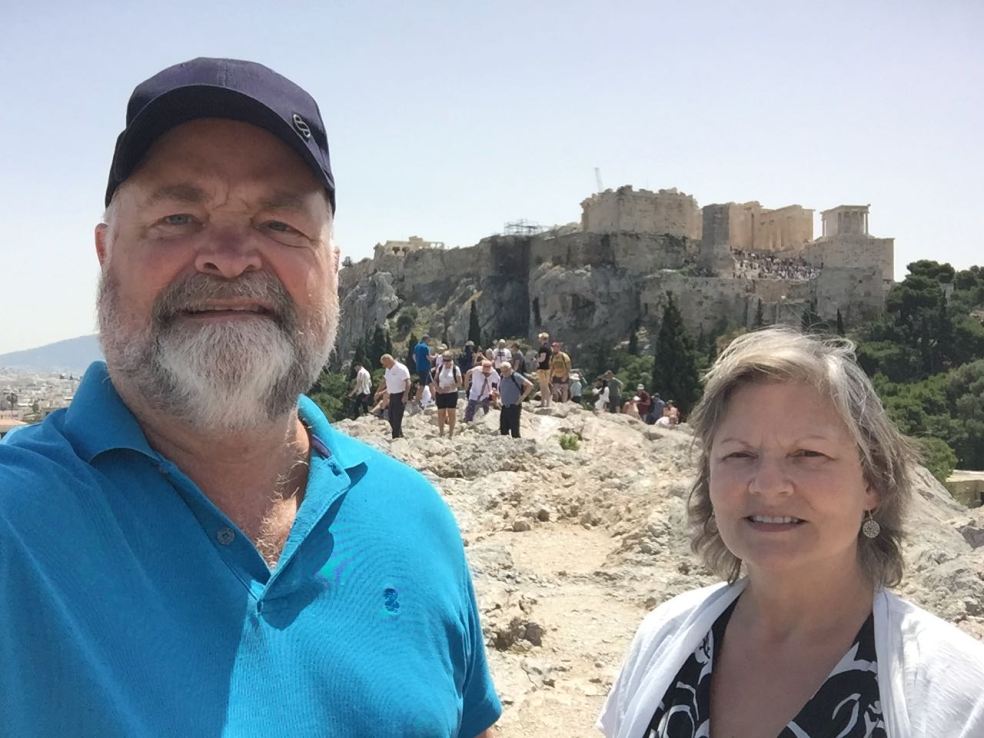 Here you can see better how it was just one big hunk-a hunk-a… um rock. Not burnin’ love. Thangyouberrymuch.
 I had forgotten that we’re already famous, so I quickly donned sunglasses to fool the paparazzi.
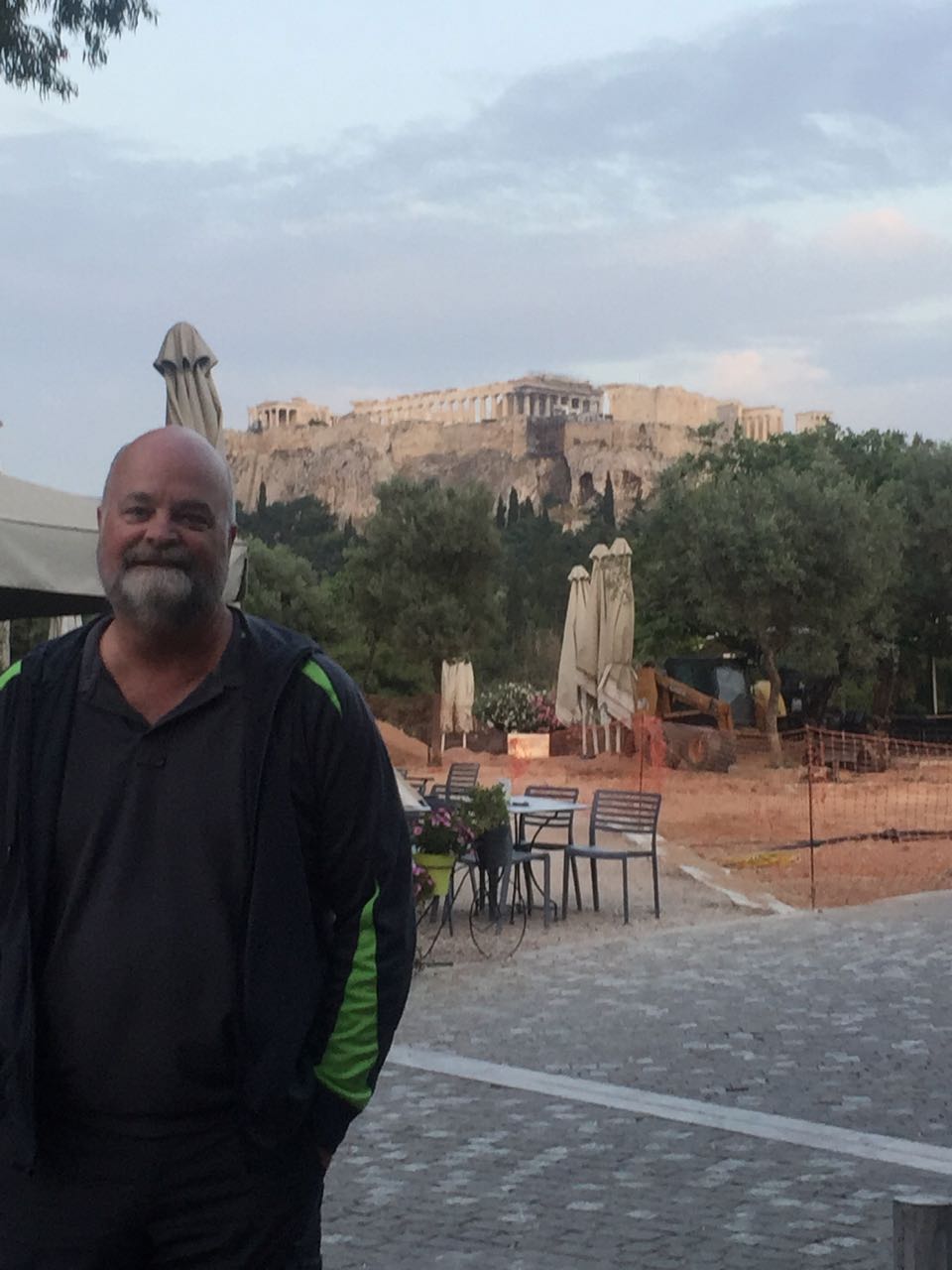 A last photo… but wait! Is this why everyone is calling me a dickhead?
 After moving to Portugal, we realized that our bucket list had grown to the point where it is now better described as a bathtub list. There are just too many different places to visit in Europe! In Portuguese, we’ve learned to describe it thusly: “É um lugar muito diversificado.” Which means “It is a very diversified place.”
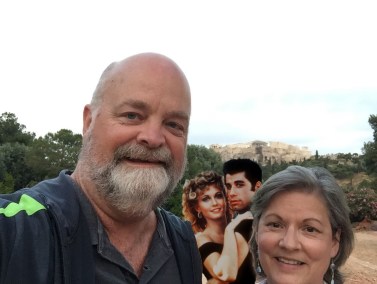 After landing in Greece, we found out that Greeks have a very hard time with spelling in the English language.

 Speaking of translating, after seeing their alphabet there’s no wonder why the phrase, “It’s all Greek to me” was popularized. We’re just glad not to have to learn a new alphabet in Portugal. Although, I do have to say it’s pretty easy to see why this Greek word here is “men:” the second-to-the-last-letter is a pair of boobs. So I think the word translates literally to: “likes boobs.” I guess Greek is easier to learn than I thought!
 Our initial impressions were undoubtedly affected by our cab ride. Our driver wasn’t of Greek descent, which is neither here nor there except for three things: he didn’t speak English (and probably not Greek either), he didn’t know where our hotel was, and he had no idea how to get there even after being provided with an address and a map via my phone. He also had no other electronics in his car (which was held together with duct tape) other than the taxi meter.
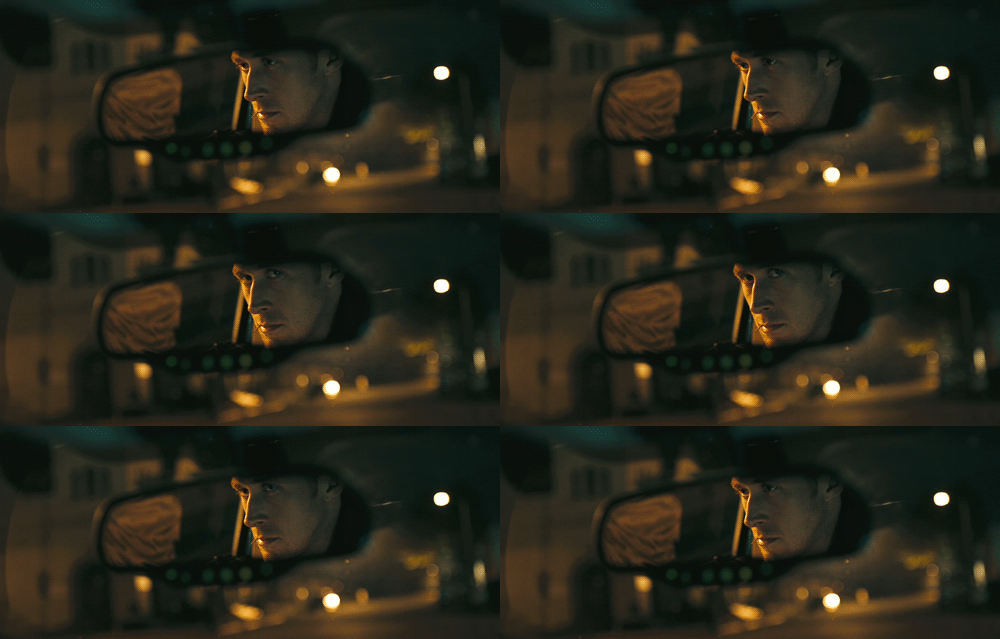 Not only was he driving like a madman, he could barely keep his eyes open! I spent the entire freeway part of the journey with my own eyes focused solely onto the rearview mirror, ready to bop him on the head if his actually closed. As it was, I would occasionally make a loud noise just to make sure he stayed awake; coughs, burps, farts, whatever it took. Carolyn thought I must’ve eaten something onerous, but I didn’t want to tell her why I was doing what I was doing so she wouldn’t freak out. Once in a while I wondered if he steered the cab so close to other cars’ bumpers while going over 140 km an hour just to keep himself awake, which freaked us both out plenty as it was.


 A typical restaurant scene with lots of outdoor tables. The area around the Acropolis had no shortage of places to eat, most of them fronted by a charmer encouraging anyone and everyone to come eat the best food in the city.

 Near our hotel the local Walmart displays its wares. Actually, it was a street filled with second-hand items. You name it, you surely could find it. Even a second hand, I’m sure.
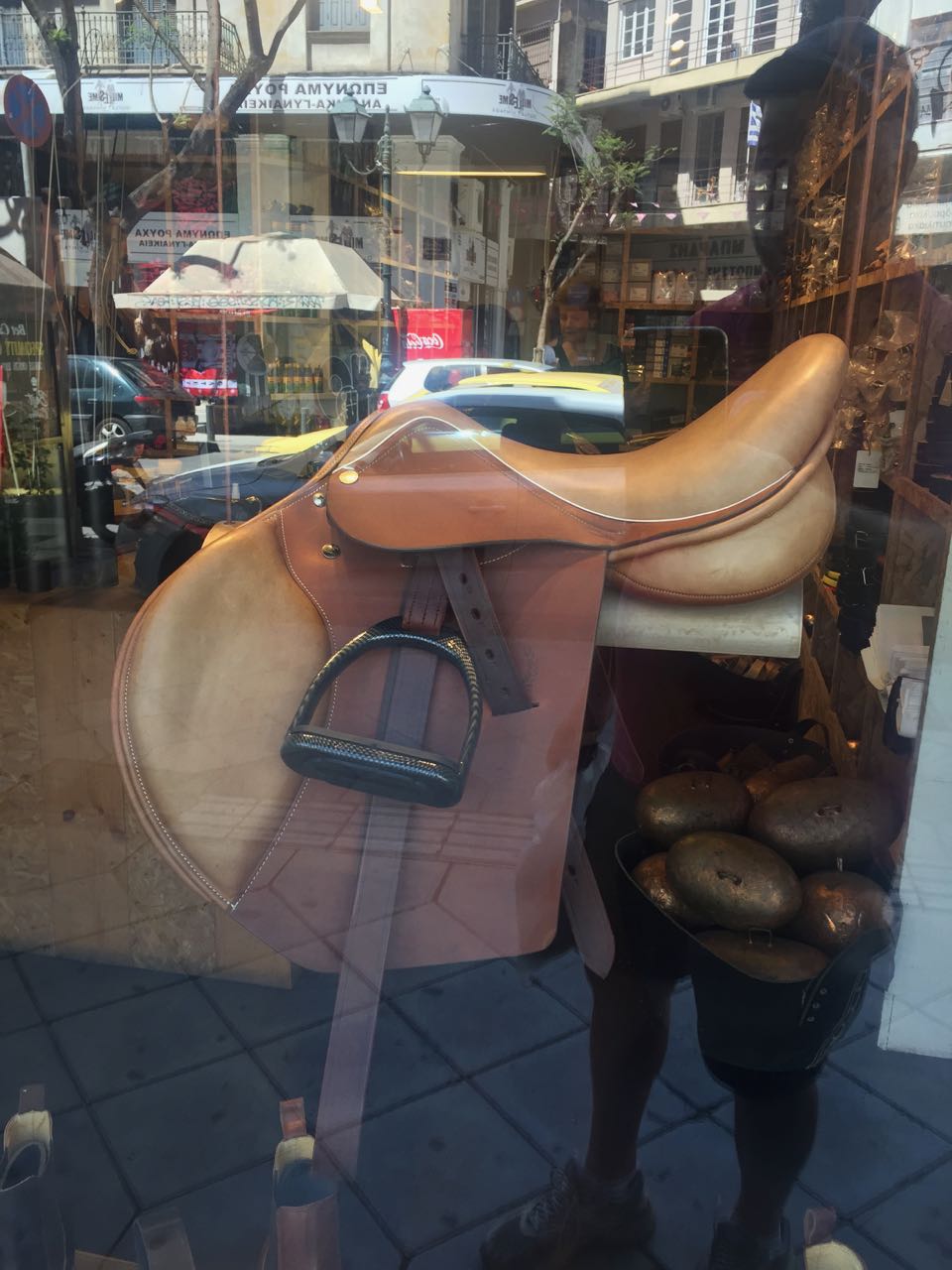 After lunch, it was time for us to get back in the saddle.
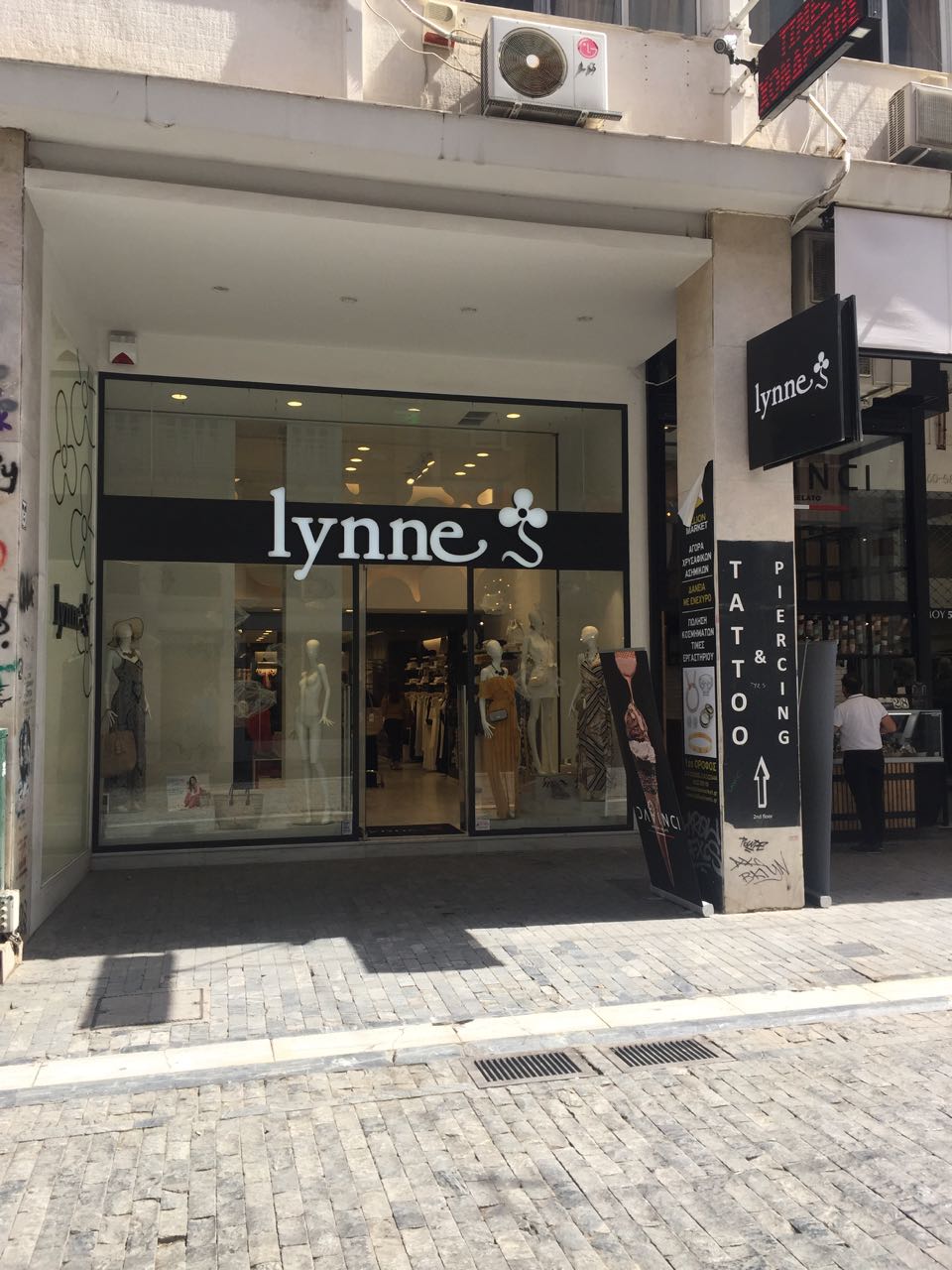 Speaking of saddles, my horse-loving sister had this store named after her. I’ll give you three guesses as to what her name is.
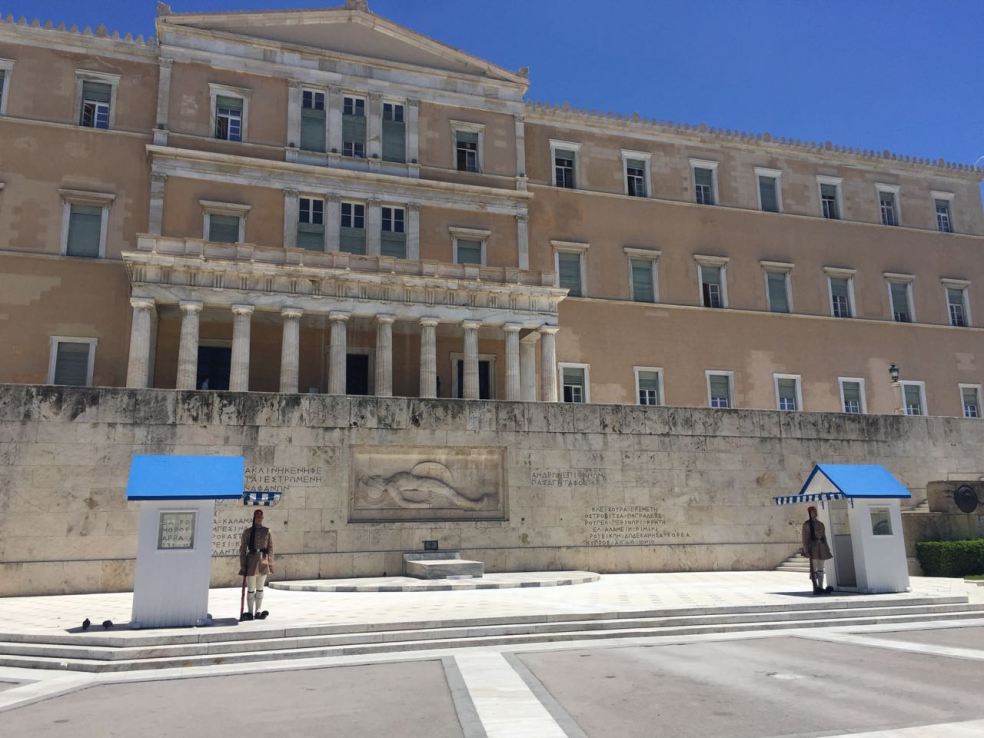 This is a government building protected by two Buckingham-Palace-esque guards. They have a rather funny routine with the changing of the guard, complete with synchronized leg kicks that wouldn’t serve them well at all in any kind of real battle, unless the enemy were turned around with their backs to them, bent over.
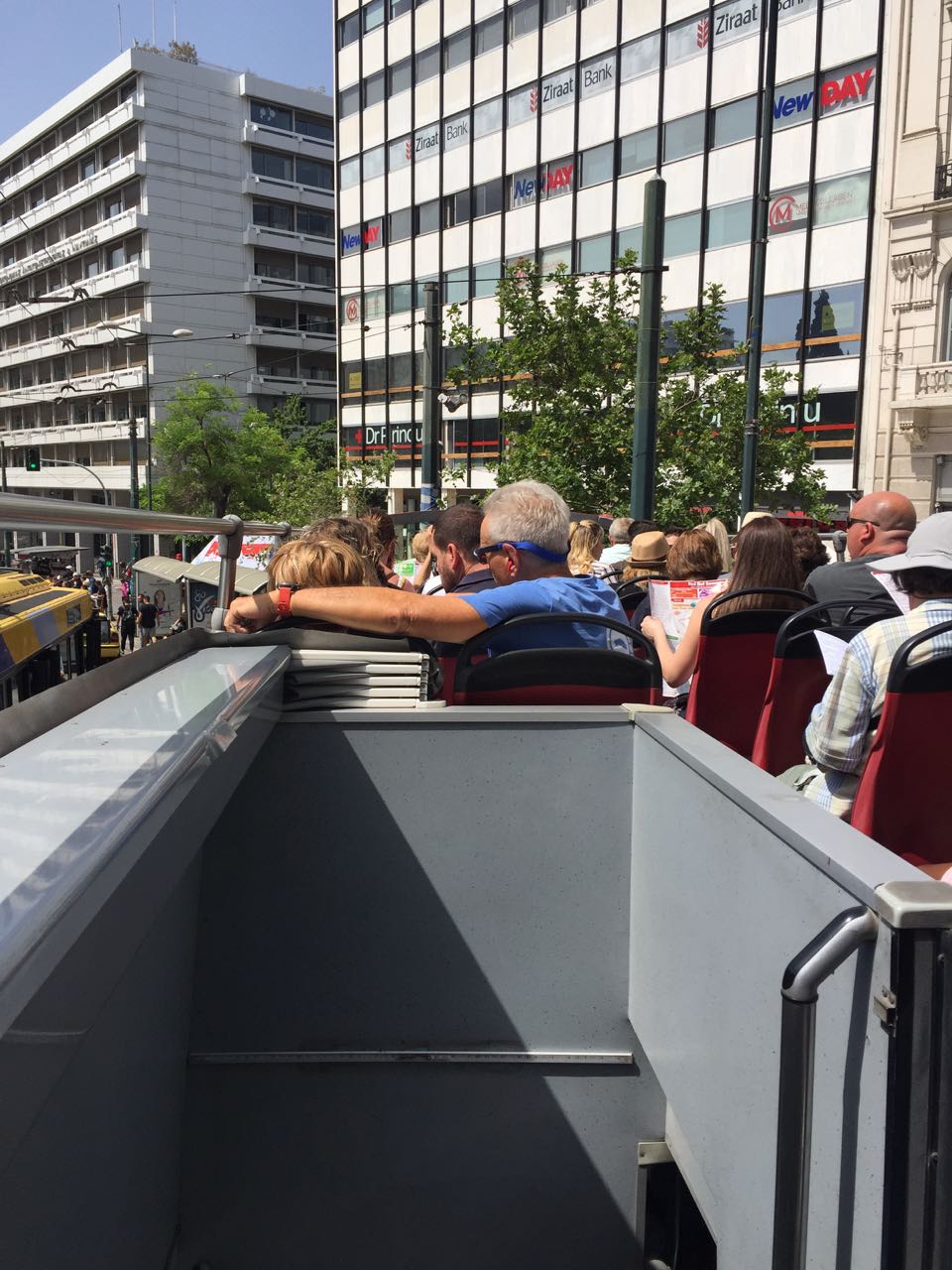 We took a Hop On-Hop Off bus just to see more of Athens than we would have on foot. It was a good way to go, except that Athens really doesn’t have that much interesting to see aside from the Acropolis and grey-haired men wearing blue shirts.
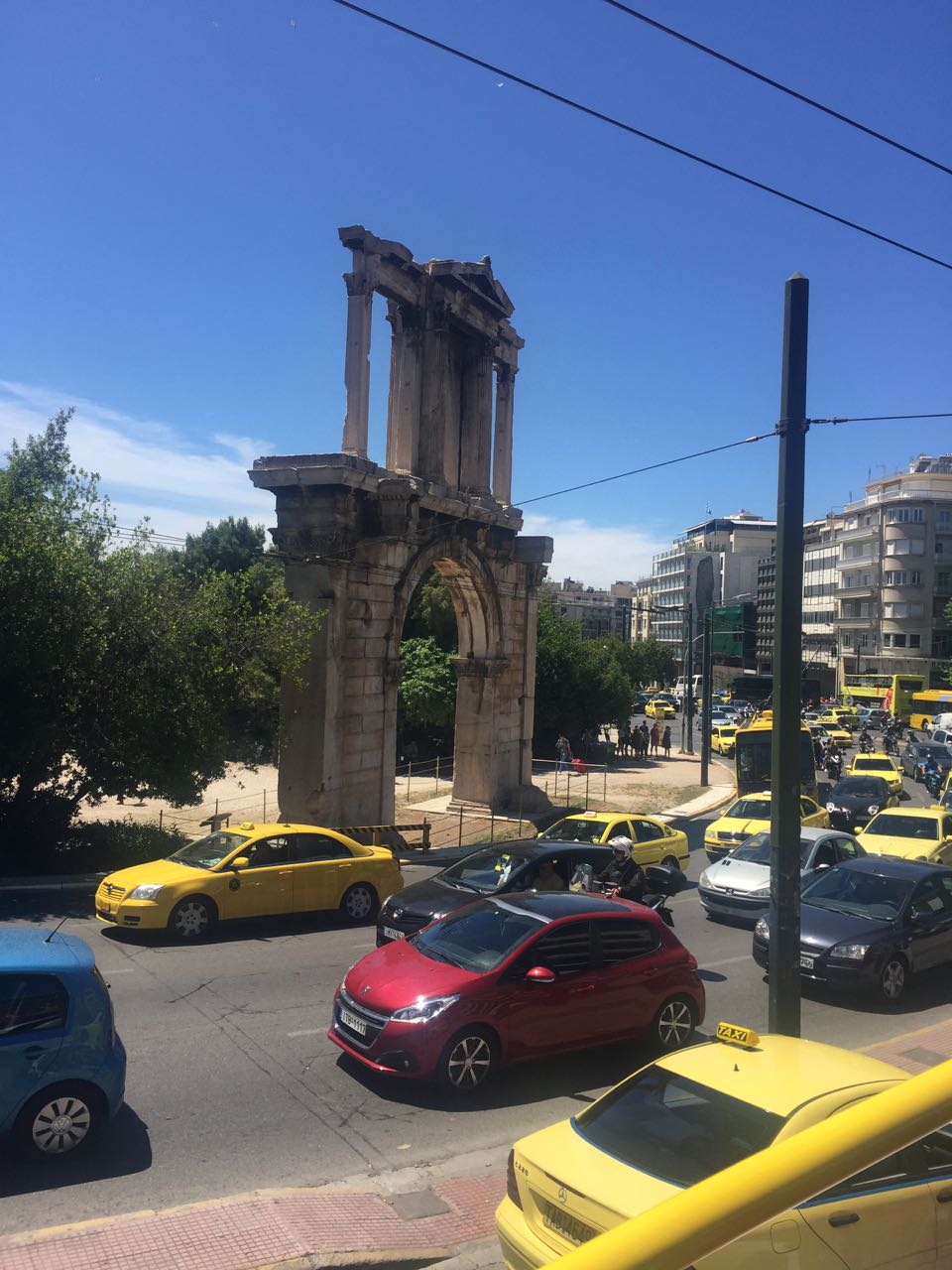 Of course there are some ruins here and there. This is Hadrian’s Arch. Built in about 131 AD, it is one of many Roman ruins scattered throughout the city.
 Speaking of ruins… don’t think for a minute Europeans aren’t very well versed on American politics. Someone captured one of the prevailing sentiments pretty well.
 This may be a response to the above, I dunno. Like most European cities, graffiti is prevalent, and sometimes, like the above, even in English. We were so grateful for this one in particular being in English because otherwise we would have never understood it and wouldn’t have known what we were supposed to be doing.
 Unfortunately, along with the graffiti there were other unsightly areas. Athens wasn’t a pigsty, but it surely doesn’t rank high on any “cleanest cities in the world” list. Which made me wonder… and yes, thanks to the internet, there is actually a cleanest cities in the world list. The top five: #1 Calgary, Canada (Woo hoo! You go Canucks!).
 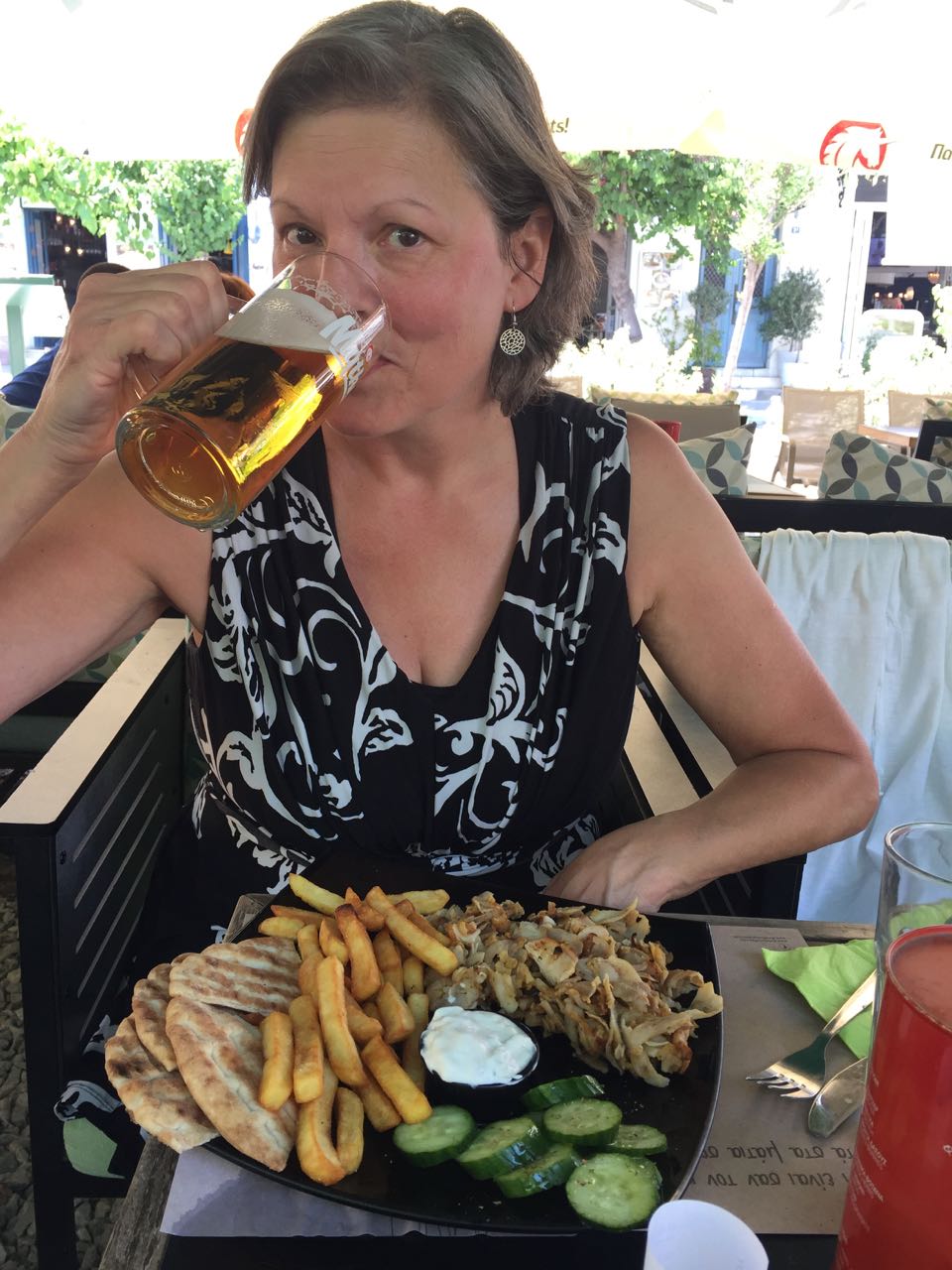 After a long day of sightseeing, there’s nothing like a cold beer to cool you down. Mythos beer was the most common we saw, and it was good! Also, the gyros in Greece are pretty much the same as the gyros you get from the fast food restaurants in the mall, so yeah, you’re eating authentic ethnic when you pass up that Taco Bell for the gyros.
 We came away from Athens thinking about two kinds of animals: cats and turtles. Wild cats were everywhere, and once in a while, usually near some ruins, you’d come across a turtle. This guy was crossing the road where he might have had to put the strength of his shell to a mighty test under the wheel of a car, so we put him back in the grass. Like most turtles, he didn’t even thank us.
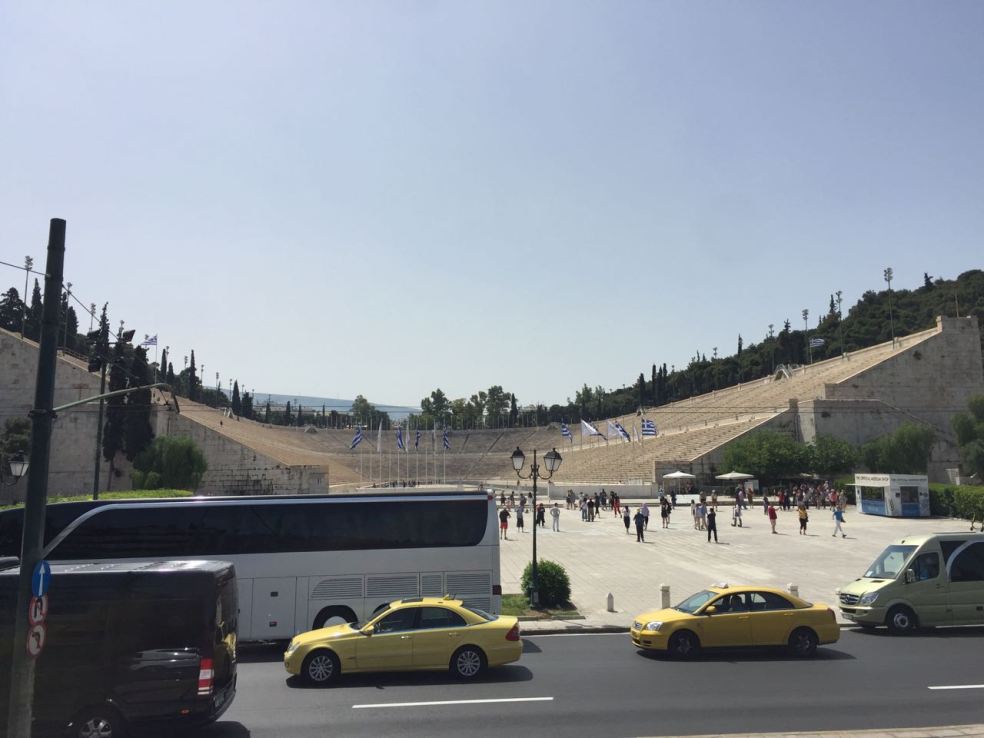 This is the Panathenaic Stadium, completed in 144 AD. It is the only stadium in the world built entirely of marble. Back then it could hold up to 50,000 spectators: a lot less if the home team had a losing season, but a lot more during the first Olympics because the athletes were all naked. Two thousand years later, all we have close to that is beach volleyball and Speedos.
 The world’s first running statue. We caught this freeze frame as he was bursting through the park on his way across the street.
 Fresh fruit and produce are often artfully displayed, although I’d hate to be the one picking a cherry from the bottom, sending them tumbling in a veritable cherries jubilee.
 This Aphrodite is artfully displayed as well. Plus she’s 50% off. What a bargain!
 And so Aphrodite made it to the street next to the second hand stores, where she found a row of third and fourth hand stores. By the time it gets to fifth hand, we think it gets put into the small stairwells.
 I have no idea what this sign says, but since they have a picture of Bogie and Bacall, it must be a classy joint.
 I think the middle store is selling vitamins based on the sign, but with all the ladders it could also be a hardware store. Either way, it’s probably a good place to get some iron supplements.
 Next up: the Acropolis.
 One of the great things about living abroad is the opportunity it gives one to meet and make friends with people all over the world.
 We recently joined a group called the “Sesimbra International Community,” which is simply a collection of people living in our area who are originally from outside Portugal. The only other commonality is that everyone speaks English (and most of them Portuguese, along with at least one, two, or three or more other languages). Recently, we got together for a potluck. To represent typical American fare, Carolyn made a casserole, and I made a cherry pie. Yes, we could have been as American as apple pie, but cherries are in season, Besides, I like cherry pie better, and aside from the pitting, it’s easier to make. And neither George Washington or I had to chop down a cherry tree to do it.
 We were delighted to find the following nationalities represented (and I hope I didn’t miss anyone): Italian, Mexican, French, Portuguese, British, Australian, and Slovenian.
 Everyone enjoyed the lunch and all the conversation. We were the only two Americans there, which made it that much more delightful for us, even if I sometimes have to strain through the accents. I’ve never been very good at understanding accents, but I think it’s improving, if for no other reason that almost everyone we speak to has one sort or another.
 Like in so many social interactions in the U.S. today, politics tends to come up in most conversations. What I almost always hear is that everyone is pretty puzzled by what’s going on there today, especially because America has long been a country well regarded by most Europeans.


 Chapter seven of seven. Hoo boy! Writing the blog about our trip may have taken me longer than the trip itself!
 In fact, legend has it that the song made famous in the movie Annie was first written here to make the people who couldn’t be squeezed in feel hopeful that there might be room the next day: “The sun will come out, Tomar-oh, bet your bottom escudo that in Tomar-oh, it’ll be fun! Tomar-oh, Tomar-oh! I love ya Tomar-oh! You’re only a day away!”
 I so wanted to show all of our individual pictures and make corny jokes or pithy comments on all of them, but there’s too damn many photos for that. I think Tomar set a personal record for us in terms of photos taken; we were there for quite a while. Of course, I had to share a few separately because they’re just too ripe for the pickin’. For instance in the above I’m sitting right next to a kitchen and I’m pretty sure those holes had something to do with cooking, but it sure doesn’t look like it. It reminded us of the public toilets in the Roman Colosseum and a story of sponges we have since tried very hard to forget. Still, based on looks alone, the phrase, “this food tastes like shit!” can’t help but come to mind.
 This is just to give you a sample of the many glorious pictures you’ll see if you have the time to watch the slide show. We were quite impressed with the entire shebang.
 And so without further ado, I present the slide show of photos. Wait, where is everyone?
 baldsasquatchdotcom