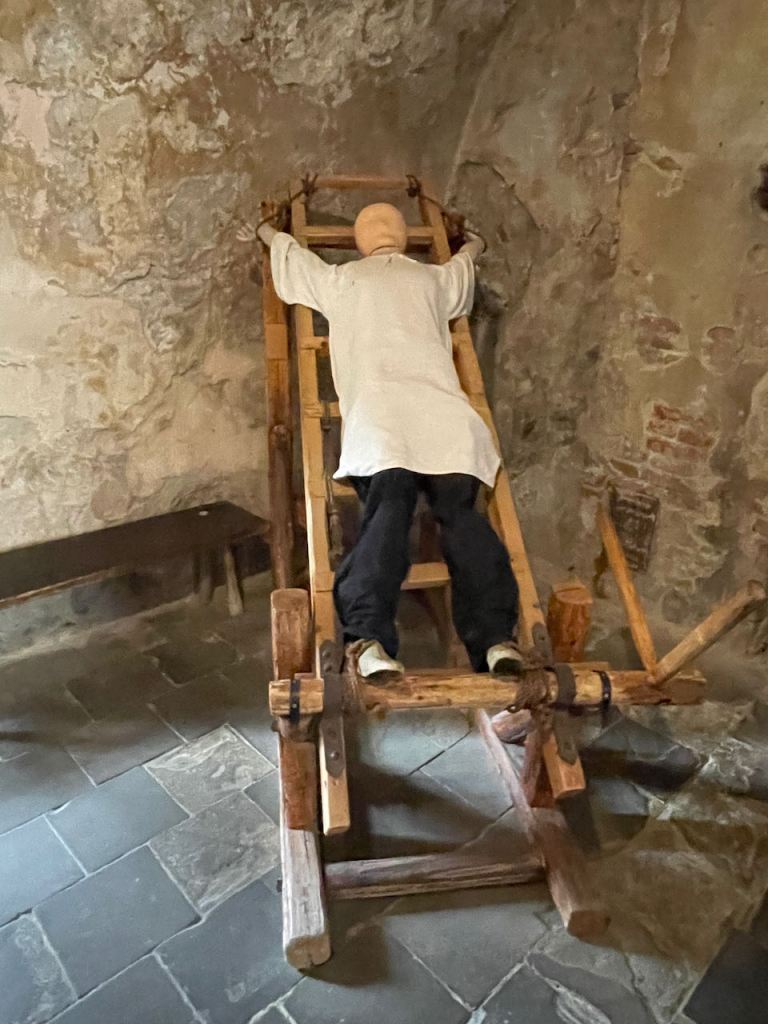
Even as I struggle to learn Portuguese, I’m often grateful that I don’t have to learn English as a new language. Most Portuguese know at least some English, but it’s mostly spoken English. Even native English speakers have a hard time with spelling and grammar. In Portuguese, “castle” is “castelo,” pronounced just like it’s spelled. But English speakers pronounce it “cassle,” like “hassle.” Which learning a new language definitely is. Anyway, here follows our visits to two unique German schlösser (castles in German, or what happens after one too many beers).
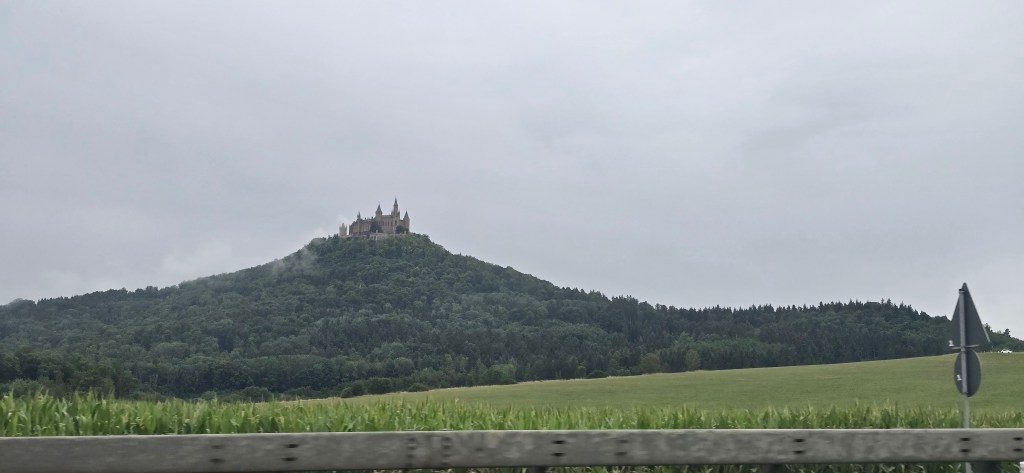
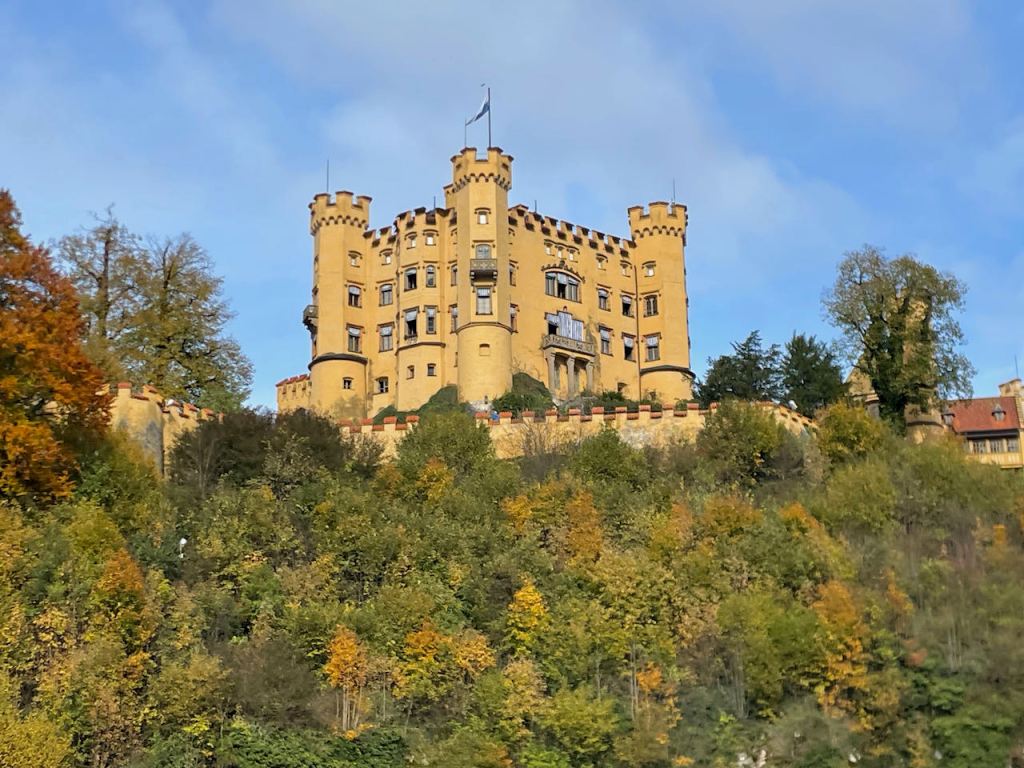
About 60 km south of Stuttgart is a town called Hechingen, which hosts a fancy German castle called Hohenzollern Castle, named for Herr Heinrich Henzollen’s ho.
From a distance, it looks very much like a castle. But the closer you get, the more you realize it looks very much like a castle.
This is what it looks like when they invite Satan over for brunch.
This is actually the third castle to be built on this spot. The first one was built in the early 11th century. It was completely destroyed in 1423 after a ten month siege by the pesky Swabians. I bet you’ve never heard of Swabia before, have you? It’s a region in Germany, I think it’s famous for inventing Q Tips.
In 1461 they completed the second castle, which was larger and swarthier, but eventually fell into disrepair, which was apparently a hole so deep they couldn’t pull it out. So they built this third and current one between 1846 and 1867, making it one of the most modern castles on that spot.
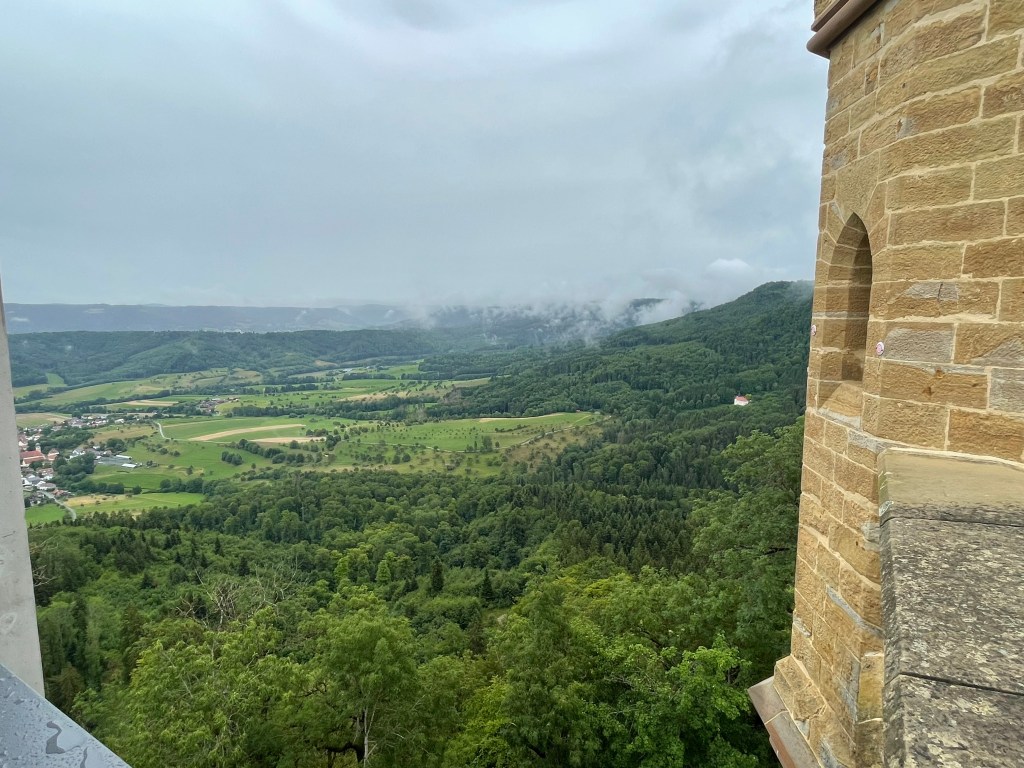
Like most castles, it has views to die for. Here Masi takes a break from all the sightseeing to enjoy the scenery. He lost his forearms in a horrific reaping accident, but we tried not to talk about it too much, especially when he attempted to count to eleven (he still has ten toes, but after that, he got a bit lost).
Fortunately for us, Hohenzollern Castle is renown for its healing properties, including miraculous limb regeneration. Unfortunately, he now has seven fingers and three thumbs, but at least he can count to ten now.
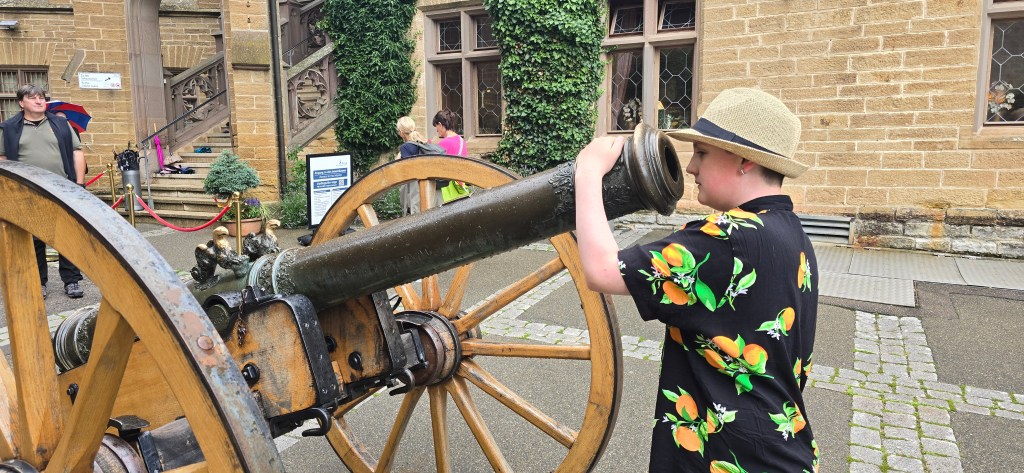
The last words of many a young soldier: “Is this thing load—“
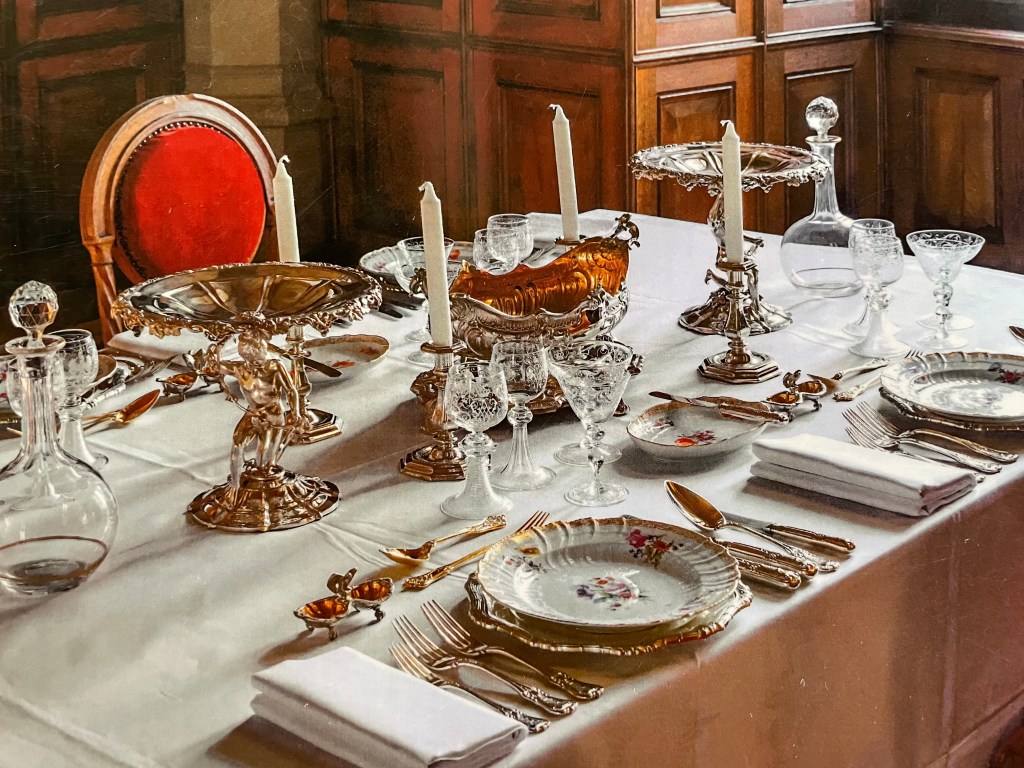
It’s much safer to stand in front of swords as long as they’re affixed properly. The castle staff kindly set out a table for our lunch, but we’re kinda snobbish and just thought the whole thing was a bit pedestrian. I mean, c’mon, only three forks? Pssh. What do they think we are, peasants?
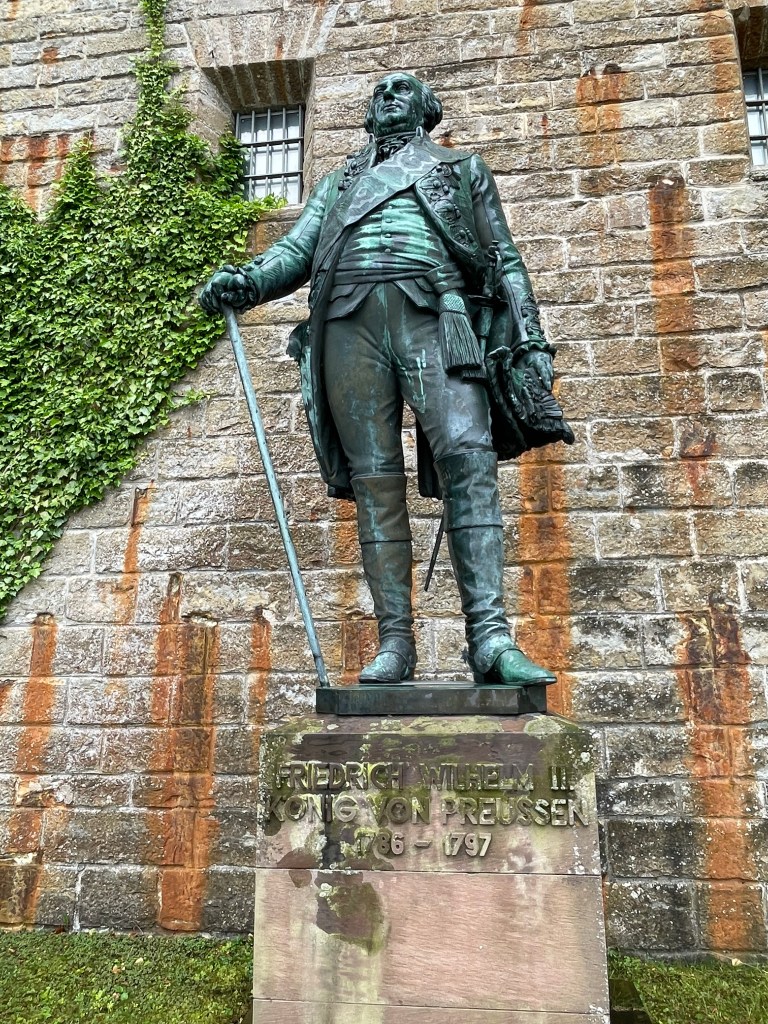
On the right is evidence that the olden Germans had some weird growth hormones in their beer. If you zoom in on the dates on this statue, it says Friedrich Wilhelm was born in 1786 but died in 1797, so this guy was only eleven years old when he posed for that statue! Hmm, I wonder how old Hitler really was… he did act like a toddler sometimes.
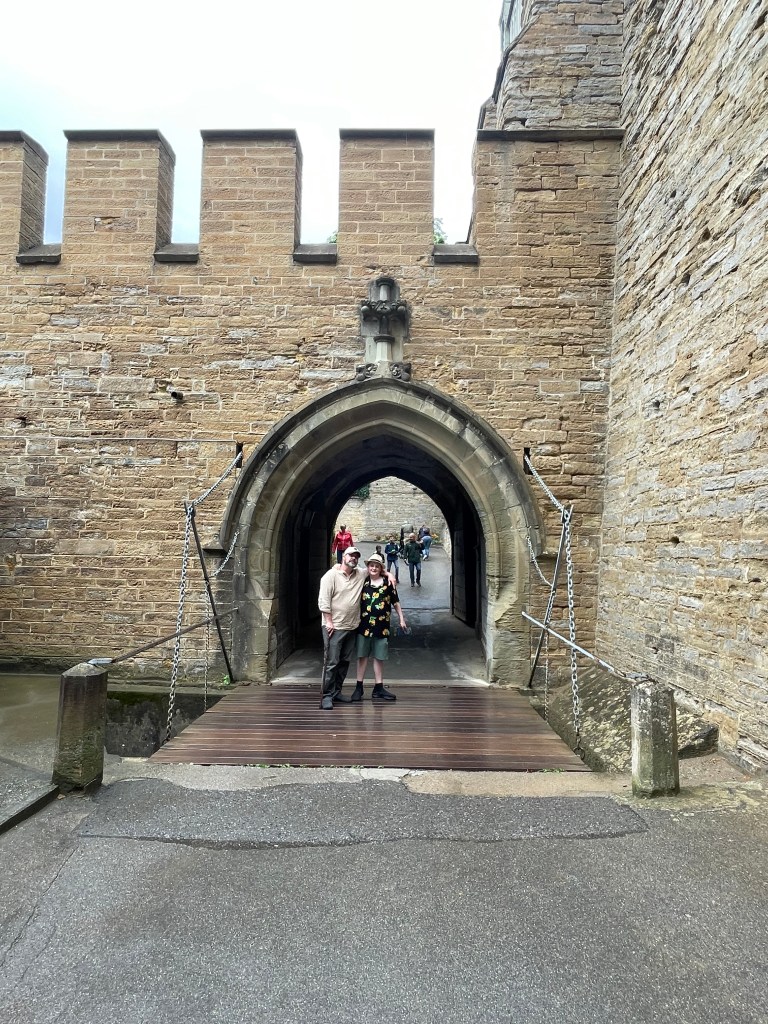
I wonder if men in untucked shirts and baseball caps would have had the same fearsome effect on any attackers.
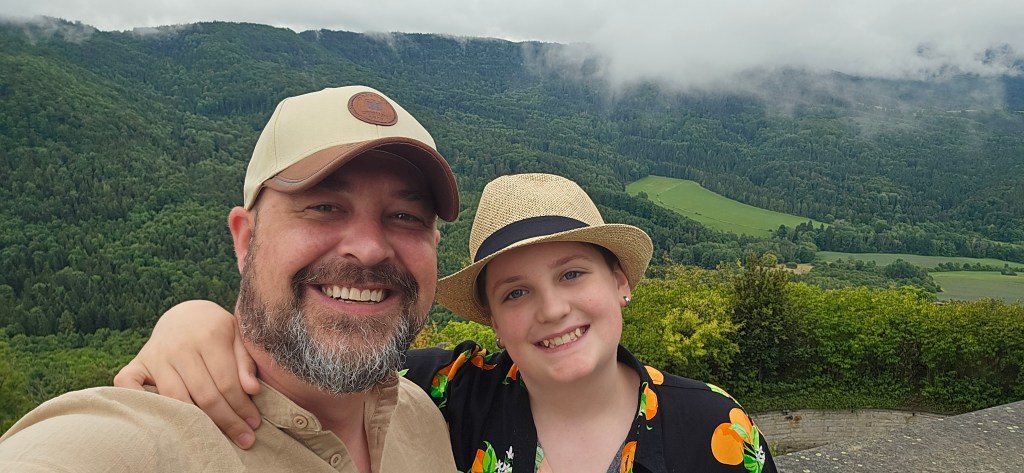
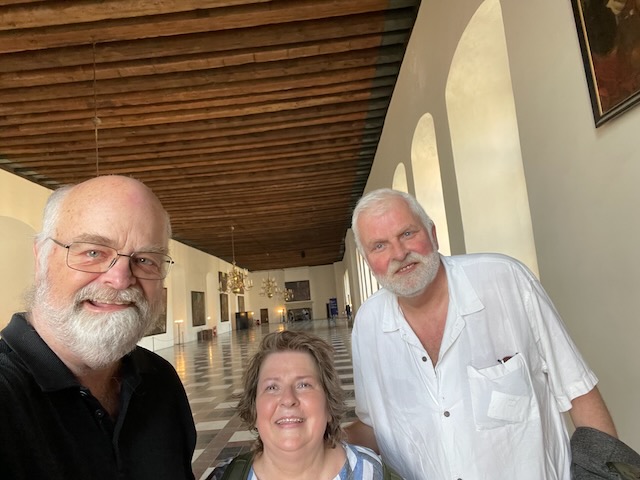
In the end, my two handsome boys enjoyed the visit and even managed to hold those smiles for the fifteen or twenty seconds it took for me to figure out why the photo button on my iPhone wasn’t working. Ah, turn it over, dummy.
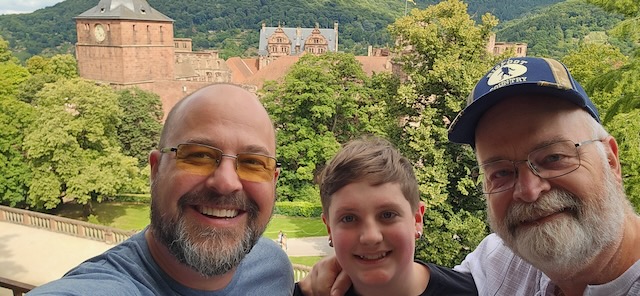
Next on the castle-y tour was Heidelberg Castle, perhaps named after someone named Delberg to whom everyone said “hi.”
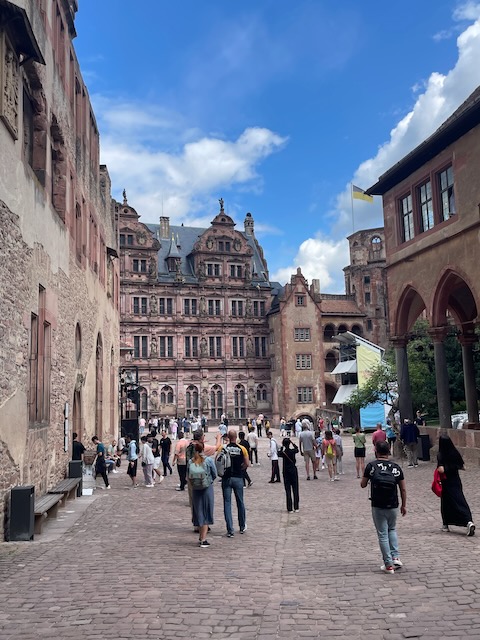
Actually, the name Heidelberg is derived from the German words meaning heath and mountain, apparently because it was unwooded at the time so the Germans just sat on the hill eating Heath bars. Perhaps the trees knew what they were doing by staying away because the castle has been struck by lightning at least twice. The first castle structure was built before 1214 and was later expanded into two castles, but in 1537, a lightning bolt destroyed the upper castle. Then in 1764 another lightning bolt caused a fire which destroyed some of the rebuilt sections. Whoa! Someone up there wasn’t happy with those castles!
The castle has only been partially rebuilt, with some of it still in ruins. I thought the inside was just as interesting as the outside, although outside some of the buildings were impressive.
Like most castles, the views are spectacular, overlooking the city of Heidelberg. The city was largely spared bombing by the allies in WWII mostly due to its lack of strategic importance, and was occupied by the Americans at the end of the war. They of course also brought with them new McDonald’s and Burger King franchises, which resulted in the average Heidelbergian gaining about 10 kg (22 lbs.) during the first year of occupation.
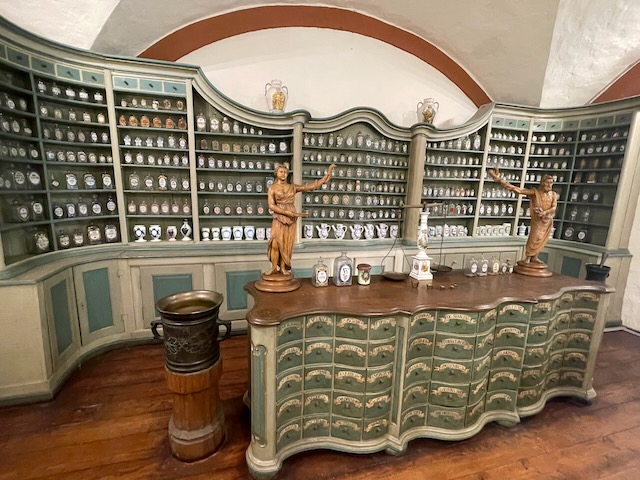
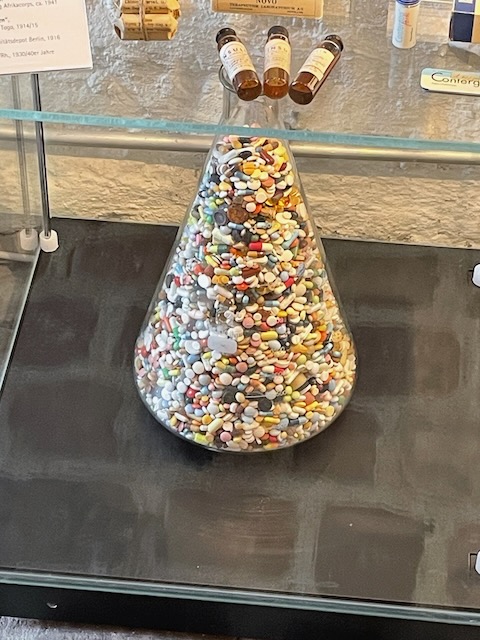
Inside the castle they demonstrated their pharmaceutical prowess of yore in the Apothecary Museum. The jar on the right held just enough pills to get through the day if you had a headache.
On the left is either a beer-making machine, a pill-making machine, or, based on the picture to the far right, some sort of auto-erotic device. Yeah, you go first. In all the top pharmacies back then, opium was an important medication for things like headaches, concerns about where pimples might happen, and when you otherwise felt fine and wanted to party. I can only speculate on what they did with the container on the right. Google Translate had no idea what “pichurim” is, so I can only guess it was something so nasty they decided to just banish the entire concept, but this appropriately shaped container seems to have survived the whitewash. I’m hoping that dish isn’t filled with expired testicles removed after too many nights of auto-erotic machines and opium. That would be nuts.
Someone once told me that Germans like beer. This gigantic beer barrel is all the proof one needs. Unfortunately, Masi figured out a way to tap into it and had downed a number of mouthfuls before we could get to him.
After a last look at this interesting castle, we rode the funicular down to old town Heidelberg.
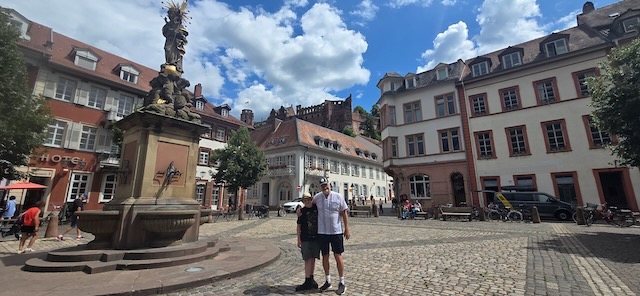
Old Town Heidelberg is very cute with some great old buildings (again, spared during WWII), and a fair amount of tourists (mostly made after WWII). We had a nice German lunch at an Italian restaurant, er– was it a nice Italian lunch at a German restaurant? …and otherwise enjoyed walking around the area.
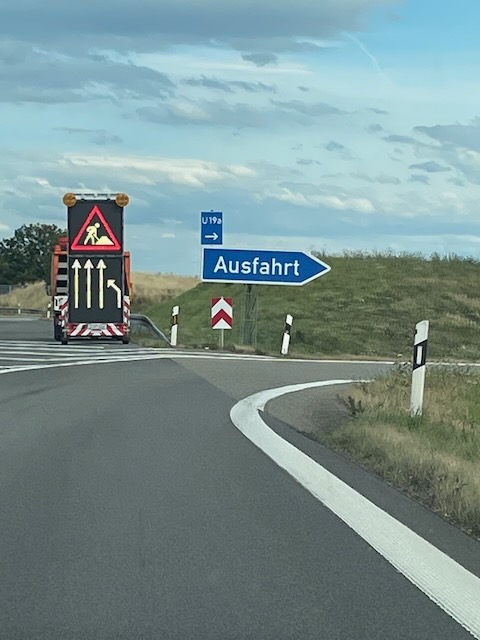
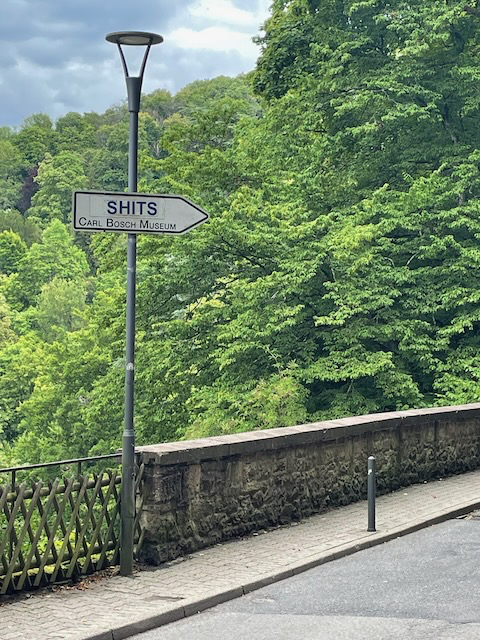
The Germans seem a bit obsessed with bodily functions. Fortunately, no matter how much explosive diarrhea we had, it was always easy to find a sign pointing the way to go.
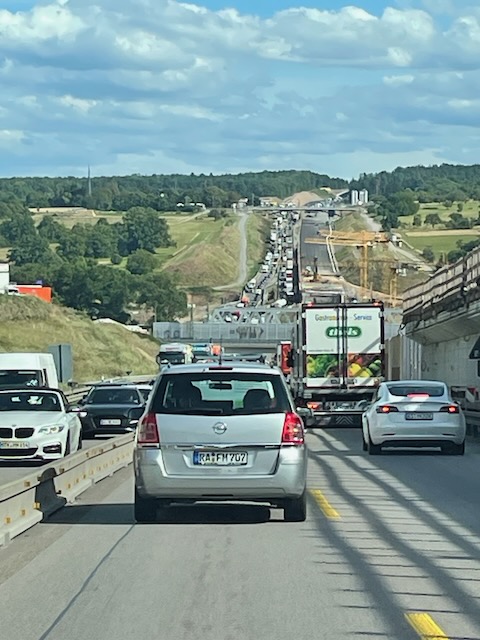
We settled in for the two hour drive– er, check that, I don’t know how many hours it took us because we encountered more than our fair share of jammed-up freeways as we made our way around the country.
Occasionally we would break out of the traffic jams and find a place to stop and see something interesting, in this case the Rhine Falls, known as the largest waterfall in Europe by average flow rate (the falls are actually in Switzerland, but I had some extra room). To be candid, it didn’t really seem all that impressive to us. Europe seems to be a little light on the waterfall flow rate department if this is the best they’ve got. The Rhine Falls are just the 23rd largest by flow rate in the world. Many Oregonians might be surprised to learn that the Willamette Falls in Oregon City is even more powerful, ranking 17th in the world, and no one there pays it much mind. There’s a small viewpoint on a busy highway where you will occasionally see a car stopped to view them. I guess everything is a little more exotic when it’s in a foreign country.
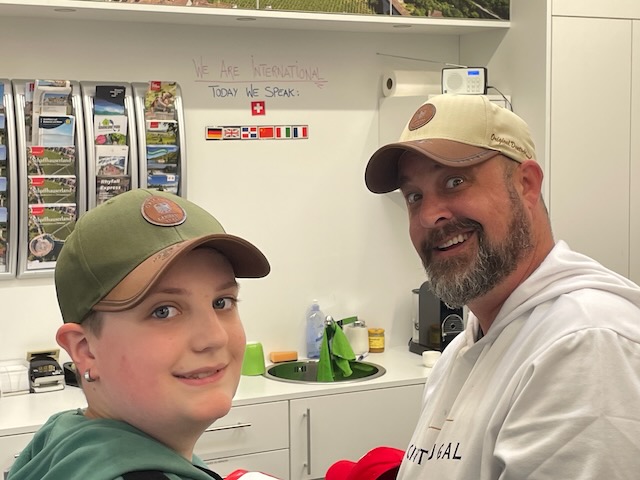
Ah, but they do have something the Americans don’t have, the need to speak multiple languages. In the gift shop they put up these little flags to show what they can speak on any given day. I tried some Swahili on them but was met with a blank stare, like I usually get when I speak Portuguese to a Portuguese.
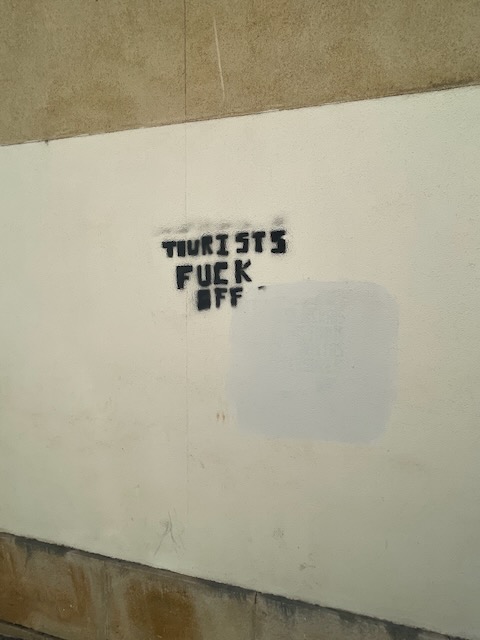
A good percentage of Europeans are proficient at English. Except here I’m not sure who Off is, but I think it’s a little presumptuous of them to provide a suggestion like that. Does Off even know about this? Oh well, at least they care enough to offer some guidance, but a little more information would have been appreciated.
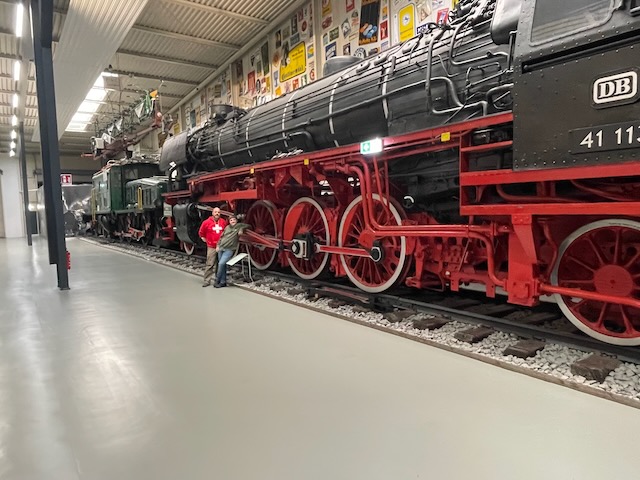
This was the summer of the long family (and very welcomed) visit. My son Luke and my grandson Masi came to stay with me for about six weeks, which was a great help in alleviating some of my occasional loneliness. His wife Brooke was only able to make it for the last two weeks due to work obligations. We mostly spent the first part of the visit just hanging out at home and seeing a few more of the sights around the area, but we also booked a trip to Stuttgart, Germany. Luke wanted to see Germany, but he didn’t want to go to a big city, so Stuttgart filled the bill. Plus, the name “Stuttgart” comes from the Old High German term “Stuotgarten,” meaning “stud garden” or “stud farm.” Since we’re three generations of studs, Stuttgart seemed like a perfect fit. And no, I didn’t even make any of that up.
I mean, that’s three generations of studliness right there.
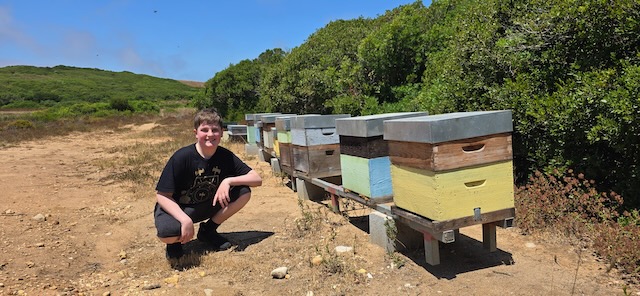
I took them on a tour of one of my regular walking routes; it’s hard to beat that scenery. We also found a bee farm. Since Luke & Brooke have been beekeepers in the past, they enjoyed seeing how the Portuguese do it. On a related note, I once asked my Portuguese teacher if couples ever called each other “mel,” because “mel” means “honey” in Portuguese. It’s only a three letter word, but no matter how I said it, she couldn’t understand what I was asking, I think mostly because it had no context and my accent probably made it sound like “mal,” which means “bad” …like my Portuguese. Anyway, after sorting out the question, she said “nâo,” which means “no” but rhymes with cow, and you have to plug your nose when you say it.
We walked all around Lisbon, and watched in amazement as a tower grew out of Luke’s head. We had to pry it off before he could get back in the car; it’s a good thing I had a crowbar in the trunk.
I had a brief conversation with Cristiano Ronaldo, but he declined to reveal what kind of underwear he wears. In fact, he seemed a little annoyed at the exchange, he just crossed his arms and stood still, staring at me.
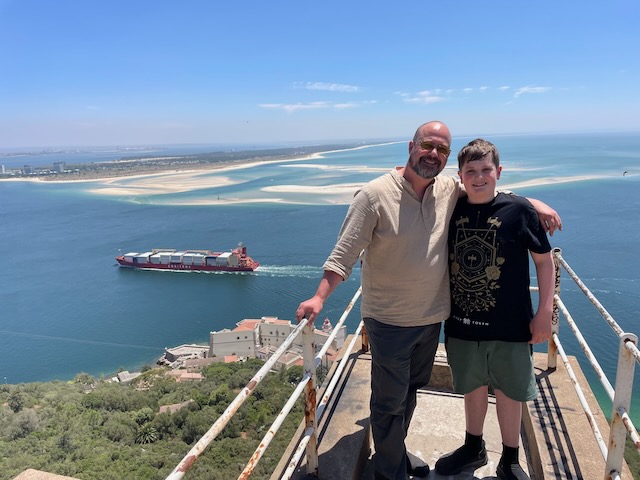
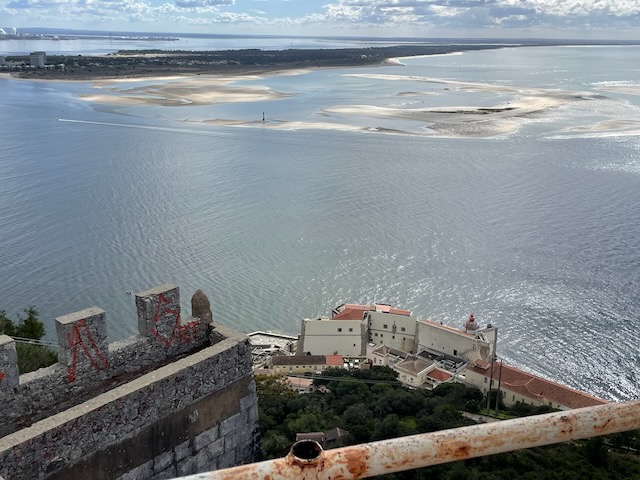
That’s Troia in the background in the middle picture, an upscale resort just a short ferry ride from Setúbal. And Praça do Comércio is a must-stop for anyone who needs to stop when they get musty.
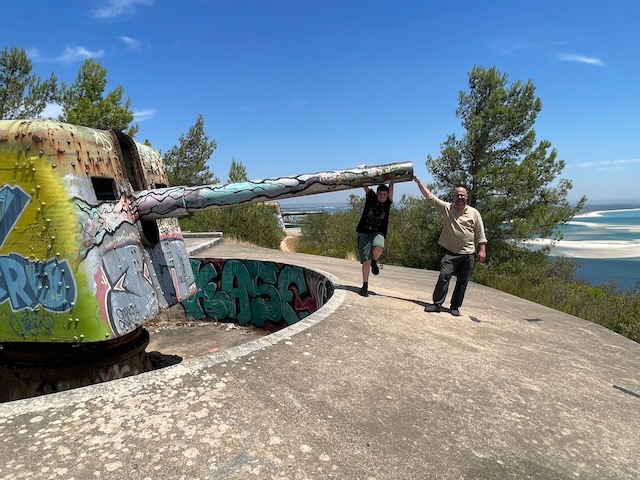
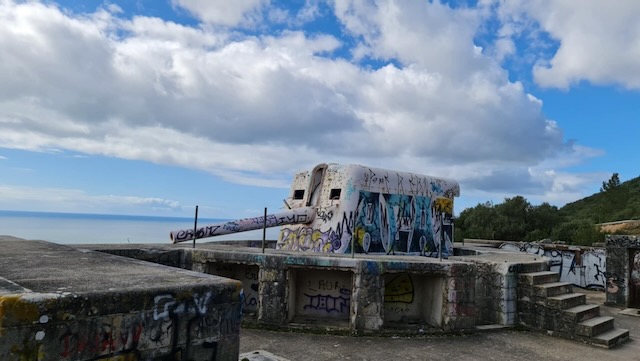
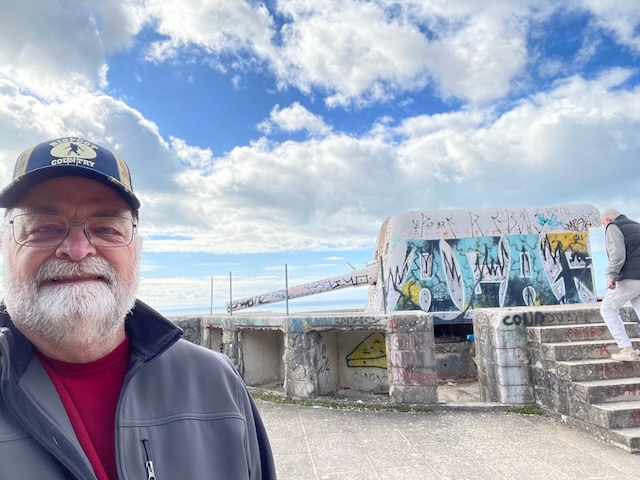
We also visited the World War II-era cannons I’d discovered with my good friend Per a while back. It was such an unexpected sight since Portugal was neutral during that war. Masi also learned that the Portuguese use many of the same swear words that Americans use. I don’t think they use “doggonit” or “shucks” though. And boy howdy, I can now say I’ve stared down the barrel of a gun and didn’t even flinch.
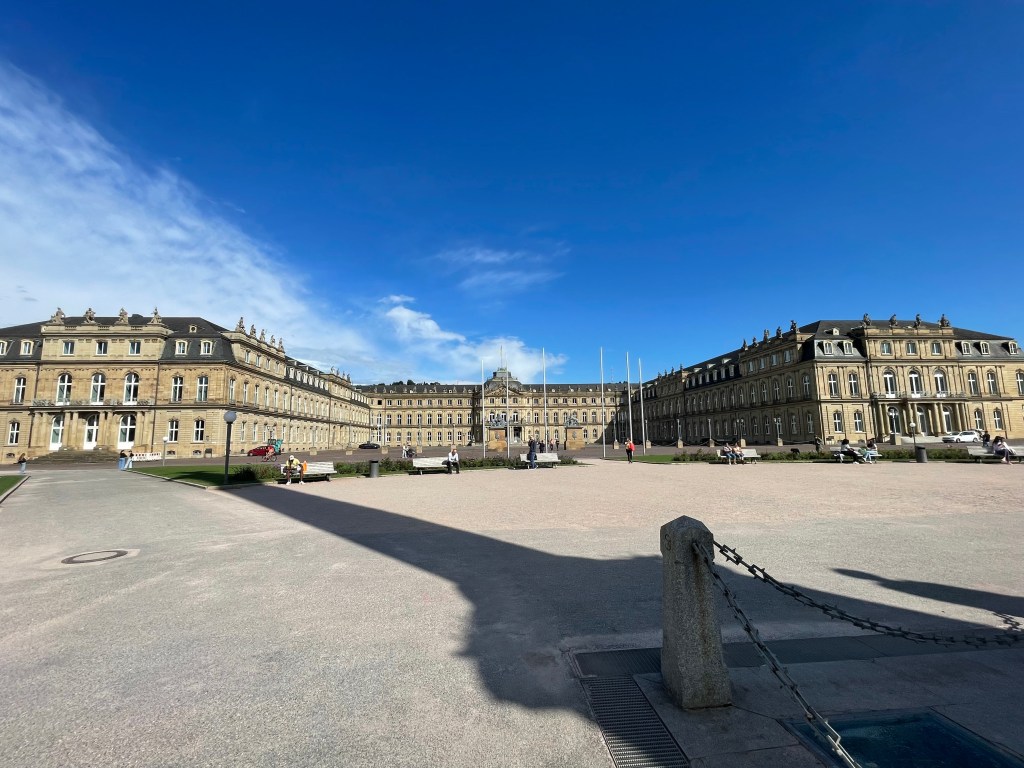
So off we went to Stuttgart via Lufthansa with these promotional-catalog-quality photos. That’s me playing the grumpy old man in the background. Do you suppose I could make a career out of that?
Later on they conked out, only to be jolted awake when I started screaming, “Oh my God, we’re going to crash!” I told the police at the gate that I have Alzheimers, so I barely got arrested.
Stuttgart is a nice enough city, but other than some museums, there wasn’t a ton to see there. According to TripAdvisor, the two top things to do there are The Mercedes Benz museum and the Porsche museum. Luke’s a car guy, but he knew Masi and I would enjoy either about as much as a hair follicle museum, so we basically used Stuttgart as a launching pad for a multitude of other cities and countries. Besides, we weren’t in the market for any studs from their numerous stud farms.
Both Luke and Masi are pretty strict rule followers, just like most Germans, so if the Germans want us to be gross, by gum we’ll be gross!
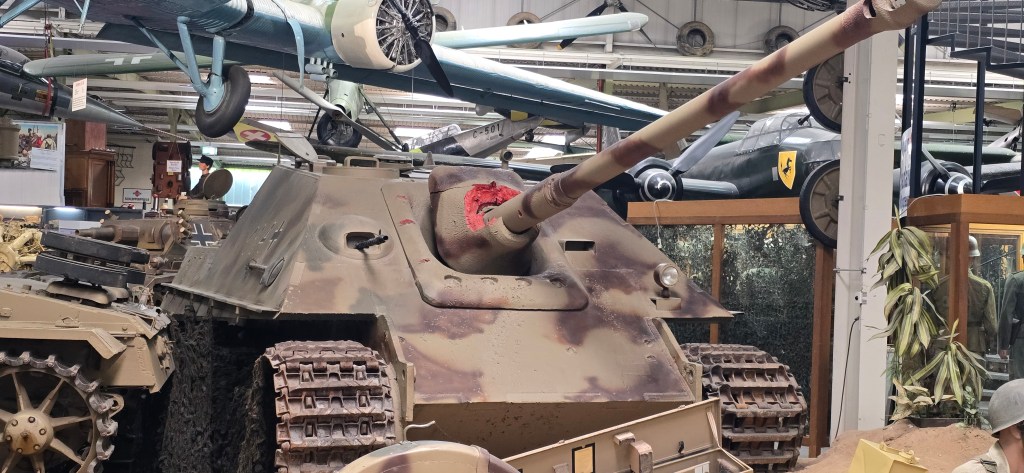
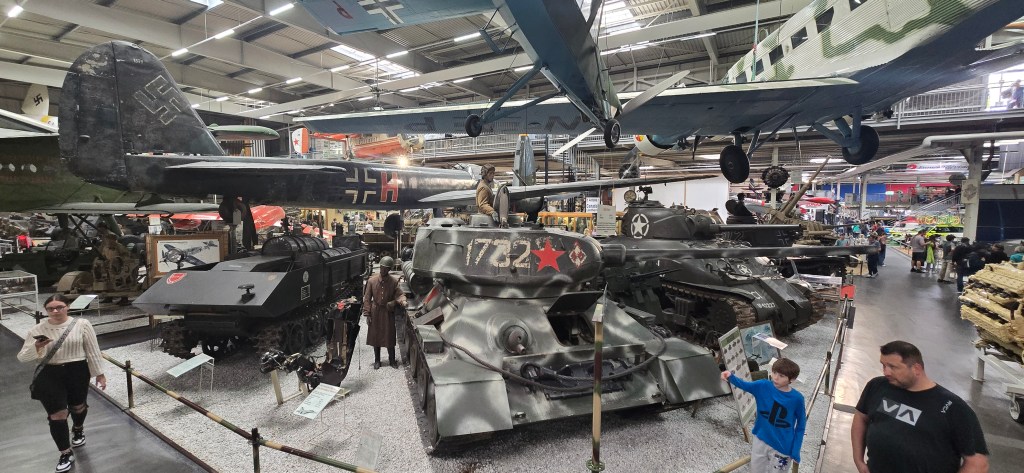
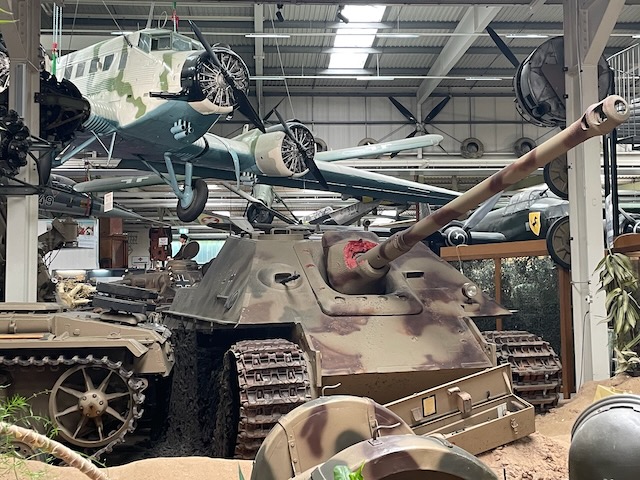
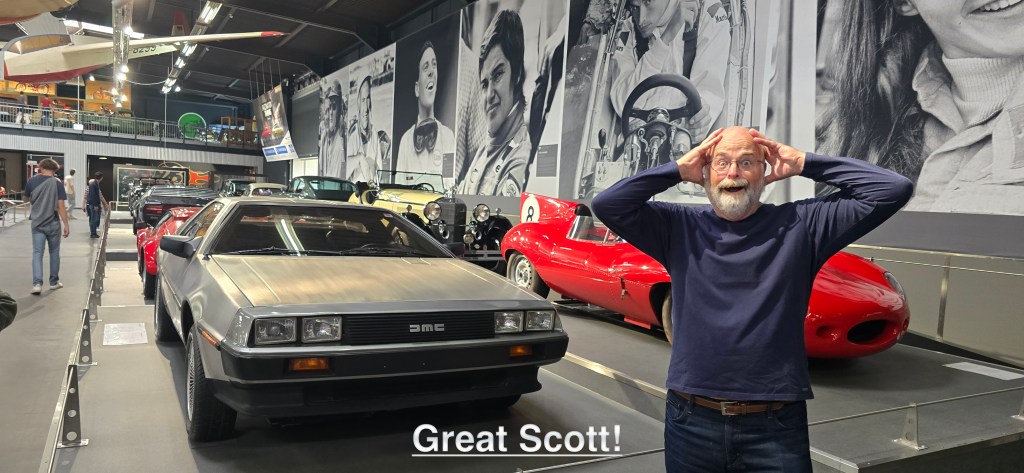
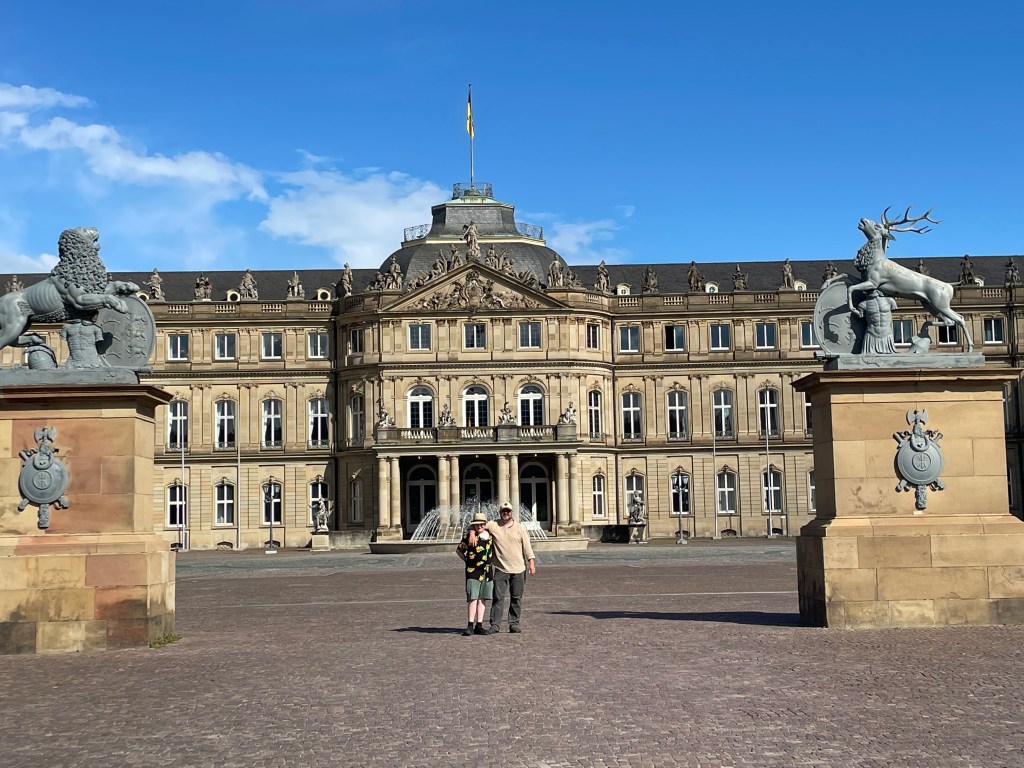
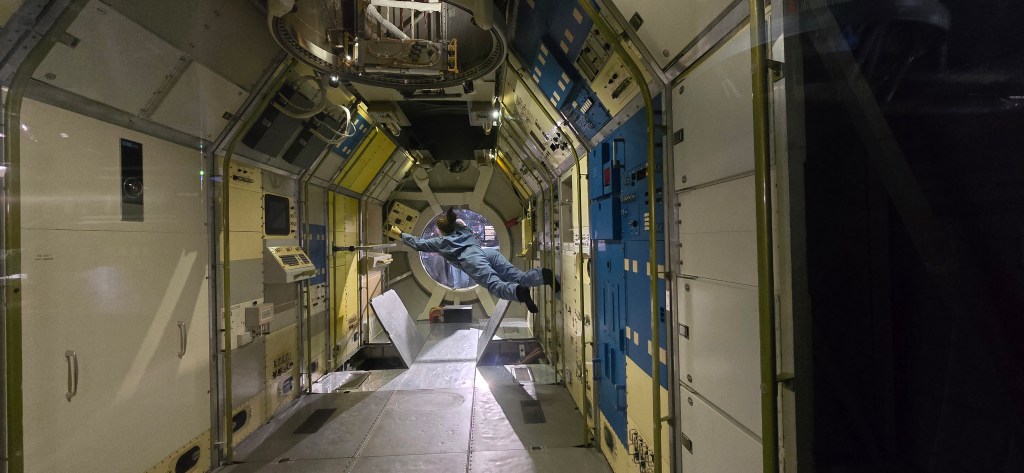
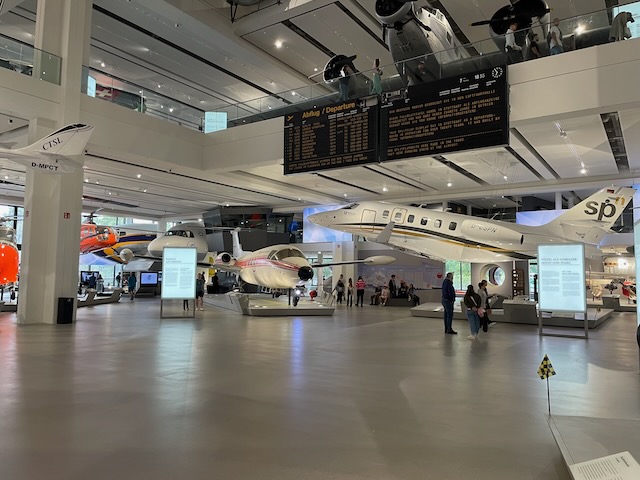
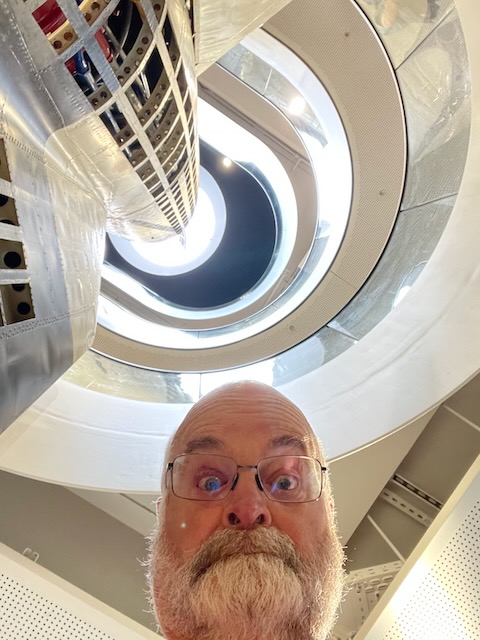
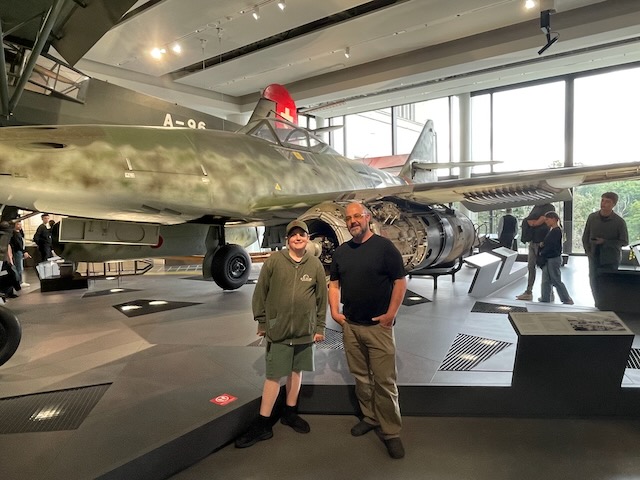
Exploring the wonders of science and technology at the Deutsches Museum in Munich.Exploring the Deutches Museum in Munich, showcasing impressive aircraft and military technology.An exhibit featuring a space suit alongside a model of the vehicle it was designed for, showcasing the intricate design and technology of space exploration.Exploring a high-tech space module at the Deutches Museum in Munich, showcasing the wonders of science and technology.Inside the Deutches Museum in Munich, showcasing a fascinating collection of aircraft and aviation history.A playful selfie taken from below a unique architectural feature, showcasing a spiraling structure above.Exploring the Deutches Museum in Munich, featuring impressive aircraft and technology exhibits.
One of our expeditions from Stuttgart was to visit the Deutches Museum in Munich, which is the largest museum of science and technology in the world. Here are just 7 of the 1,823 or so pictures we took, I doubt anyone wants to see a bunch of museum pictures so I didn’t include any more than that here. But I did experiment with an AI feature for the first time by asking AI to provide captions. It did a serviceable job, if a little repetitious, but I couldn’t get it to tell any jokes. You’ll always be able to tell that Bald Sasquatch wasn’t written by AI because of all the alternative facts and other nonsense that somehow worm their way in, especially if I’m writing after a day of snorting mushrooms. Perhaps humor will be the only way we can distinguish between what’s human and what’s computer in the future! Dad jokes may save humanity!
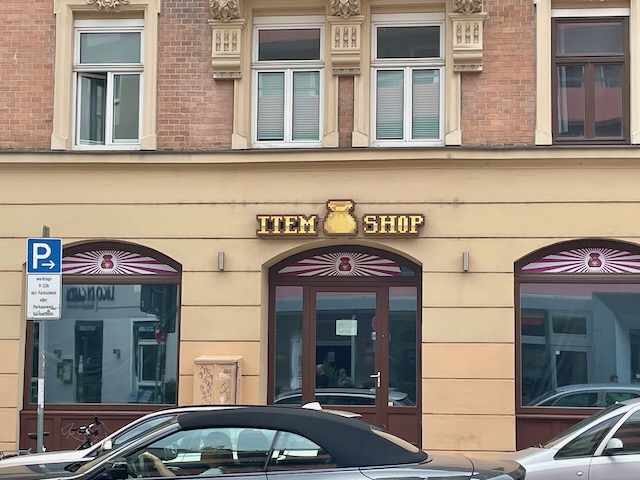
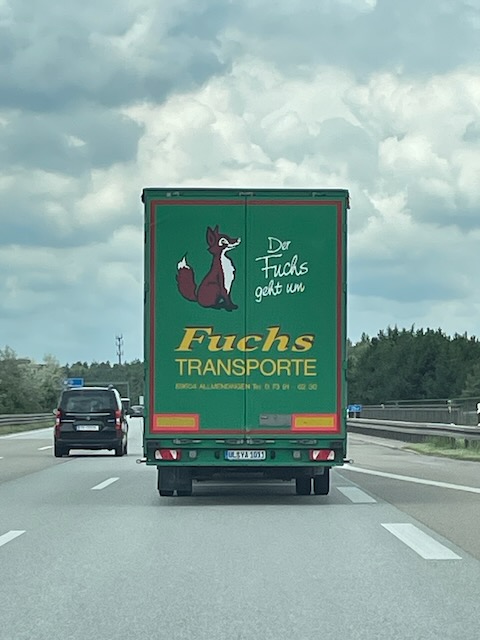
For example, AI will probably never understand why any of these pictures are humorous. I love the store name “Item Shop.” I suppose if you asked them what they are selling, they’d only need to reply, “items,” even if they have something dropped off by “I don’t give a Fuchs Transporte.” And I cracked up at what people did to the chewing gum sign. Even though not all of them were fresh, many of them still tasted fine.
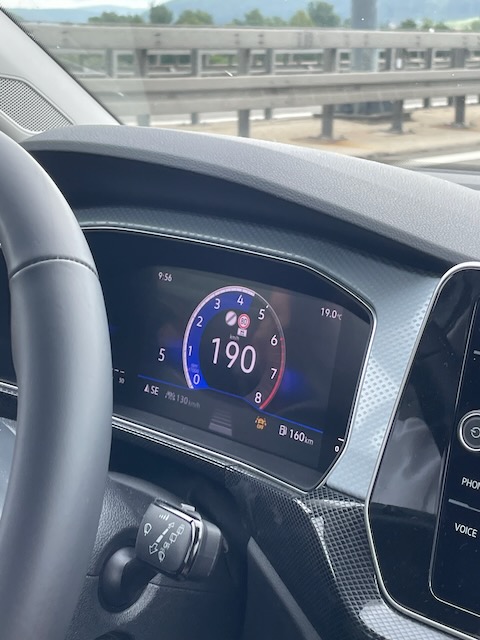
Driving on the Autobahn was fun for Luke, I think 190 km/hr (118 MPH) was about as fast as he went, but he probably went faster when I wasn’t looking or after the G forces made me pass out. I took the photo on the right simply to compliment the Germans (they love it when I compliment them) for their consideration and insight. Near the entrance in a large underground parking lot are these parking spaces with a sign indicating that they’re for women drivers only. Since women generally have to be hyper aware of their surroundings at all times, it’s a thoughtful thing to allow them to have a close place to park instead of wandering around a gloomy dimly-lit underground floor where rapists, neo-Nazis, or Ted Bundies might be lurking around every corner. The next thing we need to do is make sure women have double the public toilet capacity; I feel so sorry for them when I walk past a line of about 50 females and am able to stroll right into the men’s room. I think we need more female architects.
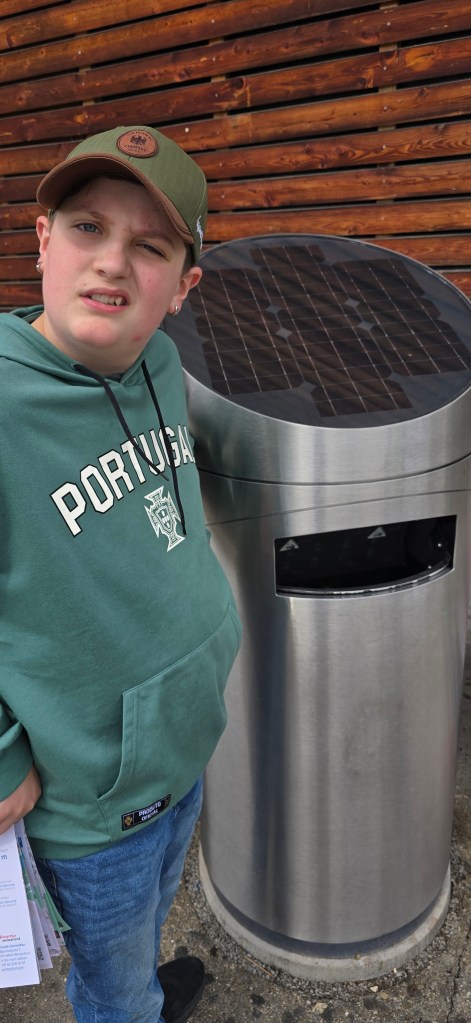
We had an authentic German meal at an authentic German restaurant (“Is this an authentic German restaurant?” I asked). But later Masi was a bit confused as to why a trash can needed a solar panel. I have to admit I didn’t have a good answer for him, but if he wanted to stick his hand in the slot to find out, that was his business.
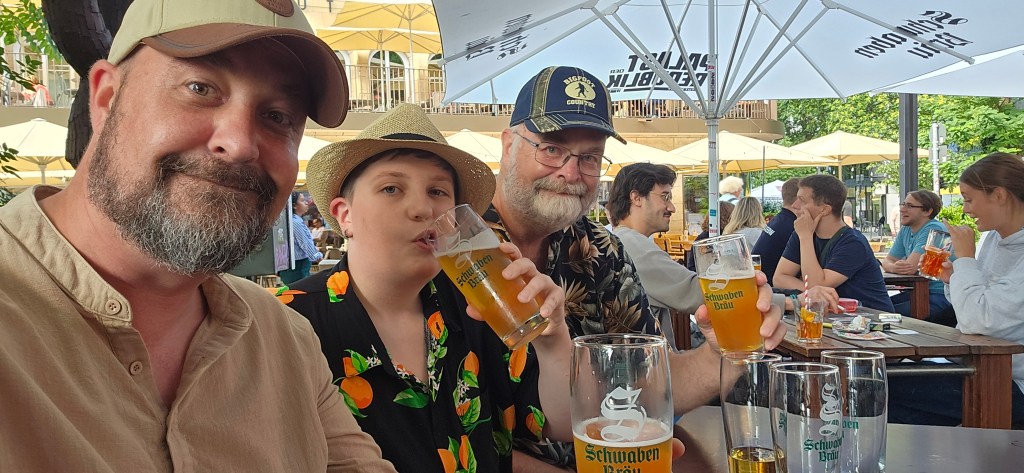
We started Masi down the road to alcoholism by letting him imbibe his first (or so he says) beer while in Munich. As long as you’re with an adult, anyone aged 14 and up can legally enjoy a beer at a restaurant in Germany. We did kinda cheat since he was only 13, so we penciled a mustache on him, but damn if the kid didn’t down the whole glass, even wiping the foam off his fake mustache with the back of his hand at the end (of course, the mustache came off too, but the beer was already gone at that point). But truly, I think it’s kinda cool that Masi will always be able to say he had his first beer in Munich, Germany, with his dad and granddad. That’s something I hope he always remembers. I won’t, because I wasn’t driving and so had eight of them. Or ten, or something. I can beerly remember anything anymore, even without alcohol.
I should mention here that Germany has significantly higher per capita alcohol consumption than the U.S., but lower rates of alcoholism and alcohol-related health issues. Simply put, the German approach to beer works better than trying to keep anyone under 21 from having any.
I will say that it was a good way to keep him quiet on the drive home!
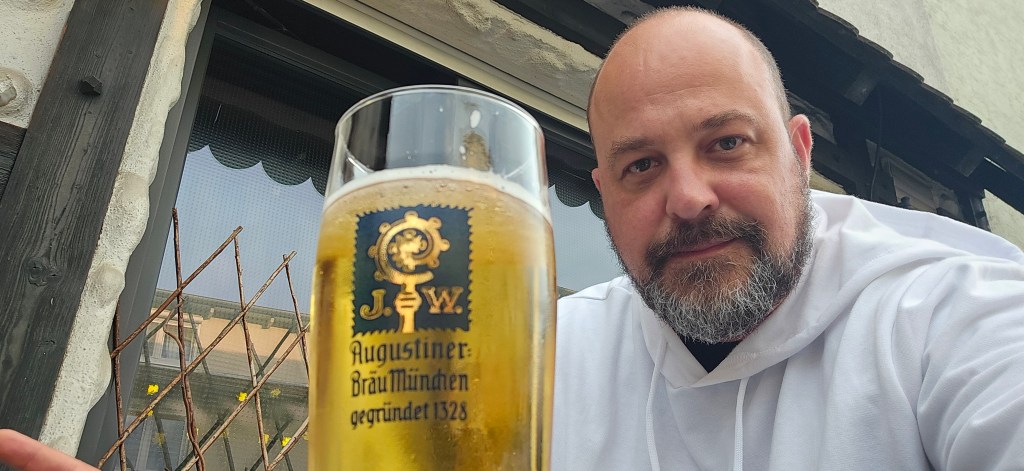
Luke was on a different-beer-a-day regímen at the restaurant across from our apartment. When in Germany, you gotsta have lotsa beer, I think it’s a law there.
Anyway, we had a good time during this portion of the trip. More cities and countries to come! But probably no more beer, I still have a headache.
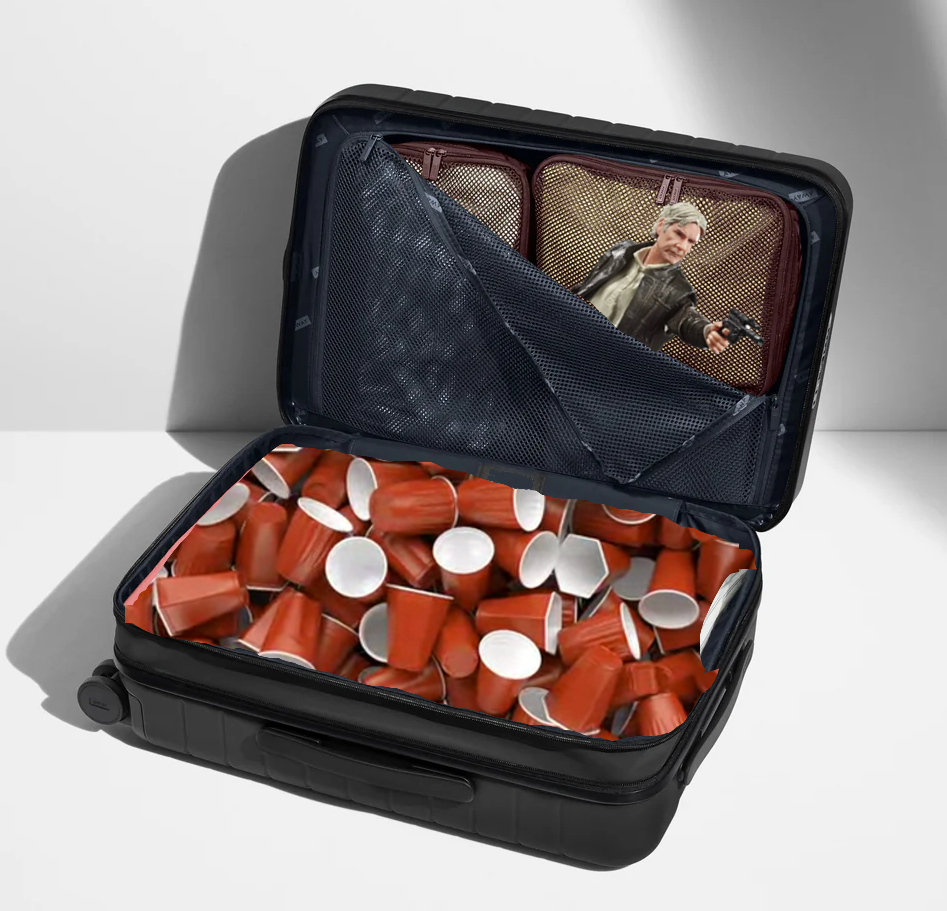
I’ve been reading online that Solo Travel is becoming a more and more popular trend (probably because everyone else seems to be so annoying these days). So I decided to try it out. Since I rarely bother with reading past the headlines, I loaded up my luggage with Solo cups and my favorite Hans Solo doll and set out on my first solo adventure. Unfortunately, I quickly learned that Solo cups make terrible underwear and that Hans Solo dolls are useless in real life except for pretend-shooting toe monsters in the hotel bathtubs.
By now you may be wondering what Häagen-Dazs has to do with solo travel, this blog, and elephants. We’ll start with the fact that, like many of the alternative facts proffered by Bald Sasquatch, Häagen-Dazs is a completely made up name. However, it was invented to sound Danish (and in fact was intended as a tribute to Denmark’s support of Jews during World War II, so now I can’t make fun of it). As a result of all my exhaustive research (which took me actual minutes), I figured my first solo venture should involve Danish things, so I put a Danish pastry topped with Häagen-Dazs ice cream on top of a small table made of Legos while wearing one of those Viking hats with horns that Vikings never actually wore, and called up the two greatest Danes I know, Pia and Per. I don’t know why you brought up elephants, I think you’re just trying to confuse me.
When Pia learned the specifics of my solo adventure, she rightfully became a little concerned and decided that perhaps Per should visit me posthaste to make sure I was right in the head. Later I mitigated her concern by showing her pictures of Per dressed up like this just to go to the grocery store. Touché, or as we say in the states, too shay.
Seriously, Per, being the good friend that he is, flew all the way in from Copenhagen for a long weekend just to keep me company as I adjust to living completely alone, except for the scary monsters that want to attack me but so far have been thwarted by anti-monster blankets.
Plus he’s even taller than me so the monsters really made themselves scarce during his visit.
The cool thing about this particular visit was that we discovered some things not too far away from where I live that I hadn’t seen before. For instance, I had been planning to go to Forte de São Filipe in Setúbal for some time but just hadn’t gotten around to it, but fortunately Per had a round tuit in his wallet so we ventured out to conquer the fort, as well as Setúbal.
However, before we even got there, Per asked about another small fort he had seen on Google Maps that was supposedly on the way to Setúbal. I scoffed and call him a dumb stupid idiot for even suggesting I didn’t already know of every fort and castle between Sesimbra and Setúbal, but he persisted, and so to humor him I drove to the coordinates on Google Maps.
So we turned onto a nondescript gravel road and promptly drove over a cliff and died.
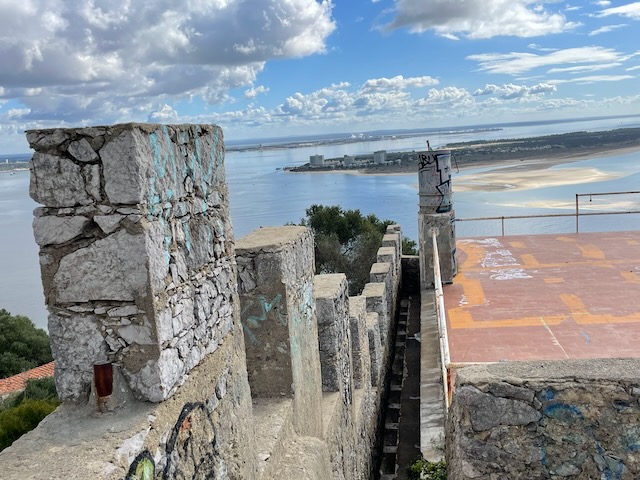
OK, not really, but I know I had you going for a second, because that was written by a ghost writer. We did actually find an old fort that apparently no one pays any attention to because it was covered in graffiti and had more than a few fairly hazardous areas including loose guardrails, wobbly steps, and unexploded land mines. There was also no entrance fee, so I guess you get what you pay for.
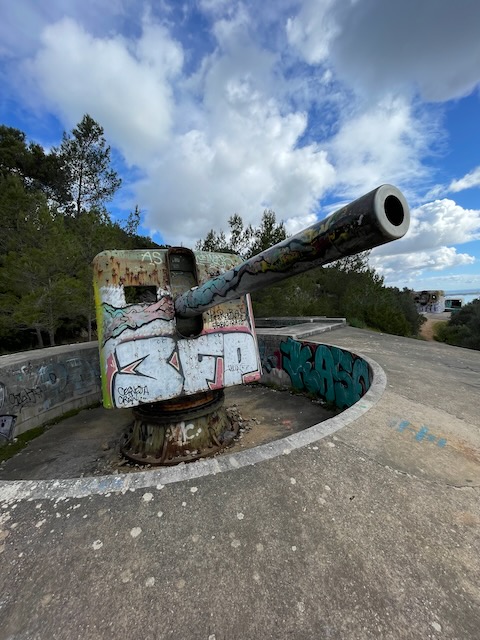
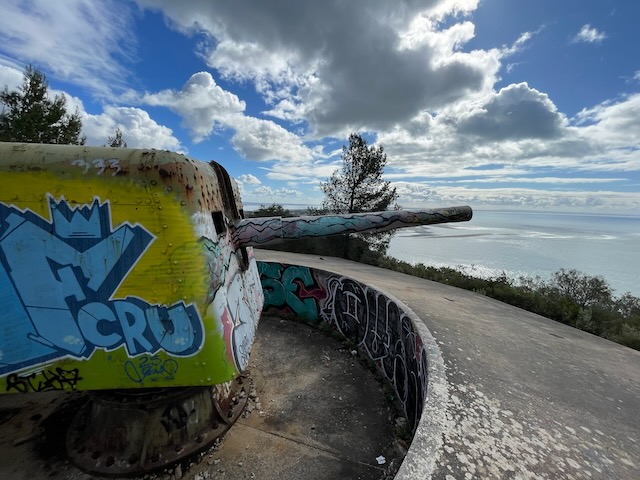
I noticed the road to the fort continued on around a bend, so I decided to explore a little. To my surprise I stumbled upon an old World War II bunker/artillery battery that I had no idea Portugal even had. Portugal was neutral during WWII, but I suppose they didn’t want to be completely helpless in case someone like the evil Spaniards or Mayans decided to attack.
Like the fort, the place has been completely ignored except by taggers and one very confused old German soldier who hadn’t heard the war was over. Anyway, I took measurements of the gun barrel dimensions and as my summer project I’m going to see if I can build an artillery shell and scare the hell out of some tourists on Troia, which is a resort area just across the bay.
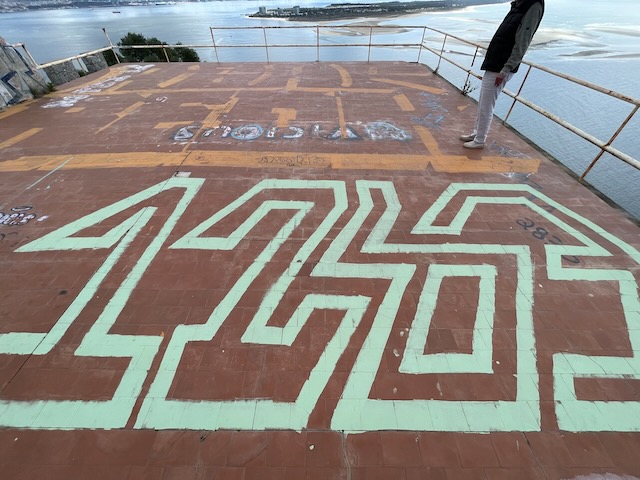
I have absolutely no idea what the writing in this photo means. I think it either might be a signal for aliens or the remnants of a lost Mayan civilization that somehow made its way across the Atlantic ocean. Or maybe it’s some kid’s Hot Wheels track.
There’s nothing here that a little paint and military-grade Viagra wouldn’t fix. I mean for the gun. Seriously. C’mon, man, I’m single now and trolling for babes, so stop with the Viagra jokes already.
After that heart-pounding discovery (there were stairs, after all), we went on to the Forte de São Filipe, which was interesting mostly because it’s an old fort, and old farts and old forts tend to attract one another.
As usual with most forts and castles, it offered up some stunning views, here of Setúbal and its environs. After we quenched our thirst at the outdoor restaurant, we set out to conquer Setúbal.
By conquering Setúbal I mean walking around the place and enjoying a delightful lunch at a family-owned restaurant that proved my adage that the more unremarkable a Portuguese restaurant looks from the outside the better the food probably is. And I have no idea what that statue is supposed to be.
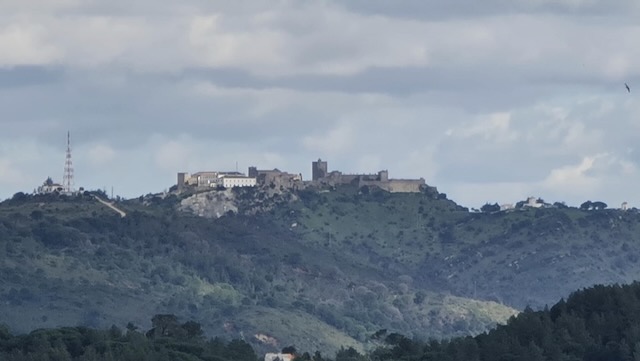
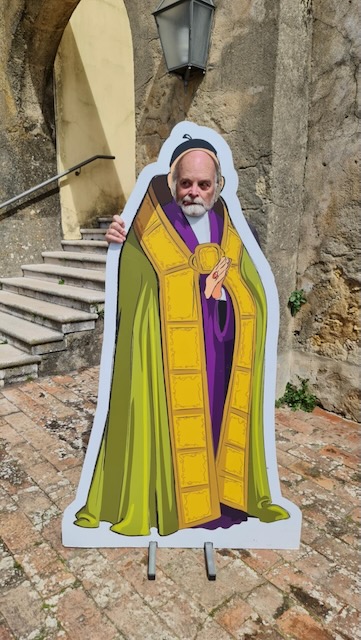
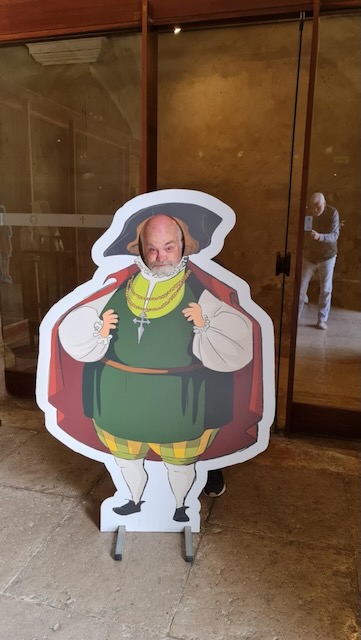
We also visited the Palmela Castle which overlooks Setúbal and catered to our wildest cross-dressing and costume fantasies.
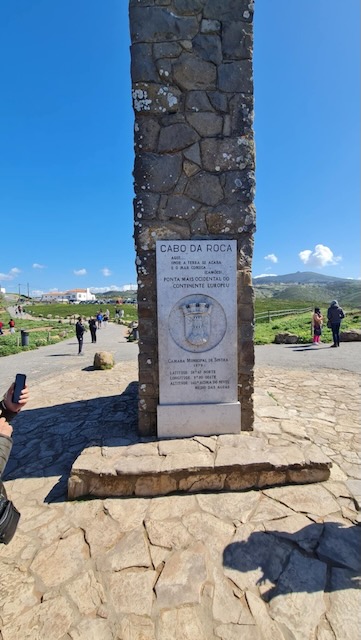
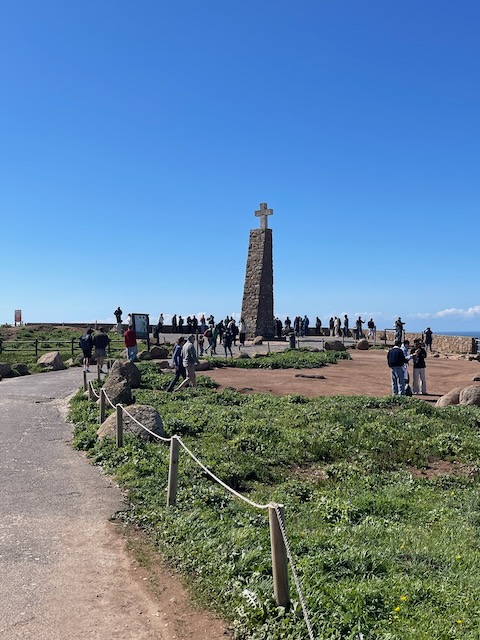
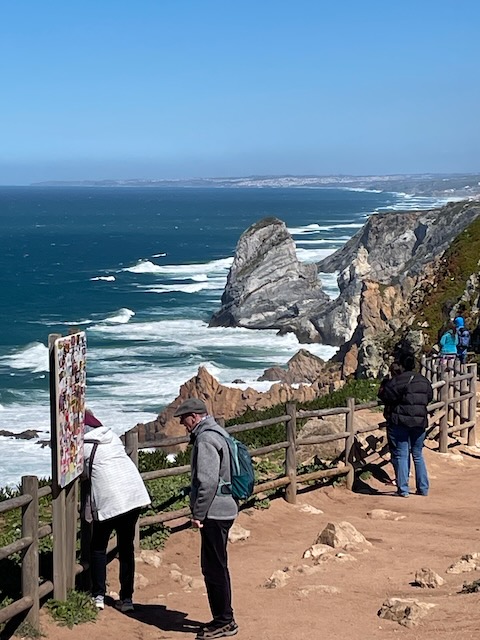
On another day we drove to Cabo da Roca, which is the westernmost point of all of continental Europe, and is where Almond Roca would have been invented if they had more almond trees nearby. The guy on the top left isn’t either Per or myself, but I figured if he was going to point his camera at me, I’d return the favor, leading to an old bald guy staredown that lasted for hours. He won because apparently he has a bigger bladder than I do.
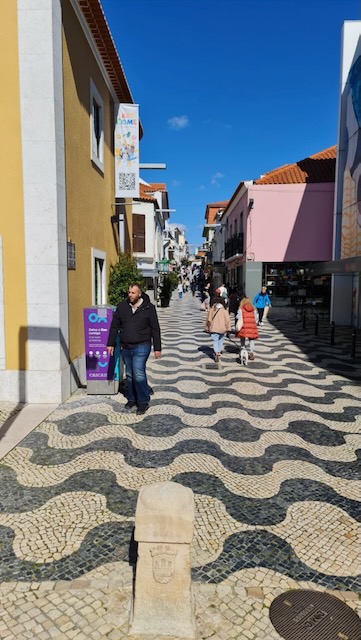
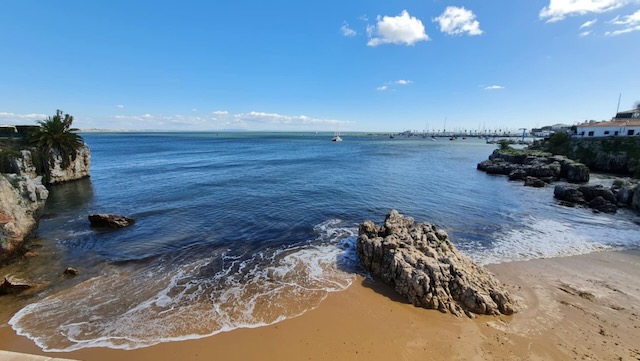
On the way home we stopped in picturesque Cascais and then got caught in a Friday night traffic jam that added at least two hours to the drive, but at least we got a terrific view of the freeway.
But before long we were all nestled into my sweet home of Sesimbra, with its silvery moon, wonderful seafood restaurants, a beautiful stretch of beach named California Beach, which the locals swear that the state of California was named after, and a harbor featuring cleverly disguised submarines.
Once Per cleared me for a visit to Denmark with a good chance of not needing to call in the authorities, I booked my ticket and a month or so later began the journey of learning how to cope. I knew I’d be able to learn all the skills I’d need in order to live alone in the capital of everything coping-ness, aka Copenhagen. As the Danes already know, “hagen” means “the chin” in Danish, so Copenhagen essentially translates to “Coping after taking one on the chin.”
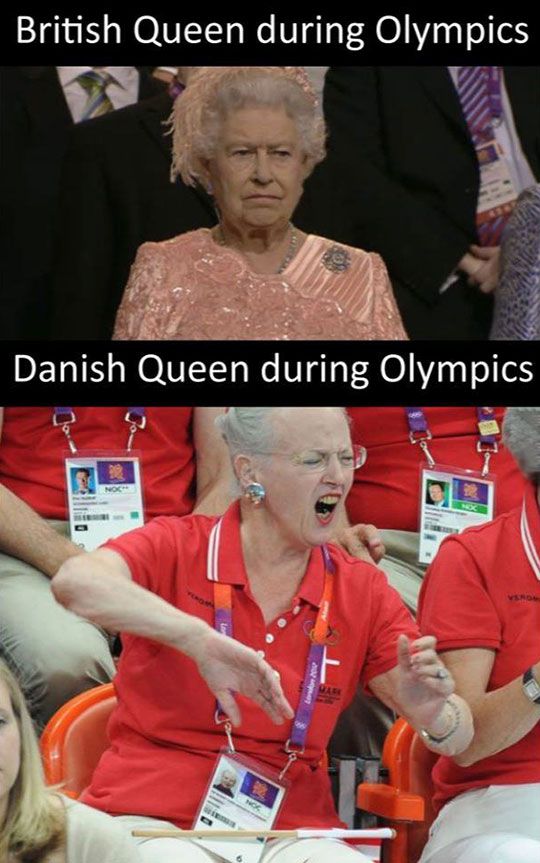
Besides, their royalty is bad ass.
But truly, what a great place to cope since Denmark routinely is in the top five or even first in so many important country metrics like health care quality, happiness, education… pretty much all quality-of-life metrics, mostly only competing with its Scandinavian brothers for the top spot. Copenhagen is the city every other city in the world should want to be when it grows up.
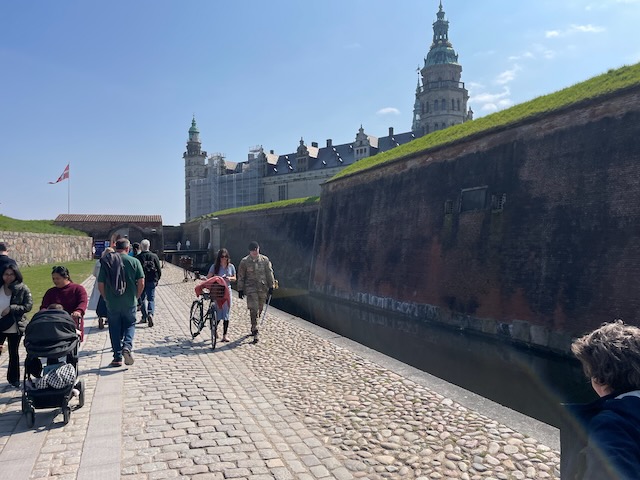
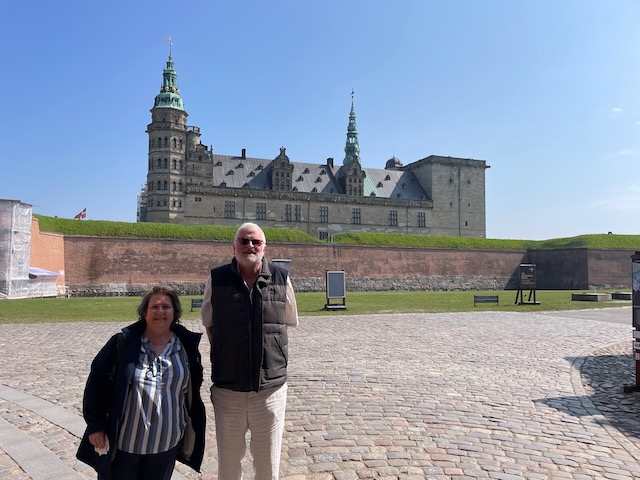
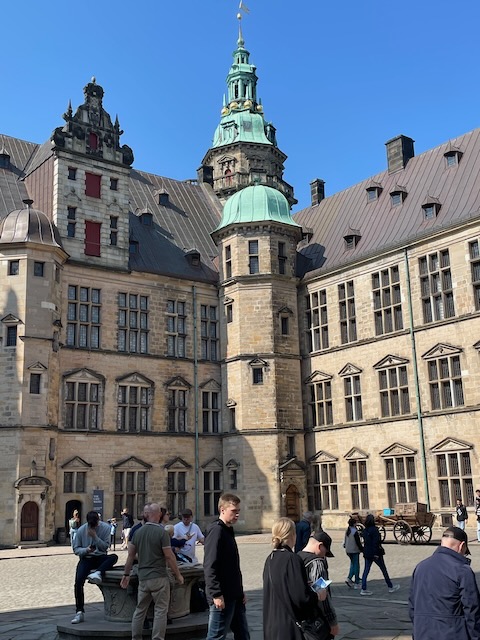
This was my second visit, so my gracious hosts took me ’round to places I hadn’t seen before, like the Kronborg Castle.
Kronborg is a very important Renaissance castle, with one of the reasons being that it is the setting for William Shakespeare’s play Hamlet, which I think is a story about a little pig.
So of course you can find all sorts of Shakespearean gift ideas, including this elephant condom with “To be or not to be” proudly displayed to ensure elephants think twice before doing whatever it is animals do to make baby animals. Anyway, it’s a great gift for the elephant owners in your life.
The castle is absolutely gorgeous and has been very well-maintained, although it could eventually need a good pressure washing which will cost millions of Danish kroner (they didn’t adopt the euro because they were already perfect), not only because it’s so large but because they can’t use any actual water pressure out of fear of damaging the old stone, so someone has to stand there all day just trickling a hose on one spot.
In case you’re wondering what the cannons were pointing at, across the water there is Sweden. An interesting piece of historical trivia is that Denmark and Sweden have fought more wars against each other than any other two countries in the world. The last one was in 1789, so now they just poke fun at each other with internet memes instead. But like two brothers, they can make fun of each other, but if an outsider tries to do the same, they’ll rush to the other’s defense. You don’t mess with that Viking blood!
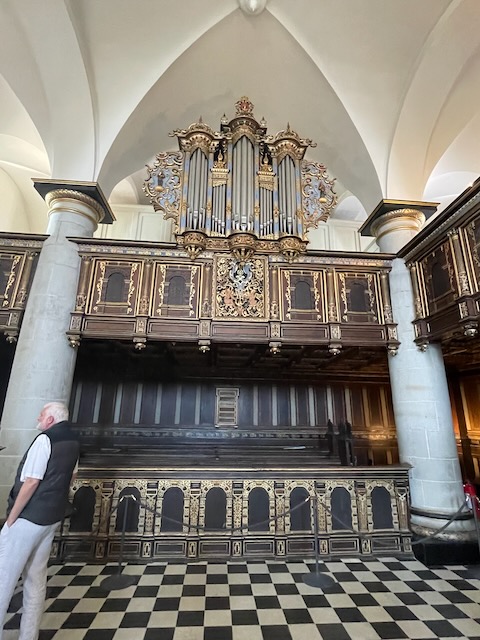
Speaking of Viking blood, the Danes are known for their huge organs.
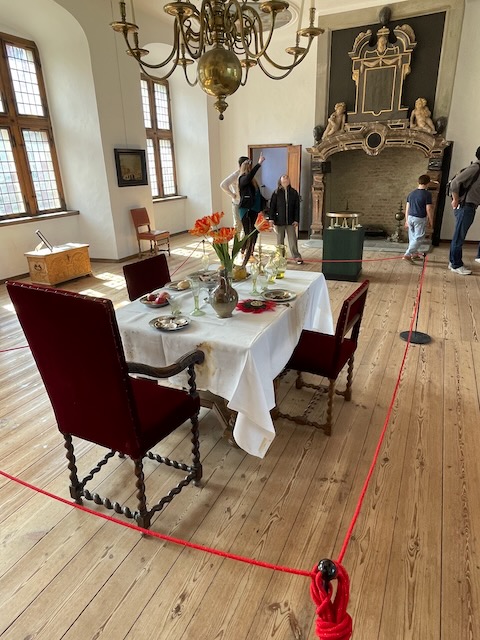
Inside, they were kind enough to offer up a free buffet, but I found the flavor to be rather like plastic.
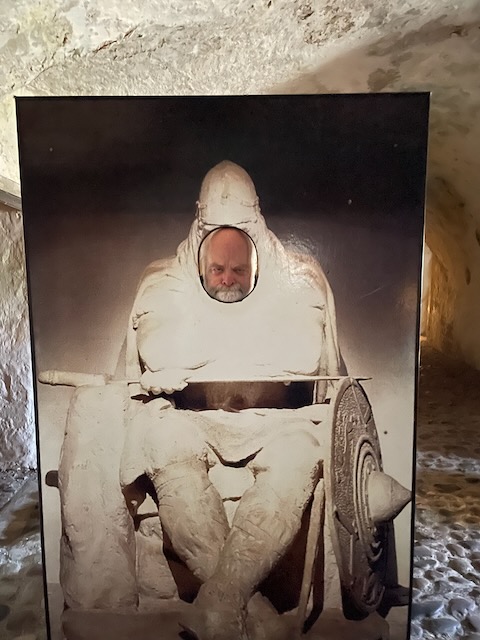
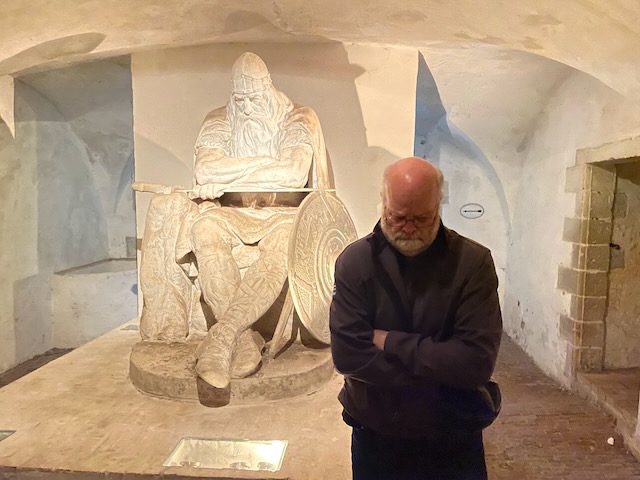
So the story is that this legendary king, Holger the Dane, will awaken and rise up and do some serious smiting should Denmark ever need any smitissery. I was trying to look like him but only succeeded in looking like an old guy sneaking a nap while standing, which is something I’ve perfected of late.
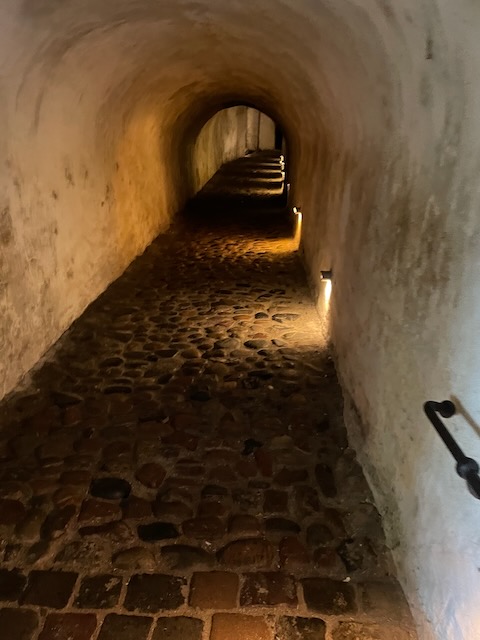
A typical day in the life of a Danish King involved walking down this long hallway to get to the dinner table and then off to bed. It must have made for an exhausting day.
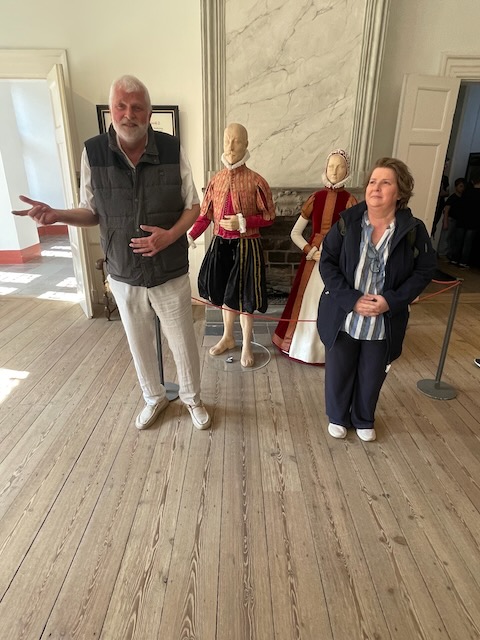
A diorama of four mannequins, with the two in front demonstrating what modern clothing would look like on today’s servants, as well as the significantly increased height due to today’s modern gravity.
Ever thoughtful, the Danes built a table with a mirror so you can take a selfie with the ceiling in the background without having to look up. I could’ve looked up, but would have probably cracked my head open after the fall.
The Danes hate it when you touch dusty windowsills.
This is the great room. You wouldn’t know it with us in the way of the photo, where it really only seems to be a pretty good room, but once we’re out of the picture you can see it’s actually really great.
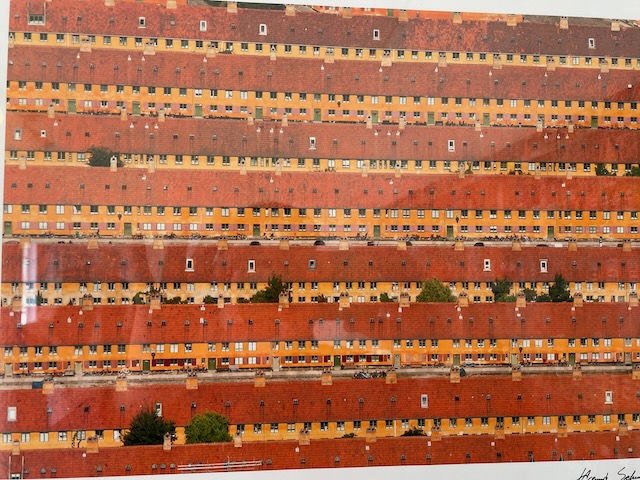
You might be wondering what these are.
OK, I said that about the pictures of houses because I was wearing this hat I’d purchased at a huge open air market and as a result was being a bit of a dickhead, because I was supposed to be.
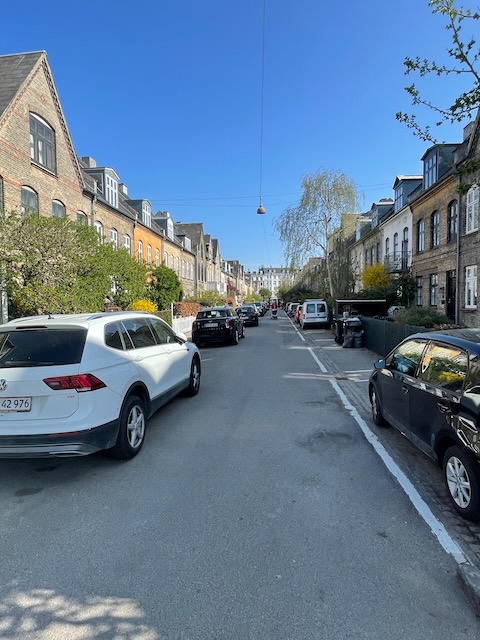
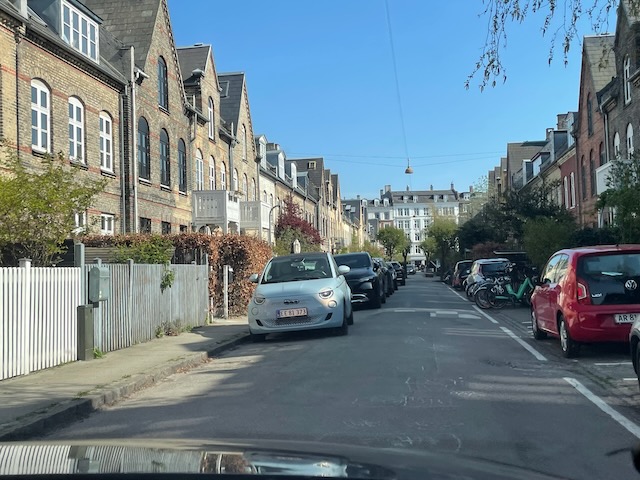
Now that I have that hat off, I can tell you that these are some of the houses in those pictures, which were taken from the air and were not Photoshopped or anything of the kind. The view from the ground is always a bit different than from the sky, especially if you’re falling without a parachute.
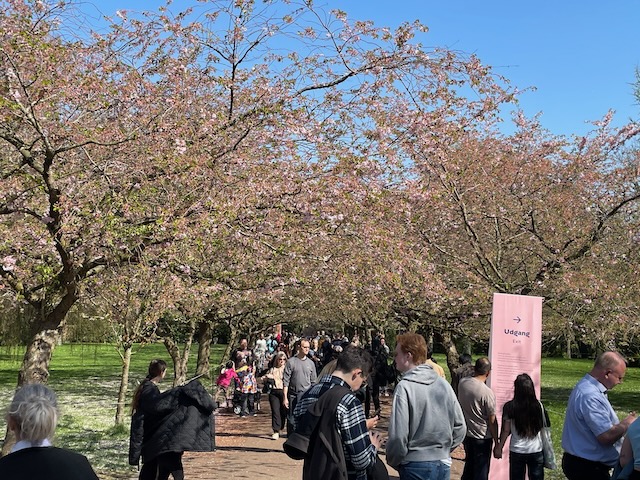
We decided to see the Cherry Blossoms, which bloom for just a short time every year and we were at the tail end of the bloomin’ season. Nearby was Grundtvig’s Church, which is one of the more famous churches in Copenhagen due to its unique design. It also has two organs, whereas most humans have about 78, so we win.
It’s a beautiful walk down the Path of Infinity to get to the blossoms. When we began our journey on foot, the blossoms were in full, glorious bloom. By the time we got there, half the blossoms had given up waiting and fallen to the ground.
While we were mildly disappointed at nature for not catering to our whims, Pia snagged herself a kindly groundskeeper and he drove her back to the car after doing some wheelies, making some jumps off a few ramps, and scaring the hell out of a few old people in wheelchairs, hooting that they were just rookies as he left them in his dust.
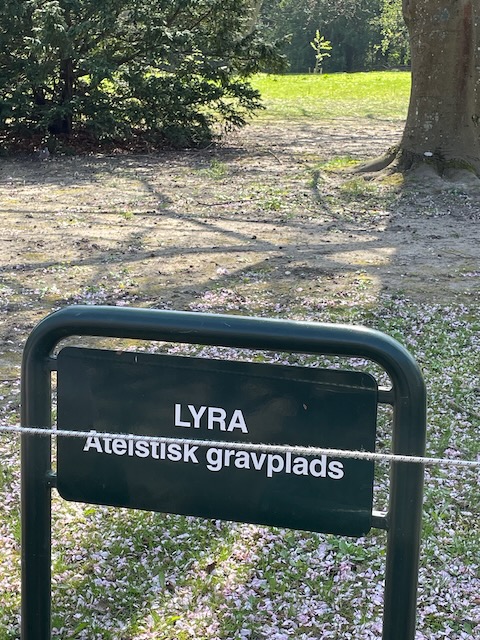
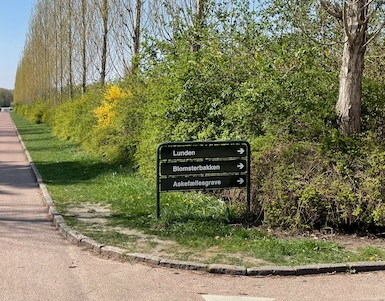
This sign, and you can double check me if you want, indicates that this is an area of the graveyard reserved for atheists. True story. I thought it was funny that I couldn’t see any gravestones, but then again, if there’s one group of people who couldn’t care less about what you do with their bodies after death, it’d be atheists.
Danes are so badass that they have signs directing you to London, which is 1,262 km (784 miles) away and would take you over 200 hours to walk, plus a ferry.
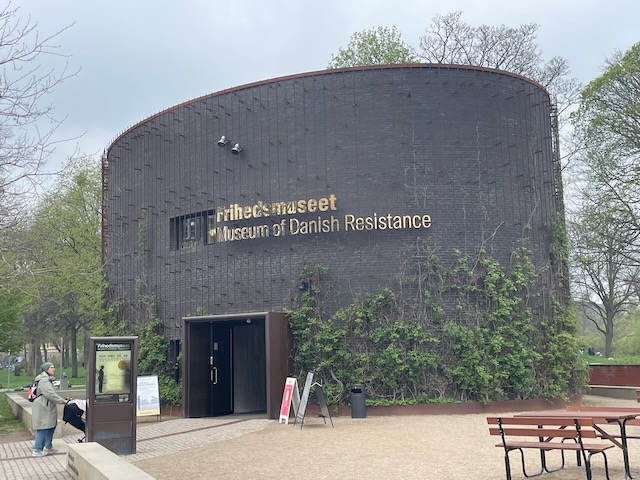
Speaking of badassery, in World War II the Danes, being very pragmatic, surrendered quickly in the face of a dominant German force, and then schemed to have the Germans allow them to govern themselves. Eventually that collapsed, especially in light of the ongoing underground resistance, which this museum documented for us. It’s amazing how many stories have come out of World War II.
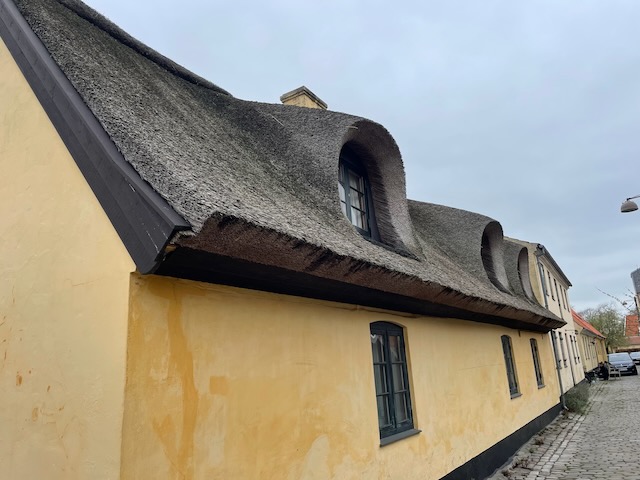
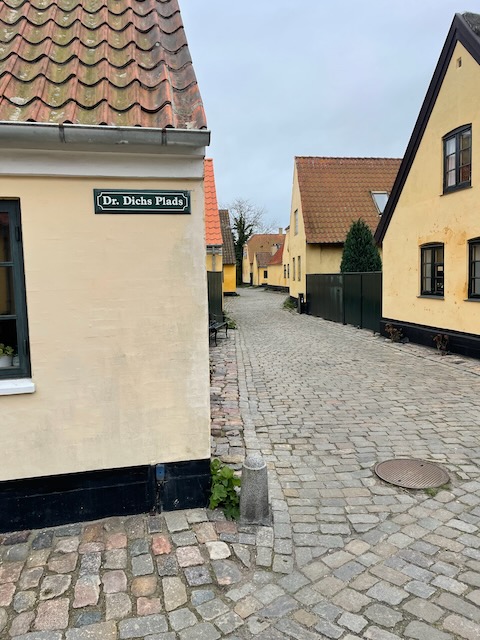
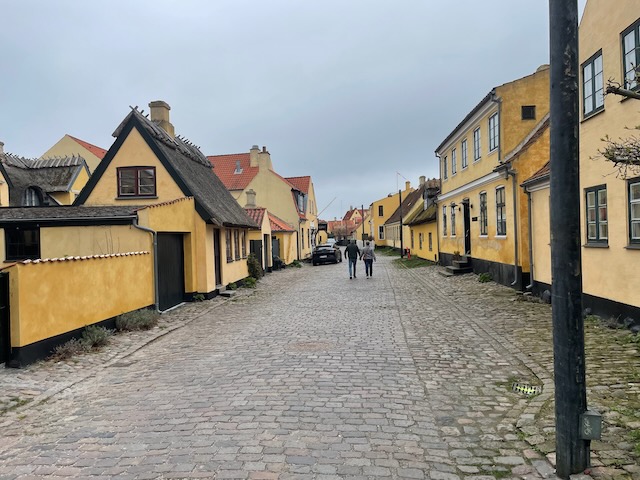
This section of housing in Copenhagen consists of old houses whereby the owners have to adhere to specific aesthetic standards. If you paint it the right color, you’re in. I said, you’re in. Just don’t piss them off, that’s all I’m saying.
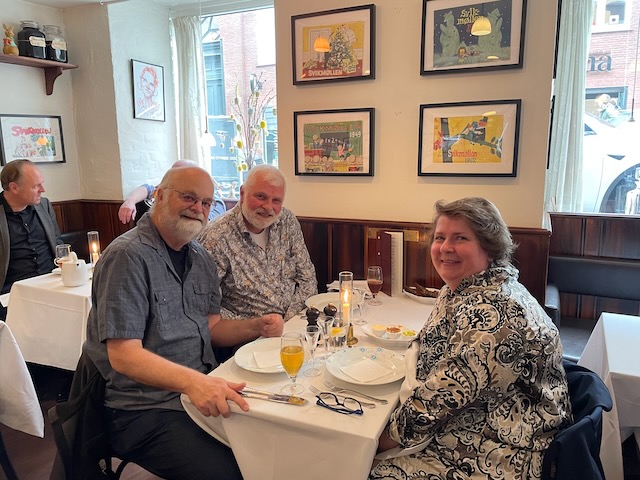
The first time I was there, my Danish friends took me to this wonderful restaurant downtown with a very special Easter menu. It actually was one of the best lunches I’ve ever had. This time, it was maybe a tick less gooder than the first time, but that may have had something to do with higher expectations as well as slightly fewer shots of schnapps. Everything tastes better with schnapps.
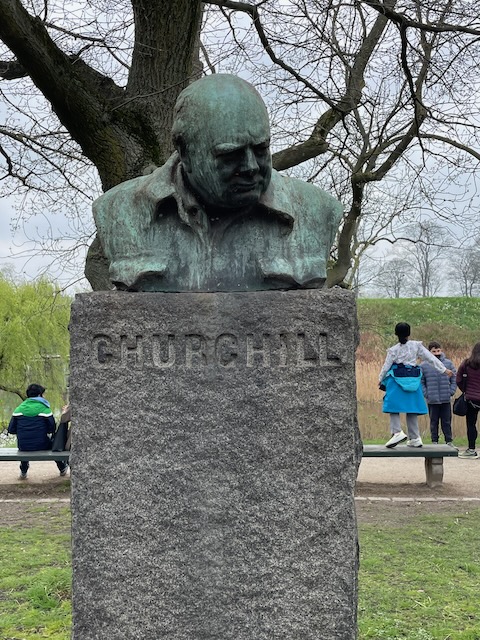
I gotta tell you, you can’t really see it here with these shots, but there were times when I sat in the car at a stop light or some such, watching the combination of all the bikers and walkers and friendly people, and it reminded me of a sort of utopia. I’m really not kidding. In fact, during my visit I discovered that I’d neglected to bring a sufficient quantity of pills to treat my glaucoma (I counted one a day, when I actually take two a day… boy, math is hard). Since it is utopia-like, Per simply got on the phone, was put through to a doctor, who understood the dilemma I was facing and so issued me a temporary social security number and a prescription, all done over the phone and entered into their system online. The next day we walked into the closest pharmacy, the pharmacist called up the record, and within minutes I had a bottle of 100 pills. On top of all that, they were pills she had never even prescribed before, and remember, I’m a complete foreigner. Maybe instead of tearing everything down in the USA, Mr. Trump, you ought to consider building systems like the Danes have… their lives are easier and they are happier and healthier as a result. I know it’s easier to destroy than build, but damn, there are people in the world doing this stuff right; everyone should be taking notes. That’s a Churchill we should be willing to die on.
You finally made it to the funny sign portion of this entry, which signals that it’s about ready to actually be the end. Sorry for the length, I would have made it shorter but I had too many words I had to use up.
Anyway, the first one on the left is from Portugal. The Portuguese are pretty straightforward, and “frango” is the word for “chicken” in Portuguese, and so here they’re offering some tasty chicken ass.
Not to be outdone, the Danes tell you where to go if your farts are really smelly in the middle picture.
I think the photo on the right speaks for itself.
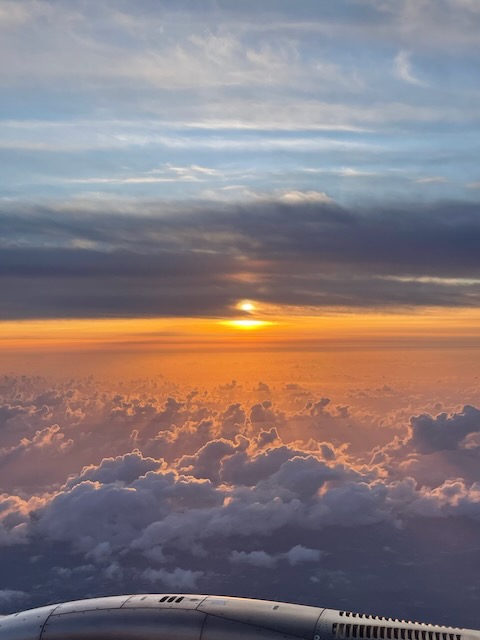
Portugal welcomed me back with open arms and a beautiful sunset. I was glad to be home, but even more glad to be shown so much care and concern from two very nice and empathetic people. I still really haven’t taken a solo trip; for some reason sharing a travel experience with someone makes it so much more meaningful than seeing it all on my own. Maybe someday I’ll score the perfect travel partnering babe. Ha ha!
The last part of our Eastern European tour finished up in München, Germany’s third largest city. Since we were arriving in October, we expected Octoberfest to be in full swing. We looked forward to things like guzzling beer straight from drinking fountains, free steins of foamy brews being offered to us as we staggered around town, and seeing lots of beerded ladies.
Alas, it turns out that Octoberfest really starts in September, and was long over by the time we got there. Way to sneak one past us, Germans! One less set of tourists you didn’t have to worry about huh? Oh well, we really don’t like beer all that much anyway.
We settled into our rented apartment, which was a little bit of an odd one in that we were more or less in an office building and our apartment was the only one on the floor. We were surrounded by businesses of all kinds, as well as a fairly noisy construction project going on somewhere in the building, and they started with the drills about 6:00 AM. On top of all that, there was a party in the parking lot on a Friday night until maybe 4:00 AM, and we could hear them clearly even though we were about ten floors up. And I thought the Portuguese were late night partiers!
The above photo was the view from our apartment; not exactly nature’s scenic beauty. That building houses some sort of bean company; my theory is that the smokestacks were there to carry away all the, well, fartiness. We could only hope we were upwind.
The building we were living in was noisy seemingly all day and all night long. Then I took a closer look at the signs for the various businesses on our floor. It was only then that I understood why we would probably never get a good night’s rest in Munich:
Yeah, I guess it pays to research the floor of your rented apartment. The good news is I finally got some of that jackhammering I needed done.
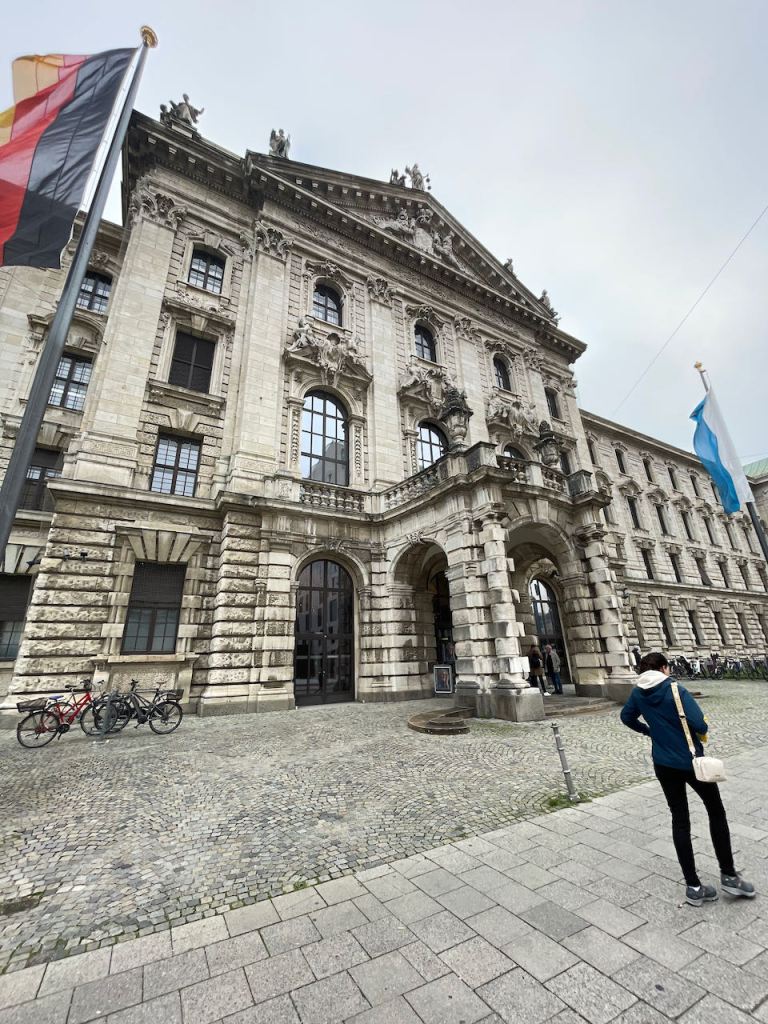
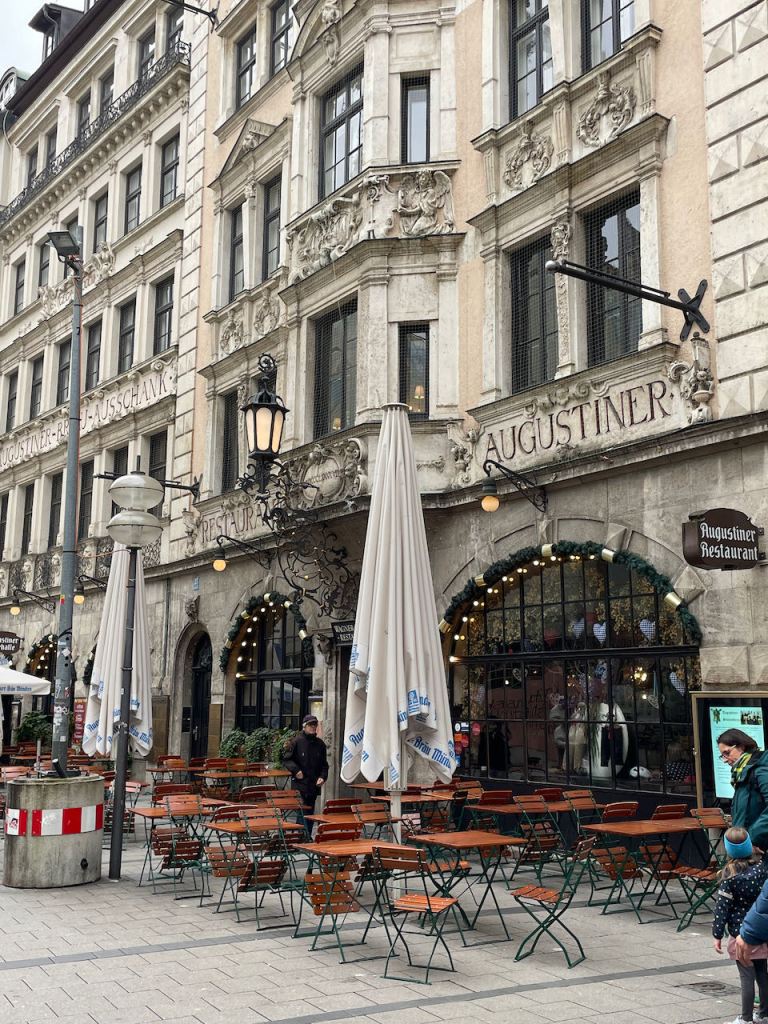
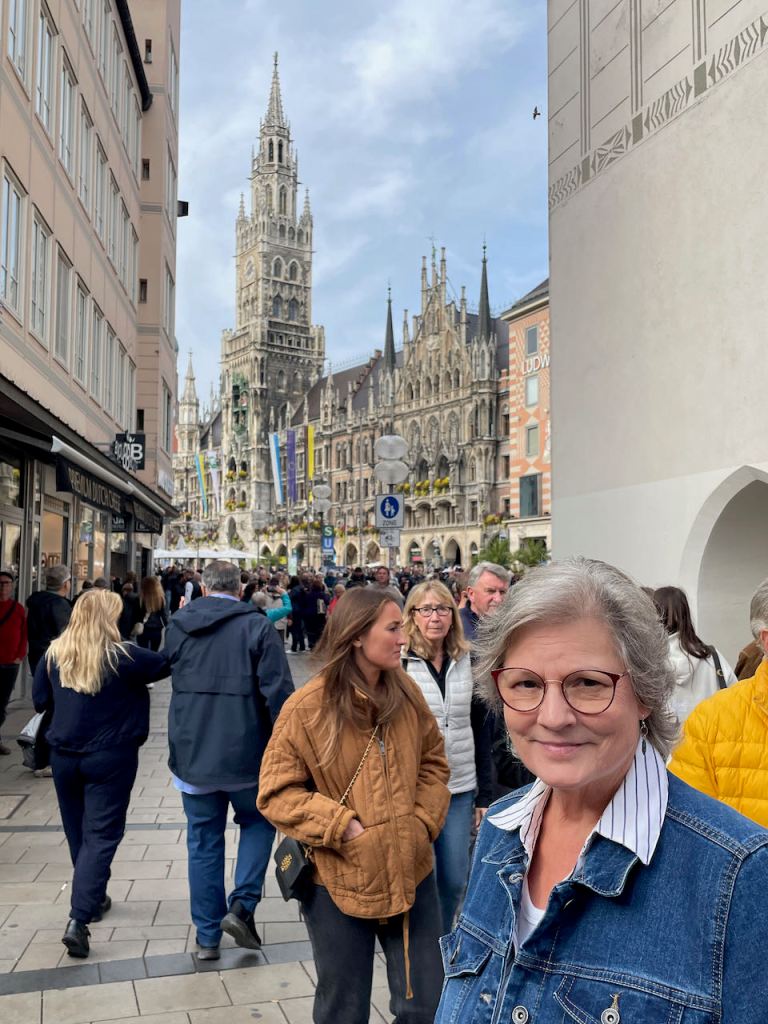
As we drove around Munich, like Innsbruck, we found the city to be nothing worth going gaga over. I’m sure it’s a fine place to live with all the services anyone might need, but the only real tourist draw for us was old town Munich (the Marienplatz). And that didn’t disappoint, so we were glad to have experienced Munich overall, especially with some of the day trips available by using the city as a central hub.
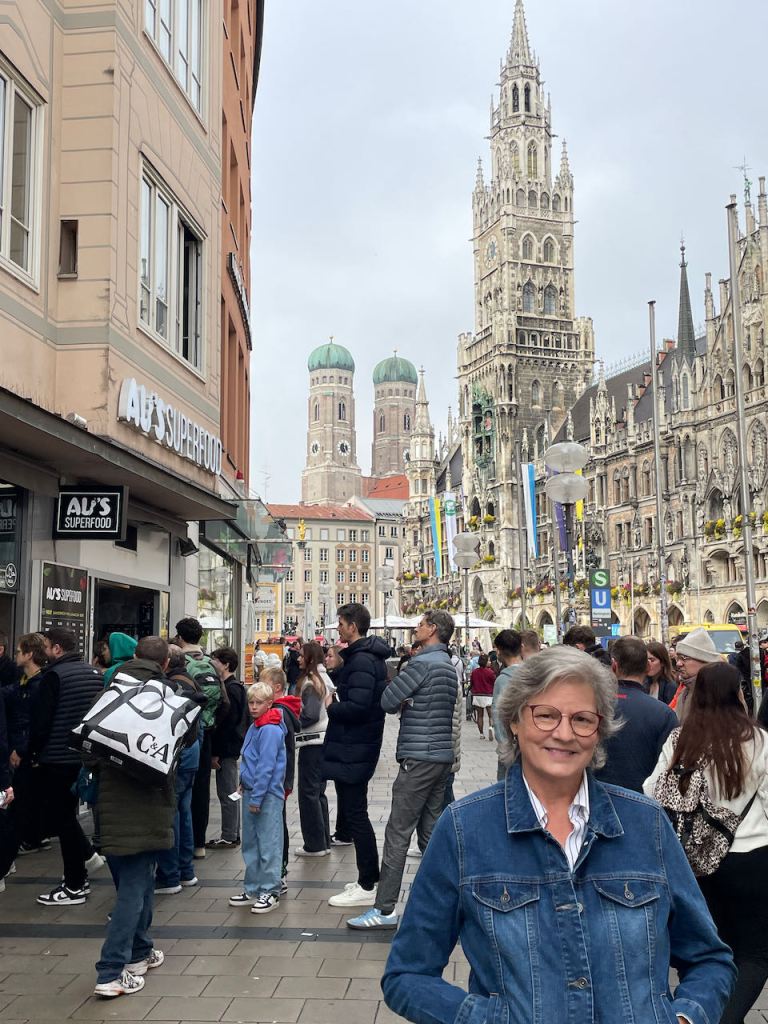
Beautiful old buildings surround the Marienplatz. In WWII, Munich was originally spared much bombing because of its distance from the UK. However, as the allies closed in during 1942, the city became a big target, and then was nearly obliterated by 1944 with 70% of its buildings being destroyed.
Since it ended up in the hands of the Americans after the war and it didn’t have to labor under the yoke of the Soviet Union, the city was completely rebuilt, and used its pre-war street grid (which may not have been the best idea), restoring much of its former glory especially in the Marienplatz. Munich also hosted the 1972 Summer Olympics, which unfortunately became infamous when Palestinian terrorists took members of the Israeli Olympic team hostage and all of the hostages died during a failed rescue attempt.
Marienplatz is dominated by the “new town hall” and this column in the middle photo called Mariensäule, which was erected in 1638, and is still erect to this day mostly as a result of receiving regular doses of Statue Viagra.
Shopping abounds with lots of high-end stores and restaurants in the area. I did get a kick out the somewhat kitschy Nail & Spa shop using American flag decor to promote itself, as if somehow American nails are a thing? I’m not sure it’s still a good idea because America’s reputation in Europe has taken a huge hit what with the political goings-on there. Maybe they should go with an Iceland theme, no one hates Icelanders.
They went so high-end with the shops that they even opened a store just for Christ (featuring large repeating signs because after 2,000 years, of course he’s starting to get a little near-sighted), and who could resist picking out the juiciest earthworms ever from Wormland? I’m surprised that’s not a thriving worldwide chain by now. Mom: “Let’s go to Wormland!” Kids: “Yaaay!”
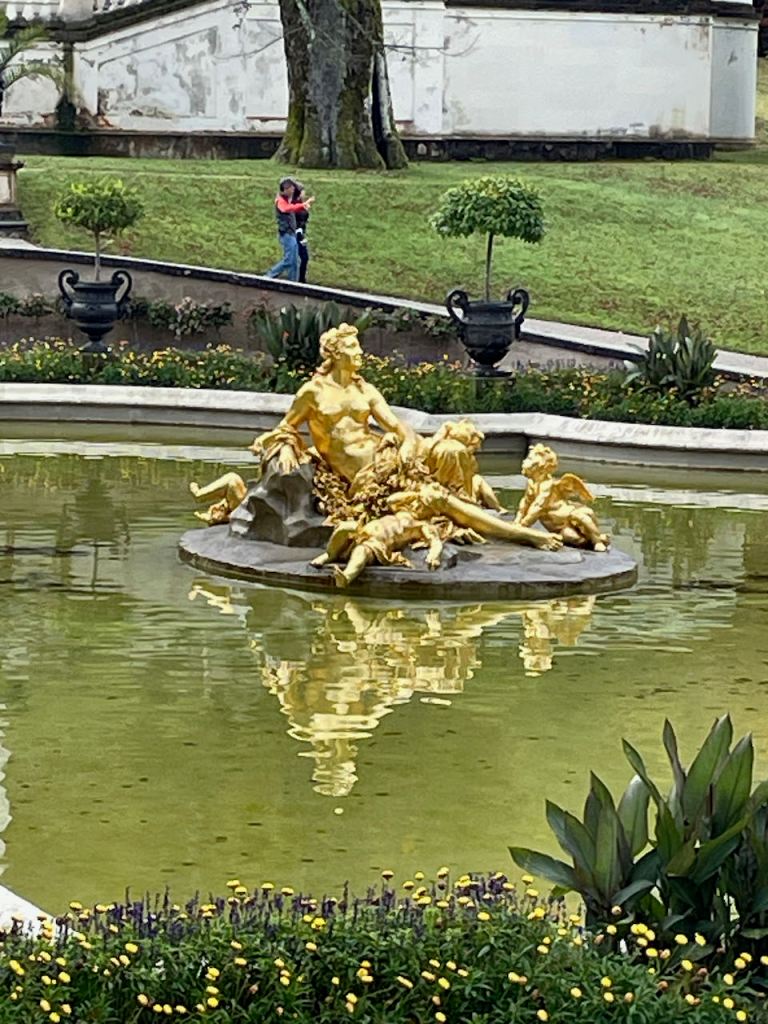
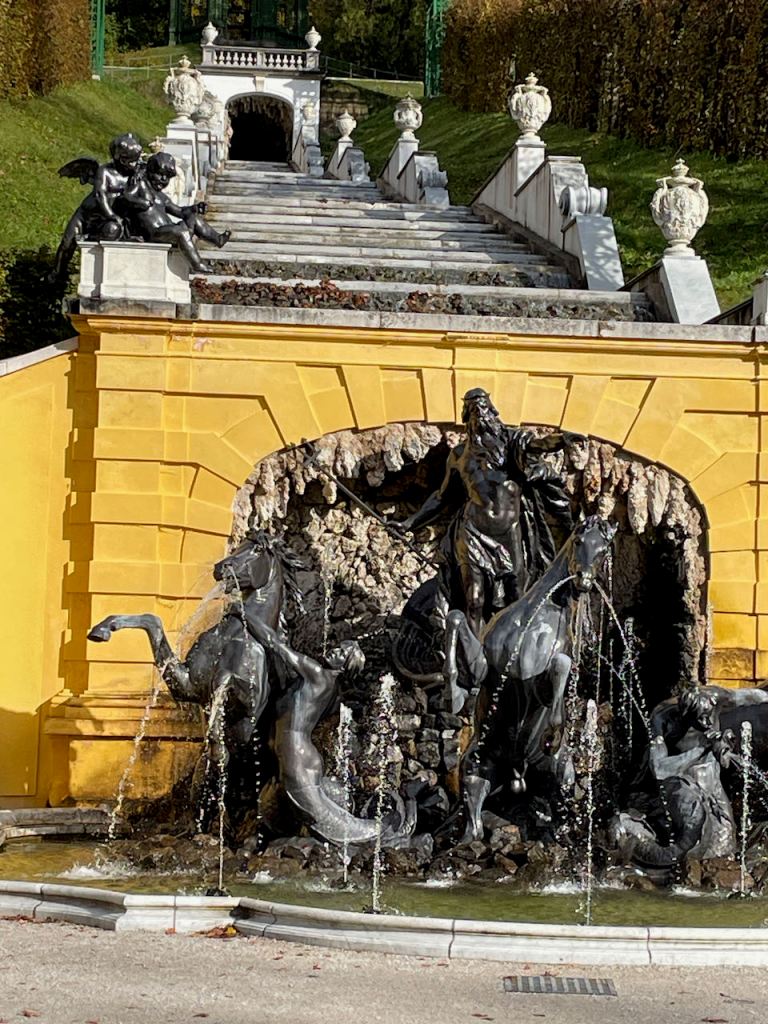
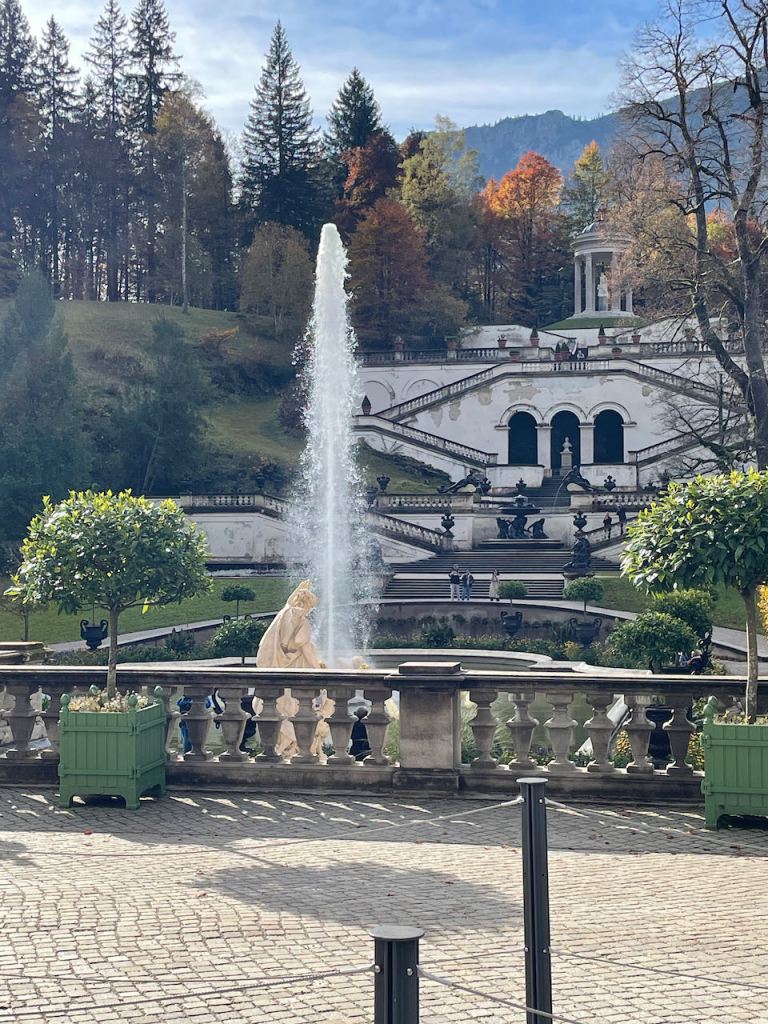
About an hour’s drive outside Munich is Linderhof Palace. Schloss Linderhof is one of three palaces built by King Ludwig II of Bavaria but was the only one actually completed. Unfortunately, they didn’t allow picture-taking inside the palace, which we toured, but our tour guide was not of the highest quality and while it was gaudy and somewhat interesting, if they’re not going to let me take pictures then this is all the attention they get out of this blog. Harrumph. Damn Linderhoffians.
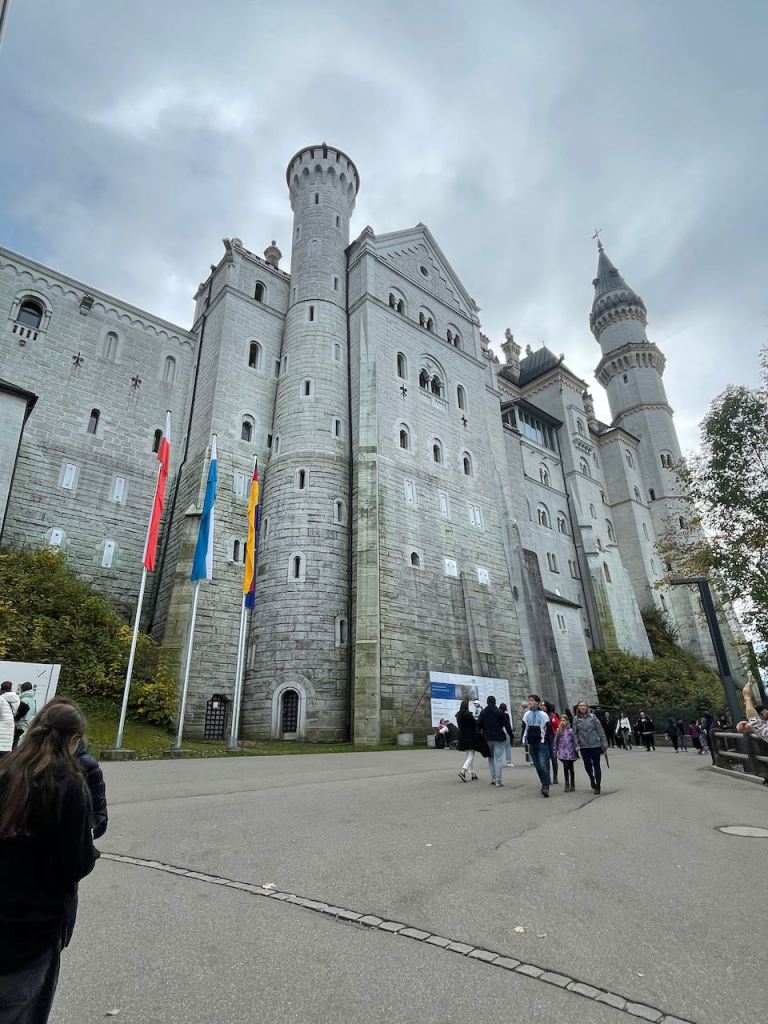
The crown jewel of our daytrips outside Munich had to be this fairy tale castle called Neuschwanstein Castle, which I still can’t pronounce despite hours of trying. Okay, maybe once. Anyway, I’m sure you’ve already seen pictures of this all around the internet, it is, shall we say, slightly picturesque.
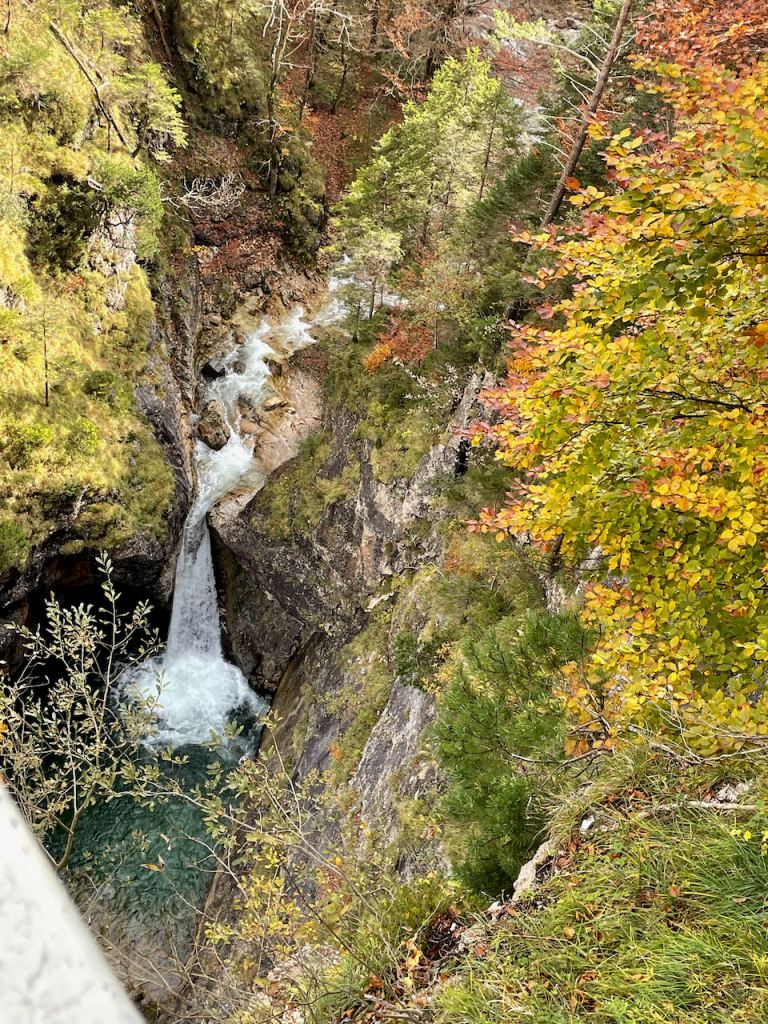
You get that photo by braving the crowds and standing on a bridge you hope like hell was designed to hold 100 people. I was also terrified that someone would jostle my arm as I tried to get a picture, possibly sending my iPhone deep into the chasm below. So I rushed to the railing shoving men, old ladies, and baby carriages out of my way, snapped my photo and then I got out there before anyone figured out why that one guy fell off the bridge. It was all just a little crazy. I guess there’s something to be said for taking your own photo, but it’s kinda funny to watch 100 people jostle and maneuver to get the exact same shot everyone else is, and the internet already has. Of course, I scoff, but I did the exact same thing. Damn tourist.
This is what that bridge looks like from the castle. I’m the third damn tourist on the left.
Neuschwanstein Castle is located above a small tourist-trappy town where there are also a couple of other lesser castles. We didn’t tour these; we were gunning for the big boy.
As it turns out Neuschwanstein Castle is a lot like dating a supermodel. She may look great from the outside, but once you get a peek inside her liver you discover she’s slightly overrated. That comment is certainly influenced by the fact that they don’t let you take any pictures inside, and even if you wanted to they wouldn’t have blown anyone away. It was just a bunch of old furniture with lots of liver spots. I kid, it wasn’t bad, but it was a small letdown from the grandiosity that seemed to offer so much promise. Damn supermodels.
As with so many castles and palaces on hills, the scenery was gorgeous, so the whole experience was well worth doing. It’s just that the best part of it was pretty much taking the same photos that the internet has in probably the tens of thousands. The above are unique though, with angles and lighting like the world has never seen before. I know I should sell them as tokens or whatever that crap is, but dammit, I maintain that I always want this to be a free blog for everyone! And that includes all four of my loyal readers!
Otherwise, that was pretty much all she wrote. The trip was long, tiring, but well worth the price of admission, covering five countries, countless castles, over 2,500 kilometers driven, and hardly any pedestrians doing damage to our front bumper. We had full insurance coverage in any case. Damn jaywalkers.
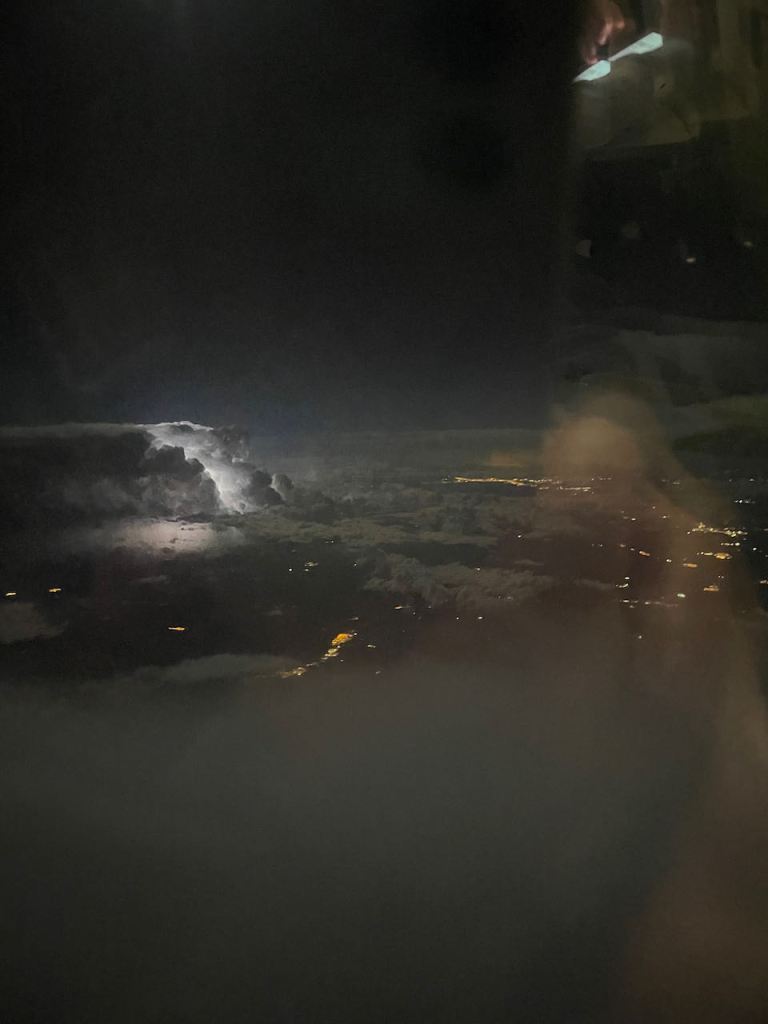
On the flight home we were treated to this amazing lightning display. Was it a portent of things to come?
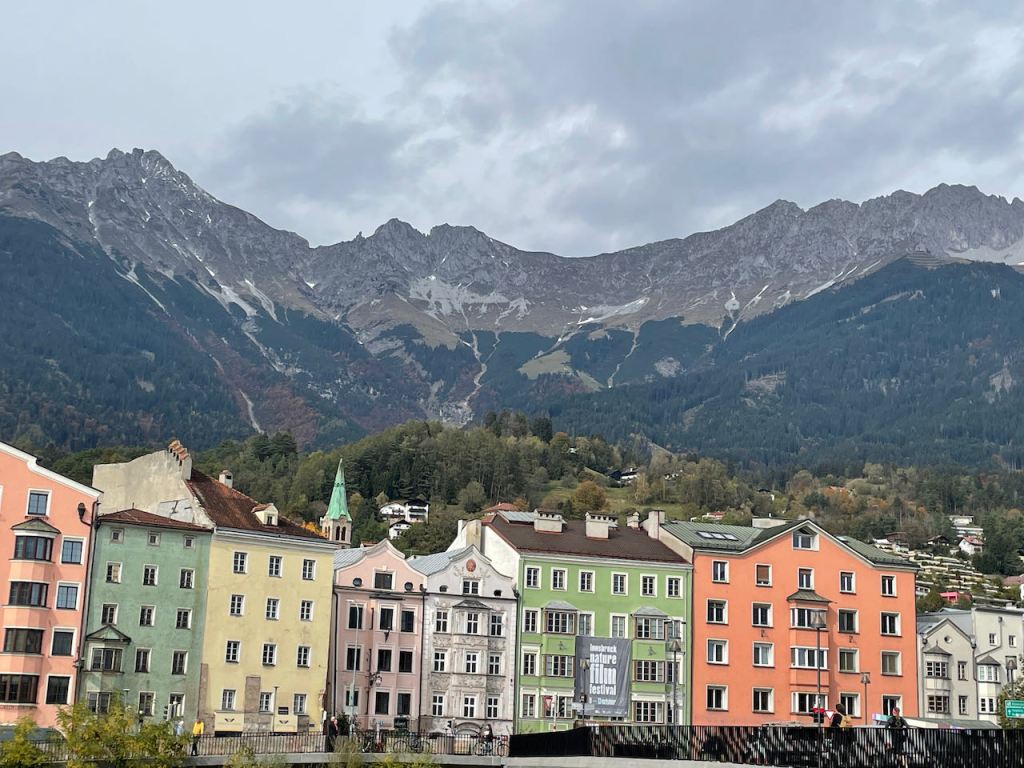
Innsbruck, Austria was a tale of two places for us.
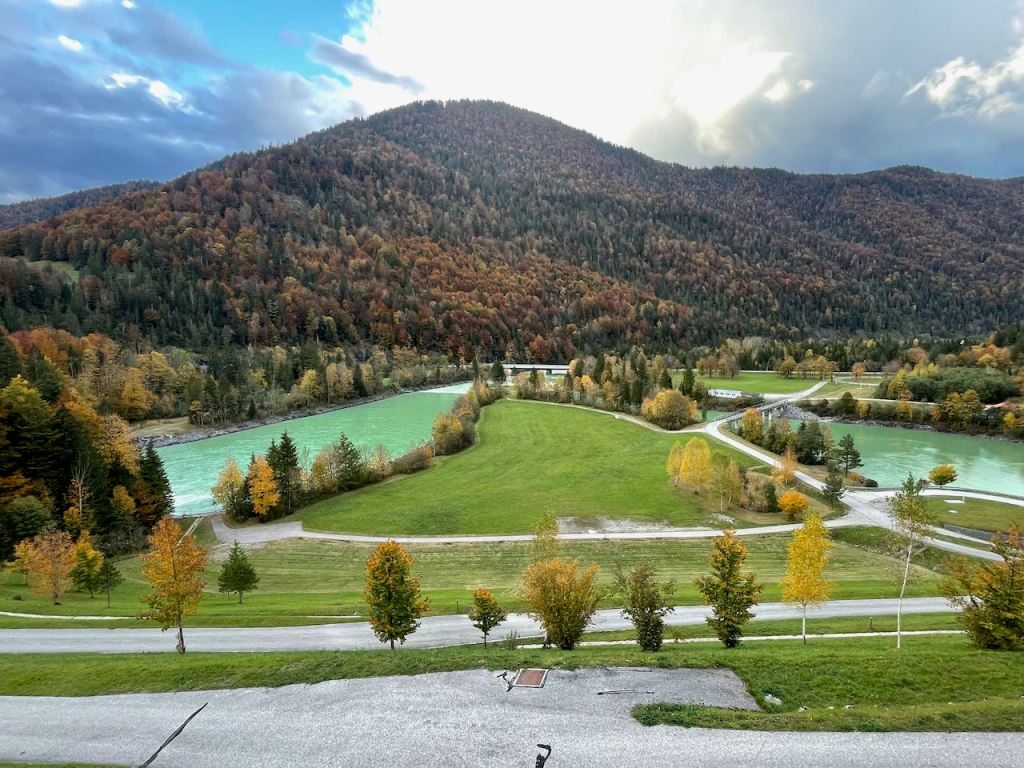
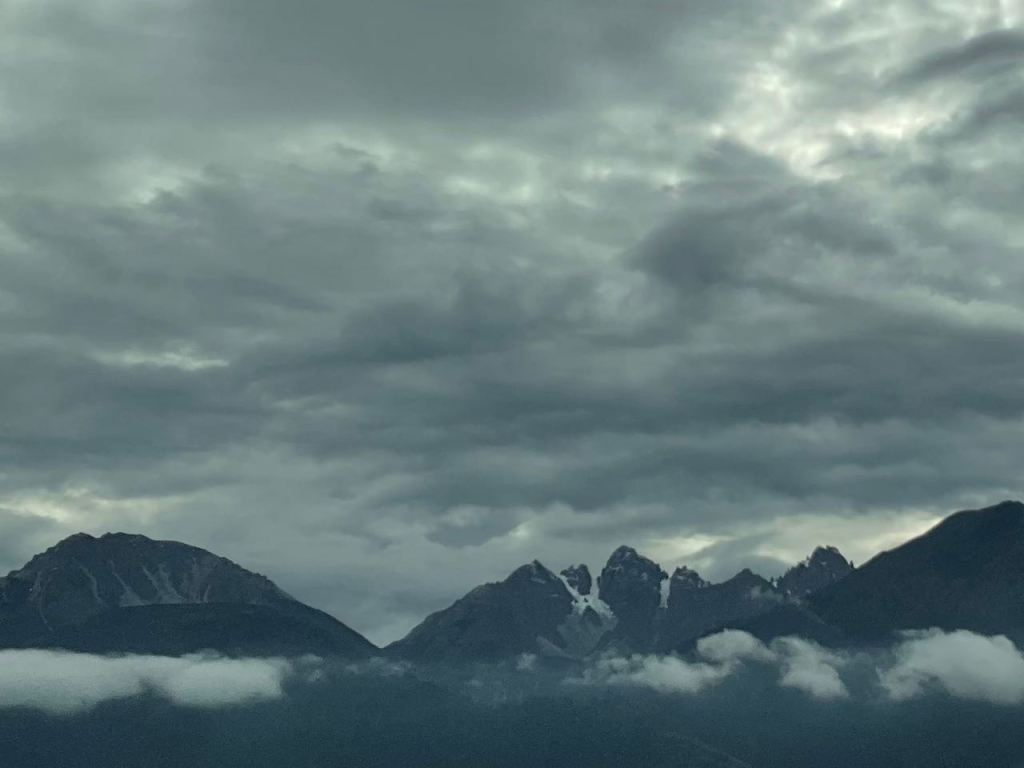
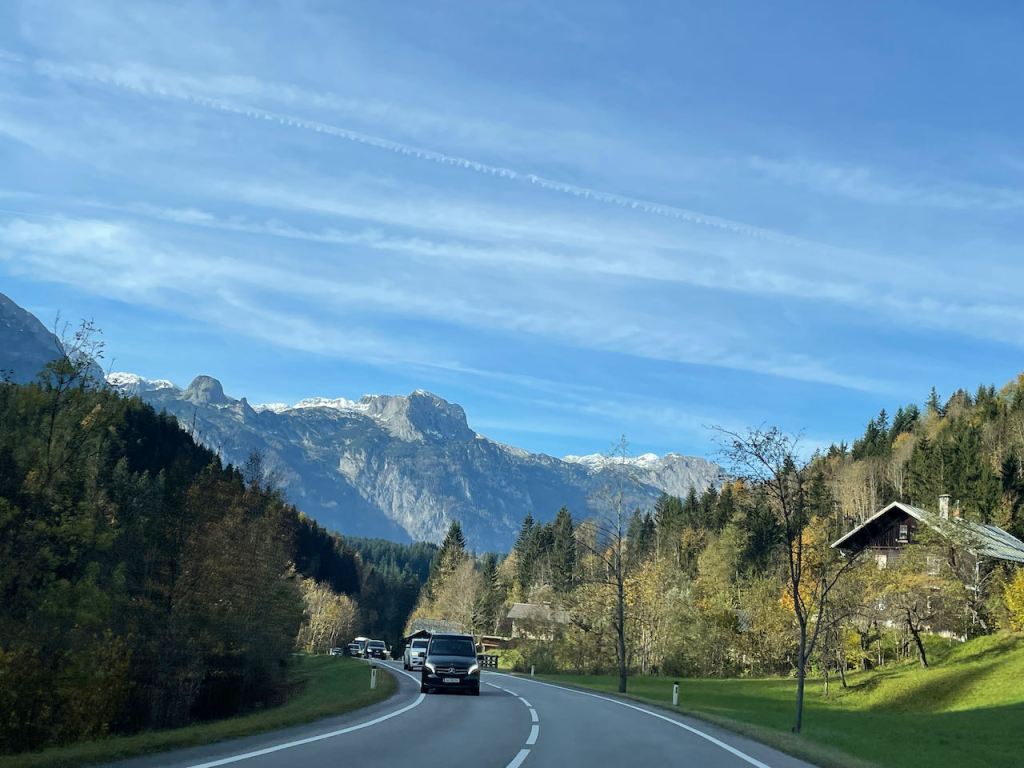
On one hand, we observed some of the most eye-wateringly beautiful mountain scenery we’ve ever seen during the drive in. Carolyn was snapping away from the car as we made our way through the mountains and into Innsbruck. Oohs and aahs could be heard throughout the drive. We never could figure out where the sounds came from, but it added to the experience.
I’ve actually already used a lot of photos from that drive in previous entries because they just ended up being a jumble of scenic photos in folders and I wasn’t always clear where they were taken. Besides, there are lots of photos of natural mountainous beauty on the internet. Of course it’s not nearly as thrilling as seeing them in person. Just like boobs.
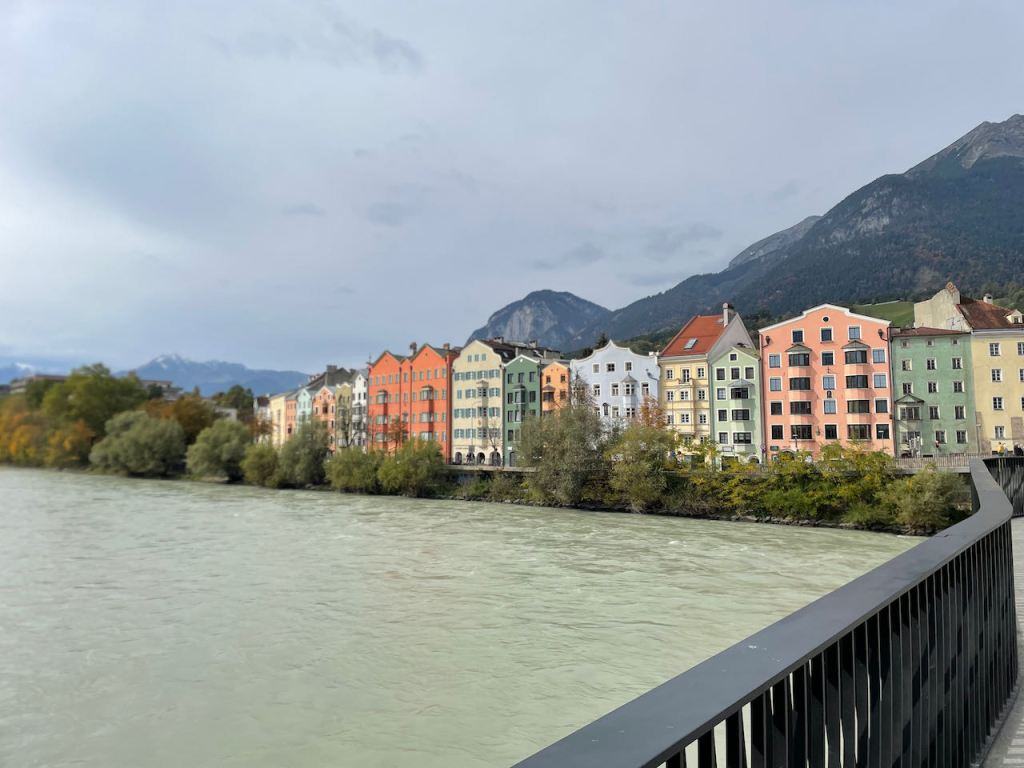
Once we entered Innsbruck, we noticed the main part of the city was, frankly, rather boring-looking. It is heavily touristed, but the sightseers generally come there to look at two things: the Alps and old town Innsbruck.
As you can see, the mountains are kinda hard to ignore as they dominate the skyline of the city. In the winter, they magically change to the color of my beard, except the yellow parts on my beard tend to be from leftover spaghetti or lemon popsicle stains and not from whatever causes yellow snow.
Another claim to fame for Innsbruck is that it is one of only three places which have twice hosted the Winter Olympic games, joining St. Moritz, Switzerland and Lake Placid, New York with that distinction.
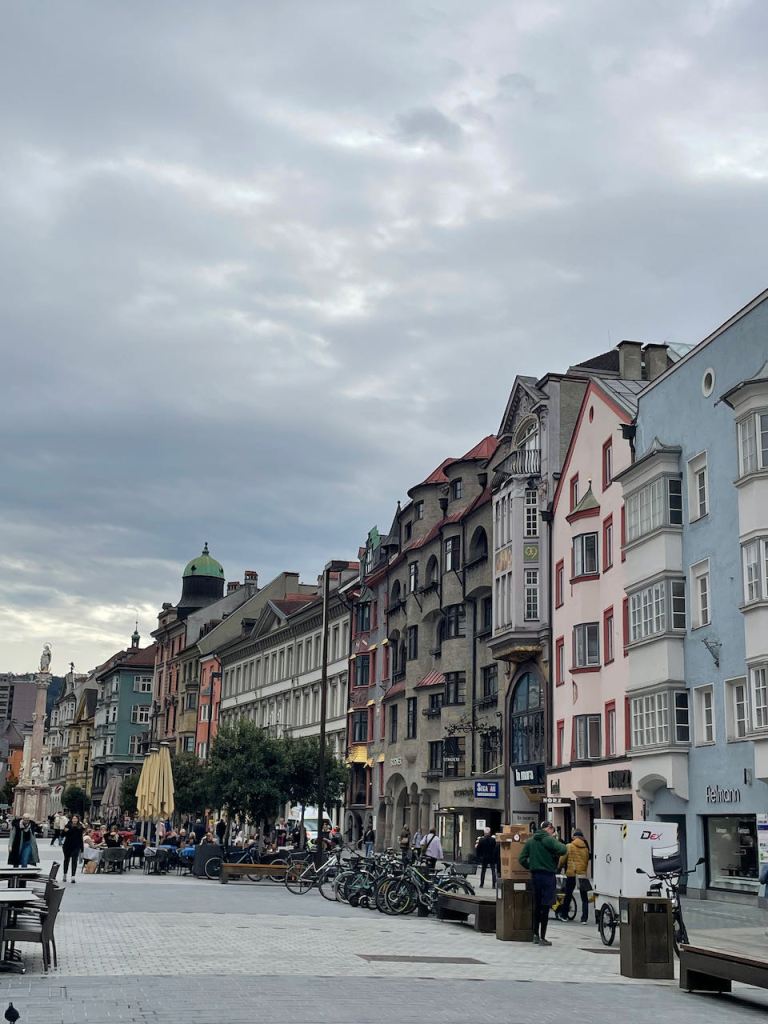
The old town area was picturesque, but we easily covered it in just part of a day. But I do have a little anecdote as a result of our being there. During all of our travels we never really encountered a horrible disaster, like having a car break down in the middle of nowhere in a foreign country, or getting mugged, or finding someone’s toenail clippings in our shower. But just to show how easy it is to end up in a catastrophe, as I was walking around the town I reached into my pocket for a slightly used mint or something, and I accidentally made my rental car keys tumble onto the pavement. They landed about a hand’s width away from a sewer grate. I stood and stared at the keys for a few moments, marveling at how just a few inches (equal to a few cms, or even more mms, or a whole buttload of μms) can spell the difference between disaster and a minor blog anecdote. Just then a kind young woman –probably thinking I couldn’t bend over that far because I was just standing there gawking at some dropped keys– walked by and picked the keys up and handed them to me. “Danke!” I uttered with genuine gratitude at such a kind gesture. Anyway, disaster averted, and additional humbling instilled to remind me that while we haven’t had any big disasters, that’s not all because we’re so good at traveling. A little luck here and there never hurts.
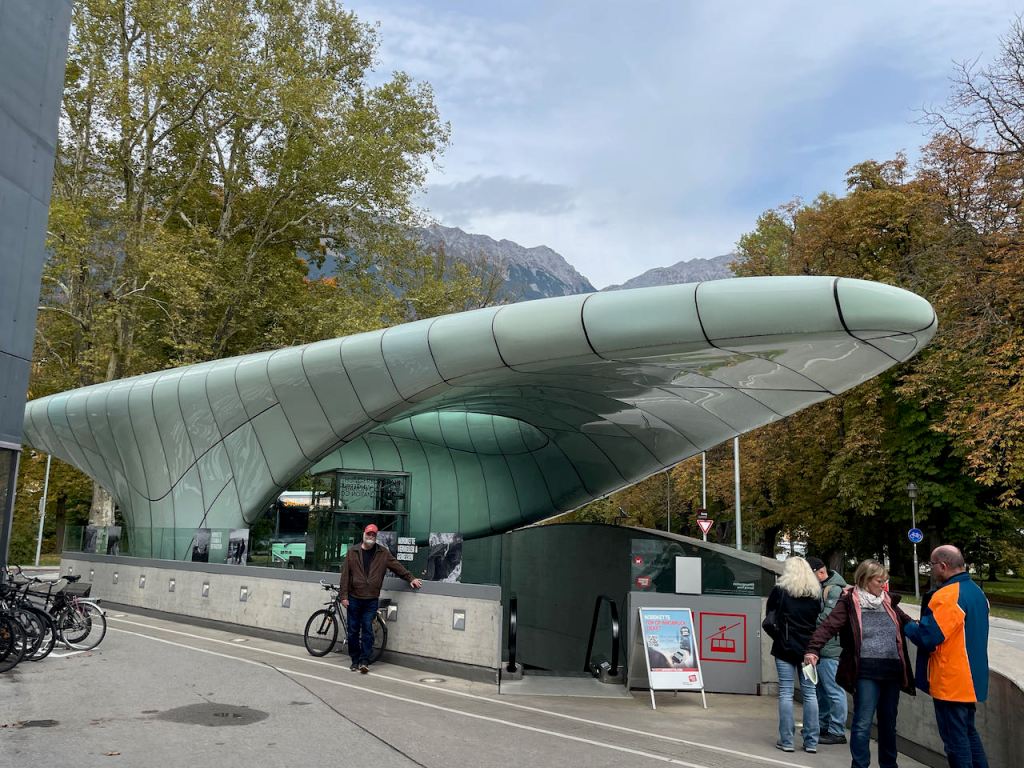
This is the spaceship that shuttles Austrians back and forth to the moon, but ssshhh, it’s highly classified. They hide it’s true purpose by calling it the “Top of Innsbruck,” pretending to be a cable car that takes you to the top of the mountains. But since we had packed our salt mining gear instead of moonwalk attire, we opted not to take the ride. We figured if they really did go to the top of the mountains, it wouldn’t really be worth it because we just drove through said mountains and there wasn’t enough snow to make it truly glorious. Plus it would’ve cost over $100 for the two of us. We’re not cheap, but we travel frugally, and that really didn’t feel particularly frugal to us. Although I did steal that bike and sold it for a tidy profit. Between the bike and our Top of Innsbruck savings, we pretty much paid for the day, including lunch and one ice cream each.
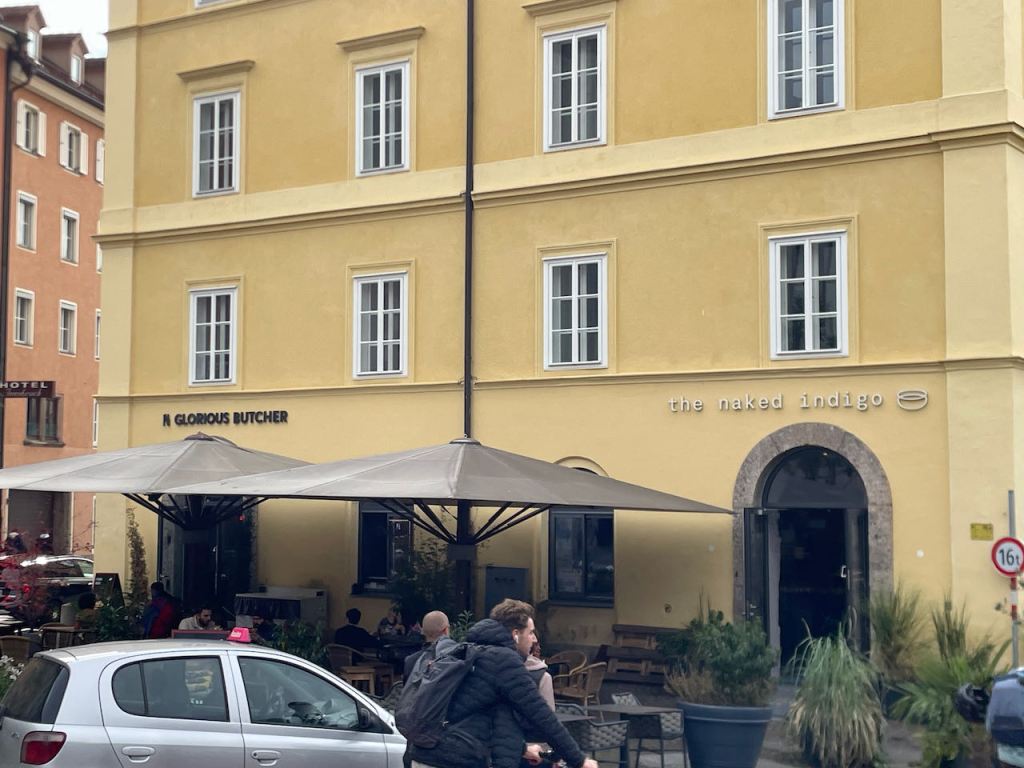
We did want to partake in some genuine Austrian food, but we had a hard time deciding between eating some glorious uncooked meat or sampling some naked indigo. I was unclear as to whether that meant you had to be naked to eat there, or perhaps just stoned enough where you’d marvel at how their nude shade of violet tastes a bit like the au naturel mauve you consumed the last time you were stoned. Of course, it could be a restaurant that caters exclusively to synesthesia sufferers (those who can taste colors). I am a bit allergic to chartreuse and and red gives me zits, so we stayed away just in case.
We opted for a beer instead. Actually, we had some delicious sausage (you’ve gotta eat some sausage and drink some beer in Austria and Germany or you’re never allowed in again) and thoroughly enjoyed our meal in a nearly abandoned restaurant, because no one there eats lunch at the time we did, apparently. Either that or it was the worst restaurant in Innsbruck and we’re too stupid to tell the difference.
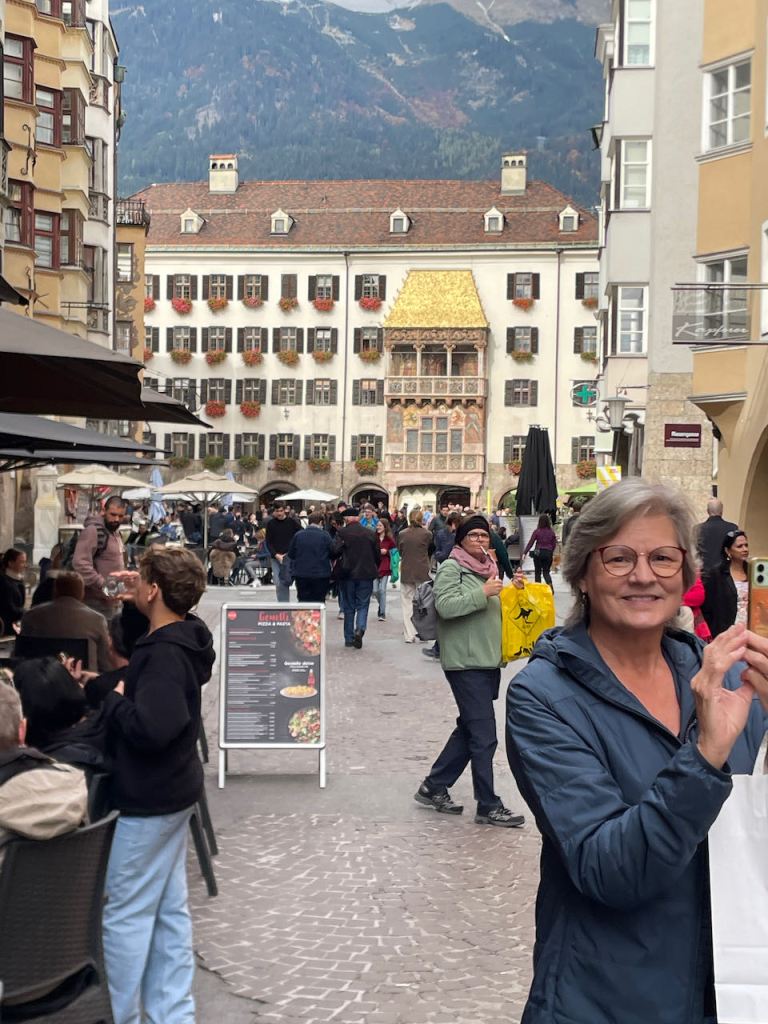
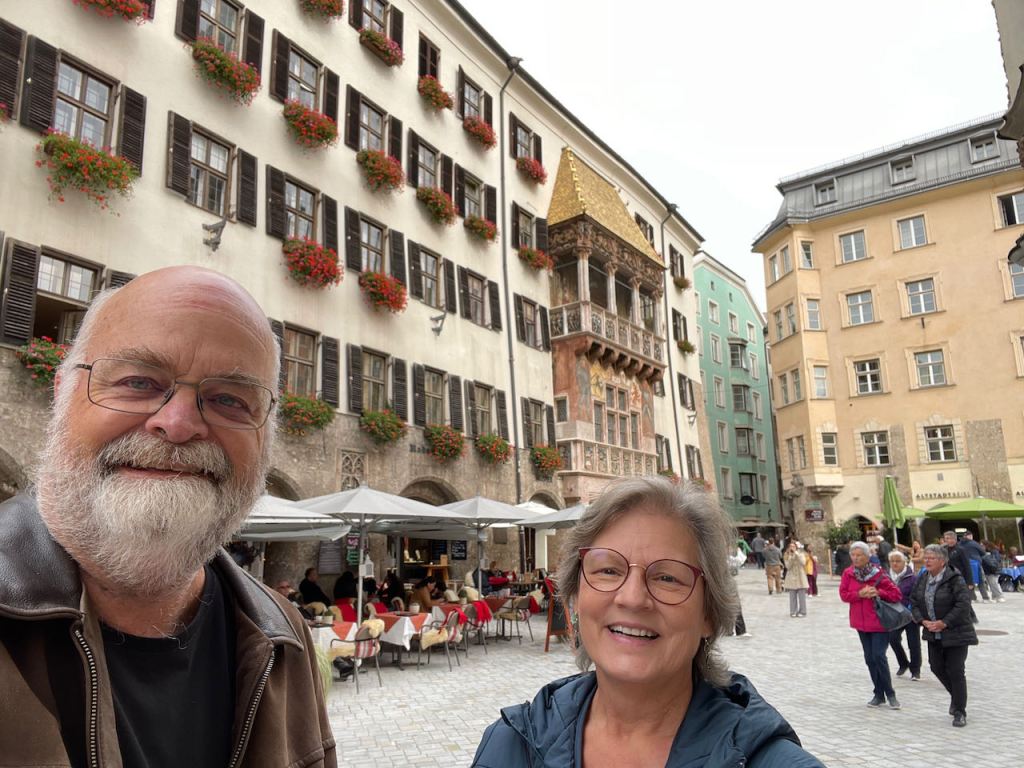
I learn a lot about a place by checking out various travel sites’ “things to see” lists (when a children’s playground is the third most popular, you know you’re in trouble). One must-see destination that kept popping up was this golden balcony roof, made of gold by some Holy Roman Emperor to impress his wife.
Here’s my travelogue summary: It’s gold and it’s a roof.
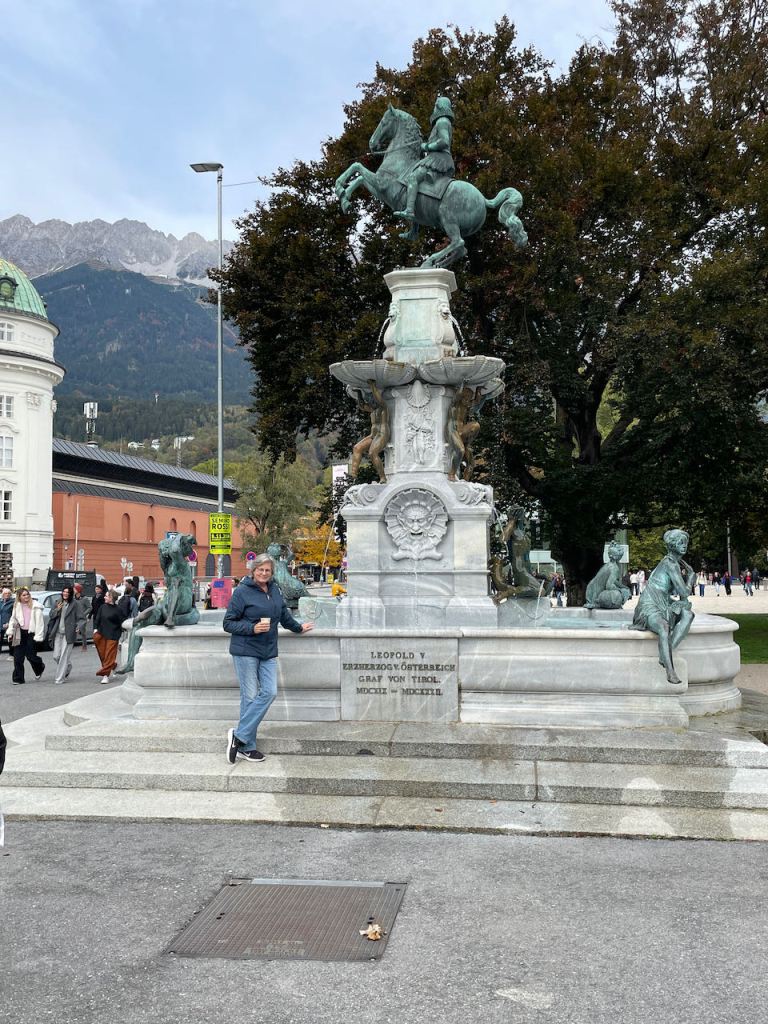
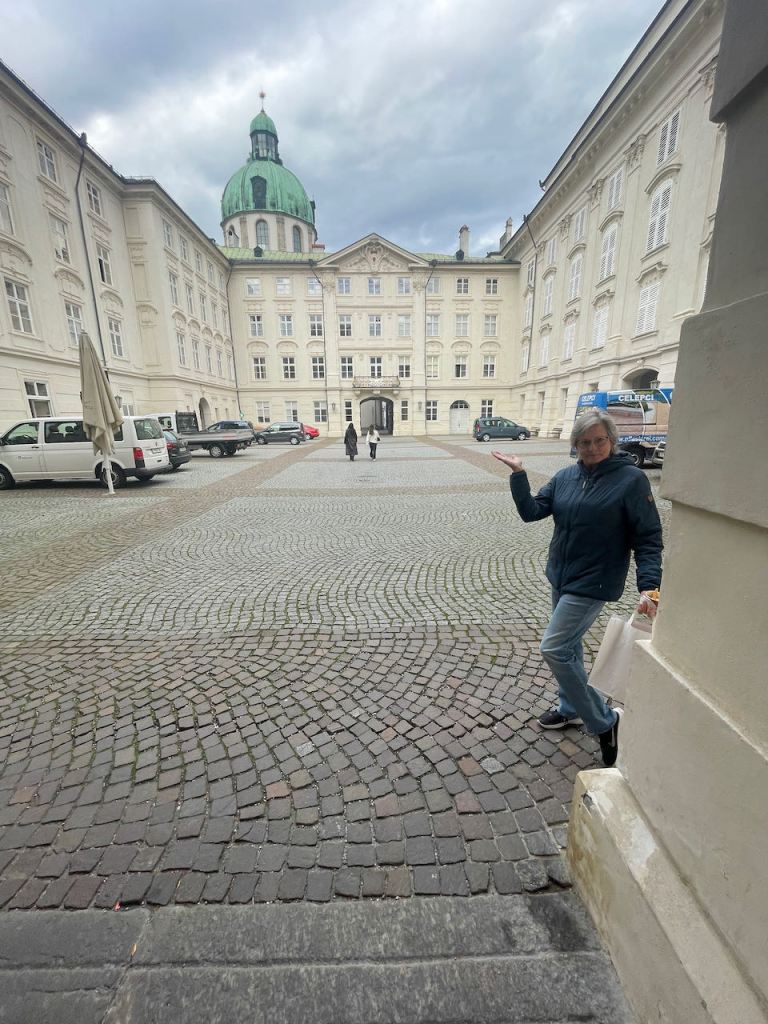
Here’s the rest of Innsbruck old town. We’re glad we came to see it if for nothing else than the beauty of the Alps, and old town was worth a whirl, but it’s probably best as just a good old-fashioned ski town, albeit one that keeps your keys out of the sewer, so it’ll always have a warm place in my heart just for that. Plus I saw a gold roof.
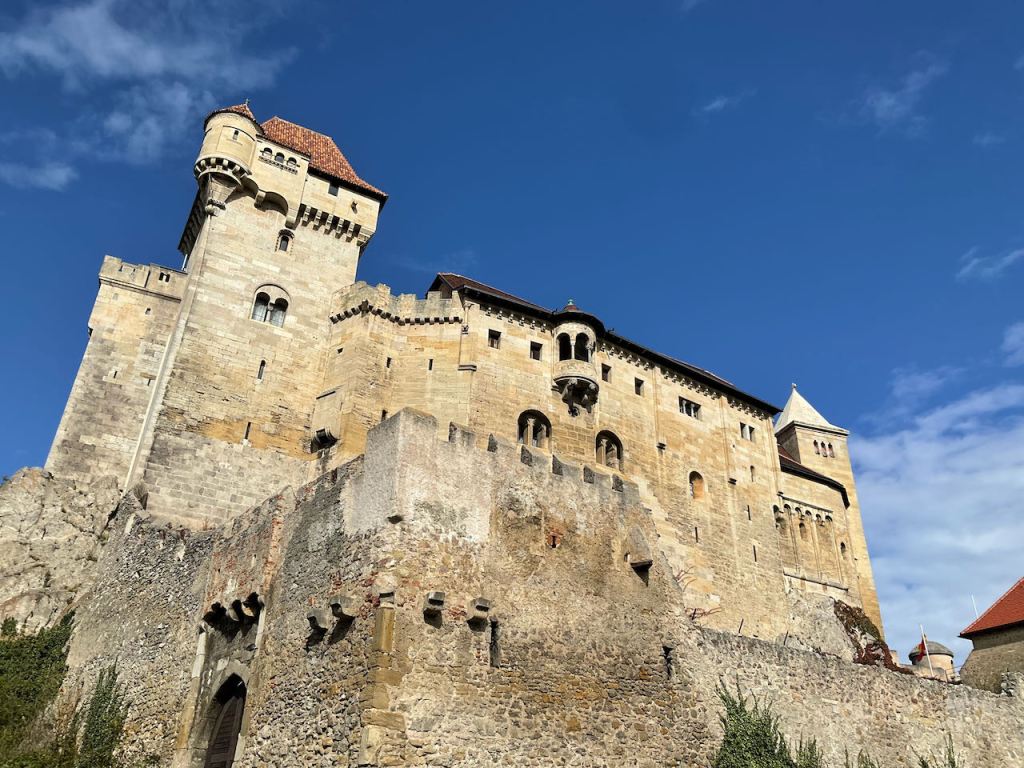
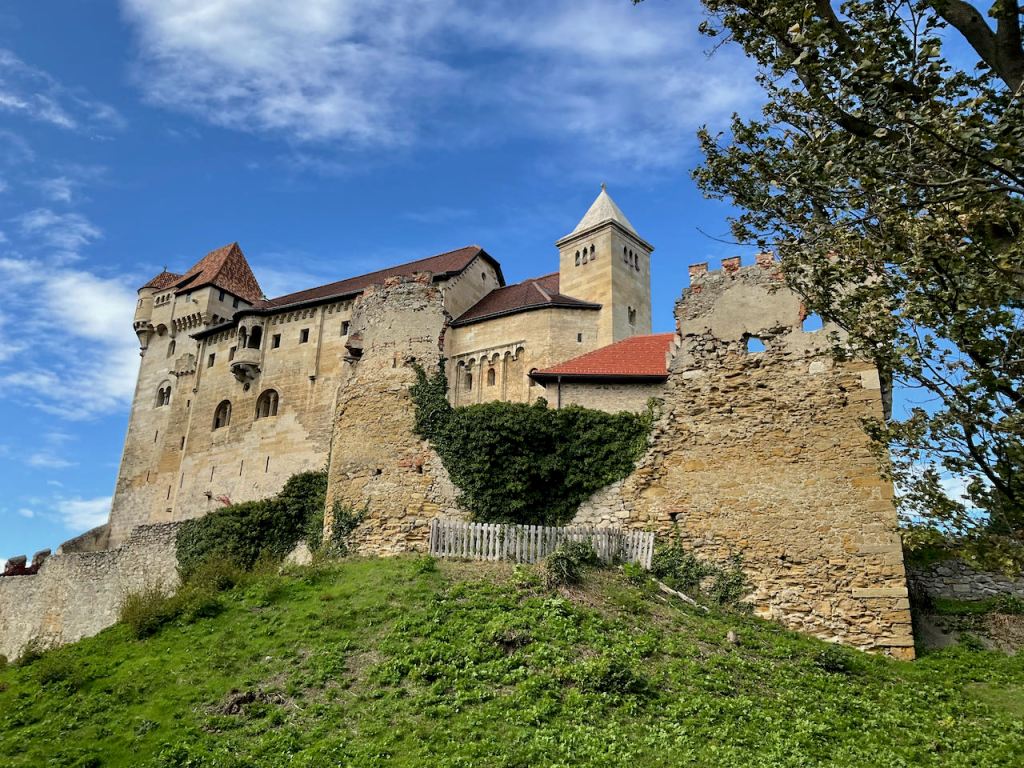
One of our short detours we made as we drove around the countryside was a visit to Liechtenstein Castle, which sounds a bit cooler than what we found. The castle was closed on the day we visited, so we wandered around and snapped some shots and called it good. It wasn’t on a big hill with a vast vista to view anyway, which is normally one of our favorite things about castles. Hugo of Liechtenstein built the castle between 1130 and 1135 (those are years, not times) right next to some modern neighborhoods. Or at least that’s how it ended up.
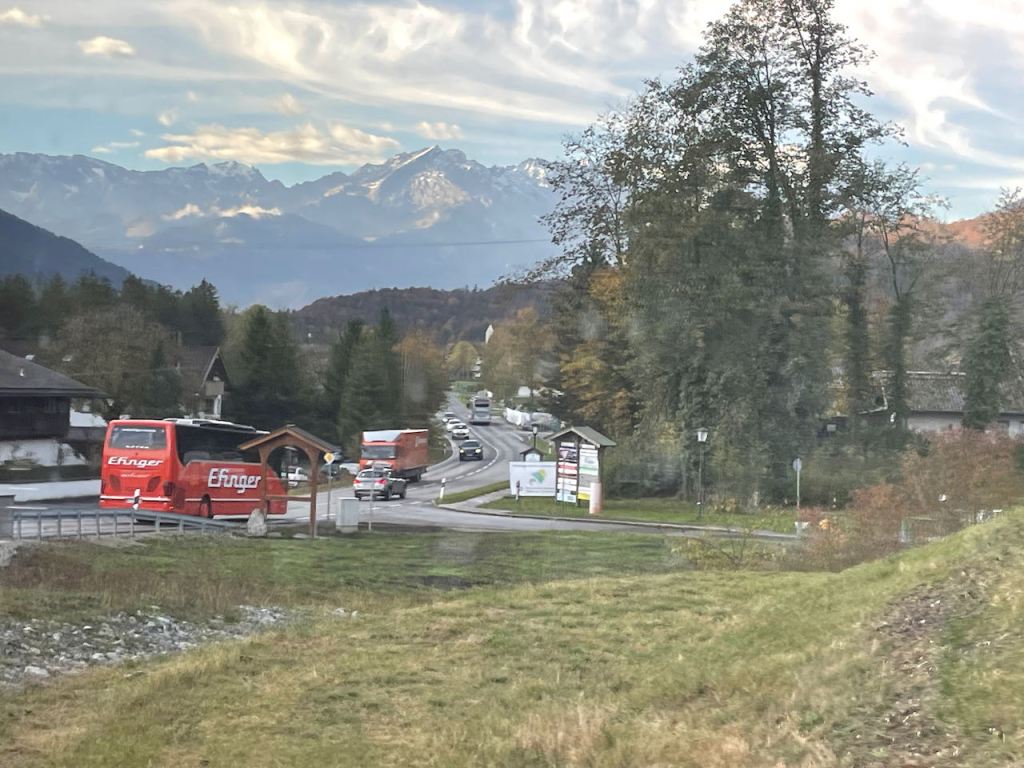
For the last leg of this arduous journey, we made our way to Munich (or Munchin’, as the stoners call it), which offers up an amazing old town area as well as serving as a hub for visiting some of the most striking castles and palaces you could ever hope to see, and will in our next entries. Before I go though, I have to share these signs we saw in Austria as a final farewell to that magnificent country:
Sexual mores in Europe are decidedly less conservative than in the US, but I was surprised that even famous prostitutes (hor stars) could advertise on city streets. I’m not completely sure what “damit stemm ich alles” means but my best guess is that it’s a warning to anyone carrying an STD: “Dammit if your (stemmy thing) itches there!”
The advertising campaign continued down the street by reminding people that anyone other than a genuine hor star is most likely going to be a dog dirt bag. Remember, cheaper isn’t always better.
A candlelight dinner in Austria apparently comes with a well-risen (and rad besides) wiener. Not sure if they provide one themselves or just reminding everyone as to what to expect after a romantic meal.
They must have strong truth-in-advertising laws because this sign readily admits that the casino always wins (wiens).
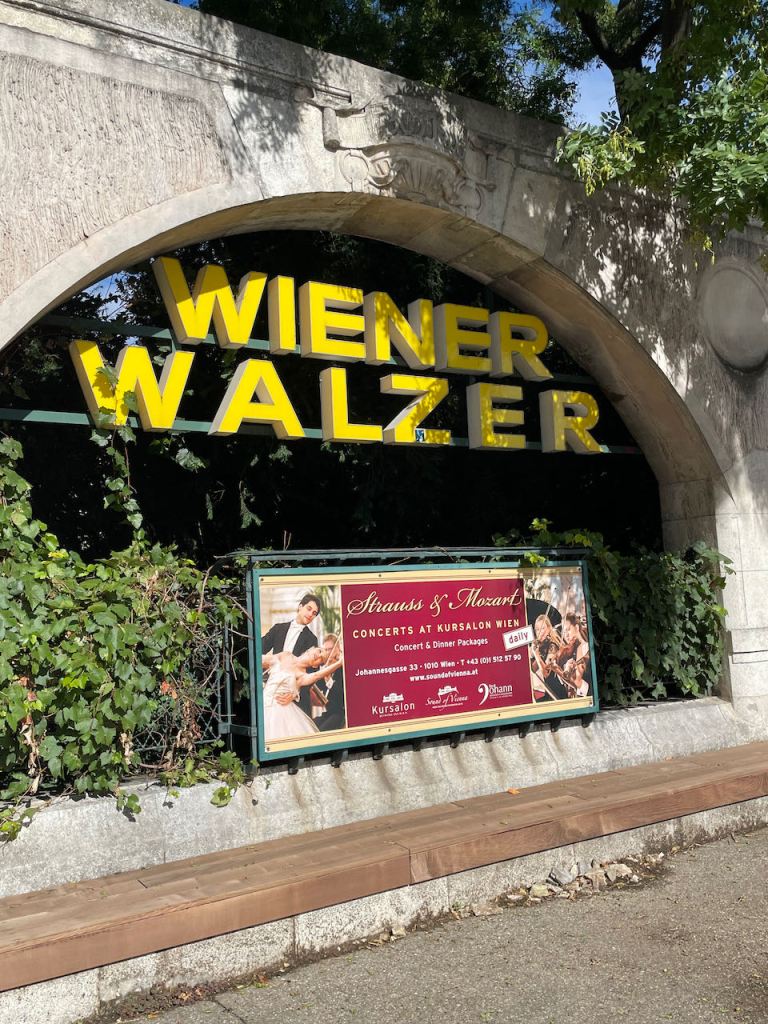
I desperately wanted to see a show with lots of wieners waltzing. I guess it shall have to remain on my bucket list because we took a schlong turn somewhere.
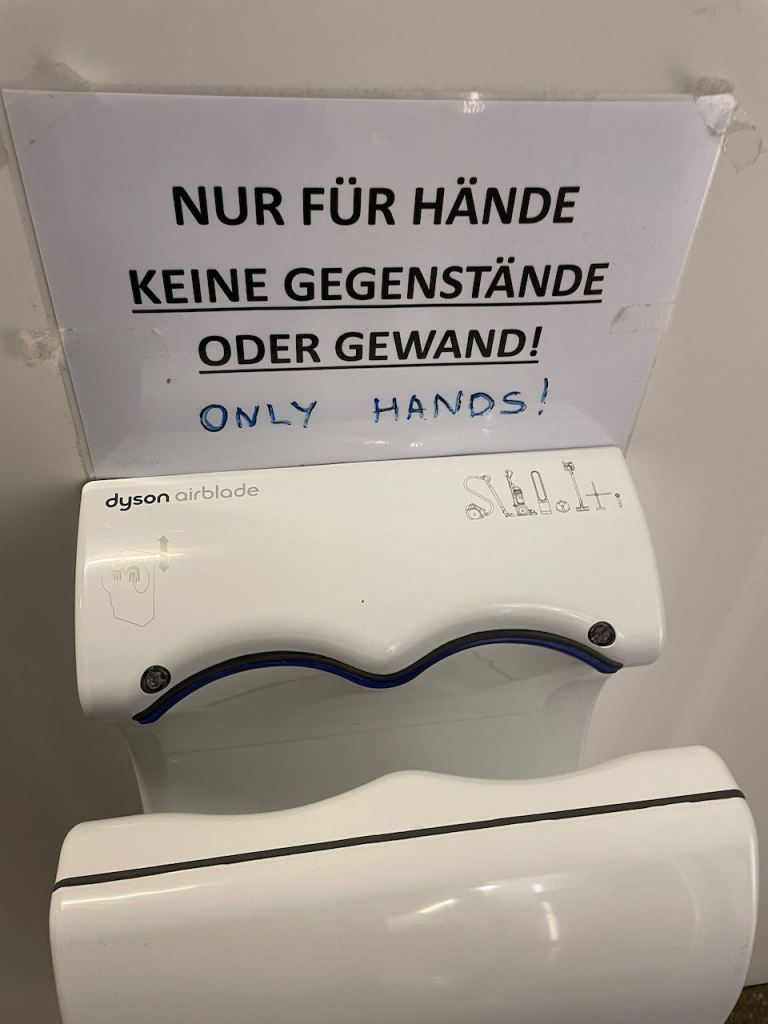
I downed four straight beers to help wash away the mental imagery this conjured up. Why was this restroom sign even needed? You go to a public restroom and blow hot air on what? They even had to handwrite a version in English. I decided to use the outside of my pants to dry my hands instead of inserting them into that mosh pit of potential viruses.
When you put these two photos together, you’re gonna get an explosive result. As most people know, a wolf fart generates amazing power and explosiveness, and becomes a lethal weapon when ignited by a sparked ass. I figured this was probably an old relic from a WWII Wunderwaffe (Super Weapon) program. OK, I know that was more than a stretch, but, y’know, it’s not always easy to come up with yolks; whether good, bad, or scrambled.
Omelet myself out now, so until the next entry, auf wiedersehen!
When we first arrived in Vienna, I wondered what its residents called themselves. Viennese? Viennanamese? Vienna Sausagers? I wracked my brain trying to think of a word I could use to make fun of them in the blog. When I learned that Vienna is known as “Wien” in German, I knew what I’d call them: Wieners! Hilarious right? However, much to my dismay, I discovered that they do in fact call themselves Wieners, which kind of takes the fun out of it all.
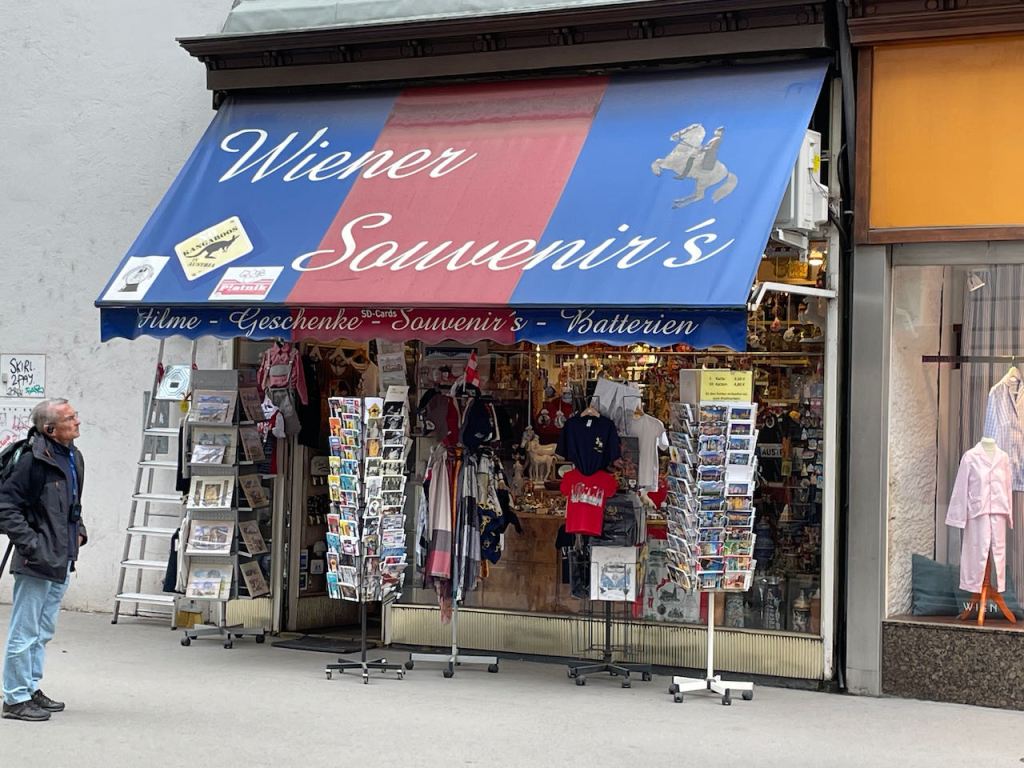
That was also when I realized I could walk into the shop pictured here without hiding my face because it is, in fact, not a sex shop. They are bad at English apostrophes though.
At least I can honestly say that we’ve now both seen thousands of wieners. In addition, Vienna is the only city in the world where every dog is a wiener dog.
According to worldsbestcities.com, Vienna ranks 12th best in Europe, with 9 and 11 being Istanbul and Zurich, making those the only two above Vienna that we haven’t been to (the top five are London, Paris, Berlin, Rome and Madrid), so our visit to Vienna made it 10 out of the top 12 we’ve seen so far. It certainly was one of the most beautiful. Depressingly, we’ve only seen 44 out of the top 100 European cities, which puts an exclamation point on the idea that we’re never going to see them all. Accordingly, we’ve just decided to enjoy what we see and accept that in our lifetimes we will never see everything, which helps when we feel like skipping something and taking a nap instead.
We rented a small apartment that was just a short walk away from the Votive Church, which is located in Sigmund Freud Park, which we avoided walking in much because at our age we didn’t want any Freudian slips.
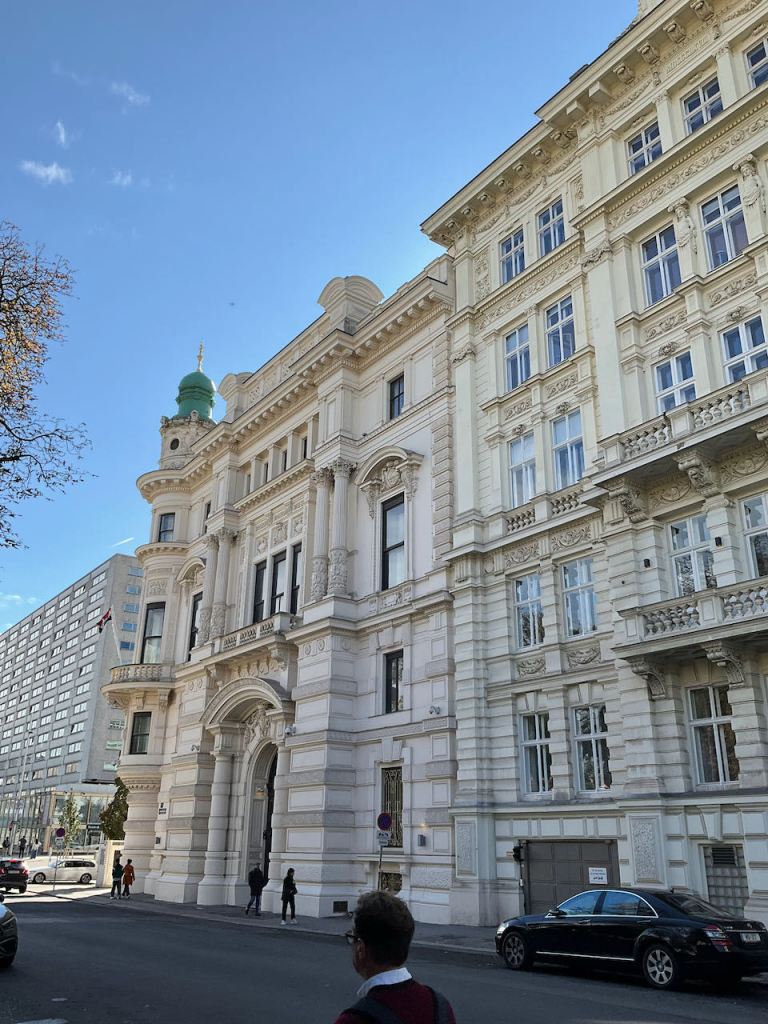
The apartment was also just a short walk away from Vienna’s Ringstraße, which is an area full of grandiose buildings, museums, statues, and strange double s’s.
It seemed that everywhere we turned, there was something magnificent to see, which was slightly amazing in that the Allies bombed the hell out of Vienna during World War II. While some historic buildings survived, many more were reconstructed after the war. We could only see any evidence of this by looking at rows of apartments, where some of them feature relatively new construction next to obviously older ones. Fortunately, they’ve cleared out all the dead bodies by now.
Even outside the Ringstraße, it seemed that everywhere we turned there was something magnificent to look at.
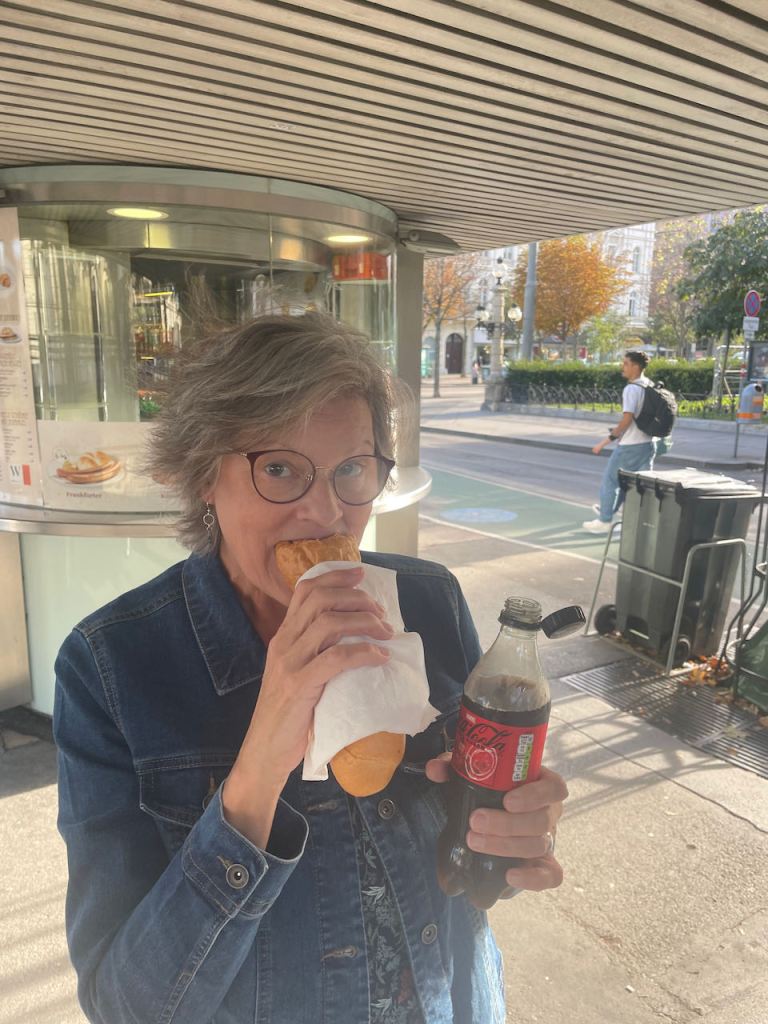
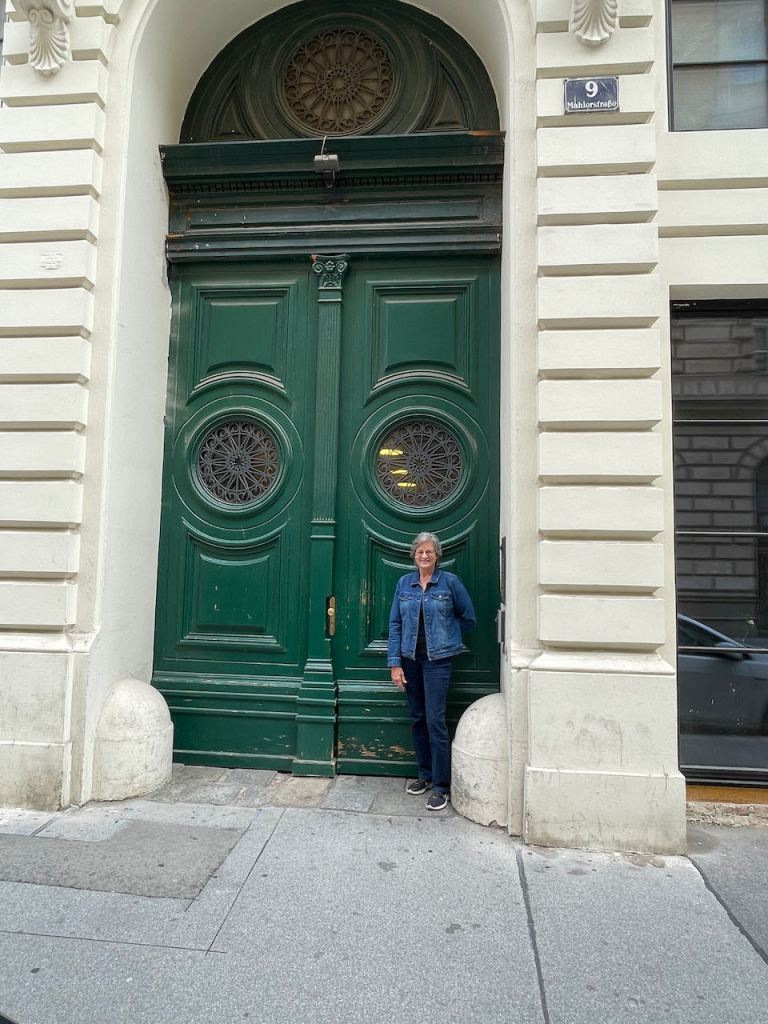
There was so much to see we barely had enough time to shove a sausage down our mouth plus take some Door of the Day pictures. But I think it’s important to partake in local cuisine, so although Vienna sausages are generally those little weiners in a can, we settled for some massive ones between the buns and called it good.
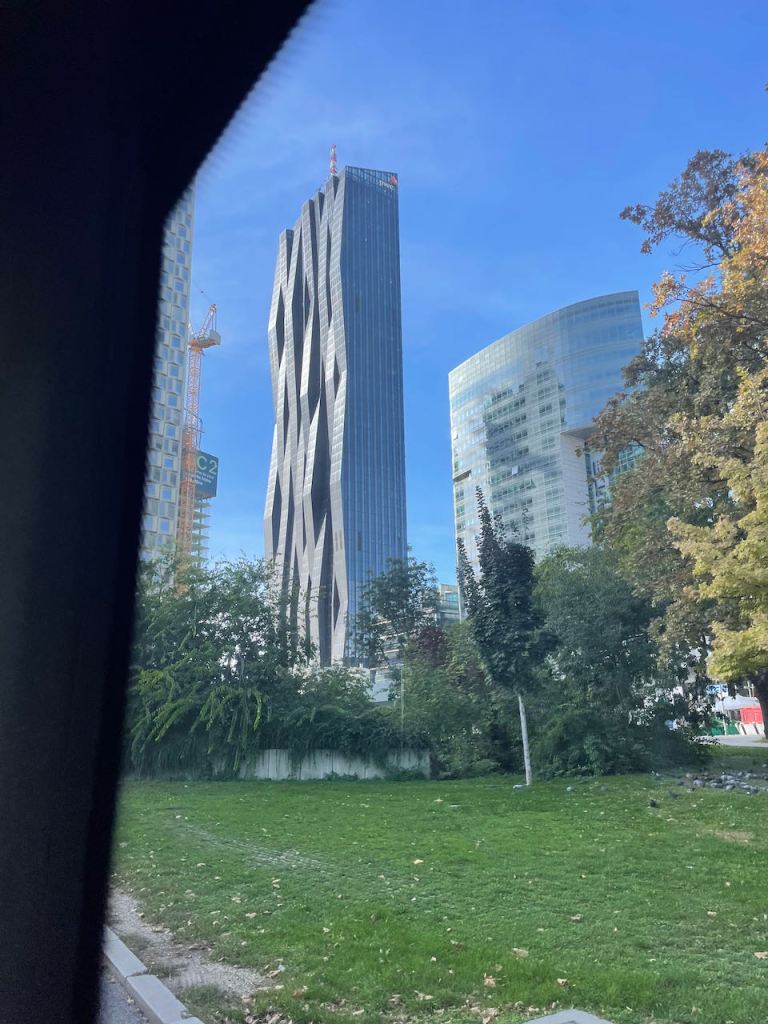
Not every building in Vienna is an old marble masterpiece of architecture. Here is a juxtaposition of new vs. old; one of their very modern buildings as well as a Roman excavation site in the heart of the city.
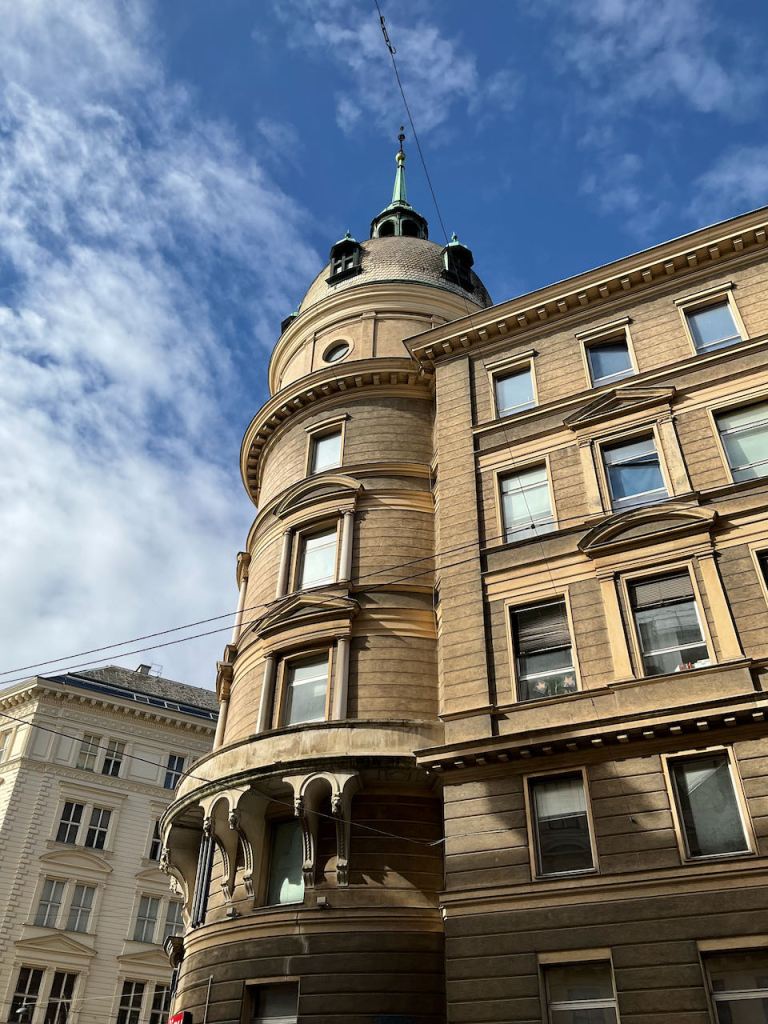
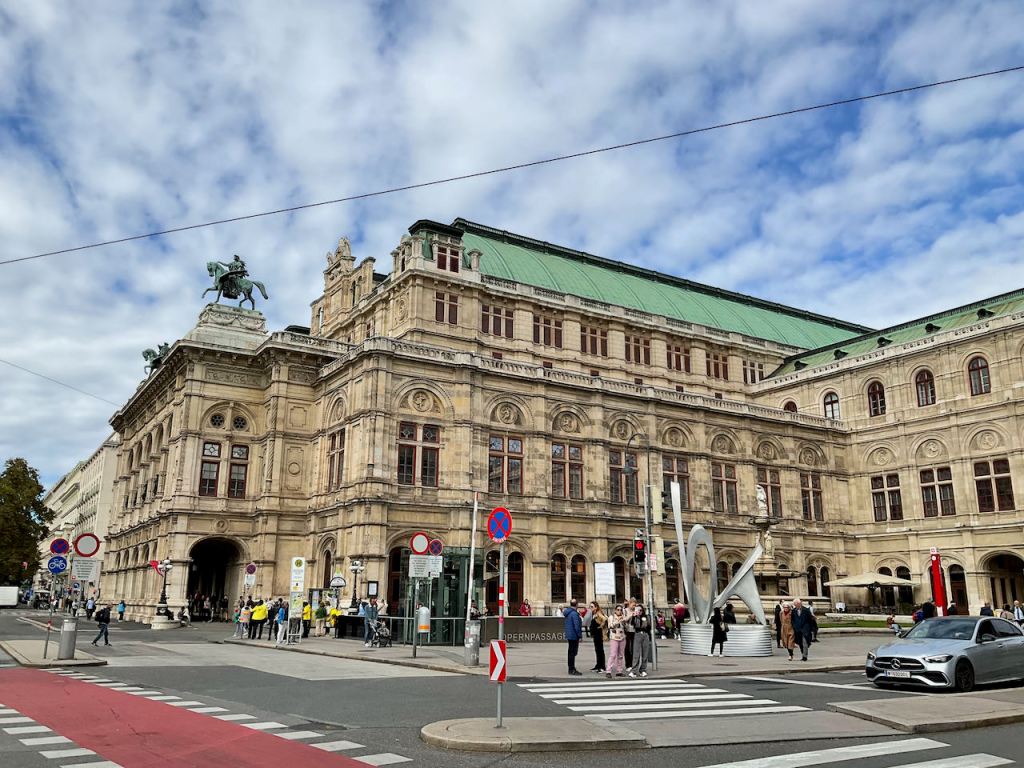
But boy did those old masterpieces dominate. Everywhere we turned, there were statues, monuments, and Weiners. The last picture on the lower right is of the Vienna State Opera House, which ended up being a little notable for us because it seemed as if wherever we walked, we somehow ended up next to the Opera House. We thought maybe we were in an episode of the Twilight Zone.
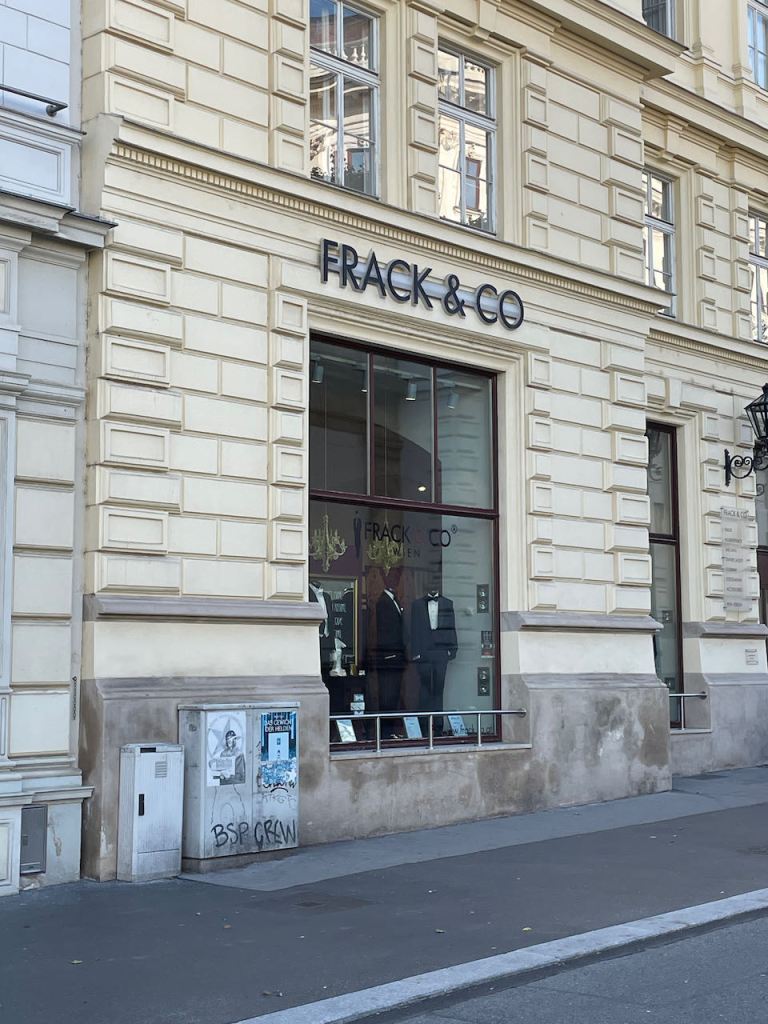
We noticed these pipes running through town, I learned that they’re there to pipe water from some subway construction. And here I thought they were probably Strudel Timely Delivery systems, which we avoided because we didn’t want STDs. Also, the picture on the right is only for fans of the Battlestar Galactica reboot. Frack off if you don’t get it, which is exactly what Carolyn is telling me to do in the middle picture. I imagine if one of the Galactica people landed on the planet and saw that sign, they’d be really confused as to what the company was selling. Anyway, that’s all the swearing you’re gonna get in this entry, I’m all swore out from the last one.
So this is Vienna, as beautiful a city as you’re likely ever to see.
And here’s the fracking Opera House… once again following us everywhere.
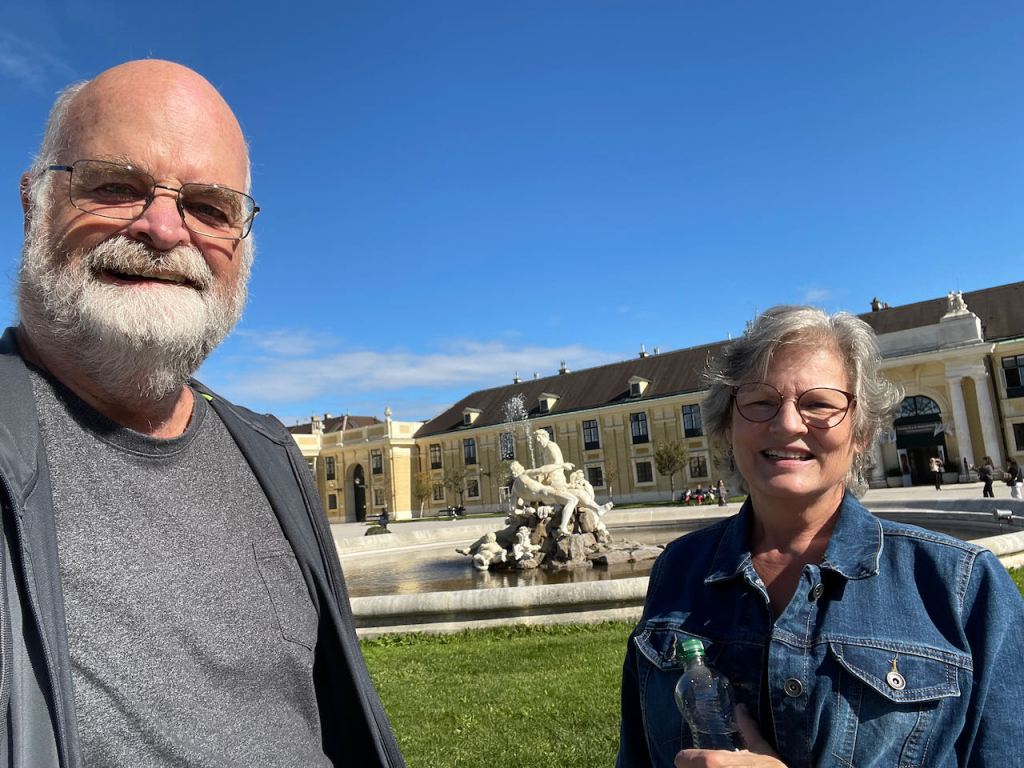
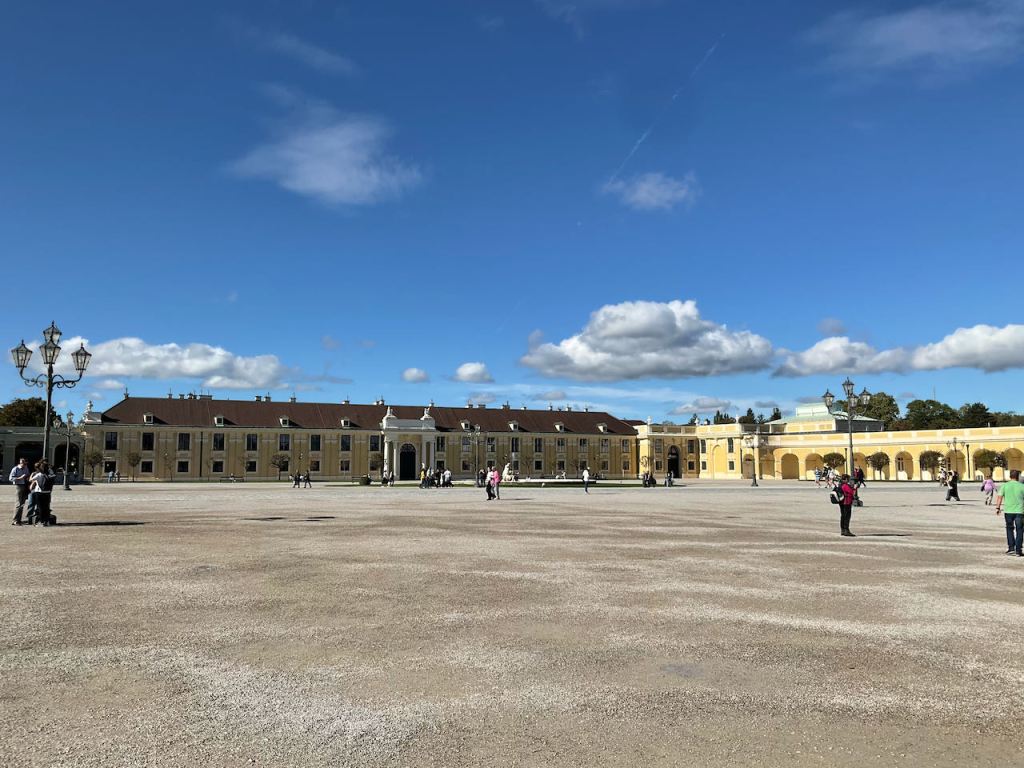
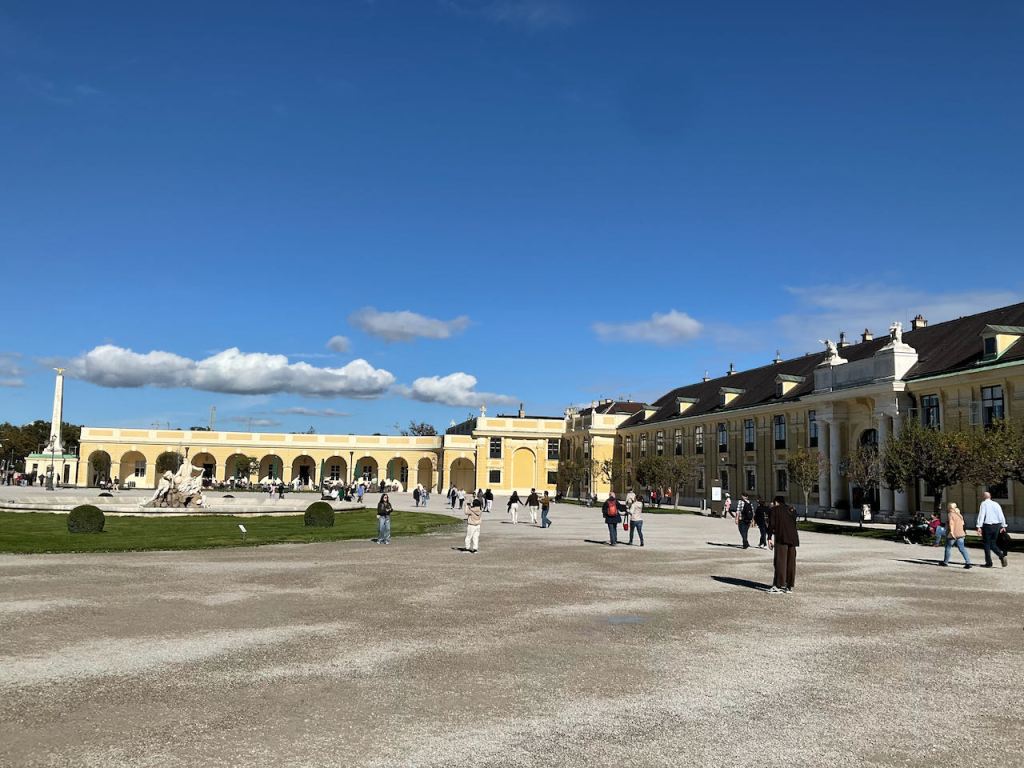
One of the key sites to see in Vienna is the Schönbrunn Palace. Construction of the palace started in 1696 and was completely redesigned after 1743. It is yet another UNESCO World Heritage site. It’s also a testament to the power and influence of the Habsburgs, and was built on a former hunting lodge site that the Habsburgs had used for centuries. The Habsburg dynasty was one of the most powerful dynasties of Europe, running from the 15th to the 20th century. To keep their power in the family, they engaged in a lot of Inbreeding, which spawned a name for one of their deformities: a jutting jaw, now known as a Habsburg Jaw. I suppose one of the benefits is that they had a place to hold an extra weiner while eating.
I was amazed at the design of this statue, which looked uncannily like Carolyn. It was about then that I snuck another look at her real-life jaw to make sure it wasn’t Habsburgian.
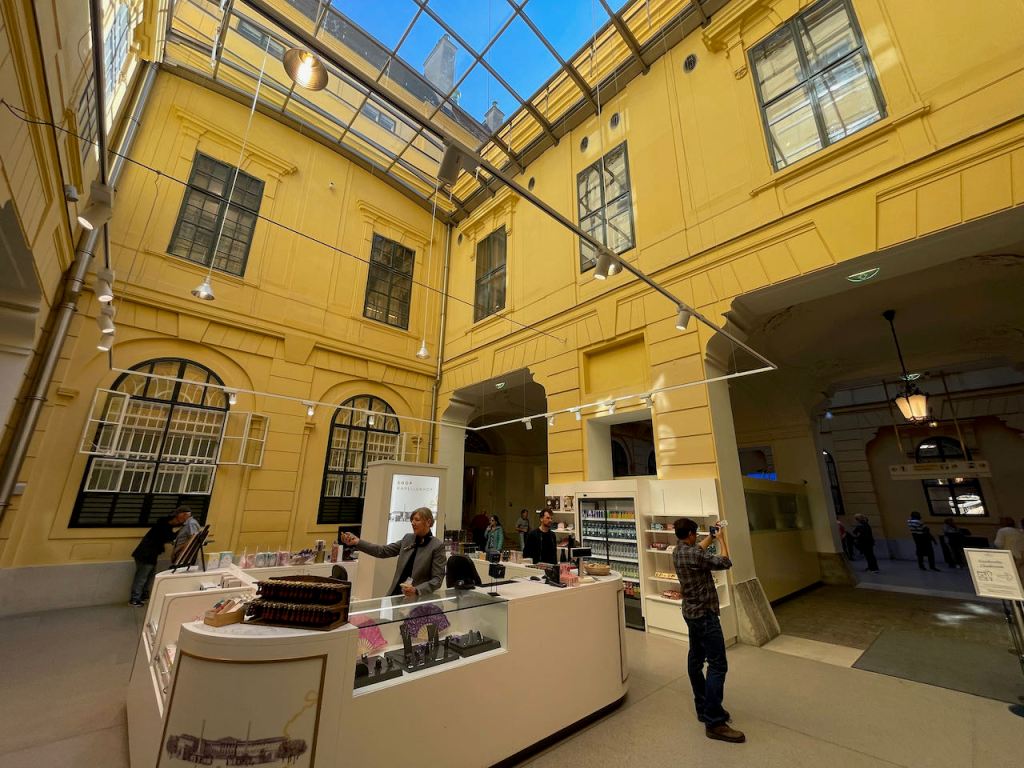
I took a picture of this sign because I found it slightly amusing that the vast majority of tourists walk to the “You are here” location, which is right by the entrance, way across a huge plaza. Once there, they discover that they have to walk right back all the way across the plaza again to go buy the tickets. We were so irritated about it all that we only ventured into the front entrance and snapped a photo so we could honestly say we’ve been inside the Schönbrunn Palace. Plus we didn’t want to end up with a Habsburg Jaw by seeing something jaw-dropping and accidentally replacing ours with one of theirs.
Europeans are apparently so casual about their toilet needs that they had this urinal right out in the open, at least that’s what I thought it was. Unless it was where Habsburg-jawed people are forced to wait. Okay, enough with the Habsburg Jaws already!
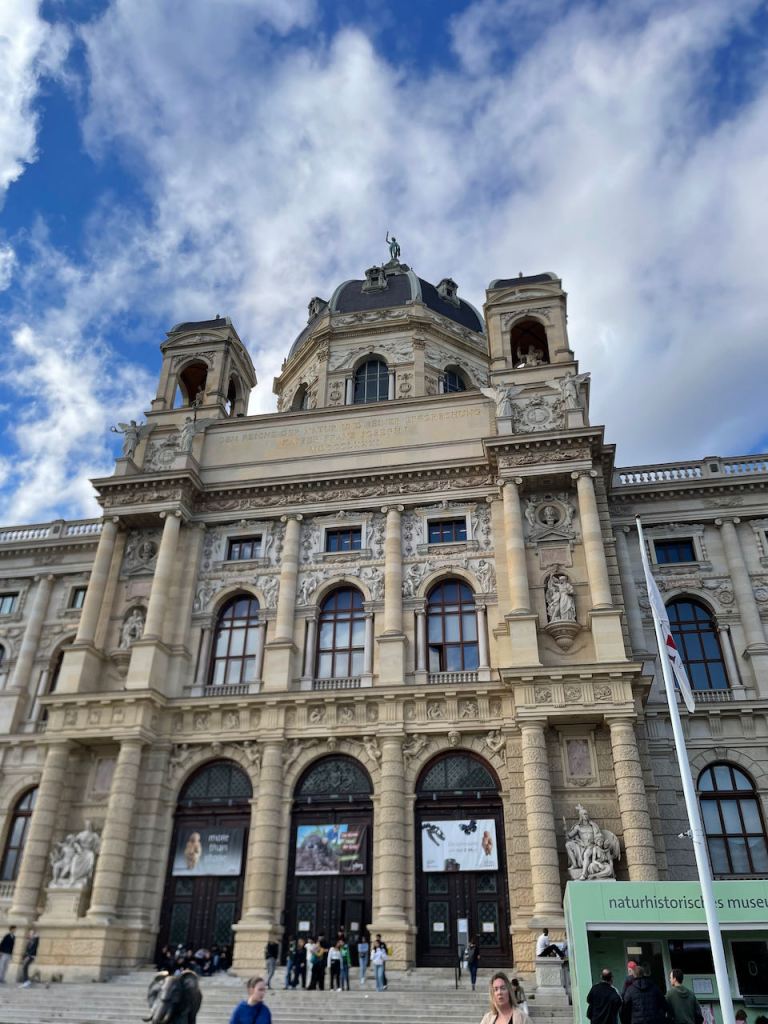
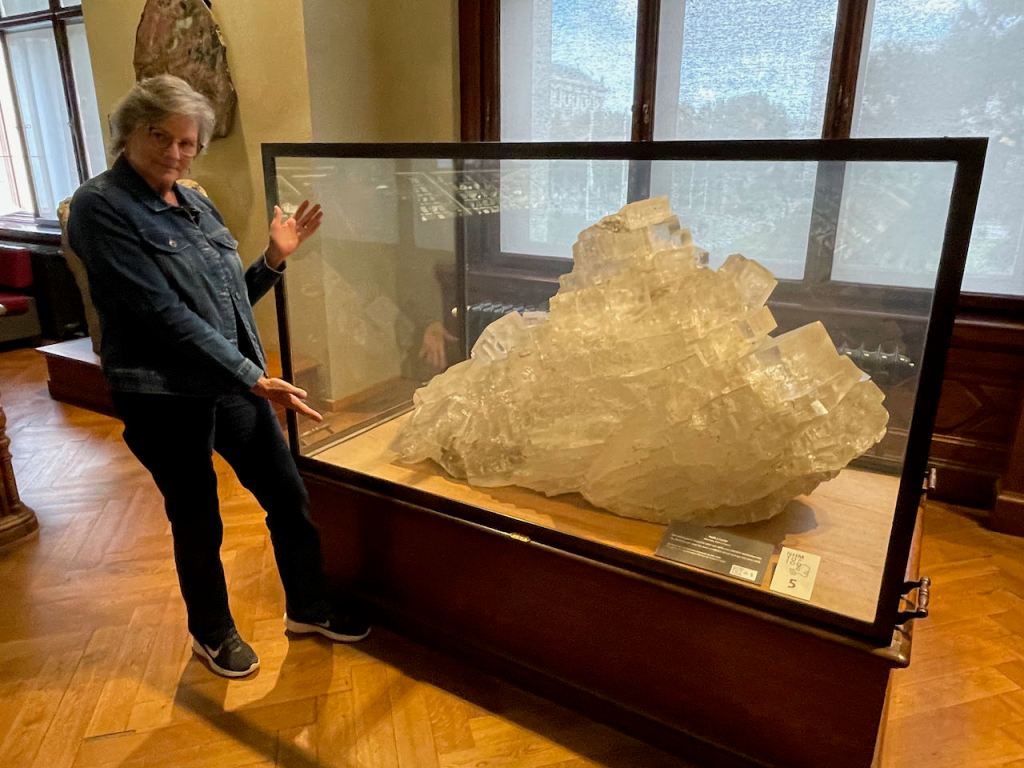
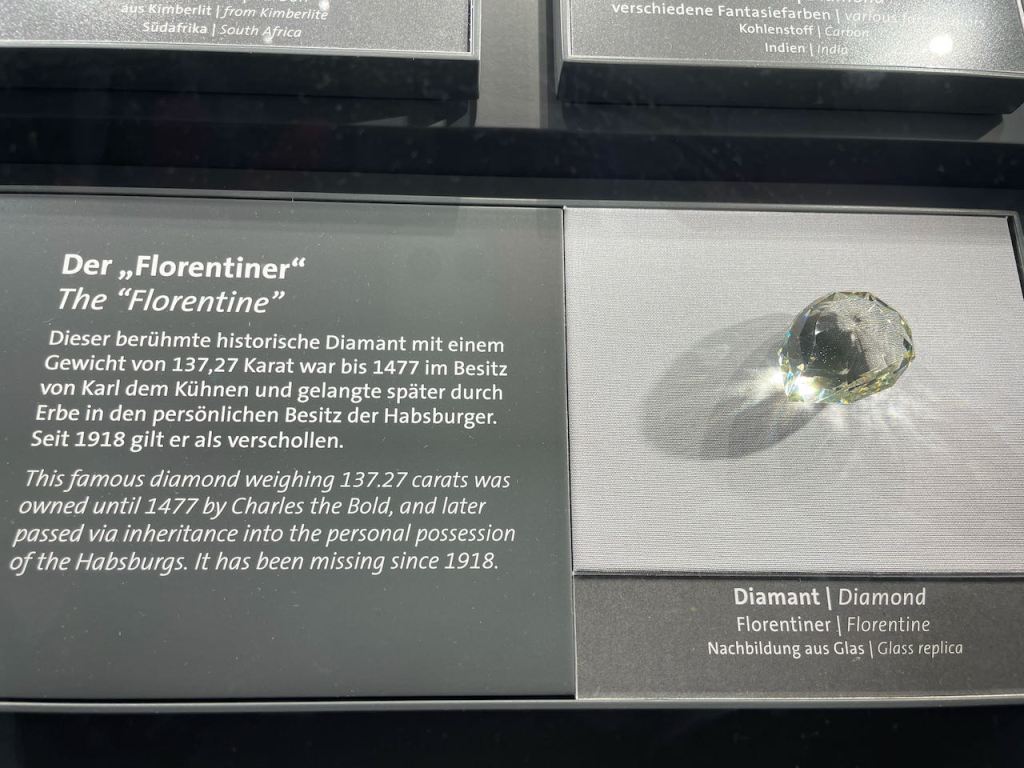
One of our other stops was to the Museum of Natural History. While we both feel a little museumed out lately, we thought it worth a visit, and we were right to do so. They had the largest collection of precious minerals, gemstones, and meteorites that we’ve ever seen. Room after room was filled with every imaginable variation of rocks and minerals. I learned that the great variety found on earth is due to all sorts of combinations of factors, including geological activity such as volcanoes, plate tectonics, and water-rock interactions, as well as biological activity, such as chemical reactions with oxygen and organic material. I’m not sure why so many of them end up so beautiful, but thanks Earth!
The museum is also the home of a large dinosaur exhibit, as well as a number of prehistoric displays. No, no, not the wife, she’s not that old yet. But she would barely make a sock for that monster’s leg.
This is a model of a sea scorpion from 320 million years ago. However, since it looks so much like a spider, it’s also Carolyn’s worst nightmare. If she ever really pisses me off, I’ll put a picture of this under her pillow. Actually, I’d never do that because I prefer my face completely un-clawed, my limbs attached, and my jaw decidedly non-Habsburgian. Okay, last one.
The museum did have a few skeletons in its closet, including this display of the first nudists in history.
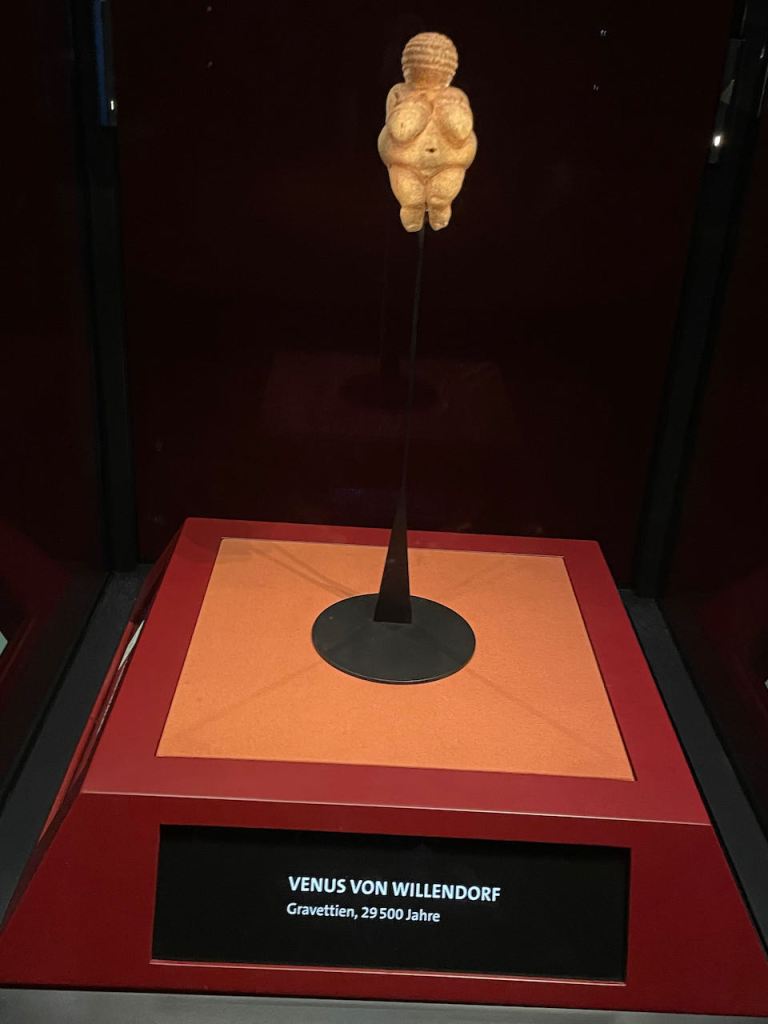
It is also the home of the very famous Venus Von Willendorf, which is only 11.1 cm. (4.4 in.) tall. It is estimated to have been made about 30,000 years ago, and most archeologists believe it had something to do with fertility or sex. So the next time your wife or girlfriend asks if they’re too fat (right answer: “Of course not honey! I love you just the way you are!”), also point her to a picture of the Venus Von Willendorf and say, “Besides, this is what used to turn men on! See, you’ve still got a long way to go!”
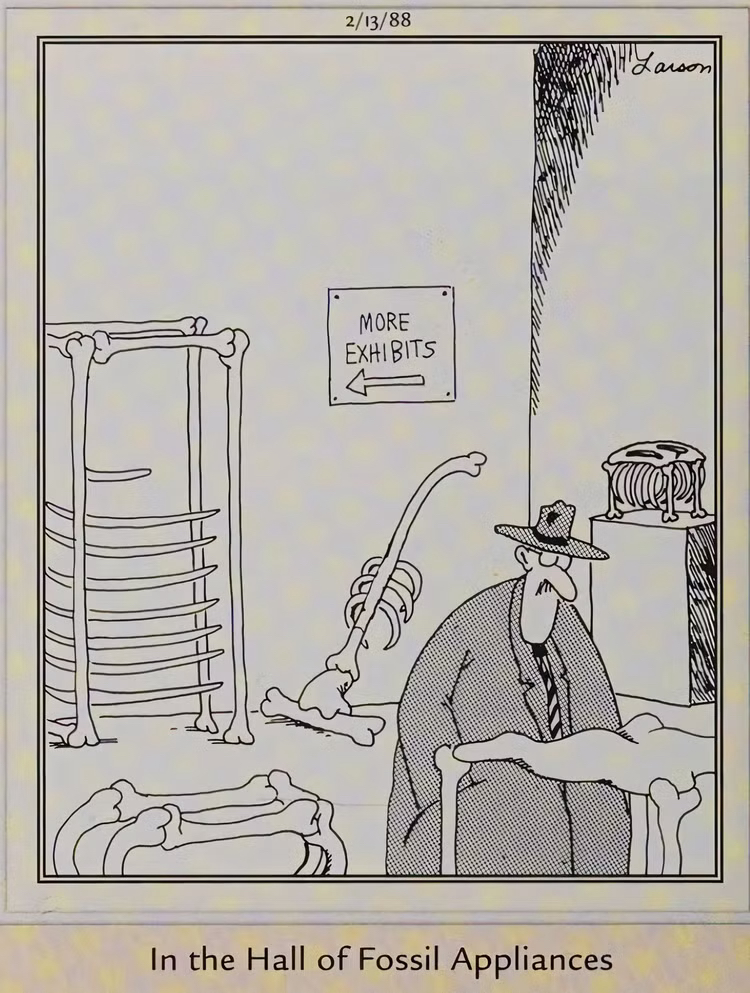
Lastly, I’ll turn to a professional to wrap it up with a few museum-y giggles.
One of the things we like to do in Europe is visit small picturesque towns and esque a bunch of pictures. One of those towns was Mödling, Austria, best known for being the capital of the Austrian district of Mödling as well as being unknown to 98.7% of all Americans.
It’s also famous for the “ö” in its name, which is pronounced by forming an O with your mouth, placing your tongue just behind your last molar, making a gargling sound like you’re swishing around mouthwash, and then fluttering your tongue rapidly while exhaling. We’ll just stick with pronouncing it Modeling.
It also features a statue in the town square entitled, “Homage to the Dairy Queen Ice Cream Cone.”
People have been living in this area since the Neolithic Era, which is the fancy name for “Stone Age.” Despite it’s advanced age, it’s a cute little place and we enjoyed wandering around taking photos and just seeing what popped up.
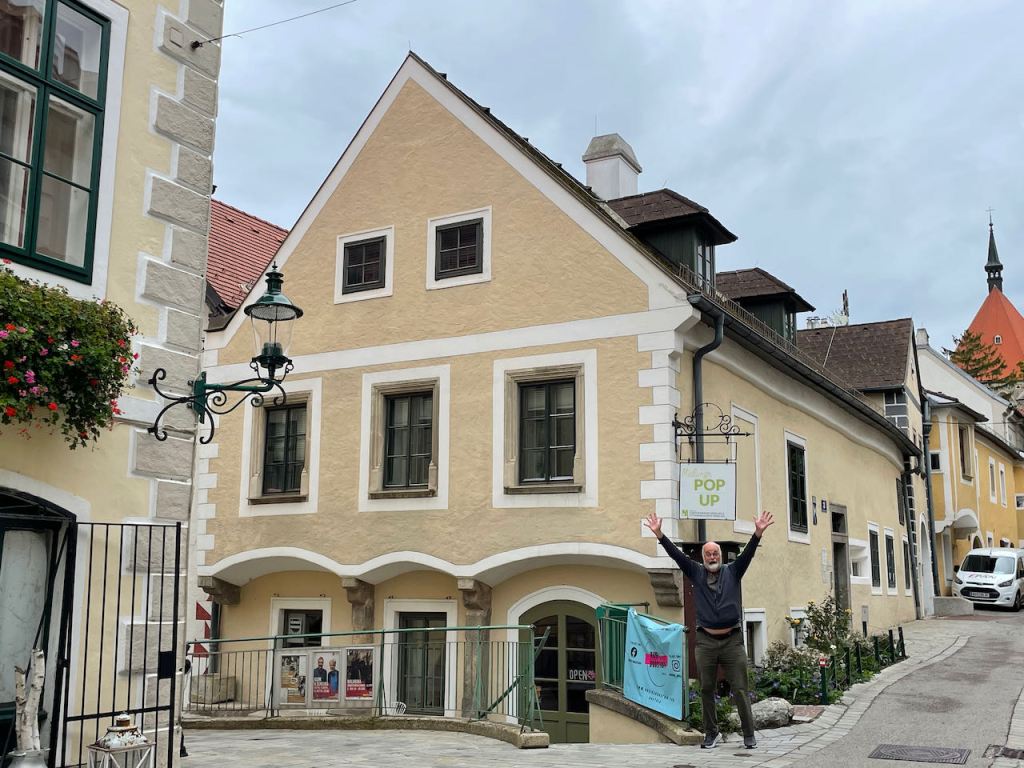
Well there you go, our first Pop Up. I didn’t actually jump because I didn’t want to break a hip.
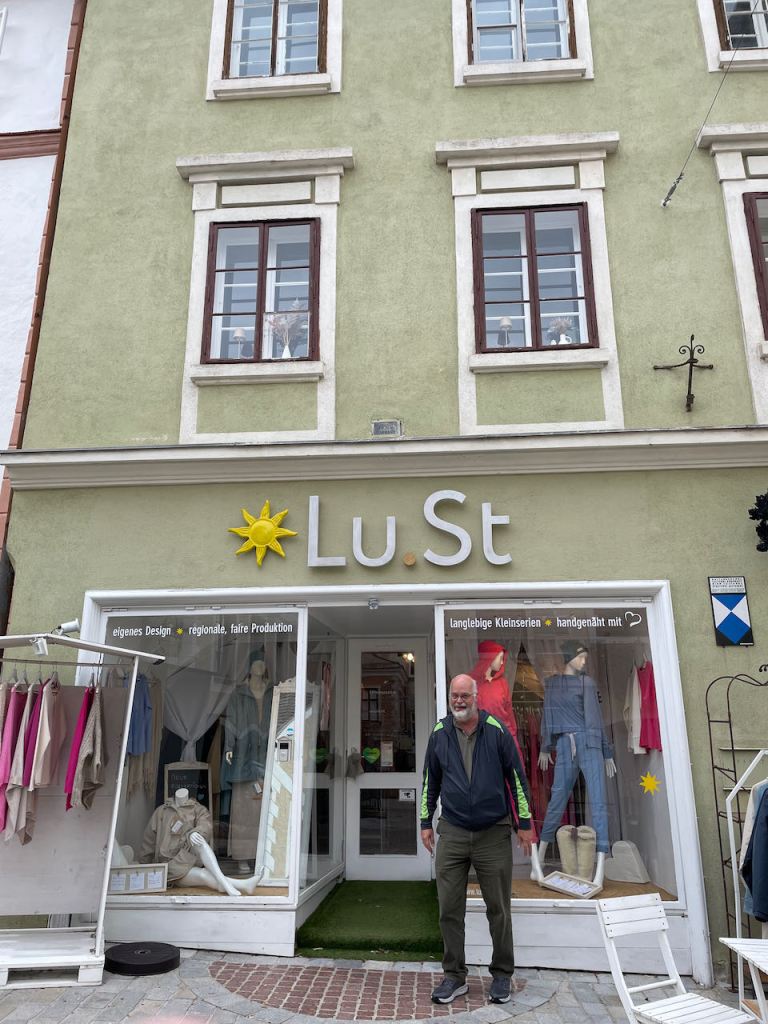
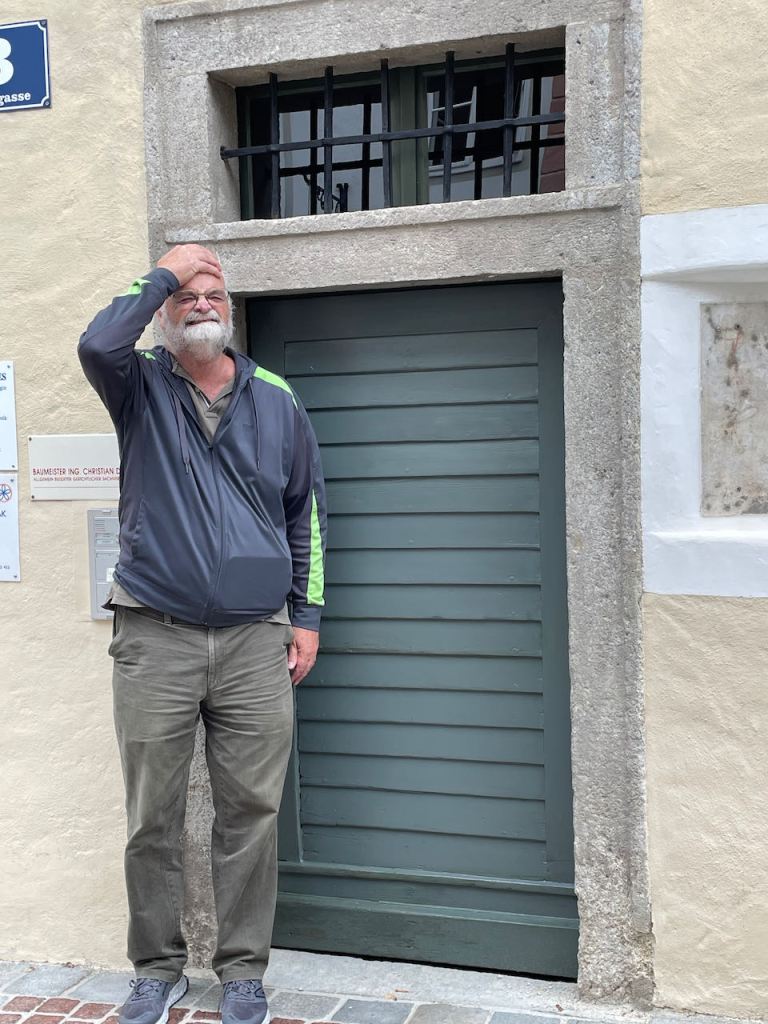
In addition to being famous for having two dots above its name, Mödling also offers a tour of the Seven Deadly Sins. Here, we see me enjoying some Lust, and then I experienced Wrath because they make doorways so low you’re guaranteed to get very pissed off after bonking your head. I might as well add Gluttony here because my stomach looks like I ate a whole Happy Meal without taking it out of the box.
We missed out on the other deadly sins, but we’re hoping that by taking pictures of a couple of churches we will be forgiven for the ones we experienced.
One of the advantages of sight-seeing in a small town is that there are a lot fewer pictures to choose from. Despite that, I couldn’t for the life of me remember the stupid joke I had in mind when Carolyn took my picture in front of the Teeladen store. But it was hee-larious, I’m sure.
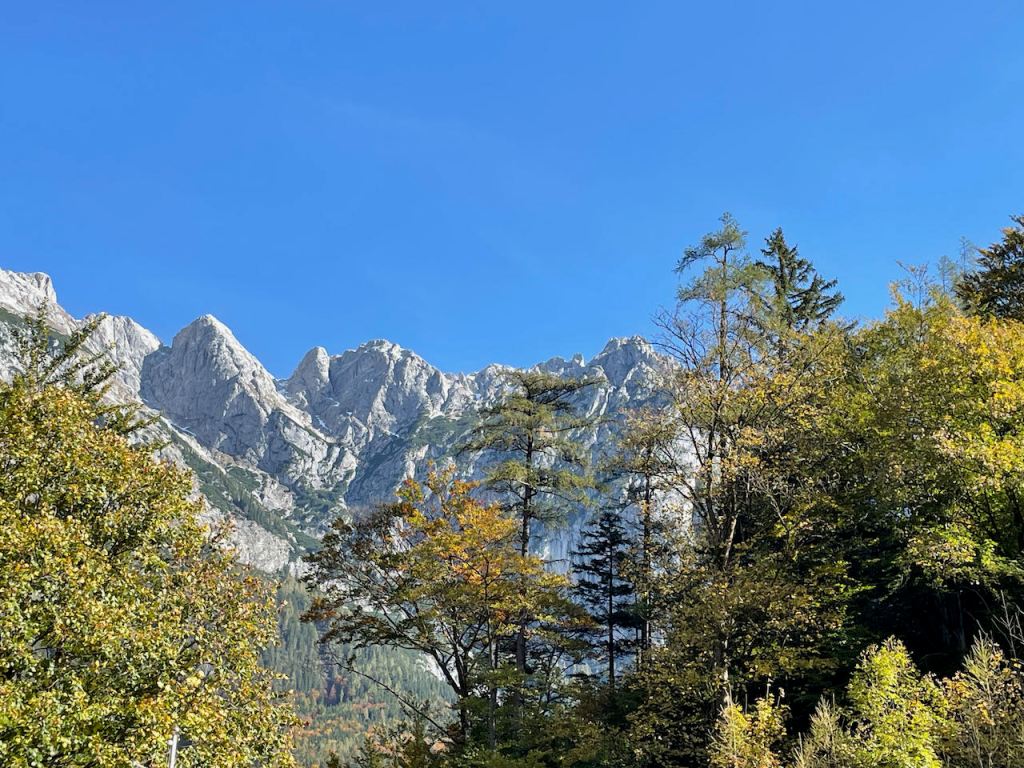
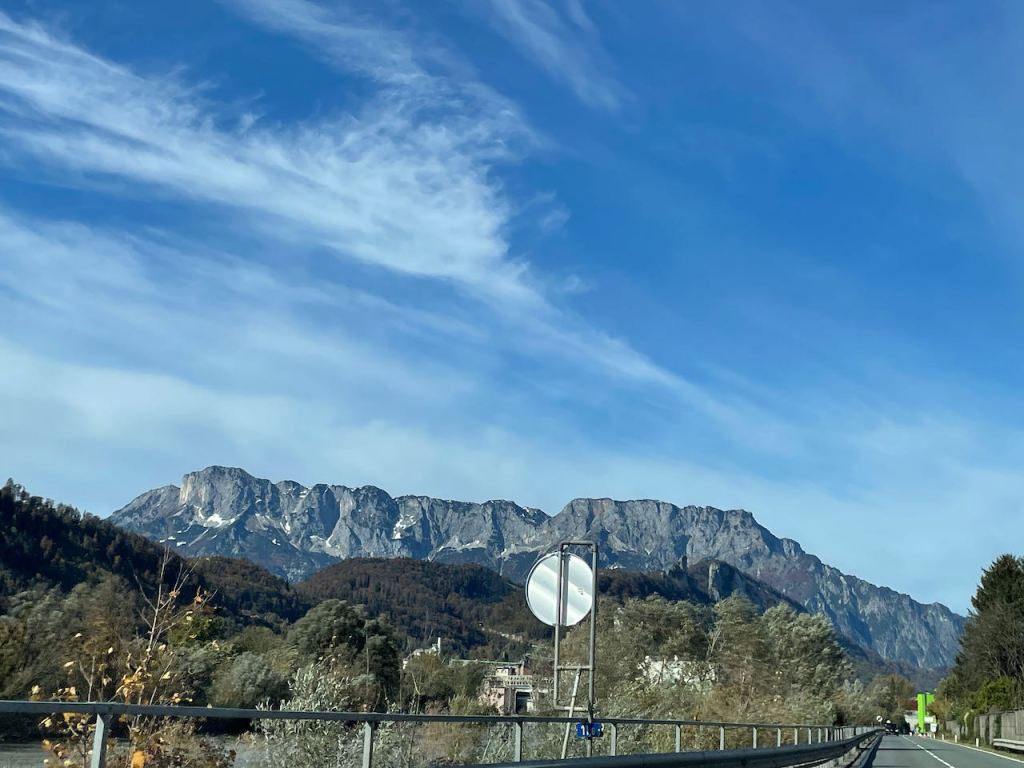
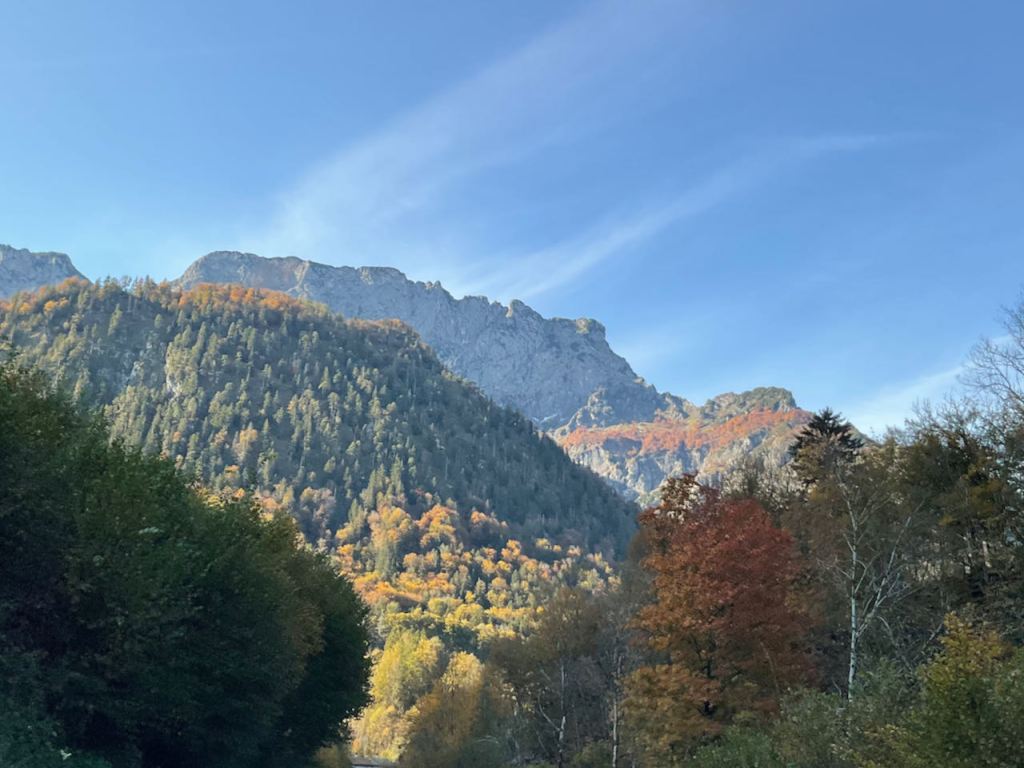
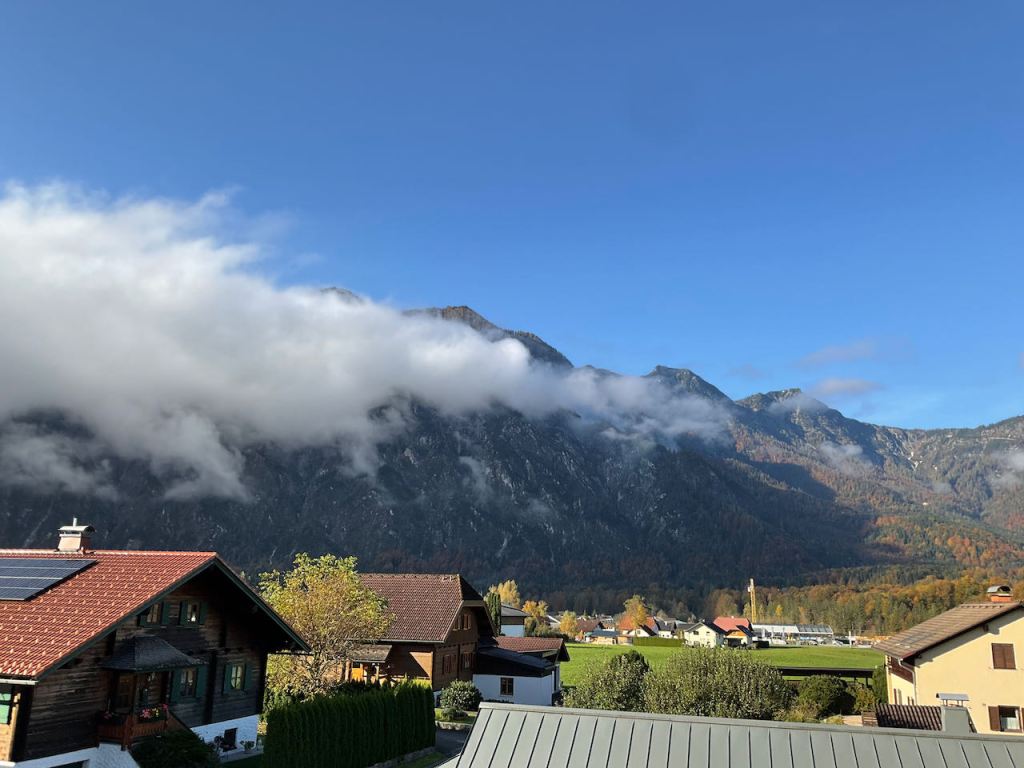
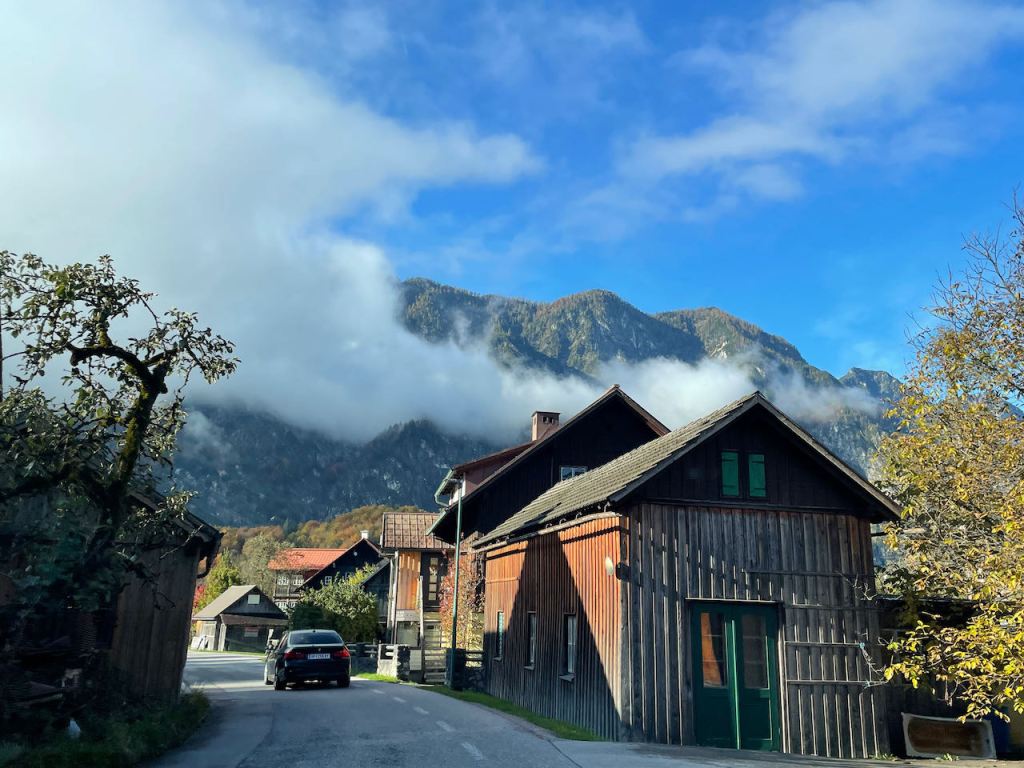
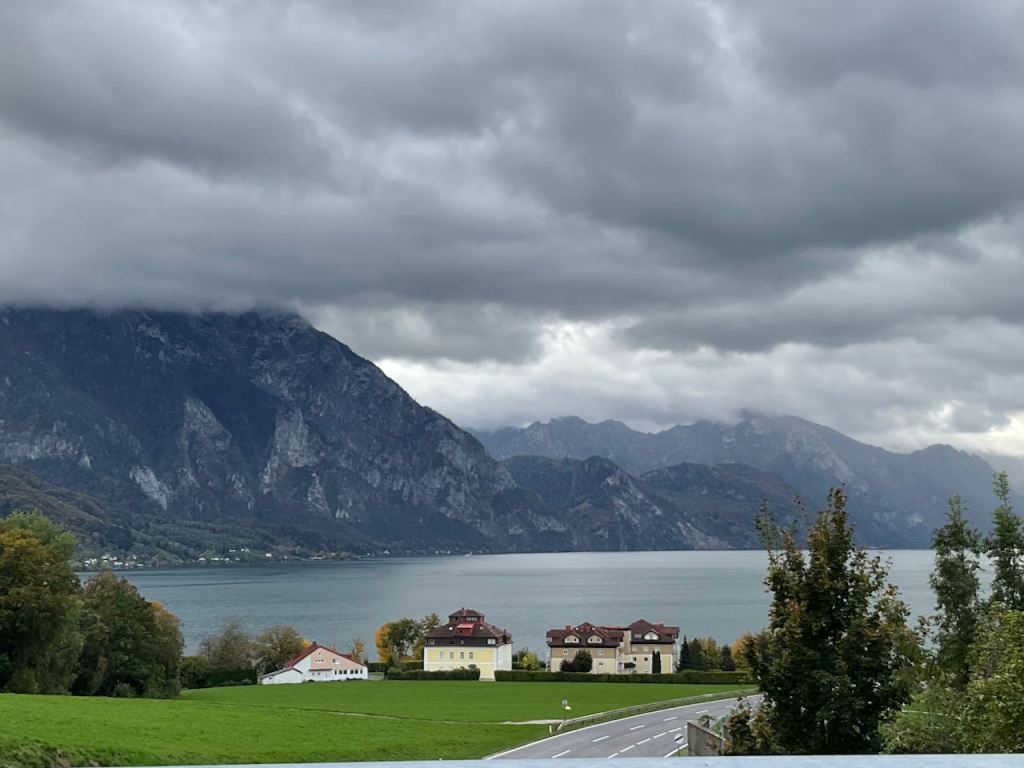
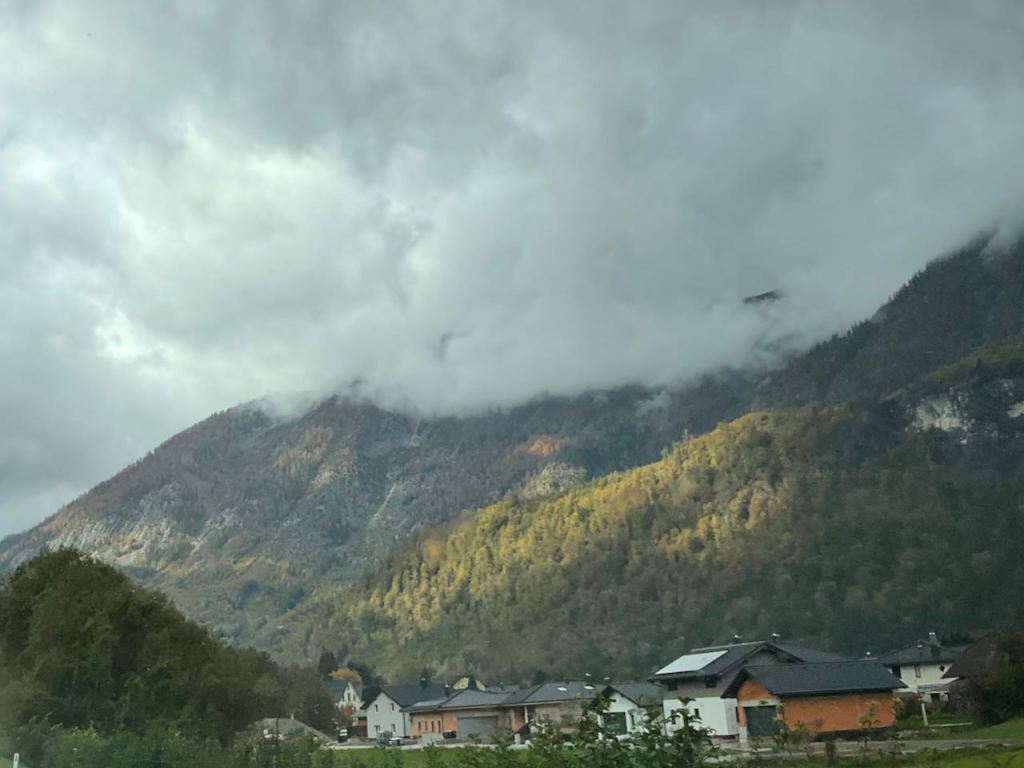
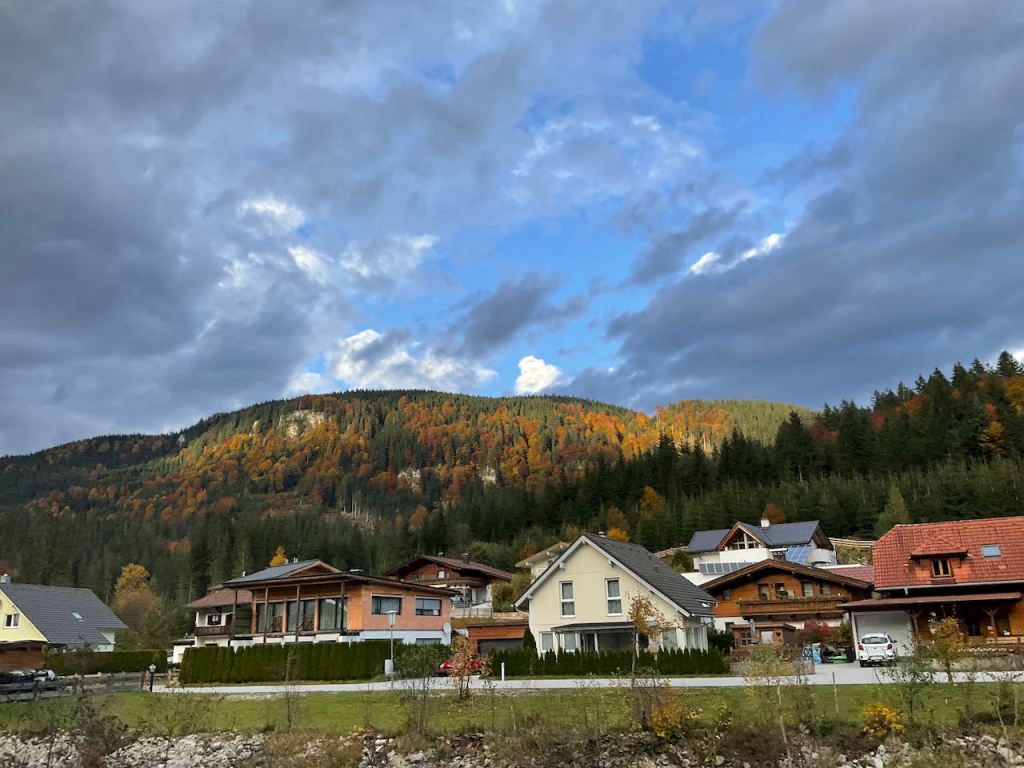
Before we move on to Hallstatt, here are some photos of the Austrian Alps we encountered while on our drive. Any one of these would make a great background for your computer screen, don’t you think? The beauty of driving in this area is that the drive is just as entertaining as the destination. There’s a lot to be said for driving around in a car instead of bypassing all this natural beauty by flying in.
Of course, there are also some other advantages as well.
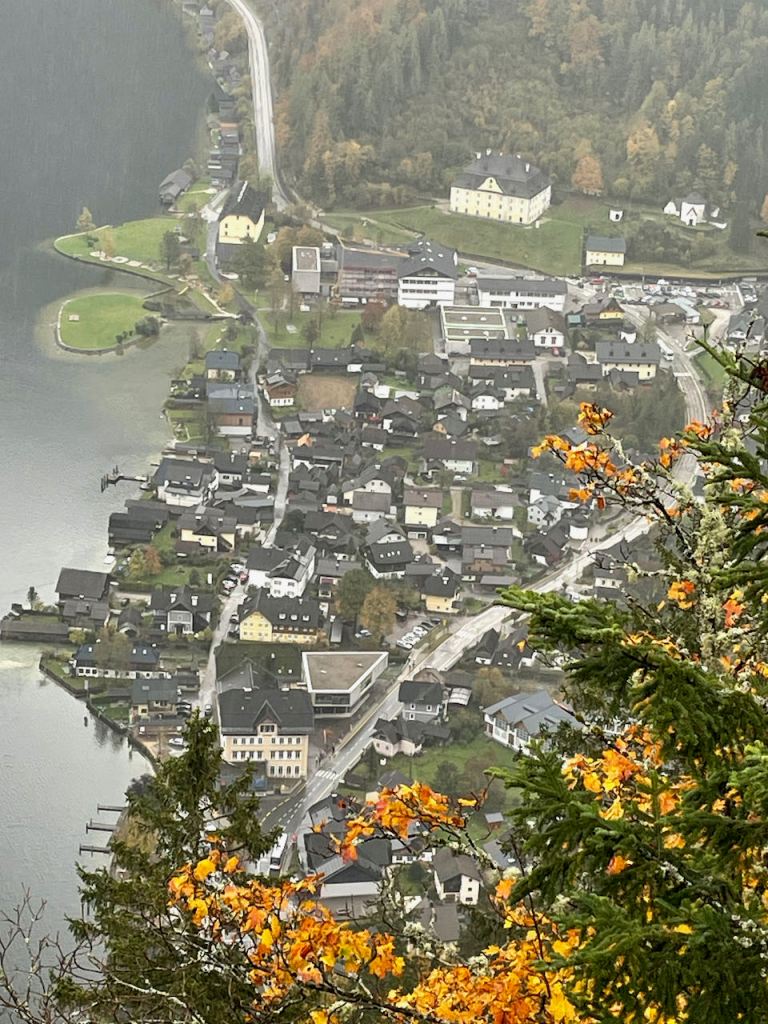
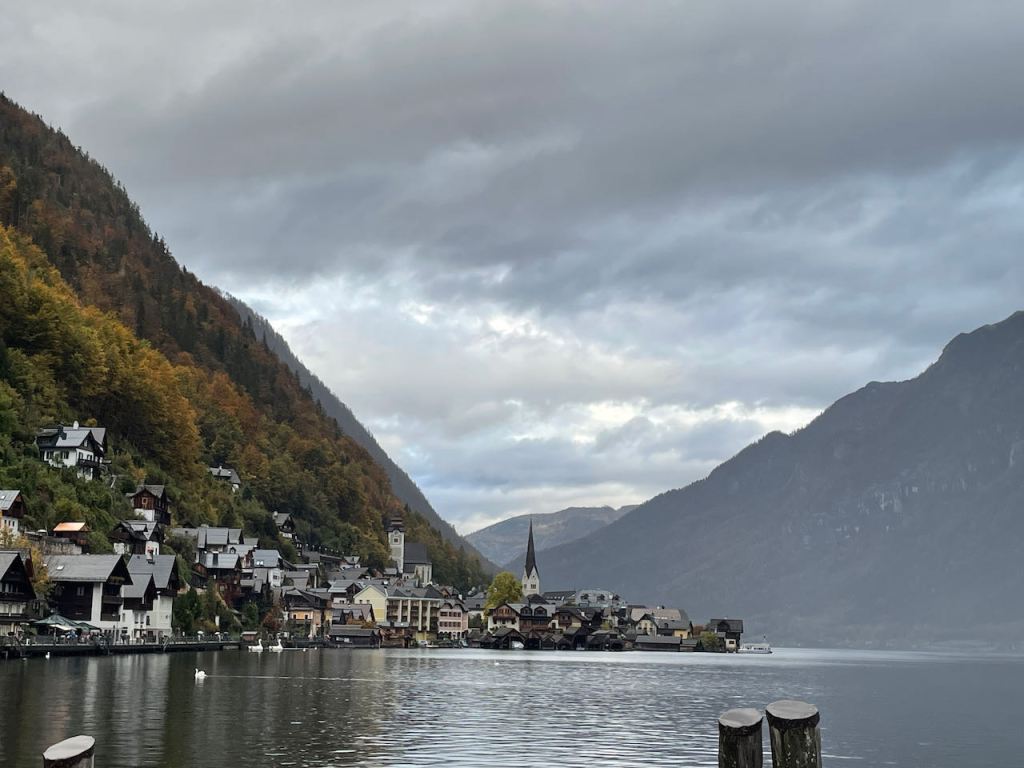
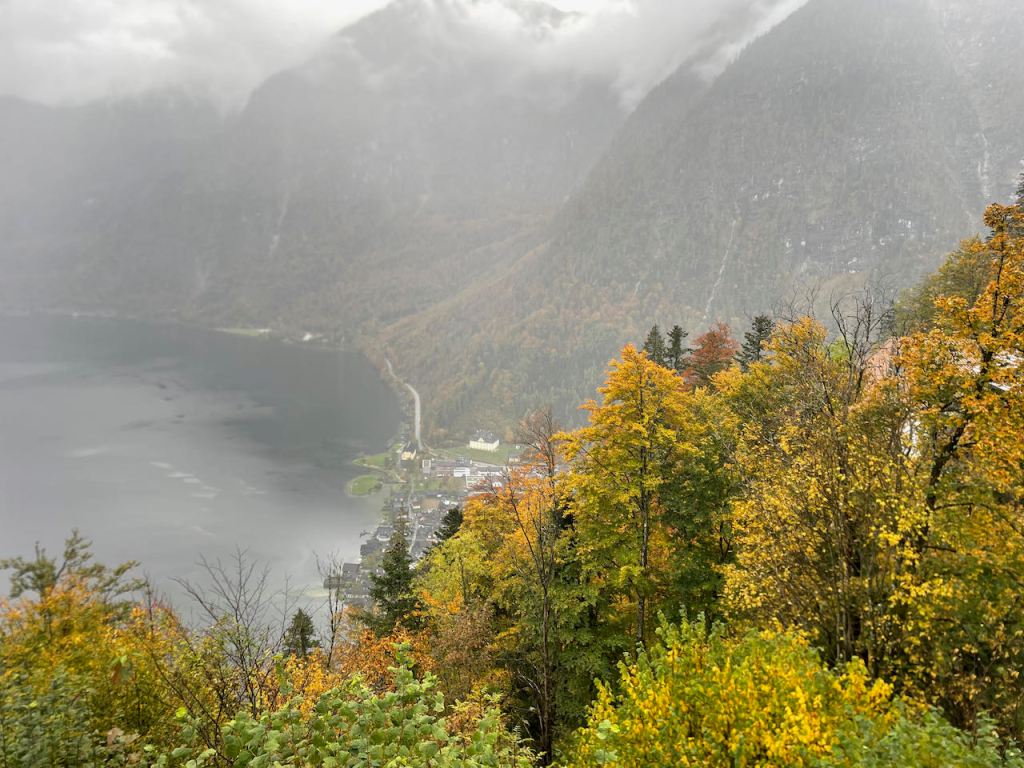
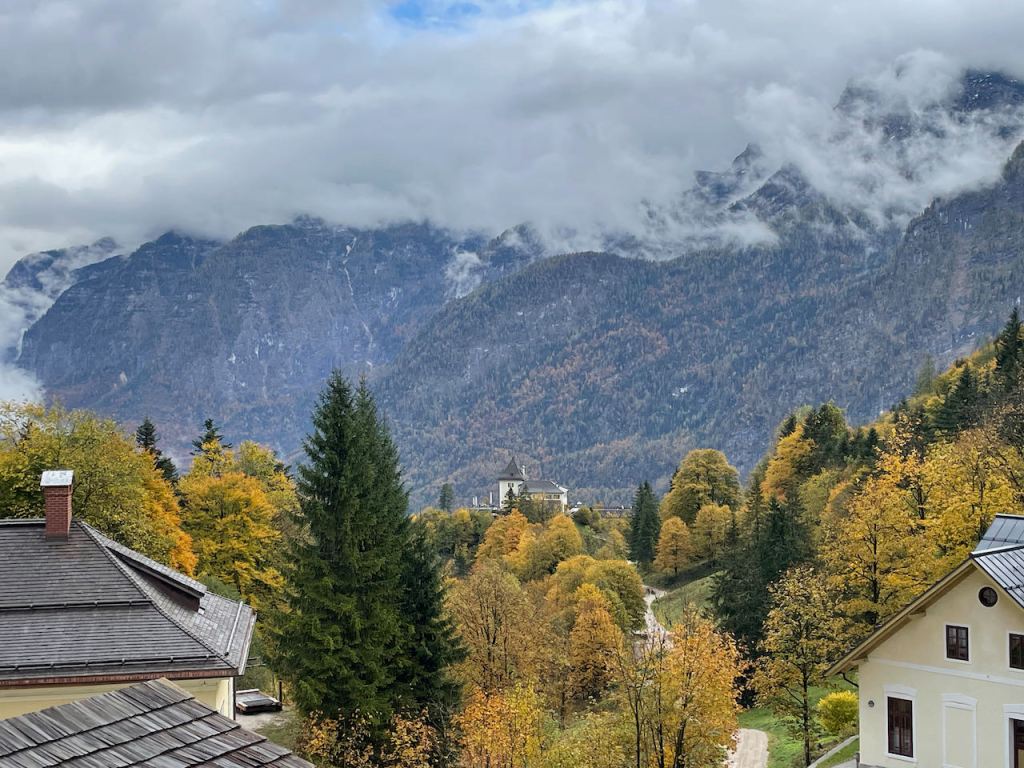
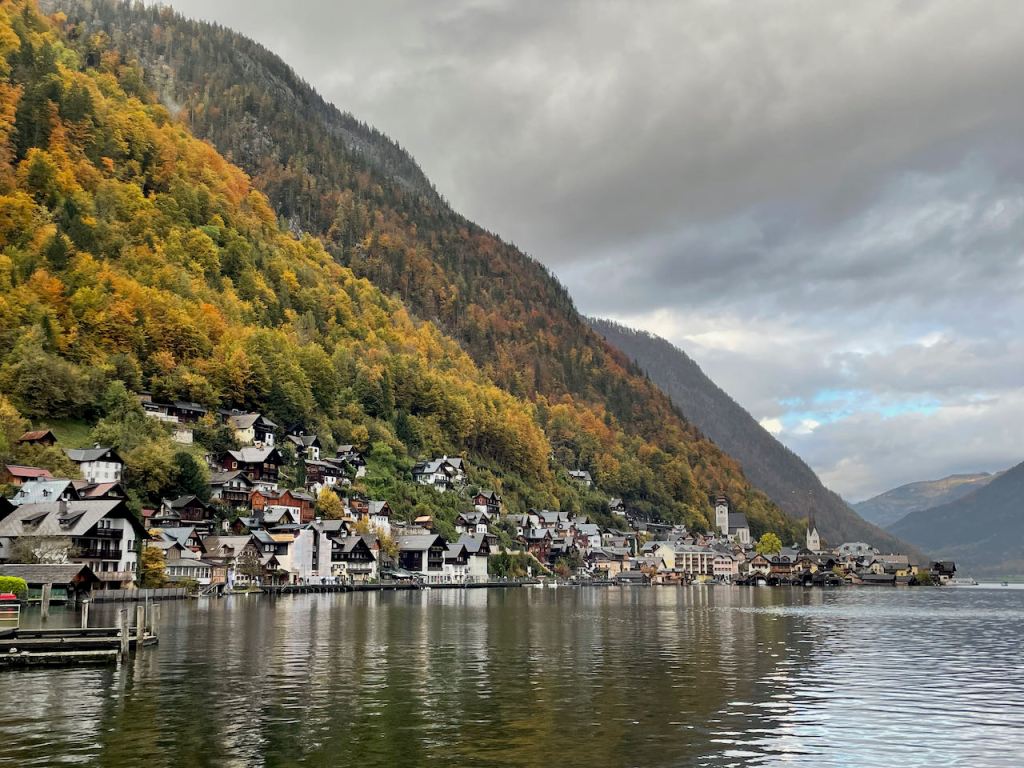
Hallstatt is a small town in Austria that is so naturally beautiful it was declared a World Heritage Site by UNESCO in 1997. Carolyn has long wanted to visit, being drawn by the amazing photography that regularly pops up on the internet. And it didn’t disappoint. The town even greeted us with a rainbow; we felt so special that they went all out just for us. Munich didn’t even give us any free beer.
Halstatt is such a small place that it’s easily viewed in just part of a day. In 2020, the town had a population of 780, but is now a shining example of over-tourism, with estimates ranging from 10,000 to almost 30,000 tourists per day. It was hard to see how they had the infrastructure to handle all that, so we eventually ducked into the salt mines in order to earn our keep and avoid having Austrian dung thrown at our heads. Which isn’t a thing, I just like to say dung.
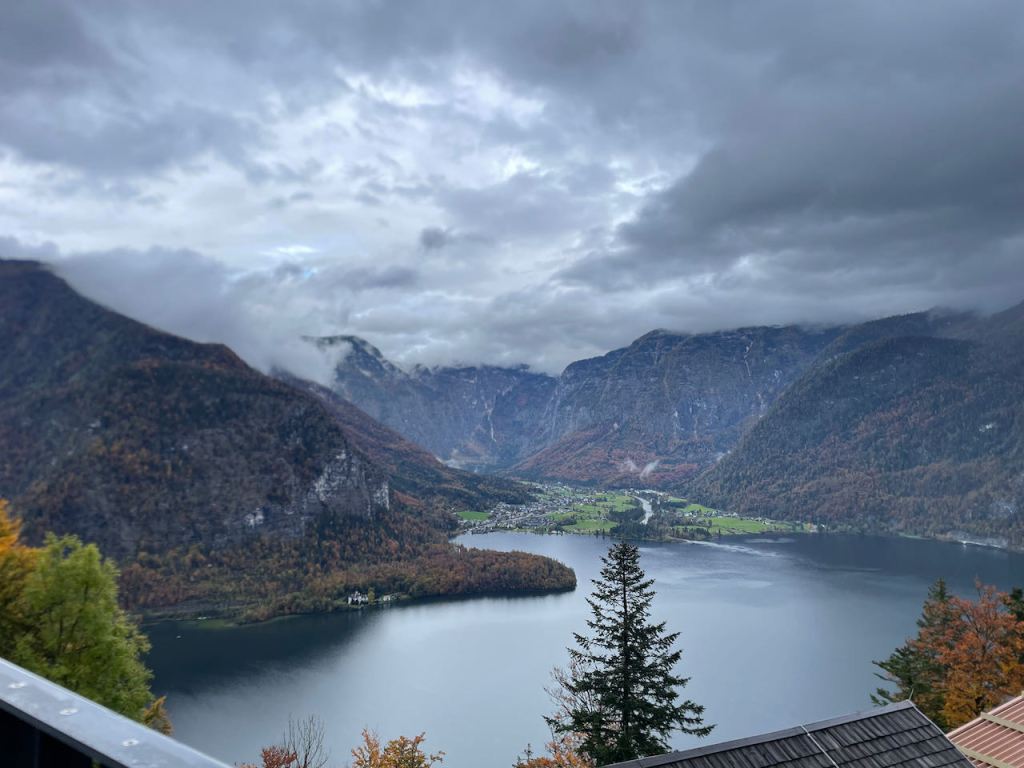
Hallstatt is surrounded by beautiful Alps and sits on Hallstätter See (aka Lake Hallstatt). It features rainbows for very special tourists, as well as the Hallstatt Ossuary in a chapel called St. Michael’s, where they have more than 1,200 human skulls, 600 of which are artistically painted with symbols, names and dates, while the other 600 remain nude. As far as we know, none of the original owners have come to collect any just because they had their names on them. We didn’t bother with the ossuary because we’ve been to Portugal’s Chapel of Bones in Évora as well as the catacombs in Paris, which has an abundance of formerly used bones. Plus we thought an ossuary was where they practiced Jiu-Jitsu. (OSS is a reverential term used in Jiu-Jitsu. See, that was a preemptive joke-splain right there.) Hallstatt also has the aptly named Hallstatt Museum, which we also didn’t see because we’re a little museumed out. But I’m sure it’s wonderful and probably features many halls and stats.
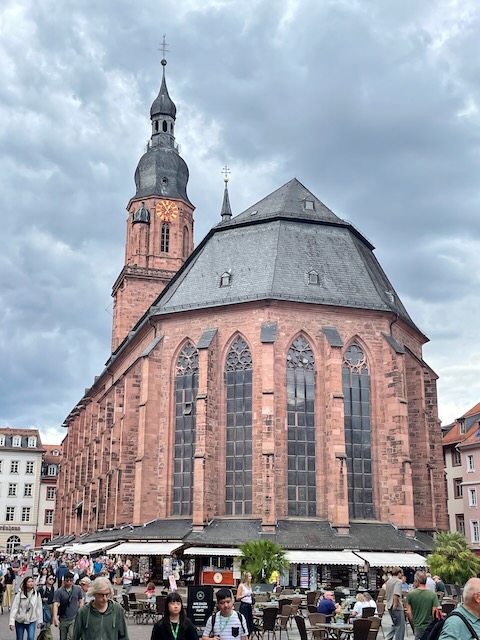
We’re not as good at photography as many of the folks who have posted pictures in Instagram and who helped make Hallstatt known as “the most Instagrammable town in the world” to the chagrin of all 780 residents. Instead, we give you some unique commentary to make up for our lack of professional photography skills. It may not actually make up for it, but it’s all we’ve got. Oh wait, there’s a slightly used mint in my pocket if you want that.
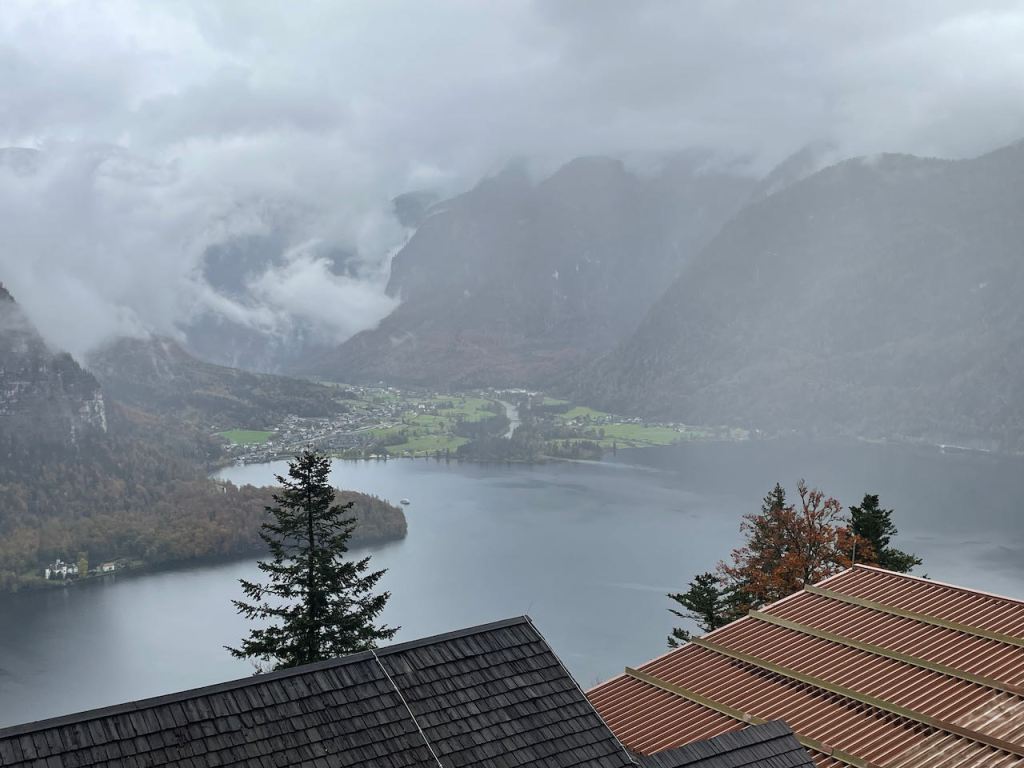
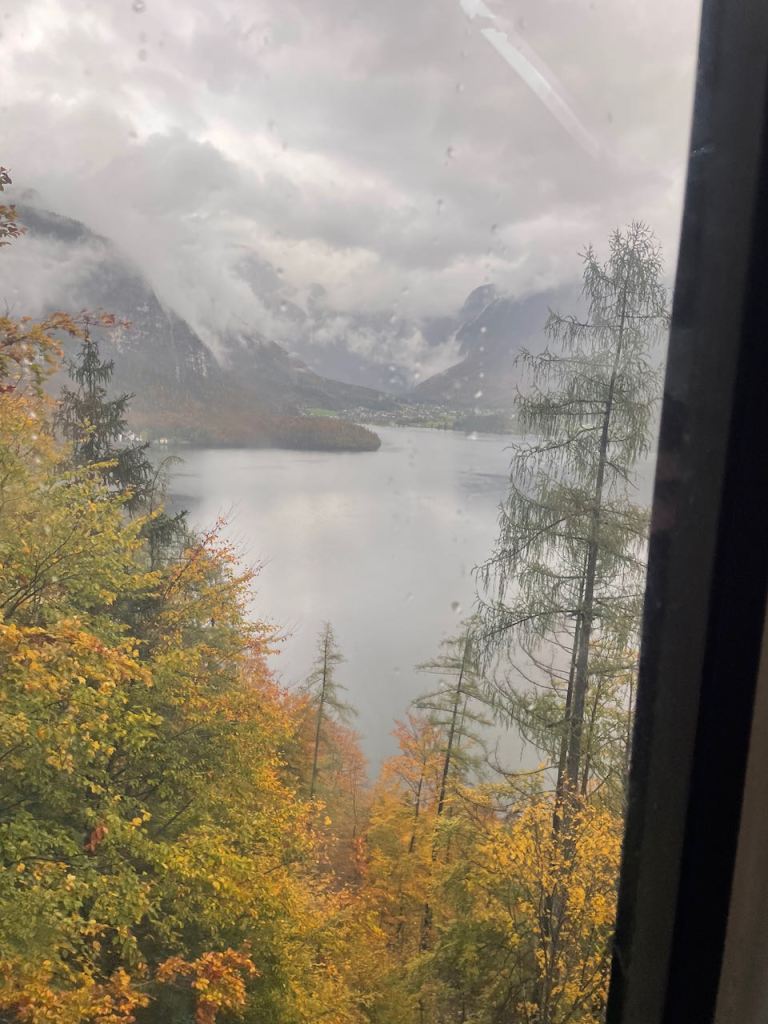
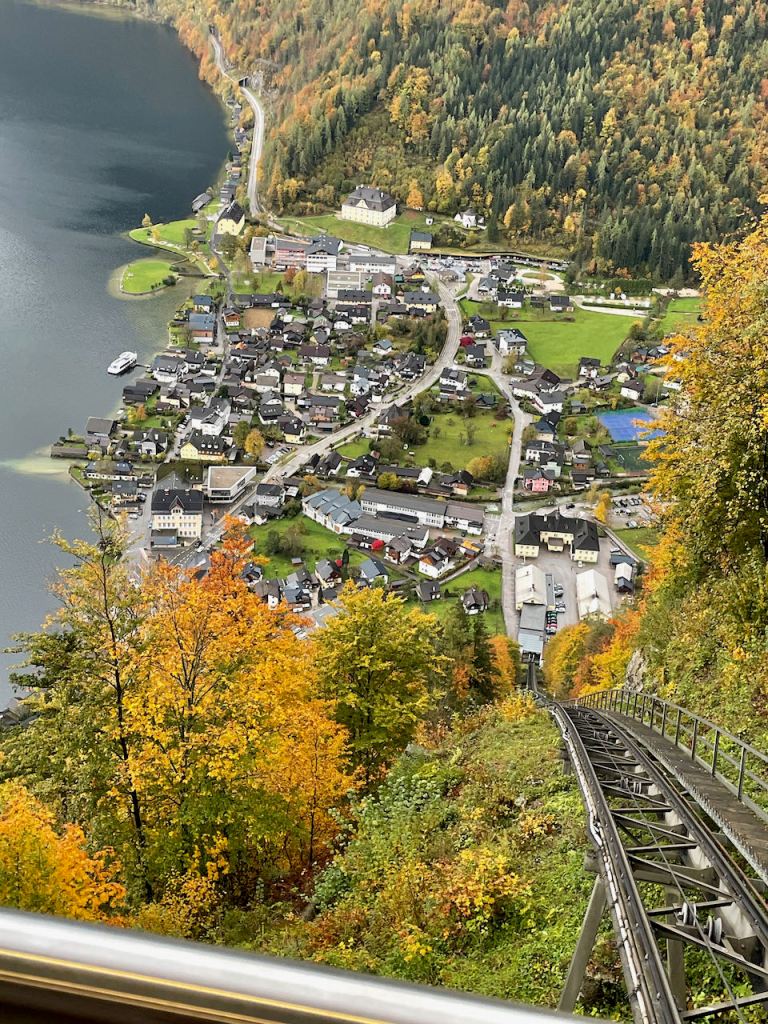
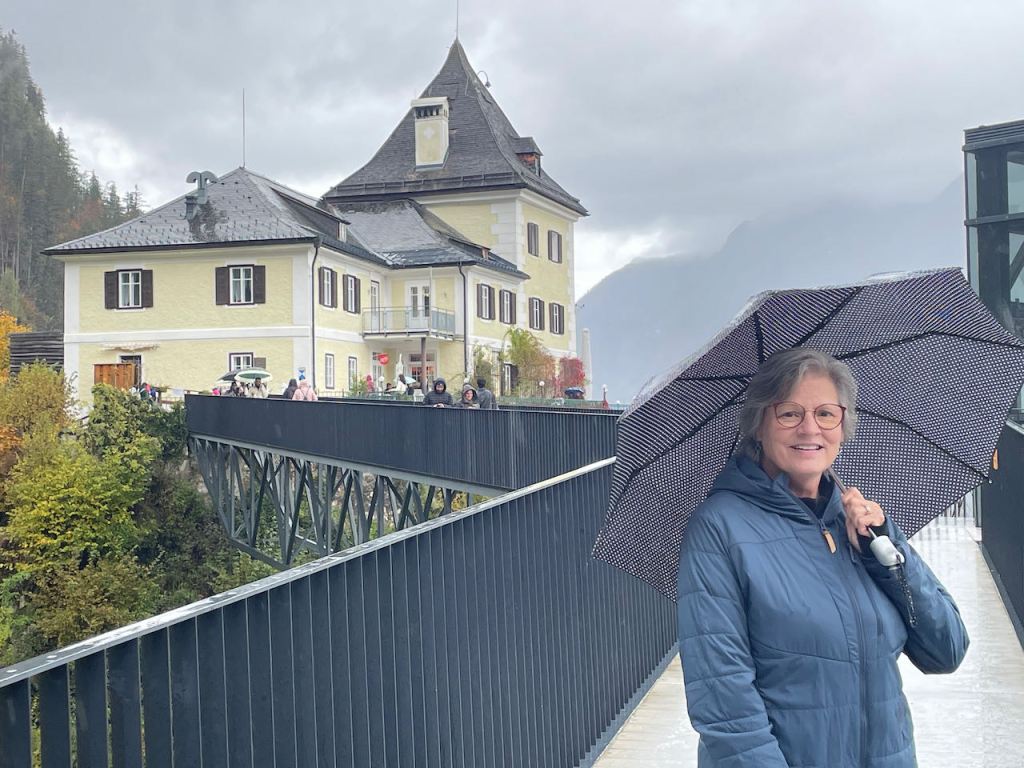
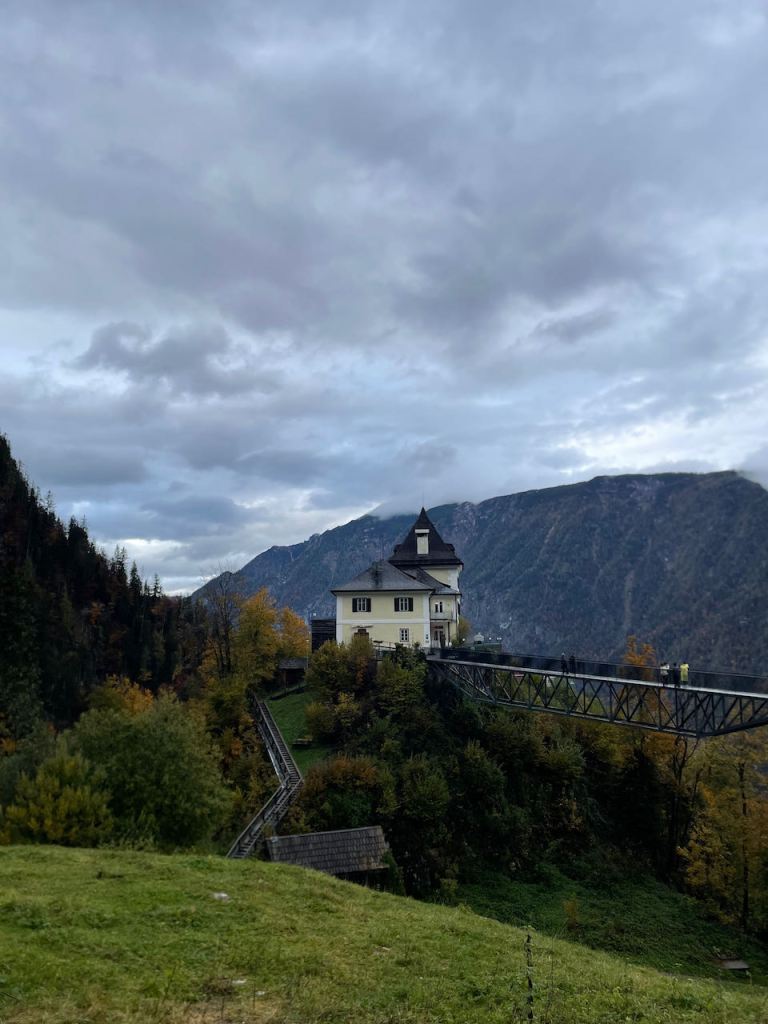
Additional beautiful views were had by taking the funicular (yet another one!) up to the salt mines, which we’ll get to in a bit. At the top of the funicular is the Hallstatt Skywalk, which offers stunning panoramas and long lines for selfies. Enjoy the scenery!
I have dozens more scenic photos, but I didn’t want to post them all since so many people have approached me saying, “There aren’t enough words in your blogs! The pictures are nice, but I use my toilet time for reading and there just isn’t enough to read per poop!”
Okay, I’m lying. Actually, if I had a euro for every time someone grumbled about BaldSasquatch having “too many words,” I’d have more euros than I do now, so from now on I will demand a euro from anyone who makes that comment. In fact, I just need one more euro to lose one less euro on this project. But enough about the millions I’m not making, onward and upward, it’s almost time to trudge off to the salt mines!
OK, I see you’re slightly constipated, so I had to offer up one more set of Hallstatt pictures first.
Up, up, up we went, over 360 meters (1181 feet) above the town. Given that we were going to an actual working salt mine, I had to wonder if that’s where they came up with the word “funicular,” maybe just so the workers might be convinced that what they were doing was fun. Otherwise, it would be called a “nofunatallbutatleastitisapaycheckicular.” Then fourth graders and many grown American men could giggle because it contains “tit.”
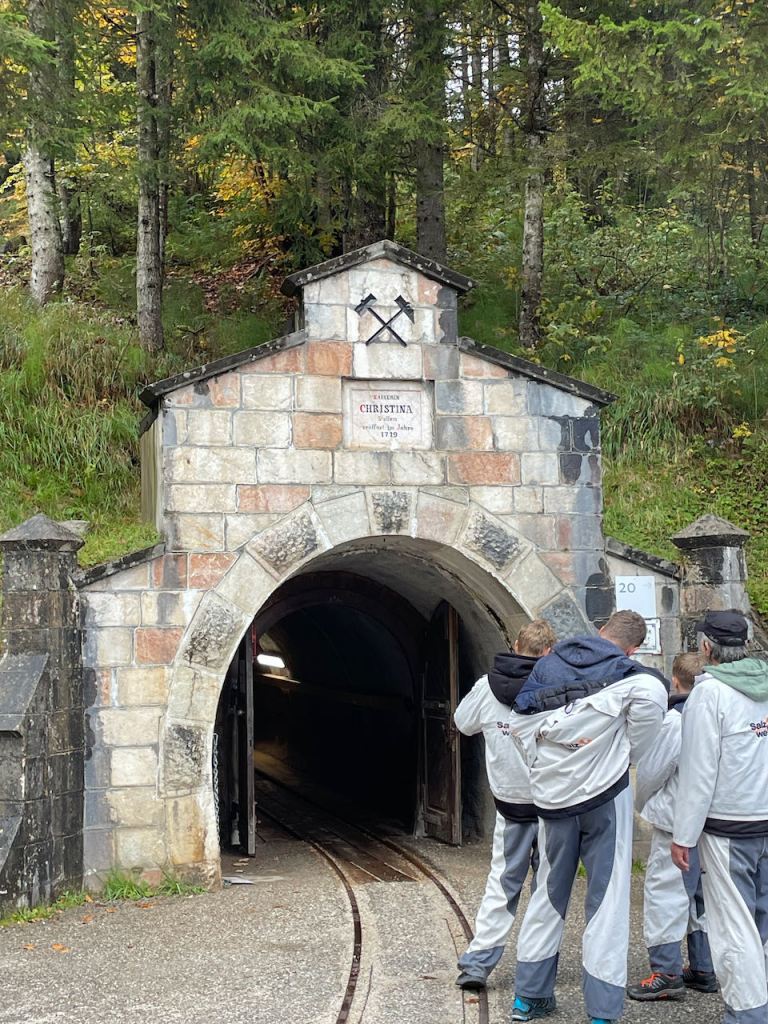
Once we made it to the top, we dressed up in our finest salt mining gear (it pays to pack for every contingency!) and prepared for our trek deep inside the mountain. This was our Salt Trek: To explore strange new condiments. To seek out new spices and new causes of high blood pressure. To boldly sprinkle where no one has seasoned before!
When I saw this sign in the waiting room, I knew exactly what was going to happen. You see, if you’re in a salt mine, you obviously have to use salty language (well, duh!). We knew we were being reminded of that by reading the above sign and realizing what it rhymes with. That said, fair warning, the rest of this entry is going to contain some very salty language. So if you’re offended by words that have been deemed objectionable by the U.S. Department of Words We Think Are Too Salty, then just scroll to the end of this entry or close your laptop with a light but firm slam to express your distaste, because I have to tell you that what follows is gonna contain some very salty language, dadgummit. Okay, I started it with an old swear word, but don’t worry, all the latest and greatest will be represented here.
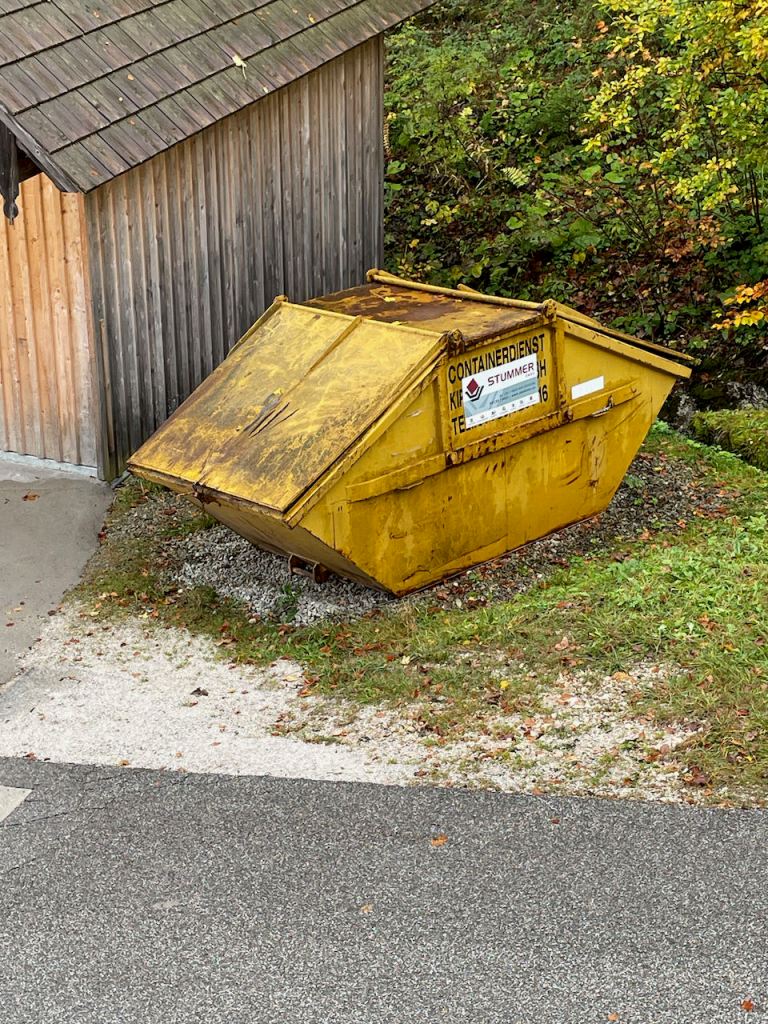
On our way up to the goddamn mine entrance I took the scenic photo on the left. Carolyn asked if I made sure to crop out the ugly-ass dumpster. I said, “yes, of course dear.” Then I took another close-up shot of the dumpster, just because I’m an ornery son of a bitch.
The dickhead tour guide (he was actually nice, I just had to figure out how to work in a “dickhead,” and we encountered no dickheads throughout this whole trip) marched us like jackasses to the mouth of the tunnel and made us do the wanker walk for what seemed like hours upon fucking hours. I fully expected never to be heard from again, surely much to the delight of those who cringe every time they read another swear word. Although I found it interesting that both Trump and Vance used words like “motherfucker” and “bullshit” during their rally speeches, upending hundreds of years of the tradition of mostly non-vulgar political public speech (often offset by more “fucks” per sentence in recorded history when the tape recorders were running in the oval office; Tricky Dick, I’m pointing at you). So I guess if it’s okay for the President… although I definitely draw the line at even talking about pussy grabbing. Unless it’s my cat. Oh, and no felonies here either, unless escaping from a salt mine counts.
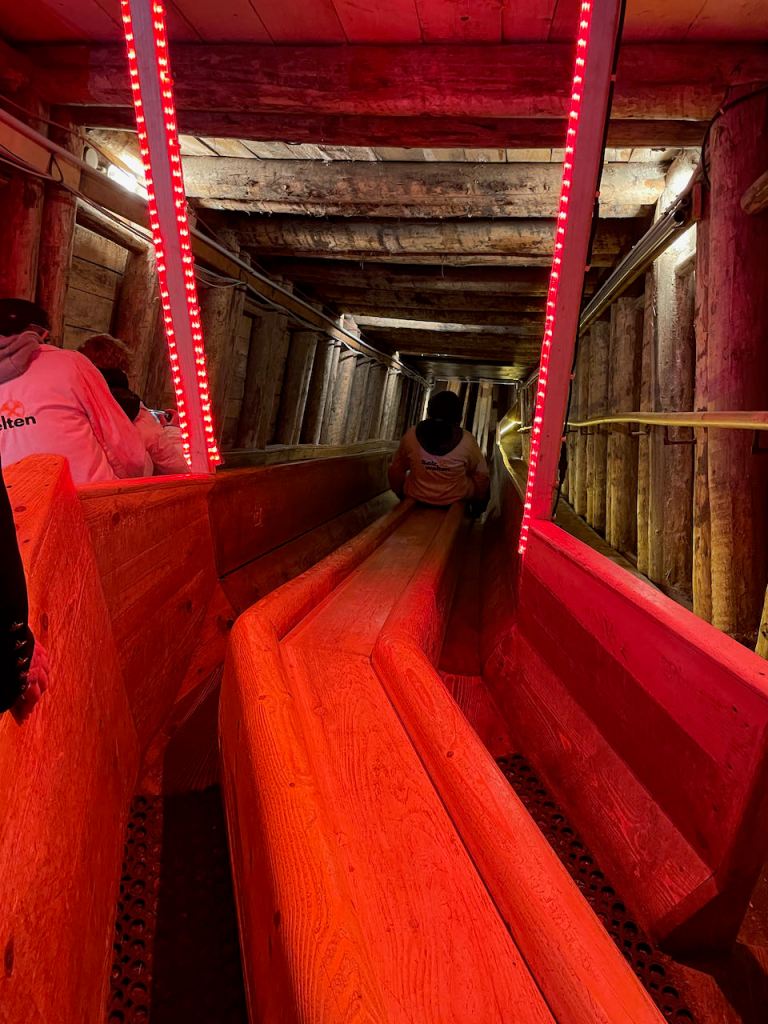
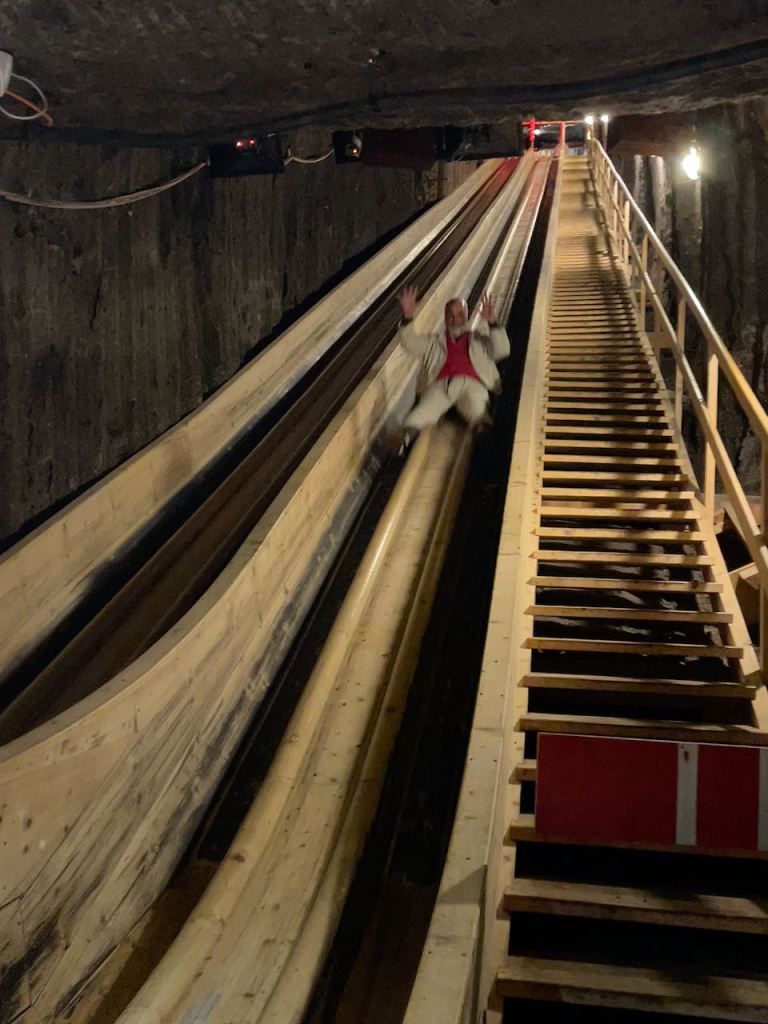
One of the things we learned is that to move between the levels of a salt mine you get to ride a long-assed slide… as long as you want to go down. It was a little goddamn scary at first because, y’know, we haven’t been kids for a couple of millenia now, but we managed to keep the skin on our asses and land on the bottom with only a few salty phrases like, “Whew! That was some salt-assed shit-scary piss-wizardy ride, boy howdy!”
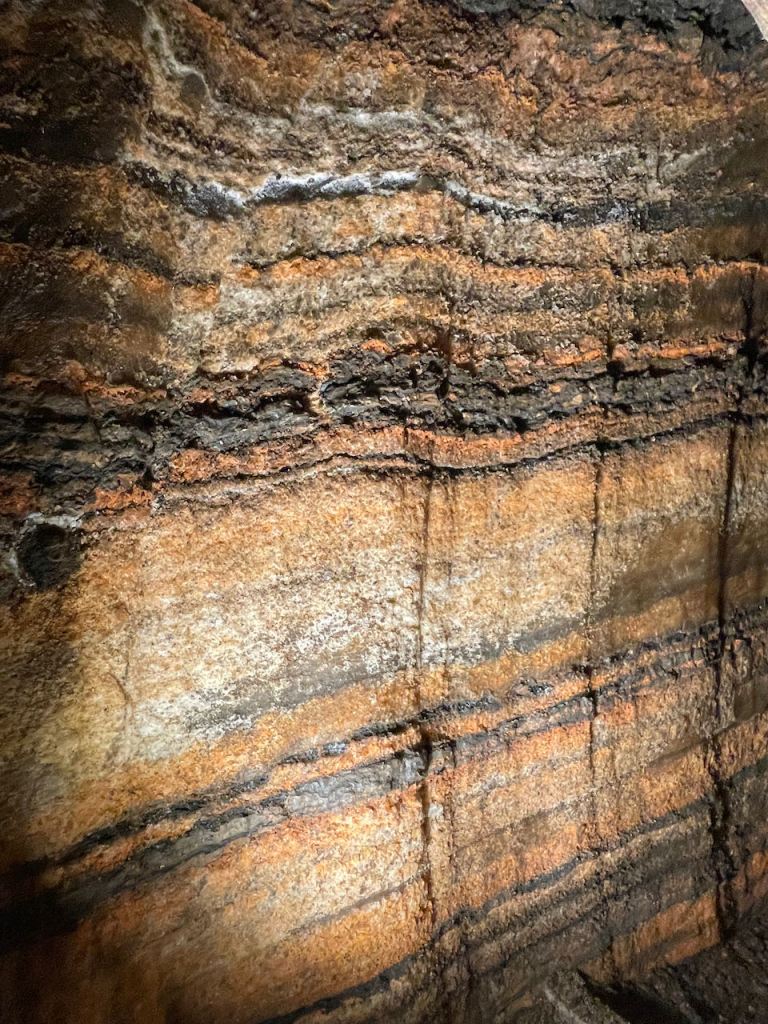
If you ever had the urge to lick something salty besides your partner, then come to the Hallstatt salt mines and lick the damn walls. We didn’t lick a wall ourselves, but we did lick our fingers, and then ever so gently began circling them slowly around and around until -oh wait, wrong lick thingee. Anyway we did in fact taste the wall. Spoiler alert: it was salty. These are the stratusses of salt layers, only interrupted by an occasional black pepper stratus. If you can believe it, even though this mine is the oldest operating salt mine in the world, with excavations dating all the way back to 2,000 years Before Kee-ryst (don’t worry, I never use the lord’s name in vain, although I’m guessing Jesus might’ve uttered a “goddammit” or two when his wine conversion count came up a little short… or would he have said “Daddammit?”), they have only mined about four bloody percent (The Brits- represent!) of all the salt in the mountain. Suffice it to say, humanity will have enough salt to last until we blow the motherfuckin’ planet up.
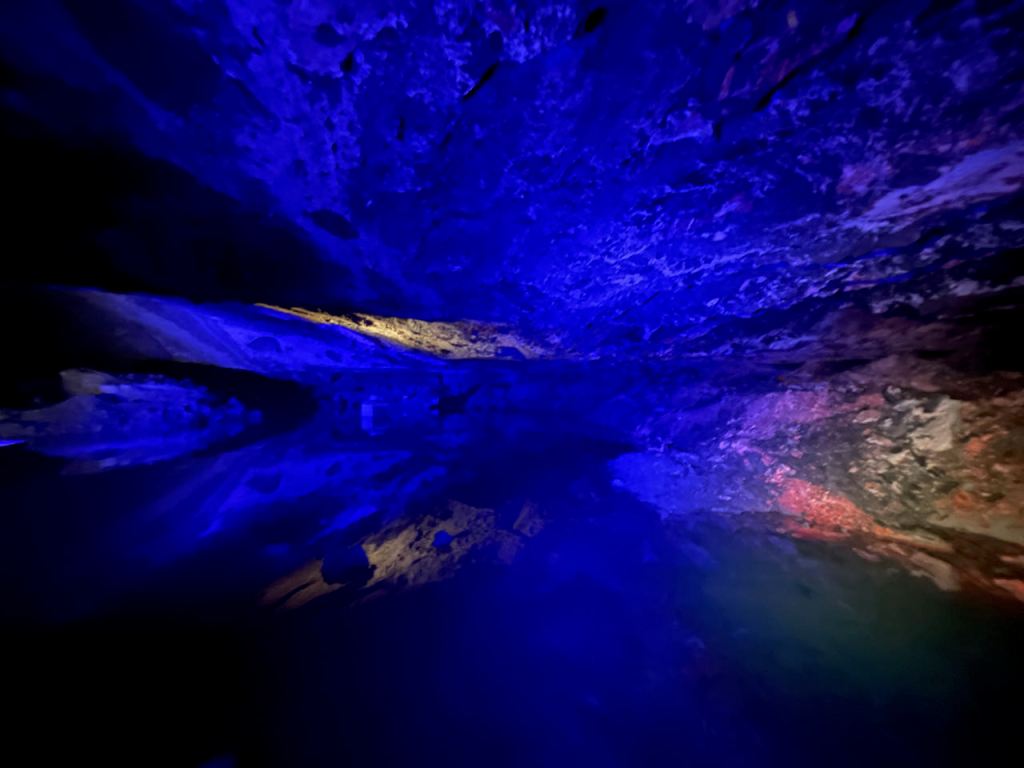
As we toured the mine, we were shown how salt apparently makes everything look like blue balls (unless this was formerly a stage for Blue Man Group), plus we saw a salty lake. All the tourists hurled obscenities at the salty lake because it needs that to keep it moist.
At the end of the tour, they loaded us on to this “train,” which looks like long-ass wooden benches for a long-butt picnic table. (Seriously, why can we say “long-ass” but not “long-butt?” Oh the vagaries of English are endlessly perplexing! Just like every word that starts with “vag.”) Also, we were slightly pissed off that the assholes didn’t give us a paycheck, talk about a horseshit way to get free labor. I almost burst all my gonads hauling those grains of salt. Fuck ’em all anyway, it’s all fuck news.
OK, here’s some pretty scenery to help everyone relax from all that saltiness. Now I’ve got to go wash my mouth out with soap.
We were very excited to shop for Polish polish, figuring that if nothing else, the repetition of the word would confirm that you are indeed holding polish. Carolyn, being an Interior Designer, talked about Polish polish in almost mystical terms, kind of like Cuban cigars or yogurt-pooping unicorns. We never did find any, probably because “polish” in Polish is “pastować.” I saw a bottle of that and thought it was something you smash spaghetti with.
We made the four hour drive (well, it was supposed to be four hours anyway; bladders and castles wreak havoc on driving times) from Trenčín to Kraków, checking off two countries we had never been to, bringing our total to 21 European countries so far, give or take.
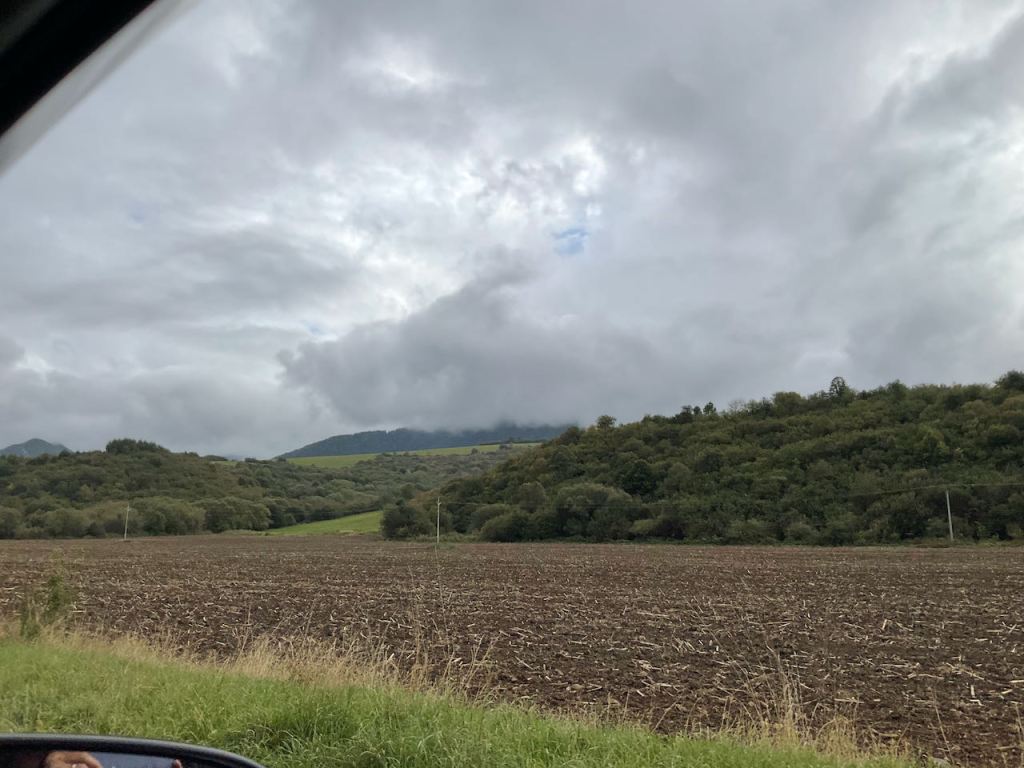
The above was among our first views of Poland’s landscape. We discovered that the countryside was largely the same as Slovakia’s. It’s almost as if nature doesn’t really care about human borders. Psscht. Stupid nature. Doesn’t she know that humans are the only things that matter?
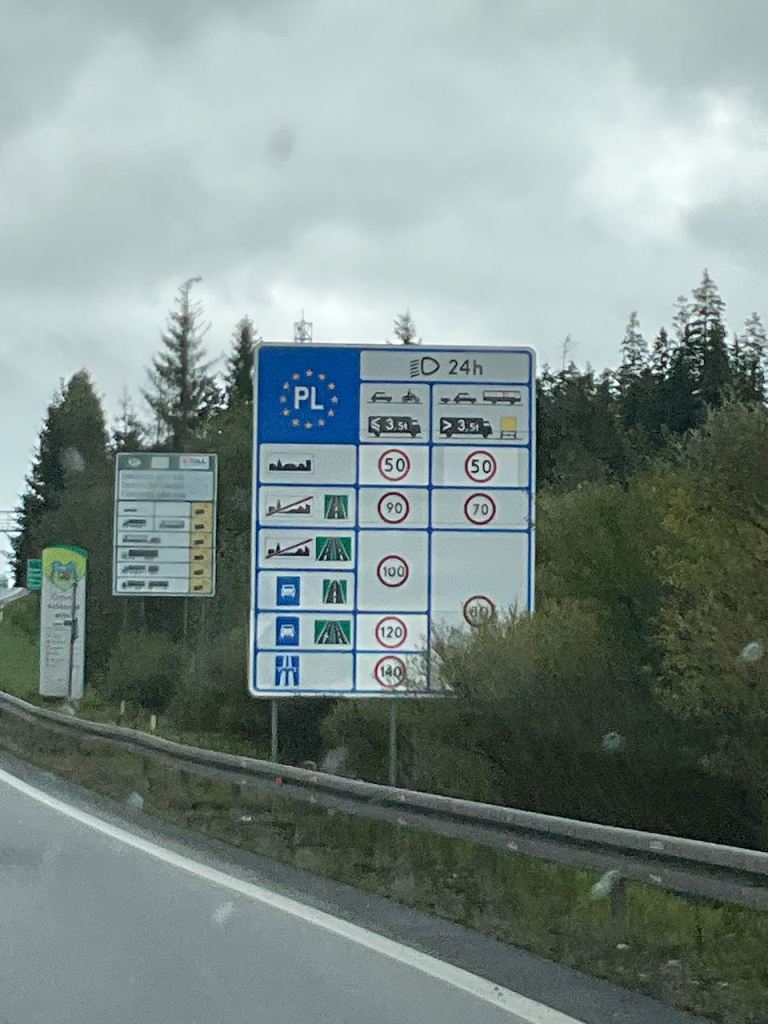
To show nature who’s boss, humans put up a big sign letting us know we were in, um, Ploland? The license plates in Portugal, which is the only other country in the EU that even starts with a “P,” simply have a “P” on them because Portugal joined the EU in 1986, whereas Poland didn’t make it in until 2004, so Portugal got first dibs. But why not use “PO?” Maybe it’s because in Polish, “po” means “after,” while in Portuguese, it means “dust,” while in American English, it means a penniless hooker. Oh wait, that’s actually “po-ho,” so we’ll settle for it being how they say “pour” in the south. Or poor. Or pore. My God I’m glad I’m not still learning English.
Whatever the reason for the “PL,” those in the know and who want to save time just say “Pluh” when referring to Poland. Now you can be an insider too! In fact, you can try it out on the next Polish person you meet. Just say, “I’m thinking of flying to Kraków, Pluh.” Your Polish friend will be so impressed!
When I think of Poland, I think of potatoes, polish vodka, and long skinny sticks. However nowadays, Poland is only the eighth-largest producer of potatoes in the world. While I don’t know the above is a potato field, I’m sticking to my story that it is, especially since I don’t see any long skinny sticks.
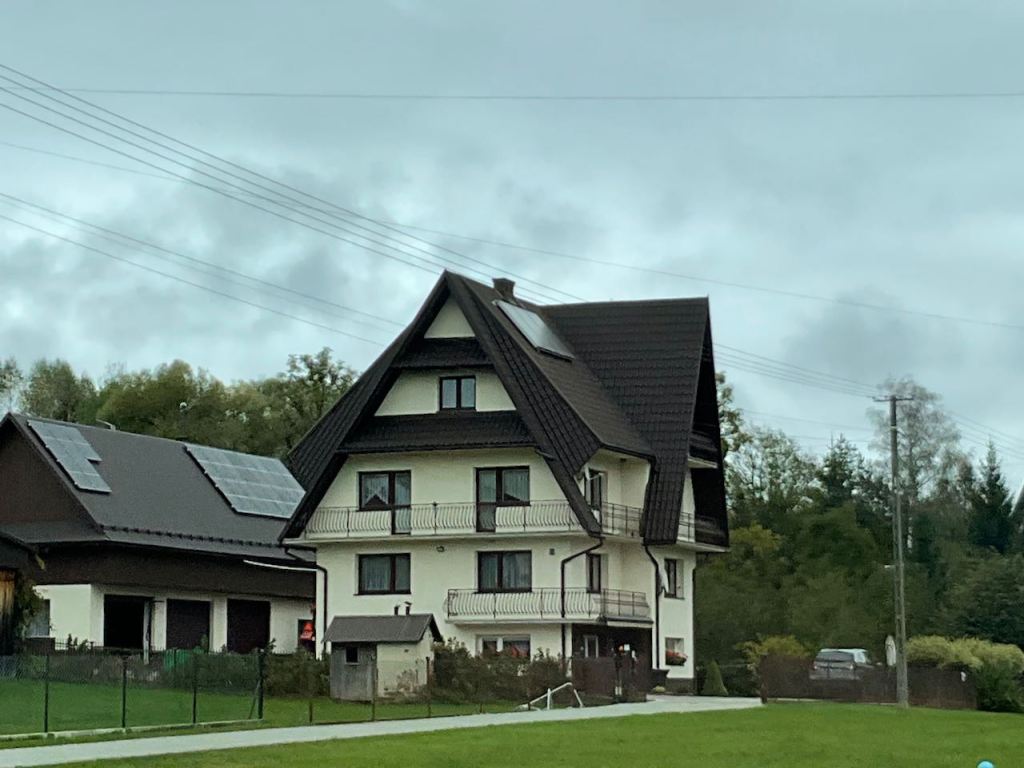
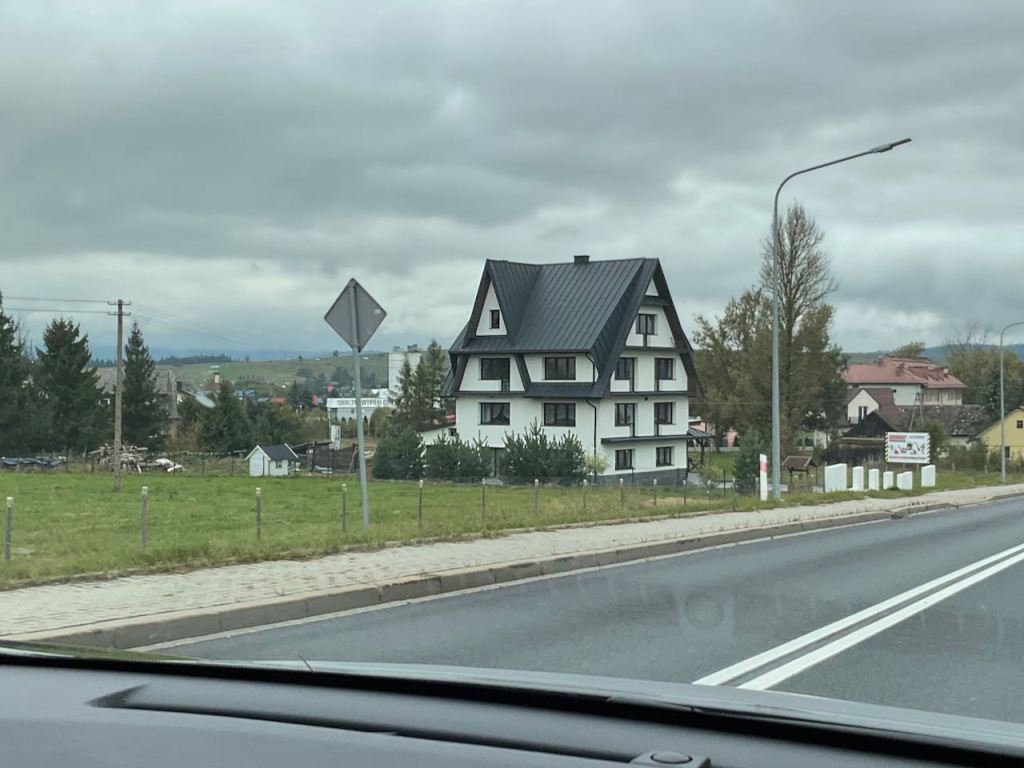
As we drove toward Kraków, we noticed a distinct difference in the housing from what we saw in Slovakia. Many, if not most, of the houses we saw were at least two or three stories tall, which each level being nearly identical to the one below. It seemed a little contrary to what we know of Poland, since it suffered through a Communist regime after World War II until 1989, and it usually takes a while for prosperity for the middle classes to catch up after being subjected to what really was just a dictatorship, controlled by Moscow.
So we asked a Polish guide why they had so many multi-story houses and he told us it was because during the Communist regime, people had to save money so those houses were designed to be multigenerational. So you just lived with your parents and maybe grandma and grandpa, like those lazy old people from Charlie and the Chocolate Factory who wouldn’t even get of bed until they learned that Charlie was going to get a tour of Willy Wonka’s factory. Oh then grandpa’s able to jump out of bed and dance a jig. Lazy old bastards; their muscle tone must’ve been just one step away from jellyfish, so I think grandpa might’ve snorted a bit of meth before doing that jig. Do you ingest meth by snorting it? I have no idea and I hope you don’t either.
A couple of the residences we saw were capable of housing families the size of small towns while others offered permanent sleeping arrangements.
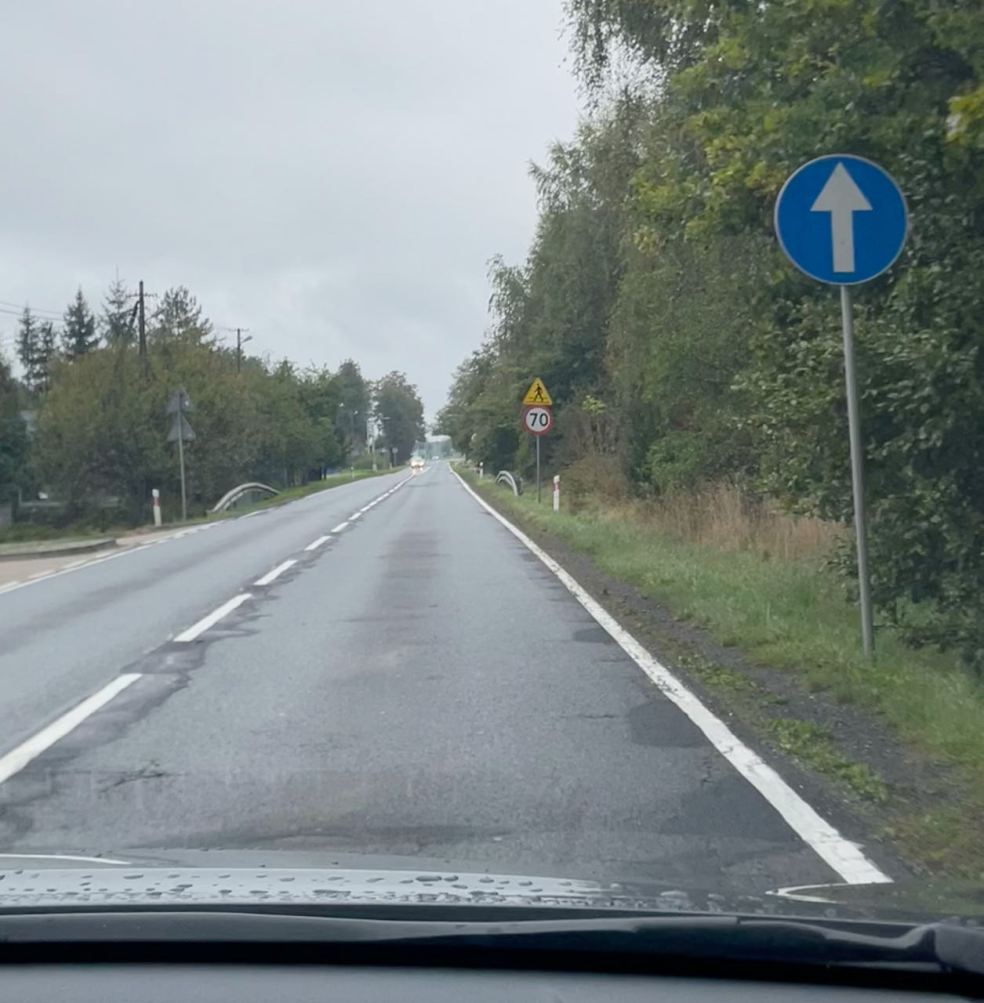
The purpose of this boring photo of the road is to remind me to tell the story of what it’s like to drive in Poland. At least on the two-lane roads (we were told there aren’t that many four-lane highways in Poland, although we found at least one), you discover that 70 km/hr is pretty much the standard cruising speed, but you have to lower it to 50 km/hr and sometimes 30 km/hr when entering a town. Often the towns are close enough together that within a minute you go from 70 to 50 to 30, and then just as quickly back to 50 and then 70 because many of the towns are quite small. This happens over and over and over again. It’s like driving in a mini version of Groundhog Day.
I try my best to drive the speed limit in foreign countries; but my best isn’t always good enough because they have radar cameras everywhere so I’ve gotten speeding tickets in about four different countries. The two hardest things about driving within those speed limits is that some cars have a little chime they spew –trust me, it’s spew– when you go even ONE kilometer over the speed limit. I’m trying to keep it at 70, but of course sometimes it slips up to 71, BING! Dammit. I go back down to 68, look at some sight and apparently press ever so slightly on the gas, BING! Our drives consisted of a lot of bings. And you can’t really use cruise control because you’re speeding up and slowing down so often.
On top of all that, if you do adhere to the posted speed limit you end up with a long line of impatient drivers behind you who apparently don’t mind that there are cameras and who passed us whenever they got the chance.
We took a picture of this bus passing us because… a bus passed us. We were doing the speed limit. There was one time I was probably doing something like 10km or so over the speed limit for about ten seconds, we got a nice big flash in our face telling me that we’re gonna have yet another country’s ticket coming. You know, in Iceland we never saw one speeder. If the sign said 100, then by golly that’s what everyone did. Not so in Poland, despite the fact that they have plentiful cameras and they’re not afraid to flash drivers. Out of curiosity I looked up speeding ticket averages in Iceland and Poland. Perhaps predictably, Iceland’s ranges from USD $195- $460 or more, while Poland’s ranges from $25 to $100. I think I’ll be finding out how true that is soon enough.
So it’s either piss off the locals, or risk getting a speeding ticket. BING!
After all that stressful driving we needed to find someplace where we could get drinks to pour into our alkoholes.
One of the ideas I’ve embraced after traveling all around Europe is that if we’re going to use a hotel, which is almost always a good idea if you’re going to stay right in the middle of downtown, is that I favor American-branded hotels over any other. It’s not that European hotels are bad, it’s just that Americans, well, they’re pretty damn good at providing comfort, and their usual cheery helpfulness can be very appreciated when you’re needing help, and most American-branded services in Europe have at least a little touch of American customer service in them. That said, throughout my entire life I have avoided Holiday Inn. In my mind, they’re just a small step from Motel 6, and are often shabby or rundown. So look at the above picture and gaze in wonder on what is easily the most beautiful and amazing Holiday Inn I’ve ever seen. On top of that, it was right on the border of old town Kraków, which is exactly where we wanted to be. We had a lovely stay and I’d highly recommend it if you’re staying in Kraków. It’s affordable too, just over 100 euros per night for a standard room.
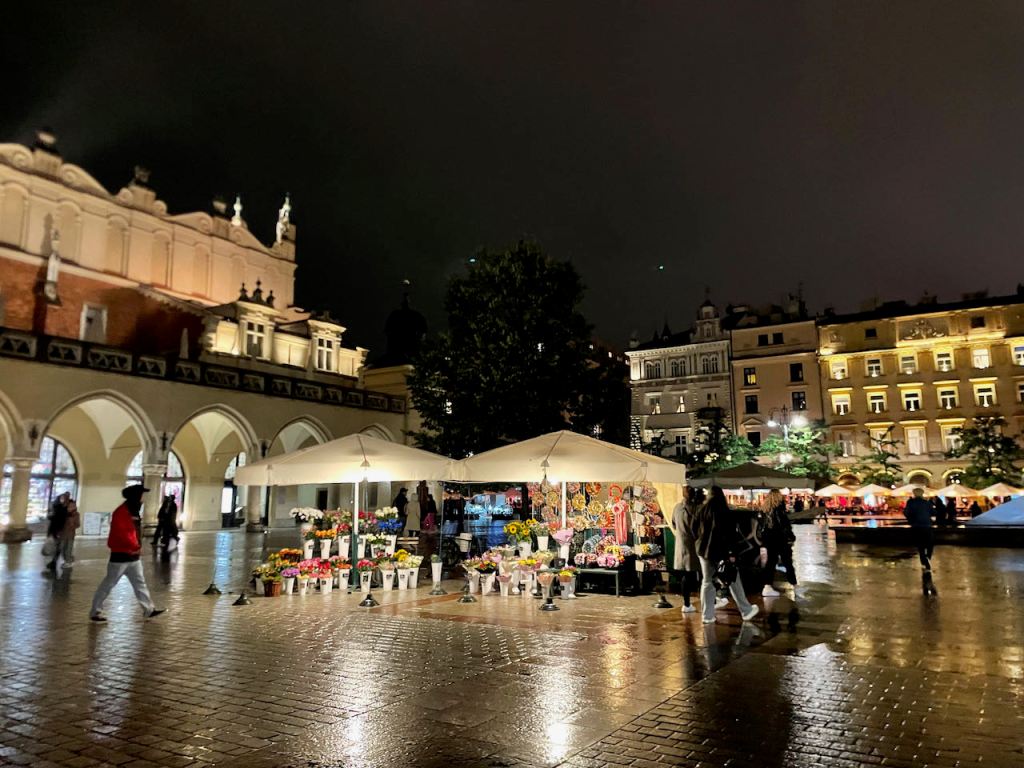
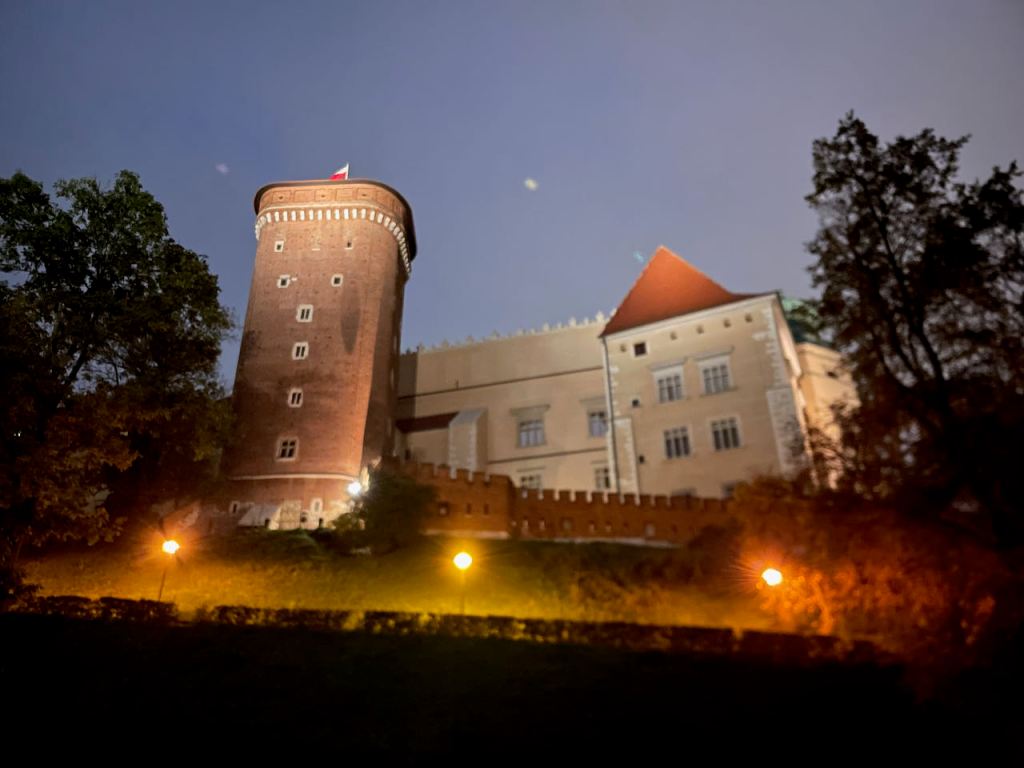
Without a lot of time to spare, we felt fortunate that the best sights of Kraków are experienced in old town, called “Stare Miasto” in Polish. Most city guides you see about Kraków pretty much focus on this area of the city, and our favorite Holiday Inn ever was only a short walk away.
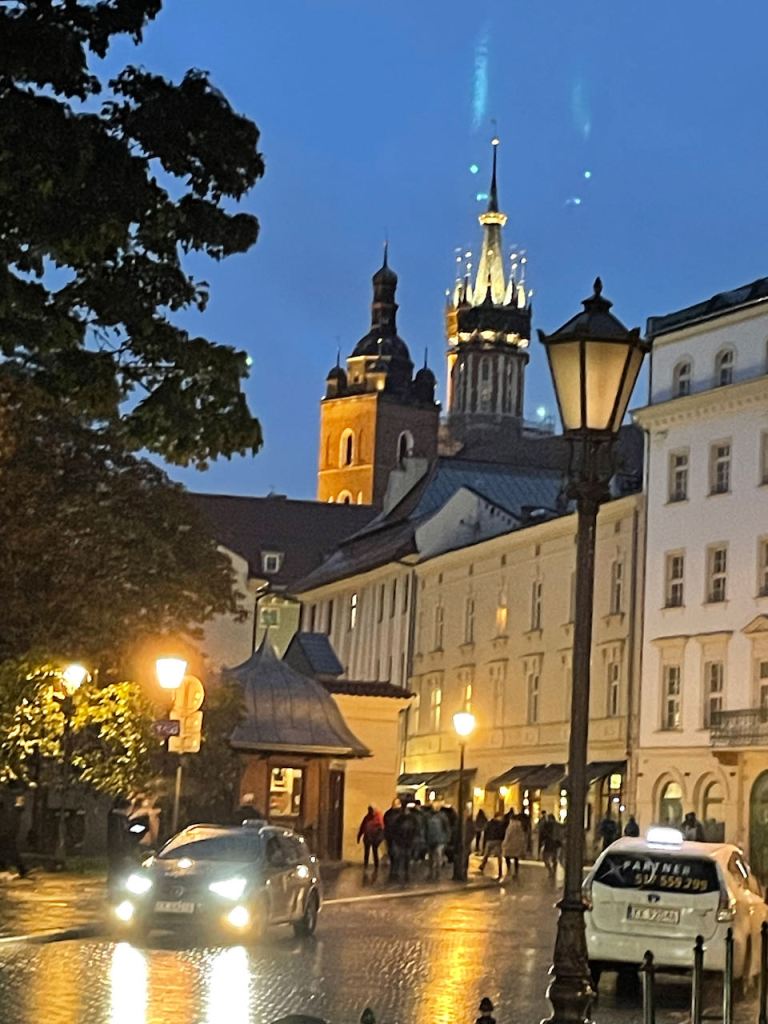
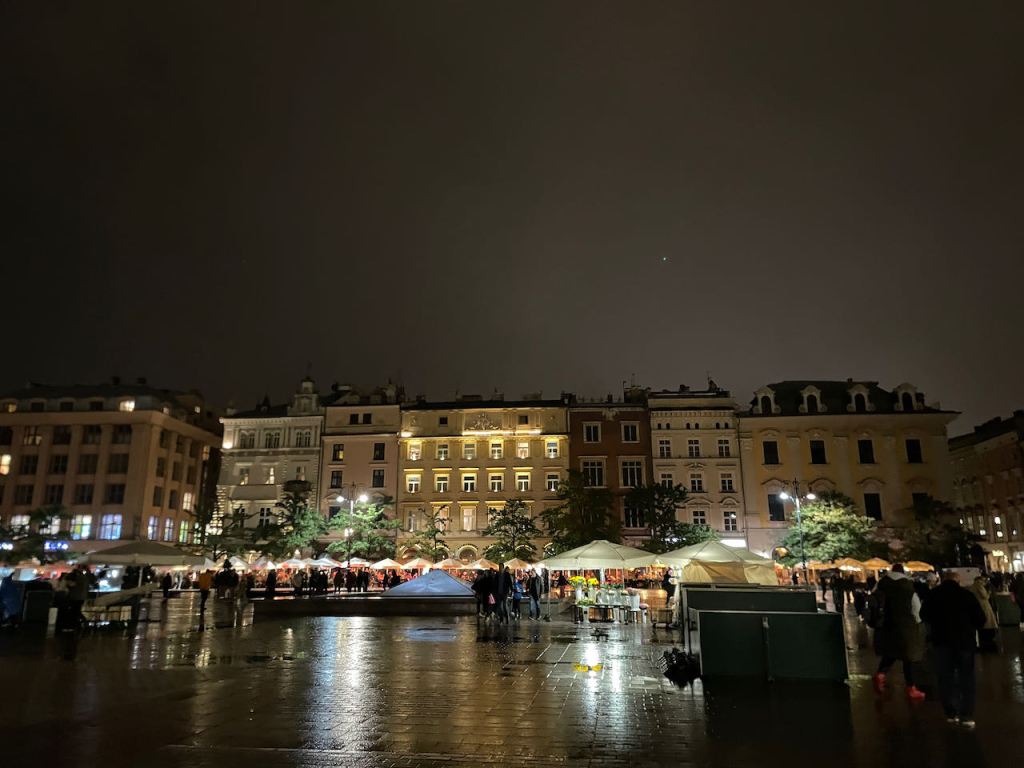
The area didn’t disappoint. It was alive with tourists and beautiful old buildings, and even though it was well-touristed, the area felt safe and we weren’t bothered by any blatant touristy hassles.
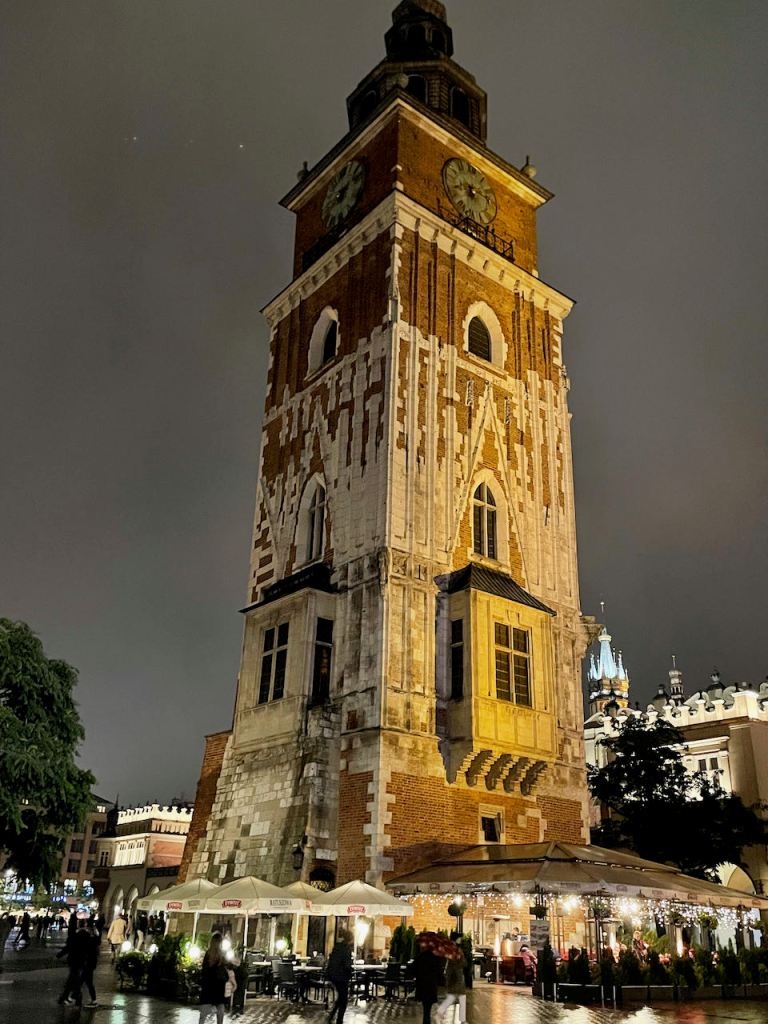
I could go do some research and detail the names and purpose of each building (actually, many of them were churches and castles so we hardly needed much help there), but the truth is we didn’t much care about the details while we were seeing them, so I’m imagining most readers wouldn’t either. We just enjoyed their grandeur and beauty. I did find it interesting that the largest and most imposing building is the Cloth Hall (Sukiennice), rebuilt in 1555, in the photo below. Basically it’s the world’s oldest shopping mall. We figured it had to be some sort of palace or government building, but no, it was, and is still, a shopping mall.
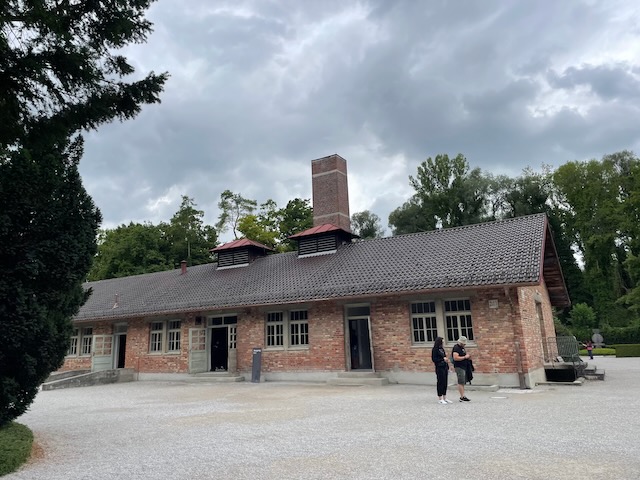
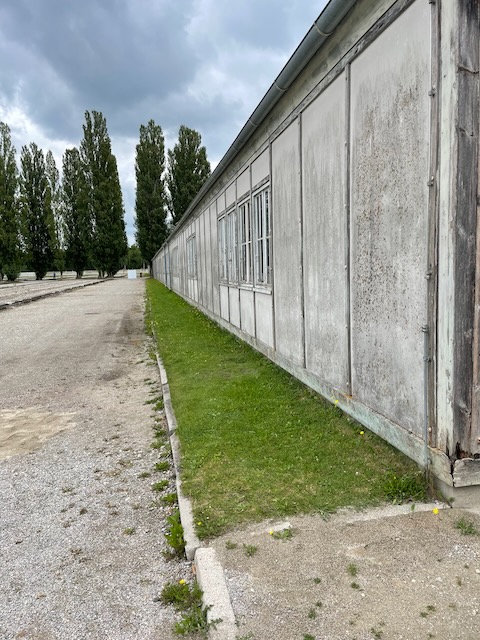
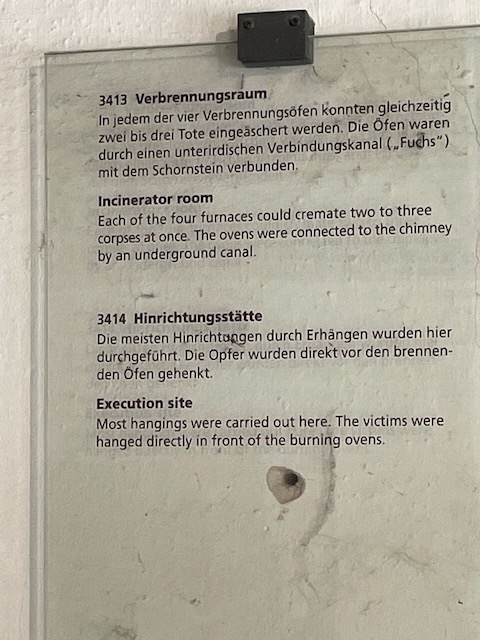
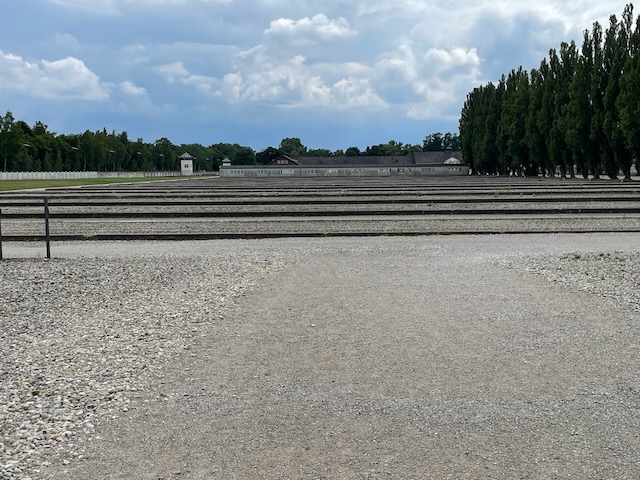
Kraków wasn’t bombed during WWII, which is part of the reason these buildings are still standing. They had the Kraków Ghetto, established to exploit, persecute, and terrorize local Polish Jews, because of course it was so obvious that the Polish Jews are the reason Germany lost WWI. Kraków has some WWII memorials and museums, such as the Jewish Ghetto, the Schindler’s Factory Museum, the former Plaszow Labour and Concentration Camp, and the original Gestapo Prison, but we were only going to have time to visit the biggest monstrosity of them all: Auschwitz.
If you were to tell anyone who asks how to find the most frequented tourist spots in a European city, just tell them to look for the horse-drawn carriages. Many if not most large European cities seem to have them out there in tourist areas. It looks romantic, I suppose, but after riding in one or two over the years we’re happy to settle for photos and fewer horse farts.
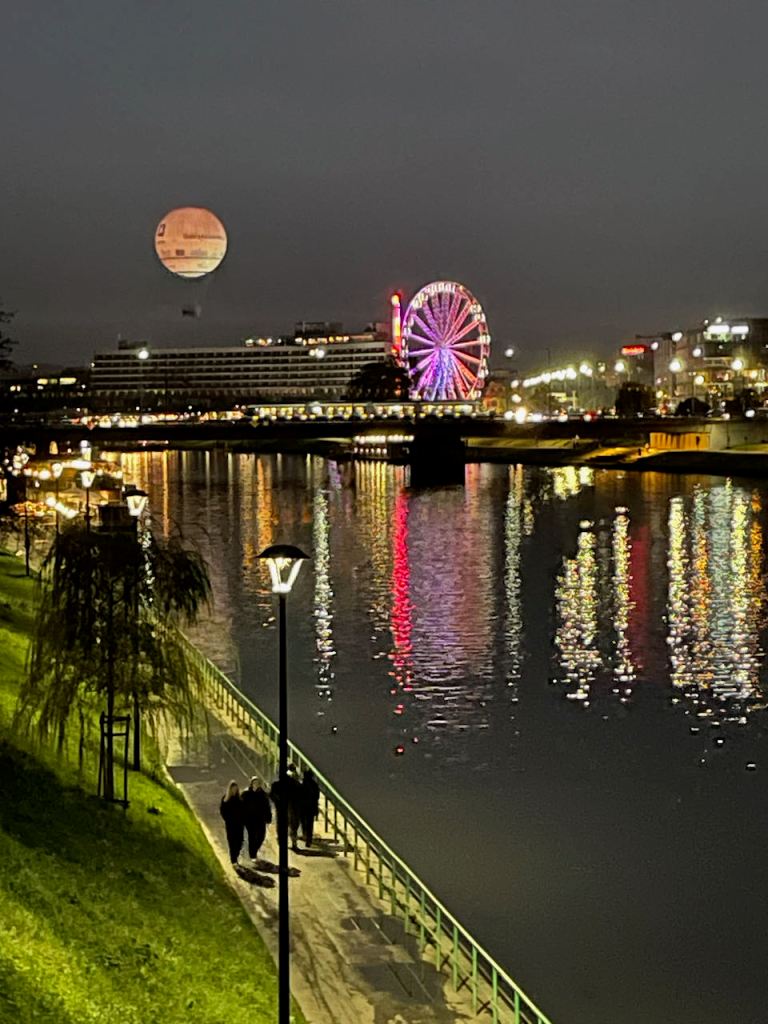
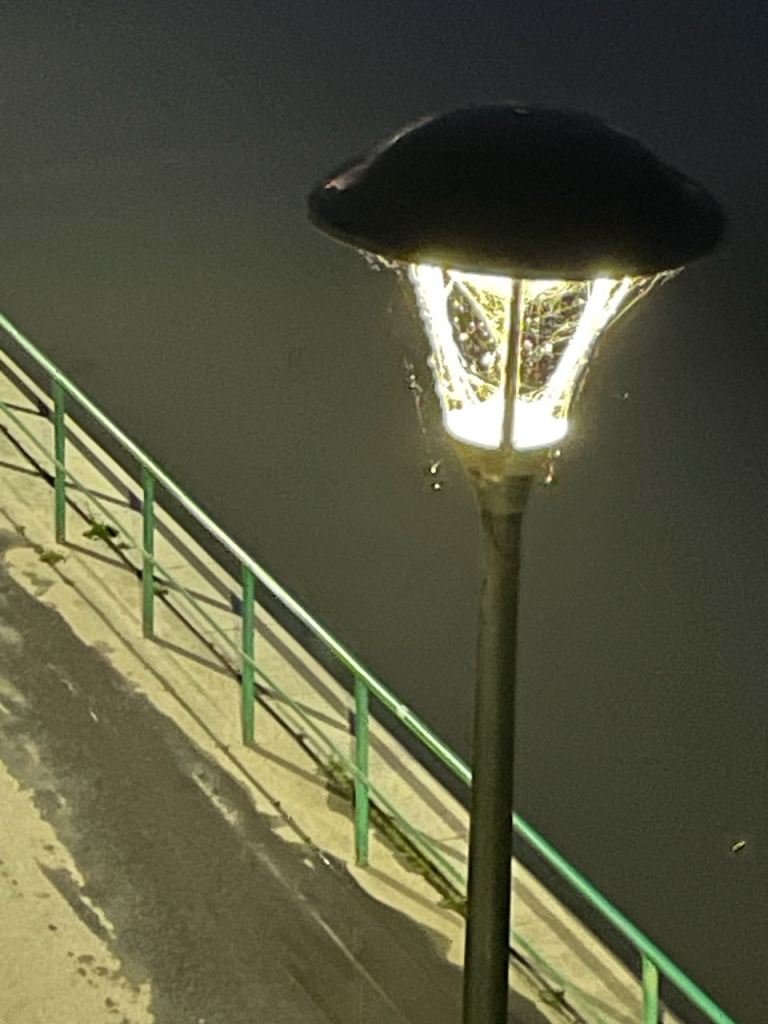
As we wandered around the area we spotted this amusement park across the water. That’s not the moon to its left, it’s a hot air balloon. We took a closer look at one of the lamps and saw that it was a feeding ground for what had to be some very fat and happy spiders. Letting them stay that way seems like a very eco-friendly way to keep the bug population down. It must work, we weren’t bugged by anything.
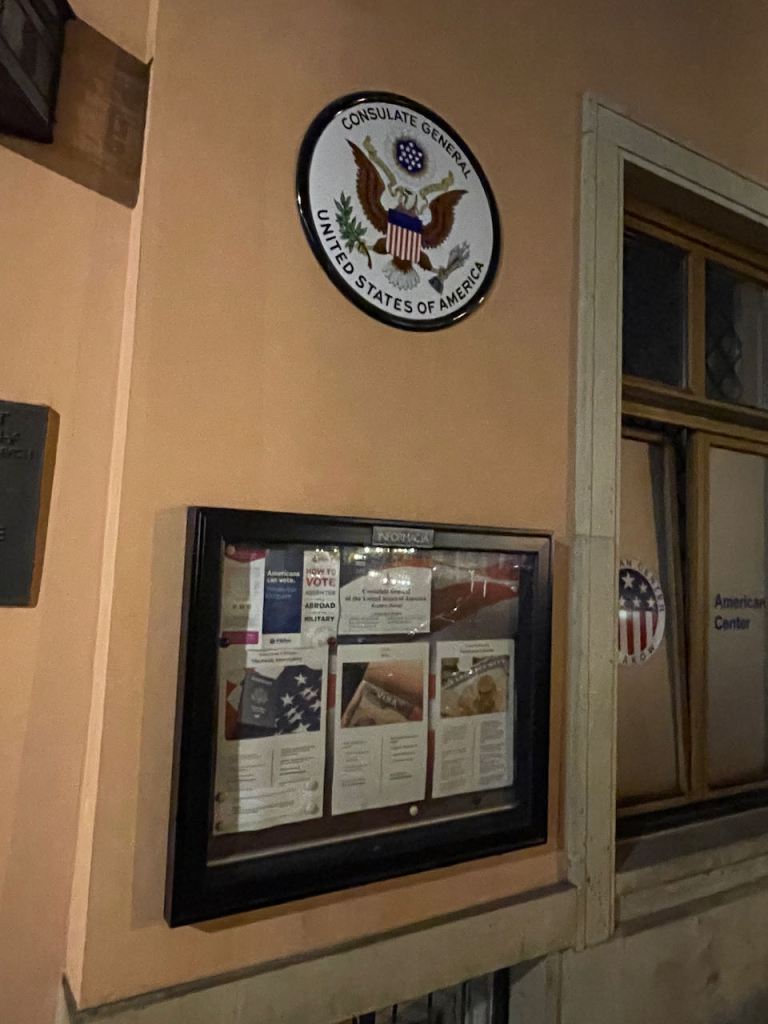
Somewhere along the way we spotted the American Consulate. I tucked its location away in my brain in case I succumbed to a desire to shoplift or beat up a local again. Of course, seeing as how my brain can only retain about the last ten minutes of information, I promptly forgot where it was and so decided I had better behave.
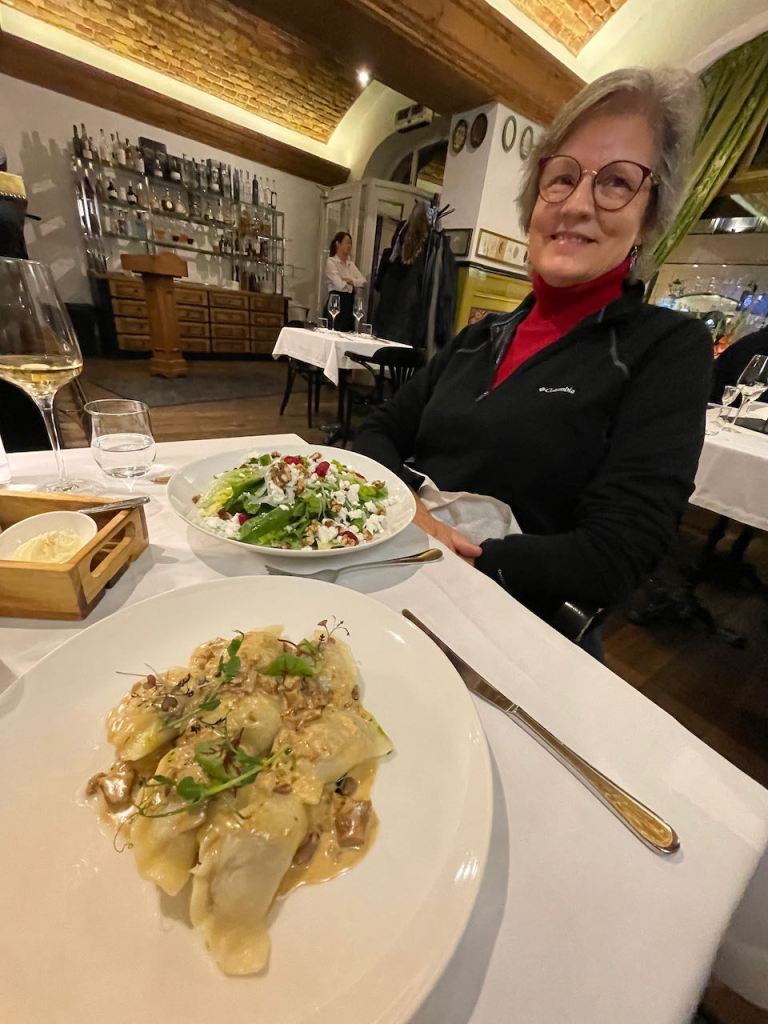
We found a nearby restaurant that featured good old fashioned Polish food (we’re not foodies, but I always try and seek out the local dishes just to slightly immerse into that country’s culture). I promised our friends who couldn’t make the trip with us that I’d try and report on pierogi: Polish dumplings, a common food in Poland. It’s a dish invented almost 800 years ago that stuck around because potatoes are a cheap staple. The dumplings themselves don’t have much flavor, so it’s all about what’s inside. They didn’t have any with hot fudge sundaes in them, so I had to settle for whatever this was, I don’t remember. But it was tasty.
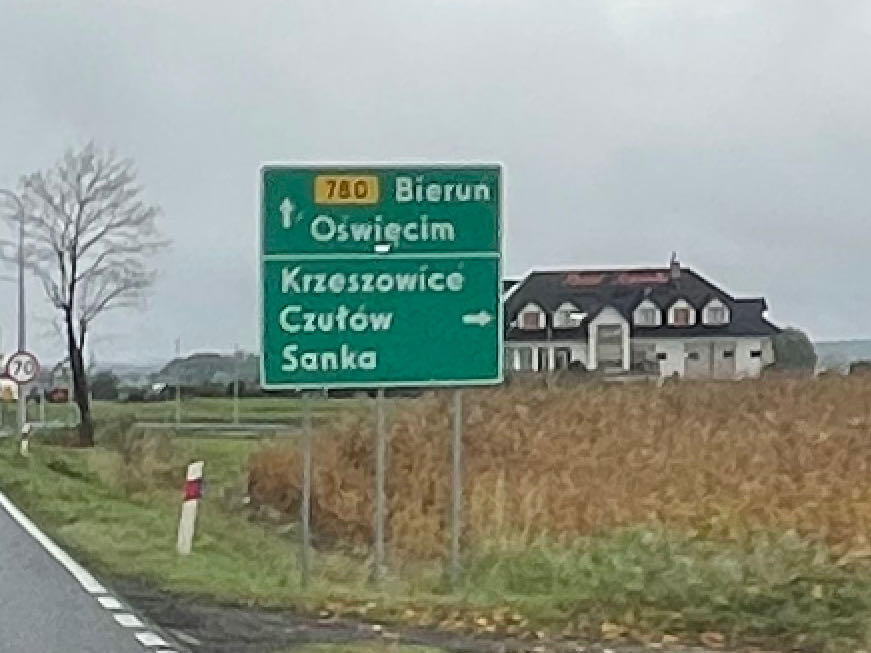
The next day we drove past this ominous sign. That’ll be the next blog entry.
As our bodies slowly but surely ooze their way into old age, the idea of a long, arduous travel itinerary with lots of stops just doesn’t feel like something we want to do anymore. So what did we do? We booked a long, arduous travel itinerary with lots of stops. That’s the problem with getting older, you forget what you vowed never to do again until you’re in the middle of it wondering who else you can blame.
If a sightseeing vacation is like a buffet, then many Americans who travel to Europe often plan to stuff as much into their sightseeing gullet as possible, sometimes resulting in what I call “mental vomiting” (and by “what I call,” I mean I made it up just now), whereby all the sights and experiences just regurgitate into a big, smelly, often hard-to-remember mess. (Way to ensnare your audience so artfully by talking about vomit in the second paragraph, Anderson! Woohoo! Anyway, I’ve already given up my dreams of a Pulitzer for the Best Travel Blog Featuring a Hairy, Fictitious Animal, so yeah, vomit ho!)
But since we live in Europe, we are able to be a little less stressed out by the Buffet d’Travel, because we know two things: 1) Coming back to a place is almost always an option because we don’t have to do that grueling 20 hour expedition from the states, and 2) We will never ever see everything there is to see even if we were on the road 363 days a year (we’d take Christmas and New Year’s off), and so we don’t sweat it if we don’t see everything.
However, the cornerstone we built this whole trip around was Auschwitz. We felt as if it was our duty to see it. Humanity has done some awful things to each other throughout our existence, and I think it’s important that we don’t sugarcoat histories or forget them. There are holocaust deniers out there as well as some extremists who proclaim that the camps were “humane.” I would beg to differ (actually I wouldn’t beg, they just need to be slapped upside the head), I think Auschwitz provides the very definition of “inhumane.” So the more of us that see the place of atrocities firsthand, the less traction these dipshits might get with their hateful revisionist histories.
Once we decided on Auschwitz, we realized Krakow is very near there, so hey, let’s spend a few days in Krakow (which was not on our bucket list but should have been), and as long as we have a car let’s drive through Slovakia and Czechia and y’know what? Carolyn always wanted to see Hallstatt and that’s on the way to Munich during October, so free beer for us, yay! Oh wait, there’s Innsbruck too, where they held the winter Olympics twice, so let’s take a daytrip down there and maybe we’ll see a famous skier. And then we saw a road sign to Budapest, so I’m like, “Honey! You wanna drive to Budapest too?” We seriously considered it because even though it wasn’t on our bucket list, how often are you close enough to drive to a place like Budapest? Ultimately we decided that a city named after big flying bugs that look like fat bald men was probably not worth it, because of course Buddha Pest was the original name of the city. And Buddha Pest insecticide is almost impossible to find nowadays, so yeah, naw.
We flew into Vienna because we had original plans with some good friends, but sadly they had to back out at the last minute due to family issues, so our itinerary became a little fluid. While flying into Krakow would have saved some driving time, we likely wouldn’t have added Slovakia to our countries-visited list, nor would we have discovered the charming little town of Trenčín. So fly into Vienna we did, where we promptly hopped into our rental car and left the city in our rearview mirror. “We shall return!” we cried. No one in Vienna cared.
Anyway, this sign for the Vienna State Opera greeted us and I couldn’t help wondering whether the woman in the photo was looking shocked because the man was singing an opera at full volume right into her ear, or whether he’s whispering, “Opera is stupid” even though he’s an opera singer, or whether he is admitting that he just peed his pants.
We decided to put a couple of hours in on the road because Vienna to Krakow is a five hour drive, so I had selected Trenčín because it was the desired distance away and it is in Slovakia, plus I liked the little bowl on top of the “c.” I was going to make a joke about that, but then I looked up how to pronounce “č” and I thought the instructions were funnier than anything I could come up with: Your tongue is positioned at the front end of the hard palate (i.e. the roof of the mouth), close to the front teeth. č – (“tvrdo” č – the “hard” č) = tš. Try to blend the sounds t and š into one “hard” sound and there you go! The tongue is positioned more backward against the hard palate.
Yeah, well, I like my “c’s” to take as little work as possible, thank you very much, so I’ll stick to my English and bad Portuguese, the latter of which has already damaged my nasal cavities. However, you have to admit the USA’s full name would look much more exotic if it were spelled: The United States of Američa. Naw, now that I see it, that’d be Socialist-y fer sure. Plus I still don’t know how to pronounce “č.”
So let’s move to our Trenčín experience. Raise your hand if you’ve ever been to, or even heard of, Trenčín. Yeah I thought not, but if you have, why are you raising your hand when you’re alone reading?
We’ll begin with the Hotel Elizabeth, because that’s where we stayed. The hotel started operations in 1902, I think making it one of the newest buildings in all of our photos from the trip. He he. Anyway, it’s a charming hotel, and sits just beneath the medieval Castle of Trenčín, and was otherwise the perfect destination for our one night stay.
As you can see, it was a bit of a dreary morning and we still had to drive off to Krakow, but there was a cute little town square and so we wandered around just enjoying the ambiance of this little Slovakian town. It made me wonder about the hundreds and hundreds of small charming towns all around Europe we’ll never see or hear of. Like I said earlier, we can’t see ’em all, but the ones we do we sure enjoy!
The town’s skyline is dominated by the Castle of Trenčín, whose history dates back all the way to Roman times. A cliff with a large inscription abuts the hotel, and tells of a victory by the Romans in 179 AD. Of course, I’m taking their word for it, it may be an ancient No Parking sign for all I know.
Carolyn scored two Doors of the Day in Trenčín, so she left happy.
We’ll move on from Trenčín just as soon as we grab a snack from the local 7-11. To be honest, I have no idea if most Slovakian convenience stores leave this much floor space open or if the owner of this shop is some sort of neat freak, but I was kind of bemused at the sight. In the USA, you’d have to walk past huge stacks of six packs with big cardboard cutouts of your favorite racer showing how awesome beer and car racing go together, along with racks of candy, and then more racks of candy, plus 38 varieties of chips just to reach the cashier sitting behind a counter that looks like it was merchandised by a hoarder. In comparison, this store just puts one 20-pack of soda on the floor and decides that’s about all the floor space they can sacrifice.
While in Slovakia, we learned that it’s quite renown for all of its castles, somewhat to our chagrin because we were just passing through. But we did stop at one that was along the way to Krakow, and that’s the Orava Castle, named after Orava, a famous sword-wielding flying squirrel with a cape. Orava actually does mean squirrel, so boy howdy that little rodent must’ve been quite the specimen! Of course, nothing instills fear into an enemy like facing an angry squirrel. “The squirrels are attacking! The squirrels are attacking! Aaaaaah! Run for the hills!”
The castle was built when the area was part of Hungary, with the oldest parts being built in the thirteenth century and the most recent parts in the early seventeenth century. Of course one of the main things we like about castles are the views, and the Squirrel Castle didn’t disappoint in that regard. We didn’t go nuts for it, but it was nice.
In addition to the views, Carolyn scored another Door of the Day, while I scored a Dress of the Day, a Window of the day, and a Carriage of the day. Our trip was already so Of the Day fulfilling!
I was thinking this cannon probably wasn’t all that efficient given that if the aim is just a little bit off, like it is in the photo, after all the smoke and dust clears you’re going to see that you inadvertently expanded your window size quite a bit. They eventually moved the three barrel design over to big battleships, which was great in WWII, but have now been rendered obsolete by $100 drones.
But you know, they always had comfortable sleeping arrangements available for those who screwed up. While it’s obvious you’d have to be a real dummy to end up being tortured like that, I still feel for them because their clothes are pretty bland plus everyone knows you don’t wear white pants after Labor Day. It’s just all so sad.
Speaking of sad, you see, these are the challenges we face with different languages. I hope that’s not a Roasted Grandma in there, you never know what weird customs all these foreigners get themselves all up into. Plus everyone knows you don’t eat Roasted Grandma until Easter. Still, that is a pretty good price.
What, first it was hobbits, and now it’s Yoda? Okay, I’m gonna offer up a sneak preview just to show why that headline makes sense. This photo is taken from the inside of a cave, known as –and I know you’ll never guess this– the Yoda Cave. I don’t know how they came up with that. Actually, rumor has it that George Lucas spent a fortnight in the cave doing psychedelics sometime in the early ’70s.
In fact, if you look carefully, to the left you can see the outline of Princess Leia’s chin, lips, and nose. Additionally, the outline of Luke Skywalker’s buttocks is easily seen on the right, and Hans Solo’s cleft chin is obviously part of the rock formations on the far left. So I guess we can thank Icelandic caves and LSD for Star Wars!
Kirkjubæjarklaustur
Maybe I should’ve used a Star Trek metaphor, given that Captain James T. Kirk’s actual name was James T. Kirkjubæjarklaustur, only shortened because so many aliens couldn’t pronounce it. A lot of people have no idea that Captain Kirk was Icelandic.
Anyway, Kirkjubæjarklaustur was a verdant source of all sorts of things to see and do, including talking with Yoda and playing with actual lava. Off we go to where no man has gone before!
First we had to get our motor runnin’, then head on down the highway, lookin’ for adventure, and whatever comes our way… Born to be Wild, Born to be Wi-i-i-i-ild!
I might add the following verse just for us:
Driving a dumb Ford Puma
Swerving to our doom-ah!
With the conTrolls fighting us at every turn
The Ford engineers must burn!
Born to hate the stupid Ford Puma, born to hate the stupid Ford Puma!
Okay, I’m sticking to my day job, don’t worry. Oh wait, I don’t have a job.
And yes they do take their troll-lore seriously here. And no, these aren’t trolleys. And yes, I often answer unasked questions out loud. It’s called “quirky,” not “mentally challenged” like they said at the ward.
Kirkjubæjarklaustur also hosts the charming little town of Vik with its 300 or so inhabitants, which itself hosts the lava show, which you’ll see in just a bit (or sooner if you cheat and scroll down). While the two of us are pretty tired of looking at grandiose cathedrals, in Iceland there were quite a few of these quaint little churches in most towns, generally with the same charming design. As an American who is currently observing religious thought steadily insinuating itself into American politics, seeing these little churches makes me wax philosophical about the good ol’ days, when churches were mostly just a social gathering place as well as a place of acceptance, caring, generosity, and the occasional apple pie. It’d be a lot better to have a bunch of apolitical small churches like that than a politically involved national mega-religion trying to tell everyone how to behave through the government. And if you only disagree with that because your religion is the one behind all of it, then you just proved my point.
With today’s highly charged political climate in the US, a house like this might be lookin’ mighty appealing to a lot of Americans right about now.
So here’s the outside of the Yoda Cave. The cave is part of a promontory called Hjörleifshöfði, which literally means the residence of Hjörleifur, plus a lot of dots. Poor Hjörleifur was the 8th dwarf in Snow White, so he didn’t make the cut, and then he tried out for The Hobbit, and made it all the way to the 14th dwarf, but they only needed 13, so he made a costume that looked like his door entrance and tried out for Star Wars and landed the part. The rest is history, at least BaldSasquatch history, especially if you don’t worry about the impossibility of the timeline I just laid out, unless you believe, as I do, that Hjörleifur was a time traveler.
The area is a very short drive from the highway over a dirt road, and surprisingly it’s apparently privately owned as the request for parking fees (done online all over Iceland) were for a private individual, not the government. Pretty low overhead income stream I’d say.
Now I’d like to introduce you to Moss Heath, who will be our tour guide through all things moss in Iceland. Moss Heath is probably a lumbersexual. Did you know there was such a thing? A lumbersexual is a burly breed of man that looks more like a rugged outdoorsman than a model. I stumbled across that while looking up different ways to say rugged beauty of Iceland. I was relieved that it had nothing to do with being kinky with planks of wood.
Moss, moss, moss everywhere. In your soup, and in your hair. You can’t stop moss, you can’t use floss, and you can’t toss moss sauce for a loss. Cuz moss is da boss, even if you cry, “No mas! No mas!”
Compare these two pictures above to the two pictures above them. Notice the difference in color? We visited in May, which is apparently right about the time the moss starts changing color to green. We would’ve loved to have seen the fields in their full verdant splendor, but it was also fascinating to nearly be able to see the color change right before our very eyes.
They have so much moss they store it on top of their houses for later use in making moss soup, a common staple of Iceland, at least until Bosch came in and took over Iceland’s staple industry.
Our hotel (Hotel Laki) was in the Kirkjubæjarklaustur district as well. The location was a great jumping-off point for exploring further away from Reykjavík than I think many tourists go, unless they’re driving the entire Ring Road around the island. The two pictures on the right were taken from our room; you can rent a regular hotel room or little separated cottages at Hotel Laki. I guess those would be good housing for a honeymoon, depending on the decibel level of your moaning and screaming.
We also got to see the results of a nuclear test. Just kiddin’. As good as humans are at destroying things, they got nothing on Mother Nature, who can simply belch and lay thousands of acres to waste.
Not far from the hotel are the majestic views of Fjadrargljufur Canyon. Getting to that view entails an uphill hike, but we managed it just fine and it was worth every step. It was also fun chatting with a German couple we met up there who kindly took our picture (duh- that’s obviously a German-taken photo). We’ve had some nice conversations with fellow travelers over the years; a lot of them Germans. They either like traveling more than most or are more prone to chatting with Americans.
Vik is the home of a clever little business called The Lava Show. It’s held in a relatively small, nondescript room, but who cares, the star of the show is a very hot Miss Lava. After a film and a talk by an engaging host, the lava began rippling its way into our laps.
As it oozed on down the channel, the presenter picked up a metal stick and began playing with the lava, telling us all about the many properties of the material. As soon as the lava entered the room, the temperature began to climb steadily upward, until it became like a sauna, resulting in a flurry of coats being removed. Since we were in a Scandinavian-esque country, I halfway expected everyone to keep going and sit naked as if in a sauna, but I think most of the guests were tourists from outside the country, so I only saw a glimpse of a bra strap. Miss Lava remained completely unclothed, however.
We learned that when volcanoes erupt, particularly the one near Vik, the lava isn’t their biggest worry. It’s the tons of water that gets released from the glaciers above the eruption, resulting in a flow of water greater than the four largest rivers in the world, combined. You get trivia points if you can name the four largest rivers in the world. Answer at the end of this post.*
We also learned that Iceland protects its citizens in case of destruction by eruptions, floods, or troll attacks. They are automatically covered and will have their domiciles and belongings replaced in case of such a disaster. It’s nice to have a government that actually looks out for its people, especially the ones who suffer from some bad luck. Although I don’t know if you can call it bad luck when you pretty much live right on top of a volcano.
Afterwards the lava cools down fairly quickly. It’s eventually recycled for future shows and is heated up inside a specially made oven they got from Lava Ovens R Us, just outside Reykjavik. To set this business up, they also had to deal with municipal officials who initially responded to their request of bringing flowing hot lava and tourists together indoors with, “You want to do what?“
Here are some of the scenes showing lava flows; the one on the right was from a news report on a volcano that erupted just a couple of days after we left. “The Andersons? Yeah, they just left.” “Okay, we can erupt now.” Swine lava.
Rangárþing
This is the only photo we took in Rangárþing, so apparently there’s nothing else interesting in that district. Just for kicks, I looked it up in Wikipedia: Rangárþing eystra (Icelandic pronunciation: [ˈrauŋkˌaurˌθiŋk ˌeistra]) is a municipality located in southern Iceland in the Southern Region, between Eystri Rangá in the west and Jökulsá á Sólheimasandi in the east. The largest settlements are Skógar and Hvolsvöllur.
That’s it. That’s all there is to read. So now you’re an expert on Rangárþing.
Also note that Skógar has about 20 residents and was still worthy of making the list. So, yeah.
Reykjavik
Before visiting Iceland I was a bit curious about Reykjavik, because there really didn’t seem to be a lot of landmarks or interesting things to see published about the city. In fact, on most top ten things to-do lists the only activities or sights within Reykjavik are food tours and the Lava Show (they opened one up in Reykjavik too), the rest are tours outside the city. Reykjavik is the capital and Iceland’s largest city, but it also only has about 140,000 residents. By comparison, if you’re an Oregonian you’ll probably know of Gresham, Oregon, which has about 110,000 residents, so just a bit smaller, and not exactly a place that screams tourist sites. Salem and Eugene in Oregon are both larger than Reykjavik and really not exciting in the least. Kent, Washington is about the same size as Reykjavik, and is just as boring (just like Boring, Oregon). And in Portugal, Reykjavik would be its 6th largest city, right after Braga. Having been to Gresham, Salem, Eugene, Kent, and Braga (which most Americans probably never heard of, but is in fact a lovely little city), I guess it makes sense that there’s not a whole lot of reason to expect anything glamorous out of Reykjavik.
Our first stop was to catch a ride over Iceland in a simulated flyover adventure that makes you feel as if you’re actually flying over the landscape. I rode something very similar called Soarin’ Around the World at Disney’s Epcot Center years ago. Perhaps one of the best testimonials as to the beauty of Iceland was Carolyn being brought to tears simply due to the beauty of what she was seeing. Since I’m a man and am under strict parental orders to never cry, I of course didn’t, but I could tell that I would’ve had I been more of a girly man. I did make sure to grab my crotch, spit on the sidewalk, and loudly proclaim my desire for a beer when we left the place just to make sure everyone understood all my manliness.
(Okay, I actually choked up a little too, but don’t tell anyone. It really was that breathtaking.)
One of the iconic structures in Reykjavik is Hallgrímskirkja, which is a Lutheran church and the second tallest building in Iceland, after Smáratorg Tower, which is an office and retail building that also served as Smaug’s lair for a time. Also, Hallgrímskirkja looks like something Saruman might’ve lived in.
The architecture in Reykjavik is classified as “normal,” by the Architectural Rating System Syndicate and Enterprise Strategies (ARSSES), based in Helsinki, Finland.
One of the top tourist sites of Reykjavik is Rainbow Road. I couldn’t read the Icelandic signs, but best I could decipher was that you have to be gay to walk on it. We snuck Carolyn on for a quick shot and got her off there before any hoards of lesbians could descend upon her. I wanted to walk on the colors too, so I approached a group of men who were obviously there as gay stand-ins, and grabbed one of their hands and sashayed over to the rainbow, dragging him behind me. Unfortunately I must not be a very attractive gay man because the guy yanked his hand away and slapped me in the face. Or maybe he was just a damn homophobe.
Just another couple of random photos trying to salvage some sort of picturesque beauty out of a utilitarian town.
One of the interesting landmarks in Reykjavik is the Perlan museum. And by “interesting landmark” we mean “the best of what little there is to actually see.” I mean, it’s a fine little city, don’t get me wrong. It’s just not touristy-picturesque. Besides, the wonder and beauty of Iceland is in nature, so I think Iceland is smart not to try and gussy up Reykjavik just for tourists. On top of all that, Iceland is currently ranked as the third happiest country in the world, right after Finland and Denmark, so whatever they’re doing is working.
We did learn about what troll women looked like, plus they had this statue of an even bigger one. Doh! You know I kid, Wifey. To me you’re absolutely the most beautiful trolless in the world. The pointy-eared TILF there doesn’t even come close, although you have to admit, she’s pretty hot for a troll.
One of the featured exhibits was an ice cave, made entirely out of –you’ll never guess– frozen water. That’s right. They even carved out an ice throne designed to give those with hemorrhoids some relief. To thank them when I left the cave I gave them a typical Icelandic icy stare, which is always appreciated.
By the way, it was really cold in there, so Carolyn ran pell mell to the exit as soon as she could. I stayed so I could experience what it felt like to be a freshly caught trout thrown into the freezer. I only left after I’d had it up to my gills.
One of the features of Perlan is a slowly rotating top featuring a very nice restaurant. When we travel, we eat a lot via grocery store, but we wanted to experience at least one good Icelandic restaurant dish. It turns out that restaurant is actually quite a nice one, with a focus on Icelandic culinary traditions. The sheep eyes were a little gooey, but everything else was great! After lunch, I walked around the outside snapping a bunch of shots in order to make what amounted to a 360 degree view of Reykjavik. Instead, I selected these four shots because there’s just not enough to see to make all that work worthwhile.
Thingvellir National Park
Believe it or not, we’ve come to the last leg of our Icelandic experience, albeit with a stop where we all get to see the edge of the world, more or less literally. Iceland sits right on top of where the Eurasian and North American tectonic plates sit across from each other in a rift valley, usually exchange pleasantries. Sometimes, however, they get into shouting matches, which is why there are about 130 volcanoes in Iceland, 32 of which are active.
Near the rift valley is the Oxararfoss waterfall, best known for its water cascading over rock.
Walking away from the waterfall and toward the rift offers up this view. That’s North America on the left and Europe on the right. You can tell because the cliff on the right is much more liberal.
We didn’t see much snow other than the glaciers while in Iceland, so this little spot of white hunkiness got us all twitterpated and we took 14 photos of it. But I’m only showing you the best one.
I’m gonna have to trot out some more Lord of the Rings references because this looks exactly like the trail Sam, Frodo, and Gollum took as they entered Mordor. Except I think that one rock on the right used to be on the other side. Pphht. Movies are so fake.
Actually, that photo would make for a pretty interesting and challenging jigsaw puzzle, wouldn’t it?
Standing in the middle of that means you could get squished like a bug if the continental plates decided to quit shovin’ and began reaching out to each other for a hug.
This is what babies see when they look out of their baby carriage.
And this is what Sam and Frodo saw after they crossed the border into Mordor.
Mount Doom.
Whenever we’re traveling I like to snap photos of signs that are made funny because of language differences, or just because I figured out some way to make fun of them. Here is my collection from Iceland, starting with an inn that thinks it’s a bank… or the other way around. I had absolutely no idea which one it was, so I looked it up. It is a hotel. But apparently with ATM themes throughout.
When your bratty kid snores too loud, he’s called a snorrabraut.
I made sure I didn’t bring any broken flowers on any of our hikes, because apparently they’re not allowed. I also wore sneakers since boots obviously aren’t allowed either. It was sure fun walking on that grass once I had the right equipment!
I tried saying a bunch of complimentary things to the cliff edge, but it remained steadfast in its insecurity. Or unsecurity, which is how Icelandianisticish people say it.
Apparently Kaffi’s vagina was impressive enough to get a whole building named after it.
I guess you say, “I have to go snyrting” when you have to use the loo. They are pretty polite in Iceland, always minding their snyrts and q’s.
Based on the color alone, I think we all know what this is. I’ll only add that there’s a limit to the kinds of exotic foods I’ll try, and I do draw the line at frozen poop.
This isn’t a sign, unless it’s a sign of impending electrocution. It’s actually a picture from our hotel room that conveys a couple of points. First is I think it’s a great idea to hardwire a hair dryer into the wall; that’s a pretty effective theft deterrent. But it’s also a little unsettling to have an electrical cord dangling into the sink. Of course, most of us almost always use a hair dryer over a sink (although my hair drying days were long gone a couple of decades ago), but still, this doesn’t feel very safe. We somehow survived, however.
I’m gonna close this Icelandic Trilogy with a bunch of pictures of Northern Lights, taken from inside the Perlan museum. Unfortunately, we weren’t there at a good time for actual Northern Lights, although we were treated to same during our cruise in Norway. However, those were a little bit blah, especially with the naked eye. I don’t know if we’ll ever get a chance to see the real spectacular versions, but hey, that’s why photography was invented! I was gonna pretend that we saw these ourselves, but then I realized it would violate the BaldSasquatch code of only printing the 100% truth. About everything. All the time.
Um, what’s wrong with my nose?
Fare thee well Iceland, we’re glad to have known ye!
* The largest rivers of the world, in order: Nile, Amazon, Yangtze, Mississippi.