That’s it.
That’s all I got for this entry. There’s nothing more important anyway.


That’s it.
That’s all I got for this entry. There’s nothing more important anyway.
Good.
Aside from sex, food is probably humanity’s greatest physical pleasure. While people are understandably reluctant to ask others how the sex was in other countries, they certainly ask about the food! So I took pictures of an array of foodstuffs (don’t worry, I won’t publish any sex pictures) we encountered during our trip to Italy. Well, there is in fact one sex pic below. Apologies in advance to my Mom.
 Speaking of which, this is about as sexy as chicken gets! Actually, the reason for this picture is that this is a “chicken salad” as ordered from the menu. Granted, it was in an inexplicably inexpensive restaurant on the outskirts of Rome, but still. Technically it is a chicken salad, if the recipe for one is as follows: Dump some lettuce on the plate. Throw a piece of cooked chicken on top. Voila! Even I can follow that recipe!
 This was part of the menu of said restaurant. Yes, two euros for a Pizza marinara and three for a Pizza Margherita, which is pretty much their pizza staple. And they were of decent size as well. Although after the chicken salad I wondered if the Margherita pizza simply consisted of some dough with a margarita placed on top. Which would have been a great deal actually, but I was still throwing up from my hangover so had no desire for another margarita.
 You can’t go to Italy without eating some spaghetti. I think it’s illegal, actually. So Carolyn enthusiastically stuffs her face to prove she didn’t need to be hauled off to jail.
 This is how you store leftovers while in an AirBnB. Plus it’s further proof that we ate spaghetti in case they raided our apartment to check.
By the way, after you eat spaghetti, do you refer to it in the pasta tense?
 Our companions were on a quest to find the best gelato in Rome, even being willing to brave this madhouse. The jury is still out on which was the best. Guess we need more tasting.
 Speaking of madhouses, welcome to the asylum! Actually this was a very nice Michelin-rated restaurant (although none of the food tasted like tires, for which I was grateful) with rain forest decor and the finest group of traveling companions we’ve ever had the pleasure of being with. At least in April of 2018. In Italy. In that particular restaurant anyway.
 Just like the two euro pizza restaurant, their servings were actually pretty generous.
 You’d be a cuddle bunny too if you’d just imbibed two gallons of wine (which is 1.15 stones in metric, which is also 11.5 pebbles, or 11,111,111.5 grains of sand).
 I can’t tell if this is before lunch, but it’s definitely after the two gallons of wine. Our Dutch friend Astrid is checking with me to make sure Carolyn’s really going to be okay.
 Pastries are a big thing in Rome. After a polite sharing of the pastry by Wilco (he’s from Holland, so of course we went dutch on all the food), I demonstrate the advantages of sporting facial hair. You get to taste whatever you ate for a long time.
 Unless it’s fish. After one unfortunate experience, I learned that you shouldn’t keep fish in your mustache. Anyway, if this handsome dude had a mustache, it would be like a Hitler mustache, only sideways. He’s better looking than Adolph either way.
 On a tour we were told that Rome is like lasagna due to all of its archeological layers. So I made sure to order lasagna at the next restaurant we went. Here, our friends are comparing the photos they took of their own food.
I think the food you’re raised on may be the most important determiner of what you’ll like to eat for the rest of your life. I mean, I ordered frickin’ lasagna in frickin’ the heart of Rome, and I still like my Mom’s better. Even if she did make it with 30% fat hamburger, tomato juice mixed with flour (because sauce was more expensive), and lasagna noodles she rescued from the dumpster. Just kiddin’. But I do love my Mom’s lasagna. And my Mom.
 Burro soap. Who would’ve thunk? I thought maybe it was good for cleaning, you know, your ass. Except burro means butter in Italian, which I quickly discovered the first time I washed my hands with it.
 Now for the sex pic! These are the penis cookies I was so generously given for kissing a bride and giving her two euros. I promise I won’t make a joke about the dark one being bigger.
 Aperol is an Italian apéritif made of bitter orange, gentian (which is a flower), rhubarb, and cinchona (which is another flower), and a secret combination of herbs. So with all those ingredients taken from a garden, it’s an essential component to a healthy diet. Here Wilco demonstrates a typical nutritious Dutch lunch.
 After enough Aperol you’re about ready to kiss anyone. Although who could resist a handsome dog like Wilco?
 Wine with dinner. A must in Italy. Along with being with a woman who doesn’t object to having her butt pinched. By me anyway.
 The Italians must like their sweets. This is a shop filled with nothing but clever ways to make sugar look better, because of course the taste is otherwise so bad.
 And that’s no yolk.
 Are my puns driving you bananas?
 I’m not sure what these are supposed to be. But it’s either a barrel o’ fun or 450,000 calories, or both.
 There’s no doubt that eating sugar in the shape of a pizza slice gives you all the nutritional benefits of, um, sugar.
 If you throw these in your mouth you get to claim exercise points while eating sugar!
 The gorilla wasn’t licorice. In fact, it tasted a lot like plastic (and the store clerk didn’t appreciate me licking her ape).
 Gelato. The King of Desserts as far as I’m concerned. In Rome, there are one of these shops every twenty meters or so. I think it might be by law.
 The Romans eat so much fart-inducing food that they have hotlines you can call if your partner’s farting (or confartigianato in Italian) gets out of hand.
 This puffy pastry looks delicious but it ain’t no gelato.
 For the holidays, such as Easter, they go all out with their confections. In this case, these go in like a lamb, but out like crap. Actually not like crap, just crap, just like everything else you eat. My Mom still thinks crap is a swear word. At least I didn’t use the word shit.
 Carolyn, honey, this should’ve been our wedding cake!
 I think a sugar alien popped out of that egg.
 It takes a lot of bread to live in Rome.
 Cappuccino. The King of Hot Drinks. As demonstrated here by my queen.
 Now you can say you’ve seen a plate of authentic spaghetti as served in Italy. The next day we took a tour through the spaghetti groves where we watched them harvest Angel Hair Pasta.
 Carolyn demonstrates the proper way to eat spaghetti in Italy. You have to be careful because the pasta police can show up unexpectedly at any moment and give you a ticket if you’re not eating it properly.
 This is supposed to be a one-person pizza. Between that and stopping at a gelato shop every twenty meters, it’s no wonder we gained 2 stone! (That’s 27.8 pounds.) Okay, maybe not two whole stones, but plenty of pebbles.
 I haven’t got quite enough in my mustache for the rest of the day yet, although I’m saving the whipped cream on my nose for Carolyn.
Unlike many of our travel companions, we aren’t “foodies,” although I’ll try just about anything. Except I don’t really care for bleu cheese (they can’t even spell it right), green peppers, panda, siamese cat, and anything that tastes like you’re licking a pier. Carolyn likes most anything too as long as it’s been cooked to blackened perfection (her mother overcooked everything, so there you go). But Italy was filled with tempting offerings, and we enjoyed virtually every one of them, even the burro soap.
Although I have to now give a shout-out to the pastries of Portugal, lest Portugal become jealous of our love for Italian food. Click here for The Prettiest Pastries in Portugal, and How to Recognize Them.
And that wraps up our Italian adventure!
 What a rip off! They say it’s a leaning tower- but just look at this picture. It’s almost as straight as an arrow!
Of course, they say perspective is everything.
The production of the Tower of Pisa began in 1173, and took almost 200 years to finish. That’s why they named it Pisa, because it takes a lot of pizzas to feed two centuries worth of workers.
The structure began to sink in 1178, after construction had progressed to the second floor. This was due to a too-shallow three meter foundation which was set in weak, unstable subsoil. The fact that they used all those leftover pizza boxes for the foundation didn’t help either.
Ironically, the flaw that created the lean is what makes it an enormously popular tourist attraction. Which just goes to show you, sometimes it’s the flaws that make you beautiful!
 Okay, now do you believe the thing really leans?
 So here’s the real deal with the actual lean. It’s quite a remarkable-looking building, especially with its lean physique.
 I suppose the residents take the tower for granted, but it’d be a pretty cool structure to see on your way to get groceries every day, even if it doesn’t look like it’s leaning from every angle.
 They were kind enough to provide parking for jet fighters, so you can get there in any one of a number of ways apparently.
 I don’t know how many of these people arrived via jet fighter, but there were sure plenty of ’em. Tourism in Italy seems to be thriving just fine.
 Fortunately, Carolyn arrived just in time to keep the building from leaning further. Or is it “farther.” I hate those two words. Leaning “more.” That’s good enough. In Portuguese we just say “mais.” Mais leano.
 Psh. Everyone saw what she was doing and so started posing for fake pictures to look just like it. But Carolyn is the only one really holding it up, as you can tell by comparing the two photos.
 Those who haven’t visited Pisa may not realize that the area, called the Piazza dei Miracoli (Square of Miracles) doesn’t only consist of the Leaning Tower of Pisa, but also features the Pisa Cathedral, the Pisa Baptistry, and the Camposanto Monumentale (Monumental Cemetery), as well as a couple of museums. I can attest to the fact that the Square of Miracles works, because it sure seems like a miracle that we live in Portugal and can hop on a plane to Rome and Italy and Pisa and points beyond for the price of a nice dinner. Okay, maybe with a nice bottle of wine or two included, but that’s my kind of miracle!
 The baptistry is in the foreground. Construction was begun in 1152. It is the largest baptistry in Italy.
 This is the Pisa Cathedral, construction of which began in 1063. It is the largest cathedral in this picture.
 This is Moses, or at least someone as old as him. Oh wait, the statue is of Moses. Ah, I thought you meant the other old bearded guy.
 This piece is entitled Fallen Angel, and is a temporary piece of contemporary art on display in the square. It was original simply entitled Angel, but then, you know, it fell.

Inside the Cathedral.
 These are the stairs that take you to the top of the baptistry.
 We swear they were this worn down before we stepped on ’em!

 And these are the views that greeted us once we made it to the top. That’s a lot of space just for sprinkling water on a baby’s head!
 Although the other buildings are beautiful, the Leaning Tower of Pisa is the main attraction of course. You have to pay extra and make a reservation to climb up the tower, and so we did. Security was pretty tight; not even any little old bags were allowed. But they let Carolyn in. Phew!
 This isn’t the way to the top.
 This is.
 Heights aren’t necessarily my thing. Actually, I’m not afraid of heights, per se, I’m just nervous about the landing.
 Although I love the views you get from above. It’s like practicing being in heaven.


 I don’t remember going into the tower the first time I visited Pisa, but the top of it sure rings a bell! Note how the bells look like they’re hanging a bit crooked, they’re actually hanging straight.
 Bucket list: Check!
Generally, when we travel, we plan ahead for some of the major things we want to do, but then allow timing, mood, weather, luck, and whimsey to guide us in discovering other things to experience and see. Such as it was with working in an unexpected trip to Pompeii. We found ourselves with an extra day to kill while in Rome, and so decided to take a day trip bus tour down to Pompeii.
 The bus drove through Naples, the sum total of which netted four –count ’em- four!– usable photos and a fairly lousy lunch. Naples isn’t a city that’s doing all that well, led by an unemployment rate of about 28%. It was once a busy industrial city, but many factories have shut down in the last few decades. Naples is also characterized by high levels of corruption and organized crime, which often starts with serving very bad lunches to tourists driving through on busses.
We did get to see some waves crashing on the shore. It looks like a city that will be affected by climate change, as the waves regularly surged onto the main boulevard that borders the water. This was pretty much the highlight of our drive through town.
 Although there is an interesting castle right on the water, called The Castel dell’Ovo, which literally means “The Egg Castle.” There’s a whole story behind that name I won’t bore you with. Besides, I have no yolks for it. Anyway, it is the oldest standing fortification in Naples, dating back to Roman times. The first castle on the site was built in the 12th century by the Normans. Speaking of which, how could everyone tell who was who if they were all called Norman?
 This is the volcano, Vesuvius, that made Pompeii famous. If it hadn’t blown its top and buried the town, we might never have heard of Pompeii. The mountain doesn’t look like much, actually, so its understandable why they weren’t worried about it when they built the town. Besides, the land is very fertile due to the volcano, so the town grew because of the volcano, and then was destroyed by it. Reminds me of Stormy Daniels.
 It’s amazing all that ash didn’t ruin their great lawns. Obviously, the technology the Romans had for keeping grass green was way ahead of its time.
 There a couple of auditoriums, one of which was played in by Elton John, another by Pink Floyd. So they still work!

 If you love old ruins like we do, Pompeii is a special treat. Because normally when you visit old Roman ruins, you see the “skeletons” of the walls only. It’s truly amazing to see an entire town in 3D, very much like it was in its heyday.
 With just a little imagination, you can see how colorful and decorative the city was.
 Not that you can tell from this painting, but many artistic and scientific skills were lost for a thousand years after Rome fell. Artists from the Renaissance actually got excited digging up old Roman ruins because they were able to see quality, style, and skills that were long since forgotten, and so resurrected them for their new art.
 To accommodate wheeled carts but keep pedestrians feet out of the mud, they built sidewalks and placed these stepping stones between them. Note the groove where the wheels wore down the rock.
 This was an entrance to a house. You can tell this isn’t a Roman-era photograph because she’s wearing glasses, and no one wore glasses back then. They all had contacts.
 Again, when you realize that most of the Roman ruins we’ve seen don’t even have walls, when you see an entire city so well preserved, well, it makes you want to add another “i” to the end of Pompeiii! Actually, nowadays they’re writing it as “Pompei.” I’m guessing that with all those eyes, people thought the word looked like a potato.
 AD 79. That’s when Pompeii was buried. I’m not sure we can build any better columns today.
 The city was full of fountains, running water, and gardens. Plus they even predicted the shape of the United States, with the red, white, and blue included! Those Romans were really ahead of their time!
 This is a picture that decorated one of the brothels. Despite zooming in and poring over every pixel, I still couldn’t quite figure out what kind of hanky-panky these two were up to. But it probably cost him ten dēnāriusses, which is 100 asses, which has to be where the term “piece of ass” originated. I’m just making that up, but it sounds right!
 Just imagine hordes of people walking around in togas, carts clattering on the stones, and big neon signs advertising fast food hanging on every other wall.
 Amazingly well preserved tile flooring. We want this for our shower.
 At the time of Pompeii’s destruction, it was thought to have a population of about 11,000. Today, about 3 million tourists visit Pompeii every year. What Vesuvius didn’t destroy, all those tourists might. They’re now talking about regulating the number of tourists because it’s starting to get a little out of hand.
 Despite the treasure trove of historical riches, Pompei (or Pompeii or Pompeiii, whichever you prefer), could be placed on the List of World Heritage in Danger by Unesco. Hundreds of millions of dollars are needed to help preserve, restore, and investigate the ruins, many of which are still buried.
 Carolyn thought there’d be a bad smell from all the dead people.
Actually, it was kinda chilly there on that day.
 One of the rooms where various artifacts are being held. The glass cage holds the skeleton of a dog, who was buried right as he was licking –um, ah, well. Anyway, at least he went out with a smile on his face.
 A view to die for (literally), and a bronze guardian.
 1,000 years after this was painted, this little bathroom fresco might have been the most formidable painting in the world. The painters at the time were still struggling with perspective and realism; the Romans had techniques that were completely lost until the ruins were dug up. If Rome hadn’t fallen, I still say you might be reading this from your pod on Mars.
These people were buried by ash, dying almost instantaneously. How many times has it happened that someone was going about their daily life, thinking of plans for dinner or whatever, only to have their lives upended, or even dying unexpectedly? This, actually, is one of the main reasons we’re tootling about the world seeing this stuff. You only got one life to experience what you want to experience, so get out there and start experiencing it. You never know when a Vesuvius might reach out and get you!
 Venezia!
After my first trip to Venice about ten years ago, I decided that it can be conquered in a day, more or less. That said, this visit was full of new experiences and surprises, including listening to an opera on the street, getting accosted by criminals in chains, planting a smooch on a gal who had cookies in the shape of penises draped all over herself, and chasing down a fox (the animal kind, not the aforementioned genitalia-adorned lady) with our rental car.
So maybe it’s two days.
We decided to drive up from Florence instead of taking a train just so we could see the sights, stop when and where we want, and get a chance to run over animals. Turns out we had to settle for two out of three.
The loser of the three ideas mentioned above are the sights. The drive between Bologna (the next closest city… or maybe that’s what we had for lunch) is rather plain. As you approach, it all looks rather industrial, offering little evidence of the incredible beauty and uniqueness of the city that sits –perhaps floats– across the bridge.
Parking isn’t cheap, and you have to find your way to a water taxi from the large parking structure in order to get into town. The train would certainly make things easier, and if we were to do it again, I think we’d take it. So I guess you could say that in the future we’ll be better trained. Bah-dump-buh.
 One of the most popular and iconic areas is St. Mark’s Square, which is dominated by “The Great Church of St Mark,” which you can’t see here because I don’t like things or people that call themselves great. If it was humbly called “The Pretty Good church of St. Mark” I could get behind the whole thing.
 As you might imagine in Venice, lawnmower sales are in the toilet, which I hope this whole water system isn’t a part of.
 Gondolas are everywhere on the water, but serve no purpose other than as a tourist ride.
 Carolyn made me promise her to take her on a gondola ride while there, but after I saw the 100 euro price tag, I made some minor adjustments. So, uh, here we are on the gondola ride. I know you might not remember this well honey, but we’ll always have this photographic evidence that we took one! By the way, have you seen my coat with the white fur collar? I can’t find it anywhere!
 This is a scene of some water, buildings, and boats. I have a feeling that most pictures taken by tourists in Venice can be described thusly.
 This is the aforementioned domineering and really great church of St. Mark, who, for whatever reason, is the patron saint of attorneys. No wonder it goes about bragging all the time. And the cost per hour just to visit! They probably bill in fifteen minute increments. We decided not to go in because of the lines and just in case they really took the patron saint stuff seriously and sued us for smudging the tile.
 Even though it was March, a time we thought would be at least a little off-season, the crowds were pervasive. In the foreground you can see a young pickpocket sizing up his prey.
 This is a scene of some water, buildings, and boats.
 This is a scene of some water, buildings, and boats.
 This is a scene of some water, buildings, and boats.
 This is a scene of –oh, sorry. Obviously this is a famous bridge because a lot of people are on it. It has one of those names you take very seriously while there, but completely forget as soon as you walk away.
 And in case you missed it the first time.
 The story behind this unique art is that a set of parents grew exasperated with their young son who kept telling the joke about the Swiss mother who took her daughter Heidel and son Hans on a hike in the alps, and when her brother fell off the cliff, Heidel cried, “Look Ma, no Hans!”
The young boy would laugh uproariously each time he told it, even the one hundred and forty fifth. So his parents built this artwork next to their house in order to prevent him from ever telling that joke again, because now there are always hands.
 She sticks with me despite the bad dad jokes, for which I’m eternally grateful.
 We thought this street was incredibly interesting only because it had no people on it! We wandered far afield to get away from the crowds, and were rewarded with views of the daily life of Venetians as well as some other cute surprises.
 This is a scene of some water, buildings, boats, and a gondola.
 Again, no crowds! Woo hoo!
 The obligatory this-door-may-be-a-bit-too-short shot. We thought maybe they only had hobbits in Portugal.

In some of the back alleys we wandered, we saw occasional craftsmen and artisans doing their thing. This man is a toilet seat artisan. Or not.
 We were amazed to see that they memorialized Carolyn’s birth year in Venice! And she hadn’t even been there before! As they say in Portuguese, “Inacreditavel!” Still, despite our insistent banging on the gate, no one let us in. Tourist trap, obviously.
 Well, my birthdate door pales in comparison to Carolyn’s. It’s probably a prison or mental hospital.
 Just call me De Mezo, which means “Taller than your short-ass tunnels.”
 This is a scene of some water, buildings, and boats.
 Carolyn sitting back admiring her freshly painted graffiti.
 We were shocked to see prisoner transfers were done with very little security. Seriously, it turns out this is a sort of a pre-wedding tradition. The soon-to-be-prisoner/groom is paraded around by his friends who sing lustily and generally have a good time. When they confirmed he was getting married, I said, “Oh, I’m so sorry!” They got a good laugh out of that.
 I’m sorry, but few men can see a woman walking around with penis cookies draped all over her and not be driven to kiss her. It’s kind of like when Spock went all crazy on Kirk after getting doused with lust hormones. It’s just not his fault, man!
Actually, this is the female version of what the men were doing. If you plant a kiss on her cheek (and more importantly donate a euro or two to the cause), you get a penis cookie! It’s a win/win! You can tell she was really getting into it.
 Although when we got back to our apartment, Carolyn decided they probably weren’t her thing; her hair’s even shocked.
 These guys couldn’t (or wouldn’t) play the theme song from The Flintstones as requested, but I gave them a euro for gamely trying to play Stairway to Heaven.
 This is a selfie in front of some water, buildings, and boats.
 A short video of this incredible singer is posted here. Now I’m no fan of opera, but this woman was amazing. As far as we could tell, she was just passing by and encountered this group of men all dressed up in period costumes doing some sort of fundraiser. So she steps up to the mike and goes all Pavarotti on them. What a delightful little treat we encountered just by wandering the back streets of Venice!
 Churches everywhere, and they all cost enough to feed the people for decades. But hey, who needs food for the body when you’re getting food for the soul?
 The actual reason the Catholic church made their churches so gaudy –or is it goddy?– (sorry), was to make sure church-goers felt humbled and insignificant. I could have saved them a lot of money just by pointing out that I feel exactly that way every time I look up at the stars. Build churches with no ceilings and have the services at night!
 This is a scene of some water, buildings, and boats. And you know, the shape of that dome is a lot like the shape of an astronomical dome. If you’re not going to do the no-ceiling thing, at least retrofit a nice telescope in there.
 This is an entirely different and amazing scene of… some water, buildings, and boats.
 Carolyn goes all artistic with her camera. Three doors of the day in one!
 I took this photo to give us some ideas for our own outer home decor.
 Another Door of the Day. Actually she was just monkeying around.
 The sun began going down and the lights in St. Mark’s square began lighting up. We were hoping it would be real dramatic and awesome, but…
 It looked like the same square except with some lights. Oh, well.
 Lining the street level of this arcade is a series of high-end shops. The kind where if you have to ask how much something costs, you either can’t afford it, or, you know, just didn’t know what the price was.
 When the sun went down and the lights came up, the band started playing, just like in the Titanic movie. I wasn’t sure if that meant the city was now sinking and I should push all the women and children aside during a mad dash to the boats or not.
 I opted to play it cool.
 Photobombing our own travel pictures.
 And this is the hair of the dog… or fox as it turns out.
About a half hour outside of Venice I spied a blur that ran right into the driver’s side tire. We heard and felt Thunk! followed by a pair of Clunks! as the tires rolled over the hapless animal. It had moved so fast I had no time to react, which was probably a good thing. We stopped at the next available rest stop, and I pulled this lock of fur out of the bumper. Once we got back to our apartment, we did some research and decided it was a fox, which are very common in that area. Fortunately, I’d read that buying the extra car insurance they always try to foist on you is actually a good idea in Italy. So for the first time in my life I bought it, and it paid off. Because boy howdy, she came out an inspected the car with a flashlight like she was a teenage girl looking for a zit on her face right before the prom. She went over every inch of the paint until she spotted a small scratch in the car door, whereupon I mentioned that we’d hit an animal, although I was not even close to being positive that the tiny scratch hadn’t already been there when we rented it.
“So sorry, we will have to charge your credit card 300 euros.”
That’s a pretty blatant rip off (even if my separately purchased insurance will cover it), so I didn’t bother to tell her about the broken mudguard on the front of the car that really was the result of that impact. She got so caught up in the thrill of catching the scratch that she didn’t look over the rest of the car. The 300 euros is plenty for ’em anyway. Scoundrels.
The Uffuzi Gallery in Florence Italy is one of the most extensive and beautiful museums you’ll ever visit, with works by Botticelli, Michelangelo, Leonardo da Vinci, Raphael, and Rembrandt, as well as important paintings from luminaries such as Vivalderi, Papposcoopa, Ricadanaldo, and Memoraldi. It is one of the most famous art galleries in all the world, as well as one of the most visited, including the top gallery draw in all of Italy. Also, the last four names listed above I totally made up. I like to punk the skimmers.
Every piece in the gallery is a genuine Florindian, or whatever you call “being from Florence.” Florencial? Fluoroscopian? From the Flo? Anyway, more than seventy percent of the paintings were painted by Florentine masters. No word on how many slaves were forced to paint too.
 We used a tour guide, which is a really good thing to do in a museum like this because if you spent even just five seconds looking at every piece of art you’d be in there for months, and then find yourself arrested for eating a painting just to survive, especially if it was a Papposcoopa.
Our guide is pictured here next to a portrait of Galileo Galilei (who was born in Pisa but didn’t have anything to do with trying to topple the tower) and lived most of his life under house arrest by the church for being a really awesome astronomer, physicist, philosopher, engineer, mathematician, and occasional Mel Gibson impersonator.
The conflict between science and religion continues to this day, as evidenced by how thoroughly disdainful religionists often are of the findings of virtually every climatologist on the planet who are convinced that climate change is human-influenced. I think it’s amusing (if it wasn’t so dangerous) that many conservative politicians’ talking points have evolved from, “There is no climate change” –the mantra from just a few years ago– to “Sure, there’s climate change, but we don’t know what’s causing it, so let’s pump even more coal and oil into the air just in case it’s not that!”
The science-y people have always seemed pretty smart to me, especially in comparison to people like Mel who thinks it’s all the fault of the Jews. Mel. What a weird name. Sounds like what you’d say about a bad odor when you have a cold. “Wad dat mell?”
Anyway, our guide hailed from Russia –where their science is very hard to understand because it’s all in Russian– and was very informative (thankfully she spoke in English). One interesting bit of trivia she taught us was that the word “bankruptcy” comes from the Florentine dialect: banco rotto, which means broken desk (this is all true btw). Bankers typically just set up desks in offices, and when a banker couldn’t pay for his debts, soldiers would arrive and break the desk. If you don’t have the desk, you cannot continue your business. Today in America when someone goes bankrupt we say, “he’s broke,” or “too bad he got sick.”
 I won’t comment on each piece of art below, but will instead simply let you gaze upon all their beauty in literary silence, except to say that I was particularly excited to
  see Sandro Botticelli’s “Birth of Venus,” which was made popular by Adobe Illustrator’s use of the image on the cover of their software. She’s not a bad-looking fetus even if I do say so myself. Which I just did.
Now Adobe is using a logo that’s just “Ai” instead. Oh, how that Ai logo inspires me! Not.
They didn’t even get the capitalization right on the “i.” Bring back the adult fetus!
Anyway, without further ado, the Uffuzi Gallery:


I read that during the summer the wait times to get into the Uffuzi Gallery can be as long as five hours. It was still very crowded, but I’m glad we didn’t try visiting it then!
 Beautiful Firenze stole our hearts!
But we need them back Firenze… Lisboa is starting to get very jealous!
Known as Florence to Americans, it is the capital and most populous city of the region of Tuscany. It is also famous for helping The Brady Bunch become as popular as it was. The popularity of that show helped save television in America, which was in dire straits because it consisted mostly of Gilligan’s Island reruns interrupting 16 minutes of commercials.
You doubt this? Well, here’s all the proof you need: if the late Florence Henderson (her real name, btw) parents had named her after any of these other Italian cities (and I’m not making any of them up, honest), I’m certain she wouldn’t have been hired, and the producers would have gone with Jane Fonda or Twiggy instead, and the show would’ve bombed because everyone hated Jane back then and no one could have seen Twiggy when she turned sidewise, and the recurring joke of “Where’s Mom?” while she was standing right there would have gotten very old very fast, just like many of my own jokes.
Anyway, here is a list of actual Italian city names:
I think we can all be happy her parents went with Florence.
While saving early ’70’s American TV is easily its most important accomplishment, Florence is also considered to be the birthplace of the Renaissance. It was one of the wealthiest cities of that time, and was famous for its garments and cloth.
The name was changed to Firenze near the end of World War II after the Germans lit the river on fire while retreating. The tactic didn’t work, however, because the Allies simply waited for the river to carry the fire away. No wonder they lost the war.
Actually, the name comes from Latin “florens,” which means “blossoming.” Just like Florence’s hair, or cheekbones.
Anyway, it is a gorgeous city with lots of history and art… and tourists. Holy moly are there lots of tourists. Plus you don’t want to try to park a rental car downtown. We braved it once just for the heck of it (the bus ride wasn’t that bad, but Carolyn’s butt got pinched eight times and mine only once, so in a fit of jealousy I wanted to try a different mode of transportation). Finding a big parking garage wasn’t too hard (although I think there’s only one), but when we left, it took us about 45 minutes to move thirteen meters. I saw a snail on the ground that was maintaining a good lead on us until it got squished by a weaving motorcycle.

 As for the pictures, I’m going to be perfectly honest here. There is a plaza area that not only has two piazzas: Piazza del Duomo and the Piazza San Giovanni (three when all-star catcher Mike Piazza visits), but also three big buildings, and it’s all a little confusing for the uninitiated. Plus we didn’t take a tour and all that research on funny Italian names kind of exhausted my desire for doing more research, so I’m not really sure which is which. They’re just all pretty to look at so we settled for that.
 This is probably either the Florence Baptistery, the Florence Cathedral, or the Campanile di Giotto.
 This is probably either the Florence Baptistery, the Florence Cathedral, or the Campanile di Giotto.
 This is probably either the Florence Baptistery, the Florence Cathedral, or the Campanile di Giotto.
 This is neither the Florence Baptistery, the Florence Cathedral, or the Campanile di Giotto. I know my wife Florence when I see her.
 The Ponte Vecchio, (or Old Bridge in a charming example of clever name-making), was built in 1345 after the previous bridge (named The Really Old Bridge) was destroyed in a flood. During World War II, it was the only bridge across the Arno that the retreating Germans did not destroy. Instead they blocked access by demolishing the medieval buildings (or Old Buildings) on either side, which obviously didn’t work because we won.
There have been shops on Ponte Vecchio since the 13th century, although much of the bread they sold back then is now pretty stale.
 This bridge is called Ponte alle Grazie, but unlike the Ponte Vecchio, it was destroyed by the Germans. Reconstruction was begun after the war; it was completed in 1953. For that we say, “Grazie!” which means “Go let the cows out to feed” in Italian.
 Nice knockers!
 This is what we generally looked like while walking around Florence, especially if we lucked into an area without crowds. Unfortunately, that means many of our photos are of streets like this.
 I couldn’t find a name for this massive waterfall –okay, maybe it’s more like a watertumble– across the Arno River. So I named it “Ld.” That way, when Mr. Schwarzenegger visits, he can say to it, “You complete me.”
 I took a video of this as well but I’m too cheap to spring for the WordPress version that allows video, so you’ll have to settle for written sound effects: “SSSSSSSSHHHHHHHHH!”
 This is Claudia and Henri. We don’t know them. In fact I just made those names up. I didn’t mean for them to be the centerpiece of this picture, I was just trying to show that there were lots of crowds around Florence. Maybe Claudia and Henri are professional photobombers.
 Another look at the Old Bridge, just because it continued to be cool an hour after the previous shot.
 This is near the entrance to the Uffuzi Gallery, which I will be effuzive about later. These are replicas of the original Statue of David and a Guy Holding A Man’s Head to His Groin.
 This is a really famous guy, and a statue.
 This is a really famous building. Look it up if you want to know the name of it.
 The river Arno. Florence wouldn’t be nearly as beautiful without that river running through it, just like A River Runs Through It wouldn’t be nearly as beautiful without Brad Pitt.
 Trust me, we have 100 more pictures of the river, and these aren’t even our best. You’ll have to fork over the $9.99 a month subscription fee to see our real award winners. But as a special bonus, you’ll get 696 pictures of a very buff naked guy. I know what you’re thinking… they’re not of me (I say as I chuckle abashedly).
We visited two museums in Florence, one is the Uffizi Gallery (which will get its own entry), and the other is Galleria Dell’Accademia, which is most famous for housing the Statue of David and Nothing Else Anyone Cares About.
If David weren’t in there, this gallery would be next to a Burger King offering a three euro discount coupon for entrance with every Whopper. And the entrance fee would be three and a half euros. Just kidding. There were a couple of other interesting things, I just don’t remember what they were and our phones filled up with pictures of David.
Still, it’s worth the price just for him, which is as impressive a marble statue of a naked man with huge hands who just got done killing a giant as you’ll ever see.
 When you enter the hall where he lives, you have to give the museum curators kudos for really making it the centerpiece. Seriously, give them a Kudos bar. That thing was heavy!
 As you approach, you may find yourself amazed that you’re actually in the same place as one of the most famous pieces of art ever. And then a naked guy photobombs you. Sheesh.
 And so you start snapping the first of 700 hundred photos, 650 of which look almost exactly the same.
 So you desperately try to find photographic angles no one else in history has ever taken before. And that’s when you notice his hands are huge. I mean yuuuuge! These are not Trumpian hands, I can promise you that!
 Something else might be Trumpian, but not the hand. It all looks like it’s in the same proportions as when I changed my one-year-old son’s diaper!
Just sayin’!
 This is called the Rape of Sabine. There are a lot statues depicting rape around Italy. Obviously the MeToo movement was looong overdue.
These are unfinished works by Michaelangelo, which provided some insight as to the process. I just marvel at how someone could use only a chisel to create such ideal masterpieces.
 As for me, I’m lucky enough to be married to a different kind of ideal masterpiece.
 After visiting the Colosseum, a plethora of beautiful monuments beckon within walking distance, or, if you were a Roman Senator, a XXIX denarii chariot ride, usually hailed via an Uber stone tablet.
True Roman Trivia: a denarius was equal to 10 bronze asses (I don’t know if the coins were shaped like donkeys or butts).
One of the most striking buildings, as more or less described by Wikipedia, is the Altare della Patria (“Altar of the Fatherland”), also known as the Monumento Nazionale a Vittorio Emanuele II (“National Monument to Victor Emmanuel II”) or Il Vittoriano (“A Sick Vittoriano”), or Grande Edificio Bianco con Molti Nomi Diversi (“Big White Building With a Lot of Different Names”), and is a monument built in honor of Victor Emmanuel, the first king of a unified Italy and the inventor of the stick shift.
The monument, the largest in Rome, was controversial, especially since its construction destroyed a large area of the Capitoline Hill with a Medieval neighborhood. The monument itself is often regarded by residents as conspicuous, pompous, too large, and really, really, white.
It has also been described as being “chopped with terrible brutality into the immensely complicated fabric of the hill,” by someone who was a little full of himself. What the average Italian usually says is, “Mama Mia! What the hell is that shit?”
 It is clearly visible to most of the city of Rome despite being boxy in general shape and lacking a dome or a tower. The monument is also glaringly white, built from “corpse-white marble” imported from Botticino in Brescia, making it highly conspicuous amidst the generally brownish buildings surrounding it. For its shape and conspicuous nature, Romans have given it a number of humorous and somewhat uncomplimentary nicknames, including la torta nuziale (“the wedding cake”), la dentiera (“the dentures”), macchina da scrivere (“the typewriter”) and la zuppa inglese (“English soup dessert”), and una grande pila di merda bianca (“a big heaping pile of white shit”).
It was inaugurated in 1911 and completed in 1925.
 Regardless of many modern Romans’ feelings toward it, it’s an impressive building and a sure stop for tourist photography. We didn’t go inside into the museum because at some point you can only see so many museums before going into museum overload.
However, our group gladly posed for a picture taken by a Japanese tourist, who then emailed this photo as well as 3,204 others he took of the structure. We only kept this one.
 Next up is the Trevi Fountain, which was completed in 1762. The origin of the name is unclear, because Trevi isn’t actually a word, but it has something to do with “three streets.” It uses water sources originally used by the ancient Romans and in fact is one of the oldest water sources in Rome, the others being the Tiber and the water in our rented Roman apartment.
It’s made from the same material as the Colosseum and spills about 2,824,800 cubic feet of water every day, all recycled. Roughly 3,000 worth of euros are also tossed into it daily. Legend says that a coin thrown into the fountain will ensure a return to Rome. It must have worked because I threw a coin in it ten or twelve years ago… and now I’m back! However, I didn’t throw a coin in it this time, but as we sat contemplating the flowing water I looked down and saw a hundred dollar bill at my feet. No joke. I picked it up, thinking it might be some kind of scam, but lo and behold, it was all mine! Just visiting the fountain apparently brings good luck!
The monument has been featured in many films including Roman Holiday and Three Coins in the Fountain (who can forget Steve Martin’s comically aborted sing-a-long on the bus in Planes, Trains, and Automobiles, one of my all-time favorite movies. Okay so you forgot, but I didn’t). The fountain is also replicated at Epcot in Walt Disney World. The rumors that Walt’s body is cryogenically frozen beneath the water are untrue. He’s embedded in one of the statues. It’s the one that looks a little goofy.
We took pictures both during the day and at night just because we thought it would look cool at night. It didn’t really, and here’s proof. You can see the differences though, it’s like night and day.
 Near the Trevi Fountain is the Pantheon, which is so-named because you must wear pants into the building. While free today, it is being converted to a pay-to-get-in location because of its popularity (over 6 million visitors a year, which is written as MMMIIIXMMXCCVVVCCMMM in Roman numerals) and because Italy needs money.
The Pantheon is a former Roman temple (now a church) on the site of an earlier temple commissioned by Marcus Agrippa during the reign of Augustus (27 BC – 14 AD). The present building was completed by the emperor Hadrian, with estimates that it was dedicated about 126 AD (which I always remembered as “After Dhrist”).
The building is circular with a portico of large granite Corinthian columns (fun fact: there is no such thing as Corinthian Leather. They made that up because it sounded cool, especially when spoken by Ricardo Montalbán). Almost two thousand years after it was built (the Pahtheon, not Ricardo), the Pantheon’s dome is still the world’s largest unreinforced concrete dome. Almost sixty years after it was first built, my dome is almost back to the way it was when I first came out of the chute.
It is also one of the best-preserved of all Ancient Roman buildings, in large part because it has been in continuous use throughout its history, plus they used to have plastic sheeting over everything just like your grandma’s couch and carpet.
 Six heads are better than one when you’re trying to figure out what’s wrong with your camera. But at least we got a shot of the opening in the dome.
 Here I welcome the news that we were still able to get in for free.

 Here are a couple of panoramic shots taken by spinning around. Trust me, the thing is round. Either that, or the LSD you swallowed is starting to work.
 Next to the Pantheon are the famous Spanish Steps. These are famous and popular really only because lots of people go to see them because lots of other people go to see them. They’re just stairs people! There are 135 steps and no wheelchair access, unless you “accidentally” push Aunt Matilda from the top because you just found out you’re in her will. They are called the Spanish steps because it was built in order to link the the Trinità dei Monti church with the Spanish square below. I wish Trump would visit the site so he can see that the Spanish (many of whom immigrated to Mexico, despite the native peoples’ protestations that “They’re bringing drugs. They’re bringing crime. They’re rapists. And some, we assume, are good people.”) also brought with them very good step-building capabilities.
 The sun was certainly shining in this photo in front of Trajan’s Column. The column was built to commemorate Roman emperor Trajan’s victory in the Dacian Wars and stands 115 feet (35 meters) tall. It is located in Trajan’s Forum and was completed in 113 AD.
 Nearby is a museum dedicated to Trajan’s Market, which was long thought to be the world’s oldest shopping mall. Recently, many scholars decided it actually might have been administrative offices for Emperor Trajan. I like the mall idea better. Although they may be right because I looked all over for an ancient McDonald’s or Claire’s sign and found nothing, although I did find a petrified Pizza Hut-a box next to a couple of bronze asses, so who knows.
 You have to look closely to see Carolyn on the bottom left. The lower doors are for chariot parking. The middle doors were the destination for shoppers deposited by small catapults, which pre-dated the escalator.
 Statues like this are on display throughout the museum. We only took pictures of the headless ones.
 This is the view from the market, giving us another look at the Altare della Patria (“Altar of the Fatherland”), also known as the Monumento Nazionale a Vittorio Emanuele II (“National Monument to Victor Emmanuel II”) or Il Vittoriano (“A Sick Vittoriano”), or Grande Edificio Bianco con Molti Nomi Diversi (“Big White Building With a Lot of Different Names”), plus some ruins.
 This is another view from the market except without the Altare della Patria (“Altar of the Fatherland”), also known as the Monumento Nazionale a Vittorio Emanuele II (“National Monument to Victor Emmanuel II”) or Il Vittoriano (“A Sick Vittoriano”), or Grande Edificio Bianco con Molti Nomi Diversi (“Big White Building With a Lot of Different Names”), plus some ruins, Trajan’s Column, and some bald dude.
 Trajan’s Market. I still think it was a mall. At least there’s no Altare della Patria (“Altar of the Fatherland”), also known as the Monumento Nazionale a Vittorio Emanuele II (“National Monument to Victor Emmanuel II”) or Il Vittoriano (“A Sick Vittoriano”), or Grande Edificio Bianco con Molti Nomi Diversi (“Big White Building With a Lot of Different Names”) in the picture.
 Here’s a panoramic shot from the mall, including the Altare della Patria (“Altar of the Fatherland”), also known as the Monumento Nazionale a Vittorio Emanuele II (“National Monument to Victor Emmanuel II”) or Il Vittoriano (“A Sick Vittoriano”), or Grande Edificio Bianco con Molti Nomi Diversi (“Big White Building With a Lot of Different Names”).
By now you’ve probably nodded off so I’ll just throw a bunch of pictures of and in the Borghese Gallery down below without comment. You’re asleep anyway, so what do you care? Although the very last one is of you in the shower.


 We loved the sculptures, they are simply magnificent. Especially the one of you in the shower.
Now on to the rest of Italy!
Happy Easter AND April Fool’s Day! Hey, does this mean this is the day Jesus comes back and says, “Ha ha! I was just kidding!”?
In keeping with April Fool’s Day, I will refrain from being my usual serious, reverent, and solemn self. I can only hope my reader(s), and God, forgive me. Although I will admit that at least three of the stated facts in this blog entry are true. Probably.
 The picture above is a panorama shot of St. Peter’s Square, which houses St. Peter’s Basilica, which is built on top of St. Peter’s tomb, which was right next to St. Peter’s Grog & Gift Shop until it went out of business.
 Just to reiterate, don’t worry, as a former Catholic I’m fully licensed to poke a little fun at the church. Besides, my Confirmation name was Peter, so that gives me further license to do so (it’s true, look it up in the Vatican Chronicles). If you’re not or never were Catholic and you don’t know what Confirmation is, don’t worry. I never did either. I just picked Pete’s name because the nun was looming over me and it was the only apostle’s name I could remember at the time. I was about to say “Thorton Fogbottom,” but this nun was a professional loomer and carried a metal ruler on her hip in a holster, so I thought better of it.
The basilica (so-named because the only thing the laborers were given to eat was basil) is a massive structure, and is the place where you can watch the pope come out and give a sermon, wave his hand to the crowds, check on the weather, or hang his laundry. The first time I was here, my late wife Dolly and I were present when Pope Benedict gave a sermon. It was in German, or Italian, or some third-world language like that. It reminded me of the days when Catholic Mass was all spoken in Latin, which meant going to church was great for an hour’s worth of daydreaming. Anyway, seeing the Pope like we did would have been a lot cooler if Francis had been the Pope at the time, he’s a much more happenin’ dude.
Trivia: Francis and Benedict are roomies. Francis eschews the trappings of Popedom and prefers living humbly, so he rooms with Benny and presumably watches over him a bit since he’s 90 years old. You gotta love a leader like that. Where can we get one?
The picture on the upper left is the Tiber river, so named because Julius Caesar’s little nephew couldn’t pronounce tiger. Which was sad, because “Tiber! Tiber!” were his last words just before the tiger ate him, but no one paid him any mind because no one knew what a tiber was.
You don’t get just any average run-of-the-mill trivia on baldsasquatch.com.
The other pictures are from inside St. Peter’s Square, which features an Egyptian Obelisk to commemorate the only two Catholics who have ever been from Egypt. Made of red granite, it stands 25.5 meters tall, which is 84 feet for those of you who still can’t convert meters to feet in a flash, like we now can. (Well, with the help of an app anyway.) It’s so tall I couldn’t get the very top of it in the picture.
 The obelisk was originally erected in Egypt in the city of Heliopolis (where helicopters were invented) by an unknown pharaoh, who is now also known as The Guy Who Built a Monument Impressive Enough to be Moved to the Vatican But No One Knows His Name Anyway. That puts a bit of a damper on any hope that your accomplishments will ever be remembered, huh? It dates back hundreds of years before Christ. I can hardly believe it was transferred from Egypt so long ago, because I can’t imagine moving that thing without a crane and a supertanker. The ancients had magic, I’m sure of it. Although I do wonder how many ships are on the bottom of the Mediterranean, held down by an 80 foot tall piece of granite. “I thought it would float!” were the last words of many an engineer back then.
Once inside, you’re treated to a view of a dead pope, who died many hundreds of years ago from asphyxiation while trying out the box. No one said they were all geniuses. The basilica is the largest church in the world, continuously thumbing its domey nose at the desires of various TV evangelists who would give their left Lear Jet to have the biggest instead.
 We climbed the stairs to the top of the basilica; here Carolyn catches her breath after sprinting up all 1,130 steps (320 in metric). There are another 231 to get to the very top for the outside views (both of those latter numbers are true- I looked it up). The walls are lined with mosaic tiles. The inside of the path is lined with a metal grate to prevent cell phones from traveling through someone’s head and tearing the hell out of their alimentary canal. That happened twice, and it rectum both.
 While the enormity of the place pretty much grabs you by the throat as soon as you walk in, it’s only by being up at the top and looking down that you realize how big it really is. The basilica, not your throat.
But you know, God takes up a lot of space, so they kind of had to do it.
 You don’t get this kind of shot of the inside of the dome from the ground floor. Unless you have a telephoto lens and are a lot better photographer than me, which includes just about everyone, even the dead pope, and every Japanese.
 That’s a long way down. Just sayin’.

Moving on from St. Peter’s, we ventured into the Vatican Museum, which includes the Sistine Chapel, which you may have heard of because it was featured on an episode of The Simpsons. The crowds have been coming ever since.
We took a tour with a guide, who kept telling us it would only be two more minutes before we could go in. “Two more minutes!” Ten minutes later: “Two more minutes!” I photoshopped an extra finger on my hand just to be polite in this post, because I’d finally had it with her after the 21st time she said it.
To give her grace, the crowds were ginormous. If we wouldn’t have booked a tour, we would have been one of the Great Unwashed standing outside for hours on end. Instead, we were the Pretty Good And Had a Shower.
 Welcome to the Vatican Museum.
To borrow from Emerson, Lake & Palmer, one of whom may have been Catholic:
Welcome back, my friends
To the show that never ends
We’re so glad you could attend
Come inside! Come inside!
 The hordes of The Great Unwashed who managed to make it past the door. The museum should have been built in Sardinia, because you feel like a sardine everywhere you go.
 At least our group took a shower in the morning, even David the Robot. His ear implant gives him special powers, such as having less hair than me, which is quite an accomplishment.
 Did you know the church anointed the pinecone a symbol of fertility? Leave it to the Catholics to pick the most asexual thing it could find for that. They defaced the statues by covering up all the genitals with fig leaves and coffee cups, and then named the pinecone a symbol of fertility. That thing would hurt no matter where you put it! They weren’t just good at guilt, they made people terrified to have sex!
Guido: “Um, darling, this is for fertility.” Darling: “Get the hell away from me with that thing!”
This is what they called the rhythm method.
 It was a sin to leave any plaster showing on a ceiling.
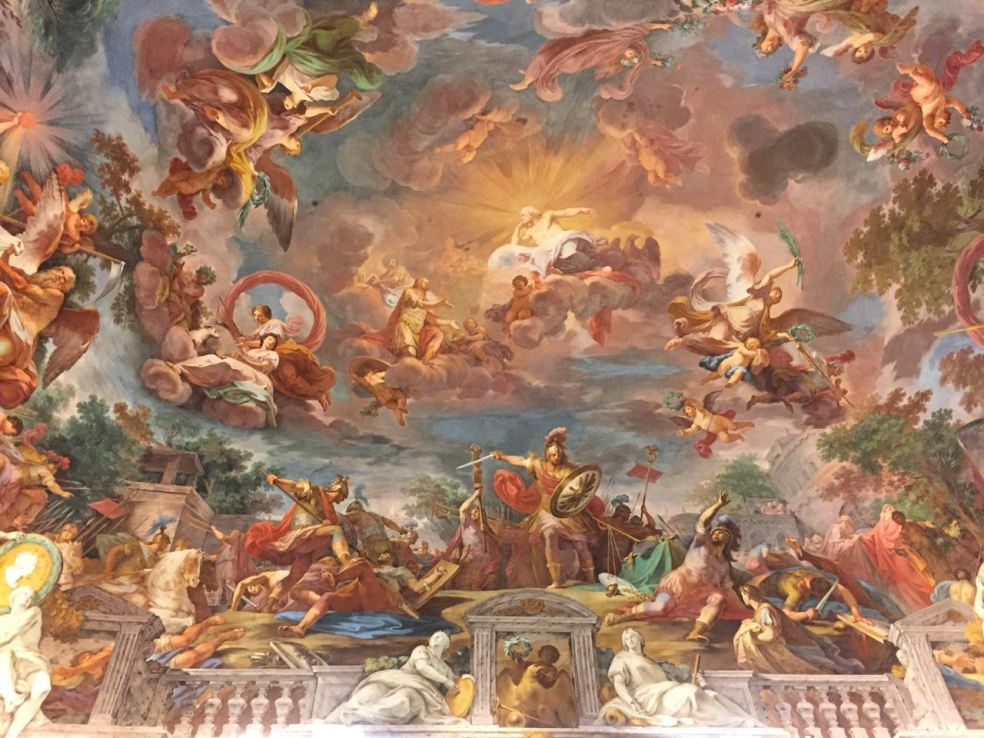 But I’ll admit the artwork is pretty gorgeous. This is named, “The Riot After St. Peter’s Grog & Gift Shop Closed Down.”
 This statue survived The Great Genital Cover-up, although he did lose a member. Of his fan club. That’s what I meant. He lost a member of his fan club. Yeah that’s it. On the other hand (literally), maybe that’s what in his left hand.
 This is Harpo. She stood next to Groucho. The sculptor got good marx for his work.
 This is an actual bathtub. I ordered an exact replica from eVaticanBay. I’m sure Carolyn will figure out where to squeeze it in, she’s an expert at that kind of stuff.
 These guys had fun throwing grapes at the crowds below. Actually, it’s a painting. Fooled ya, huh? And it’s all 2D; you don’t even need glasses for the 3D effect.
 Here’s another bathtub for those sad times when you have to take one all alone. Plus they used them as tombs, true story. At least you went down with a clean corpse!
 This is a commemoration of the first time someone tried to use a snake to clean out the bathtub drain. It looks awfully similar to one of my experiences trying to do the same, except I wasn’t naked… although the similarities in our physiques are quite striking.
 These statues blow the myth all to hell about walking like an Egyptian. Of course, with all that weight on their heads they couldn’t walk very pharaoh.
 This is what a sardine can would look like from the inside if it were a Catholic one.
 In the biz, this is what we call a “two dome shot.”
 Here’s a one-dome-shot.
By law, no building can be taller than St. Peter’s dome in the historic center. A 30-floor skyscraper in Rome named Torre Eurosky is actually taller (true story, I know you don’t believe most of what I’m writing here, and I can’t imagine why, but this is true). I guess it’s far enough away to steer clear of the law. However, the architect is now going to hell.
 They were having a 2 for 1 sale on Pope memorabilia. In a more serious vein, one of the things we’ve noticed in Europe is that most cars are grey, white, or black. Note that there are only a few red ones, and that’s it. I’m not sure why that is. Our next car is going to be purple. But only if I buy it when Carolyn is in the states.
These were all taken from atop the dome. Because of the aforementioned law, this is one of the best vantage points for a view of Rome. I just wish all those people would have gotten out of the way so we could see it!
And now, the coup de gras for our Very Vatical Vatican Visit: the Sistine Chapel.
Unfortunately, photography is prohibited within the Chapel. This is due to, of all things, Nippon TV in Japan getting the rights to all imagery in exchange for ponying up millions for its restoration (again, this is true). Which is ironic because the Japanese have been voted The Most Likely To Take 300 Pictures of the Same Boring Thing While Traveling sixty-three years running (okay, that one may not be true, but only because there’s no award by that name). Of course, now the internet comes along where you can find all the pictures you want of the chapel. I wonder which Japanese executive had to commit harakiri over that deal?
But to still support this arrangement, various guards in the room are constantly shouting “NO PHOTO! NO VIDEO!” as well as “SSSSSHHHH!” when the masses get too noisy. They’re not often invited to weddings.
That said, you can imagine this intrepid rule-breaker thumbing his nose at such conventions (especially after I found out about it being all about copyright law, which meant I wasn’t going to hell for surreptitiously snapping photos). So I cradled my iPhone near my waistline, even using the back camera so the front of the phone would be facing the ground, as if I was only admiring my iPhone case. Since I was trained in spycraft back in the ’80s, I knew all the tricks.
 Unfortunately, not all of the attempts turned out so well.
 Sometimes my thumb got in the way, and sometimes my head, which looks a lot like a bearded thumb here. Plus I took a shot of the most boring section of ceiling possible. It isn’t easy to bring my loyal reader(s) illegal photographs!

And if you think these are bad, you should see the ones I deleted!
 At last! Success! I got this one as we were leaving, figuring I could scurry out the exit before one of the guards took me down with a taser and a chokehold.
 Carolyn followed my lead with her own shot of the wall. I shouted, “She did it too!” as we ran out the door.
Here’s another piece of trivia from our guide: When the powers-that-be finally saw what Michelangelo had created, they were a bit uncomfortable with all the nudity. After his death, they painted over as many of the “private parts” as they could. But they didn’t paint over the images on the ceiling because it was just too high for them. Just goes to show, you gotta get high to appreciate nudity!
 I’d love to say I took this shot as well, but I just stole it off the internet. Ha ha! Stupid Japan TV!
I stole this paragraph from Wikipedia too:
The Sistine Chapel (/ˌsɪstiːn ˈtʃæpəl/; Latin: Sacellum Sixtinum; Italian: Cappella Sistina [kapˈpɛlla siˈstiːna]) is a chapel in the Apostolic Palace, the official residence of the Pope, in Vatican City. Originally known as the Cappella Magna, the chapel takes its name from Pope Sixtus IV, who restored it between 1477 and 1480. Since that time, the chapel has served as a place of both religious and functionary papal activity. Today it is the site of the Papal conclave, the process by which a new pope is selected. The fame of the Sistine Chapel lies mainly in the frescos that decorate the interior, and most particularly the Sistine Chapel ceiling and The Last Judgment by Michelangelo. Photographs of the chapel are prohibited by copyright. If anyone is caught taking videos or photographs, or even if evidence comes to light afterwards, the penalties can be severe. If you know of any violations of this law, a generous reward is offered. Please report them immediately to http://www.vaticancopyrightlawscofflawsaregoingtohellsohelpthemontheirway.com.
 We took our first ever flight on budget airline RyanAir. Other than the wind whistling through the plane and the view of the ground 30,000 feet below peeking through the wooden slats, it wasn’t bad, especially for the 150 euro per person fare. Actually, the only thing that seemed discountish is that the airline is given the worst place in the terminal. The line through security was long, but I admit it did move pretty fast (they can’t afford X-Ray machines, so they just ask each passenger, “Are you a terrorist?” If you give them the right answer, you get right through).
Italy is a bit messed up politically and financially, and much has been written about garbage and potholes there, at least in the articles about garbage and potholes. We saw our share of both, but because it wasn’t summer, it really had no aroma. It is just a… Roma.
However, they did screw up our Door of the Day with their graffiti. There is lots of graffiti all over Europe, even ancient ones in Pompeii. Apparently it’s a cultural thing that spans over thousands of years. Of course, in Pompeii it’s spelled graffitii.
 Rome is also known as The Eternal City, The Capital of the World, The City of Love, The City of the Seven Hills, and The City With The Colosseum Plus Some Other Things To See. We also know that all roads lead to Rome, and we should do as they do while there (assuming the ancients ate a lot of gelato), and that it wasn’t built in a day. However, the Colosseum was built in only eight years, so they obviously had quicker bureaucracies back then. Plus slave labor. I don’t know how we accomplish anything anymore without slave labor. Although working for the minimum wage comes damn close.
Any trip to Rome has to center around the Colosseum. Also (and originally) known as the Flavian Amphitheatre, it is still the largest amphitheatre ever built, and could hold up to about 80,000 spectators, or 8,000 sumo wrestlers. Completed in 80 AD, it has withstood the test of time as well as the pillaging of the barbarians. By the way, the word “barbarians” comes from the term “bearded ones.” So I had to keep with tradition, being a barbarian myself, and chipped off a piece of the Colosseum to use as a momento in our living room. Not really, I just stole its soul with photographs.
Still, the Colosseum cannot fail to impress, as it was intended to do 2,000 years ago.

We met up with a group of friends from the US as well as Holland, which is also known as The Netherworld, which is where the word “Dutch” came from. Yeah, I know it’s confusing, but dam. In fact, lots of dams. I think they come up with all those names to hide from the barbarians. “Holland? Naw, this is, uh, The Netherlands. Yeah, that’s it. Holland is way over there, just take a left at the dike. Am I Netherlandish? Oh no, I’m uh, Dutch. Yep. Just a little Dutchman, got nothing to do with Holland. Just go that way, there’s a whole bunch of gold and gelato over there I hear.”
The first picture below was taken with some great relief after one part of our group found the other part, despite the effort we put in to losing them. We pretended to be happy they found us, especially in group photos.

 Once gathered, we took a tour of the place with a guide, who informed us of several common misconceptions. For one, the emperor didn’t use thumbs up or thumbs down to indicate the fate of a gladiator. That’s just Hollywood.
  They speculate that it was probably an open palm vs. a closed fist. The gladiators were investments, so it wasn’t common for an injured one to be given the fist. Also, Christians were not fed to the lions there, although prisoners were made to “battle” various animals with their arms tied behind their backs. The animals usually won.
And gladiators generally didn’t sport variations of Russell Crowe’s physique, they tended to be short and fat (which is pretty much the way he looks now, so I guess he was told all about it after the movie). The reason for this was that it made it easier for them to survive sword cuts, the important organs being buried beneath fat and all. Accordingly, it’s also when McDonalds was invented, although back then they called it MacinaDonaldos. One chubby gladiator could put down three Grande Mackos, a large order of Italian Fries, and a grape shake without hardly belching afterward. Otherwise, Gladiator is all Hollywood.
Another piece of trivia was the way they handled public toilets. A dozen or more men and women all sat in a row, and shared the same sponge to clean their backsides. We all agreed that the worst job in the world would be the sponge-cleaner (the second worst just being anyone who had to go while in the Colosseum). The poor soul with that job was usually a slave, or one of emperor Trumpini’s former cabinet members.
 Carolyn wanted to take a picture with the gladiators who wander around outside the Colosseum hoping to bilk the tourists. I fondled a fiver in my pocket and figured “why not?” After the photo session, he nonchalantly asked for 20 euros. In response, I un-nonchalantly suggested some creative places where he could stick his sword. Anyway, I threw the five and a couple of coins at him after hearing all about his starving children, for which we were rewarded with a stream of insults as we walked away. They’ve had a lot of problems with those guys, so they have been banned from walking too near the Colosseum. Throw ’em to the lions I say! At least now that we got our picture.
 On the walk to the Colosseum, we found a field where they grow red-headed stepchildren. It was the end of the season, so the rest apparently had already been picked.
 While there’s a military presence there, a lot of this is the fact that they’ve closed down the boulevards next to the Colosseum to cut down on the exhaust fumes discoloring the monument. And since Italian drivers will drive just about anywhere, the automatic rifles serve as a pretty good deterrent if they try it there.


 Next to the Colosseum is Palatine Hill, which coincidentally is the name of the street where we first lived after our family moved to Oregon. Our house wasn’t quite as elaborate as some of the buildings below, although it did have a pool, a zip line, and a trampoline, all of which our seven-kid family managed to destroy within a year. Each of the kids eventually grew up to be barbarians, except our lone sister, who only had a stray hair or two on her chin. Actually, she often still does since she’s in her sixties, except now they’re both grey. That’s only in here to check to see if she’s reading this.
The Arch of Constantine is one of many arches around Rome, which were built if a war resulted in over 10,000 enemy deaths. I’m not sure who did the counting. And if you were the 10,001st enemy, could you form your hands into a “T’ symbol and call time?
The tour of Palatine Hill is best taken with a guide because so many of the buildings are gone. But it’s still impressive and amazing to imagine yourself in those times, walking around the place, hoping no one notices that you’re from 2,000 years in the future. You might be given away by the roll of toilet paper in your pocket, so bring your own sponge.
 The picture above (by Cassius Ahenobarbus, who you’ve never heard of, but who wants credit for the picture) shows how the place looked before time and the Bearded Ones whittled it down to the skeleton. The Circus Maximus is completely gone, but it’s where they raced their chariots, ala Ben Hur. It held upwards of 150,000 spectators, which dwarfs even the Colosseum. Since seven is Rome’s lucky number, the races consisted of seven laps. Hence, the seven dwarfs. All stories lead to Rome.
 The area surrounding the Colosseum is rather festive, with big crowds, street musicians, and someone blowing bubbles all over the place. Anything to make a euro! Speaking of which, the euro needs a single syllable nickname like “buck.” I’m going with ‘Ro. Anything to make a ‘ro!
 Beggars are fairly common around Rome. Generally they attempt to look as pitiful as possible, although I think a lot of them just take naps out there and wake up to happily find some coins in their hat. In our first foray to the Colosseum, we were accosted by a gypsy who knew so little English she didn’t even know what “no” meant. And I delivered a shouted “NO!” on my third attempt at communication. I had to practically peel her off Carolyn because she just kept coming, clawing at her. Afterward, Carolyn noticed the zipper on her little purse, which had been tucked “safely” under her arm, was opened. We were just seconds away from losing a credit card or cash. I have often thought about hiding an opened mouse trap in a purse while walking in cities like Rome. But then I know one of us would forget and hilarity –bolstered by a stream of cussing– would ensue.
 After a long day of hiking around Rome, one needs to clean one’s unmentionables. However, one does not often find a dryer in an apartment in Rome, so one must make do with what one is given, in this case, the towel warmers in the bathroom. Hey, they were clean. I think.
 It is pretty easy to commit suicide in Rome. Just sayin’.
 But we’ll seal this entry with a kiss under the “A” for Anderson. Holy moley, I’ve only covered the first part of our adventure in Rome so far. We still have the rest of Rome, plus Florence, Naples, Pompeii, and Venice to go! No wonder we’re so tired! I don’t know how those guys conquered all that and more!

