There are bad museums and there are good museums, and then there’s Dachau.

The museums I’ve visited in Europe have largely been interesting and informative. While I don’t always seek them out, if there’s a decent-sounding one nearby I’ll generally venture into it.

Since I was staying in Stuttgart with my son and grandson, the Museum am Löwentor (the Natural History Museum of Stuttgart) sounded like it had promise, plus it was comparatively close to where we were stayring. So with promises of dinosaur memorabilia and some relatively decent traveler reviews dancing in our heads, we decided to give it a shot. Unfortunately, we probably would’ve been better off downing a shot or two instead.

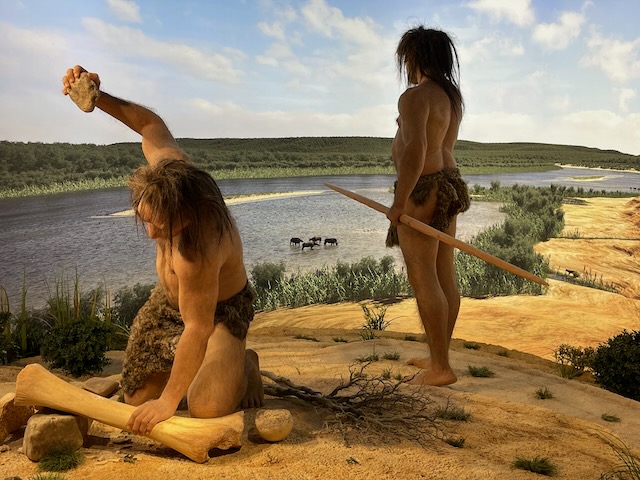
It’s not that it was horrible, but it was definitely geared toward kids younger than Masi’s thirteen years. Okay, we got a couple of cute selfies out of it, but you have to admit, neither of them are very realistic. I’ve rarely seen sharks burst through tables, and dinosaurs are extinct. Finito. Dead-o. Gone forever. And no amount of Jurassic Park movies will ever change that. Also, why didn’t that dino just go through the glass door? Big dummy.

Many of the exhibits were just dioramas; no actual dinosaur bones or the like. In addition, almost all the written material was in German, so we just kind of wandered around for 30-45 minutes, shrugged, and left.

Truth be told, the most fun Masi had there was finding this play structure and climbing around while chatting up some cute German girls. I don’t think he got a date, but he probably bragged about drinking beer with his dad and grandpa.

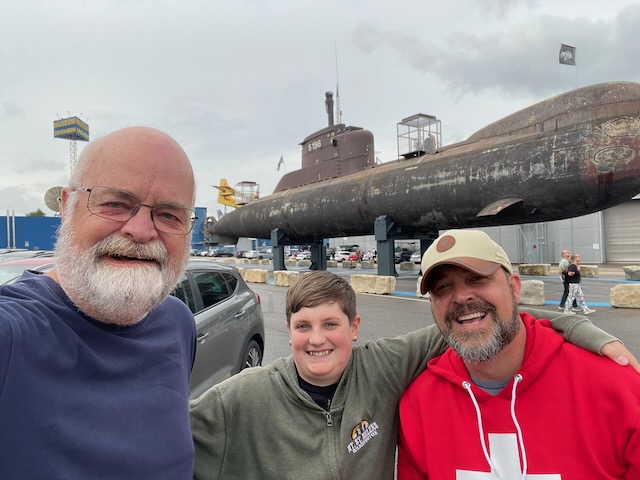
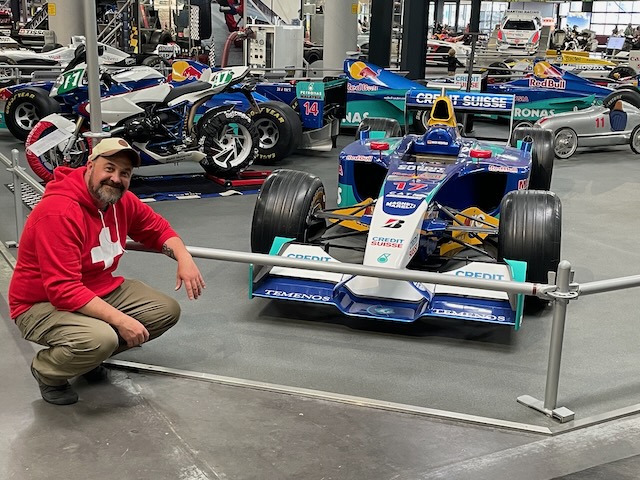
Fortunately, our faith in the whole museum experience thing was restored after a visit to the Sinsheim Technology Museum, just about an hour south of Frankfurt. I mean, all we had to read was that it has a U Boat and a Concorde and that you can go inside of both, and we were sold. Besides, I needed to get the taste of that previous museum out of my mouth. I’d accidentally licked one of the exhibits, you see.
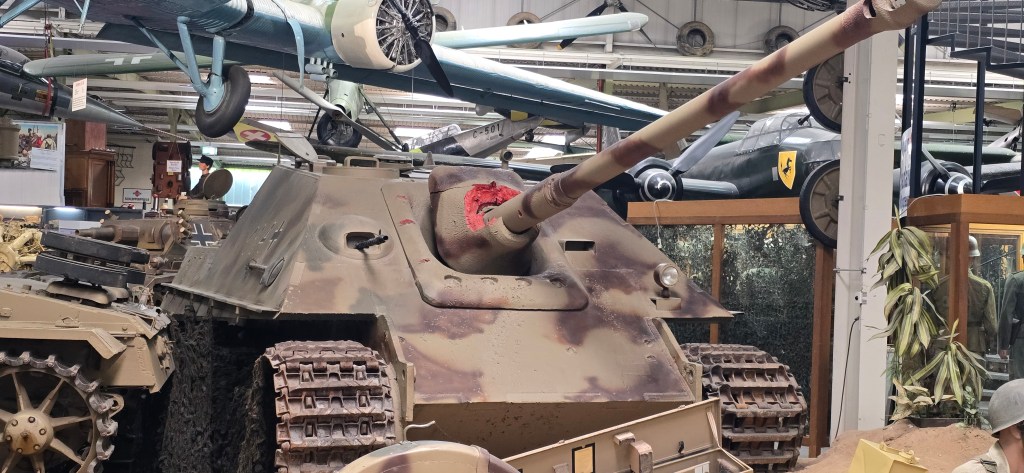
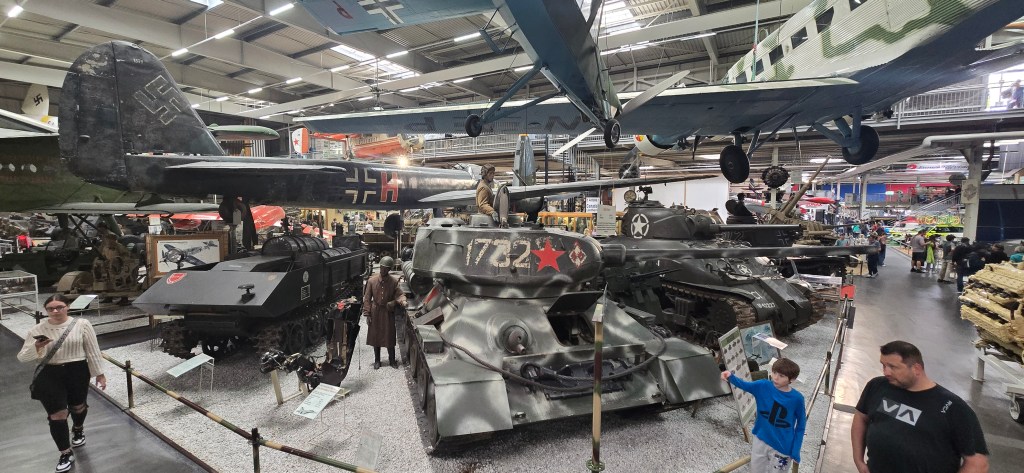
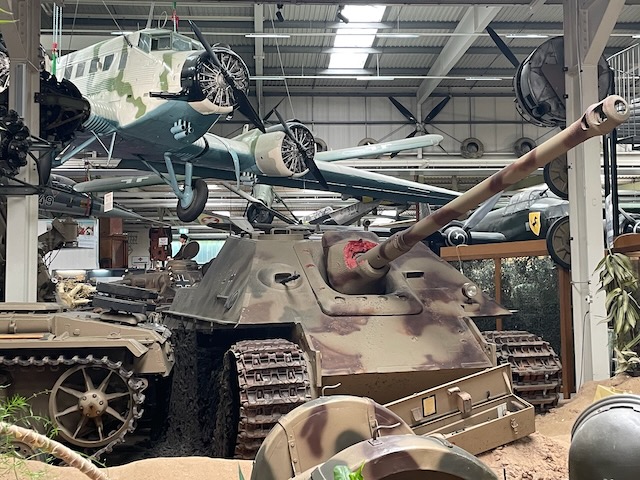
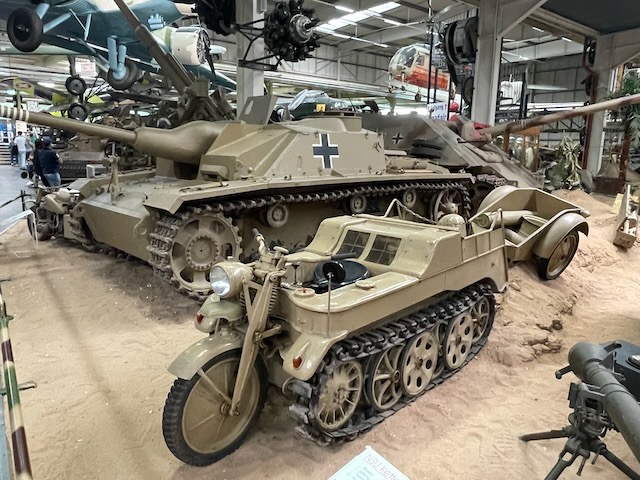
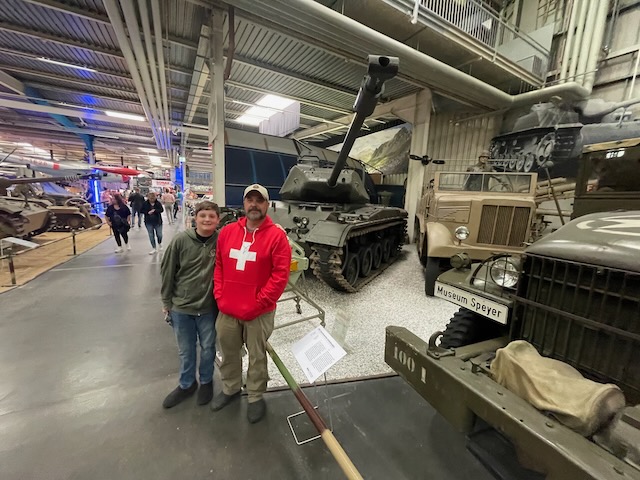
The Sinsheim museum features an extensive collection of military vehicles, mostly from WWII. Luke made sure to emphasize his neutrality by wearing a hoodie with a Swiss flag. It must’ve worked because none of us got shot at while we were there.

In the last photo you can see that they have so many vehicles they just keep a bunch of them sitting outdoors. If that had been in Russia I think they would’ve already taken them away and put them into service just to see them get blown up by the Ukranians almost immediately.

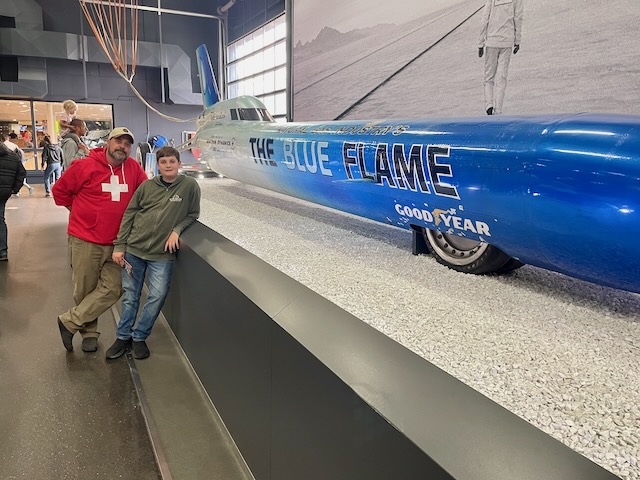
The museum also features the world’s fastest tractor.

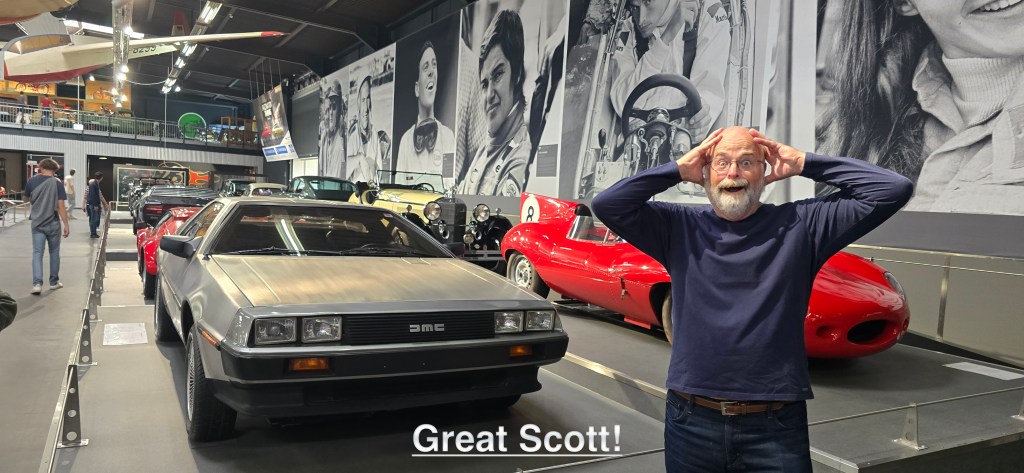
They also have the world’s coolest looking car failure that could go 88 miles per hour (142 km/h) within the length of a movie screen. In real life, the DeLorean DMC-12’s dashboard only went up to 85 mph, even though it could go faster. Great Scott!
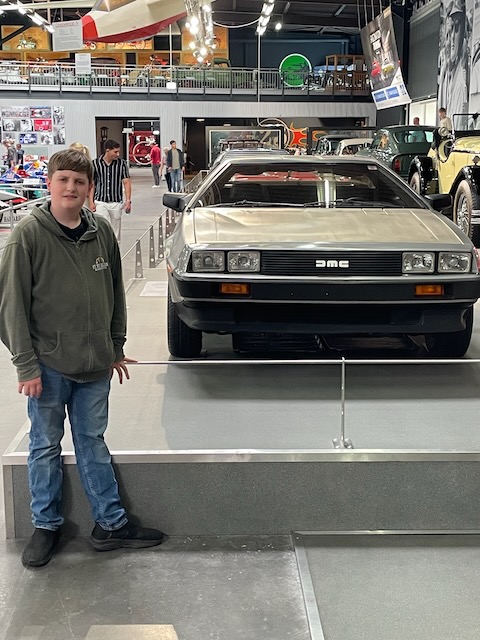
I don’t think Masi understood any of those references.

But he started acting up so we made him do some training. Push harder, kid!

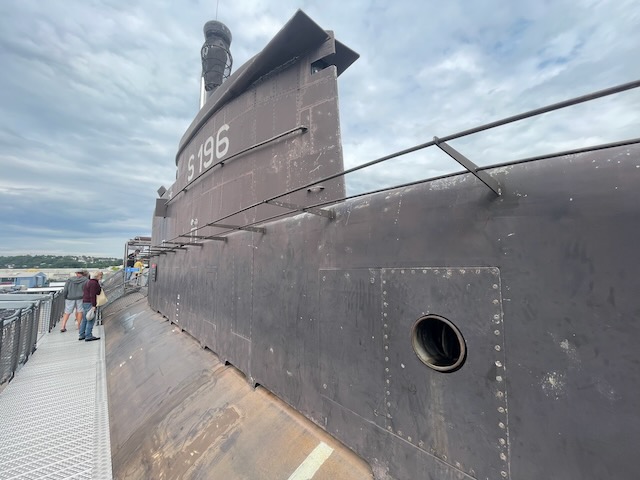
It isn’t often you get to see an authentic U17 submarine outside its normal habitat. Apparently it’s still fully functional, but now the poor sub can only look to the rain to get wet. Unless maybe she see’s a real hunky battleship lumbering by.

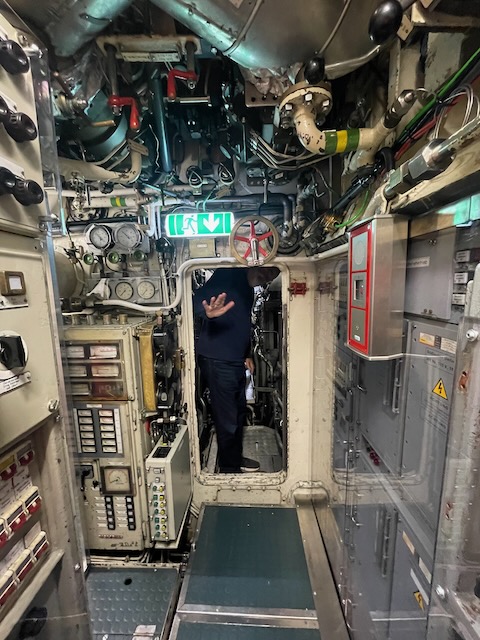
Masi disappears into the bowel of the beast. Truth be told, it didn’t feel all that claustrophobic, unless of course you envisioned yourself trapped in it underwater for days at a time with 22 other stinky sailors. The sub was in service from 1973 to 2010, so while the term “U Boat” conjures up things like Das Boot and WWII, this was more modern than that and had no blood on its ha– er, rudder.
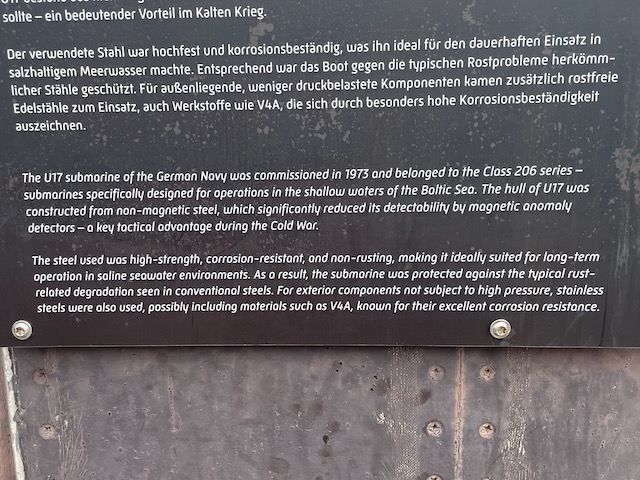
Sometimes it’s just easier to take pictures of the provided information, but that can also screw up my made-up stories too. It’s a delicate balance, this game I play.

And this was a real racetrack, honest. Really. No I mean it. Why you lookin’ at me like that?

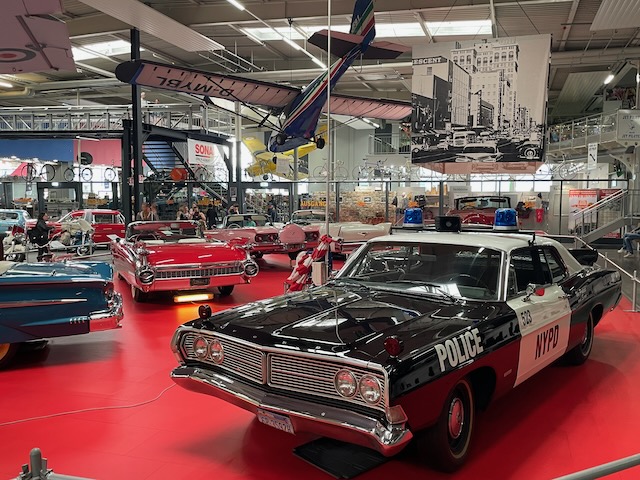
They had old classic cars galore.

And race cars as well, both old and new, and everything in between.

Some of us cared more about those things than others.

Do you know what happens when you sample a little too much of the wares from a beer truck?
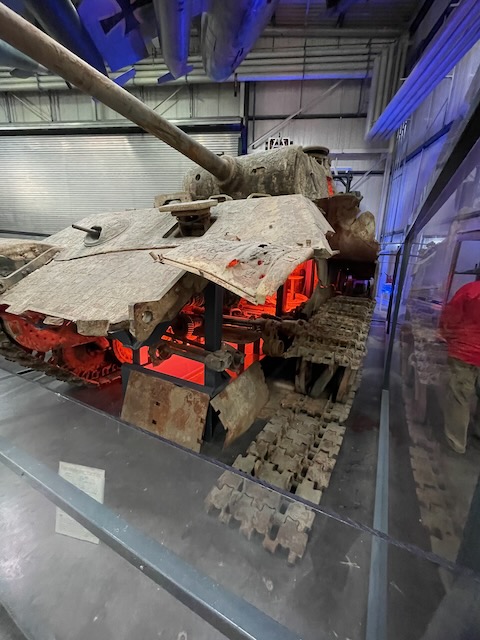
Yeah, that’s right, you crash and burn your tank. Don’t get tanked in your tank is what I always say.
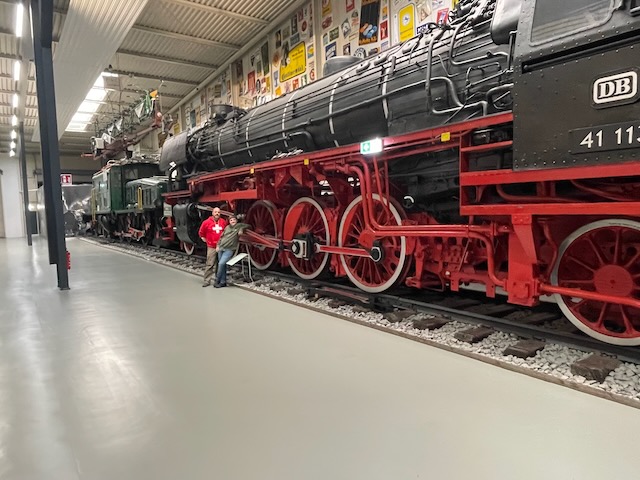
However, it’s okay to drink away if you’re driving a train. It’s not like you can make a wrong turn or anything, and based just on the size of that beast, you’re gonna win any confrontation you have with just about anything stupid enough to be in front of you. That’s why many big trains like that have huge minibars in their locomotives. And that’s why they go chug-a chug-a chug-a.

One of the highlights of the museum was of course the Concorde and the Russian Tupolev Tu-144. Since the Russians lost the space race, I think they were doubly motivated to be the first to put a supersonic airliner into the air. They won that contest, getting the Tupolev to go airborne on December 31, 1968, albeit with lots of duct tape showing as well as a few screws plummeting to the ground and in one case, killing a cow. On March 2, 1969, Air France gamely crossed the line in second place. Isn’t it kinda funny that oftentimes countries act like little kids, competing for some nonsensical prestige that no one cares about only a handful of years later?
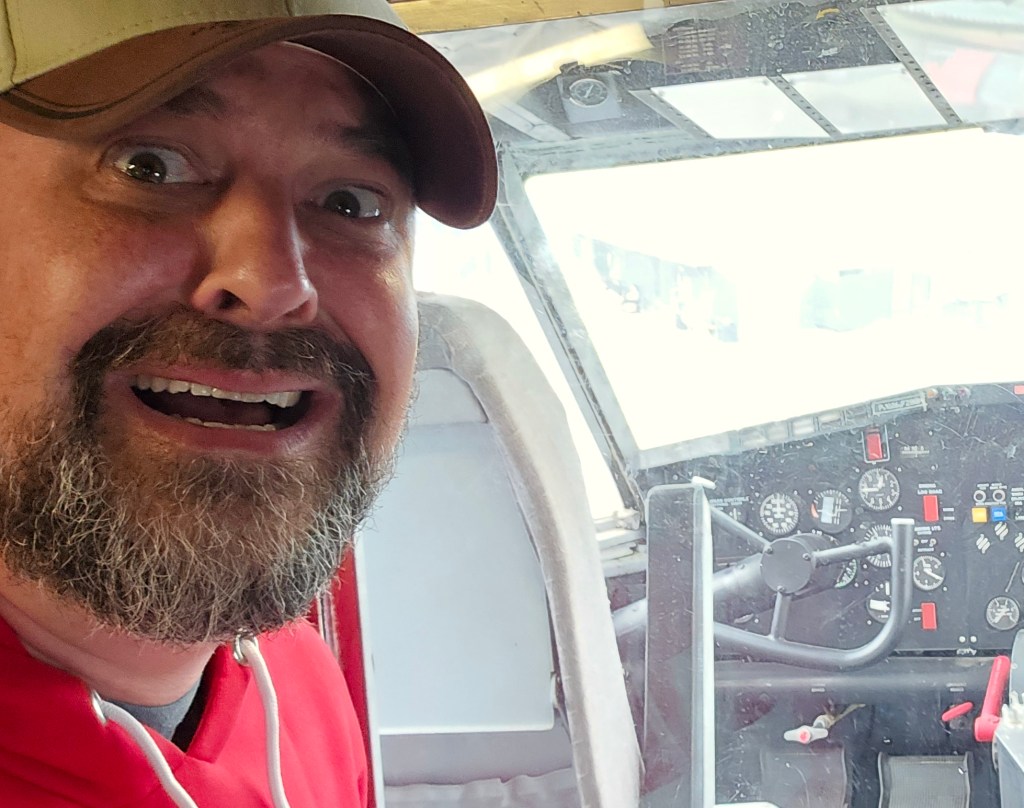
I think that’s a pretty typical reaction anyone would have if they saw that the pilot of a supersonic airliner was thirteen years old.

The exhibit was really mostly just a big empty shell, not unlike most airliners (except for the lack of seats), and the fact that it felt fast even while stationary. When it was in service, it could fly from London to New York in 3-1/2 hours, achieving speeds of twice the speed of sound. Meaning you could fart aloud to your heart’s content but the plane would outrun the noise. It made watching movies difficult, however, which is why they mostly offered up silent films.

A pretty majestic piece of machinery, that. Unfortunately, both the Concorde and the Tupolev suffered some crashes as well as a lack of financial viability… and so humanity’s march to the future did a U-turn, and we ended up back to the future with ever more shrinking and uncomfortable seats besides.
Dachau

Now this entry takes a decidedly more serious and somber turn. If you’ll recall a while ago I dedicated a whole entry to Auschwitz-Birkenau. After visiting that, I really wasn’t looking to see another example of man’s inhumanity to man, but I think it’s important that everyone understands what really can happen when hate is used as a cornerstone of a dictator’s message, so to me it was a must-see for my son and grandson. The fact that people are so gullible and so easy to coerce into hatred is still evident to this day, and that’s why it’s so freakin’ scary.

Dachau is less iconic and doesn’t have as many of the old structures still standing like Auschwitz-Birkenau.

But that doesn’t make it any less sobering of a site. Dachau was one of the first concentration camps built by Nazi Germany, opening on 22 March 1933. Unlike Auschwitz, it wasn’t purely an extermination camp, it was originally intended mostly to hold political prisoners. In 1935 it added Jehovah’s Witnesses, homosexuals and emigrants, and eventually Jews and any other undesirables from all over Europe.

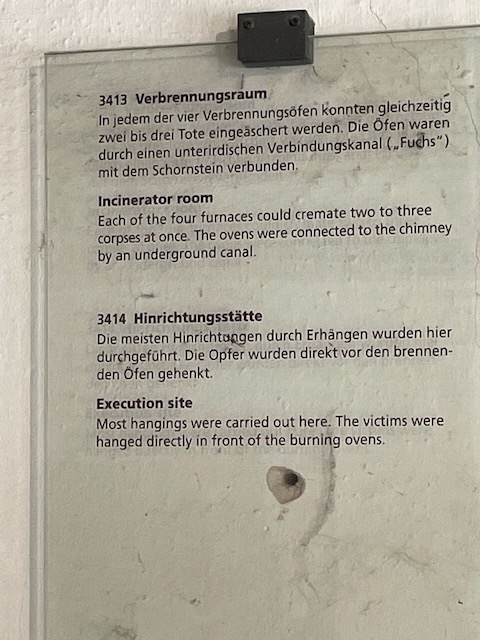
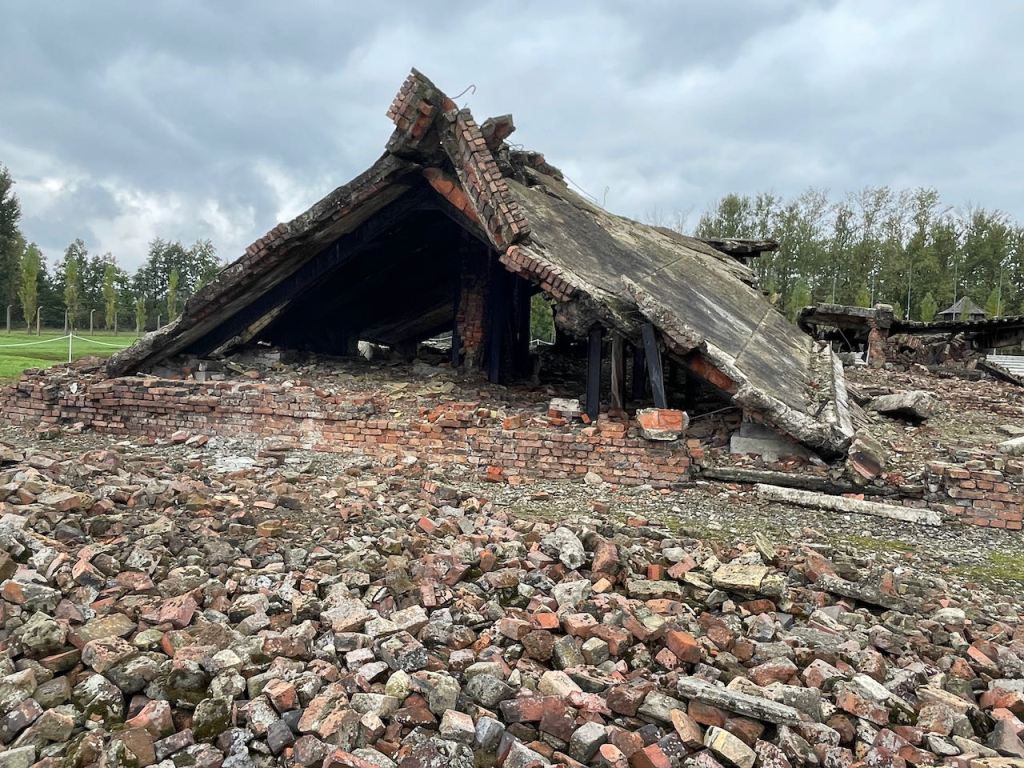
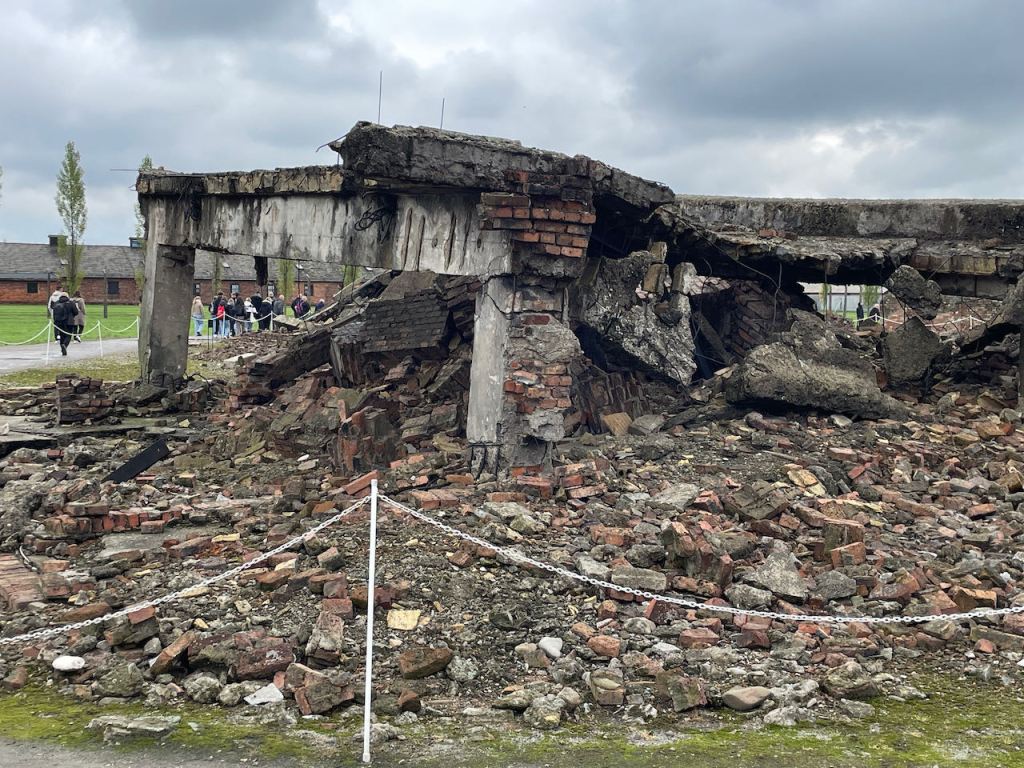
Most of the deaths in Dachau were as a result of inhumane living conditions, leading to disease and starvation, with some torture thrown in for good measure. These ovens were used to cremate the bodies. At least 40,000 people died in Dachau, but the exact number will never be known.
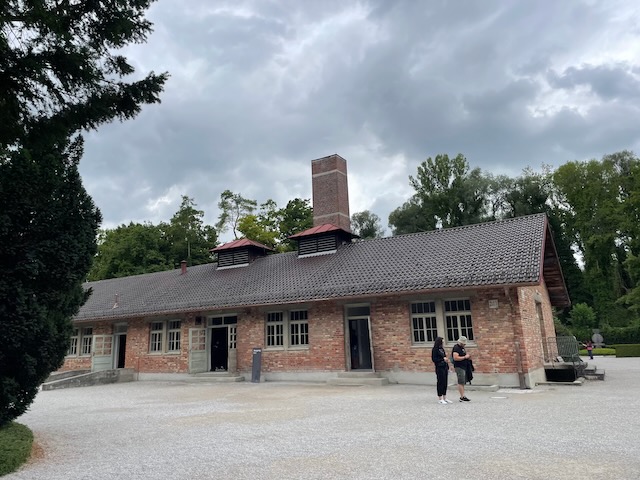
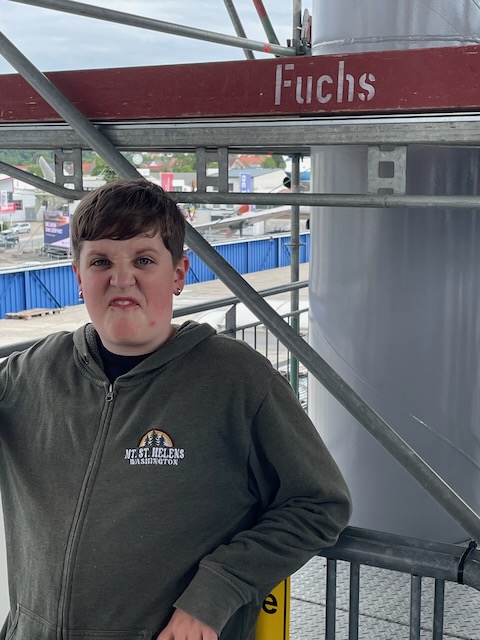
This is the building that housed the ovens.

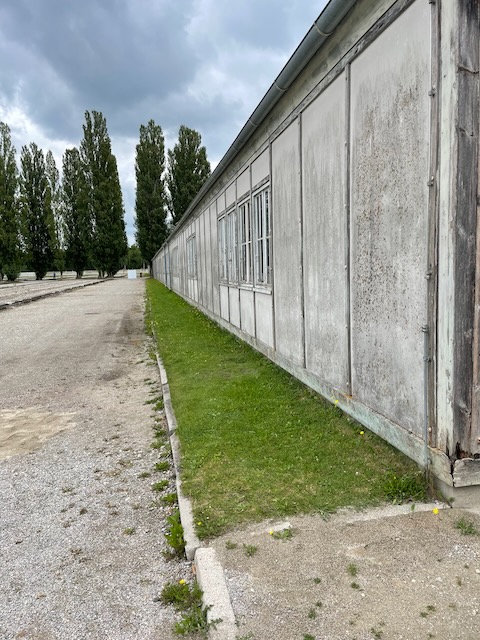
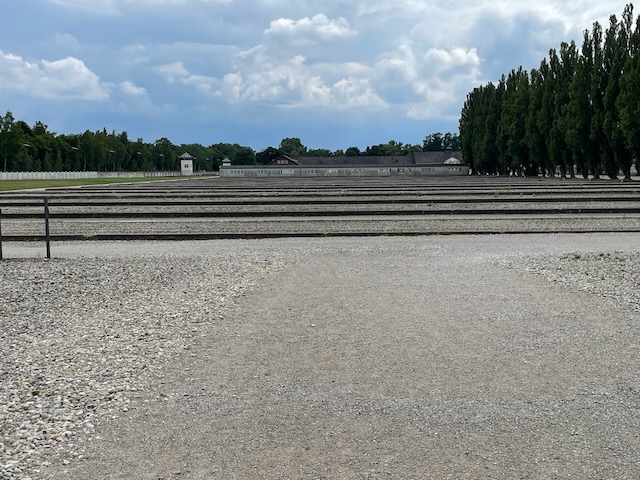
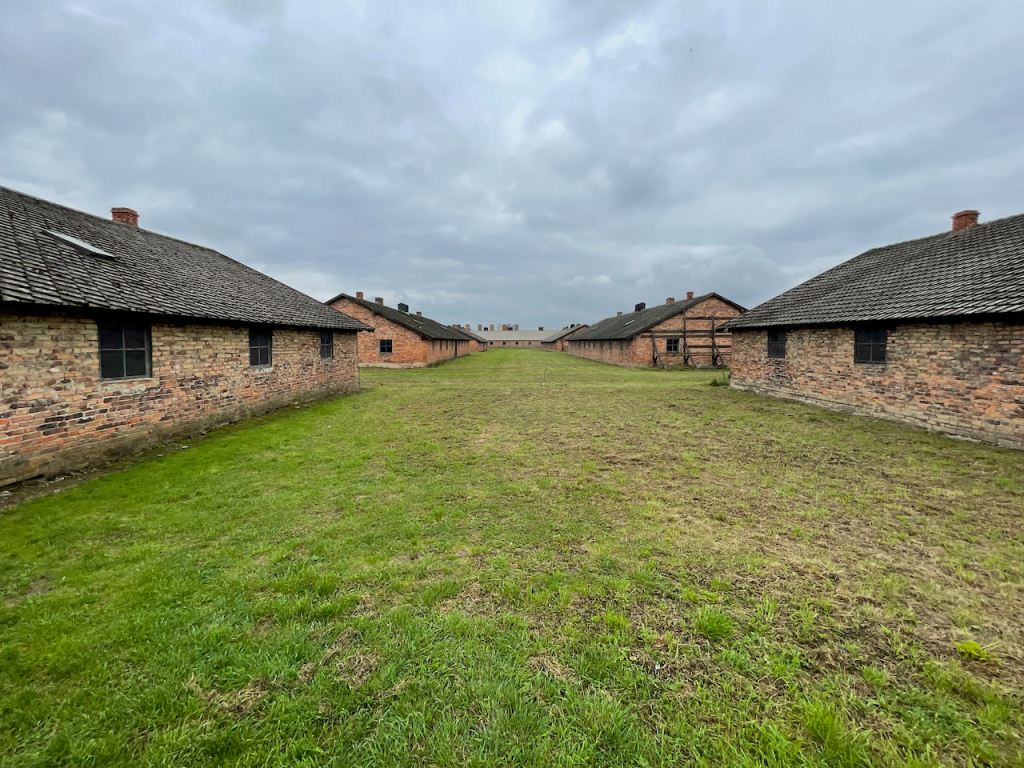
These grounds used to be lined with wooden barracks. The number of prisoners incarcerated in Dachau between 1933 and 1945 exceeded 200,000 people.

I dunno, but if I were an alien species and I visited earth and learned all about it, I think I’d put a “Do Not Enter” message around our entire solar system. Also, political events around the world lately seem to be screaming, “We do not remember or learn anything from the past!”

While visiting a notorious concentation camp doesn’t really make it the highlight of any trip, I think it’s very important that people learn and remember. It was not so long ago. The people who committed these atrocities were people just like you and me. It still amazes me that one man can manipulate so many people with lies and hate, despite all the evidence we have that it always leads to disaster. I can understand how it might happen the first time, but to see it maybe happen again? Blows my frickin’ mind.

We can make memorials, but we can’t ever forget that the people here were mothers and fathers, sisters and brothers, with people who loved them. The senselessness of it all can be staggering to the normal mind. So when any politician acts gleeful at the idea of opening up harsh prisons, or touts the death penalty, especially not as deterrent but as penalty, or vilifies and even prosecutes anyone who opposes him, those who support said politician would do well to remember that the people who are bothered by all of that are often bothered because they understand history. It’s not always about what is happening, but what history tells us always happens when we allow people to have too much power or wealth. That’s just a fact.

(Scroll down to see previous entries.)
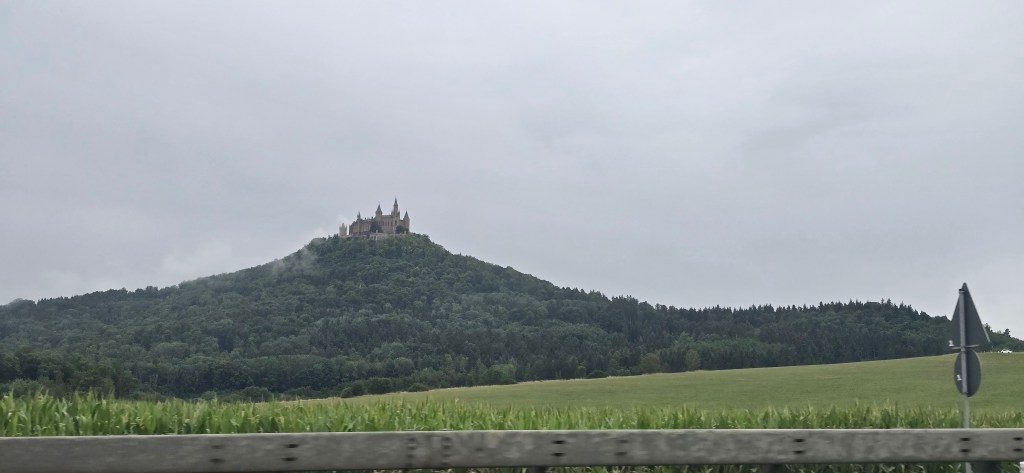
Time to castle! Check, mate!

Even as I struggle to learn Portuguese, I’m often grateful that I don’t have to learn English as a new language. Most Portuguese know at least some English, but it’s mostly spoken English. Even native English speakers have a hard time with spelling and grammar. In Portuguese, “castle” is “castelo,” pronounced just like it’s spelled. But English speakers pronounce it “cassle,” like “hassle.” Which learning a new language definitely is. Anyway, here follows our visits to two unique German schlösser (castles in German, or what happens after one too many beers).

About 60 km south of Stuttgart is a town called Hechingen, which hosts a fancy German castle called Hohenzollern Castle, named for Herr Heinrich Henzollen’s ho.

From a distance, it looks very much like a castle. But the closer you get, the more you realize it looks very much like a castle.

This is what it looks like when they invite Satan over for brunch.

This is actually the third castle to be built on this spot. The first one was built in the early 11th century. It was completely destroyed in 1423 after a ten month siege by the pesky Swabians. I bet you’ve never heard of Swabia before, have you? It’s a region in Germany, I think it’s famous for inventing Q Tips.

In 1461 they completed the second castle, which was larger and swarthier, but eventually fell into disrepair, which was apparently a hole so deep they couldn’t pull it out. So they built this third and current one between 1846 and 1867, making it one of the most modern castles on that spot.

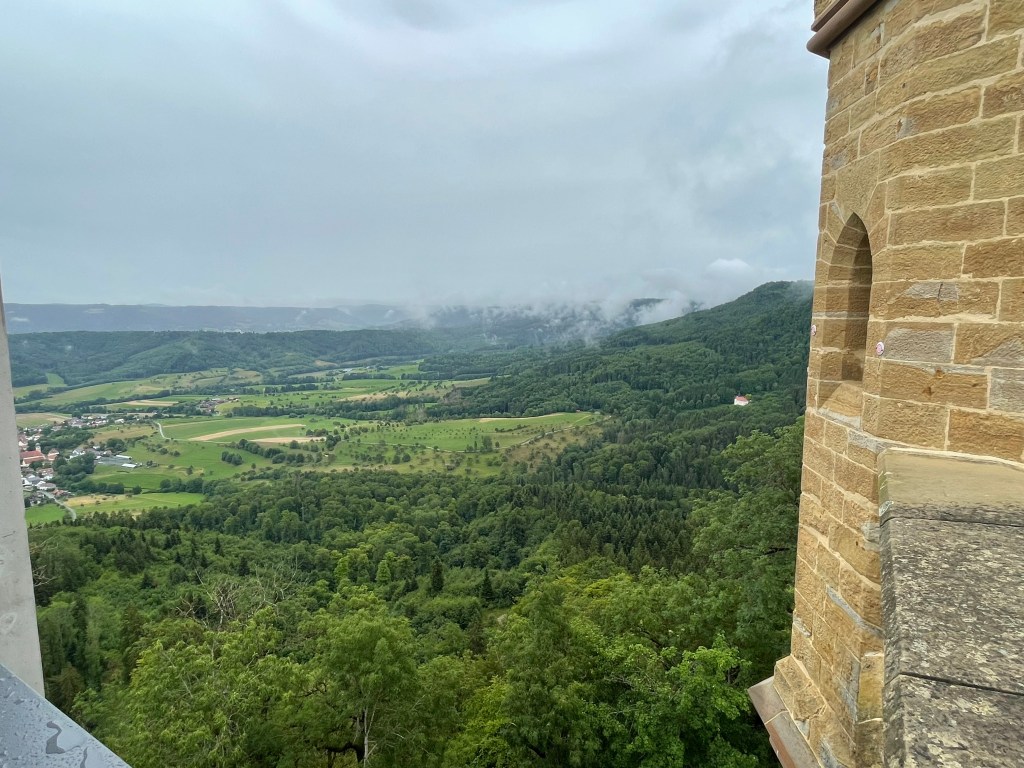
Like most castles, it has views to die for. Here Masi takes a break from all the sightseeing to enjoy the scenery. He lost his forearms in a horrific reaping accident, but we tried not to talk about it too much, especially when he attempted to count to eleven (he still has ten toes, but after that, he got a bit lost).

Fortunately for us, Hohenzollern Castle is renown for its healing properties, including miraculous limb regeneration. Unfortunately, he now has seven fingers and three thumbs, but at least he can count to ten now.

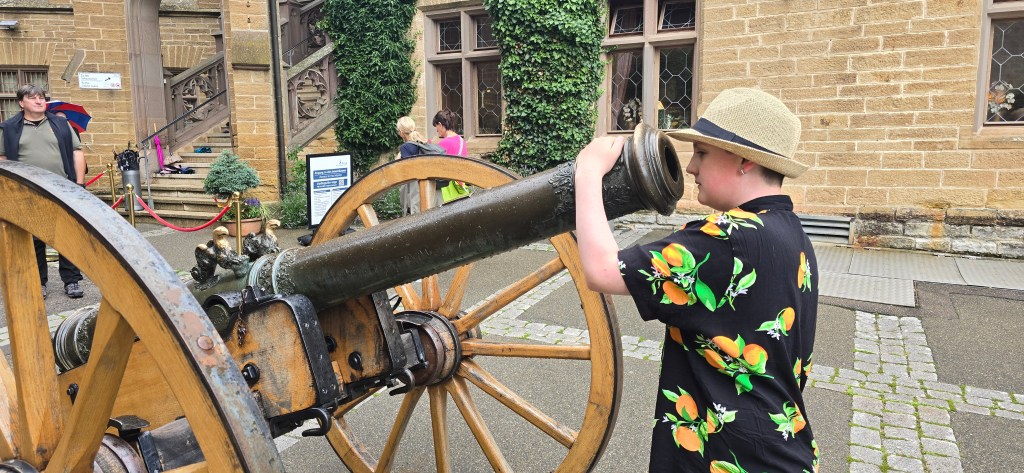
The last words of many a young soldier: “Is this thing load—“

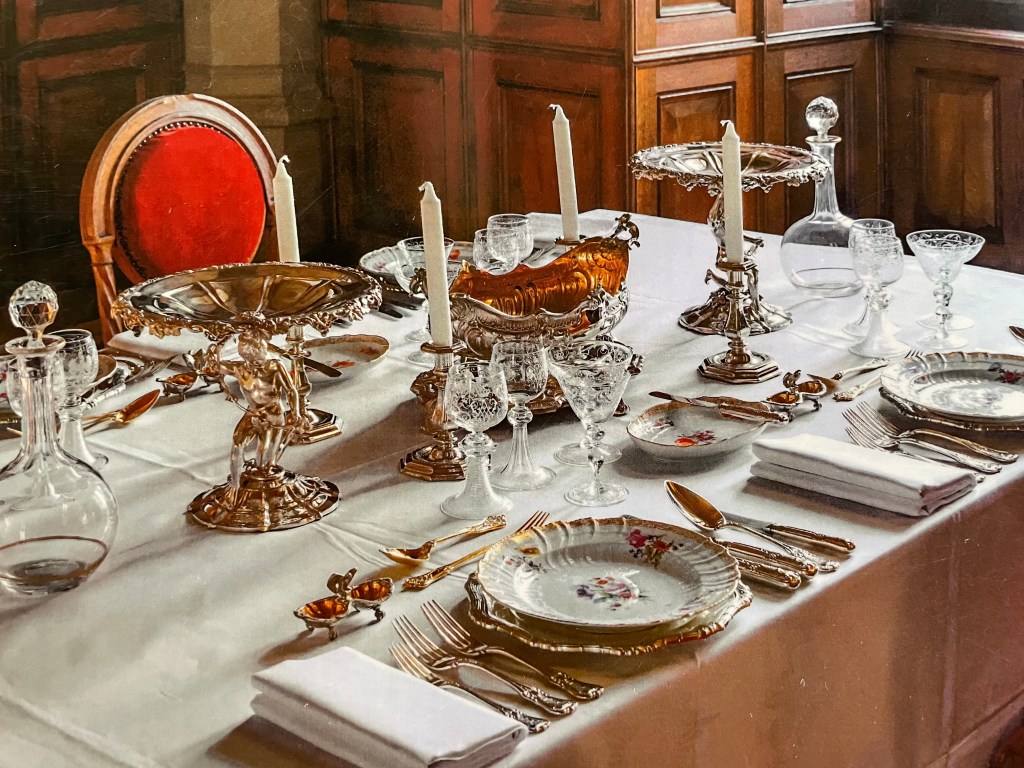
It’s much safer to stand in front of swords as long as they’re affixed properly. The castle staff kindly set out a table for our lunch, but we’re kinda snobbish and just thought the whole thing was a bit pedestrian. I mean, c’mon, only three forks? Pssh. What do they think we are, peasants?

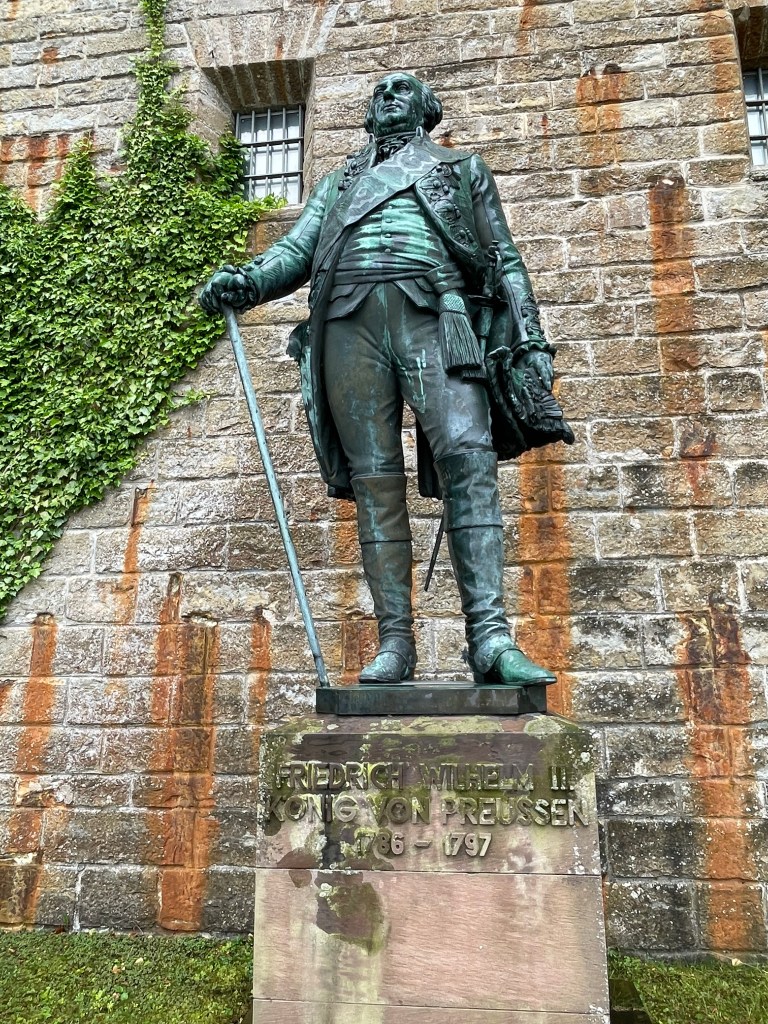
On the right is evidence that the olden Germans had some weird growth hormones in their beer. If you zoom in on the dates on this statue, it says Friedrich Wilhelm was born in 1786 but died in 1797, so this guy was only eleven years old when he posed for that statue! Hmm, I wonder how old Hitler really was… he did act like a toddler sometimes.

I wonder if men in untucked shirts and baseball caps would have had the same fearsome effect on any attackers.

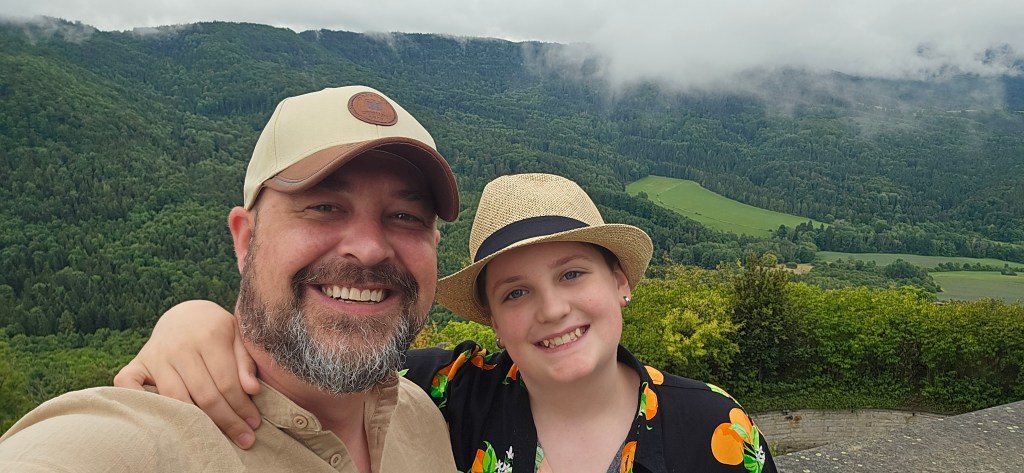
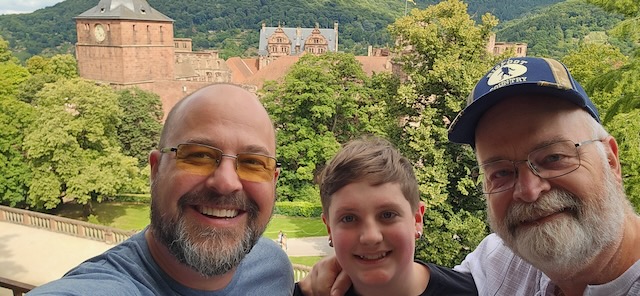
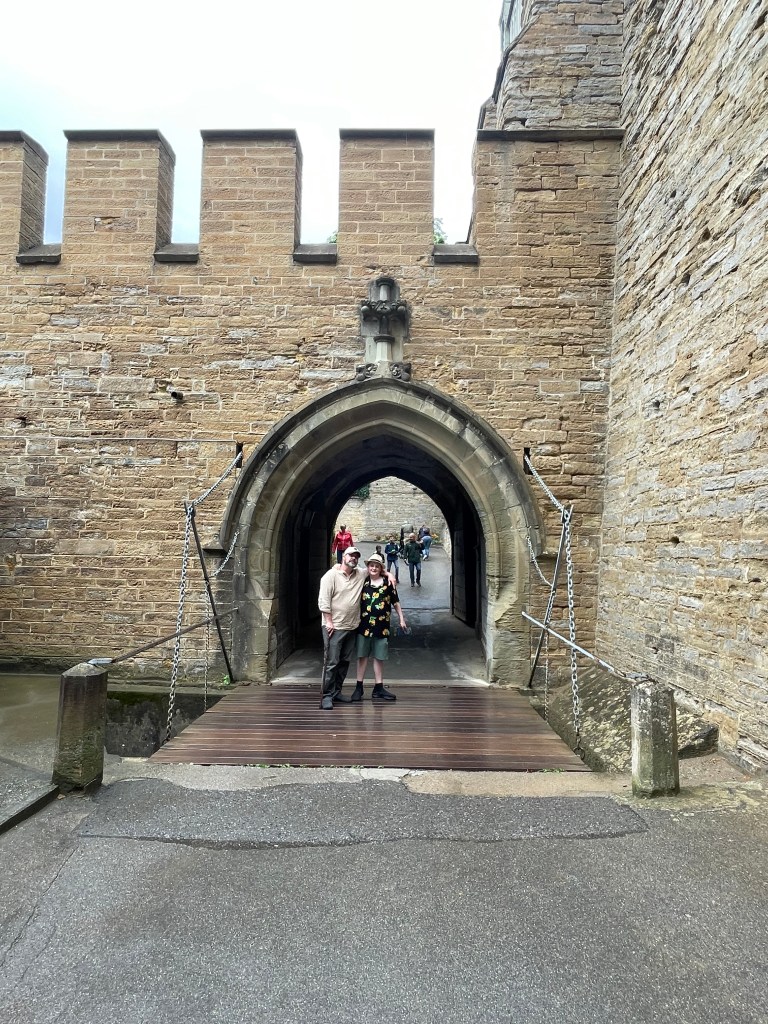
In the end, my two handsome boys enjoyed the visit and even managed to hold those smiles for the fifteen or twenty seconds it took for me to figure out why the photo button on my iPhone wasn’t working. Ah, turn it over, dummy.

Next on the castle-y tour was Heidelberg Castle, perhaps named after someone named Delberg to whom everyone said “hi.”

Actually, the name Heidelberg is derived from the German words meaning heath and mountain, apparently because it was unwooded at the time so the Germans just sat on the hill eating Heath bars. Perhaps the trees knew what they were doing by staying away because the castle has been struck by lightning at least twice. The first castle structure was built before 1214 and was later expanded into two castles, but in 1537, a lightning bolt destroyed the upper castle. Then in 1764 another lightning bolt caused a fire which destroyed some of the rebuilt sections. Whoa! Someone up there wasn’t happy with those castles!

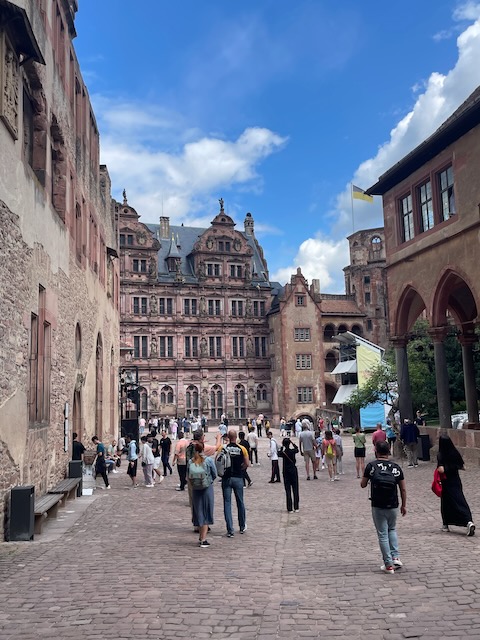
The castle has only been partially rebuilt, with some of it still in ruins. I thought the inside was just as interesting as the outside, although outside some of the buildings were impressive.

Like most castles, the views are spectacular, overlooking the city of Heidelberg. The city was largely spared bombing by the allies in WWII mostly due to its lack of strategic importance, and was occupied by the Americans at the end of the war. They of course also brought with them new McDonald’s and Burger King franchises, which resulted in the average Heidelbergian gaining about 10 kg (22 lbs.) during the first year of occupation.

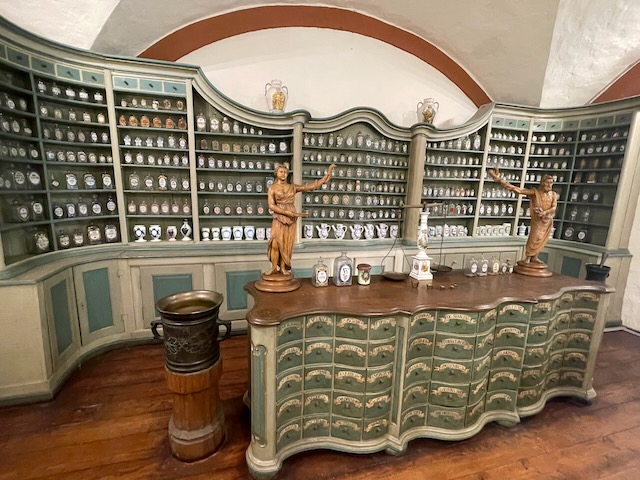
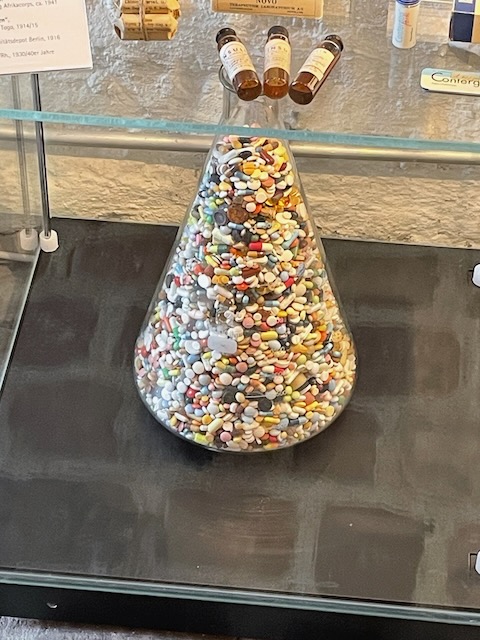
Inside the castle they demonstrated their pharmaceutical prowess of yore in the Apothecary Museum. The jar on the right held just enough pills to get through the day if you had a headache.

On the left is either a beer-making machine, a pill-making machine, or, based on the picture to the far right, some sort of auto-erotic device. Yeah, you go first. In all the top pharmacies back then, opium was an important medication for things like headaches, concerns about where pimples might happen, and when you otherwise felt fine and wanted to party. I can only speculate on what they did with the container on the right. Google Translate had no idea what “pichurim” is, so I can only guess it was something so nasty they decided to just banish the entire concept, but this appropriately shaped container seems to have survived the whitewash. I’m hoping that dish isn’t filled with expired testicles removed after too many nights of auto-erotic machines and opium. That would be nuts.

Someone once told me that Germans like beer. This gigantic beer barrel is all the proof one needs. Unfortunately, Masi figured out a way to tap into it and had downed a number of mouthfuls before we could get to him.

After a last look at this interesting castle, we rode the funicular down to old town Heidelberg.

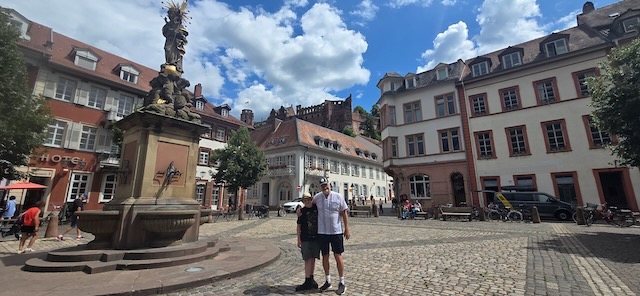
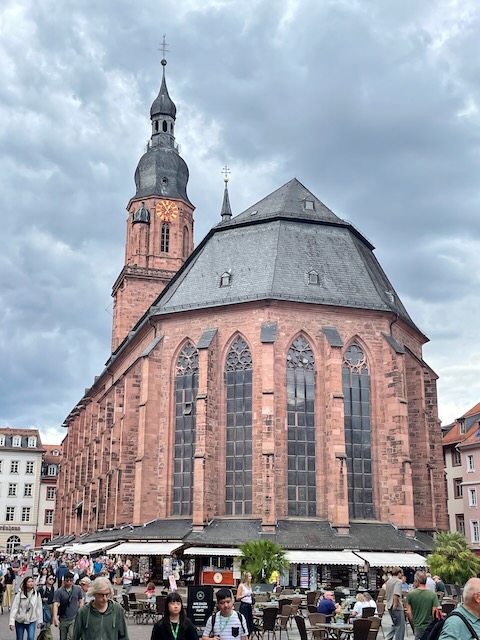
Old Town Heidelberg is very cute with some great old buildings (again, spared during WWII), and a fair amount of tourists (mostly made after WWII). We had a nice German lunch at an Italian restaurant, er– was it a nice Italian lunch at a German restaurant? …and otherwise enjoyed walking around the area.

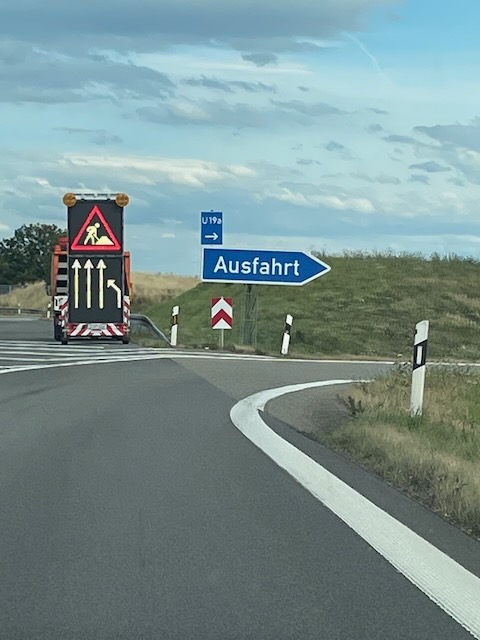
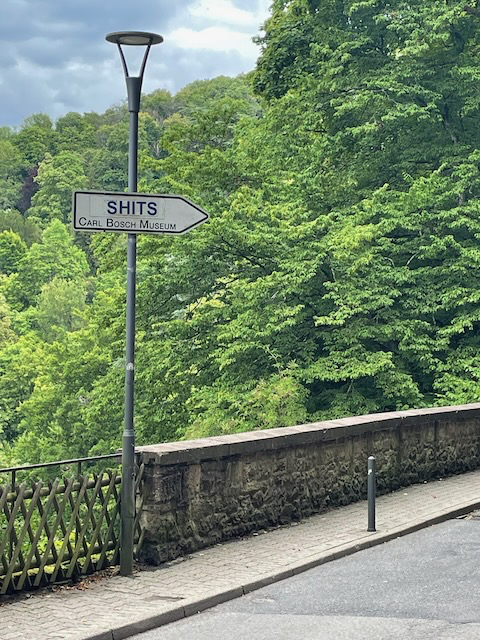
The Germans seem a bit obsessed with bodily functions. Fortunately, no matter how much explosive diarrhea we had, it was always easy to find a sign pointing the way to go.

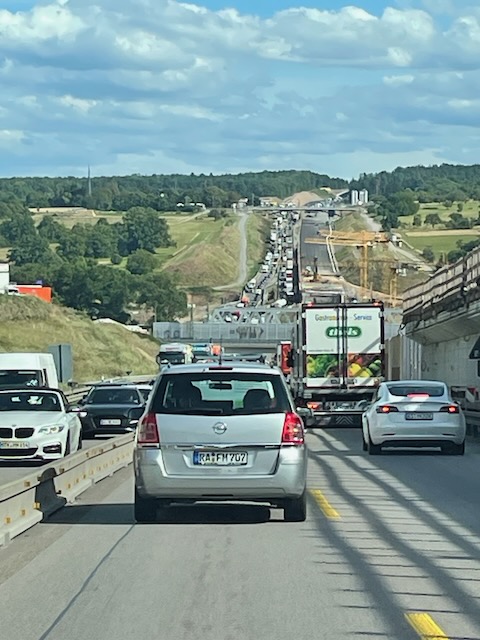
We settled in for the two hour drive– er, check that, I don’t know how many hours it took us because we encountered more than our fair share of jammed-up freeways as we made our way around the country.

Occasionally we would break out of the traffic jams and find a place to stop and see something interesting, in this case the Rhine Falls, known as the largest waterfall in Europe by average flow rate (the falls are actually in Switzerland, but I had some extra room). To be candid, it didn’t really seem all that impressive to us. Europe seems to be a little light on the waterfall flow rate department if this is the best they’ve got. The Rhine Falls are just the 23rd largest by flow rate in the world. Many Oregonians might be surprised to learn that the Willamette Falls in Oregon City is even more powerful, ranking 17th in the world, and no one there pays it much mind. There’s a small viewpoint on a busy highway where you will occasionally see a car stopped to view them. I guess everything is a little more exotic when it’s in a foreign country.

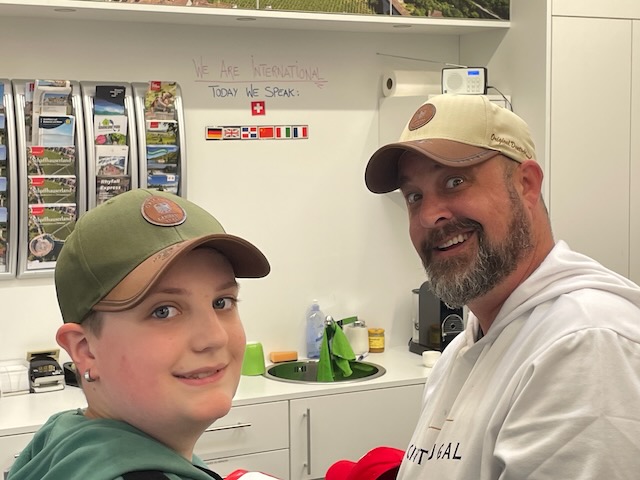
Ah, but they do have something the Americans don’t have, the need to speak multiple languages. In the gift shop they put up these little flags to show what they can speak on any given day. I tried some Swahili on them but was met with a blank stare, like I usually get when I speak Portuguese to a Portuguese.

A good percentage of Europeans are proficient at English. Except here I’m not sure who Off is, but I think it’s a little presumptuous of them to provide a suggestion like that. Does Off even know about this? Oh well, at least they care enough to offer some guidance, but a little more information would have been appreciated.

(Scroll down to see previous entries.)

Auschwitz

The name taken from this small Polish town will be forever etched into history as the centerpiece of the worst genocide in the history of humanity. The town was known as Oświęcim until 1939, when it fell under German rule. At that point the town name was switched to the Germanic version, which is Auschwitz. The nearby camp was given the same name. The Germans cleared the area around the camp to create a large buffer zone, expelling around 17,000 Polish residents, destroying eight villages and leaving Oświęcim with around 7,500 residents as of 1941.

Today, Oświęcim has over 34,000 residents. When we asked our tour guide how it feels to live in a town with such notoriety, he shrugged and said, “We remember the past, but we look to the future.” Additionally, since the Auschwitz name is the German version and is now only used to reference the camp, Oświęcim doesn’t automatically carry the stigma it would if it still held the same name as the death camp. Besides, it was all about the Germans; the Poles were victims too.

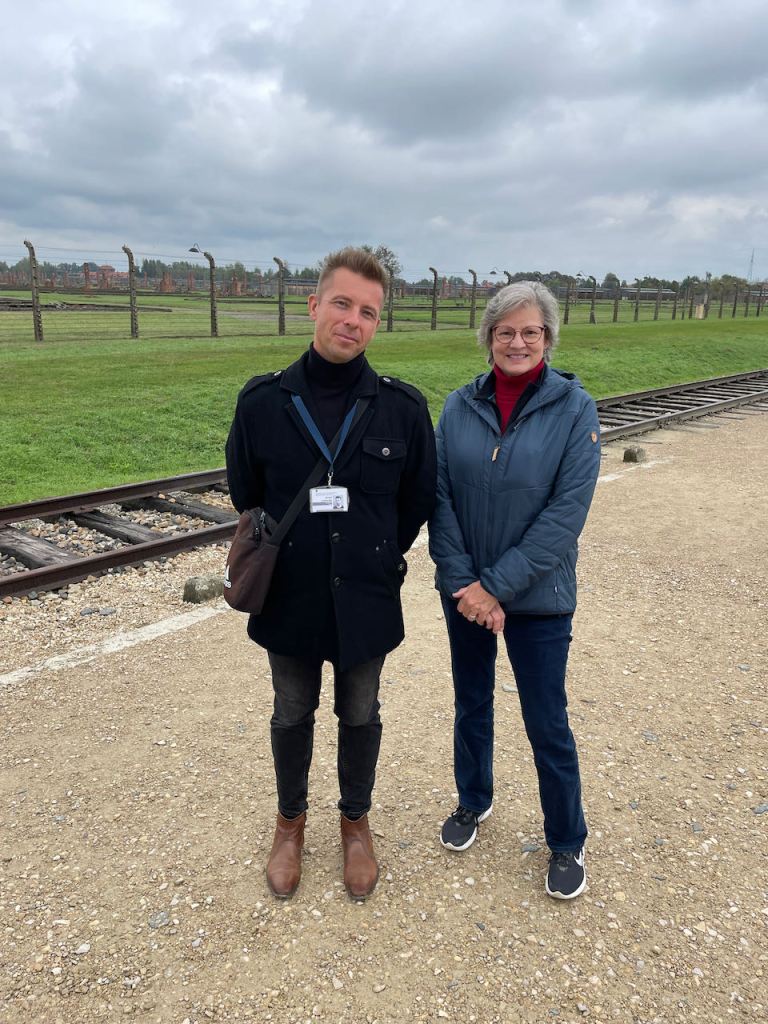
It’s a little hard to make out the infamous “Arbeit Macht Frei” (works makes you free) sign here with the tree in the background, but it’s very sobering to walk through that gate. Perhaps the two most iconic images of Auschwitz are this gate and the Auschwitz II-Birkenau gatehouse with its train tracks that led to the gas chambers (first picture). Both were gateways to the unimaginable misery and deaths of more than 1.1 million people, over 90% of which were Jewish. Auschwitz was actually the name of a system of camps, consisting of the main camp, plus Auschwitz II-Birkenau, Auschwitz III-Monowitz, and dozens of subcamps. In the interest of brevity and clarity, we’ll just call everything we see Auschwitz, even though half the tour was outside in the former location of Birkenau.

We had a pleasant and informative guide who took us on a private tour. If you ever get a chance to go to Auschwitz, I recommend booking a private or small group tour. We were allowed into a couple of places other larger groups were not allowed into, and it was nice to be able to ask any questions we liked along the way.

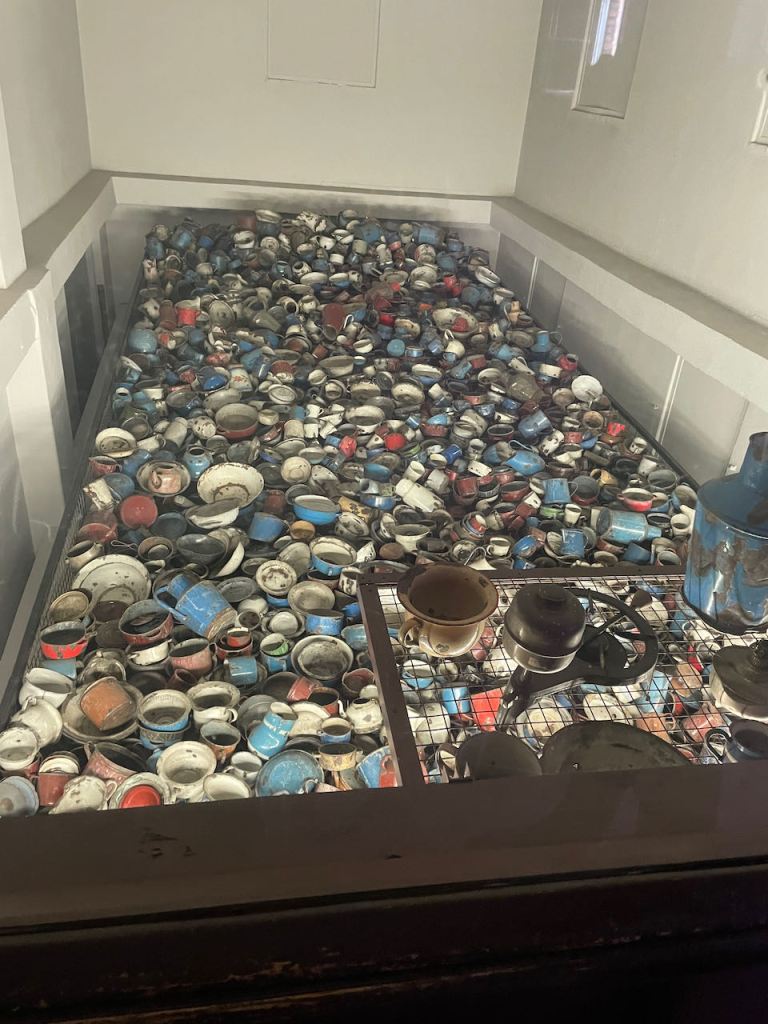
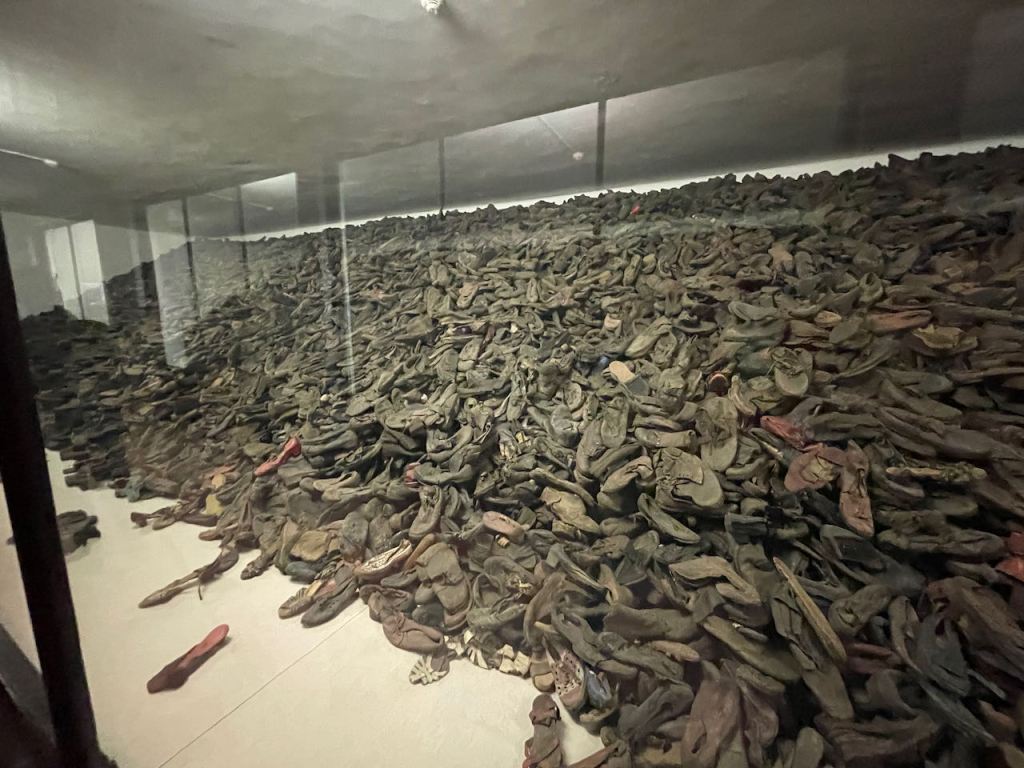
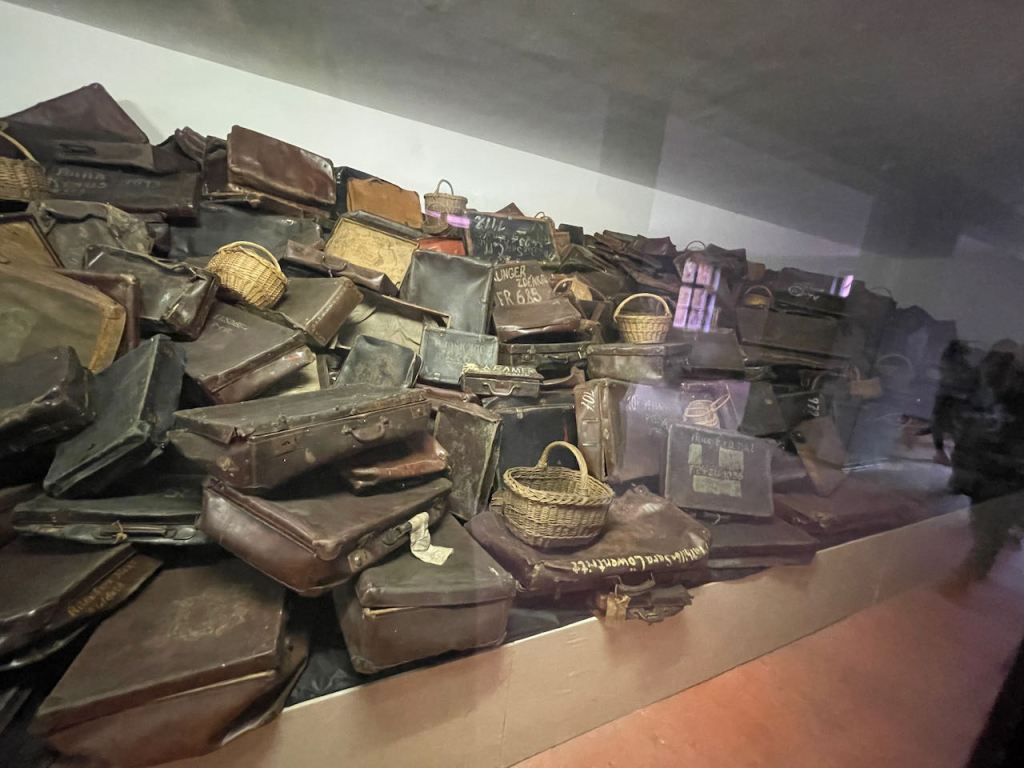
We fully expected to be emotionally overwhelmed by the visit. Strangely enough, neither of us were, although we both choked up when we saw a huge pile of children’s belongings. The Nazis separated anyone who would not be of any use to them in forced labor, meaning the elderly, sick or injured, pregnant women, and children were summarily dispatched to the gas chambers immediately upon arrival. Some infants were killed on the spot by being held by their feet and having their heads bashed in against the sides of railcars. Can you imagine? That should be hard to read. It needs to be hard to forget too, so we always remember what humans are capable of, especially when motivated by hate. As I reflected on our visit, I think we were a little bit emotionally numb, as if looking at the atrocities committed by a race of aliens. It’s hard to feel associated in any way with those monsters, but unlike what they did, I still have to acknowledge they were human. Human, but as far from humane as may be possible.

The brick buildings that were used to house the original inhabitants look surprisingly well built. The infamous structures that held Jewish prisoners destined for slaughter in Birkenau were made of wood and are mostly gone now.

Escape from Auschwitz was extremely risky and difficult, but not impossible. Known figures indicate that 928 prisoners attempted escape from Auschwitz, 50 of whom were women. Almost 200 prisoners actually got away. Most of the rest were captured, sometimes after weeks or months. It’s unknown what happened to some 250 of them. And of course the Germans always performed reprisals by killing a multitude of prisoners in retribution. I’m sure some didn’t think it at the time, but that would have actually been a blessing.

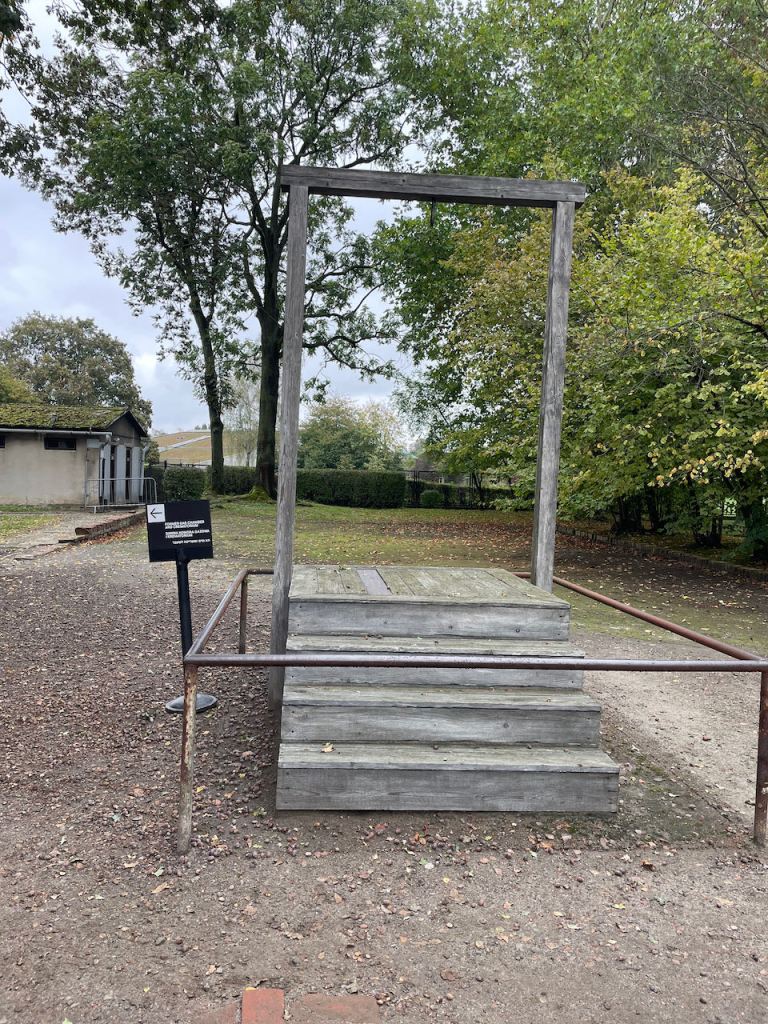
Auschwitz featured plenty of other ways to kill, including hanging and execution by gunfire. The wall above on the left is the infamous Death Wall (rebuilt after the war), where thousands of prisoners were shot. Auschwitz was a death camp, plain and simple. Thousands upon thousands of mostly Jews tumbled from stinking, jam-packed railcars and were led to the showers, ostensibly to be cleaned and deloused. The men were separated from the women in order to perpetuate this fiction. Those subjected to this extermination were not recorded or tattooed. They were simply vermin to be eradicated. Everyone had to remove their clothes, which were then scooped up and eventually sent back to Germany often for sale through thrift shops for the benefit of the German populace.

Everything was saved and put to use. Hair was shorn and used to make blankets and more. We were told the story of one of the commandants who noticed and admired a beautiful tattoo on the back of a prisoner. A short time later, that tattoo and the skin on which it was inked graced the wall of the commandant’s house as a decoration. They even experimented making soap out of the corpses. We’ve all heard stories of the lampshades made of human skin. All because one narcissistic sociopath with a lust for power decided his race was the master race, and “sub-humans” should be treated worse than animals. And scores of Germans supported him until he started losing the war. Madness.

These freight cars routinely carried 50 prisoners, but were often doubled in capacity to 100 people. It’s hard to imagine what a trip lasting days or even weeks would be like when everyone had to stand pressed together with no food, water, or sanitation. You might spend days standing next to a corpse whose body was simply held up by the people around it. The stench must have been otherworldly.

For those few who still try to either deny the Holocaust or diminish it, there is plenty of captured photographic evidence confirming that everything we know about these concentration camps is true. Still, there are always those who allow their cherished beliefs to twist their brains into undecipherable knots no matter the evidence, so we have to keep the history alive.

This was one of the few places in the facility that showed the actual faces of some of the victims. To that end, Carolyn and I both felt that the Holocaust Memorial in Berlin was more emotion-evoking. There, they tell the stories of various victims and their families, humanizing them and reminding us that they were simply people too, living their lives unaware that the sin of being born Jewish meant that you would be targeted for extermination.

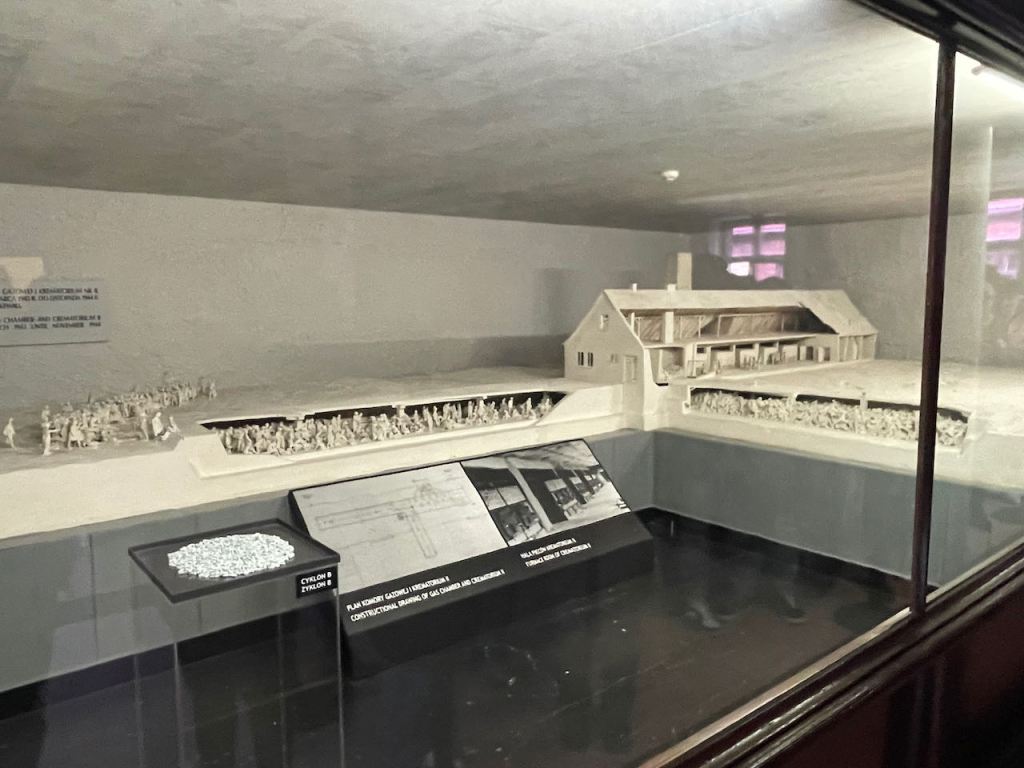
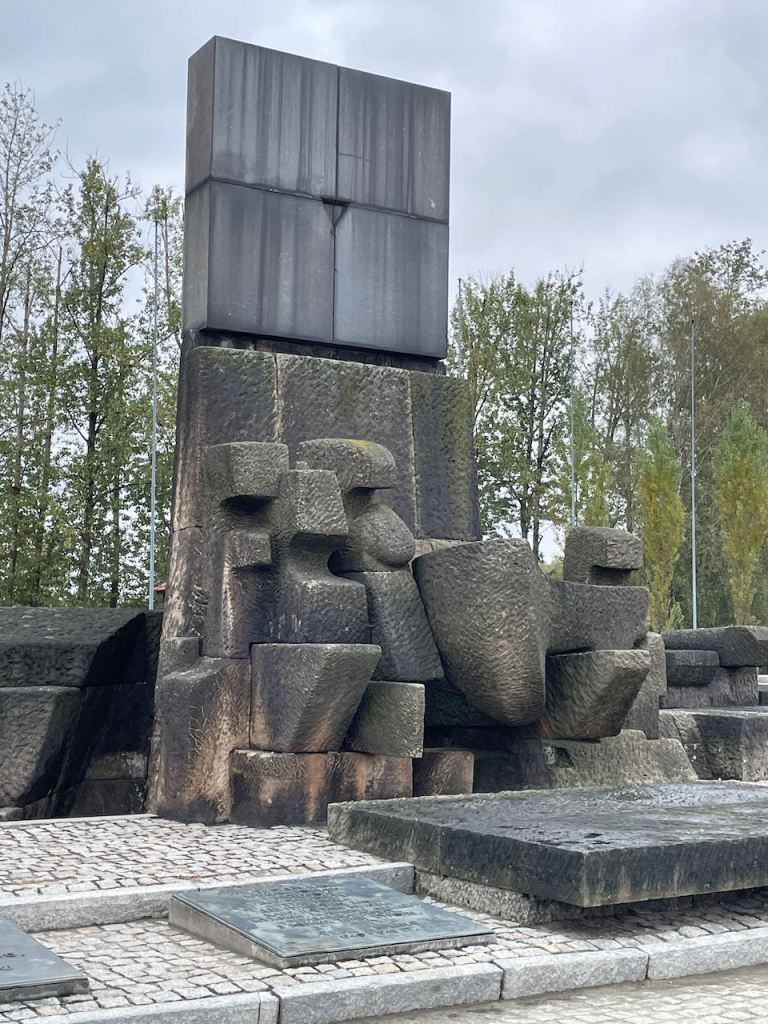
The tour offered some monuments and models, the latter of which demonstrated the efficiency with which people were herded from the trains to the gas chambers. The memorial on the right is the International Monument to the Victims of Fascism. The tour of the camp was not overbearing or dramatic in this regard, but more complementary; they mostly allow the place to speak for itself.

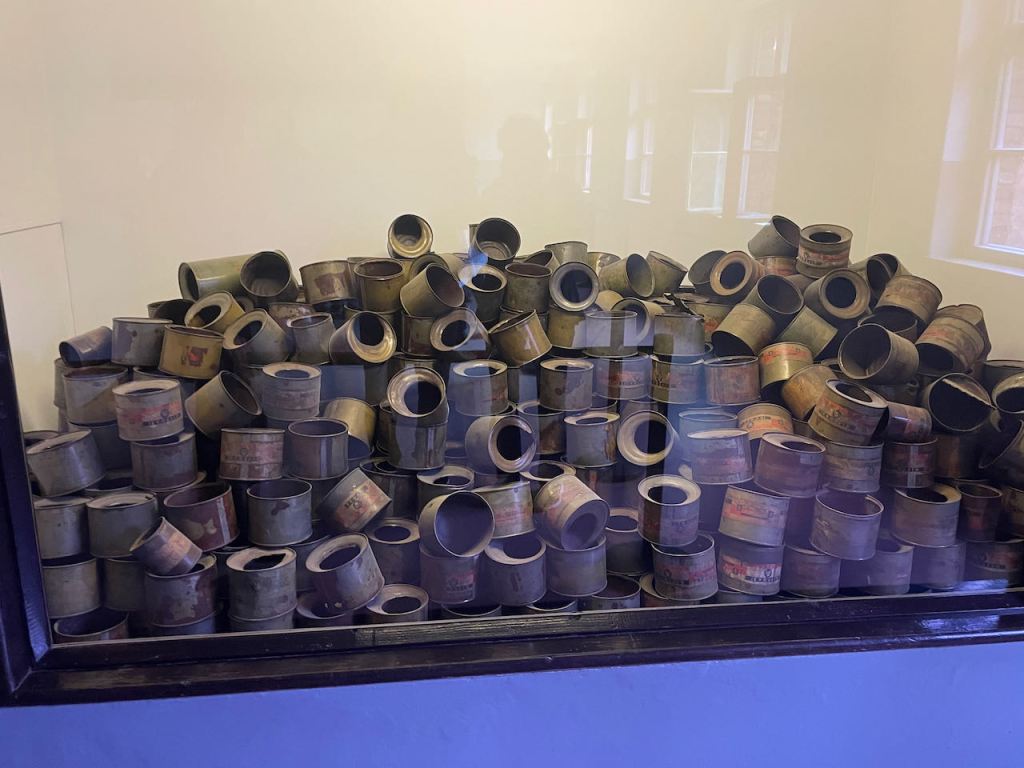
These are empty canisters of Zyklon B, a cyanide-based pesticide that was converted for use to more efficiently exterminate people. One of the comments our tour guide made more than once was that the Germans considered Jews and other undesirables to be nothing but insects. I had often wondered how anyone could treat people worse than they might treat even the lowliest animals, and I suppose thinking of them as insects is about as far down as you need to go to help justify your evil. To demonstrate how powerful yet ridiculous political propaganda can be, Dr. Josef Mengele, the notorious “Angel of Death,” an educated medical doctor, opened up Jewish people (without anesthetic), expecting to find their internal organs either different or in different places. After all, they were “sub-human.” It boggles the mind. Mengele actually escaped after the war and lived until 1979 in South America. I hope he had nightmares every night of his life.

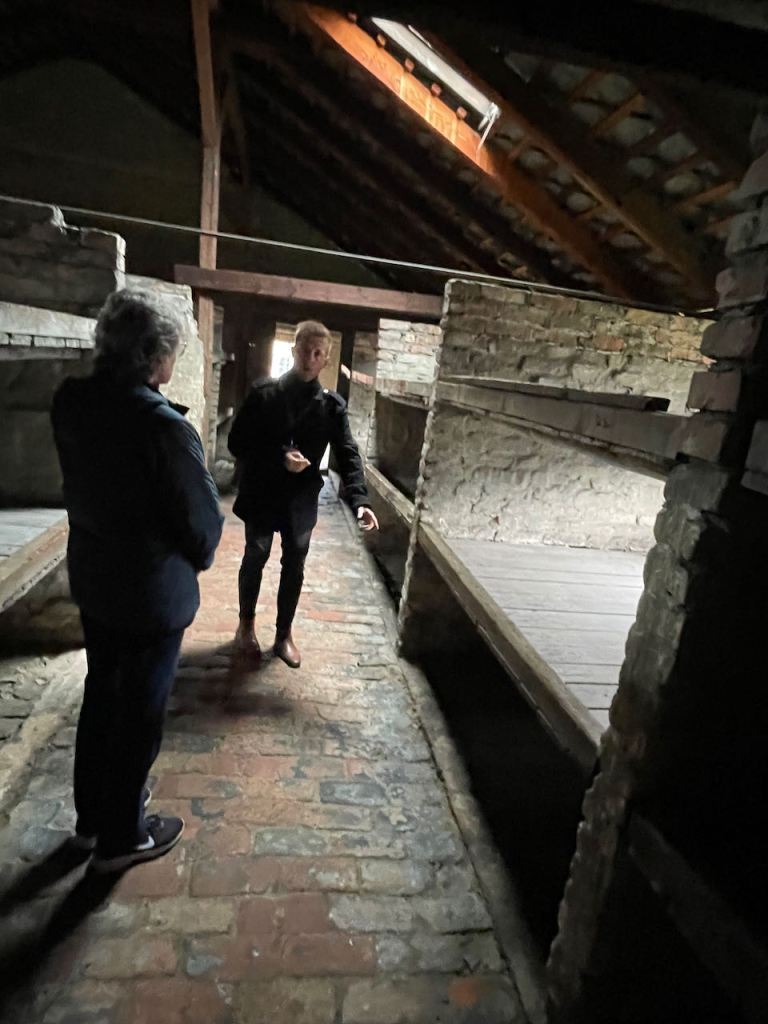
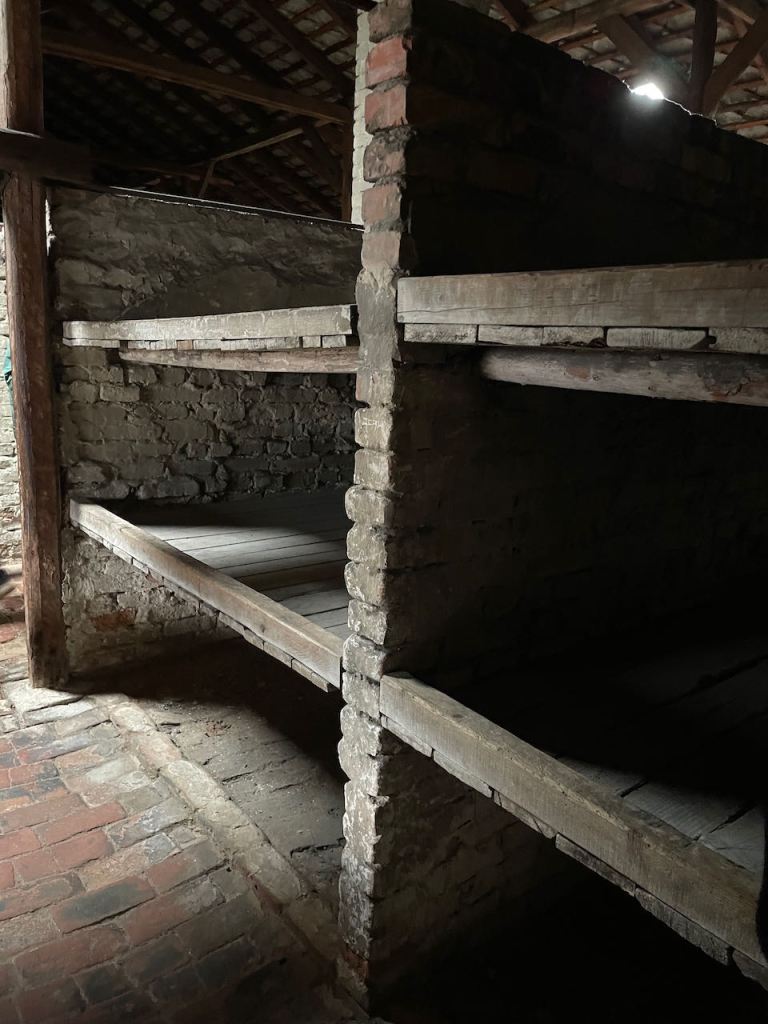
One of the most disconcerting things about being inside one of the barracks, where we could see the racks of bunk beds used by prisoners, was that the place still stank of urine. Nearly 80 years later, the smell has so permeated the wood that it may never go away. That was a little unnerving. The three-tiered bunks often held up to eighteen people, or six to a tier. FIrst thing in the morning, the dead would be carried out, and the remaining prisoners would be given a bowl of a bitter beverage similar to coffee for breakfast. For lunch, they might get a dish of thin soup made from rotten vegetables or meat, and then a crust of moldy bread and a little dab of margarine before going to bed. Make no mistake, you were brought to Auschwitz to die. You were either murdered immediately, or were put to work, where the average lifespan was 4 months.

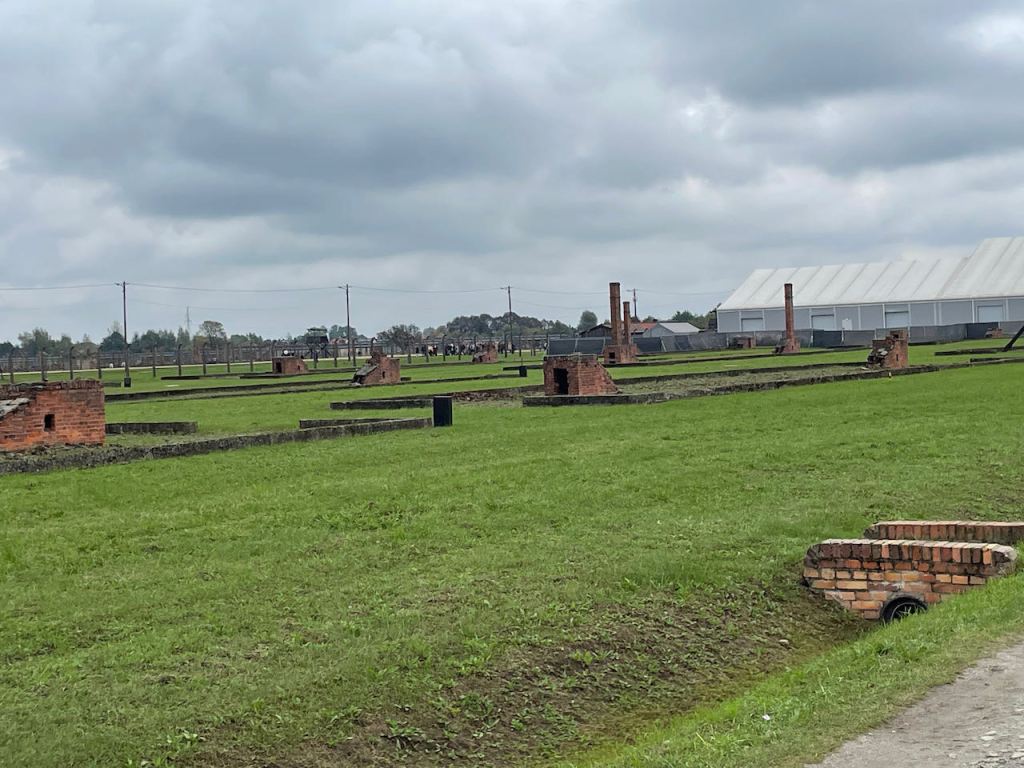
This is all that remains of the crematoriums in Birkenau. Remarkably, they’ve been able to preserve them just as they were after the Germans blew them up prior to the camp being liberated by the Russians.

The Birkenau section of the camp is quite large. Areas that originally held scores of wooden barracks now only have single chimneys left standing. Essentially, you can peer at a death machine as far as the eye can see, which prompted one of my questions to our guide. I’m not much of a believer in ghosts or spirits, but those who are generally claim that spirits remain because they have unfinished business or experienced unspeakable torment or some such. So if there were ever a place likely to be haunted by tortured souls, you’d think Auschwitz would be filled to capacity with strange goings-on from the afterlife. He indicated he hadn’t heard of any reports like that, although some people can certainly be inclined to feel a little strange being in a place filled with the echoes of so much torment and death.

There is much, much more to Auschwitz and the other German concentration or death camps. My goal here wasn’t to provide a lot of detailed history, but to give you the highlights of a tour we experienced firsthand. I became so immersed in what I was experiencing at times that I didn’t always remember to take a picture, and I didn’t think it overly appropriate to take a selfie or the like. But I think we captured the gist of it.

I will add that on the short bus ride from Auschwitz I to Birkenau, a group of young ladies, roughly high school or college age, decided it would be an appropriate time to laugh and giggle together quite loudly, culminating in their singing some sort of lively, happy song. I so wanted to shout at them, “STOP! Just STOP! This is a place of unimaginable horror and agony! Some people on this bus are grieving! Show some respect!” But I held my tongue, thinking that the world will surely mature them beyond their current youthful ignorance and exuberance soon enough. Still, the incongruity was a bit jarring.

In some ways, I will never understand the human brain and the ease with which so many of them accept hatred as a concept to embrace. While the Nazis brought in plenty of criminals, sadists, and sociopaths to run things inside the barracks (not wanting to go into those disease-ridden cesspools themselves), the rank and file German either turned a blind eye or supported the prejudice against the Jews and others. As long as it wasn’t them. This is the reason we should never forget what fascism, hatred, or often simply the lust for power, can lead to.

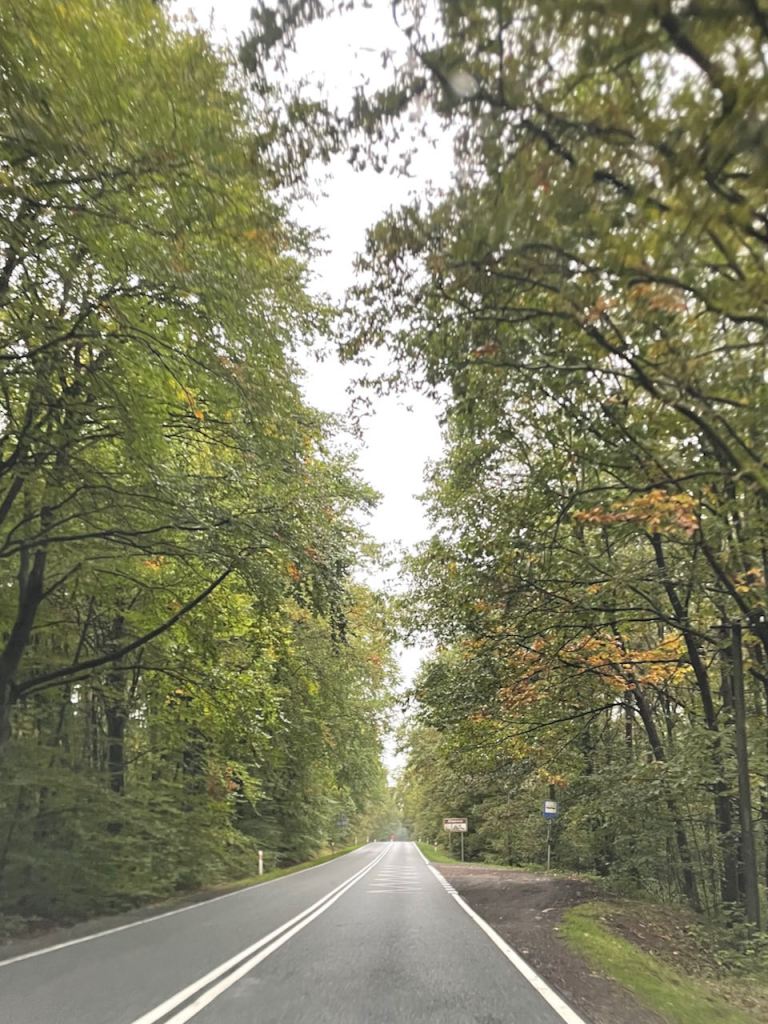
The drive back to Krakow was pretty, but we were somber. The tree-lined avenue offered its silent comfort to us, perhaps telling us that despite the horrors we had just seen, there is also a lot of beauty in the world. The only thing is… it absolutely can happen again. We must remember the past. Only with vigilance and a rejection of hateful rhetoric can we even hope that we’ll never see anything like this again. We can hope. But as I write this, Donald Trump has just been elected to a second term. Based on his autocratic tendencies alone, if this were, say, a decade or two after WWII, he wouldn’t have had a snowball’s chance in hell because the memory of what a dictatorial personality is capable of doing would still be fresh on people’s minds. But apparently memories are short. And so ultimately, we can only hope the worst doesn’t happen. Again.

(Scroll down to see previous entries.)

Last Stop ’til the Russian Border!

When I first looked at the itinerary for this cruise, I was smitten with the idea of visiting lots of small Norwegian towns along the coastline. I envisioned quaint villages of some sort; I honestly had no idea what coastal Norwegian towns looked like. That provided me with some additional anticipation because I always look forward to experiencing things wherein I was previously clueless. Come to think of it, I look forward to a lot of things nowadays.

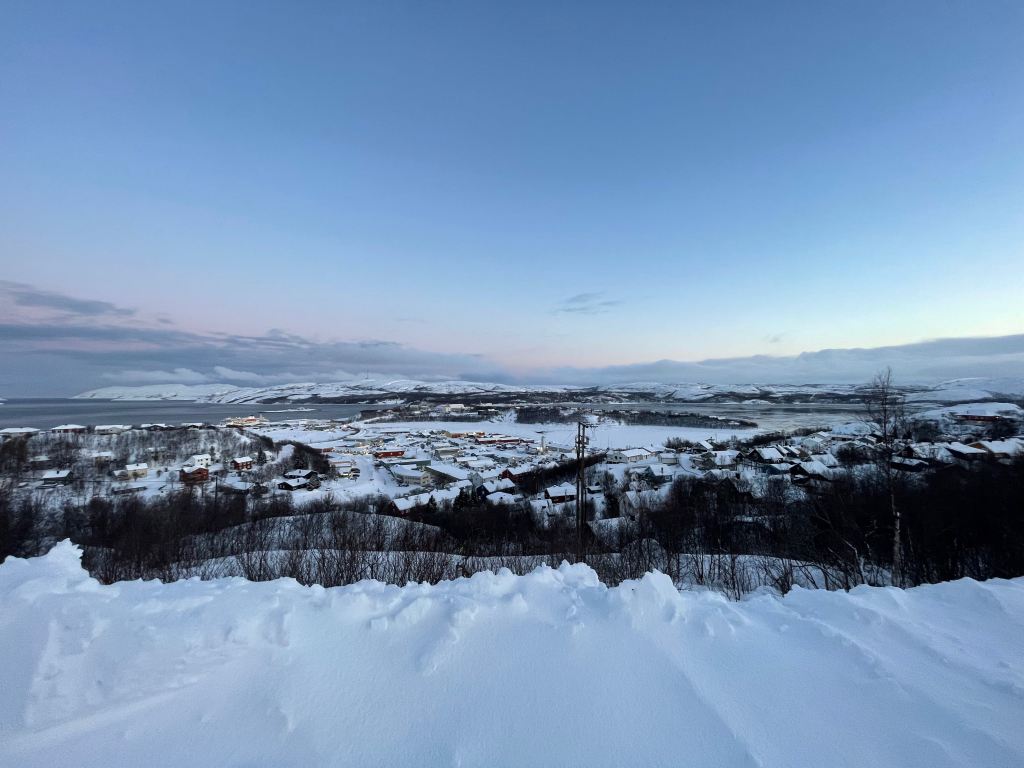
Nordvågen is a perfect example of what I wanted to see. It’s just a small fishing village with a fish processing plant and population of under 500 people. Our ship’s capacity is 640 passengers, which means that any time the ship docks, the population of the town more than doubles. I took notes in case I ever need to orchestrate an invasion of a town from a cruise ship. If all the old people pulled their weight I think we could win… that is as long as we all get potty breaks during the battle.

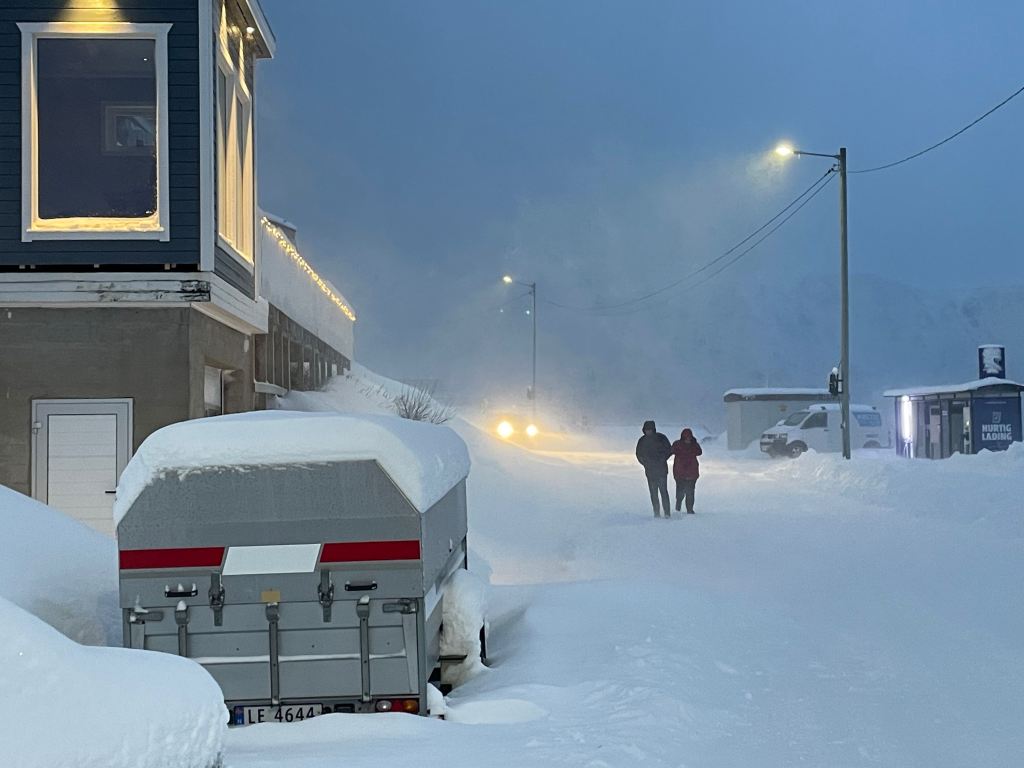
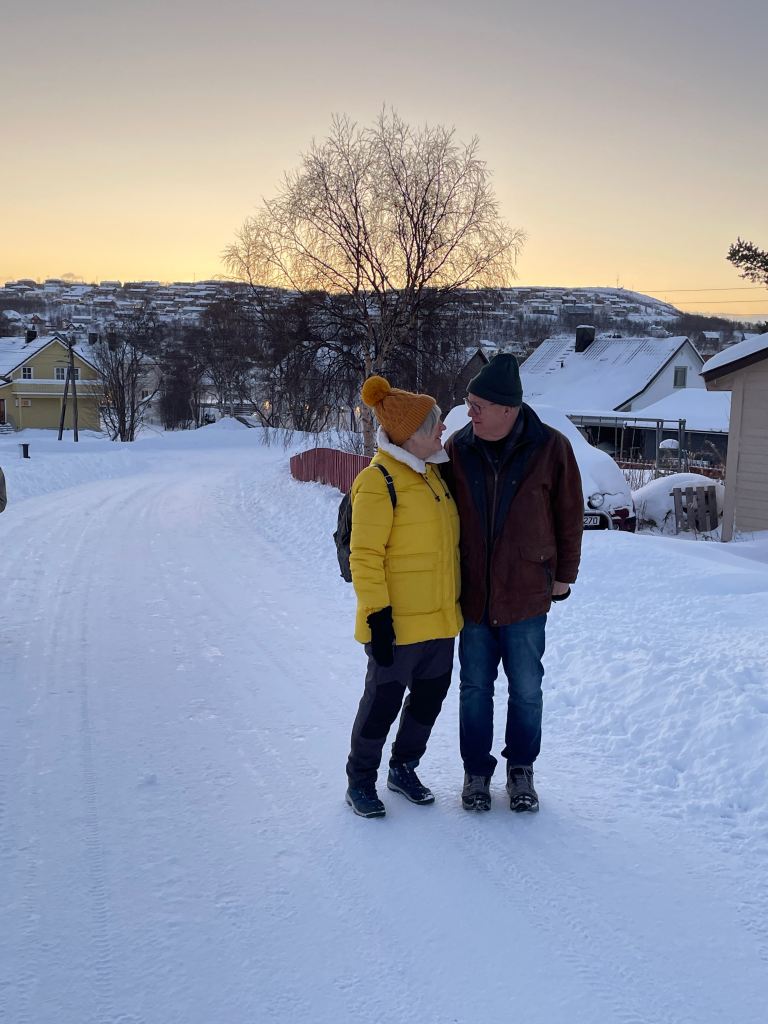
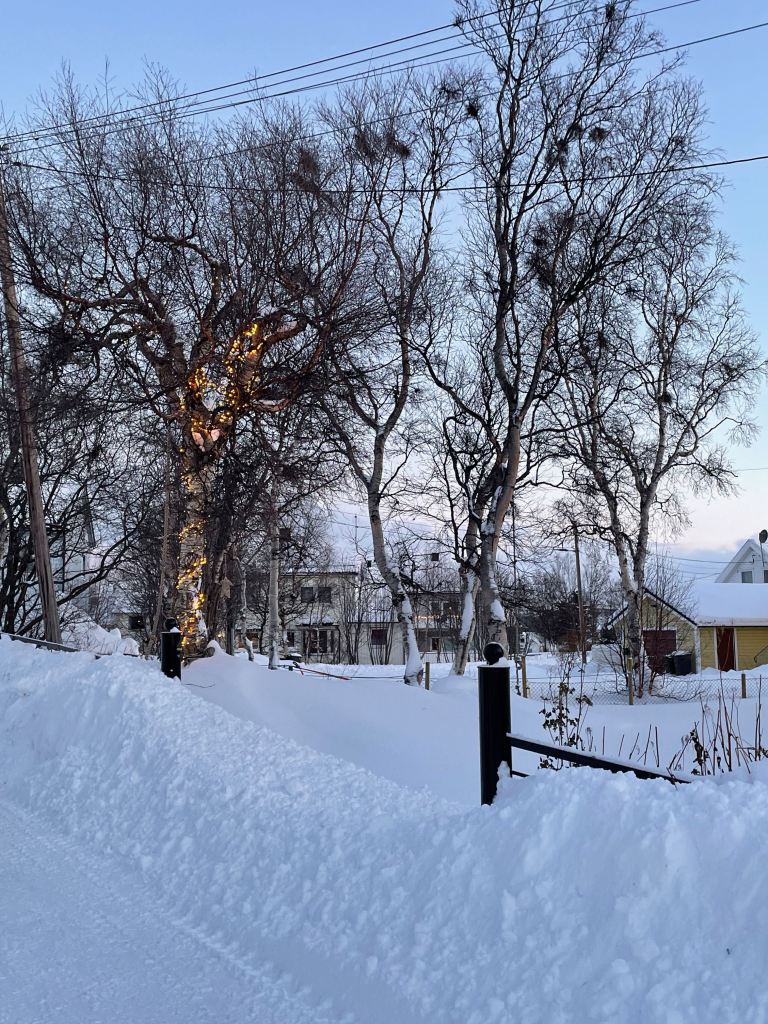
Tim and I wandered the streets separately gathering photos; the gals really didn’t want to brave the cold so it was up to their manly, burly, and heroic men to shoulder the sightseeing load. As you can see, it was obviously cold enough for the snow to pile up, which meant that it was quiet and beautiful. I love when you’re walking along and can only hear the crunch of your boots on the snow, and your labored breathing, and a weird sound from your chest that makes you wonder if you’re starting to have a heart attack.

The residents are obviously very used to the cold; there were as many people wandering around as I might’ve imagined in the summer as well. Note that these photos were taken around noon; the sun is something to be feared in these northern areas.

I saw a number of these clever transports, called a sparkstoetting or kick sled; you just walk behind it and slide your groceries, or dead body, or whatever you need to transport, along the snow. Plus they make great kindling in case of a snowdrift emergency.

Scandinavians are famous for leaving their babies outside, even in the bitter cold. They believe that fresh air and nature play a crucial role in a child’s health and development, and even healthy sleep patterns. I heard somewhere that the tradition may have started due to some ugly babies, whereby the parents hoped they’d get stolen thinking they had a bit too much troll blood in them. But most Norwegians don’t want to even broach that topic, at least based on the very rude expressions I received after I asked why Norwegians hate ugly babies. They do claim the whole thing even makes people more independent, which is why they believe so many leave home earlier than in other countries (yeah, nothing about it being due to being bad parents, which people who try and get their ugly babies stolen most certainly are). Based on the data that shows Scandinavians are generally happier and healthier than pretty much anyone else in the world, I’m not gonna argue with them about any of their customs, even if they have to raise the ugly kids too. I’m glad my parents did… otherwise I wouldn’t have had any brothers or sisters.

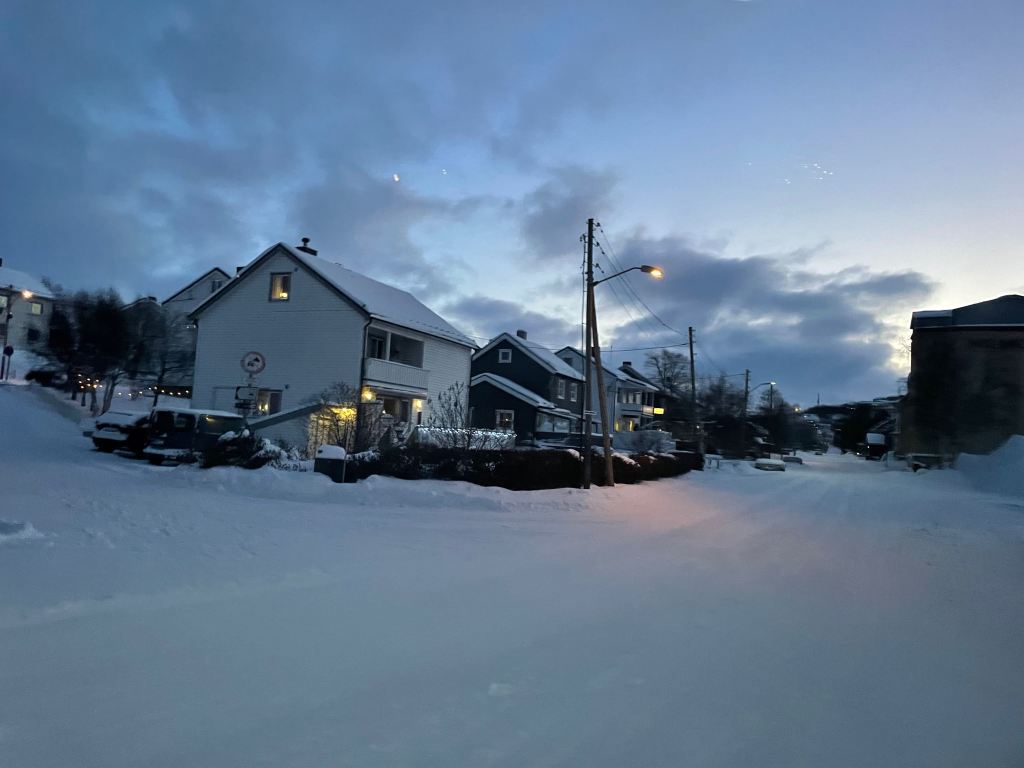
The style of their housing reminded me a bit of American housing, especially in the Pacific Northwest. There’s not really a specific style I can cite, especially since I wouldn’t know the building terms anyway because I forgot everything I learned in the architectural school I never went to, but they do use a lot of wood, probably on account of the trees, which is known to be a good source of wood. They also defy the European stereotype of having lots of ancient, charming buildings, mostly because everything got bombed during the war, plus the more ancient you get that far north, the more everything was made out of snow and didn’t last. Exploding igloos sure looked cool though.

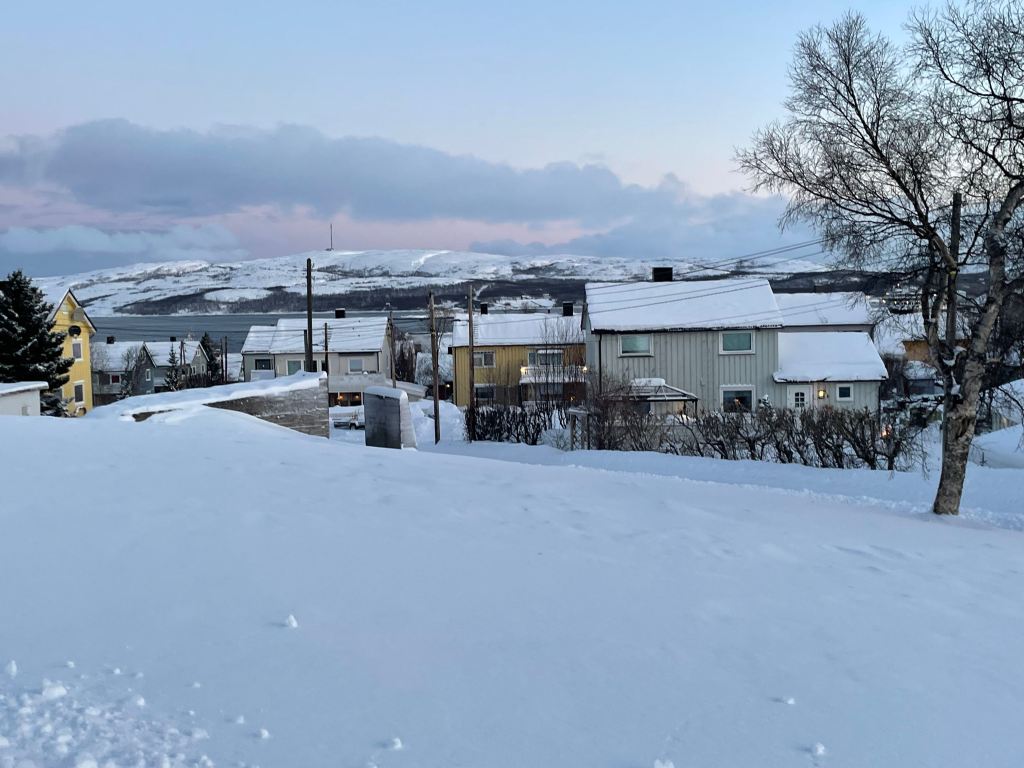
I have to say that I have a hard time imagining very many towns in the world with less than 500 people in them looking as good as Nordvågen. The snow of course helped, but it’s just a sweet little town that wasn’t designed for tourism, but instead just to keep their population warm, safe, and comfortable.

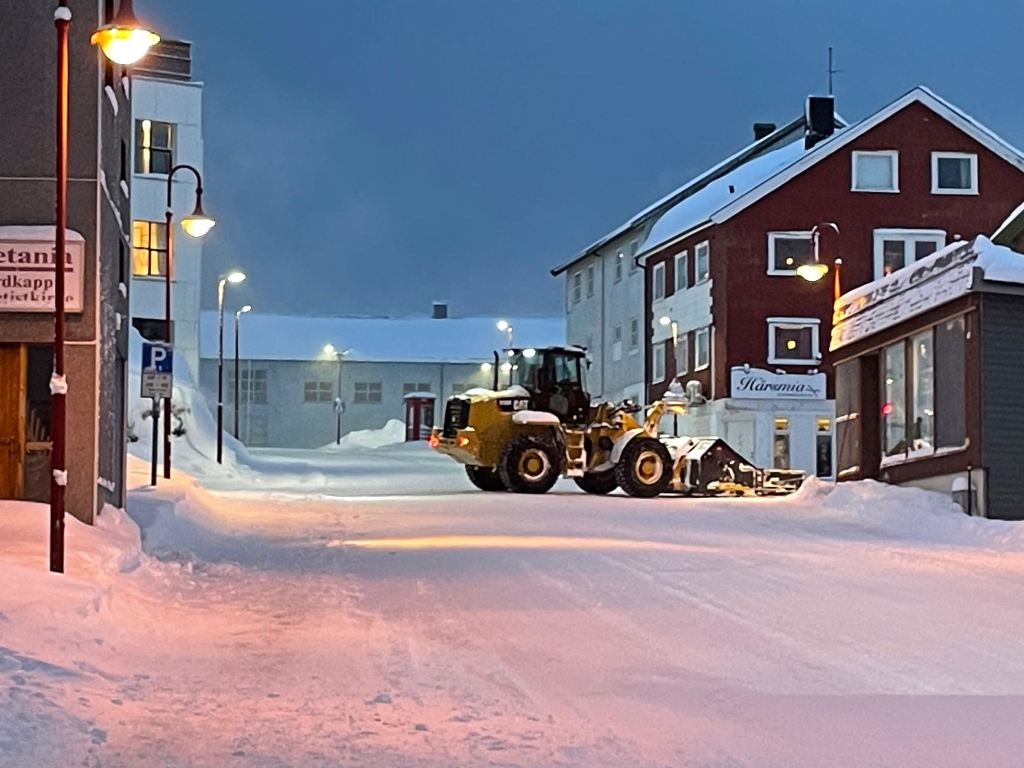
I’m pretty sure at least half the vehicles we saw were either snow plows or tractors that moved piles of snow from one place to another. In July, the average high in Nordvågen is 56°F (13°C), and otherwise hovers around freezing during the winter months. I had a hard time finding data about how much snowfall Nordvågen gets –I suppose because the town is so small– but suffice it to say there was plenty while we were there. Snow wonder they get plowed!

As I wandered in the subzero cold, I marveled at this business that had its main door propped open like it was the middle of summer. I guess they need that natural air conditioning to get the temperatures close to freezing, where these hardy Norwegians are most comfortable.

I wanted to warn them that the cold was dangerous and if you exposed yourself to it long enough you might end up frozen solid like this poor chap, but I figured they must know what they are doing. Or maybe this is just how they bury people: they prop them up until spring comes then it’s a race to see which thaws first, the ground or the dead body. Anyway, this was obviously one of the ugly unstolen babies.

Screenshot

I was delighted to see this Danger Warning I received on my phone while I wandered about the town. It made me feel really good that even though I was a tourist from another country, if there was a big problem, like a landslide, a Russian invasion, or a herd of ugly babies wreaking havoc, I’d be made aware of it. The text was even in English! This is but one example as to the benefits received when a country invests in its infrastructure and really tries to look out for its citizenry. On the other hand, maybe they were just warning me that I had a bill from Vodafone; not having a working cell phone nowadays could certainly be called a threat to life and health.

Even in a town this small, they have a store that specializes in everything a man might want. I mean, what guy doesn’t want to walk into a store filled with nothing but man shjit? In English, moil means “hard work,” because real men don’t like nothin’ that didn’t take some effort. Hard work and man shijit: it’s what makes Norwegian men feel like Thor.

After that, we finally made it to Kirkenes (one of the cruise personnel told me it’s pronounced “Sheerkenes,” more or less), which is the Norwegian town closest to the Russian border. It was here, in Kirkenes, that I met up with my two CIA handlers, code-named Jim and Joe, who were assigned to assist in the Poo-Poo-Putin operation I’d been planning ever since I was invited on the cruise. BTW, if something should ever happen to me, Tim and Susan had no idea about the plan. They made a perfect cover story.

Not only are they a cute and loving couple, but I was able to use Susan’s coat as a landmark during an especially sensitive part of the operation. I was four miles out (6.4 km or 14,305 cubits) and was running out of hope until I saw a smudge of sunshine shimmering across the tundra. I will say that the coat isn’t great in the city… we were never sure if people were going to accelerate through the yellow light or come to a screeching halt thinking it’s about to turn red. Insurance rate increases followed Susan everywhere she walked.

The bus stopped along the way to let us enjoy these spectacular views. I think some of the scenery might be Russian, but it’s so hard to tell nowadays because once they stopped with the Communism all the red went away and so now it’s really hard to tell where Norway stops and Russia starts. I yelled “Putin sucks!” real loud just to see if I could see a flash from a weapon across the way. I wasn’t worried: everyone knows Russians are bad shots.

When I travel to another country, I’m always interested in two things: their housing and their grocery stores. I think it has something to do with my curiosity as to how people in other countries really live. I thought it was interesting that just minutes from the Russian border a town in the far north of Norway has houses that could be plopped down in the middle of a Portland, Oregon or Seattle, Washington neighborhood, and no one would think a thing of it, other than wondering why a pair of witch’s shoes were poking out from beneath the foundation.

This is actually a symbolic Russian/Norwegian border in the middle of a Kirkenes neighborhood. If I remember what our tour guide said, they use some buildings nearby as a place for meetings or negotiations or some such. Obviously the red post is for the Russian commies, and the yellow one symbolizes the sacred Norwegian yellow snow.

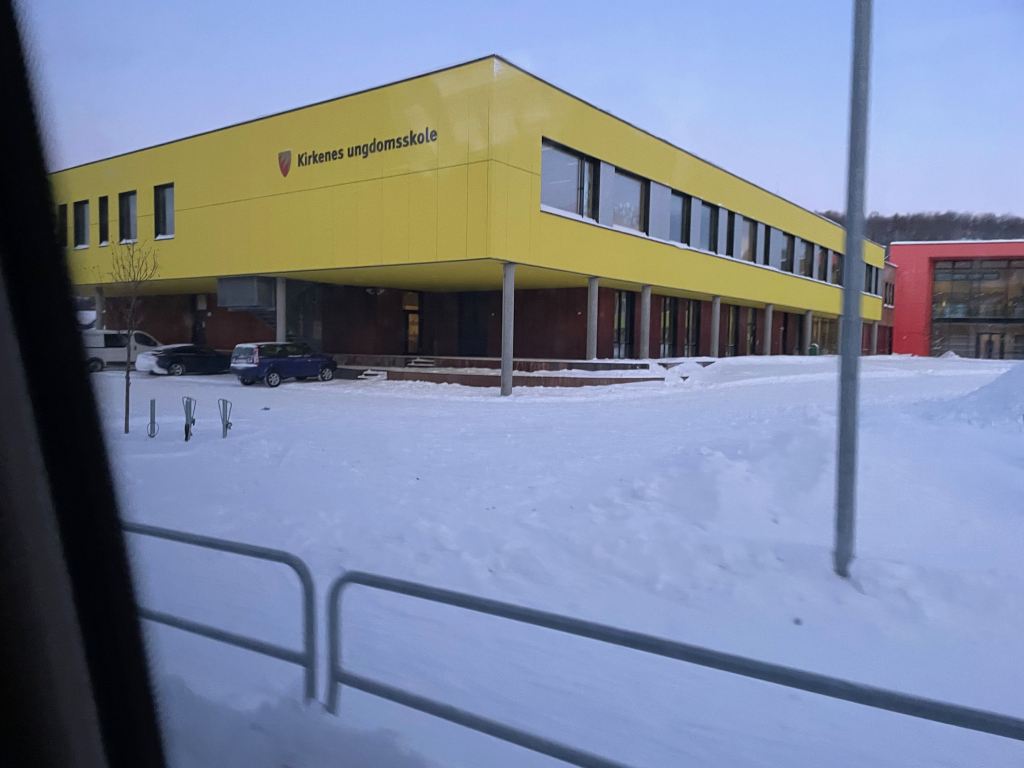
Speaking of yellow, this is a secondary school… I don’t know why I kept taking pictures of schools other than maybe they just stand out. It’s clear that Norway puts a lot of resources into education as well as the health and safety of its children, despite the cowardly paint job.

I finally made it to the undercover meeting place that was set up for Jim, Joe, and myself. Andersgrotta is perfect because it’s a WWII bunker and was named after one of my ancestors. “Grotta” means “cave” in Norwegian, so I have to think the Andersons around here go all the way back to the stone age.

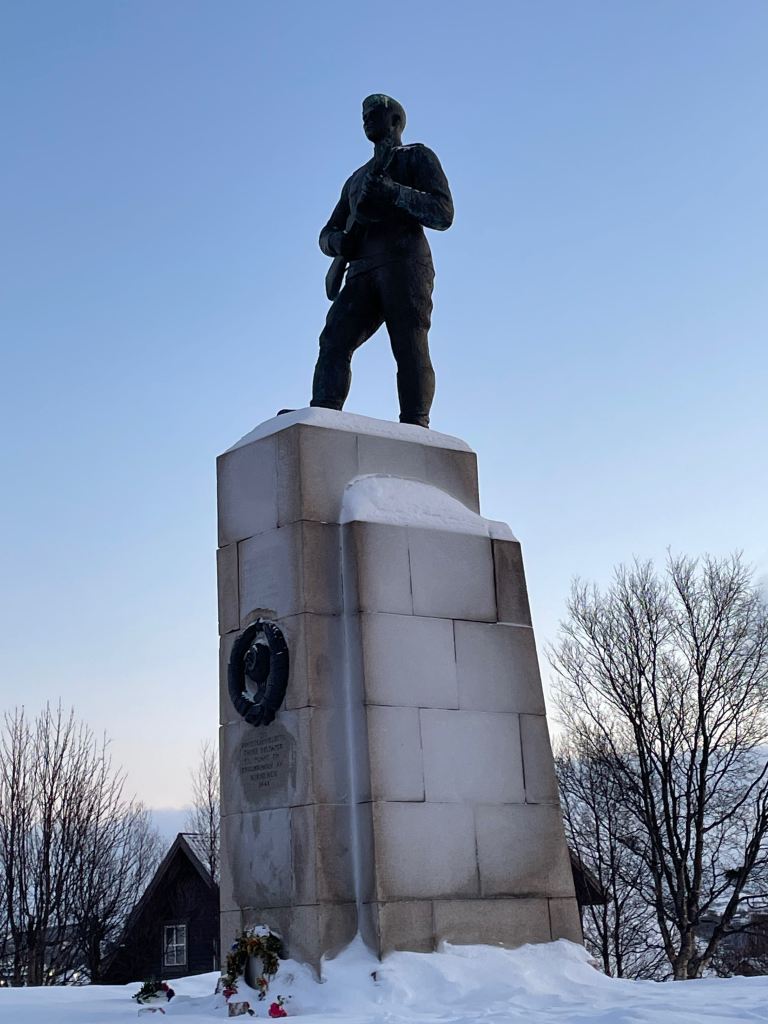
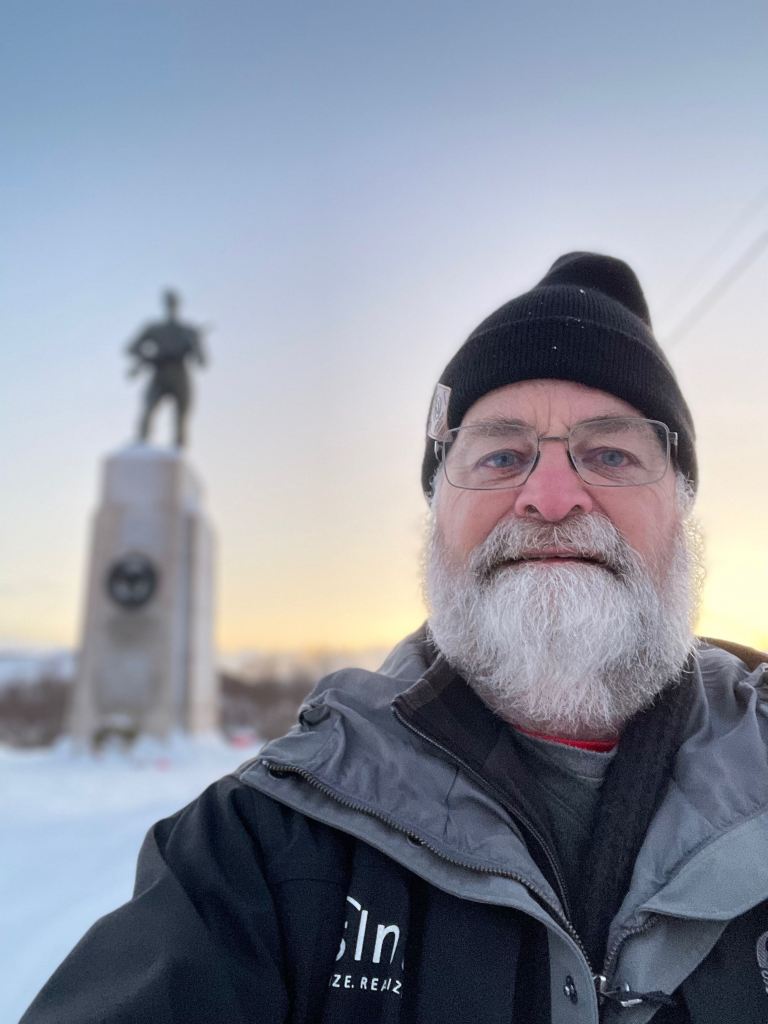
Near Andersgrotta is a monument to Soviet soldiers. In this part of Norway, Norwegians tend to still be grateful that the Russians fought against the occupying Germans in WWII. The Norwegians actually had a great time of it all by setting up a bunch of grandstands where they drank aquavit and ate reindeer on a stick while watching the Soviets and Germans duke it out.

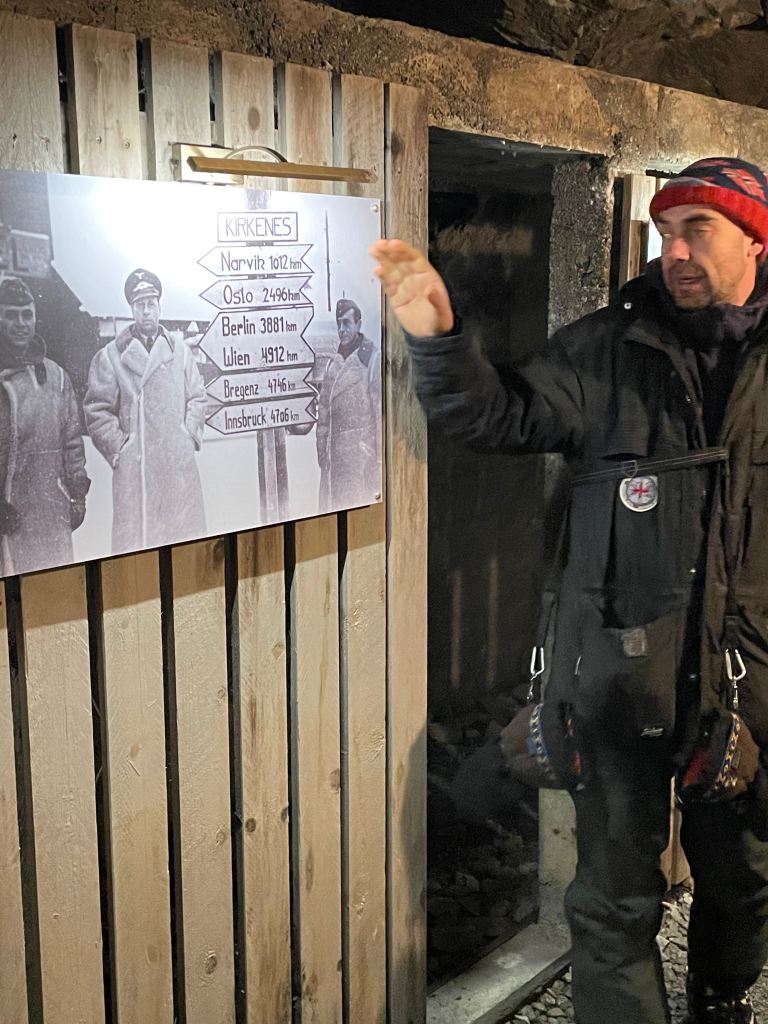
So here we are, smack dab in the middle of a typical Norwegian neighborhood, and amidst all that normalcy is a huge bomb shelter from World War II. The Nazis had bases in Kirkenes for their Kriegsmarine and the Luftwaffe, and it also served as a primary hub for supplies, so it was bombed mercilessly. Only 13 houses in Kirkenes survived the war, and one of those had a really ugly paint job. One bonus is that Kirkenes is one of the cleanest towns in the world, because they bombed the shit right out of all of it. Today, when you include the neighboring villages, the urban area of Kirkenes has about 8,000 people. During the war, as many as 70–100,000 Germans were billeted in the Kirkenes area at any given time. I’m guessing any Norwegian hookers alive back then made a fortune, even if they were ugly.

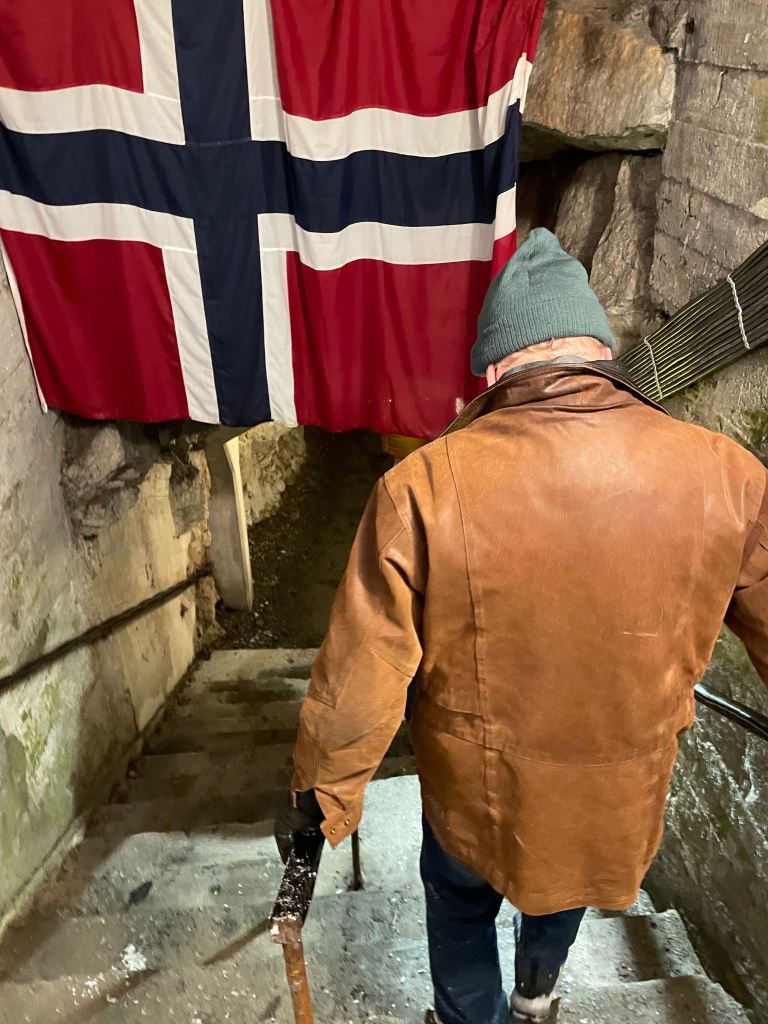
So down we went into the labyrinth. Being surrounded on all sides by solid rock was a bit eerie but at the same time I felt very safe, especially in case one of the Russian missiles intended for Ukraine accidentally ended up in Norway at that moment. After the war, the Norwegians built another shelter designed to withstand a nuclear blast, and in fact in the 1960s Kirkenes endured the repercussions from a Russian nuclear test near enough to the border to blow out most of the windows in the town. I have no idea if Russia sent over a window guy afterwards, but they sure should have!

Our tour guide provided all sorts of interesting details about the place, but one of the reasons I don’t do a lot of guided tours is because while I’m entertained and find it interesting at the time, the next day I can barely remember to put my pants on much less remember whatever a tour guide said. Besides, I was rather preoccupied with my impending meeting with Jim and Joe.

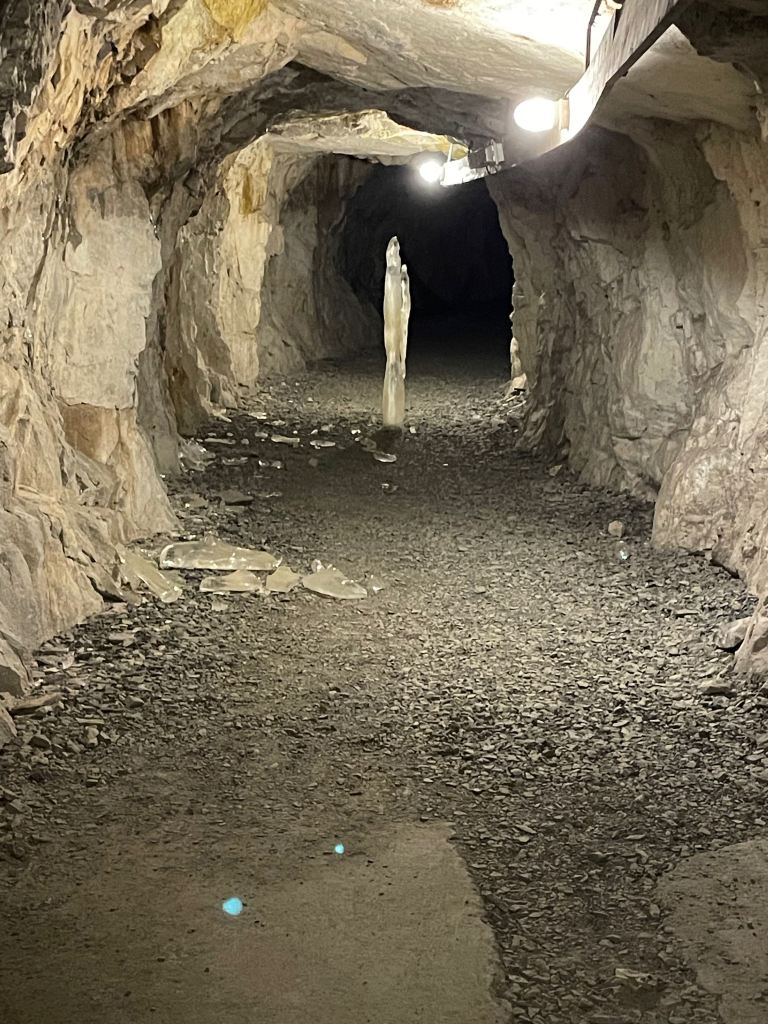
I can’t go into a lot of detail because it’s highly classified, but my instructions were to find the rock signed by a Norwegian king and then follow the nearby sign until I see the “frozen water reaching the sky.” Jim and Joe were always so dramatic.

Not only dramatic, but sometimes I question their intelligence. You tell me, do I go left or right?

Fortunately, with a bit of luck and choice words for Jim and Joe, I did find the frozen water thing, but only after dodging a huge rolling rock and hopping over stepping stones amidst a pit full of snakes. I finally met up with my Russian invasion crew where we finalized our top secret plans for my infiltration and to knock out Putin. The plan was to ––––Remaining text redacted by order of the CIA––––

(Scroll down to see previous entries.)
Why Walt Disney should have hired Adolf Hitler

Our cruise ship made a stop in Svolvær, which I assumed would be very crowded because they don’t even have the room to put a space between the “a” and the “e” in their town name, but I didn’t get much of a chance to prove that because a very interesting museum was only a short distance from the ship, and once I entered those doors I was sucked into history like I’d entered a time machine.

On this nondescript street sits an entrance you can easily miss. There’s just a little sign with the word “museum” built into it to give you a clue. I only knew of this place’s existence from the ship’s crew, who offered it up as an idea in a town where the cruise line didn’t otherwise offer any excursions. None of my fellow sailors had the same level of interest I had in the museum, so I meandered over there on my own.

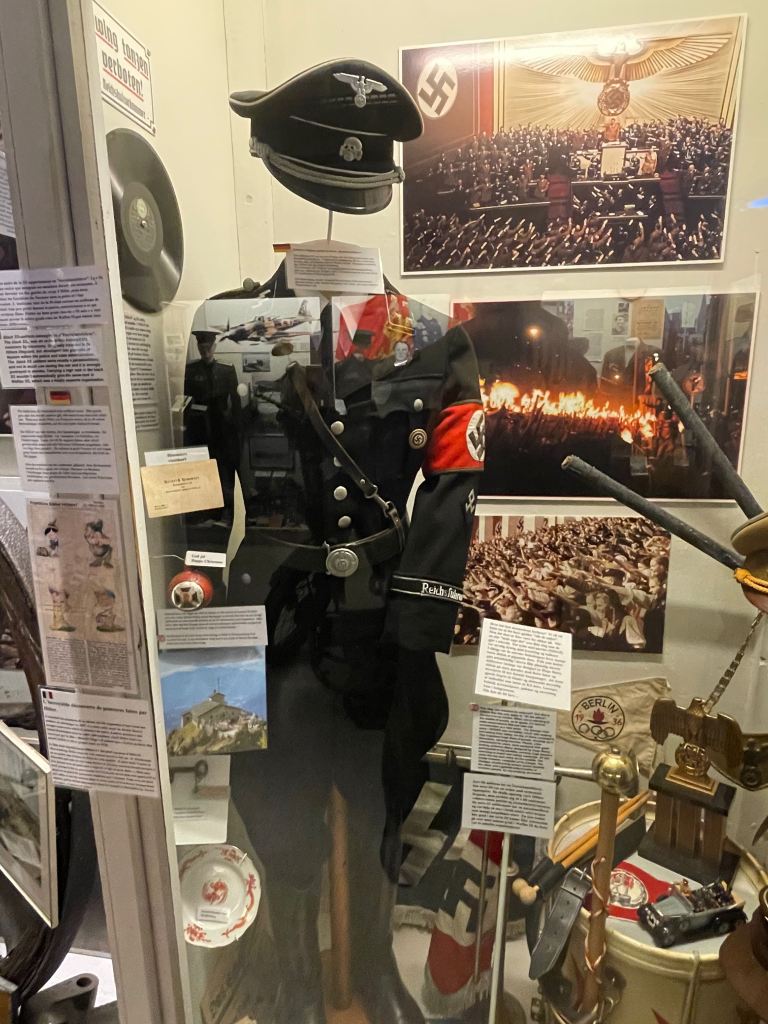
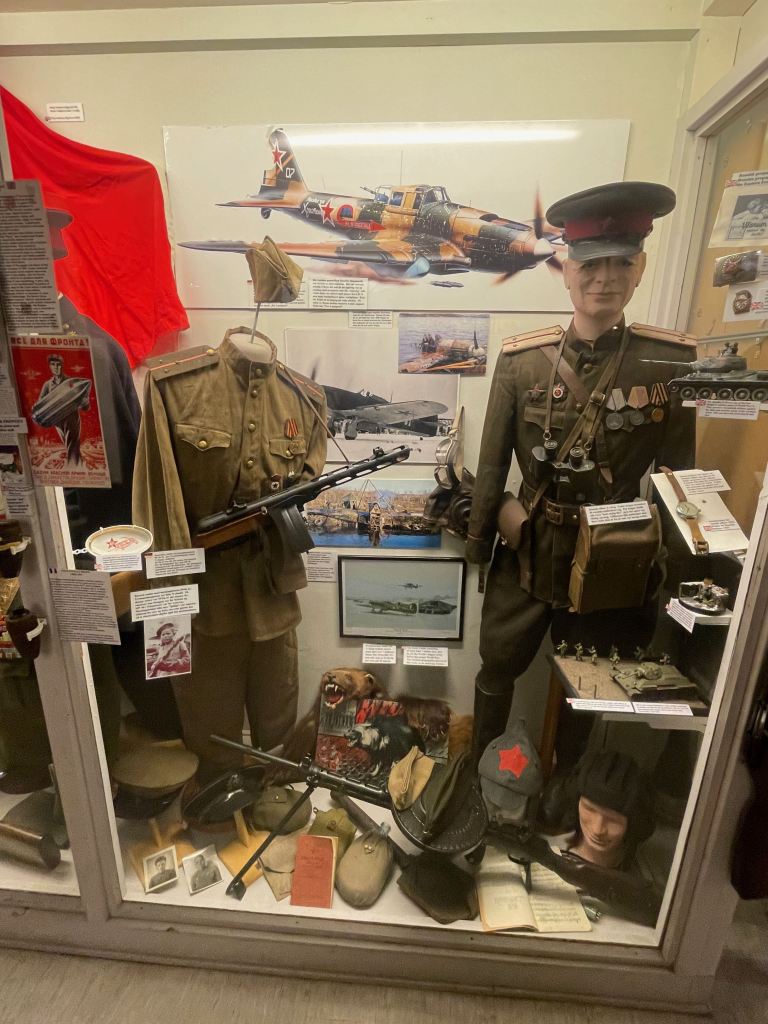
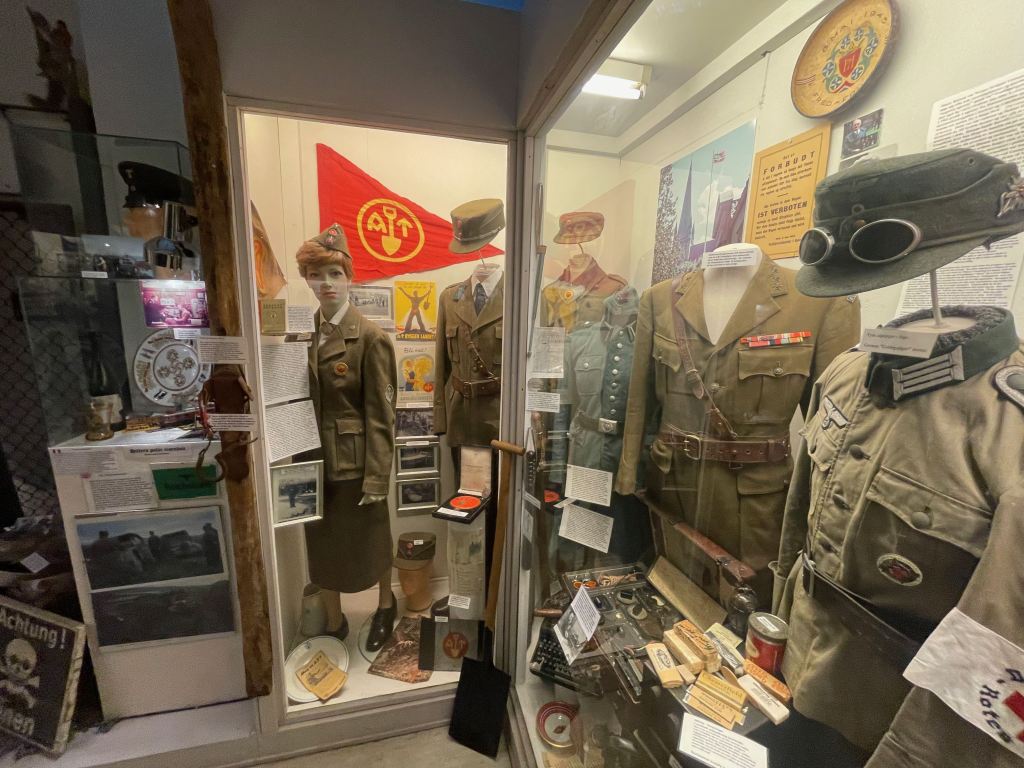
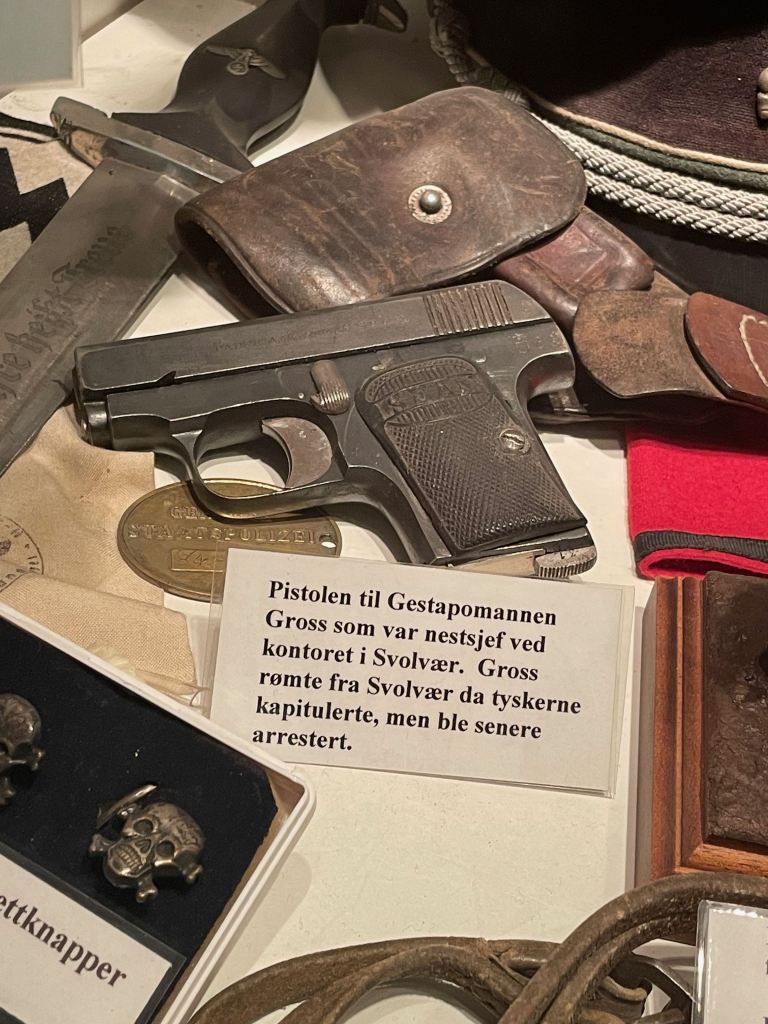
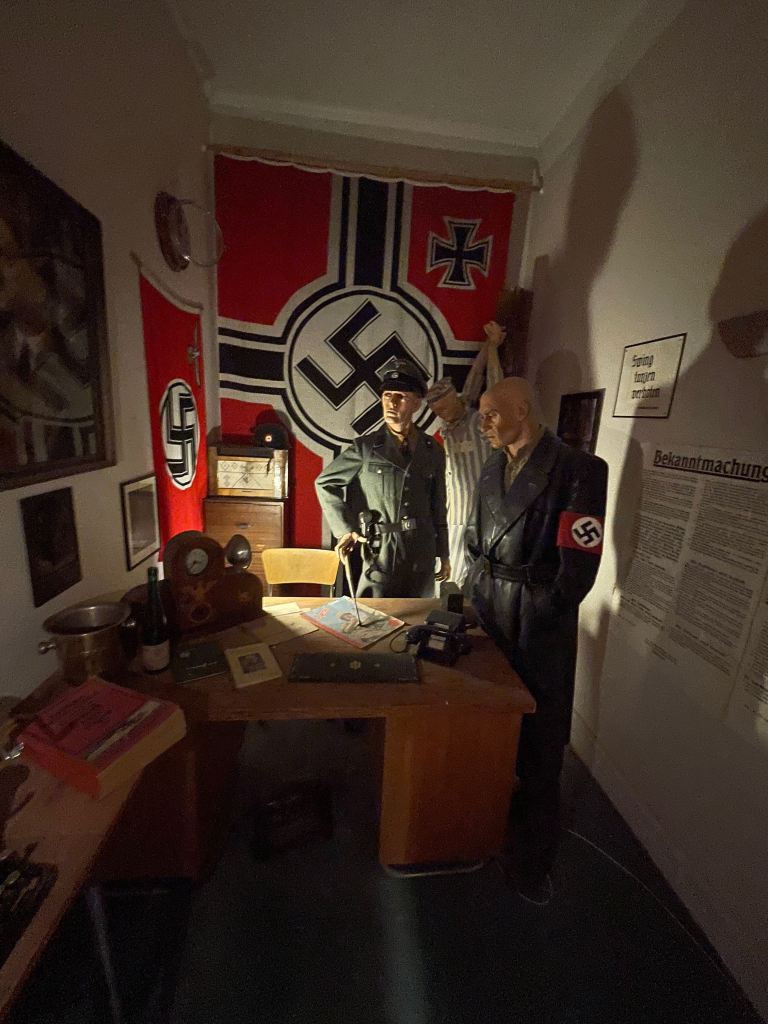
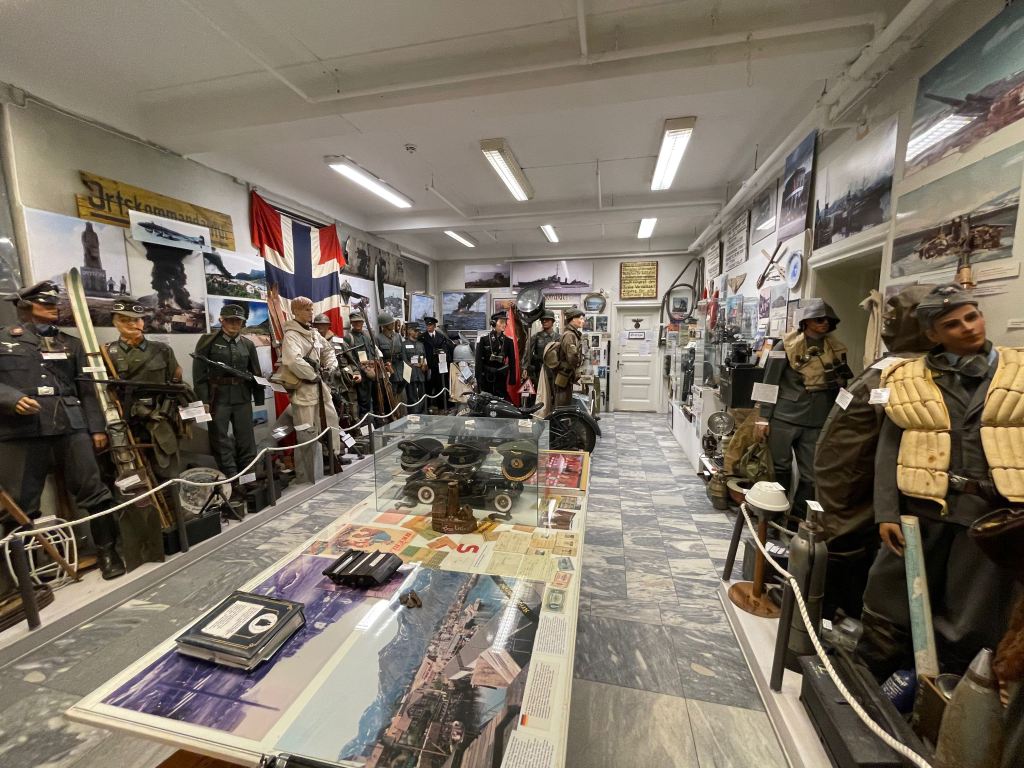
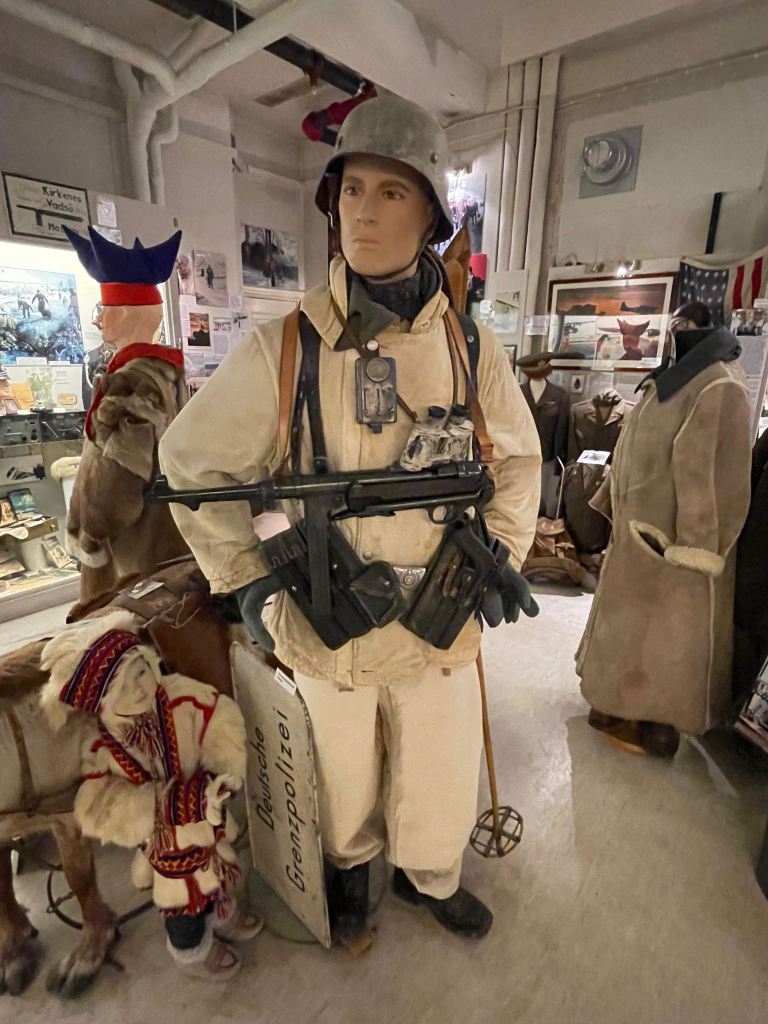
As soon I walked through the door I could see that it wasn’t just another run-of-the-mill museum. Artifacts were piled everywhere, looking more like the inside of a storage shed than a museum presentation. The owner/operator sat quietly behind his desk, reading a book. I realized I was the only customer in the place, so I glanced around quickly to make sure I hadn’t inadvertently walked into some sort of secret Nazi recruitment nest. The owner didn’t say much, but he took my money and waved casually at the collection, inviting me to simply wander around.

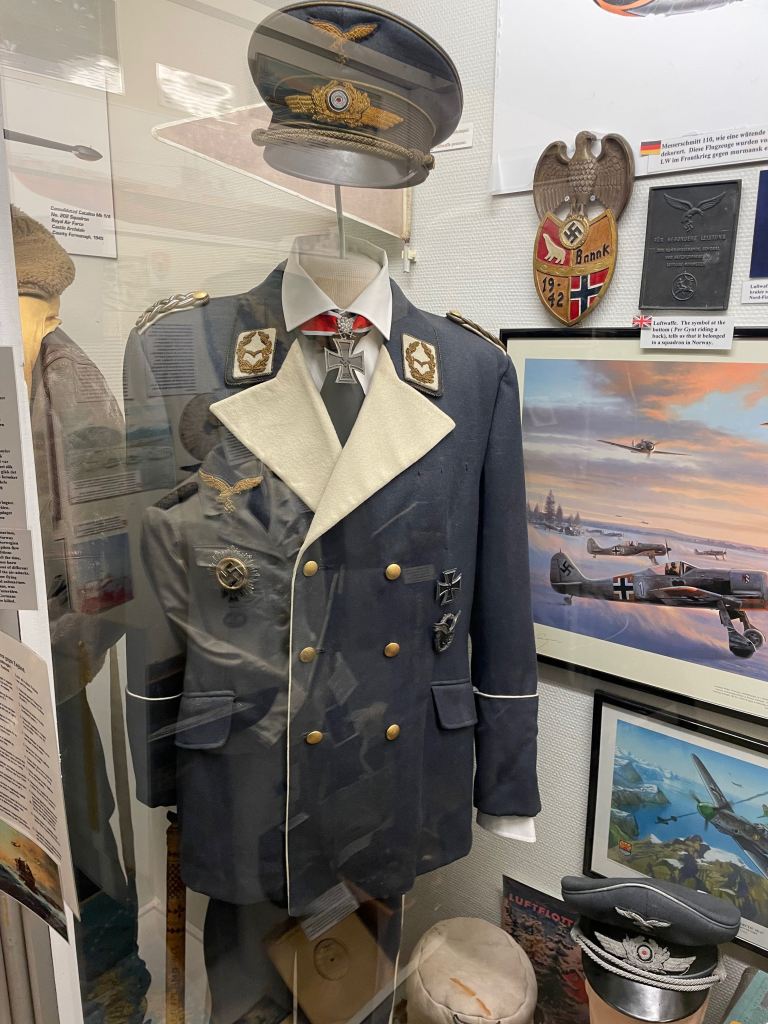
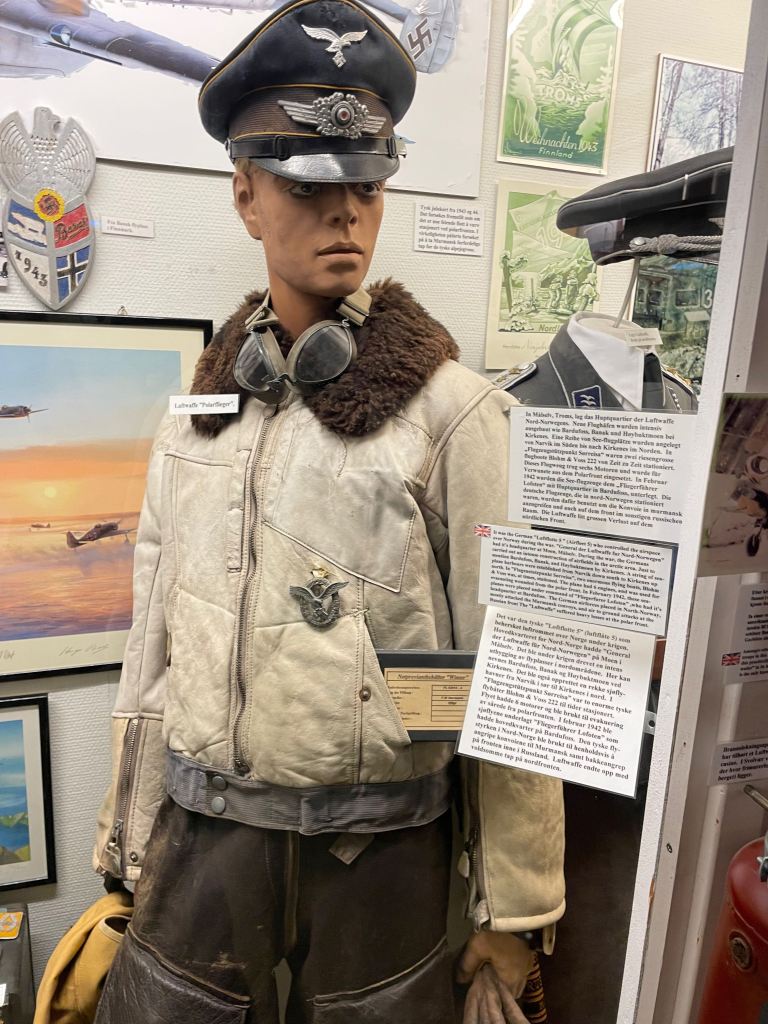
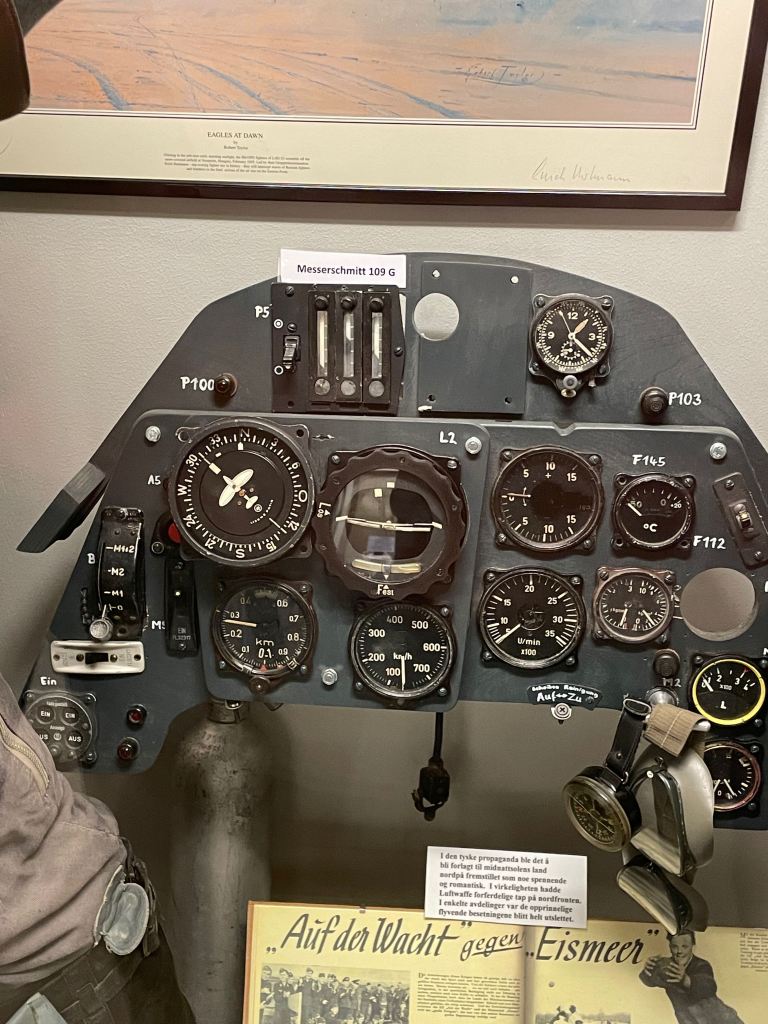
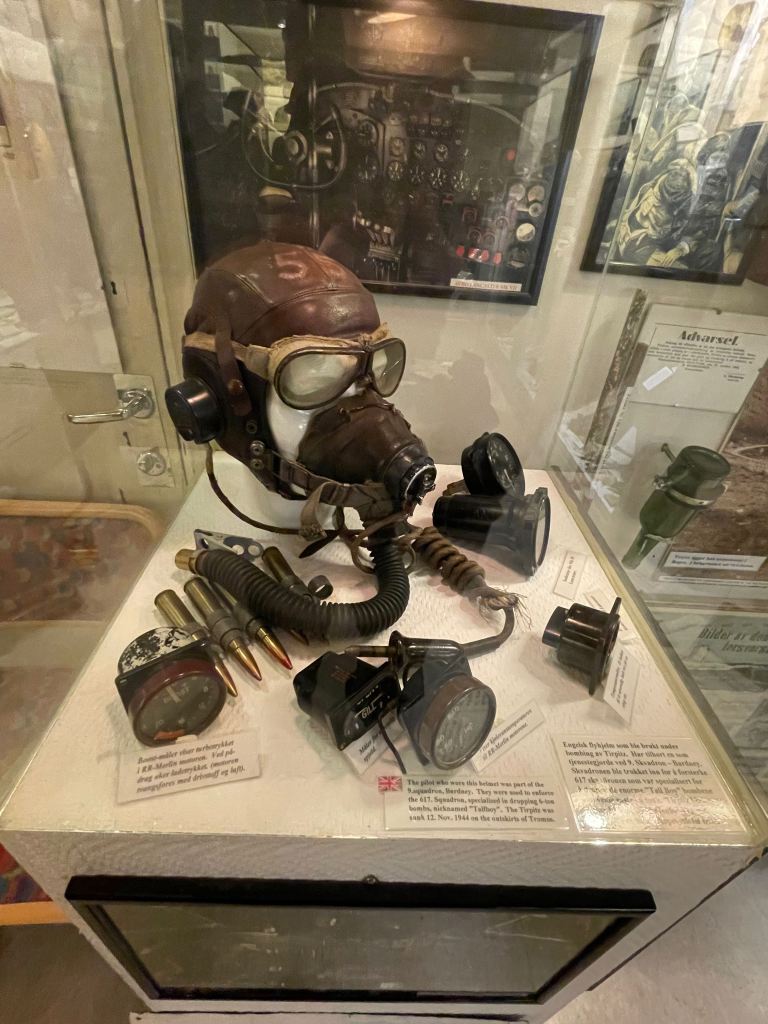
I promptly discovered that this was easily the most extensive collection of World War II memorabilia, especially the Nazi kind, that I’d ever encountered. The stockpile is mostly the result of one man’s obsession, and included uniforms galore, as well as bombs, weapons, medals, magazines, Nazi Christmas ornaments, photos, and other miscellany, all chock-a-block in a space that at first seemed small, but actually had numerous rooms in which to explore.

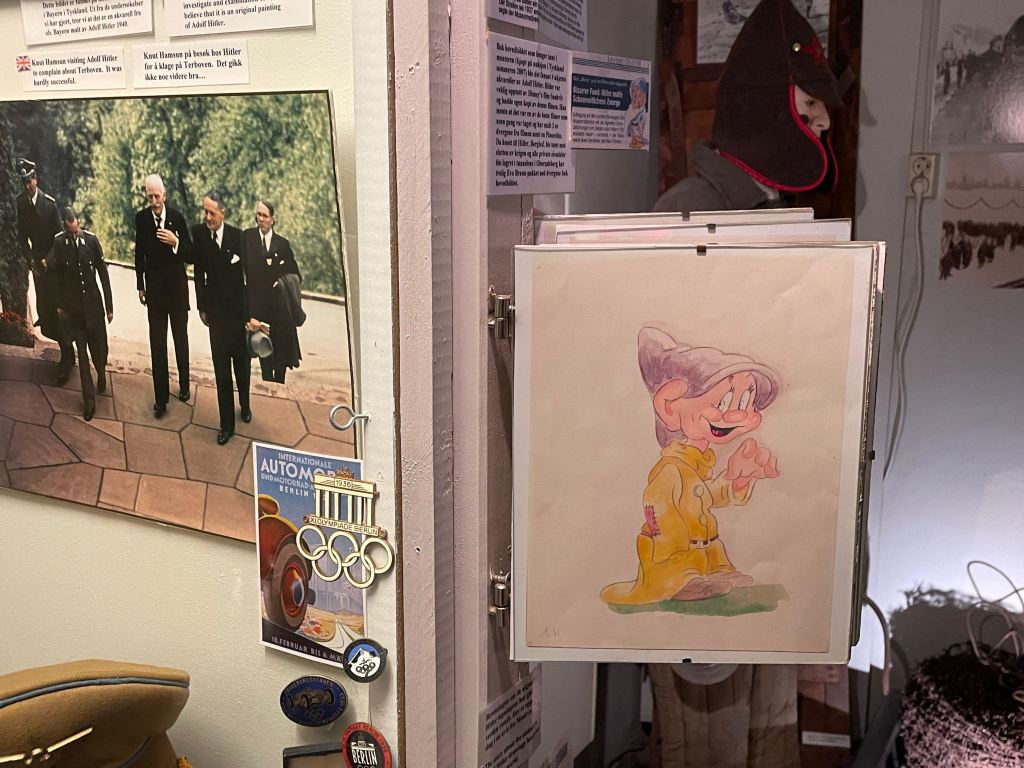
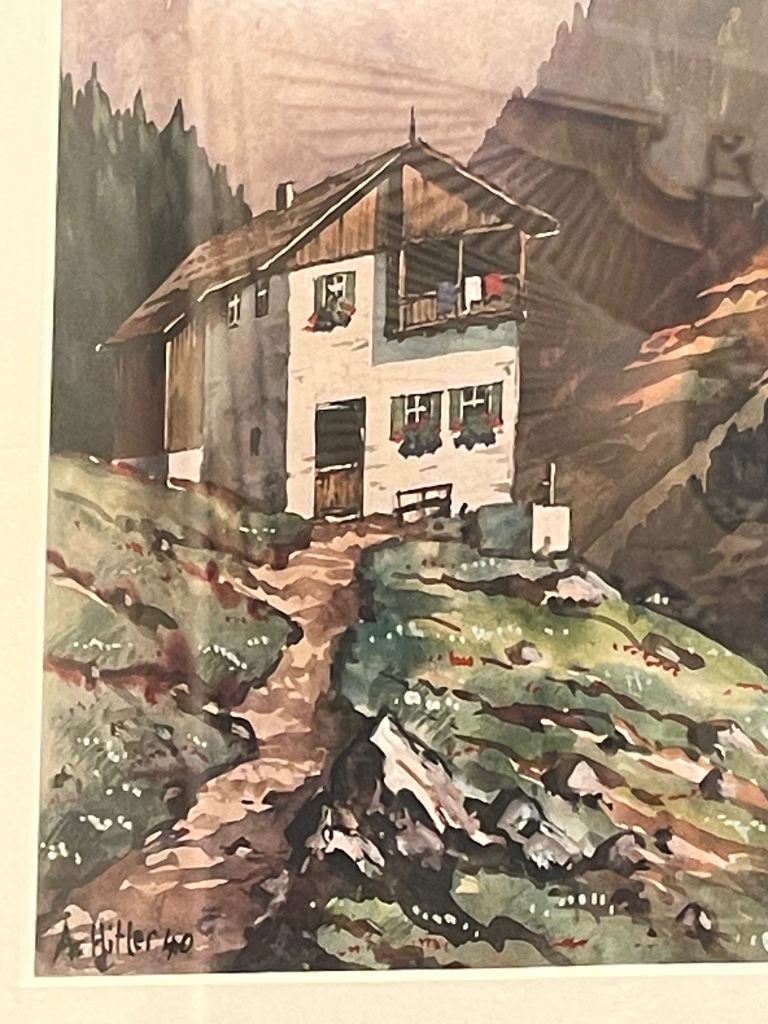
When I came across this drawing of Dopey, I wondered if it was from some sort of propaganda poster poking fun at Hitler. So I asked the taciturn owner/operator about it, and he immediately brightened up and came over to explain.

According to him, these are originals drawn by Hitler. He admitted that the Disney characters couldn’t be verified 100%, but with the “AH” initials on them plus the fact that Adolf apparently had his own copy of Disney’s Snow White, made him feel fairly certain that these were drawn by the Fuhrer. I’m familiar with some of Hitler’s other art, and the house watercolor certainly evokes the other work I’ve seen. Oh, how much less misery might the world have experienced if Hitler had somehow just become an artist instead of a mass murderer? Walt Disney, where were you when we needed you?

Here’s a close up of the initials and the signature. I didn’t want to peer in too closely at them fearing that the stink of evil might somehow permeate my skin. Actually, the truth is that apparently Adolf was, for example, pretty playful around kids. I mean, no person sits stewing in an evil broth 24/7 no matter how disgusting they are. This particular epitome of evil could draw, he liked cartoons, and could even be charming when he wasn’t planning genocide. None of that, of course, in any way makes up for his murderous ways, I’m just saying no one is completely nefarious all of the time. For example, it’s hard to look all tough and evil when you’re eating Fruity Pebbles breakfast cereal, or sitting on the toilet.

I’ll admit that it was a little unnerving to be surrounded by all of those swastikas as well as other artifacts and imagery from such an unfathomably heinous time. But I’m a strong believer in making sure we remember history. As I write this, an increasing number of radical right wing groups are making inroads into more and more countries’ politics. I think some of this happens partly because as WWII fades into history, too many forget how easy it was to convince, for instance, a comparatively well-educated populace in Germany that an ethnic group which made up less than one percent of their populace was not only responsible for their losing WW I, but that the price the group would have to pay for being the target of such misplaced and preposterous blame would be the killing of as many of them as possible, even those from other countries. Why are people so easily manipulated to support and believe this kind of thing? It’s mystifying. It’s madness.

Today, many people can’t even see the hypocrisy of merging extreme right wing nationalism and religious themes like Christmas. In the United States, the same kind of cult of personality that led to Hitler has reared its ugly head as the world looks on in astonishment. I mean, c’mon, the calculus is simple: if hate and disdain is an important part of any ideology, or politician, or your usual source of information, run away! Hatred never leads to anything good, and stopping hate starts with each of us. In fact, I’d love to make this deal with anyone: if you happen to be following or supporting a politician that, for example, refers to any group of other human beings, much less your fellow citizens, as, let’s say, “vermin,” you will agree to support someone else. Deal? Deal. Because remember, the only thing anyone does with vermin is exterminate them.

Okay, sorry, I had to vent. It’s scary out there, especially with things like Putin’s invasion of Ukraine looking an awful lot like what Germany did to start World War II. We need museums like this to remind us what happens when hate takes center stage. I mean, c’mon, 75 million people died due to World War II. That’s like executing every man, woman, or child currently living in the UK, or France (in fact, any country in the world other than the top 20 or so in population), with room left over for an additional six million Jews, Gypsies, homosexuals, and whoever else was different than them. Madness!

After I saw the extent of the collection I approached the proprietor again with some questions. Once he learned that I had a reasonable amount of knowledge about that era, he began to regale me with stories, including one I found a little hard to believe.

According to him, Hitler most likely escaped from Germany by using a combination of body doubles and pre-arranged underground transportation that eventually landed him in Argentina. When I asked him about the fact that Hitler was seriously ill near the end of the war, he claimed that it was all an act, and that he firmly believed Hitler had lived on for quite a few years after 1945.

I listened to the narrative with a major dollop of skepticism. It flies in the face of pretty much every public piece of information out there, all of which point to Hitler’s suicide. But my host had a whole big book that explained in detail how it all might have been pulled off. Obviously, no one can be 100% certain either way, but my new friend was pretty certain about it all, and of course I didn’t feel like arguing with someone who probably knows more about the Nazis than anyone I’ve ever met.

Anyway, as I told him, none of it matters anymore because obviously Hitler is dead now, so whatever time he had after the end of World War II or beyond is now irrelevant. But people from every political spectrum seem to love conspiracy theories. I’m not sure why, since the track record for truth in conspiracy theories is pretty damn dismal. From vaccines carrying tracking devices to stolen elections to flat earthers to holocaust deniers to Hillary sex trafficking children out of the basement of a pizza parlor that had no basement, some people apparently just can’t stop believing in weird shit.

Speaking of which, this photo will probably start a rumor than I’m a skinhead, but I was actually trying to display my disapproval for the image behind me. Somehow it didn’t come out quite as intended.

I’m sorry this entry wasn’t filled with my usual frivolity, but I guess I get a little grumpy when I see humanity continuing to go down roads that lead to such guaranteed misery. We have the proof people, so just stop it! Achtung! Achtung! Avoid those land mines!

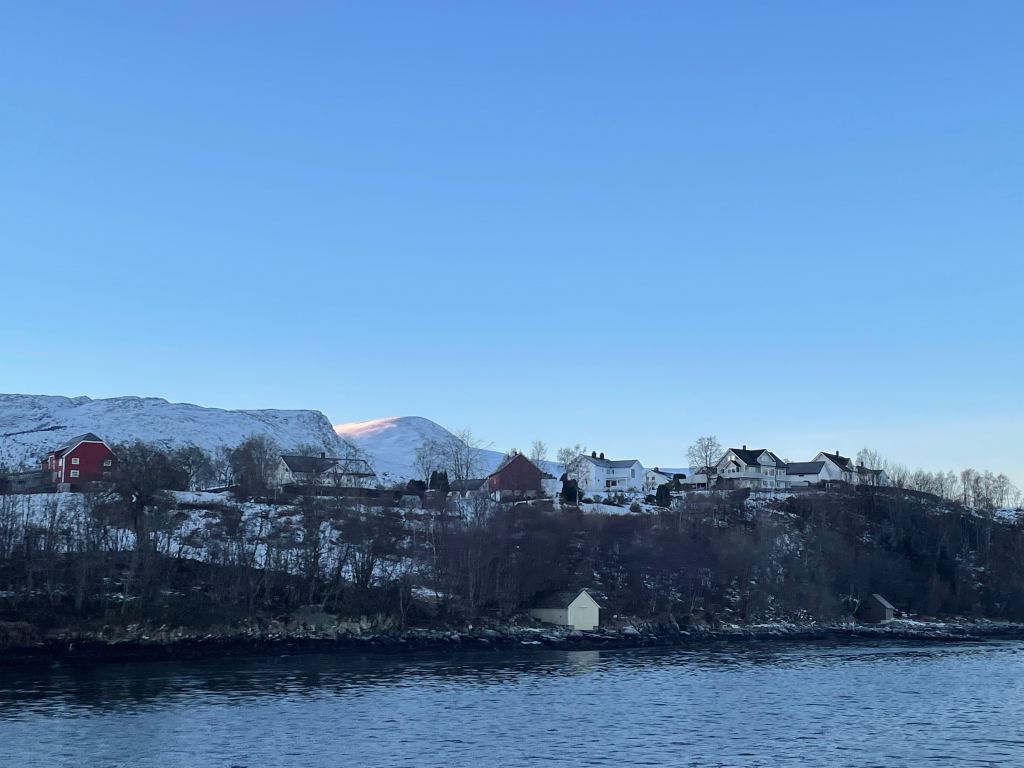
Whew! What a downer! But I can still finish this entry up by drawing from my inventory of photos taken from the ship. I know, I know, once you’ve seen one fjord, you buy a Chjevy (there’s my token dad joke at least, courtesy of my oldest son), but at least nature reminds us that no matter how mean and insane some people can get, there’s always beauty somewhere, even in a drawing of a fairy tale character by Adolf Hitler.

(Scroll down to see previous entries.)

We Lost Our Marbles in Norway

I don’t know about you, but I never gave a lot of thought as to the source of marble. I suppose I figured there were simply marble quarries here and there and that was that. So when I saw “Visit a Marble Mine” on the cruise excursion list, I was all over that like a shooter lining up a dead duck (you would only understand that if you played marbles as a kid). I played marbles a little bit way back when, but my parents made me stop after a slight misunderstanding about how one obtains more cat’s eyes. Anyway, it turns out that only 5% of the world’s marble is actually mined from mines, so that means there’s a 95% chance you didn’t know about marble mines. I think that’s the way the new math works.

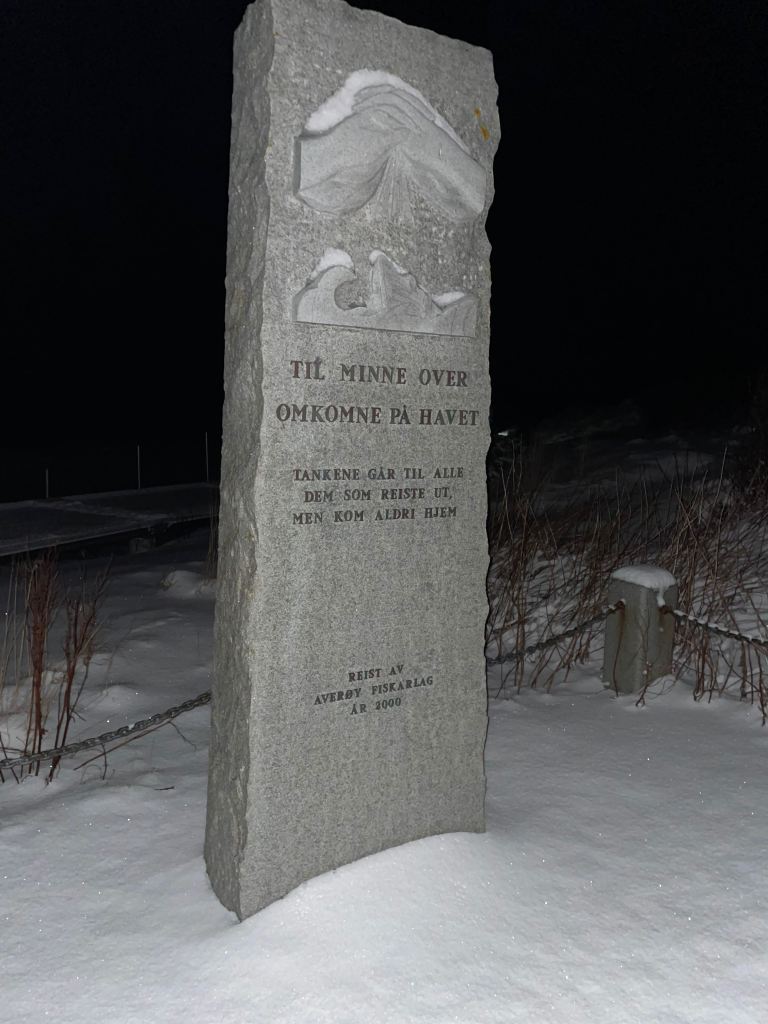
The excursion began with a bus ride into the Norwegian countryside. The excursion was supposed to take us on the Atlantic Road, apparently one of the most beautiful roadways in the world, but we wouldn’t have known either way because it was almost always nighttime where we were. The bus stopped to take us on a scenic walk but it was, y’know, dark, so we didn’t see a lot, but what we could and did see was beautiful and peaceful. The monument you see above has a headline that translates to: “In memory of those who died at sea.” I believe that underneath it says, “I died a gruesome, painful, and lonely death in an icy cold ocean and all I got was this lousy monument.”

And no, we didn’t see this scene from the expedition brochure.

But we did see the tunnel leading into the Bergtatt Marble Mine from the bus. While “visiting a marble mine” hadn’t made it onto my bucket list (had I even thought of it, it still would have only qualified for my canister list, which, as everyone knows, is a less important container than a bucket), it was still strangely interesting, and almost disconcerting, to be driving into the side of a mountain, especially without the usual accompaniment of “Hi ho! Hi ho! It’s off to work we go!” I mean, I tried, but all the other tourists just looked at me like I had lost my marbles and Carolyn kept whacking me telling to shut up.

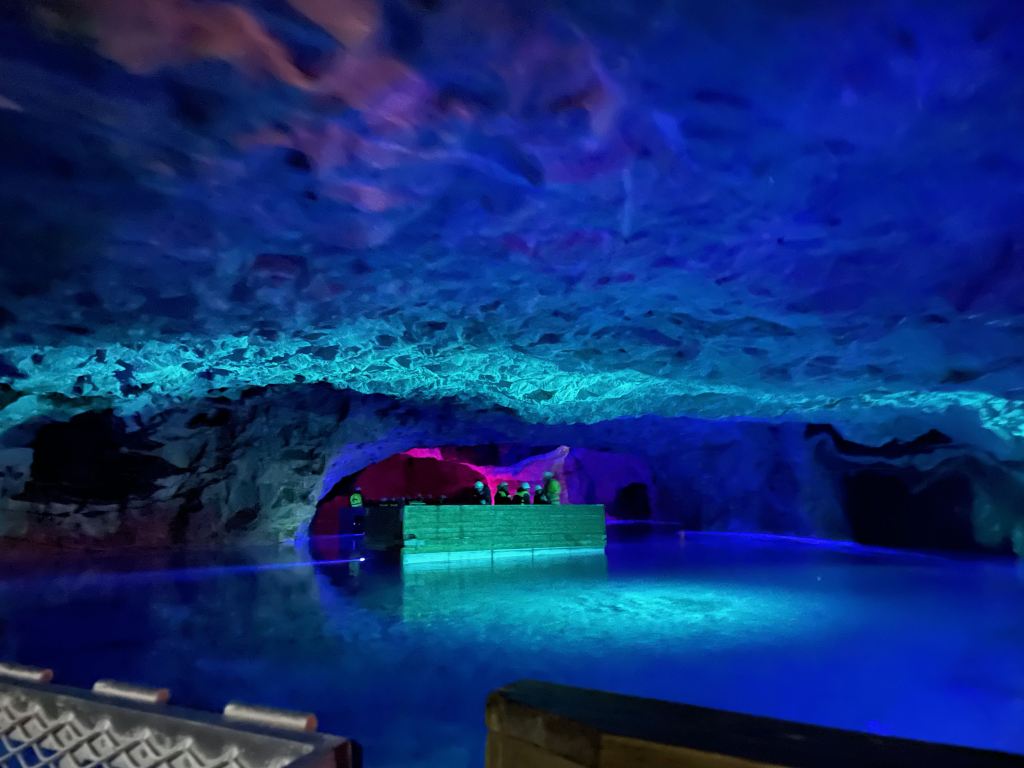
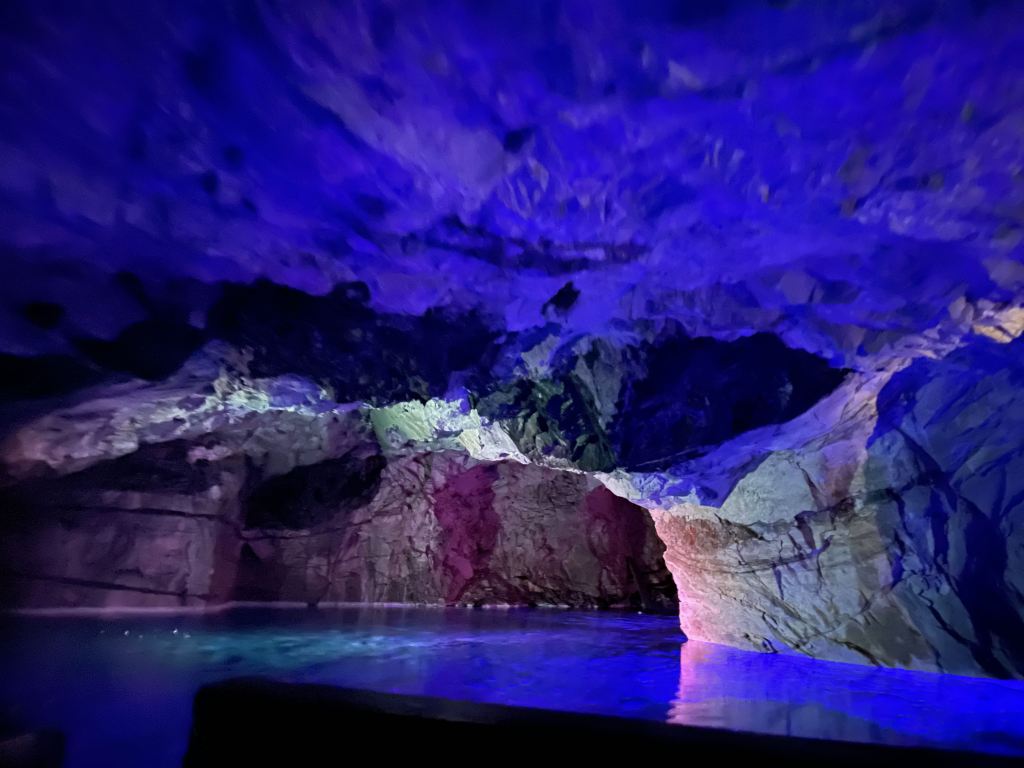
Once we disembarked, they suited us up in hard hats and life vests. Life vests you ask? Well, this particular marble mine has a river running through it, so the mine tour is provided via watercraft. So we got to be sailors and miners in one fell swoop! (Fell swoop is a weird phrase. Stare at it and repeat it: Fell swoop. Fell swoop. Weird. Although it wouldn’t be a bad name for a rock band. “And heeeeeere’s Fell Swooooooooop!” The crowd goes wild!)

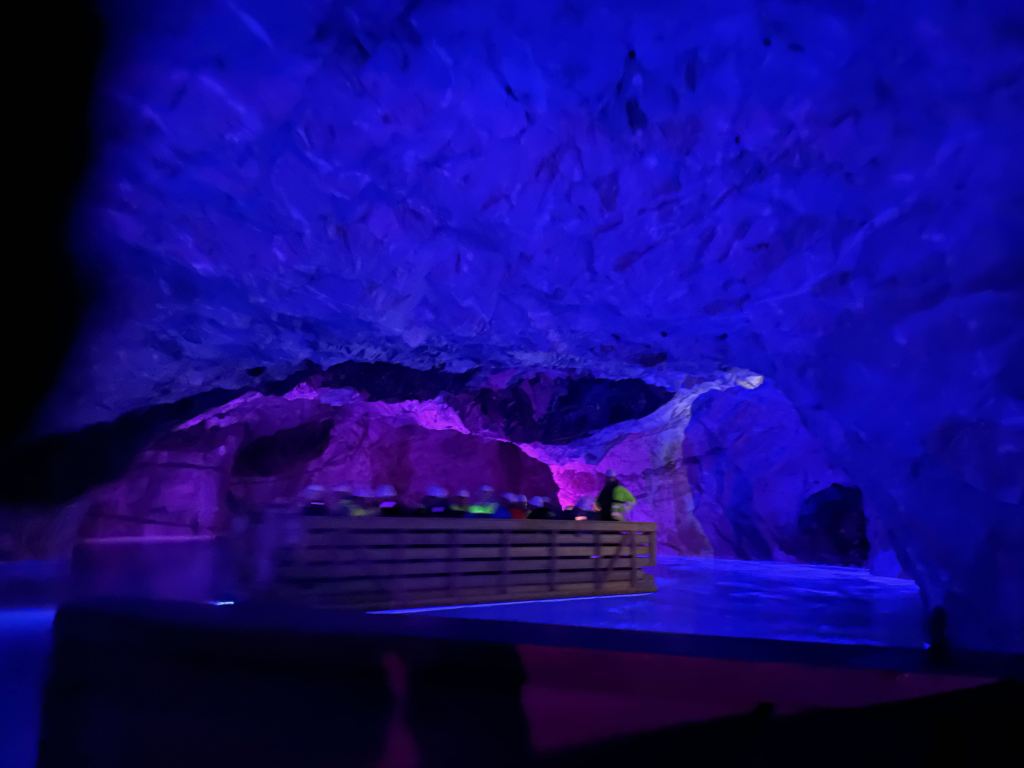
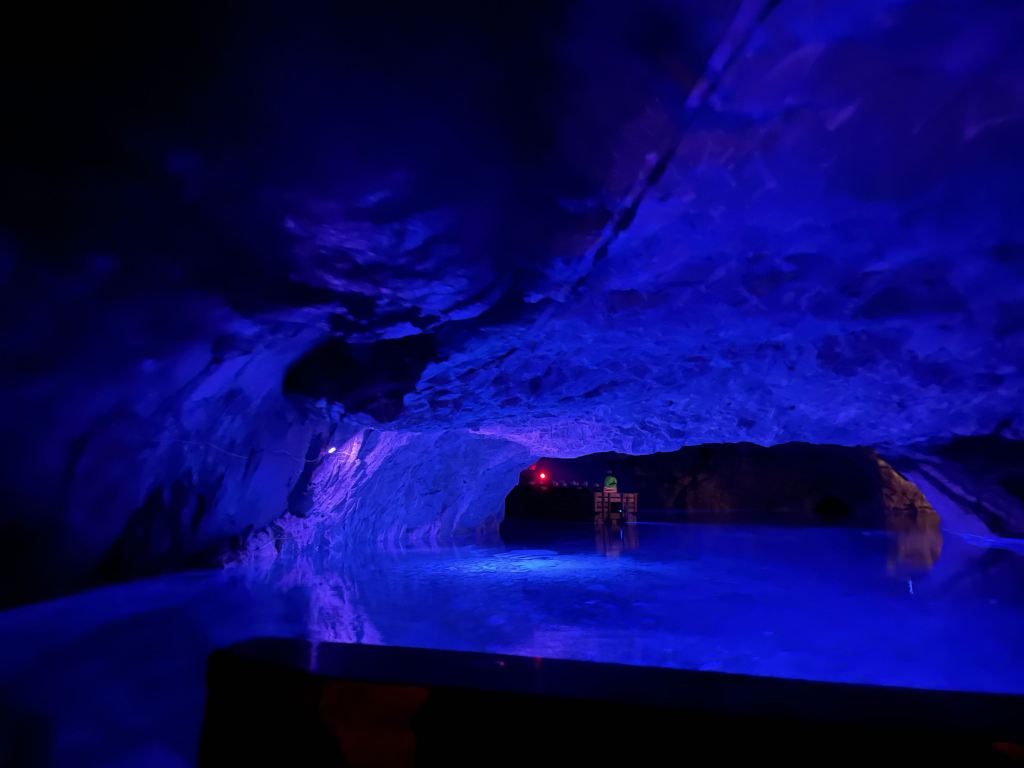
The watercraft looked more like crates than boats, but I assumed they were sea-worthy -er, mine-worthy -er, river-in-a-mine-worthy. Anyway, these caves were created by the water and mining and they are still mining in other parts of the mountain, but this section was turned into a tourist attraction and a concert venue as well as being a great place to hide a dead body.

So off we sailed into the depths of the mountain, feeling rather like the dwarfs in Lord of the Rings, except taller, and less swarthy, and mostly not fictitious, and glad that we weren’t instead feeling anything like one of the dwarfs in Snow White, mostly because the Lord of the Rings dwarfs could kick their butts, which would give a whole new meaning to the name “Bashful.”

Gimli and Glóin.

While the rafts sailed through the mountain, peaceful music wafted over us from deep within the caves. I think the song was “Sweet Child of Mine,” albeit with violins and no singing and with a completely different set of notes and no guns or roses anywhere. But it has “mine” in the title so they should have. I actually thought about the “It’s a Small World” boat ride from Disneyland as we meandered through the still water, although I was extremely grateful that they didn’t play that particular song. It’s the mother of all earworms.

Apparently the marble –”It’s a small world after all!”– from this particular mine is a lot denser than the marble they usually use for statues so it normally takes too long to create a statue from this particular marble, -“It’s a small world after all!”- so when they do of course they use it to make a woman with her boob hanging out. Psssht, men… am I right?

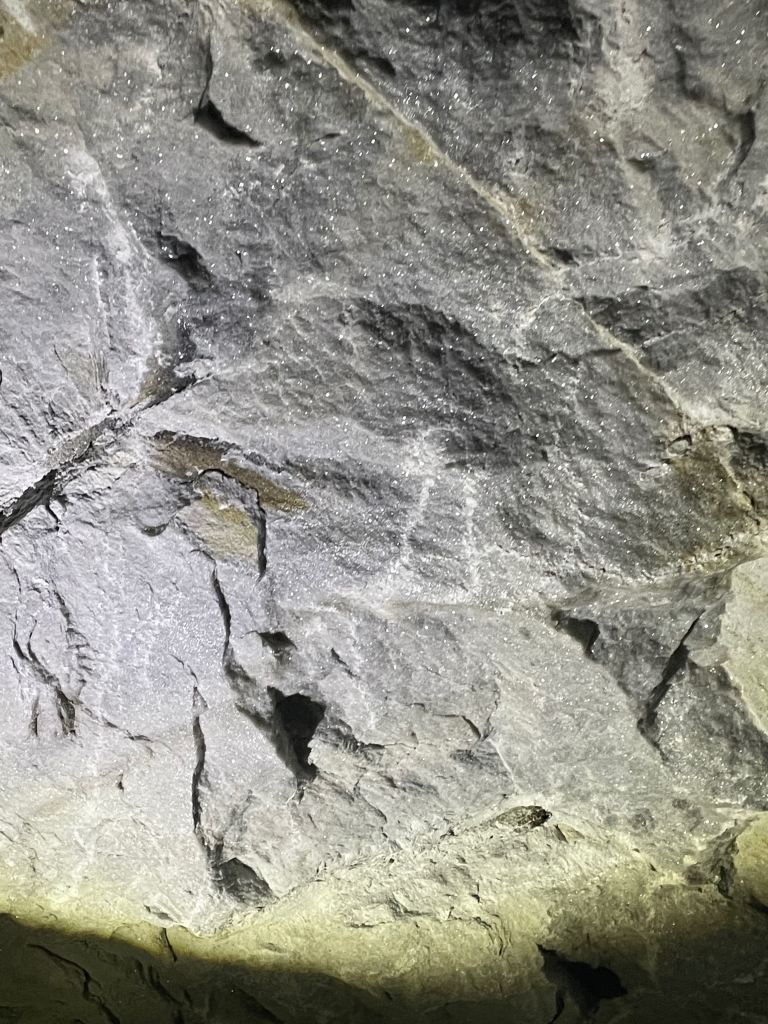
The ceiling was occasionally low enough –”It’s a small world after all!”– to bonk your head if you weren’t careful, ergo the hard hats. So these are close-ups as to what marble looks like before it’s mined as well as what my head looks like post-bonk. “It’s a small world after all!”

They showed off some marble creations which they could make because they weren’t going to sell them so it didn’t matter if it took forever to make, but get this: most of the marble mined here is actually used to make glossy paper. –”It’s a small world after all!”– Who would’ve thunk? Like the origins of marble, I hadn’t given a lot of thought as to how glossy paper is made (my friend Mark Meyer would know though, since he’s a paper maven). So when I heard that, I was astonished. Amazed. Astounded. “It’s a small world after all!” Dumbfounded. Verklempt. And ready to blow my brains out if I hear “It’s a small world after all!” in my head one more time. I’m just sayin’, if this is my last blog entry you’ll know why.

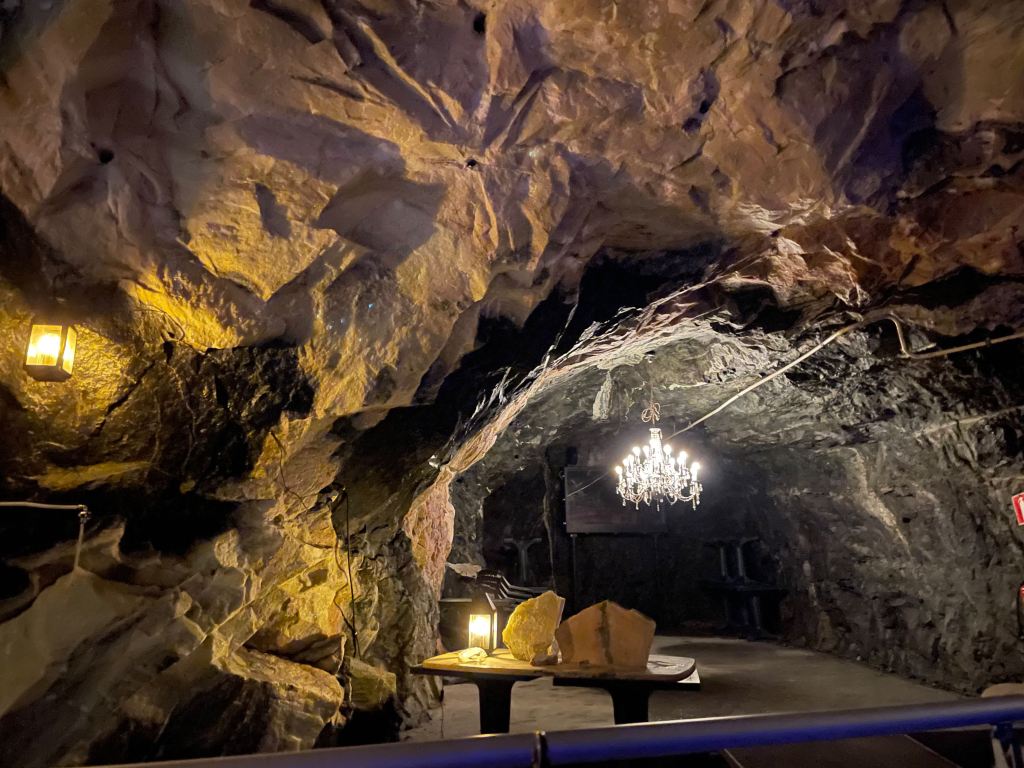
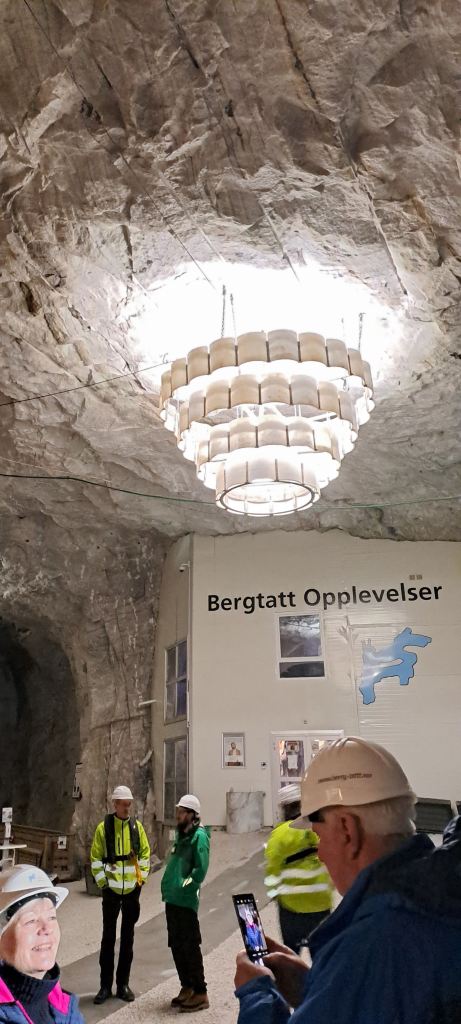
At the end of the tour, we were served some marble soup (I think) and a viewing of a promotional and educational nature from Bergtatt Opplevelser, the mining company. That hall is also where they have some concerts. I was a little baffled as to how well a concert might work there because I couldn’t understand most of what they were saying, and it was even mostly in English (I think). It all sounded rather echo-y. The video production and presentation was also kind of cutely amateurish, as if some miners had put it all together one drunken night without the help of anyone who knew anything about making a presentation. But they meant well (despite the depiction of the Nazi salute there on the screen), and overall we had a good time.

As a result of our trip inside a marble mine, Carolyn now wants to decorate our next kitchen like this. At least with this, we won’t ever lose our marbles! She proofreads and works on these blogs with me so I’m anticipating a big whack on my shoulder after she reads that she wants this kitchen.

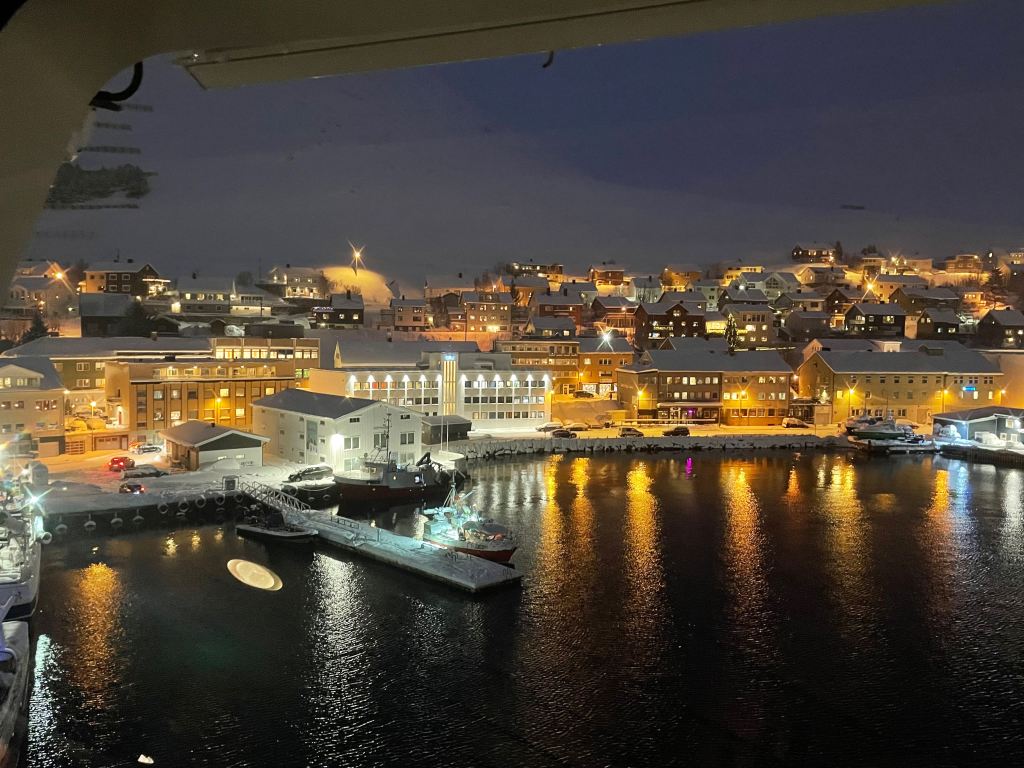
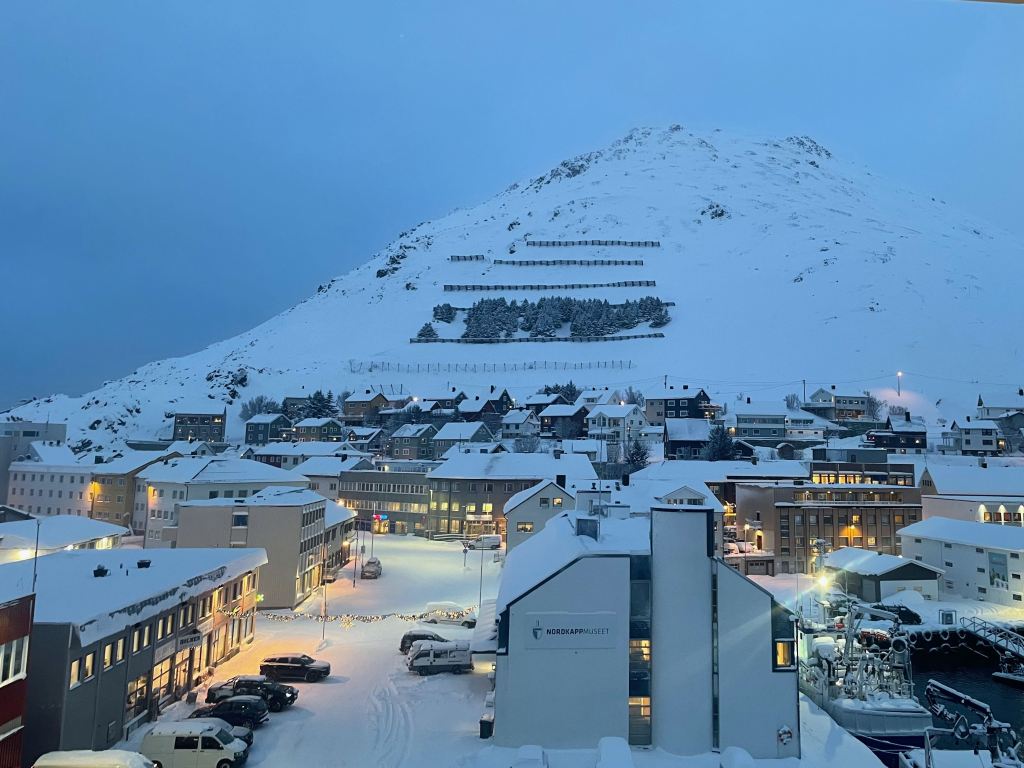
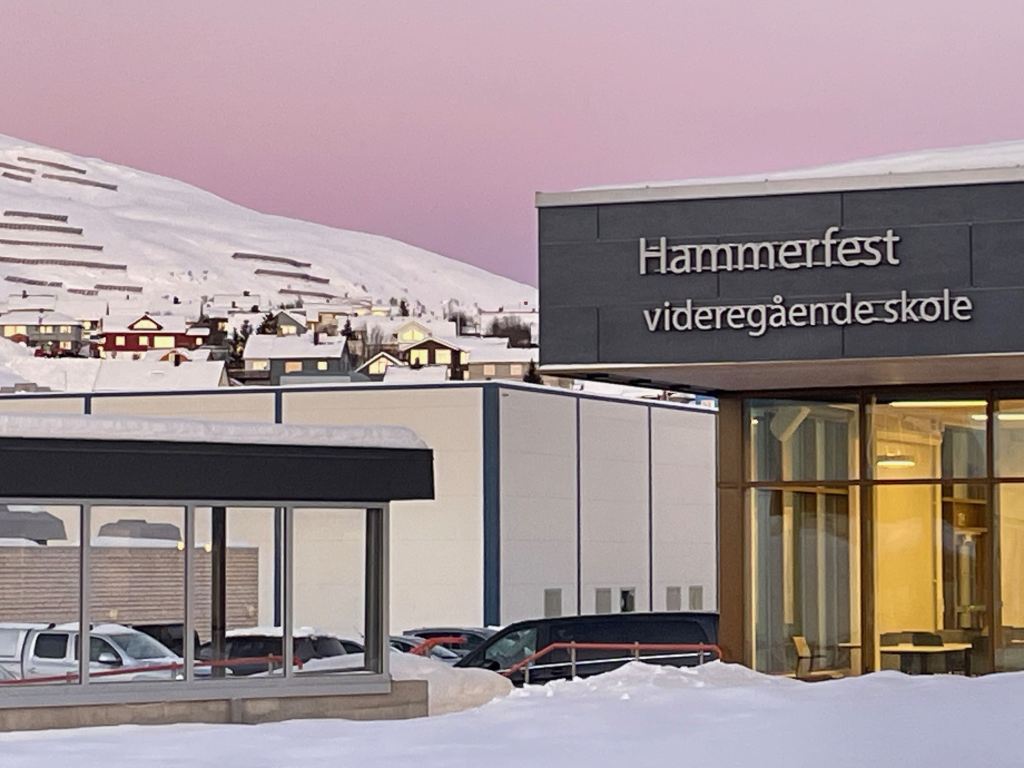
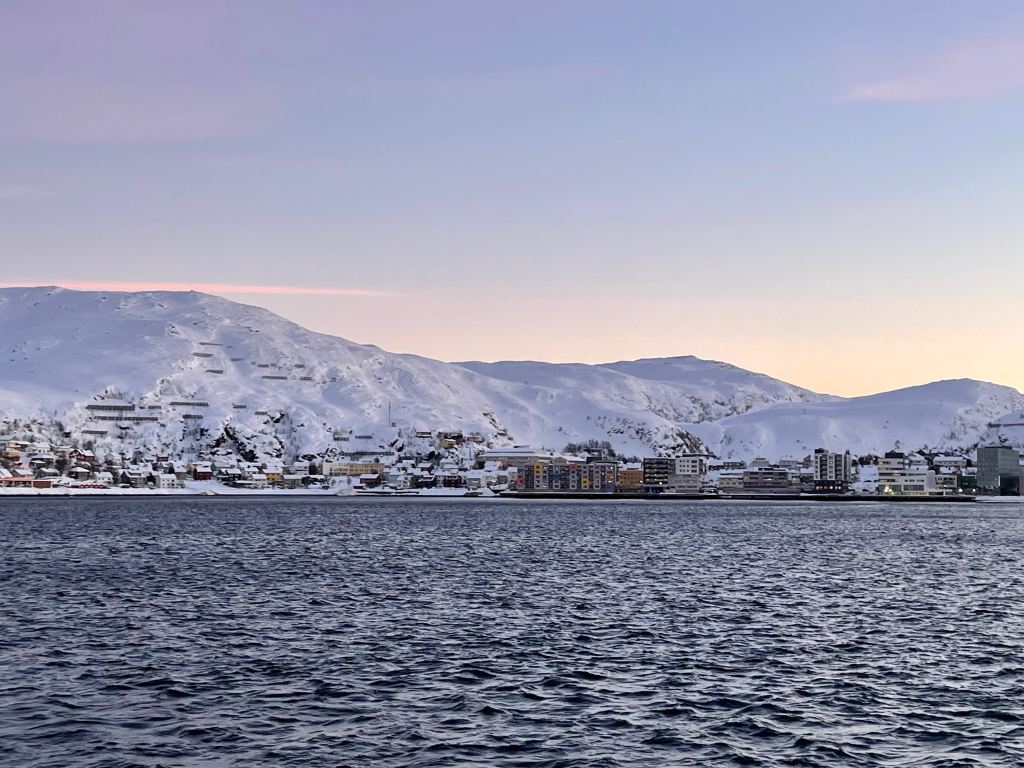
I’ll finish up this entry with a short tour of Hammerfest, voted by me as one of the top five city names in all the world. No one screws with anyone from Hammerfest, even if they were only educated in a videregående skole (which means high school). The school doesn’t need a mascot. As soon as any rival school sees the word Hammerfest they pretty much run away screaming with their hands over their heads. Also, notice the straight lines on the hill? Those are to help prevent avalanches. Landslides and avalanches are the natural hazards in Norway responsible for most losses of human life. I believe killing oneself due to It’s a Small World earworms comes in third.

As you can see, not only is it somewhat industrial –Norway is awash in oil and gas resources and has done an outstanding job of protecting them for the benefit of all Norwegians– but the town itself is just as cute as a bug, with snow-covered houses covering the hills overlooking where the Norwegian Sea meets the Barents Sea for a spot of tea. Hammerfest is pretty much at the tippy top of Norway, making it the northernmost town called Hammerfest in the entire world.

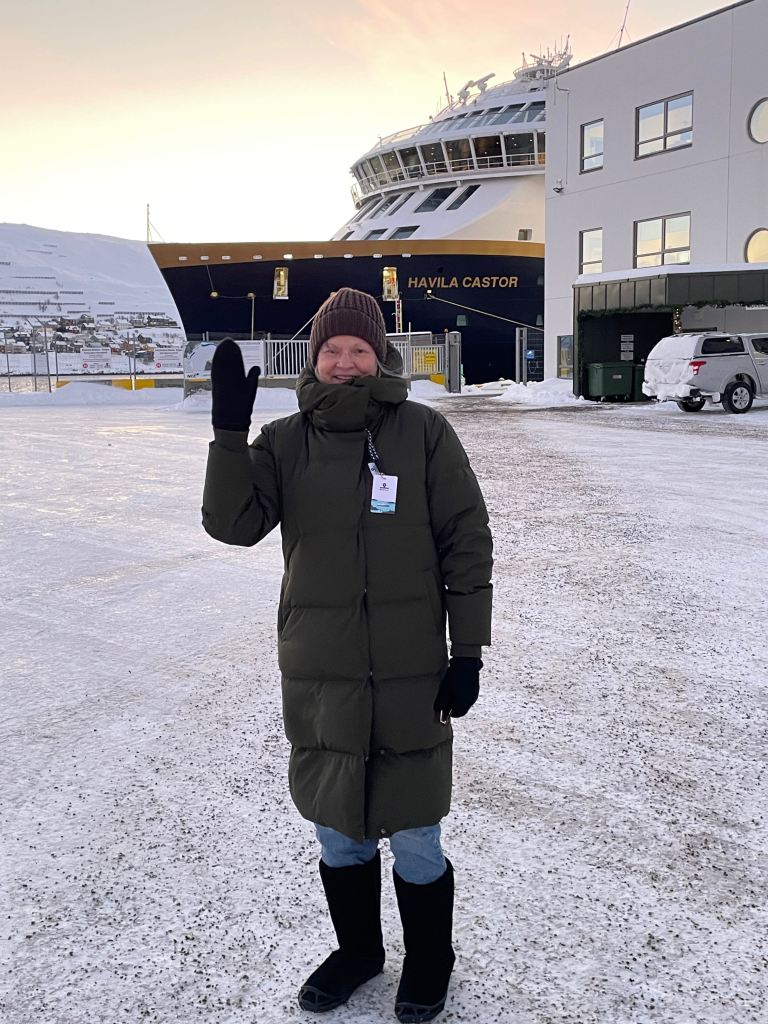
That also made it one of the colder places on our trip, hitting 17°F (-8°C) while we were there. So we donned our green sausage coats and inspected the local ambulance before walking a couple of hundred meters to a monument and then slinking back to the ship, where we stomped the snow and ice from our boots and and loudly demanded hot chocolate.

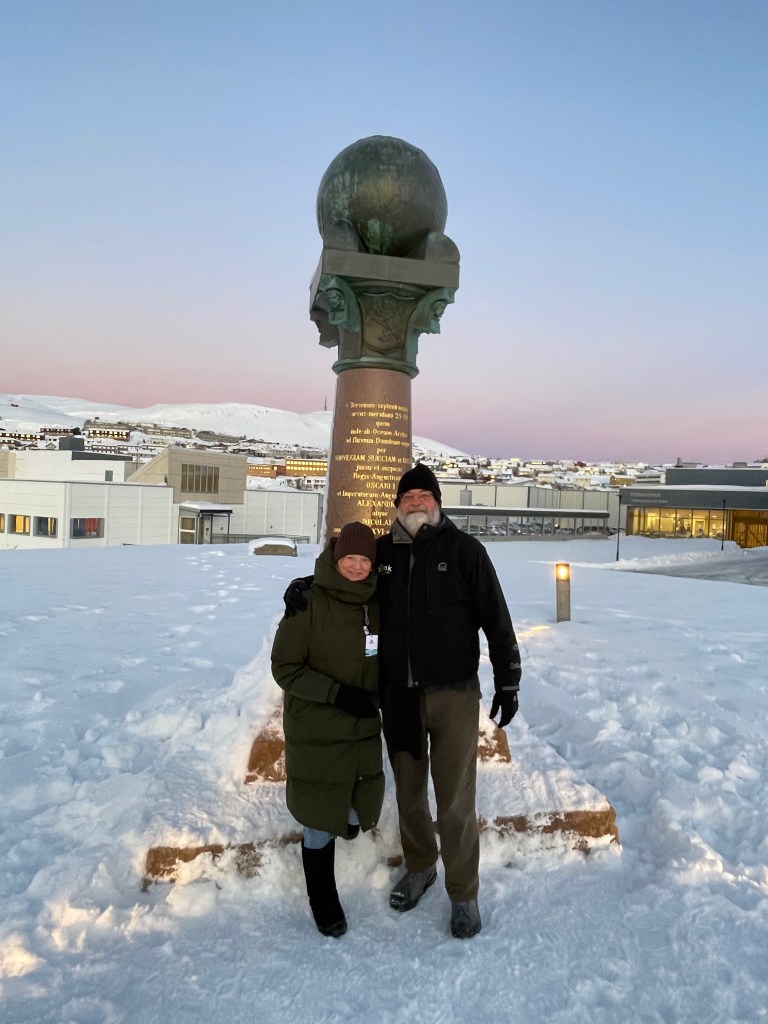
The monument itself is a “meridian column” (there goes another thing off the bucket list!) and commemorates the scientific measurements needed to see how obese the earth has become and whether it needs to go on a diet. Speaking of which, do you know the only large country (as opposed to all those small island countries where they give birth to pre-sumos) with a higher obesity rate than the United States? Kuwait. Maybe they should stop kuwaiting for take-out.

As you can see the views and scenery from the area around the monument was absolutely gorgeous, so both the marker and the scenery made it a monumental visit despite the brevity of the stop.

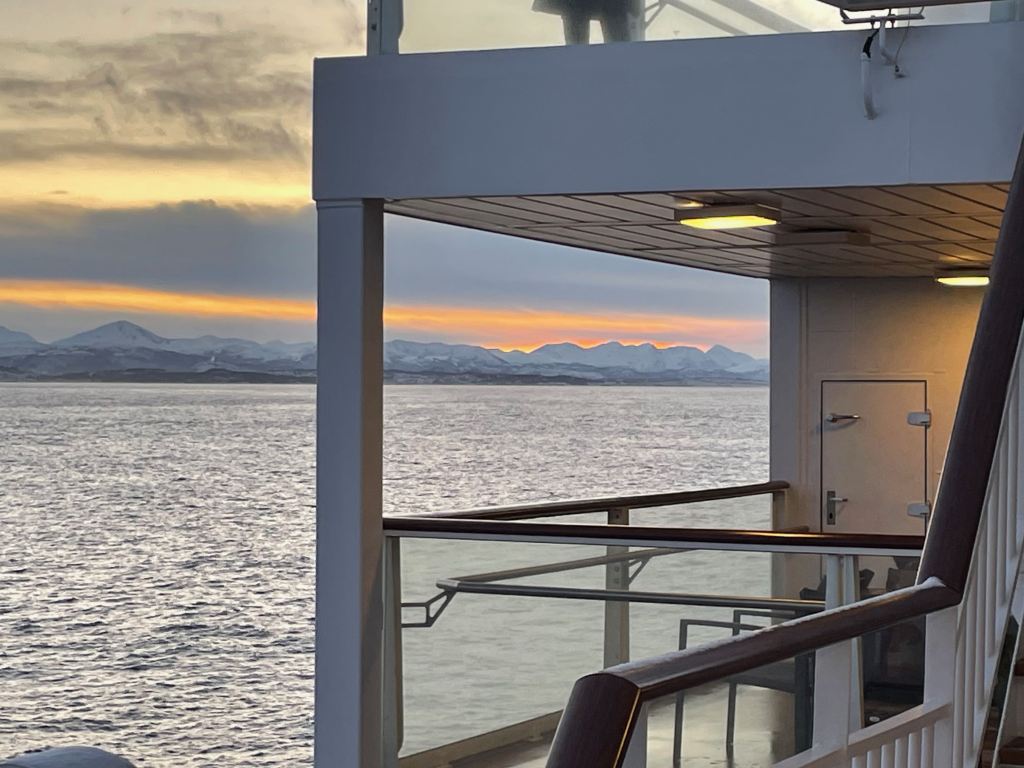
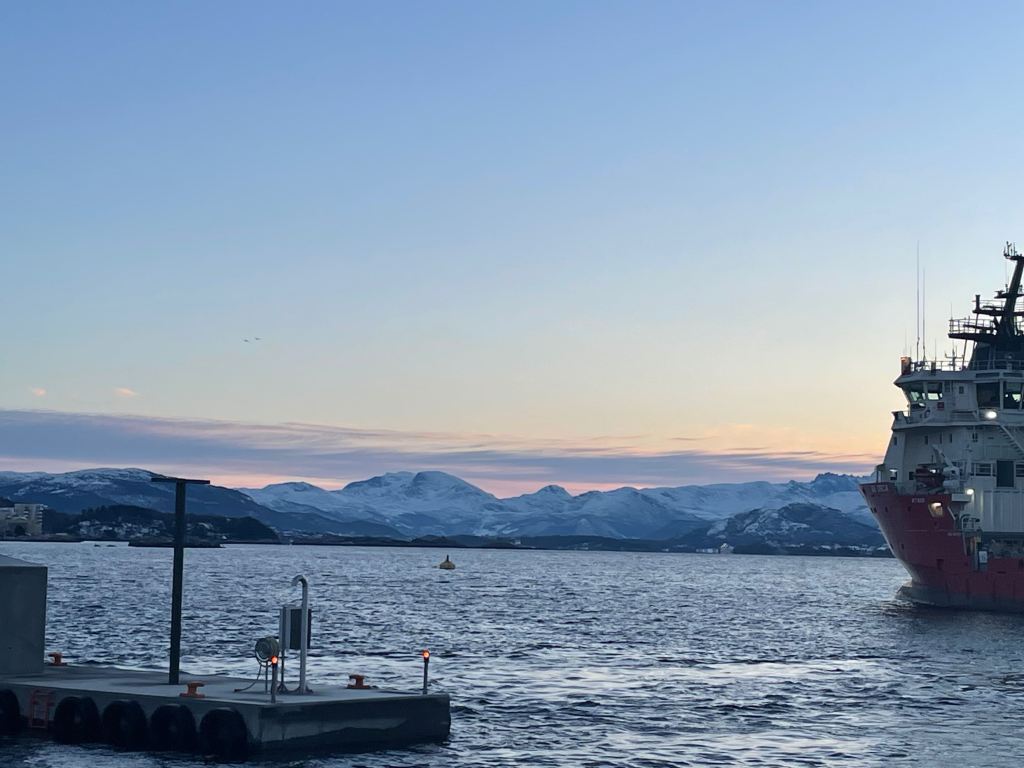
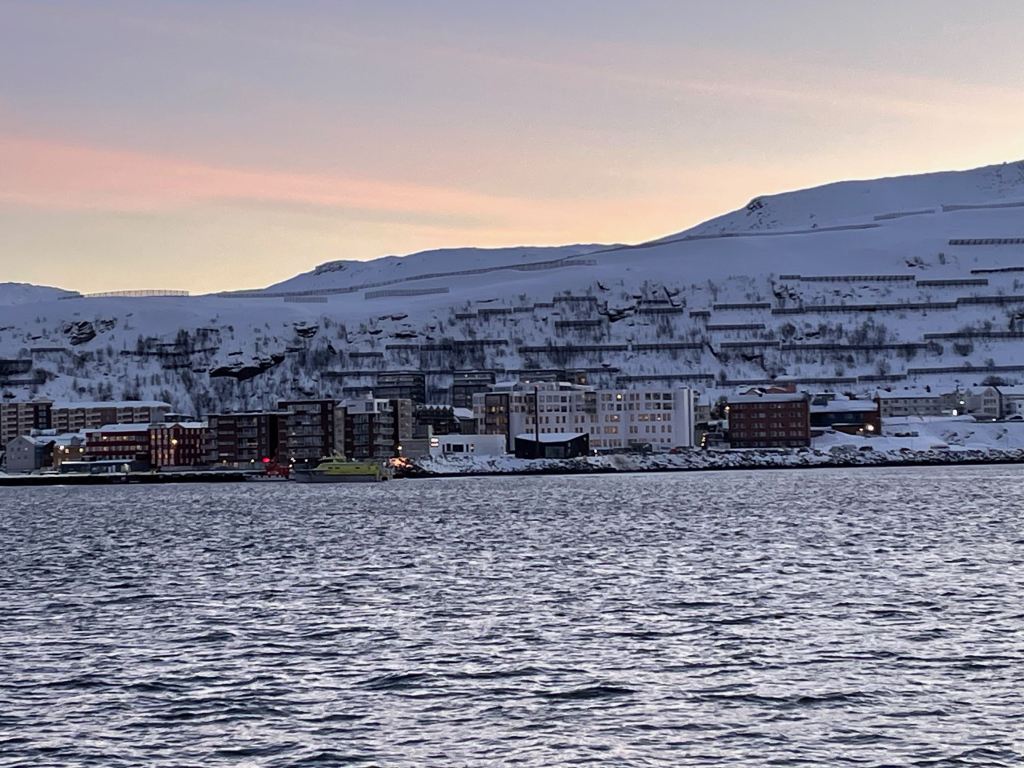
And off we sailed again into the wild dark blue yonder, ready for our next excursion while viewing scenes like the below from the comfort of our ship, hot chocolate in hand and “It’s a small world after all!” worming around in my brain. Dammit!

(Scroll down to see previous entries.)

It’s a Small World after all!