Arguably the single biggest must-see in Prague is the Prague Castle, which dates all the way back to the 9th century.
The complex has been the seat of power for countless kings, emperors, and Presidents. Today it is the official office of the President of the Czech Republic. Prague Castle is the largest ancient castle in the world. We were two of over 1.8 million people who visit the castle annually, thankfully, not all at the same time.
The castle is visible from all over Prague. Once we crossed the Charles bridge, we ended up at the foot of the hill it on which it sits.
Once you climb the multitudinous stairs to get to the complex, you’re treated to a wonderful view of Prague.
We were fortunate enough to go there in the afternoon and stay into the night, which meant we were also treated to wonderful evening views.
The multitudinous stairs.
Prague Castle includes the gothic St. Vitus Cathedral, the Romanesque Basilica of St. George, a monastery and several palaces, gardens and defense towers. The castle houses a number of museums as well.
We arrived a little bit late in the day mostly because we wandered into the area and even though it wasn’t on that day’s agenda, decided to tackle the attraction anyway.
As a result, we hurried through a couple of the buildings because they were due to close within the hour. The bonus of that was that there were hardly any other people there. The double bonus is that we conquered the entire thing in less than a couple of hours, which isn’t what most visitors would tell you is enough, but it worked out that way for us, perhaps due to the lack of crowds.
Inside the castle complex is St. Vitus Cathedral, construction of which began in 1344.
The outside of St. Vitus is both imposing and gothically beautiful. It is easily one of the most impressive churches we’ve seen since we’ve been here.
When buying tickets to see whatever you want to see, you’re presented with three choices, or “circuits.” We chose Circuit B after doing rock, paper, scissors. Turned out to be the right one, especially with our limited time budget.
Amazingly enough, the construction of the Cathedral wasn’t completed until 1929, almost 600 years from when it began. If this had been the focus of The Money Pit, when the foreman was asked when it was going to be finished, instead of “two weeks, two weeks,” he might have said “two centuries, two centuries.”
And he’d still have been off by 400 years.
Inside, St. Vitus also impresses, which was the whole point in those days. You were supposed to be made to feel small; the church was meant to convey the enormity of God in comparison. I already feel tiny in comparison anytime I’m beneath a very starry sky, but back then they hadn’t learned to look up yet.
There was a lot of controversy over art like this, with critics complaining that the kids would just sit around inside and stare at it instead of going outside to play like they did back when they were kids. The controversy abated once television was invented.
The Czech Crown Jewels. Or more accurately, reproductions of them, not that anyone could tell. The crown was made for Charles IV in 1347, making it the fourth oldest crown in Europe, just after one in Queen Elizabeth II’s mouth.
This is one of the souvenir shops on an alley called “The Golden Lane,” so-named because goldsmiths used to work there. Apparently one of the job requirements of a goldsmith was to be not much more than five feet tall.
While the Golden Lane wasn’t particularly impressive, they did have dozens of suits of armor on display as part of the attraction. It’s hard to imagine walking around in one of those things, especially on a hot day. And they hadn’t even invented anti-perspirant yet. And how do you take a leak?
On the grounds is the Rosenberg Palace, which was originally named the Renaissance palace. We peeked inside but most reviews are fairly blah on the place, so we used our limited time for other, more interesting things.
I can’t remember what this is, although I know it’s a building.
The changing of the guard. All thoughts of stealing the fake crown jewels abated once I saw their fierce weaponry.
Another view of Prague from the castle.
When the sun goes down and the lights come up, the church looks like something from an old horror movie.
In the end, the castle was certainly a sight to behold. With a little extemporaneous planning we were actually able to see everything we wanted to see without spending the entire day there.
As I mentioned in the previous post, Prague was spared much in the way of bombing during World War II, which is why it is currently one of Europe’s most beautiful cities.
When I organize the pictures I’ve taken after a trip, I try to put similarly-themed images together. When the organizational dust had settled this time, I discovered I had one folder full of nothing but Prague buildings.
Other than the astronomical clock tower on the right, we usually had no idea what any particular building was or what it was used for. So we just snapped away.
(An astronomical clock is a clock with special mechanisms and dials to display astronomical information, such as the relative positions of the sun, moon, zodiacal constellations, and sometimes major planets.)
The Prague Astronomical Clock was first installed in 1410, making it the third-oldest astronomical clock in the world and the oldest one still operating.
In any case, rather than try and make a comment about each one, I put the remaining 27 pictures in a two-minute slide show, so you can tour the buildings of Prague in the comfort of your own home. We had to do it in the cold wind and rain. But don’t worry, we’re always happy to sacrifice our bodies for your pleasure! Wow, I guess you could call us your own personal blogstitutes!
This slideshow requires JavaScript.
When we first ventured out of our hotel room, we walked along the Vltava river until we came to the most famous bridge in Prague: Charles Bridge.
Excited to see such a famous landmark, we joined the crowd snapping pictures and selfies. Although it was a nice enough bridge, we couldn’t quite make out just why it was so famous. But who can say why some things get to be more famous than others?
After taking selfies in front of the famous bridge, we trudged through the nasty weather on our way toward the city center, and noticed there were in fact a number of bridges over the river. Eventually we came to one in particular which was really crowded with tourists.
Oh, that’s the Charles Bridge. Oops. We don’t even know the name of the not-so-famous bridge we were so gleefully snapping pictures of, but what the heck. A rose by any other name…
The Charles Bridge is pedestrians-only. During the busy season, it’s just one big sea of pedestrians.
As with any sea, there are occasional buoys –er, boys, floating about.
As well as some gulls, –er, girls, too.
Like any proper famous bridge, the Chuckie Bridge has a famous spot you can touch for luck. I figure any bridge that keeps me from touching the water beneath is plenty lucky already. Plus I have a hard time believing that touching something that a hundred thousand people before you have already put their germs on will bring you any kind of good luck. Or maybe they’re just referring to the fact that you’re damn lucky if you don’t catch something from it.
The construction of the Charles Bridge started in 1357 and finished in the beginning of the 15th century. It was originally and cleverly called Stone Bridge, or also, and just as cleverly, Prague Bridge. But it has been known as “Charles Bridge” since 1870 (King Charles IV began the thing), which, while not the cleverest of names, certainly is much more clever than the first two.
Today it’s a heavily touristed bridge that serves as a main thoroughfare to the Prague Castle, which is the largest ancient castle in the world. And we saw it! And you will too!
We were excited to visit Prague, since it felt to us like it would be one of the more “exotic” cities we’ve visited since we’ve been here. Truth be told, the only reason we thought it exotic is because neither of us really knew a whole lot about the Czech Republic, except that it used to be named Czechoslovakia, it is the most easterly we’ve ever gone in Europe so far, and that the Czechs drink more beer per capita than anyone in the world.
Also, while most EU countries use the euro, Bulgaria, Croatia, Denmark, Hungary, Poland, Romania, Sweden, and the United Kingdom join the Czech Republic in using their own homespun currency, which is the koruna, which sounds Hawaiian, but it’s clearly not because there is no documented evidence that any Czech has ever met any Hawaiian. Not that I’ve seen anyway.
The exchange rate for the Czech koruna is about .039 korunas to the euro, so when you turn 100 euros into korunas you end up with 2,566 korunas. Suddenly, we felt very rich!
We thought money might even fall from heaven for us, so we looked up to the sky hoping to see the korunas floating down toward our wallets, but alas, it was only rain. That and some rather scary greeters at the door of this residence.
After figuring out the math so we could get within 50 euros of knowing what everything cost, we discovered Prague was actually very affordable. Uber, our main mode of transport, was particularly inexpensive, with most car rides costing only a couple of euros, or 4 million korunas.
Just kiddin’. 2 euros is about 51 korunas.
Anyway, restaurant fare was reasonable, as well as the things we saw and purchased in grocery stores, etc. Suffice it to say, visiting Prague won’t break the bank like it does in London, Singapore, New York, Paris, or Sesimbra, Portugal. The latter is only because if you visit us, we pretend everything costs more so when we split the checks, so we actually make money on the dining experience.
Hey, 1.5 liters of bottled water costs 17 cents here, which used to seem damned cheap compared to that of the US, where marketing has become so sophisticated that they can even make water sound like the Elixir of the Gods. Just one more reason I love Portugal… they still regard water as just plain ol’ water. But now we’re used to the prices, so when I go into a store and see it for 18 cents instead of 17, I pitch a fit and scramble for coupons. Except Portugal doesn’t use coupons like the US does. But that’s okay, having senior moments means you forget what you were looking for long before you realize that what you were looking for doesn’t actually exist.
As an aside, it’s hard to make out the weird statue thing in the picture above, so to the right is the photo zoomed, cropped, and lightened in order to see it better. Seems like an odd way to greet people living there, or maybe it just creeps out would-be burglars, I dunno.
Anyway, Prague is statistically cheaper than any major city we’ve visited over here so far. It’s listed on one site as even cheaper than Lisbon. Prague comes in at 67th cheapest, while Lisbon is 78th. Zurich, Venice, New York, San Francisco, and Boston round out the top five most expensive cities to visit in the world. If you want to go cheap, head to Vietnam. Different sites give different results, and your own results may vary of course. Frankly, we know how to travel pretty cheaply, so even though Venice comes in at the second most expensive on that particular list, we missed most of that because we didn’t overnight in the city or take a 100 euro gondola ride.
The statue above is of a guy doing a Mary Poppins over the street. It’s a piece of art that serves the purpose of reminding you to look up while walking around Prague, because if there doesn’t happen to be any floating statues above you, there’s likely to be some amazing architecture instead.
Actually, the Mary Poppins Man didn’t even make this “Top Ten Strangest Statues in Prague” list. Out of that entire list, we only saw one of them in person (to be discussed later). Which makes me realize anytime we go into a new city now, we have to first Google “Top Ten Strangest Statues in (insert city name here). Which makes me wonder, what other strange things are we missing? At this rate, we’d probably overlook The Church of Elvis in Portland if we were tourists. We need to do more research on oddities the next time we go anywhere…
… like this gorilla made out of colored pencils. It’s the lead decor for a stationary store. Great. Now we have to Google “statues made out of pencils” everywhere we go.
Not content with making gorillas out of pencils, the Praguesters enjoy creating delightful artwork out of their food too. I’m sure it tastes a lot better than taking a bite out of a Van Gogh.
Here I’m tickling the chin of Louis de Funes, who is a famous French actor. But he was apparently so short he only got small roles. Ha ha! Maybe he’s there to show us how fleeting or regional fame can be, because I’m willing to bet no American reading this has ever heard of him, even though one of the films he was in was nominated for a Golden Globe in 1974. Of course, I personally have no idea who or what has ever won a Golden Globe. Until now. But it was the movie, not him. Which I don’t remember anymore. So I guess my comment is still correct. Wait, what was I talking about?
Anyway, I guess he’s famous in many countries including the Czech Republic and other countries in that area of Europe and even Russia, but he’s almost unknown in the English-speaking world. He’s dead now, so I don’t think he can improve his fame much beyond the above picture in my blog, which may double his current fame in America. This was in front of a candy store-slash-wax museum. Prague has no shortage of touristy places to visit, even if they have to use an obscure dead actor who was famous in one part of the world fifty years ago to promote their store.
They also have a famous piece of artwork of a bunch of sitting seagulls on the Vltava River, which is the river that runs through Prague. Oh. Carolyn just chimed in and said this isn’t artwork, these are real live birds. My bad. I think they’re waiting in line because, being birds and therefore stupid, believed a rumor that this is the line to get into the new Star Wars land in Disneyland. Stupid birds. We all know that line starts in Sacramento.
You don’t have to be well-read to visit Prague, but it pays to be, well, red. These exotic old cars trundle about Prague carrying shivering tourists, because even when it was close to freezing, they had no tops. Sheesh. We only go around topless in these big cities during the summer.
There is a mildly humorous story associated with this picture in front of a church. Unfortunately, we don’t have the funny photo to go with it, so you’ll have to settle for the story. As I stood up there to strike a pose, some people came out of the church and stood near me, pausing before going down the steps. Carolyn was trying to maneuver me into better position, so she was waving her hand and telling me to go this way and that and stop and whatnot. A gentleman standing in front of me thought she was telling him what to do, and lo and behold, he obeyed her commands, moving this way and that, and then dutifully standing still for the shot. I stood behind him chuckling, and even Carolyn didn’t realize at first that’s what was happening. Finally the man’s wife yanked him to the side with a laugh. After all that, we didn’t even get any pictures better than the above.
So we finish this first Prague Blog entry with a Door of the Day for Carolyn. But this was just a taste of what Prague had to offer. It is a truly magnificent city, perhaps mostly because it was pretty much the only major city in Europe that wasn’t extensively bombed during World War II, so the old great buildings still stand in all their original splendor.
Most people know Paris is the city most associated with the phrase, “City of Light,” but it’s also been used to describe the following cities in one way or another:
We missed all these interestingly named towns in Germany.
Anchorage, Alaska; Aurora, Illinois; Baghdad, Iraq; Baltimore, Maryland; Birmingham, Alabama, United States; Buffalo, New York; Curepipe, Mauritius; Eindhoven, Netherlands; Elbląg, Poland; Gwangju, South Korea; Jyväskylä, Finland; Johannesburg, South Africa; Karachi, Pakistan; Las Vegas Valley, United States; Los Angeles, California; Lucerne, Switzerland; Lyon, France; Manresa, Spain; Medina, Saudi Arabia; Miami, Florida; Milford, Pennsylvania; Natchitoches, Louisiana; New Bedford, Massachusetts; Ohrid, Macedonia; Perth, Western Australia; Tehran, Iran; Tamworth, Australia; Quanzhou, China; Varanasi (Banaras), India; Venice, Italy; Wheeling, West Virginia; and Wolverhampton, United Kingdom.
And so, in keeping with my “A City of…” theme for this trip, I offer up Dresden as another entry to that already long list. Here’s why:
In February of 1945 the US and England dropped almost 1,500 tons of high explosives bombs and over 1,100 tons of incendiary bombs on Dresden, creating a hellacious firestorm and pretty much destroying the entire inner city. The bombing remains controversial to this day.
On one hand, the Germans considered Dresden an important defensive military strongpoint and a vital hindrance to the advance of the Soviet armies. On the other hand, the war was almost over, and Dresden was a beautiful city (nicknamed the “Florence on the Elbe” as well as “The Jewel Box”). It appears that the English and Americans bombed it mostly because they had the bombs anyway, plus they may have wanted to damage a place that was sure to be in Soviet hands after the war.
But since the city was chock full of refugees fleeing the Soviet advance, mostly innocent civilians died in the raid, with estimates ranging from 35,000 to 135,000.
In any case, for a couple of nights during the war, it was most certainly one of the brightest lit cities on the planet.
After the war, it fell under the control of East Germany (and therefore the USSR). They rebuilt some of the historic buildings, but they also built a number of buildings in the ugly, boxy, “socialist modern” style; I guess so that we’d always remember how boring Communism is.
A much better picture of Dresden than I could have taken.
We found Dresden to be absolutely stunning in the inner city area, with buildings that, while rebuilt, are surely just as gorgeous and impressive as the originals. But the rest of the city looked a little blah to us, with its boxy apartment buildings, nondescript structures, and not a whole lot else that was interesting. That said, we were mostly on foot and certainly didn’t see the entire area, but without that inner city, it’s hard to imagine Dresden being any kind of tourist destination today.
And so, without further ado, here are our pictures:
This is an area called Brühl’s Terrace in the inner city. It is a popular location for taking walks, people watching, and debating with your travel companions as to how you pronounce the ü. I argued for Ooh-dot-dot.
This is Catholic Church of the Royal Court of Saxony, aka The Dresden Cathedral. The church was badly damaged during the bombing (which will be a common theme here). The East German government restored much of it, and after reunification it was restored more fully. It was originally completed in 1751.
Not to be outdone by the Catholics, the Lutherans have the Frauenkirche of Dresden, which is now one of the most important churches in Germany. It was mostly destroyed by the firestorm as well. It remains an important symbol because the Communists wanted to turn it into a parking lot. The Germans simply wouldn’t allow that, but the church wasn’t fully rebuilt until after the German reunification.
The Semperoper is the opera house of the Saxon State Opera, and was originally built in 1841. Only an empty shell was left after the Dresden firestorm. Exactly 40 years later, on February 13th, 1985, the opera’s reconstruction was completed. Of course, I’m not sure anyone bothered to ask who listens to opera anymore, but it’s an impressive building nonetheless.
When we saw this building with that big slogan, I didn’t know if was some propaganda relic from East Germany’s past or an advertisement for a pub. I translated it with Google Translate, and this is what it apparently says: “A life without joy is like a long journey without a guesthouse.”
So I’m guessing that’s a hotel? Looks more like a prison maybe. In any case, just an idea of the blah kind of landscape outside of the inner city.
We couldn’t tell the date of construction of apartments like this, but the blocky style is certainly reminiscent of the Communist approach to architecture, i.e. bo-ring…
I’m pretty sure this was built after the reunification because it actually has some artistic design to it. I don’t think it’s an atomic plant, however. We didn’t think so because we didn’t grow a third eye or anything after walking by it. Yet anyway.
The inner city of Dresden at night.
This is a Christmas tree in the Wiener Platz, which is an important transportation hub of Dresden, especially for sausages. Otherwise, why would they call it Wiener Platz? Duh!
This monument, dubbed “The Golden Horseman,” is a statue of Augustus the Strong (1670-1733) and is covered with gold leaf. Augustus’ great physical strength earned him the nickname by breaking horseshoes with his bare hands (!) and engaging in fox tossing by holding the end of his sling with just one finger while two of the strongest men in his court held the other end.
Fox tossing. Now there’s a sport we don’t see on ESPN very often. I’d have been more impressed, however, if the animal were an elephant or a hippo.
Carolyn freezing in front of the Katholische Hofkirche.
A wide angle view of the inner city square.
A view of the Frauenkirche of Dresden as seen through the Fürstenzug on Augustusstraße (talk about a mouthful!). The Fürstenzug (Procession of Princes) is a large mural of a mounted procession of the rulers of Saxony, and is one of the largest porcelain tile artworks in the world.
It was originally painted between 1871 and 1876 to celebrate the 800th anniversary of the Wettin Dynasty, Saxony’s ruling family. In order to make the work weatherproof, it was replaced with approximately 23,000 Meissen porcelain tiles between 1904 and 1907. Apparently those are the things to use for construction if you anticipate a fire bombing, because the damage to it was minimal.
According to Google Translate, that sign says, “A tribe of horses whose career extends to our days in the gray past, he went on to say with our people.” Apparently any kind of writing on walls is essentially graffiti, which is almost always unintelligible.
The view across the river Elbe.
More inner city Dresden. The whole area is easily walked in less than an hour, but only can be fully appreciated with a day or two of exploration.
I thought it a good idea to reach out between nations and hug a Pole.
This is the outside of the Zwinger, which is a palace in Dresden. Zwinger is actually a term for what is essentially a killing ground: an open area between two defensive walls that was used for defensive purposes during the Middle Ages.
This Zwinger was eventually walled in, and is now a museum complex that contains the Gemäldegalerie Alte Meister (Old Masters Picture Gallery), the Dresden Porcelain Collection (Dresdener Porzellansammlung) and the Mathematisch-Physikalischer Salon (Royal Cabinet of Mathematical and Physical Instruments).
It was of course largely destroyed in the bombing, but like much of the rest of inner city Dresden, has been rebuilt to its former glory.
We also went into a museum called “The Green Vault” that houses the largest collection of treasures in Europe. It was founded by Augustus the Strong, and so I would’ve expected some broken horseshoes or a video of fox tossing, but no.
They also didn’t allow any pictures so all I could do is steal the one above from the internet.
As we wandered through some shops, I came across these sweatshirts on a rack. No other city was represented. Portland and Seattle are our two hubs in the US when we go back. I guess we’ll have to go back and be tourists there now! They must be so exotic!
We were flummoxed when we found out our train to Prague was delayed by about half an hour. I’d read that German trains are on time 99% of the time! What the hell’s going on here?
This is what you do when you’re waiting for a train and otherwise have absolutely nothing else to do.
So that’s Dresden. It only gets one entry because the area wasn’t huge and there was only so much to see. Plus we already covered the Christmas markets in a previous blog, and that was some of the reason we went there.
Other interesting Dresden factoids:
The Christmas market there is Germany’s oldest.
Originally, back in 1933, Dresden was home to over 6,000 Jews. In 1945, only 41 were left.
The novel Slaughterhouse Five by Kurt Vonnegut (one of my favorite authors of all time) was set in wartime Dresden. As a result of that novel, I had a mental picture of what I thought Dresden might look like. It looked nothing like I had pictured.
From 1985 to 1990 Vladimir Putin, while working for the KGB, was stationed in Dresden.
The following products were invented in or around Dresden:
Not every visit to a new city has to be filled with sights unique to the area. Museums of every kind abound in most cities, and many of them are just as interesting as the museums you might want to visit in your hometown, especially when you have a hankering to see some dinosaur bones.
The Natural History Museum in Berlin is famous for three exhibits: the largest mounted dinosaur in the world (a Giraffatitan skeleton), a well-preserved specimen of the earliest known bird, Archaeopteryx, and it also now houses one of the best preserved skeletons in the world of a Tyrannosaurus Rex.
That’s why we went to the museum: we thought it would be pretty cool to see something older than what we see in the mirror nowadays.
So without further ado, here are the photos:
The Guinness World Record Certificate confirms that this is the tallest mounted dinosaur skeleton in the world. That’s just his big toe, I think. It kinda looks like a wooden Dutch shoe, doesn’t it?
No, this isn’t the tallest one. This was the dinosaur version of “it tastes like chicken.”
This is the dinosaur version of Manute Bol. The one on the left. He’s over forty feet tall, which means he would probably have peered into your fourth story window when he wanted to get back inside after going potty.
Speaking of caring for pets, the guy who made the Arc Encounter in Kentucky thinks Noah put two of these in a boat. (As well as I guess two each of the other 700 plus species of dinosaur we’ve found so far.) And then sailed with them for over a year.
I’m reminded of Roy Scheider’s line in Jaws: “We’re gonna need a bigger ark.”
Is it any wonder that someone invented dragons after coming across a dinosaur skull like this?
A battle between a Tyrannosaurus Rex and a dragon would have been epic. My money would be on the dragon, because the Tyrannosaurus Rex was around before flame throwers were invented and so hadn’t evolved any defenses. Duh.
The Tyrannosaurus Rex had the strongest bite in history. This was problematic for them when they tried kissing, which may be why we don’t see any more little Tyrannosauruses running around.
It’s pretty obvious we’ve evolved only so far.
Okay, so we stand taller. But some of us actually believe that dinosaurs were on Noah’s Ark, so I’m not sure where that’s gotten us.
This exhibit proves that it only takes two macaws to lift a cheetah from the ground. It’s a well known fact that they do that and then dash the hapless cats onto the rocks for a fine feast of flattened feline. At least I think that’s what the plaque in German said.
This guy got so hammered the next morning he woke up in a jar.
These two walked into a prohibited room and were never heard from again.
I steered Carolyn clear of the view of this cute little (well, three feet worth of little) arachnid because I felt had she seen it, the ensuing scream might have set off all sorts of alarms and we might have found ourselves surrounded by German police officers with automatic weapons. Crisis averted.
A side-by-side comparison of the alpha predators of their times. I think lions are cuter. Up until they bite me, at which point I don’t think they’re cute at all.
Now we suddenly lurch from the Natural History Museum to Reichstag building only because I had a leftover photo of the Reichstag and thought I better use it.
Written on the building is “Dem deutschen Volke,” which means “To the German people.” This building was made particularly famous (or perhaps notorious) when in 1933 it was set on fire, allowing the Nazis to use it as a pretext to arrest and kill anybody they felt like arresting and killing.
And so we close our visit to Berlin by going through a train station on our way to Dresden. But this isn’t just any train station. Comparing an average train station in America to this Berlin station is like comparing a sandlot playground to a major league baseball stadium. It’s huge, clean, quiet, filled with nice stores, and the trains zip in and out of the huge building like you’re in a science fiction movie. The US doesn’t invest in infrastructure like Europe does; it seems they’d rather give all the money to the very wealthy so they can fly over to Europe and enjoy Europe’s infrastructure. Which is a win/win for those policies, because the Most Important People get to experience the fancy transportation hubs and the government doesn’t have to waste money on the rest of Americans. Booyah!
And we’ll finish up this entry with a Door of the Day.
While wandering through Berlin, we came across an oddly placed statue of a green man walking on a lawn. It had us a little puzzled. It looked like the result of a passionate night between a plastic army man and a Monopoly piece.
Later, as we were crossing a street, I noticed a similarity between the statue and the crosswalk light. Was that the same guy? And if it was, did it mean that walking on that particular lawn was always encouraged? Or did one of the little guys escape the light but became frozen in the real world?
Then we stumbled across a store called Ampelmann that was chock full those same green crossing men, plus a whole lotta red “stop” men. Apparently it’s a thing. Who woulda thunk? The name means “little traffic light man,” and it is a relic from East Germany, believe it or not. There’s not much left from East Germany… except for a little traffic light man.
“I survived forty years of Communist rule and all I got was a little traffic light man.” Oh the indignity of being East Germany!
The logos are plastered on everything, from chairs to napkins to soap to underwear. Actually, I don’t recall seeing any underwear, but that would seem like a great thing to sell: two pairs of panties, one with the green guy and one with the red guy. That way a woman’s date finds out pretty quickly whether he’s gonna get lucky depending on which one she decided to wear. There’s no reason to put them on men’s underwear, because, you know, the red one would never get worn.
Regardless of that genius idea, it just goes to prove that just about anything can be a thing. So now I’m thinking of opening a store with nothing but platypuses in them. Statues of platypuses. Chocolate-shaped platypuses. Sheets and blankets with images of platypuses cavorting around, topped with a pillow-shaped platypus. And of course two pairs of panties, one with a red platypus and one with a green one.
Hey, if Ampelmann can be a thing, so can platypuses. Besides, I kinda like saying “platypus.”
I also like wondering about things like why they call it a pair of panties. Can there ever be just one panty? Which means it would only have one leg? Oh, the mind boggles!
Speaking of mind-boggling, here follows a collection of oddities we noticed during our trip:
Okay, is it the best, or the worscht? We had to give them points for their clever name, and as a result this became the first meal we had in Germany. It was the best bestworscht we’d ever had up to that point, but I’m still not sure if that’s a good thing.
The Germans are so thoughtful that they put farting stations around town. So apparently this is where you fart, and that little device either sucks up the fumes, or gives you a stink-o-rating. I’m not sure which because the numbers on the device were in metric. I tried to convince Carolyn to give it a go, but she was too shy. I wasn’t shy, but alas, I wasn’t gassy either.
I’m pretty sure this sign on a pharmacy window translates to: “Well, you were my friend, but so long brave wart!”
Again, the Germans are so efficient (as well as hyper aware that if you have “germ” in your country’s name, you need to work extra hard to prevent the spread of more of them) that they even have a place for you to “dak,” which I’m sure is the German word for the sound you make when you sneeze, and then they offer a polite “gesundheit” ahead of time. I tried to take advantage of the offer, but I’m not allergic enough to Christmas trees. I coughed, but nothing happened. Bummer.
Germany also has strict truth-in-advertising laws, so if your Pelchen is crap, well, you’re gonna have to call it krappelchen. This is a river in Dresden, btw.
By the same token, if your shampoo is bad, there’s no hiding behind fancy marketing.
“He’d step over ten naked women to get at a pint.” A sign we got a kick out of in an Irish pub we went to, because of course you always have to go to an Irish pub if you’re visiting Prague, where this was. Never did see the ten naked women though.
As with most big cities, there is graffiti. I’ve always wondered the words mean, and in fact have found it interesting that for the most part, they use pretty much the same lingo, which is just as unintelligible in Europe as it is in the states. Except this one. I guess boobs are universal.
So, having been exposed to the boobs and stepped over ten naked women and invented panties to help people with their sex lives, we decided we better go to church.
Actually, when hundreds of black crows began circling our heads after I announced my plan for the Ampelmann panties, we took that as a sign that we better get into one or two right quick.
This is the Berlin Cathedral (“Berliner Dom”). It was built on a site that had various churches on it since the 1400s. The current building was finished in 1905. It at least gives the Germans something to crow about.
In 1944, an Allied combustible bomb dropped into the dome. The resulting fire could not be extinguished, and so da dome dum-dum-DUM-dummed. In 1975, reconstruction began, restoring it to its former glory.
A climb to the top of the dome reveals some impressive views of Berlin.
A climb to the bottom reveals some rather cryptic things.
They always have fences around tombs because so many people are dying to get in.
Now we’re off to the Kaiser Wilhelm Memorial Church.
The original church on the site was built in the 1890s. It was badly damaged in a bombing raid in 1943. The present building, which consists of a church with an attached foyer and a separate belfry with an attached chapel, was built between 1959 and 1963. The damaged spire of the old church has been retained and its ground floor has been made into a memorial hall. (per Wikipedia)
Either this tower is needed to relieve all the gasses from too much bestworscht, or maybe the lack of a huge offgassing tower is what really blew up the dome of the church.
As you can tell from this photo, this particular building goes all the way to the top.
The Memorial Church today is a famous landmark of western Berlin, and is nicknamed by Berliners “der hohle Zahn”, meaning “the hollow tooth”. After all the food we ate, I think we both ended up with hollow teeth ourselves.
I found an unwrapped wife under the Christmas tree, and so decided to take her home. I did almost opt for the blue present instead, but ultimately stuck with the red one. After that comment, she’ll be shopping for the red Ampelmann panties for sure. Ha!
As with many of the Christmas markets, this one was built in and around the grounds of a famous building, in this case the Kaiser Wilhelm Memorial Church. But you already knew that because you’re taking notes, right?
One of the reasons we chose to go to Germany and Prague in the winter was to see the Christmas markets. Spurred on by beautiful images like the one below, as well as articles listing the Top Ten Christmas Markets in Germany, we dug out our cold weather gear (which is otherwise completely unnecessary in Portugal) and hopped on a jet to Berlin.
Turns out photographers are pretty good at turning something that’s merely good-looking into something amazing looking. We never quite saw any scene to match the above, but we were ultimately delighted in the overall experience anyway.
In fact, for me the Christmas markets returned a good portion of some good ol’ fashioned Christmas spirit into my heart. They are delightful places, with cheerful vendors selling things like chocolates made to look like tools, traditional German foods made in huge metal pots and stirred with large wooden paddles, as well as ornaments, clothing, assorted Christmas gifts, and Gluhwein, which is a popular drink staple of the markets.
(It’s a little known fact that Gluhwien was invented by Elmer Müller, an alcoholic sixth grader who snuck wine into school by pouring it into his paste jar. He rather enjoyed the taste, and so dubbed it “Gluhwein.” The name stuck, because, you know, it’s glue. Later on, he went on to invent Elmer’s Glue, but ironically, perhaps because they removed the wine, Elmer’s isn’t particularly edible.)*
Christmas markets are crowded with folks enjoying themselves by wandering through the booths, gazing at the beautiful decorations, skating in an ice rink, letting the kids ride a small train or other rides, shopping for gifts, hobnobbing with their friends in a very festive atmosphere, or helping each other pry their mouths back open after sucking down too much gluhwein.*
Christmas markets were originally a German and Central European tradition, but it’s slowly spreading around the world. Portugal is beginning to see a few of them; but it will probably never make it big in the US because as soon as you have Taco Bell booths or nativity scenes sponsored by Monsanto, all the charm goes out the window.
In our old hometown of Portland, Oregon, there is the Saturday Market, which has largely remained homespun and charming, and since it’s Portland, a little weird. Christmas markets in Germany are like the Saturday Market, except with a much more Christmassy atmosphere and no discernible aroma of marijuana.
Anyway, Merry Christmas to anyone reading this (everyone else can go suck lemons; just don’t tell them I said that), and here are the pictures!
One of the clever ways they allow you to walk around with Christmas mugs instead of messy paper or styrofoam cups is to serve it in one with a one or two euro deposit. You can either keep the mug for that price, or return it for a refund. We kept two of them as souvenirs of Germany. I kept the wife as a souvenir from the states.
The sign above this blacksmith says, “Below is a guy you don’t want to mess with.”* I took that advice and enthusiastically complimented him on his beautiful tattoo.*
“Engel” translates to “angel.” I gotta tell ya, the Germans are so efficient they knew ahead of time that my own personal angel would be standing there to have her picture taken. They of course took the sign down as soon as she walked away, its purpose having been served.*
The aforementioned chocolates in the shape of tools. It’s good to know where you can go if you have a chocolate screw that just won’t budge.
The various markets had different rides. This one not only had a Ferris Wheel (which looked waaay to cold to ride in near-freezing weather) but a skating rink as well. We saved both our own health and that of the other skaters by staying off the ice.
You can see the palpable relief on our faces after we both agreed not to go skating.
Christmas pyramids originated in Germany, so it’s no surprise that most of the markets had at least one gigantic one.
Some of the markets are built in or near tourist sites, in this case the Berlin TV tower, which was built by East Germany in the 1960s.
Some people accused me of marrying a trophy wife but I can assure you that despite her good looks, she is anything but. Here she proves it by not being the one who is an ornament.
The decor is top-notch. Very clean, consistent, and festive. They were all very crowded, but it was a good crowded. Everyone very much enjoyed themselves, except the people who had to wear ornaments all day.
We imbibed a variety of drinks such as hot cider, apple cider with rum, gluhwein, mulled wine, and of course beer.
Although I have to confess one of the beers I had was a Budweiser. Just wanted to see if it tasted different. Next time I go to Germany, it’s no ifs, ands, or Buds.
Here Carolyn demonstrates the proper way to eat a German wiener.
Some of the markets had cute performances with dancers or musicians. Or maybe it was performances with cute dancers. Because of the crowds, I couldn’t get close enough to tell.
The malls of course got into the spirit of things with lots of decor, but they can’t compete with the homespun charm of the Christmas markets.
Gigantic Santas and snowmen were popular decorations.
We’re now looking at pictures from the Dresden Christmas markets, I figured we might as well put all the Christmas market pictures together. By the way, you don’t go to these markets to lose weight.
This is as close as I could get to taking a Christmas market picture like they put on the internet. I’ll obviously never be a professional photographer, but you get the idea.
One funny little story from the Dresden market: we actually got recognized by someone from our appearance on House Hunters International. We overheard two men speaking English, and began to engage them in conversation when one of them looked at us and said, “I recognize you two from TV! You were on Househunters or something weren’t you?” Man, we went all the way to Germany to avoid all the paparazzi, and we still get recognized!
Even if you’re not in the market for Christmas decor, the booths are delightful, colorful, and very well stocked.
And the food choices are almost limitless, many of which are especially present-worthy.
Hard to image a scene and atmosphere that is more Christmassy in spirit than these markets!
The Dresdner (Dresden) Striezelmarkt is one of the oldest Christmas markets in the world. Founded as a one-day market in 1434, it celebrated its 584th anniversary in 2018. It now has about 240 booths, and attracts about 3 million visitors. With two Americans living in Portugal added to the tally, it’s now 3,000,002.
The inevitable Christmas Pyramid in Dresden.
This guy was frozen in 1426 in the hopes that more advanced technology would be able to cure what killed him.*
Since this is what he might look like after being defrosted, they decided to keep him frozen. Besides and ironically, curing sword stabs is a medical art that has now been lost to history, so that frozen knight is completely screwed.*
After a hard day of wandering through Christmas markets, it’s time to sit down with a glass of wine. Or just because it was wine-thirty.
The famous Smurf Christmas Tree.*
The sight of her digging into her purse or me into my wallet was a common one since we just had to sample so many of the delights. I think we each gained ten kilometers as a result.* See how much easier metric is?
As you can tell by the presence of a panda, we’re now in Prague. That’s a non sequitur, which is sometimes used to create humor. Hey, we all get a ribbon for trying, don’t we?
We got a frosty reception in our first visit to Prague. Guess we’ll have to try again in the summer.
The Christmas markets we saw in Prague were not quite as delightful or crowded as they were in Germany. Maybe that’s because most of the booths didn’t accept Czechs as payment. Bah dum dum.
Don’t get me wrong, the Christmas markets in Prague were still great. It may just be that the buildings around Prague were so beautiful and amazing they overshadowed the Christmas market decor.
I think this picture demonstrates that.
This guy shook his finger at me after I took this picture. Apparently no pictures allowed. I have no idea why, it’s not like he’s using some sort of secret advanced technology. Joke’s on him though. Not only did I keep the picture, but now it’s all over the internet, being viewed by some 3,214,345 readers! Give or take 3,214,341.
Praha is how the Czechs say Prague. I wish we didn’t change the city names for each language. Shouldn’t every other language pronounce another country’s city names using the original names its own country gives them? In European languages alone, below are all the ways you would say “Lisboa.” What’s wrong with just saying Lisboa? Sheesh!
All I want for Christmas is fewer words in different languages! Since I’m endeavoring to learn Portuguese, I have a selfish reason for that request. Oy vay, there are just too many damn words to memorize.
* An asterisk indicates that I completely made up the statement that precedes it.
A view of the Reichstag from the River Spree, which ultimately flows into the Elbe.
Believe it or not, it is possible for me to be serious when I write (although if you scroll through every entry below you’d be hard pressed to believe that), but this portion of our Berlin tour calls for nothing but seriousness.
I looked forward to visiting Berlin mostly to see firsthand how the Germans have commemorated World War II, which was the deadliest military conflict in human history. My anticipation was well-rewarded; Berlin has done a good job making sure residents and visitors alike remember the horrors of that time.
Potsdamer Platz was once one of the most important intersections in Europe.
While Berlin probably can’t be described as a beautiful city (lots of plain-Jane Soviet-era buildings still exist in what was east Berlin, after all), it is certainly not an ugly city, and is rich in history and culture. Berlin is also very cosmopolitan: only 71% of Berlin’s residents are ethnic German. The rest is mostly a mix of eastern Europeans, Middle Easterners, and Asians. In addition, Berlin is a trendsetter in music, art, and dance. International artists, entrepreneurs, and young people are flocking there to be part of the scene.
Acceptance and tolerance are now woven into the city’s fabric. You could say it is now the antithesis of a Hitler city, although Berlin was always more liberal than the rest of the country during those times. It was not the hotbed of Nazism, it’s just where the capitol was.
The devastation of World War II was not just the holocaust. The holocaust was simply the most mind-numbing and senseless aspect of it. Estimates of total deaths due to the war reach as high as 85 million people killed, over 50 million of which were civilians. The USSR alone lost over 25 million people. Someone tabulated the cost of the war relative to 2005 dollars, and came up with $11,292,682,078,166.46. That’s over eleven trillion dollars. And 46 cents.
Despite the fact that blaming Jews for anything related to World War I or Germany was totally irrational and ludicrous, millions of Germans were willing to rally behind the policies and/or turn a blind eye to the mass extermination of an entire group of blameless people.
I believe this is central as to why so many folks are very uncomfortable seeing men like Donald Trump in power (as well as some of the world’s other strident right-wing leaders) with his obvious bigotry (don’t even think about denying that even if you support his policies). Bigotry led to the outright murder of six million Jews. I believe most Europeans are far less willing to allow bigotry to take hold again than many Americans, because the results of going down that road stare them in the face nearly every day.
While it seems as if we should be smart enough to learn from disaster, the main message you see when you enter the Holocaust Museum is this:
The wholesale slaughter of six million Jews just because they were Jewish should be enough reason for most politicians to pick their words carefully even today. As our leaders and representatives, they should stay as far away as possible from even hinting that just because someone might look or act different, or believe in a different version of God, or speak another language, or come from another country, they should be treated any differently from anyone else. When a politician chooses to ignore history and fan the flames of racism or sexism, or wields patriotism as a sword with which to keep the hordes of foreigners at bay, or build another goddamn wall, many people become very uncomfortable. For the life of me I don’t understand why American politics are so all-in. You can support some things, but you should hate other things even if it’s from the same party or politician, and denounce it any time you see it. One of those is bigotry.
John McCain did that, and earned the respect of many who would otherwise oppose many of his policies. Where have all the John McCains gone?
The apt and starkly named Memorial to the Murdered Jews of Europe is not a memorial designed to shove the reality of the actual brutal acts in your face. What you will find are the victims’ stories. The museum, which is housed beneath the concrete slabs, emphasizes the lives of those who were so senselessly shipped off to torture and death. These were real people whose only crime was to be born Jewish. Of course the Germans also efficiently disposed of many others, such as Gypsies and homosexuals and the mentally challenged. Or because you were liberal.
Above the museum, 2,711 concrete slabs sit on 4.7 acres of undulating ground. At first glance, this is an unusual and puzzling design. If you read up on it you’ll find all sorts of interpretations as to what it all might mean. I think only ingenious works of art can result in so many people walking away with so many varying interpretations.
In fact, Carolyn came up with her own interpretation after seeing the rain drops trickle down the sides of the slabs. They reminded her of tears. I don’t know if the designers planned that, but she’s right. And there’s no event in human history that deserves more tears than the holocaust.
Inside the museum, which fittingly costs nothing to enter, you are shown story after story of real human beings. It is a great reminder that the holocaust is not just about statistics or unfathomable numbers of people killed. It’s about six million innocent persons, each of whom was just like you and me, with hopes and dreams and loves and heartaches. And their lives were brutally taken from them simply because one man developed an irrational hatred of them because he couldn’t bring himself to believe that the Germans had simply lost World War I on their own.
Unfortunately, the tragedy of the war didn’t end when World War II was over. Europe was a complete mess. Most Jews and many more permanently lost their homes and possessions even when they returned to claim them. Millions of people were scattered about the continent, and the infrastructure was devastated. To make matters worse, the Soviets stayed in almost all of the countries they crossed to get to Germany. So those who lived in East Germany, for instance, went from the horrors of Nazi Germany to the horrors of Soviet rule. The East German security service, known as the Stasi, was just as feared and brutal as the SS. Eventually the Soviets built a wall around West Berlin, and sealed off the countries they controlled.
On of the most famous border crossings in Germany was between East and West Berlin, and is known as “Checkpoint Charlie.” It is now a tourist attraction.
There is also a section of the famous Berlin Wall that has been preserved. I’d heard that it was just a small segment, but I definitely wanted to see it. It turns out it’s bigger than I thought, and we found it a very interesting place to visit.
There is a memorial wall honoring all those who lost their lives trying to cross the wall into West Berlin.
There is the wall itself, which actually was just the last line of defense.
Even if you could climb over that wall, you first had to make it through a no-man’s land patrolled by guards in towers, with mines and dogs and sirens and in some cases guns automatically triggered by motion detectors.
Residents on both sides could see across to the other. But the wall created a chasm between countrymen that could only be healed once the wall came down and the Soviet Union collapsed.
Many of the buildings in the area that face West Berlin have large murals painted on them showing what the area looked like during the cold war.
In the end? Those millions of lives lost and trillions of dollars spent was all completely senseless, borne on the backs of lies and policies with no reality behind them. Sometimes I despair at the state of a species that is so willing to believe lies and to hate so easily, enough so as to allow six million of their fellow human beings to be tormented and slaughtered. It’s exceedingly important that we remember what humanity is capable of, both the good and the bad. This is why I get shivers up and down my spine when I see the frickin’ President of the United States tweet this:
While he has a point about the inequity of military spending (to which many might say, why the hell is the US paying 4.3% of its GDP when that means it spends more on defense than China, Russia, Saudi Arabia, India, France, the UK and Japan combined?).
But the issue I have with the tweet is that Mr. Trump demonstrates a complete lack of understanding of history: There was no such thing as a European military; they were fighting each other. In fact, Europe formed the European Union mostly to ensure something like World War II didn’t happen again. Again, no matter what your politics are you should be horrified that the leader of the most powerful nation in the world is so clueless when it comes to world history.
“Those who cannot remember the past are condemned to repeat it.”
As a side note, many people don’t know that when Germany fell, many of the upper level Nazis escaped to the Middle East, where they had cultivated allies. Once ensconced, they continued their anti-Jewish efforts, which explains some of the irrational hatred the Arabs have against the Jews. Mr. Adolf Hitler is a gift of evil that keeps on giving even to this day.
In the end, Hitler received his own just reward. I think it is so fitting that the place where he killed himself, the Führerbunker, is now simply a dirt-covered parking lot.
A fitting memorial to the most evil monster in human history.
I always wondered why it’s called Germany in English. One visit and boom! I found out soon enough.
You learn a lot about a place when you visit, and as a result of this, our first ever visit to Germany, we found out why it was called the “Land of Many Germs” (or Germ-many in the old dialect). It’s because they have so many germs of course! Here’s our proof: after we landed in Berlin and began walking around, we developed colds. That means every single time we’ve gone to Germany, we’ve gotten a cold. What other proof do you need?
This is another way to have “prison of the belly.”
By the way, in Portuguese the word for cold is “constipação.” Don’t ask us why. Maybe way back when the official Portuguese Language Translator got confused when he had both a cold and, uh, a case of the clogs.
Since that word got used up, they decided the phrase for “constipation” would be “prisão de ventre,” which literally translates to “prison of the belly.” Go figure. I thought they might’ve just used “cold” to make it even. Although that really might’ve messed up a lot of travelers when they asked for cold medicine.
I think it actually makes a lot more sense to call a cold a “prisão do nariz” (prison of the nose). I’ll try that phrase on the next pharmacist we visit when we have a cold. Why not? They can’t understand us anyway.
But we didn’t let lousy constipaçãos interfere with our sightseeing. So take that you germy Germans!
Berlin is a fascinating city. It impressed and interested me more than I thought it would. Being something of a casual student of World War II, it was interesting to see all the remnants of that war (and the aftermath, especially with the Soviet occupation of most of eastern Europe) still present and commemorated. I really think many Europeans’ worldview is still affected by that horrific time, as it should be.
So we set out to see all the sights Berlin has to offer. Being the savvy travelers we are, we usually travel by Commemorative Plate. I know a lot of people use Fodor, or Rick Steves, or Google. But we like to use the Commemorative Plate Travel System (CPTS). It’s a fail-safe way to see everything you need to see.
So here we see the Commemorative Plate telling us that the most important places to visit are the Berlin Dome (“Dom”), The Kaiser-Wilhelm-Gedachtnis-kirch, the Siegessaule, The Brandenburger Tor, the Reichstag, the Mauerfall, the Alexanderplatz, and the ketchup.
Whoops. He he. We used the plate for some french fries, you can ignore the ketchup.
First and foremost, we had to figure out transportation. Since it is Germany, we expected to see Mercedeses and BMWs barreling about like jet cars in a Star Wars city. There were some of those, but there were also a fair amount of Japanese cars as well, which surprised me just a little. Unfortunately, we tried to rent a car from a place called “My Last Name is Hitler But I Promise I’m Not Related to That Bastard Rent-a-car Company.” And all they had left was something Hitler might have driven when he was a starving artist. Or maybe that’s Mr. Bean’s old car.
Since I wanted to drive while my entire body occupied the car at the same time, we opted to mostly use Uber. Which isn’t completely legal in Germany because the Germans don’t put up with the abusive shenanigans Uber has engaged in to get their foot in every country. The app basically just hails a cab for you. But that came in handy actually, so despite Uber’s corporate nonsense, that’s usually the way we traveled. That, and a lot of walking. My calf muscles pretty much had a cow by the end of our two-week visit to Berlin, Dresden, and Prague.
By the way, I also have to say that most of the cars we rode in had very impressive dashboards. I often felt like we were actually in a jet car in a Star Wars city. I halfway expected to hear R2D2’s distinctive whistles and chirps, or Princess Leia offering directions in 3D.
Well, hell. I’ve got almost two pages done and you still haven’t seen any of the Berlin sites! Sorry. I definitely don’t have prisão de ventre of the fingers. I can only hope my readers have at least five or fifty, minutes to spare, depending on how much you skim. But beware! Skimmers miss my best jokes! Which isn’t saying much, because they’re all bad. But hey, it’s free, so quit your “jammern,” (that’s “whining” in German).
Okay, now I realize it’s going to take a few entries just to get through Berlin. So consider this Part One. And I’ll try not to ramble so much. Full disclosure: I still will.
Let’s start with the Brandenburg Gate, which is one of the most iconic buildings in all of Germany. Truth be told, perhaps because of its iconicity, as well as the impressiveness of so many of the other iconic buildings we’ve seen so far around Europe, I expected a little more out of the Brandenburg Gate. It was smaller than I imagined, and simply not all that impressive. Which is probably what a lot people thought about Hitler after meeting him for the first time.
The Brandenburg Gate was built in the 18th century, by order of Prussian king Frederick William II, and was built to represent peace.
Unfortunately, after World War II, it looked like this:
So much for representing peace. But, it was restored and still stands, so maybe peace does endure even in the face of calamity.
As we walked around the area, we happened upon a Soviet World War II Memorial. I’m sure the Soviets viewed themselves as liberators, even while they raped up to 2 million German women. In many cases women were the victims of repeated rapes, some as many as 60 to 70 times. The Soviets then remained in all of those countries until the Soviet Union collapsed. War sure is glorious, isn’t it?
At least we got some memorials and monuments.
Our hotel bordered the Tiergarten, which is a bit like Central Park is in New York, except without all the muggings. Like so much of Europe, Berlin felt safer than any large city in the states. We had no qualms about wandering through the Tiergarten or anywhere else, day or night. A street vendor was selling some qualms for ten euros, but we prefer to travel without them.
World War II and its aftermath devastated the Tiergarten: only 700 trees survived out of over 200,000 that once lined the parkway. The rest of the trees were chopped down for firewood or to make room for crops badly needed for a starving populace. Over time, West Germany brought the park back to life.
In the middle of the 520-acre Tiergarten is the Victory Column (Siegessäule), which was designed in 1864 to commemorate the Prussian victory in the Danish-Prussian War. It was inaugurated in 1873. The Nazis moved it to its present site, which probably saved it from destruction. After climbing 282 steps via a spiral staircase –huff-puff– one is treated to some outstanding views of Berlin:
And so, we have knocked off two of the sightseeing options from our CPTS (Commemorative Plate Travel System in case you forgot) thus far: The Brandenburger Tor (gate) and the Siegessaule (Victory Column). I’d say that’s pretty good work for one day, don’t you? It’s time for a beer!
Aside from dropping off your kids with an ex who just sued you for everything you’ve got, there are few destinations that cause more angst than going to the dentist or DMV.
We decided to do the latter two in the same week (neither of us have the first problem). figuring, if you’re gonna get tortured, you might as well get it all over with at the same time.
Our new dentist’s office is a small house that, like many Portuguese businesses, can be kinda hard to find if you don’t know where it is.
So we began with the dentist.
Most services here are best obtained by asking a local friend where they go. Businesses don’t do so much with websites here, and as far as I know they have no “paginas amarelas” (yellow pages), or any other colored pages for that matter.
Fortunately, we received the identical recommendation from two local friends, and so made our appointments.
Now, our experience with the private health care system in Portugal has been nothing short of amazing, plus very illuminating. Carolyn has received better care and more thorough diagnoses than she ever received in the United States, and at a cost that’s less than the insurance premiums we were paying. All without any insurance or government assistance at all.
We’re used to never knowing what anything will cost aside from our insurance co-pay (until we see the three page bill listing a $1,000 charge for a $1 bag of saline), which has resulted in medical costs skyrocketing to absurdity in the US. For example, the average cost in the U.S. for an MRI scan is $1,119, compared to $181 in Spain. Plus I think the system in the U.S. also uses the MRI to scan your wallet.
So it was of little surprise, although still unexpected, when we spotted a real live Dental Services Price List proudly mounted on the wall. That’s about $70 for a filling, which seems plenty fair to me.
On top of that, our new dentist is a young woman (which seems like it should be more common than not- I’d rather smaller hands stuffed themselves in my mouth instead of Doctor Shrek prying it open large enough to insert a basketball), and is an excellent dentist at that. Like our other medical experiences, we are absolutely delighted with the service we received.
So having turned that trepidation into delight, we set our sights on the Portuguese equivalent of the DMV, which is called the IMT. We had put off getting our licenses, even considering never exchanging them, mostly because we have a residence card which serves the same purpose as a driver’s license in the states, and otherwise the dearth of traffic cops means we have never had to show our current license. Plus, you know, our history of wanting to avoid the DMV whenever possible.
But we decided that we better get with the program because the law in fact says we must, but also because someone told us if we got in an accident we might not be covered because we didn’t have a lawful license as it were. I don’t think that’s true (more on that later), but regardless, it seemed like we might as well remain law-abiding wanna-be citizens.
In fact, I had already tried to get one many months prior, but came up empty-handed. The reason for this is that I did a Google search on what I’d need to get the licenses exchanged before I went in. The first website Google provided dutifully listed four documents I’d need. So I rounded them up and drove out to the IMT.
I left in the morning with expectations to be back sometime after dinner, since the IMT is essentially the same as the DMV, and the wait times at a DMV fall somewhere between an hour and “Oh my God I didn’t realize he was dead… no wonder the waiting room smells so bad!”
It turns out even the Portuguese equivalent of the DMV is generally less torturous than the American version. After only about 20 minutes (and no encounters with corpses), my number was called, and I plopped in front of a nice woman who spoke no English whatsoever. Now, this was a number of months ago, which means I had at least four less Portuguese words in my vocabulary, so we struggled a bit. Eventually she called over a gentleman who spoke English well, and we sorted it out.
It turns out the website Google used to answer my question had it all wrong. I didn’t need two of the documents at all, and as to the third she had no idea what it even was. At least I got one right though!
One of things she told me I needed was an apostille of my driver’s license in order to certify its authenticity. An apostille is sort of like a notary, except it’s recognized internationally. (I have to explain that because even my word processor program thinks “apostille” is wrong every time I type it, so it’s not even an American English word I guess. Plus the little red lines showing up all over my editable copy of this is driving me a little crazy. I hayte misspeling things.)
So I bagged the whole project for a while, although we did get the apostille done while we were in the states.
Months later, I was looking through what is otherwise a very helpful Facebook group, where it stated that we needed to have an apostille of our driving records, not our licenses. When I read that, I despaired a bit, and figured the hell with all of it. That’s something of a pain in the butt to get, especially when you’re overseas. So I thought I’d just keep driving with a US license until it becomes a problem. But then I remembered that the IMT lady had told me I just needed it of the license. I remembered it clearly because we had a conversation around the fact that it was simply a fraud prevention issue. Since I already had that in hand, I decided to ignore the new advice and try it again.
We’re not quite sure what to make of this door knob that’s only a foot off the ground at the IMT office.
After braving the Door For Midgets and bringing Carolyn with me this time so we could experience the torture together, we sat before two separate ladies, side-by-side. We’ve learned that they don’t like you to take only one ticket even if you want to be helped as a couple. Everyone gets a ticket (no idea what they do with conjoined twins). But at least we were side by side.
There are four things you do need, just not the ones Google told me I needed. One of the requirements is a doctor’s exam, the results of which are placed in a computer system that can be accessed by the IMT. (After seeing little old ladies’ heads barely visible above the steering wheel driving 40 miles an hour on American freeways, it seems to me this is actually a very good idea.) And we had already gotten that done.
They also required an apostille on… wait for it… our U.S. driver’s license, not our record. I heaved a sigh of relief at that one.
Otherwise, all you need is your actual U.S. driver’s license (which they take away if you’re successful at bringing the right paperwork), our “NIF,” which is a fiscal number every resident needs to have (especially to buy things like cars and houses), and our residence card. Oh, and 30 euros.
But, Portugal being Portugal, it wasn’t quite as easy as all that. Because, the apostille was from the state of Washington, which is where we’re registered as residents in the U.S. But they’d never seen one from Washington before. The state had photocopied the license and attached the page into one three-page document that was stapled together with a piece of cardboard on the corner that essentially said: “Do not remove or this whole thing is frickin’ invalid! Plus we’ll come confiscate your mattress too, because we know you must have torn that notice off as well!”
But because it was a photocopy and a foreign document they’d never seen before, the ladies in the IMT were inclined to refuse it, telling us to go to the American consulate where they should be able to, somehow, do their own verification on… well… the same pieces of paper. One of the ladies spoke no English so we typed to her through Google Translate. We kept telling her there is nothing better or more accurate than what we already gave her, and that we doubted the consulate would have any more way of telling that it was an accurate document than they could.
The other lady helping us did speak English, and after paging through the three pages over and over, finally got up and disappeared behind a door. She eventually returned about twenty minutes later (while our spirited typing discussion was getting us nowhere with Bureaucrat Number One), and said that she thought they could accept them, but if the powers-that-be determined we needed something else, they’d be in touch.
Both ladies were very pleasant and friendly. It’s simply clear that if they don’t have exactly what they expect, all bets are off, and you’re beholden to that particular bureaucrat. We’ve seen this happen over and over here. The result is that if you don’t get the answer you want from one, you go to another. If the English-speaking gal hadn’t been there to help, chances are we would have had to have contacted the American consulate, and who knows what would have happened after that. My guess is we would have come back to the IMT with nothing more than we had the last time, hoping for another employee.
But we got our licenses.
On the other hand, I wouldn’t be shocked if we receive a letter in the mail telling us we still need to go to the consulate. If that happens, oh well, we’re just glad we’re retired!
As to not having our insurance covered because I have a US license, I seriously doubt that opinion as well. We were talking to a Portuguese resident who told me that car insurance here insures the car. So if you’re driving someone else’s car, you better hope they have insurance, and you’re sure as hell not covered in a rental. Which may be one of the reasons why the auto insurance company never bothered to wonder what our driving records were, I guess. Maybe they figure it’s always the car’s fault? In any case, the insurance was significantly less expensive than in the U.S., even though I could’ve wrecked 365 cars in the last year in the U.S. and it wouldn’t have mattered. In fact, with the low cost of all insurances and just about everything else here, I’ve begun thinking that American insurance companies are the main organizations to blame for the high cost of living in the US. And maybe for Trump as well.
As for Portugal, if someone here ever tells you they’re an expert on some government policy and you absolutely have to do X, Y, and Z, they’re either delusional or full of dodo caca. You can’t possibly be an expert, because you never have any idea what’s going to go down once you start down the bureaucratic road with the Portuguese. On the plus side, almost everyone we interact with in the government is friendly, well-meaning, and polite.
I just need to work on my Obi-Wan Kenobi mind control skills a little more: “You don’t need to see his identification… these aren’t the Americans you’re looking for!”
At least the IMT gives you a comfy couch in which to wait and a fireplace to keep it cozy! Actually, that was taken in the waiting room in the dentist’s office. A great dentist with comfortable surroundings, plus magazines in Portuguese so we can pretend to look like we’re understanding what we’re reading. Where are the Highlights magazines in Portuguese?

 Arguably the single biggest must-see in Prague is the Prague Castle, which dates all the way back to the 9th century.


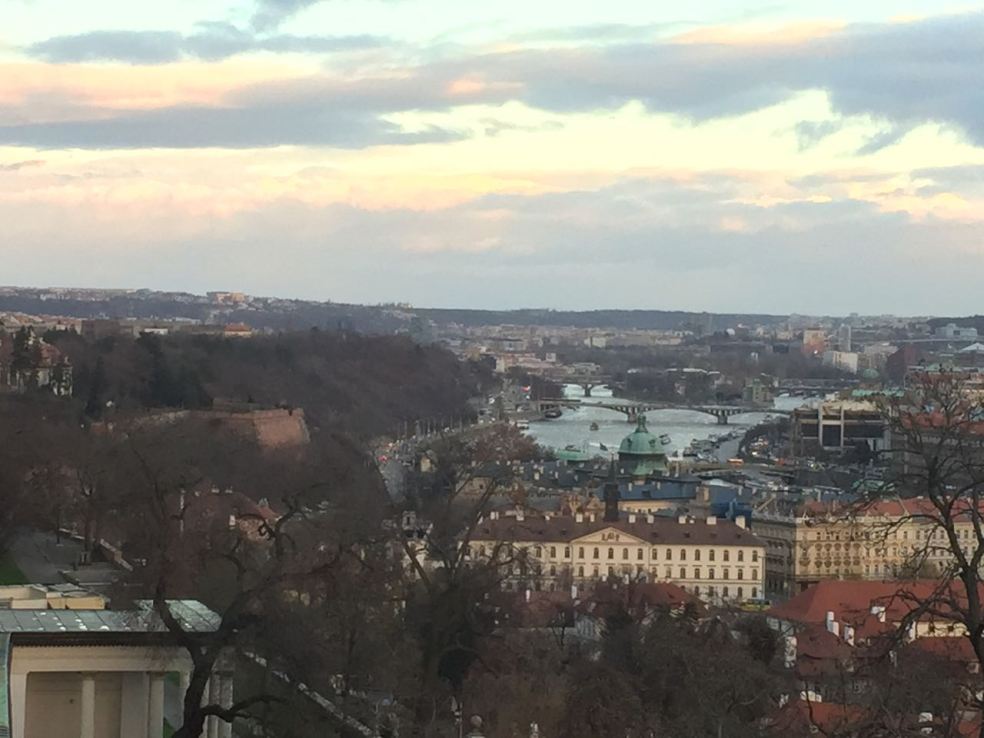 Once you climb the multitudinous stairs to get to the complex, you’re treated to a wonderful view of Prague.
 We were fortunate enough to go there in the afternoon and stay into the night, which meant we were also treated to wonderful evening views.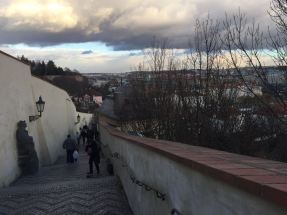
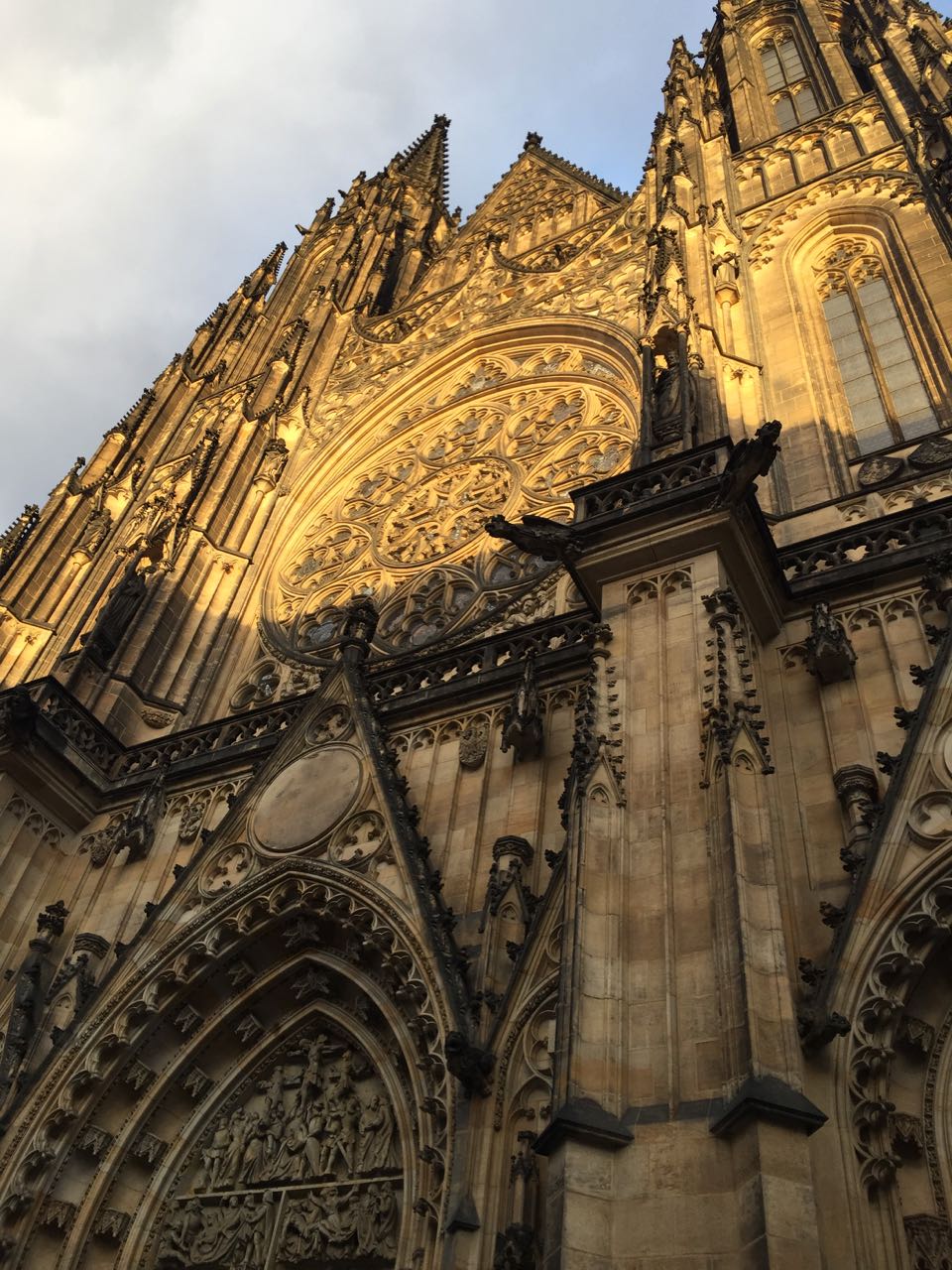 Inside the castle complex is St. Vitus Cathedral, construction of which began in 1344.
 The outside of St. Vitus is both imposing and gothically beautiful. It is easily one of the most impressive churches we’ve seen since we’ve been here.
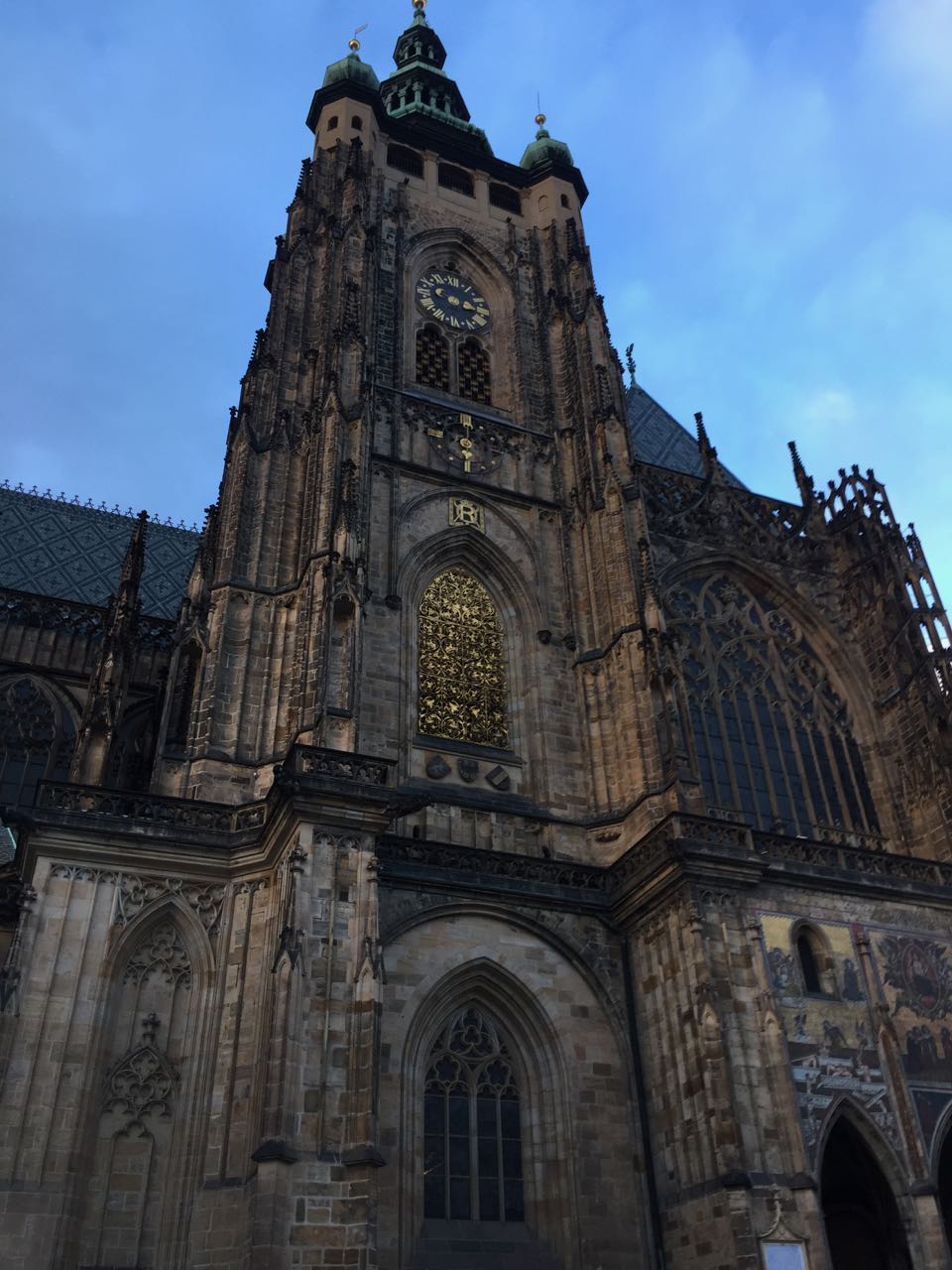 When buying tickets to see whatever you want to see, you’re presented with three choices, or “circuits.” We chose Circuit B after doing rock, paper, scissors. Turned out to be the right one, especially with our limited time budget.
 Amazingly enough, the construction of the Cathedral wasn’t completed until 1929, almost 600 years from when it began.
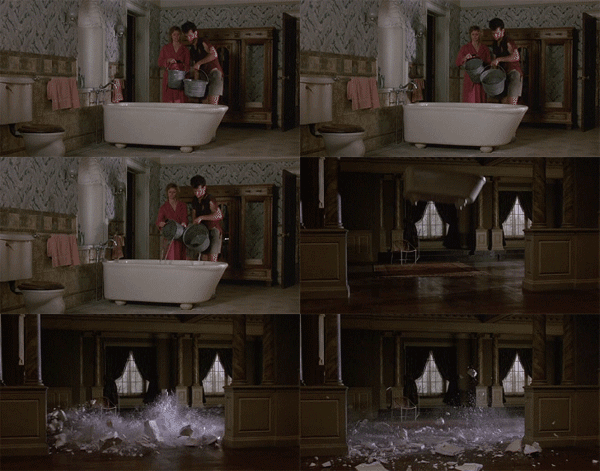 If this had been the focus of The Money Pit, when the foreman was asked when it was going to be finished, instead of “two weeks, two weeks,” he might have said “two centuries, two centuries.”
 There was a lot of controversy over art like this, with critics complaining that the kids would just sit around inside and stare at it instead of going outside to play like they did back when they were kids. The controversy abated once television was invented.
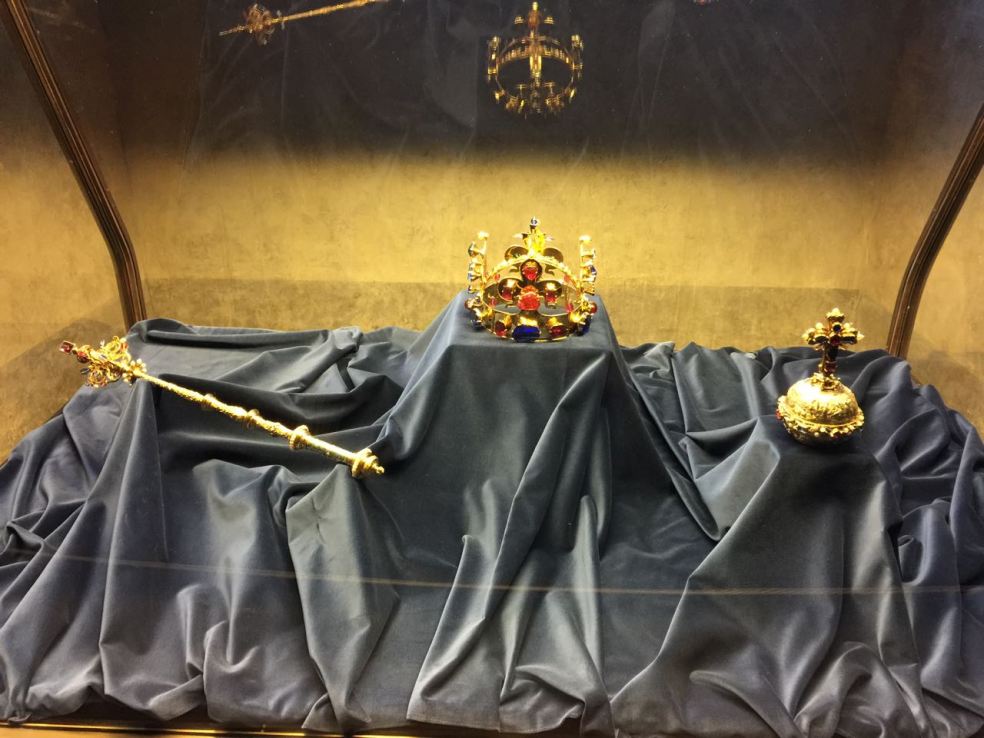 The Czech Crown Jewels. Or more accurately, reproductions of them, not that anyone could tell. The crown was made for Charles IV in 1347, making it the fourth oldest crown in Europe, just after one in Queen Elizabeth II’s mouth.
 This is one of the souvenir shops on an alley called “The Golden Lane,” so-named because goldsmiths used to work there. Apparently one of the job requirements of a goldsmith was to be not much more than five feet tall.
 While the Golden Lane wasn’t particularly impressive, they did have dozens of suits of armor on display as part of the attraction. It’s hard to imagine walking around in one of those things, especially on a hot day. And they hadn’t even invented anti-perspirant yet. And how do you take a leak?
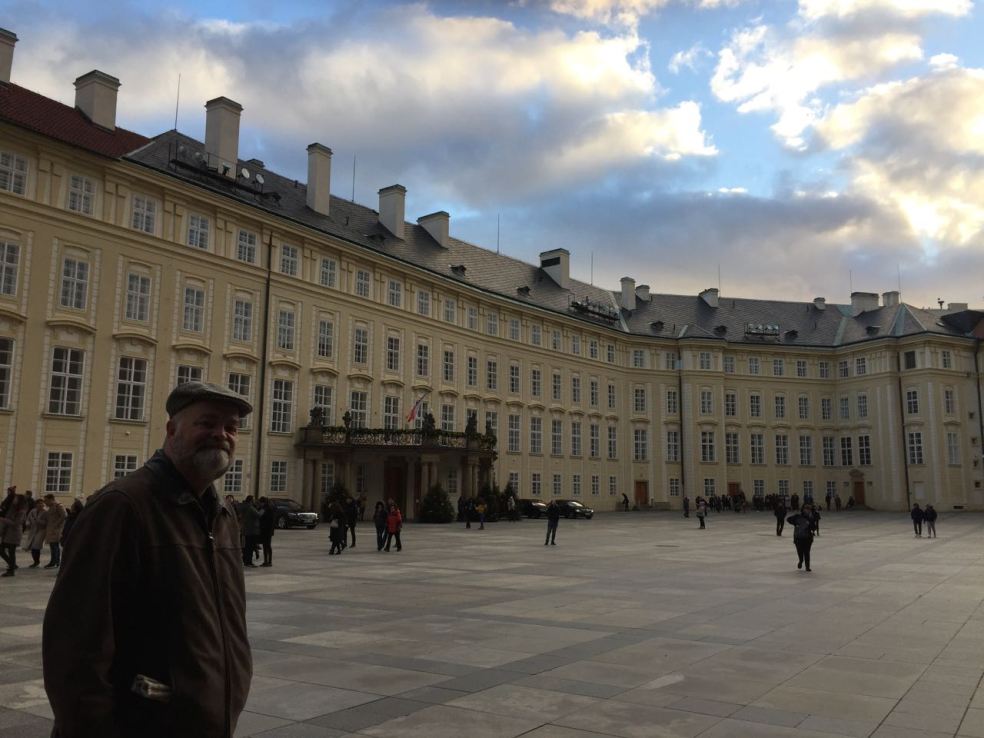 On the grounds is the Rosenberg Palace, which was originally named the Renaissance palace. We peeked inside but most reviews are fairly blah on the place, so we used our limited time for other, more interesting things.
 I can’t remember what this is, although I know it’s a building.
 The changing of the guard. All thoughts of stealing the fake crown jewels abated once I saw their fierce weaponry.
 Another view of Prague from the castle.
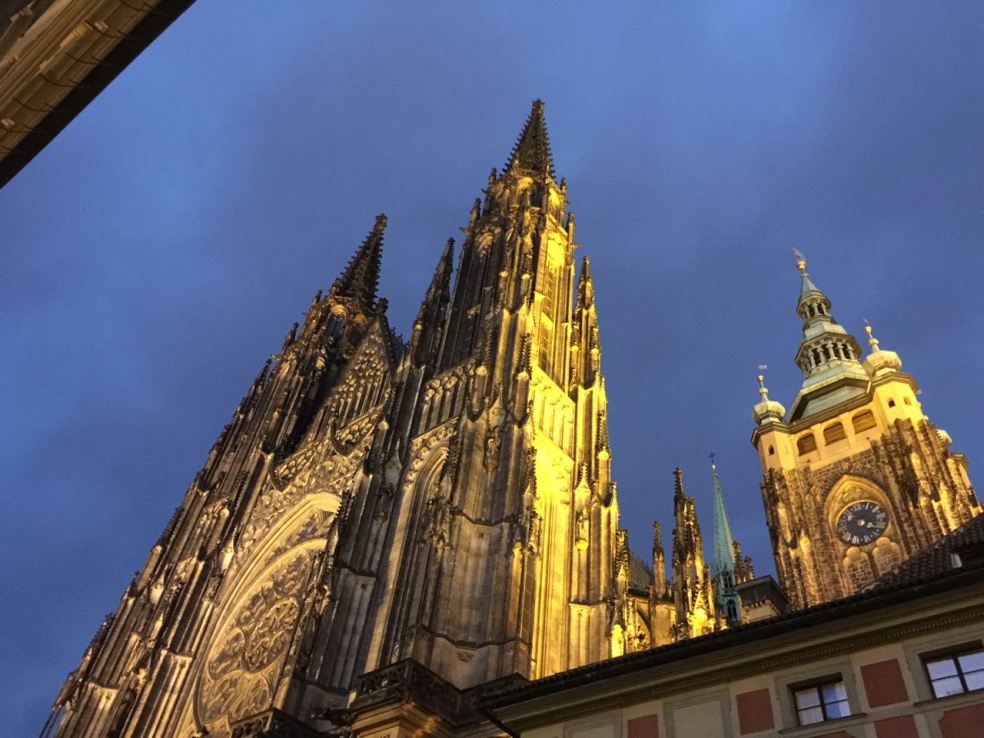 When the sun goes down and the lights come up, the church looks like something from an old horror movie.
 In the end, the castle was certainly a sight to behold. With a little extemporaneous planning we were actually able to see everything we wanted to see without spending the entire day there.
 When I organize the pictures I’ve taken after a trip, I try to put similarly-themed images together. When the organizational dust had settled this time, I discovered I had one folder full of nothing but Prague buildings.
 When we first ventured out of our hotel room, we walked along the Vltava river until we came to the most famous bridge in Prague: Charles Bridge.
 After taking selfies in front of the famous bridge, we trudged through the nasty weather on our way toward the city center, and noticed there were in fact a number of bridges over the river. Eventually we came to one in particular which was really crowded with tourists.
 Oh, that’s the Charles Bridge. Oops. We don’t even know the name of the not-so-famous bridge we were so gleefully snapping pictures of, but what the heck. A rose by any other name…
 The Charles Bridge is pedestrians-only. During the busy season, it’s just one big sea of pedestrians.
 As with any sea, there are occasional buoys –er, boys, floating about.
 As well as some gulls, –er, girls, too.
 Like any proper famous bridge, the Chuckie Bridge has a famous spot you can touch for luck. I figure any bridge that keeps me from touching the water beneath is plenty lucky already. Plus I have a hard time believing that touching something that a hundred thousand people before you have already put their germs on will bring you any kind of good luck. Or maybe they’re just referring to the fact that you’re damn lucky if you don’t catch something from it.
 The construction of the Charles Bridge started in 1357 and finished in the beginning of the 15th century. It was originally and cleverly called Stone Bridge, or also, and just as cleverly, Prague Bridge. But it has been known as “Charles Bridge” since 1870 (King Charles IV began the thing), which, while not the cleverest of names, certainly is much more clever than the first two.

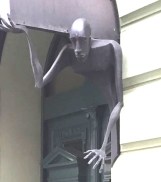
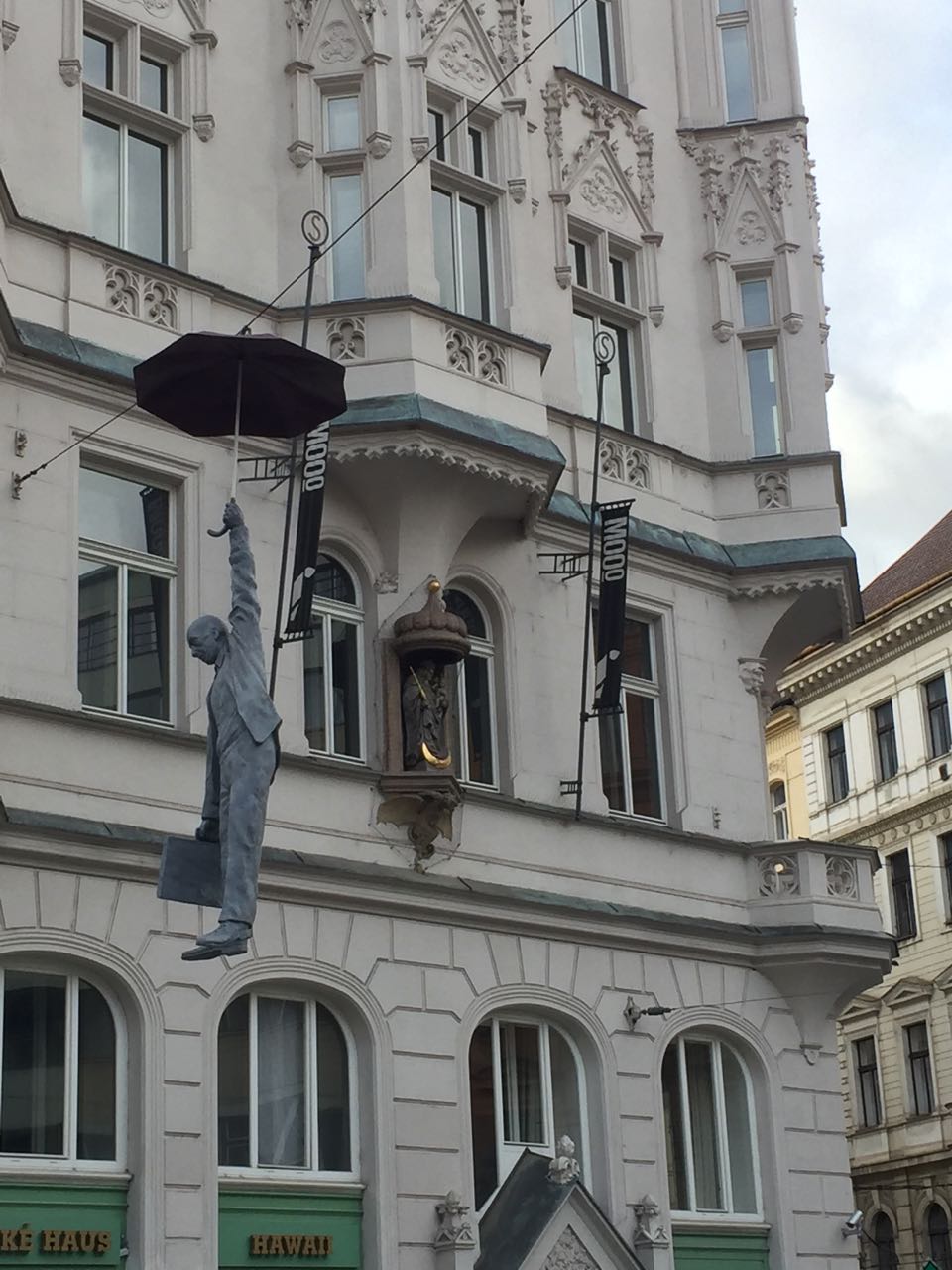 The statue above is of a guy doing a Mary Poppins over the street. It’s a piece of art that serves the purpose of reminding you to look up while walking around Prague, because if there doesn’t happen to be any floating statues above you, there’s likely to be some amazing architecture instead.
 … like this gorilla made out of colored pencils. It’s the lead decor for a stationary store. Great. Now we have to Google “statues made out of pencils” everywhere we go.
 Not content with making gorillas out of pencils, the Praguesters enjoy creating delightful artwork out of their food too. I’m sure it tastes a lot better than taking a bite out of a Van Gogh.
 Here I’m tickling the chin of Louis de Funes, who is a famous French actor. But he was apparently so short he only got small roles. Ha ha! Maybe he’s there to show us how fleeting or regional fame can be, because I’m willing to bet no American reading this has ever heard of him, even though one of the films he was in was nominated for a Golden Globe in 1974. Of course, I personally have no idea who or what has ever won a Golden Globe. Until now. But it was the movie, not him. Which I don’t remember anymore. So I guess my comment is still correct. Wait, what was I talking about?
 They also have a famous piece of artwork of a bunch of sitting seagulls on the Vltava River, which is the river that runs through Prague. Oh. Carolyn just chimed in and said this isn’t artwork, these are real live birds. My bad. I think they’re waiting in line because, being birds and therefore stupid, believed a rumor that this is the line to get into the new Star Wars land in Disneyland. Stupid birds. We all know that line starts in Sacramento.
 You don’t have to be well-read to visit Prague, but it pays to be, well, red. These exotic old cars trundle about Prague carrying shivering tourists, because even when it was close to freezing, they had no tops. Sheesh. We only go around topless in these big cities during the summer.
 There is a mildly humorous story associated with this picture in front of a church. Unfortunately, we don’t have the funny photo to go with it, so you’ll have to settle for the story. As I stood up there to strike a pose, some people came out of the church and stood near me, pausing before going down the steps. Carolyn was trying to maneuver me into better position, so she was waving her hand and telling me to go this way and that and stop and whatnot. A gentleman standing in front of me thought she was telling him what to do, and lo and behold, he obeyed her commands, moving this way and that, and then dutifully standing still for the shot. I stood behind him chuckling, and even Carolyn didn’t realize at first that’s what was happening. Finally the man’s wife yanked him to the side with a laugh. After all that, we didn’t even get any pictures better than the above.
 So we finish this first Prague Blog entry with a Door of the Day for Carolyn. But this was just a taste of what Prague had to offer. It is a truly magnificent city, perhaps mostly because it was pretty much the only major city in Europe that wasn’t extensively bombed during World War II, so the old great buildings still stand in all their original splendor.
 In February of 1945 the US and England dropped almost 1,500 tons of high explosives bombs and over 1,100 tons of incendiary bombs on Dresden, creating a hellacious firestorm and pretty much destroying the entire inner city. The bombing remains controversial to this day.
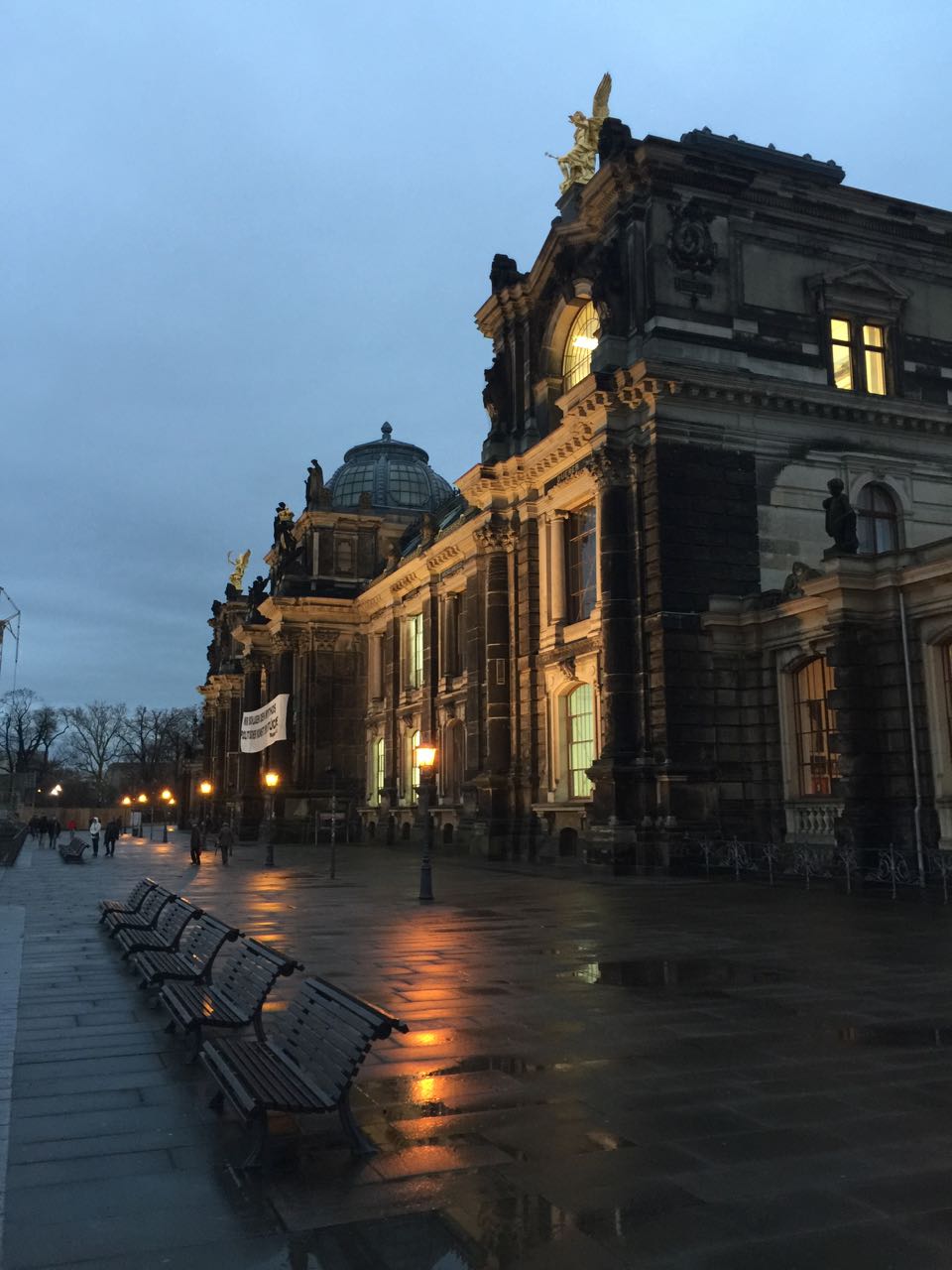 This is an area called Brühl’s Terrace in the inner city. It is a popular location for taking walks, people watching, and debating with your travel companions as to how you pronounce the ü. I argued for Ooh-dot-dot.
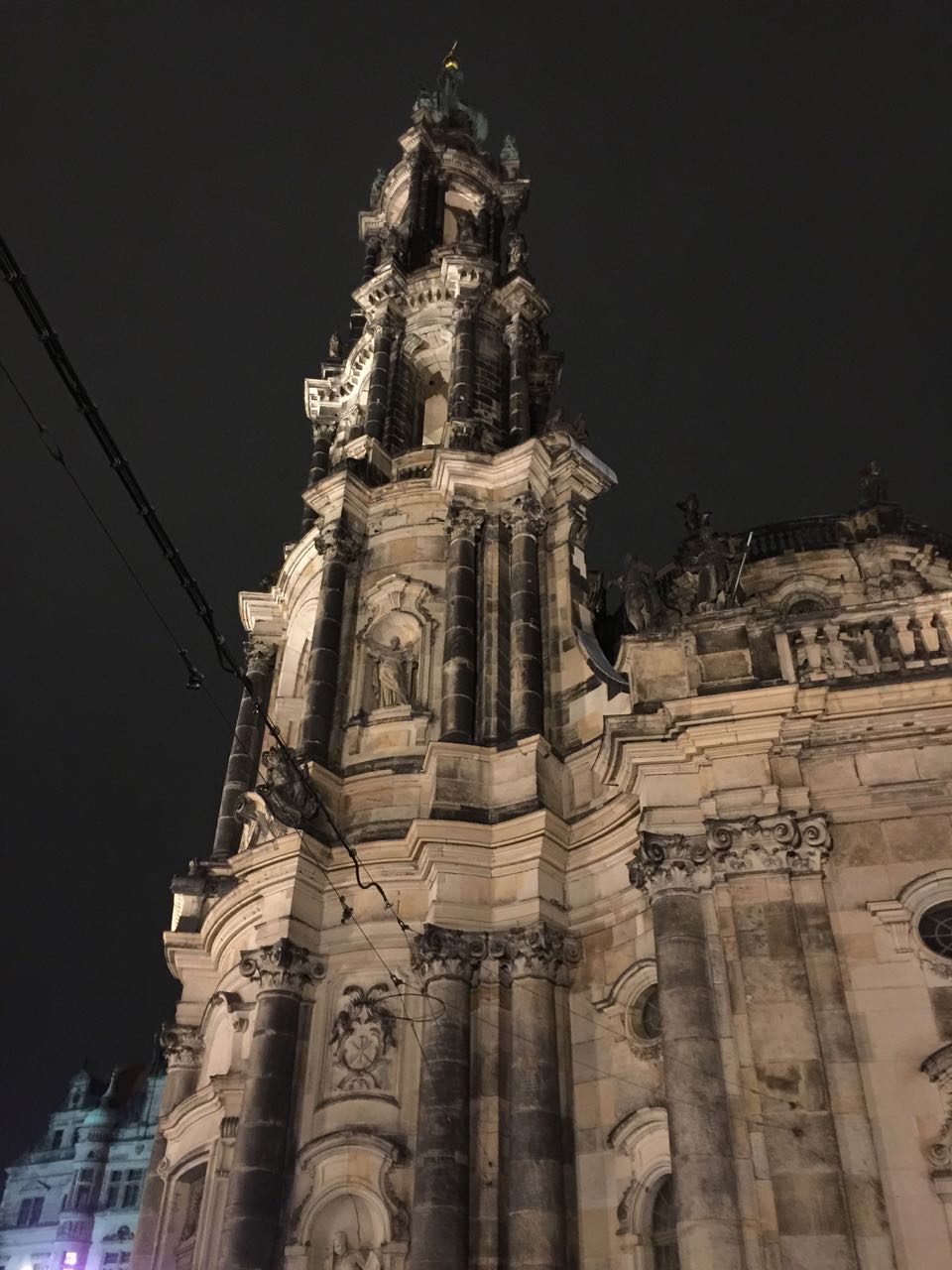 This is Catholic Church of the Royal Court of Saxony, aka The Dresden Cathedral. The church was badly damaged during the bombing (which will be a common theme here). The East German government restored much of it, and after reunification it was restored more fully. It was originally completed in 1751.
 Not to be outdone by the Catholics, the Lutherans have the Frauenkirche of Dresden, which is now one of the most important churches in Germany. It was mostly destroyed by the firestorm as well. It remains an important symbol because the Communists wanted to turn it into a parking lot. The Germans simply wouldn’t allow that, but the church wasn’t fully rebuilt until after the German reunification.
 The Semperoper is the opera house of the Saxon State Opera, and was originally built in 1841. Only an empty shell was left after the Dresden firestorm. Exactly 40 years later, on February 13th, 1985, the opera’s reconstruction was completed. Of course, I’m not sure anyone bothered to ask who listens to opera anymore, but it’s an impressive building nonetheless.
 When we saw this building with that big slogan, I didn’t know if was some propaganda relic from East Germany’s past or an advertisement for a pub. I translated it with Google Translate, and this is what it apparently says: “A life without joy is like a long journey without a guesthouse.”
 We couldn’t tell the date of construction of apartments like this, but the blocky style is certainly reminiscent of the Communist approach to architecture, i.e. bo-ring…
 I’m pretty sure this was built after the reunification because it actually has some artistic design to it. I don’t think it’s an atomic plant, however. We didn’t think so because we didn’t grow a third eye or anything after walking by it. Yet anyway.
 The inner city of Dresden at night.
 This is a Christmas tree in the Wiener Platz, which is an important transportation hub of Dresden, especially for sausages. Otherwise, why would they call it Wiener Platz? Duh!
 This monument, dubbed “The Golden Horseman,” is a statue of Augustus the Strong (1670-1733) and is covered with gold leaf. Augustus’ great physical strength earned him the nickname by breaking horseshoes with his bare hands (!) and engaging in fox tossing by holding the end of his sling with just one finger while two of the strongest men in his court held the other end.
 Carolyn freezing in front of the Katholische Hofkirche.
 A wide angle view of the inner city square.
 A view of the Frauenkirche of Dresden as seen through the Fürstenzug on Augustusstraße (talk about a mouthful!). The Fürstenzug (Procession of Princes) is a large mural of a mounted procession of the rulers of Saxony, and is one of the largest porcelain tile artworks in the world.
 It was originally painted between 1871 and 1876 to celebrate the 800th anniversary of the Wettin Dynasty, Saxony’s ruling family. In order to make the work weatherproof, it was replaced with approximately 23,000 Meissen porcelain tiles between 1904 and 1907. Apparently those are the things to use for construction if you anticipate a fire bombing, because the damage to it was minimal.
 According to Google Translate, that sign says, “A tribe of horses whose career extends to our days in the gray past, he went on to say with our people.” Apparently any kind of writing on walls is essentially graffiti, which is almost always unintelligible.
 The view across the river Elbe.
 More inner city Dresden. The whole area is easily walked in less than an hour, but only can be fully appreciated with a day or two of exploration.
 I thought it a good idea to reach out between nations and hug a Pole.
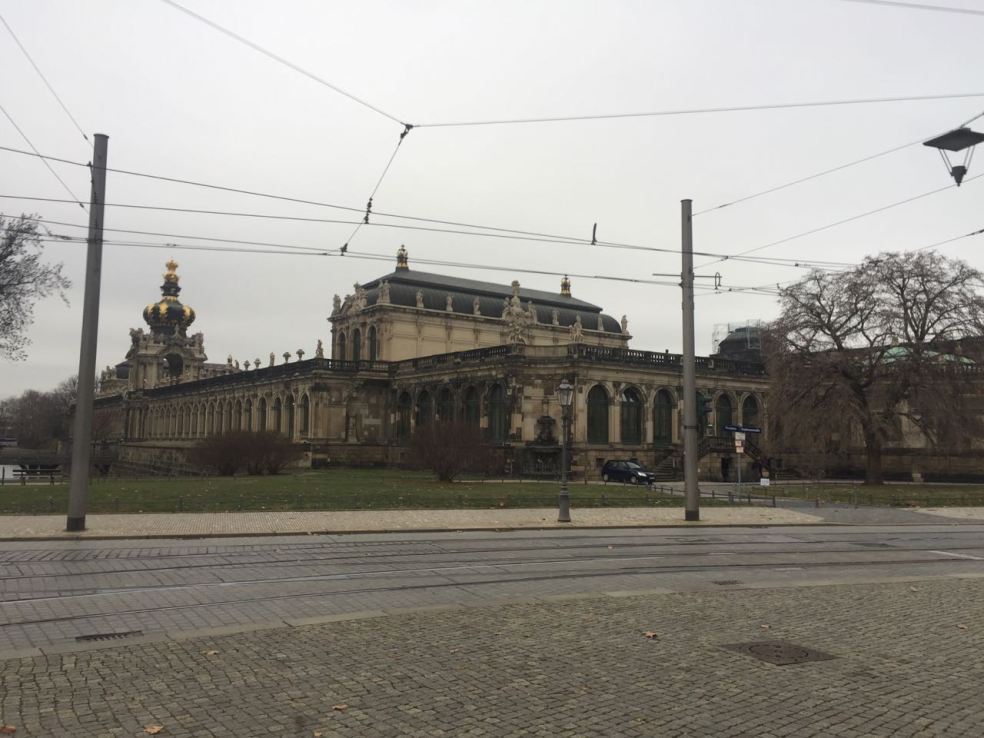 This is the outside of the Zwinger, which is a palace in Dresden. Zwinger is actually a term for what is essentially a killing ground: an open area between two defensive walls that was used for defensive purposes during the Middle Ages.
 This Zwinger was eventually walled in, and is now a museum complex that contains the Gemäldegalerie Alte Meister (Old Masters Picture Gallery), the Dresden Porcelain Collection (Dresdener Porzellansammlung) and the Mathematisch-Physikalischer Salon (Royal Cabinet of Mathematical and Physical Instruments).
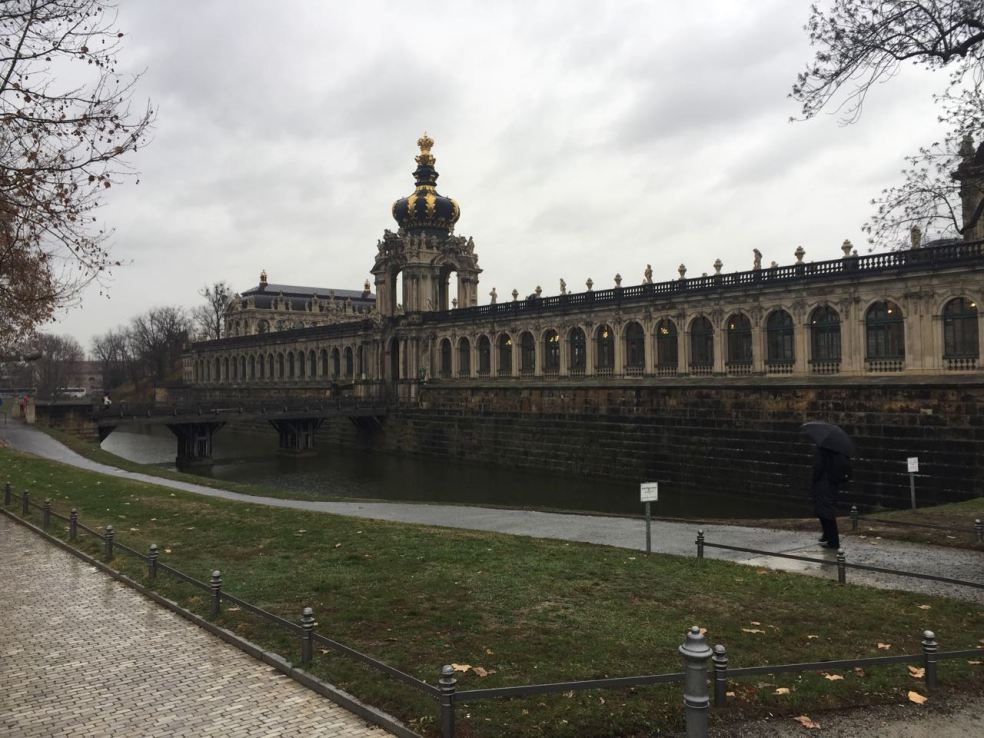 It was of course largely destroyed in the bombing, but like much of the rest of inner city Dresden, has been rebuilt to its former glory.
 We also went into a museum called “The Green Vault” that houses the largest collection of treasures in Europe. It was founded by Augustus the Strong, and so I would’ve expected some broken horseshoes or a video of fox tossing, but no.

 We were flummoxed when we found out our train to Prague was delayed by about half an hour. I’d read that German trains are on time 99% of the time! What the hell’s going on here?


 So that’s Dresden. It only gets one entry because the area wasn’t huge and there was only so much to see. Plus we already covered the Christmas markets in a previous blog, and that was some of the reason we went there.
 Not every visit to a new city has to be filled with sights unique to the area. Museums of every kind abound in most cities, and many of them are just as interesting as the museums you might want to visit in your hometown, especially when you have a hankering to see some dinosaur bones.
 The Guinness World Record Certificate confirms that this is the tallest mounted dinosaur skeleton in the world. That’s just his big toe, I think. It kinda looks like a wooden Dutch shoe, doesn’t it?
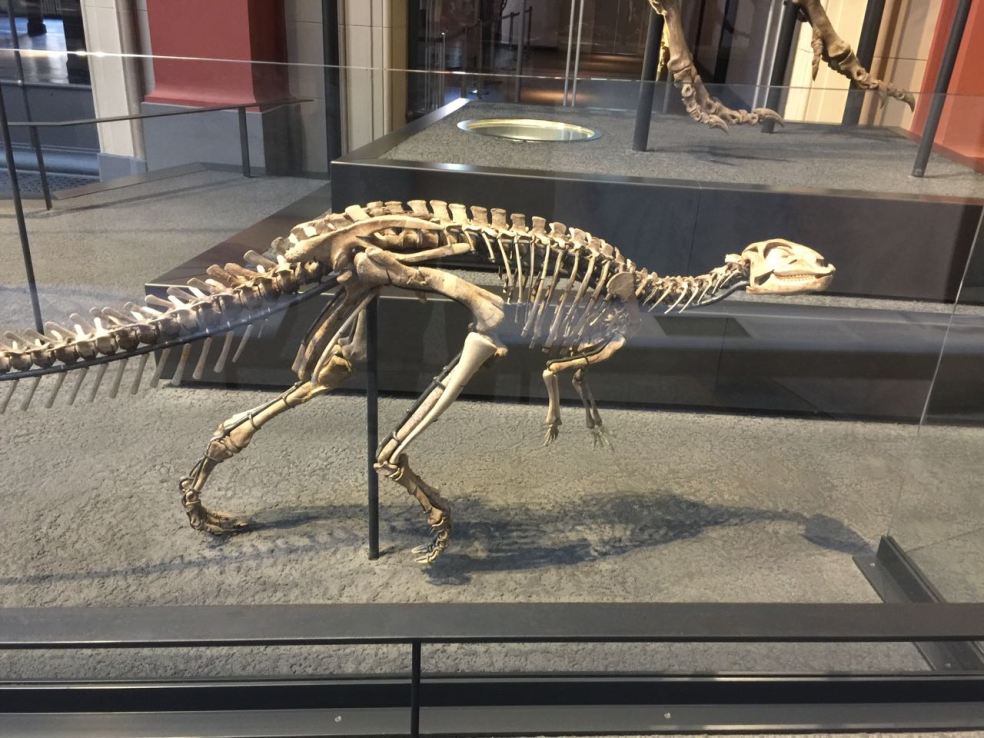 No, this isn’t the tallest one. This was the dinosaur version of “it tastes like chicken.”
 This is the dinosaur version of
  Speaking of caring for pets, the guy who made the Arc Encounter in Kentucky thinks Noah put two of these in a boat. (As well as I guess two each of the other 700 plus species of dinosaur we’ve found so far.) And then sailed with them for over a year.
 Is it any wonder that someone invented dragons after coming across a dinosaur skull like this?
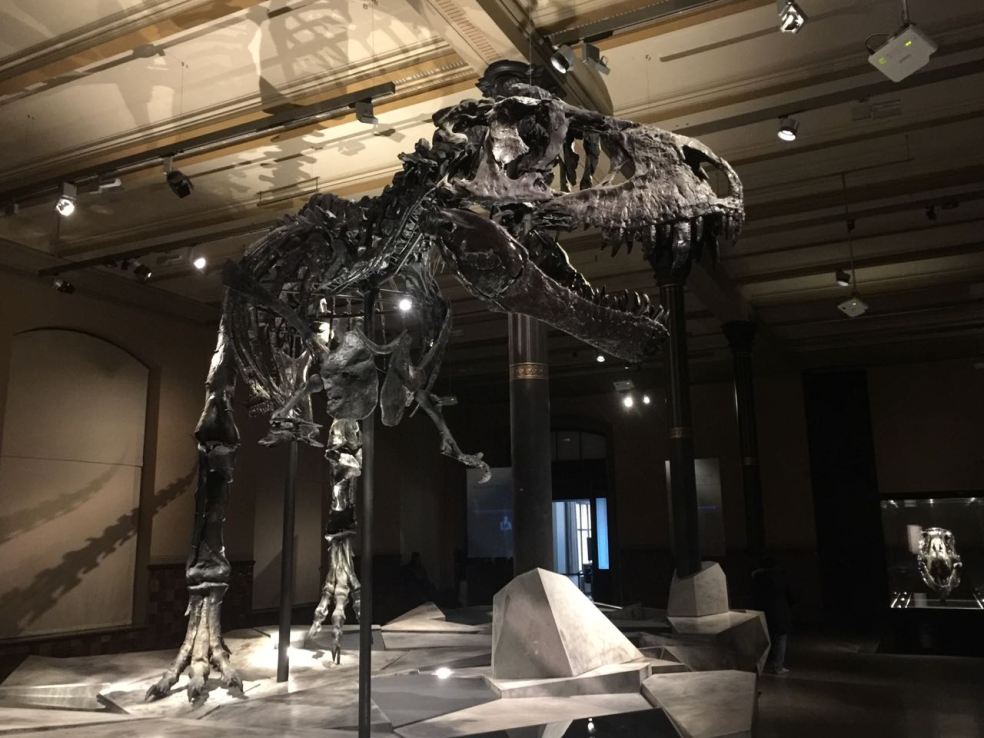 A battle between a Tyrannosaurus Rex and a dragon would have been epic. My money would be on the dragon, because the Tyrannosaurus Rex was around before flame throwers were invented and so hadn’t evolved any defenses. Duh.
 The Tyrannosaurus Rex had the strongest bite in history. This was problematic for them when they tried kissing, which may be why we don’t see any more little Tyrannosauruses running around.
 It’s pretty obvious we’ve evolved only so far.
 Okay, so we stand taller. But some of us actually believe that dinosaurs were on Noah’s Ark, so I’m not sure where that’s gotten us.
 This exhibit proves that it only takes two macaws to lift a cheetah from the ground. It’s a well known fact that they do that and then dash the hapless cats onto the rocks for a fine feast of flattened feline. At least I think that’s what the plaque in German said.
 This guy got so hammered the next morning he woke up in a jar.
 These two walked into a prohibited room and were never heard from again.
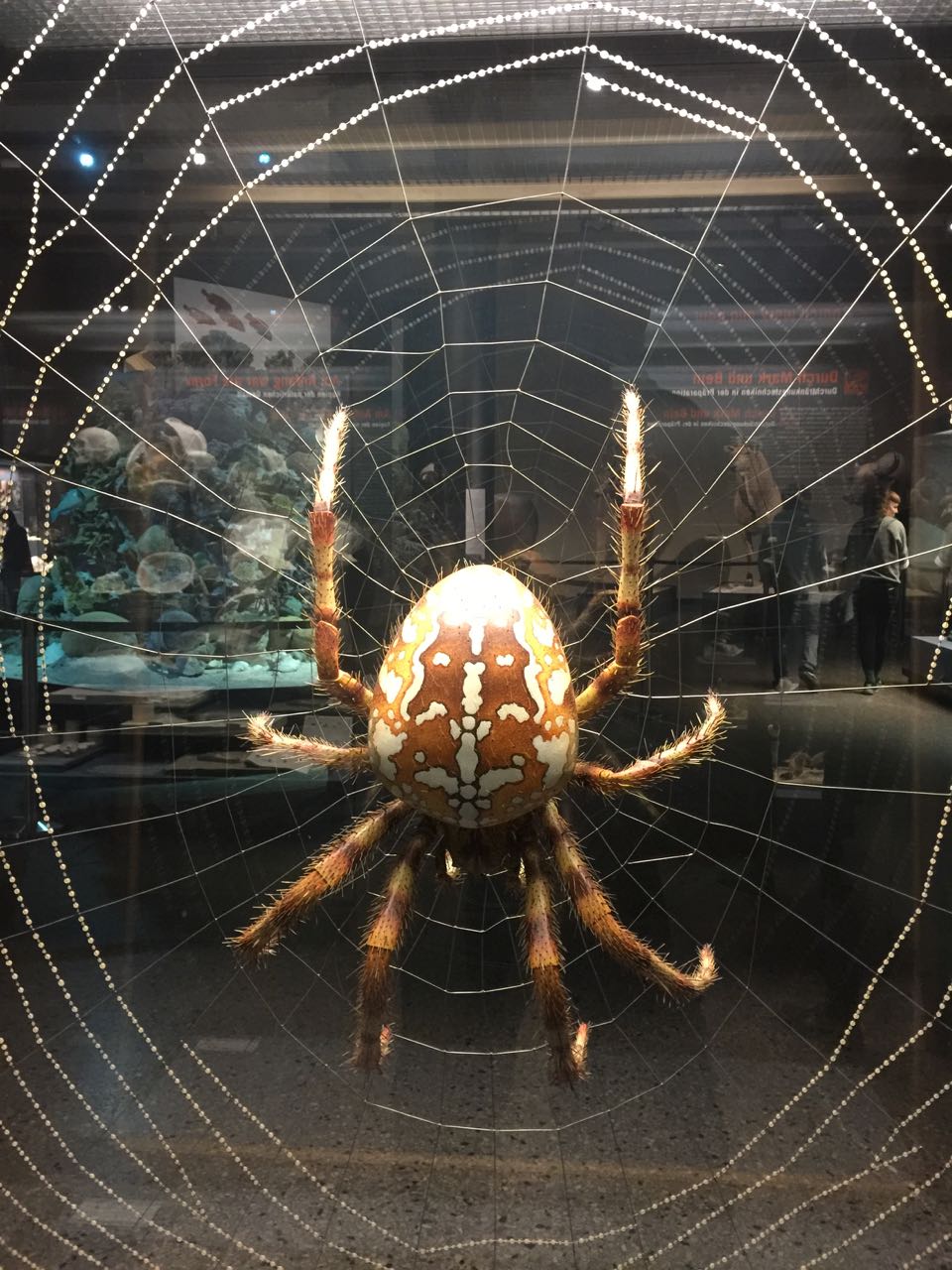 I steered Carolyn clear of the view of this cute little (well, three feet worth of little) arachnid because I felt had she seen it, the ensuing scream might have set off all sorts of alarms and we might have found ourselves surrounded by German police officers with automatic weapons. Crisis averted.

 Written on the building is “Dem deutschen Volke,” which means “To the German people.” This building was made particularly famous (or perhaps notorious) when in 1933 it was set on fire, allowing the Nazis to use it as a pretext to arrest and kill anybody they felt like arresting and killing.


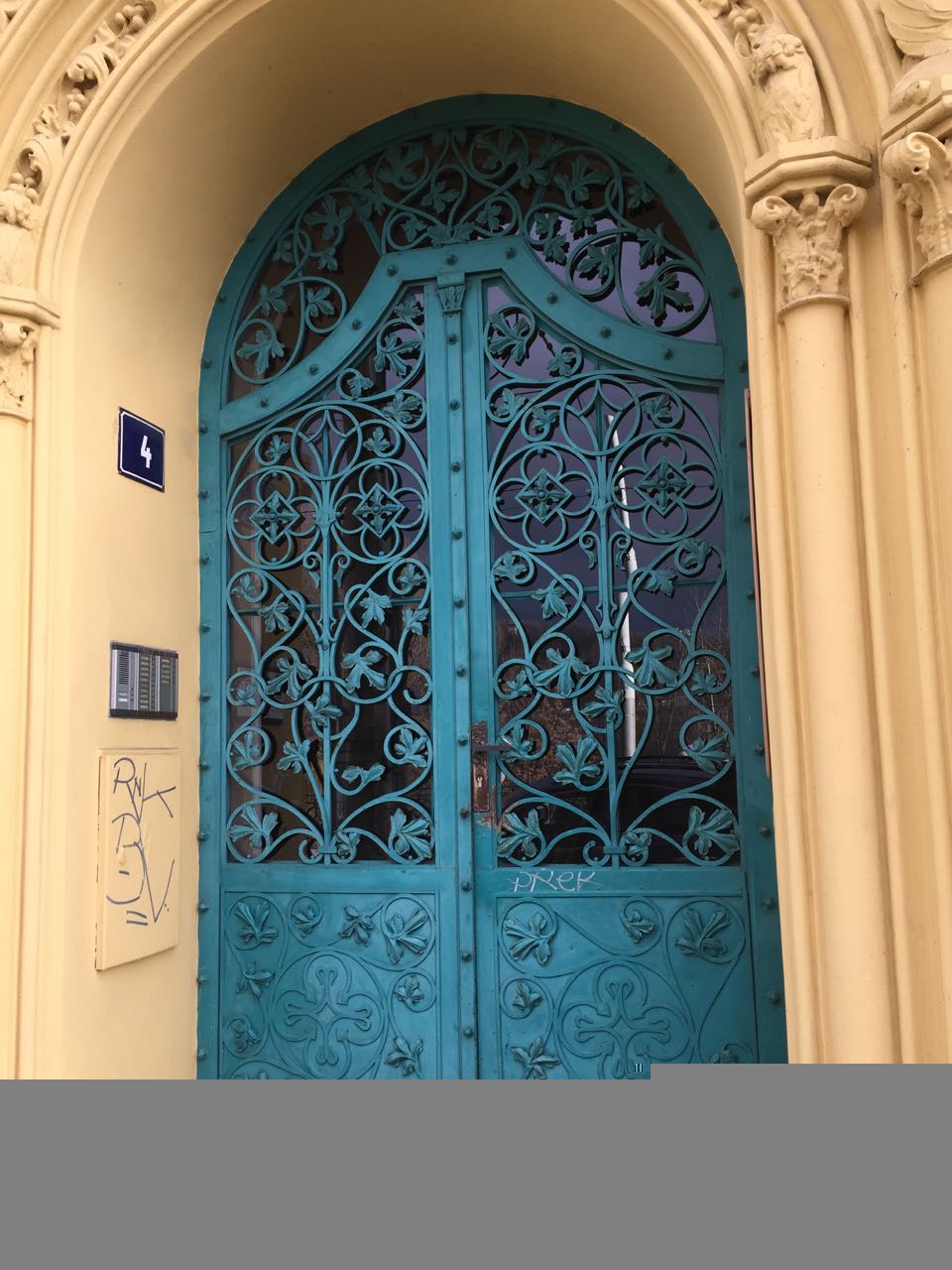 And we’ll finish up this entry with a Door of the Day.
 Regardless of that genius idea, it just goes to prove that just about anything can be a thing. So now I’m thinking of opening a store with nothing but platypuses in them. Statues of platypuses.
  Chocolate-shaped platypuses. Sheets and blankets with images of platypuses cavorting around, topped with a pillow-shaped platypus. And of course two pairs of panties, one with a red platypus and one with a green one.
 Okay, is it the best, or the worscht? We had to give them points for their clever name, and as a result this became the first meal we had in Germany. It was the best bestworscht we’d ever had up to that point, but I’m still not sure if that’s a good thing.
 The Germans are so thoughtful that they put farting stations around town. So apparently this is where you fart, and that little device either sucks up the fumes, or gives you a stink-o-rating. I’m not sure which because the numbers on the device were in metric. I tried to convince Carolyn to give it a go, but she was too shy. I wasn’t shy, but alas, I wasn’t gassy either.
 I’m pretty sure this sign on a pharmacy window translates to: “Well, you were my friend, but so long brave wart!”
 Again, the Germans are so efficient (as well as hyper aware that if you have “germ” in your country’s name, you need to work extra hard to prevent the spread of more of them) that they even have a place for you to “dak,” which I’m sure is the German word for the sound you make when you sneeze, and then they offer a polite “gesundheit” ahead of time. I tried to take advantage of the offer, but I’m not allergic enough to Christmas trees. I coughed, but nothing happened. Bummer.
 Germany also has strict truth-in-advertising laws, so if your Pelchen is crap, well, you’re gonna have to call it krappelchen. This is a river in Dresden, btw.
 By the same token, if your shampoo is bad, there’s no hiding behind fancy marketing.
 “He’d step over ten naked women to get at a pint.” A sign we got a kick out of in an Irish pub we went to, because of course you always have to go to an Irish pub if you’re visiting Prague, where this was. Never did see the ten naked women though.
 As with most big cities, there is graffiti. I’ve always wondered the words mean, and in fact have found it interesting that for the most part, they use pretty much the same lingo, which is just as unintelligible in Europe as it is in the states. Except this one. I guess boobs are universal.
 This is the Berlin Cathedral (“Berliner Dom”). It was built on a site that had various churches on it since the 1400s. The current building was finished in 1905. It at least gives the Germans something to crow about.
 In 1944, an Allied combustible bomb dropped into the dome. The resulting fire could not be extinguished, and so da dome dum-dum-DUM-dummed. In 1975, reconstruction began, restoring it to its former glory.
 A climb to the top of the dome reveals some impressive views of Berlin.
 A climb to the bottom reveals some rather cryptic things.
 They always have fences around tombs because so many people are dying to get in.
 The original church on the site was built in the 1890s. It was badly damaged in a bombing raid in 1943. The present building, which consists of a church with an attached foyer and a separate belfry with an attached chapel, was built between 1959 and 1963. The damaged spire of the old church has been retained and its ground floor has been made into a memorial hall. (per Wikipedia)
 Either this tower is needed to relieve all the gasses from too much bestworscht, or maybe the lack of a huge offgassing tower is what really blew up the dome of the church.
 As you can tell from this photo, this particular building goes all the way to the top.
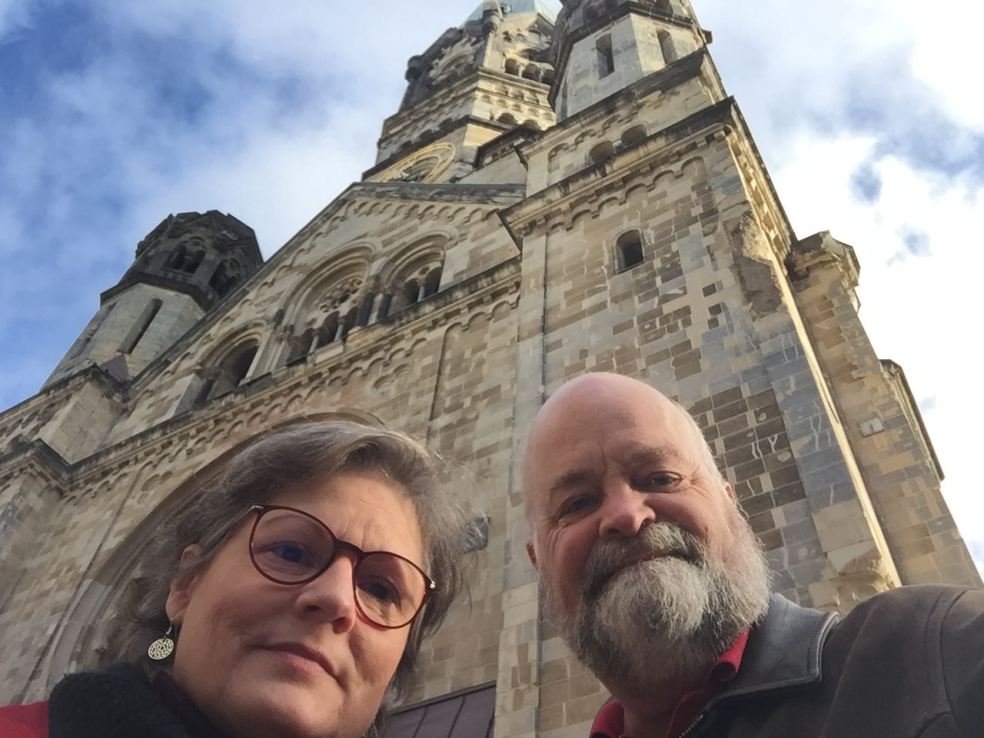 The Memorial Church today is a famous landmark of western Berlin, and is nicknamed by Berliners “der hohle Zahn”, meaning “the hollow tooth”. After all the food we ate, I think we both ended up with hollow teeth ourselves.
 I found an unwrapped wife under the Christmas tree, and so decided to take her home. I did almost opt for the blue present instead, but ultimately stuck with the red one. After that comment, she’ll be shopping for the red Ampelmann panties for sure. Ha!
 As with many of the Christmas markets, this one was built in and around the grounds of a famous building, in this case the Kaiser Wilhelm Memorial Church. But you already knew that because you’re taking notes, right?
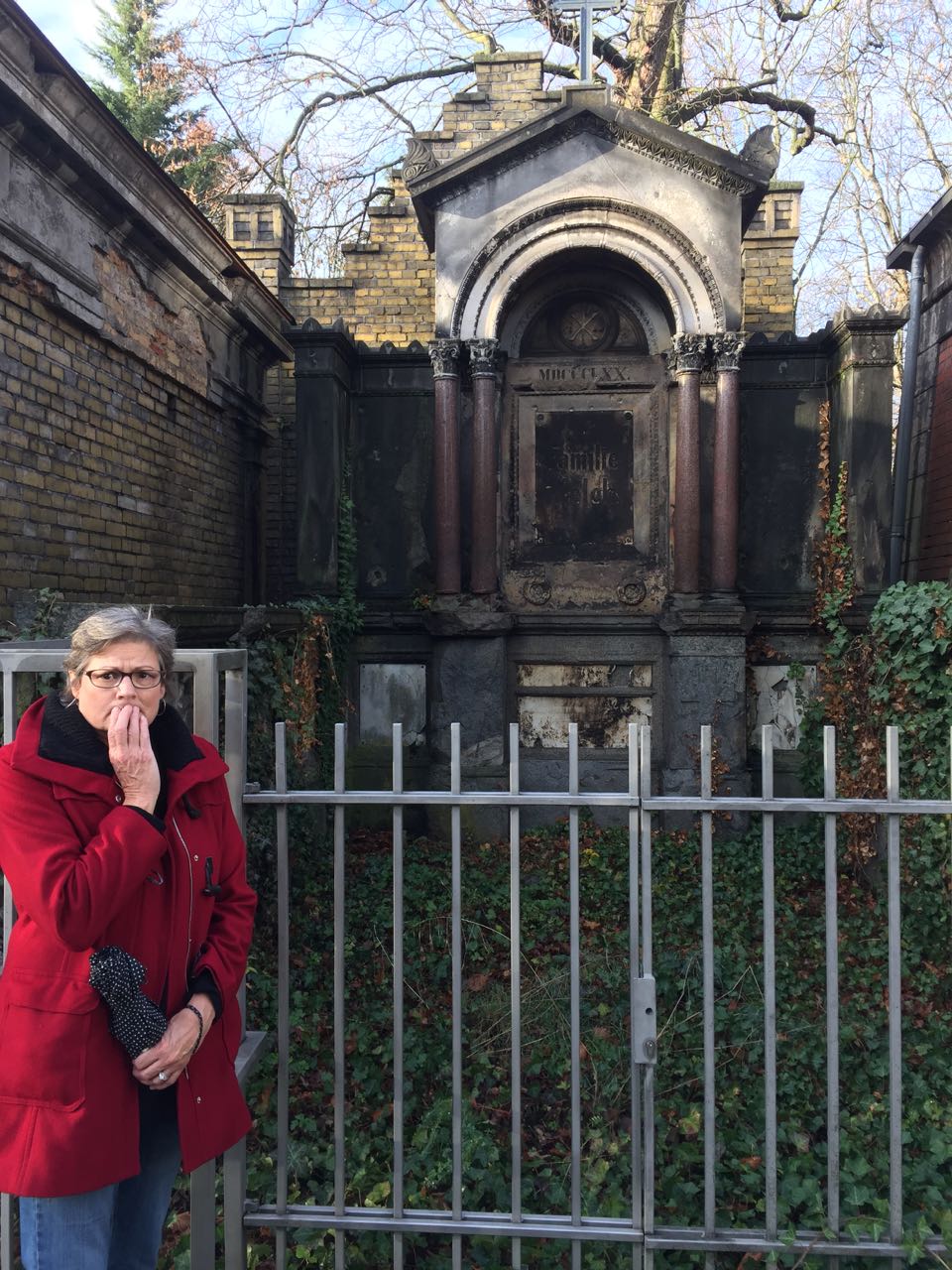 We close this blog entry with a very grave photo.
 In fact, for me the Christmas markets returned a good portion of some good ol’ fashioned Christmas spirit into my heart. They are delightful places, with cheerful vendors selling things like chocolates made to look like tools, traditional German foods made in huge metal pots and stirred with large wooden paddles, as well as ornaments, clothing, assorted Christmas gifts, and Gluhwein, which is a popular drink staple of the markets.
 Christmas markets are crowded with folks enjoying themselves by wandering through the booths, gazing at the beautiful decorations, skating in an ice rink, letting the kids ride a small train or other rides, shopping for gifts, hobnobbing with their friends in a very festive atmosphere, or helping each other pry their mouths back open after sucking down too much gluhwein.*
 One of the clever ways they allow you to walk around with Christmas mugs instead of messy paper or styrofoam cups is to serve it in one with a one or two euro deposit. You can either keep the mug for that price, or return it for a refund. We kept two of them as souvenirs of Germany. I kept the wife as a souvenir from the states.
 The sign above this blacksmith says, “Below is a guy you don’t want to mess with.”* I took that advice and enthusiastically complimented him on his beautiful tattoo.*
 “Engel” translates to “angel.” I gotta tell ya, the Germans are so efficient they knew ahead of time that my own personal angel would be standing there to have her picture taken. They of course took the sign down as soon as she walked away, its purpose having been served.*
 The aforementioned chocolates in the shape of tools. It’s good to know where you can go if you have a chocolate screw that just won’t budge.
 The various markets had different rides. This one not only had a Ferris Wheel (which looked waaay to cold to ride in near-freezing weather) but a skating rink as well. We saved both our own health and that of the other skaters by staying off the ice.
 You can see the palpable relief on our faces after we both agreed not to go skating.
 Christmas pyramids originated in Germany, so it’s no surprise that most of the markets had at least one gigantic one.
 Some of the markets are built in or near tourist sites, in this case the Berlin TV tower, which was built by East Germany in the 1960s.
 Some people accused me of marrying a trophy wife but I can assure you that despite her good looks, she is anything but. Here she proves it by not being the one who is an ornament.
 The decor is top-notch. Very clean, consistent, and festive. They were all very crowded, but it was a good crowded. Everyone very much enjoyed themselves, except the people who had to wear ornaments all day.
 We imbibed a variety of drinks such as hot cider, apple cider with rum, gluhwein, mulled wine, and of course beer.
 Although I have to confess one of the beers I had was a Budweiser. Just wanted to see if it tasted different. Next time I go to Germany, it’s no ifs, ands, or Buds.
 Here Carolyn demonstrates the proper way to eat a German wiener.
 Some of the markets had cute performances with dancers or musicians. Or maybe it was performances with cute dancers. Because of the crowds, I couldn’t get close enough to tell.
 The malls of course got into the spirit of things with lots of decor, but they can’t compete with the homespun charm of the Christmas markets.
 Gigantic Santas and snowmen were popular decorations.
 We’re now looking at pictures from the Dresden Christmas markets, I figured we might as well put all the Christmas market pictures together. By the way, you don’t go to these markets to lose weight.
 This is as close as I could get to taking a Christmas market picture like they put on the internet. I’ll obviously never be a professional photographer, but you get the idea.
 One funny little story from the Dresden market: we actually got recognized by someone from our appearance on House Hunters International. We overheard two men speaking English, and began to engage them in conversation when one of them looked at us and said, “I recognize you two from TV! You were on Househunters or something weren’t you?” Man, we went all the way to Germany to avoid all the paparazzi, and we still get recognized!
 Even if you’re not in the market for Christmas decor, the booths are delightful, colorful, and very well stocked.
 And the food choices are almost limitless, many of which are especially present-worthy.
 Hard to image a scene and atmosphere that is more Christmassy in spirit than these markets!
 The Dresdner (Dresden) Striezelmarkt is one of the oldest Christmas markets in the world. Founded as a one-day market in 1434, it celebrated its 584th anniversary in 2018. It now has about 240 booths, and attracts about 3 million visitors. With two Americans living in Portugal added to the tally, it’s now 3,000,002.
 The inevitable Christmas Pyramid in Dresden.
 This guy was frozen in 1426 in the hopes that more advanced technology would be able to cure what killed him.*
 Since this is what he might look like after being defrosted, they decided to keep him frozen. Besides and ironically, curing sword stabs is a medical art that has now been lost to history, so that frozen knight is completely screwed.*
 After a hard day of wandering through Christmas markets, it’s time to sit down with a glass of wine. Or just because it was wine-thirty.
 The famous Smurf Christmas Tree.*
 The sight of her digging into her purse or me into my wallet was a common one since we just had to sample so many of the delights. I think we each gained ten kilometers as a result.* See how much easier metric is?
 As you can tell by the presence of a panda, we’re now in Prague. That’s a non sequitur, which is sometimes used to create humor. Hey, we all get a ribbon for trying, don’t we?
 We got a frosty reception in our first visit to Prague. Guess we’ll have to try again in the summer.
 The Christmas markets we saw in Prague were not quite as delightful or crowded as they were in Germany. Maybe that’s because most of the booths didn’t accept Czechs as payment. Bah dum dum.
 Don’t get me wrong, the Christmas markets in Prague were still great. It may just be that the buildings around Prague were so beautiful and amazing they overshadowed the Christmas market decor.
 I think this picture demonstrates that.
 This guy shook his finger at me after I took this picture. Apparently no pictures allowed. I have no idea why, it’s not like he’s using some sort of secret advanced technology. Joke’s on him though. Not only did I keep the picture, but now it’s all over the internet, being viewed by some 3,214,345 readers! Give or take 3,214,341.
 Praha is how the Czechs say Prague. I wish we didn’t change the city names for each language. Shouldn’t every other language pronounce another country’s city names using the original names its own country gives them? In European languages alone, below are all the ways you would say “Lisboa.” What’s wrong with just saying Lisboa? Sheesh!


 In fact, Carolyn came up with her own interpretation after seeing the rain drops trickle down the sides of the slabs. They reminded her of tears. I don’t know if the designers planned that, but she’s right. And there’s no event in human history that deserves more tears than the holocaust.
 Inside the museum, which fittingly costs nothing to enter, you are shown story after story of real human beings. It is a great reminder that the holocaust is not just about statistics or unfathomable numbers of people killed. It’s about six million innocent persons, each of whom was just like you and me, with hopes and dreams and loves and heartaches. And their lives were brutally taken from them simply because one man developed an irrational hatred of them because he couldn’t bring himself to believe that the Germans had simply lost World War I on their own.
 Unfortunately, the tragedy of the war didn’t end when World War II was over. Europe was a complete mess. Most Jews and many more permanently lost their homes and possessions even when they returned to claim them. Millions of people were scattered about the continent, and the infrastructure was devastated. To make matters worse, the Soviets stayed in almost all of the countries they crossed to get to Germany. So those who lived in East Germany, for instance, went from the horrors of Nazi Germany to the horrors of Soviet rule. The East German security service, known as the Stasi, was just as feared and brutal as the SS. Eventually the Soviets built a wall around West Berlin, and sealed off the countries they controlled.
 There is a memorial wall honoring all those who lost their lives trying to cross the wall into West Berlin.
 There is the wall itself, which actually was just the last line of defense.
 Even if you could climb over that wall, you first had to make it through a no-man’s land patrolled by guards in towers, with mines and dogs and sirens and in some cases guns automatically triggered by motion detectors.
 Residents on both sides could see across to the other. But the wall created a chasm between countrymen that could only be healed once the wall came down and the Soviet Union collapsed.
 Many of the buildings in the area that face West Berlin have large murals painted on them showing what the area looked like during the cold war.
 While he has a point about the inequity of military spending (to which many might say, why the hell is the US paying 4.3% of its GDP when that means it spends more on defense than China, Russia, Saudi Arabia, India, France, the UK and Japan combined?).


 I know a lot of people use Fodor, or Rick Steves, or Google. But we like to use the Commemorative Plate Travel System (CPTS). It’s a fail-safe way to see everything you need to see.
 Let’s start with the Brandenburg Gate, which is one of the most iconic buildings in all of Germany. Truth be told, perhaps because of its iconicity, as well as the impressiveness of so many of the other iconic buildings we’ve seen so far around Europe, I expected a little more out of the Brandenburg Gate. It was smaller than I imagined, and simply not all that impressive. Which is probably what a lot people thought about Hitler after meeting him for the first time.
 So much for representing peace. But, it was restored and still stands, so maybe peace does endure even in the face of calamity.
 World War II and its aftermath devastated the Tiergarten: only 700 trees survived out of over 200,000 that once lined the parkway. The rest of the trees were chopped down for firewood or to make room for crops badly needed for a starving populace. Over time, West Germany brought the park back to life.
 And so, we have knocked off two of the sightseeing options from our CPTS (Commemorative Plate Travel System in case you forgot) thus far: The Brandenburger Tor (gate) and the Siegessaule (Victory Column). I’d say that’s pretty good work for one day, don’t you? It’s time for a beer!

 So it was of little surprise, although still unexpected, when we spotted a real live Dental Services Price List proudly mounted on the wall. That’s about $70 for a filling, which seems plenty fair to me.
 But we decided that we better get with the program because the law in fact says we must, but also because someone told us if we got in an accident we might not be covered because we didn’t have a lawful license as it were. I don’t think that’s true (more on that later), but regardless, it seemed like we might as well remain law-abiding wanna-be citizens.
 It turns out even the Portuguese equivalent of the DMV is generally less torturous than the American version. After only about 20 minutes (and no encounters with corpses), my number was called, and I plopped in front of a nice woman who spoke no English whatsoever. Now, this was a number of months ago, which means I had at least four less Portuguese words in my vocabulary, so we struggled a bit. Eventually she called over a gentleman who spoke English well, and we sorted it out.
 So I bagged the whole project for a while, although we did get the apostille done while we were in the states.
 But because it was a photocopy and a foreign document they’d never seen before, the ladies in the IMT were inclined to refuse it, telling us to go to the American consulate where they should be able to, somehow, do their own verification on… well… the same pieces of paper. One of the ladies spoke no English so we typed to her through Google Translate. We kept telling her there is nothing better or more accurate than what we already gave her, and that we doubted the consulate would have any more way of telling that it was an accurate document than they could.
 As to not having our insurance covered because I have a US license, I seriously doubt that opinion as well. We were talking to a Portuguese resident who told me that car insurance here insures the car. So if you’re driving someone else’s car, you better hope they have insurance, and you’re sure as hell not covered in a rental. Which may be one of the reasons why the auto insurance company never bothered to wonder what our driving records were, I guess. Maybe they figure it’s always the car’s fault? In any case, the insurance was significantly less expensive than in the U.S., even though I could’ve wrecked 365 cars in the last year in the U.S. and it wouldn’t have mattered. In fact, with the low cost of all insurances and just about everything else here, I’ve begun thinking that American insurance companies are the main organizations to blame for the high cost of living in the US. And maybe for Trump as well.
 baldsasquatchdotcom