
 The Cost of Living
Portugal is not a wealthy nation, but honestly I don’t think that’s such a bad thing. To quote just one source (the Bible): “…woe to you who are rich, for you have already received your comfort” and “…the love of money is a root of all kinds of evil” which makes Portugal a shining example as to why that admonition works, even for a country.
As an aside, I think the Portuguese are the Eeyore of Europe. They have it a lot better than they think, but they tend to look at the negative side of things, just like Eeyore. And everyone loves Eeyore, he just doesn’t know it.
Of course, Portugal is by no means a poor, third-world country, but it doesn’t appear to obsess over obtaining wealth, either. The people’s needs are generally met, with very inexpensive healthcare and college education providing comfortable cornerstones. They also appear to have a “live and let live” approach, which may have something to do with not allowing money to become the primary focus of their lives.
(One caveat to that is that I’ve noticed fairly long lines in specific stores that sell lottery tickets. I guess the easy road to riches is tempting for lots of people, especially those who don’t see any other way to get them.)
In any case, in the US at least, there are many who believe that wealth is somehow a sign of God’s grace (despite the aforementioned biblical verses). That conviction keeps popping up over the eons, because, well hey, rich people enjoy being rich and everyone else wants to be. So all sorts of justifications are generated despite all the evidence to the contrary. Indeed, throughout history, the kind of wealth that’s currently concentrated in as few hands as it is in the US has never ended well.
Portugal doesn’t have loads of riches coursing throughout its economy, turning everyone frenetic in their quest to grab their piece of the pie so they can buy a bigger and nicer car, house, XBox, smart phone, computer, or $600 handbag. There is far more equal footing here than in the US. It looks to me as if almost the entire country is more or less middle class, especially by international standards. The result is a lot less lusting, a lot more inclusion, a lot less crime, and a lot more embracing of friends and family. Or maybe it just makes everything less expensive, which we certainly appreciate.
We pay $30 a month for internet services that cost us $150 back home. We paid $50 total for a half hour visit to a doctor without any insurance involved. We pay 17 cents for a 1.5 liter bottle of water. Going to the movies is about half the cost as it is in the US, plus you get to read Portuguese subtitles during the movie. Bonus! You can also get a great cup of coffee and a pastry for a couple of bucks.  The list goes on and on. When you’re coming from a wealthy country with its exorbitant costs, everything in a poorer country seems like price-paradise in comparison.
Much of today’s American political dysfunction centers around money: how to generate more, or spread more around, or restrict more from the government and so on. In Portugal, there is no similar huge divide. Certainly, everyone’s not united in every belief by any means, but because there are no perceived riches to shove past others to go after, there is simply a lot less angst.
The comparative political peace and quiet here, the basic way of life unencumbered by lust of money, and the acceptance that life should be simple, and that family, not money, should be at the center of it, really makes us love Portugal.
 I have an analogy about all that too. Let’s say you have two rooms and a group of kids. One room is stocked with candy. The other has vegetables. Now, if you ask any kid which room he or she would rather spend time in, they’ll naturally pick the one with all the candy. But if you divide them up randomly and put one group in the candy room and the other in the vegetable room, the kids who go into the room with all the candy will undoubtedly end up fighting over who gets what (not to mention gaining weight and damaging their teeth). In the other room, the kids would most likely just eat their vegetables without much of a fuss (until their friends from the other room bragged about all the candy they got to eat, I suppose). They’d be better behaved, healthier, and overall, just plain happier.
So I’m not saying most Portuguese wouldn’t want to live in a country with as much candy -er, wealth as the US, but the reality is I think they’re a lot better off, and happier, here. Except for the Eeyore thing I guess.
As for us, our goal here is to live on something between two and three thousand a month, keeping in mind we don’t have a house payment. Living on a budget like that is the only way we could afford to retire early, bridging the gap between now and when social security kicks in. It should all work as long as we don’t live to be 100, and if we continue liking Top Ramen.
 This budget includes $450 a month for health insurance, which is only a major medical plan. Since regular doctor visits are so cheap in Portugal, unless something catastrophic happens, we’ll probably never touch the policy, so it’s a bit annoying that we even have to have it. It’s only that expensive because it’s not a Portuguese plan and is something designed for expats, covering us throughout the world. We’re looking forward to obtaining our citizenship in about six years, when our overall medical costs will undoubtedly be significantly less than that because we’ll be on the Portuguese socialized medicine program, which costs nothing to belong to when you’re a citizen.
 In the meantime, a good bottle of wine here is only a couple of bucks. If worse comes to worse, we can just stay obliterated and figure everything is fine!

 Virtually every time we take the road into Sesimbra I’ll look up upon the hill where the castle to the right sits and marvel at it. Ten years from now will I do the same thing? I don’t know… I suppose the fascination might wear off over time. But in the meantime, I receive a rush of genuine delight every time I simply drive into town. How cool is that?
 Recorded history in Europe goes back thousands of years. Humanity has left legacies scattered about the countryside, all begging to be learned about and explored.
 These are Roman ruins, people! They’re awesome! I’d pay ten euros to see them even while I complained about being charged ten euros for seeing them!
 “Historic” usually means “rooms that might be a bit too small for Hobbits.” I once stayed in a historic hotel where the bathroom was no bigger than a broom closet. I brushed my teeth with one foot in the toilet. And it wasn’t cheap!
 because cars didn’t exist when they were designed. I’ve heard multiple complaints about how common it is to find your parked car with your mirrors busted off by passing cars. Most cars in Europe have side view mirrors that can be tucked in a bit, and you’re well advised to do so when parking on some of these narrow streets. But even then, it might not be enough.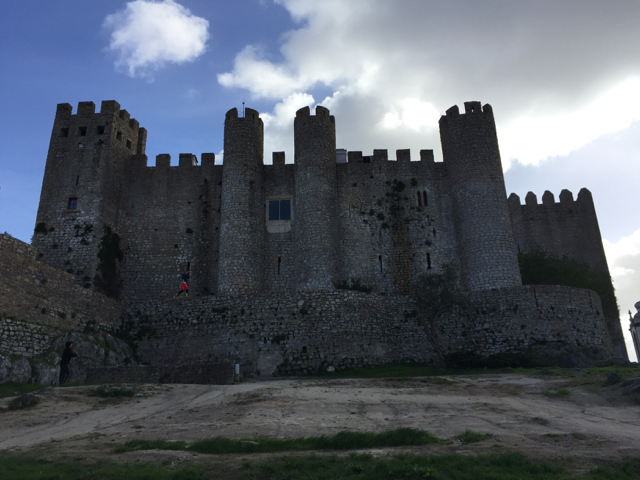
 The Food
 Ok, I know there are
  Okay, I got a little off track here. The point is I don’t recall ever seeing a restaurant billing itself as specializing in Portuguese cuisine. I did see one named “Port and Geese” once, but I think they served stout wine and goose. I just made that up too.
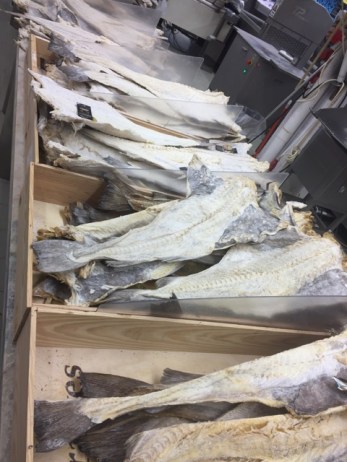 It’s a lot of work to turn that into something edible, so we’ve settled for the way we’ve (sort of) gotten used to the smell of it in the store.
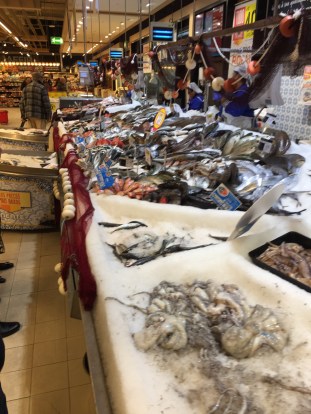 The seafood on display is varied and always interesting. Sometimes it looks like what would be found at the bottom of the tanks if an entire aquarium were suddenly emptied of water… a few hours later anyway, once all the flopping around was over. I’ve seen eels with teeth that would do a dinosaur proud, as well as stingrays, octopuses (yes, that’s the correct pluralization), and body parts of skin divers. Just kiddin’ about the skin divers, although the way the butchers wield their cleavers, I wouldn’t be surprised to see a part of a pinky amidst the meat someday.

 Television & Movies
 crime/murder rate is 105 times higher… you get the idea. And so it’s very ironic that we could ask the same question of a Portuguese wanting to move to the US, but it would be a lot more of a legitimate concern. So maybe we got out of the US to protect our lives!
 when we turned on the TV was The Simpsons, dubbed in Spanish. Unless you know Spanish, there isn’t much for an American to watch. Not that watching less TV is a bad thing, but let’s face it, when it’s 9:00 PM and you don’t want to read, sometimes it’s nice just to switch on the boob tube and put your brain on pause for a while.
 curiosity as to why he greeted me with a “What’s Up Doc?” and ended our meeting with a cheery “Th-th-that’s all folks!”
 times the price. I constantly wonder why Americans put up with a “free enterprise” system that is clearly gamed for the benefit of huge corporations, and in fact is not even free enterprise anymore. Usually, you can choose from only one internet/cable provider, and they squeeze you like a python.
 know Portuguese and rattle off a response or a question I have no hope of understanding. But we got ‘er done and it wasn’t a bad movie. But selecting a TV show or movie is quite a bit more laborious when you have to translate the titles.
 Despite that small problem, it is actually kinda nice to have a built-in potty break. They don’t sell three gallon cups of soda here, so ironically the need for an intermission is actually greater in the US. I think Hollywood sho
 Big Ideas and Little Differences
 Perhaps due to this sturdy construction style, it’s not hard to find abandoned houses in both the city and country. Unless someone tears them down, they’ll just sit there forever. Many of those derelict buildings have For Sale signs on them; I suppose someone can just come in and rebuild the walls on a foundation built during the time of Christ, and be good to go in short order.
 I have nothing against handicapped-only spaces, but the vast majority of the time in the US they sit empty. Adding these spots for people who are also stressed out in a parking lot is not only a great idea, it’s compassionate. I also love the Portuguese for not needing additional messaging detailing the fines in order to discourage lazy scofflaws from using those spots. As far as I can tell, the Portuguese generally respect these kinds of signs. Of course, they’ll otherwise park just about anywhere they can squeeze a car into, but that’s only because space is at such a premium.
 with the amount, and voila! the bill is paid. You can do the same with your online bank account as well of course. I know there are just-as-simple ways to pay bills online in the states, but every bank there does it a little different and every merchant extracts payments differently as well, and you pretty much have to own a computer to use them. Here, everyone plays by the same rules, and even if you don’t have a computer or smart phone, you can pay your bills quickly and easily.
 like you need a gun just because maybe everyone else –especially the bad guys– probably has one already. But if virtually no one has them, it really takes a lot of the angst out of walking alone anywhere, safe in the knowledge that you’re probably never going to get shot. Portugal is one of the safest countries in the world: the lack of guns surely deserves a lot of the credit. Sure, maybe the military can take over the country a lot easier here than in the US, but there are a lot of people, including myself and probably almost every Portuguese, who gladly accept that trade-off. Besides, the chances of the military trying to take over the US only to be beaten back by a bunch of folks with handguns and shotguns is about the same as someone capturing Trump kissing Obama on video. Sure, it could happen, but do you really want to invest money into a filter that would prevent your seeing that?
 ounces are in a cup and how many cups are in a pint and how many pints are in a quart and quarts are in a gallon, and even if you know all of that, it makes sense how?
 I’ve already commented aplenty about universal health care being da bomb here, so suffice it to say that it’s a big idea that trumps the American system by multitudinous kilometers, both from the standpoint of international comparative statistics and our own personal experience.
 Waste Management
 After we purchased our house in Portugal, the owner provided us with a very thorough (and extremely appreciated) list of all the things we needed to know. The names and numbers of a gardener, a painter, a doctor, the septic people, where to find everything in the house, and so on.
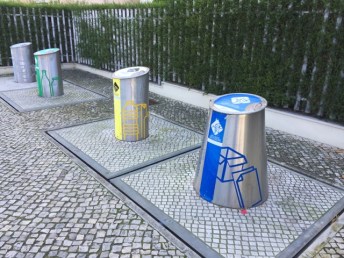
 The closest dumpster to us is just up the road, near our mailbox. Our property in Oregon had a long driveway, so I was used to hauling garbage up a road a little ways. It’s only a little bit further than that here, and well worth the extra effort anyway because there are no bills to pay afterward. We certainly cover it in taxes, but that’s completely transparent and I have to guess the whole process is actually cheaper because everyone participates and no one needs to make any money off it. I used to pay over $50 a month for garbage collection in Oregon. I doubt tax money earmarked for that here adds up to anything close to that much. Plus, they have large receptacles all over the place ready to accept recycled goods; they’re separated by cardboard, glass, and plastic, so recycling is easy for everyone, and very efficient.
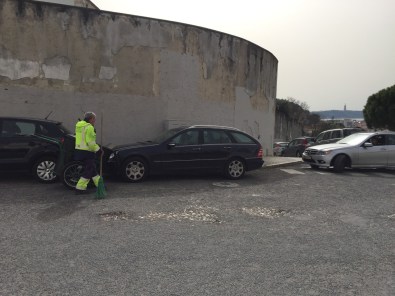 Additionally, the government employs a good number of people to sweep the streets and clean up the garbage around the city. The Portuguese are of course a vast collection of an assortment of human beings just like in every other country, except of course in Africa and Asia. Because, you know, they all look alike there. What? What’d I say? (…I’m just kiddin’, relax already). So there are always going to be occasional nitwits who toss garbage into the street, despite the ubiquitous dumpsters. Plus, the famous Portuguese sidewalk bricks often look to be held together by cigarette butts. There are more smokers here than in the states: I’m guessing the anti-smoking message here is probably ten or twenty years behind the US. But overall, the city and countryside are both relatively clean.
 I wouldn’t give them an A+, however. That grade must surely go to Singapore, where they only ban chewing gum, but the first time you throw away a cigarette butt or candy wrapper you’ll get fined $300. And the punishments go up after that. So while I’m glad Portugal doesn’t try for that grade, generally everything is cleaner than most places in the US, so it definitely gets a higher grade than most places there.
 I must add, however, that the one thing we don’t appreciate about waste in Portugal is that spotting dog poop on the sidewalks is pretty common. Some of it is surely deposited by the occasional stray, and we’ve seen Portuguese with plastic gloves on doing their scooping doody, but apparently the message hasn’t quite taken hold the way it has in the US. I can only add that any Portuguese who lets their dog just poop on the sidewalk ought to be damn glad he or she doesn’t live in Singapore!
 They aren’t without their challenges, to be sure. Portuguese drivers fully understand that when you’re approaching a roundabout, you will look almost exclusively to your left, and if anyone’s coming, you stop. Since every driver understands that, lots of drivers come barreling into the roundabout and stop only at the last second. Approaching cars already in the roundabout don’t pay them any mind, because they know they’ll stop; they always do. Of course there’s always that one time someone might not, which is what Americans like us worry about. Carolyn still jumps in her seat and eeks! a frightened exclamation every time that happens. After a year or two or ten of avoiding that one guy, I’m guessing she’ll be as steely-nerved as any Portuguese round-abouter.
 On the other hand, if you, as a pedestrian, step into the street outside of a zebra, cars will not only ignore you, they will actually speed up and aim the front bumper right at your groin. I think this aggressive intolerance for jaywalking stems from all the times drivers have had to slam on the brakes when someone makes a move toward a zebra, even though, when taking on the pedestrian role themselves, they have often been the beneficiary of said behavior. Besides, there are more zebras here than an African veldt with no predators, so step into a crosswalk or risk your life.
 Despite their presence on our top ten list, roundabouts are the scariest in this regard. When you approach, you are looking intently to your left, ready to speed into the intersection ahead of the oncoming cars as you mentally calculate the speed vs. momentum vs. distance vs. the square root of an isosceles triangle vs. reminiscing why you didn’t pay more attention in physics class –and actually your physics teacher was pretty hot– and did you remember to turn off the iron? And then you have to factor all that in and compare to the risk and cost of the damage to your car and physical well-being should you have missed a decimal point in your calculations. And you have to do all that within the 1.2 seconds it will take for the oncoming car to hit you should your calculation be in error.
 ing downtown. No music, no conversation, no screams of panic before I plow into another car. Don’t say nuthin.’ I’m on the hunt for wayward pedestrians.
 baldsasquatchdotcom