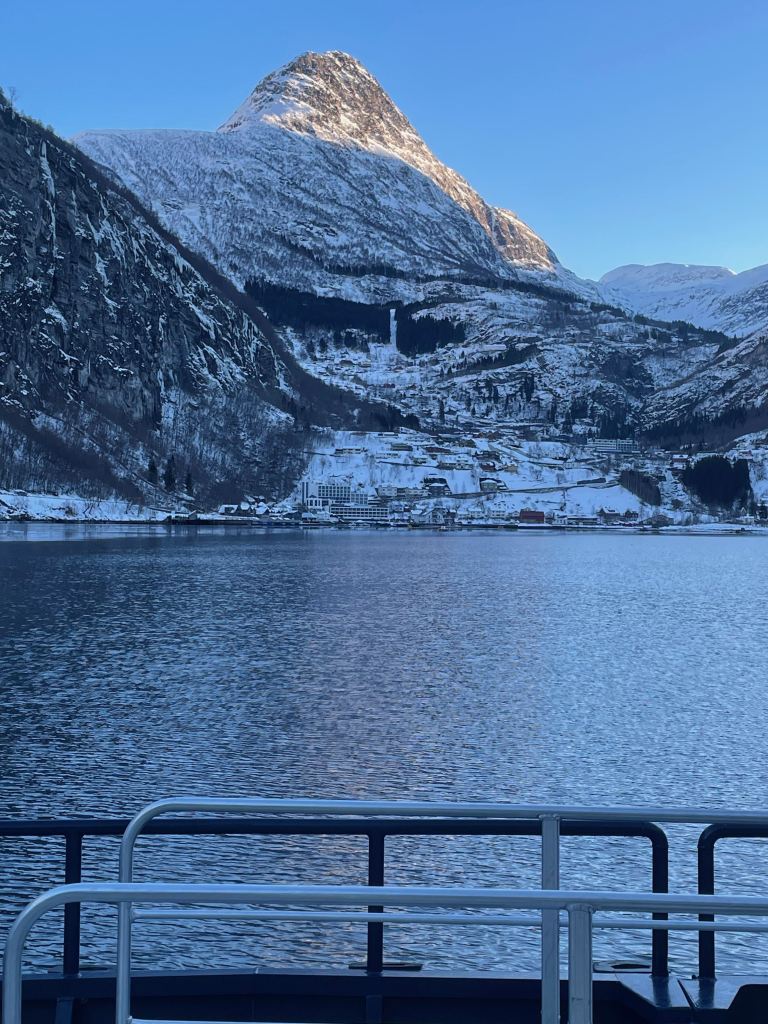
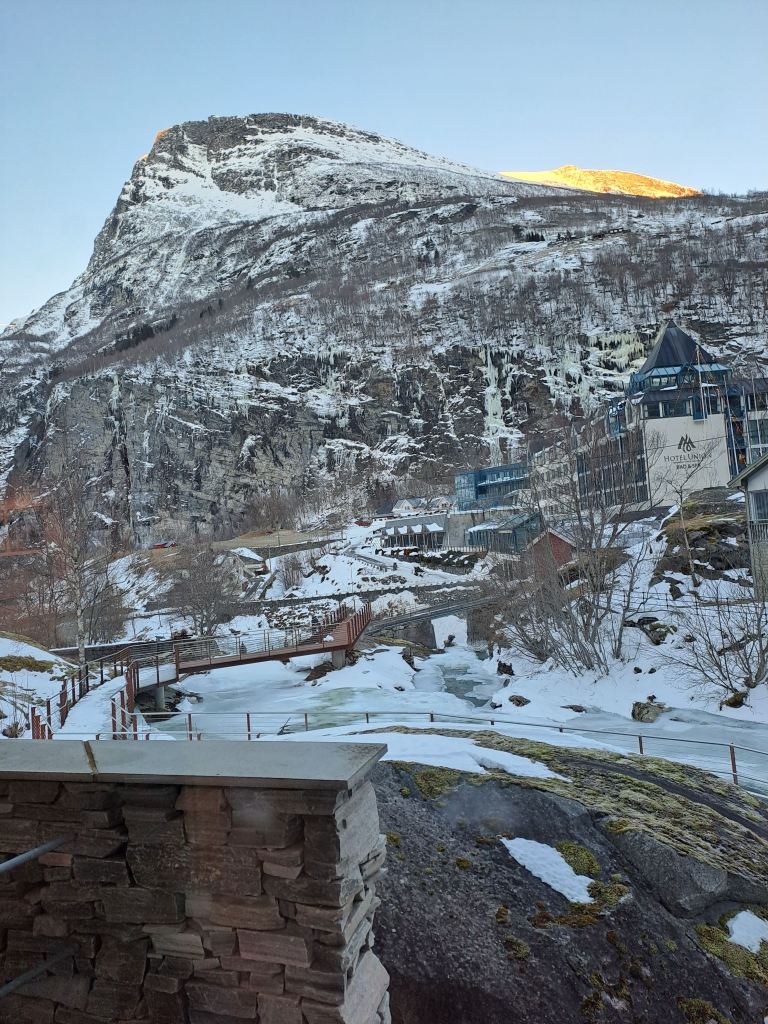
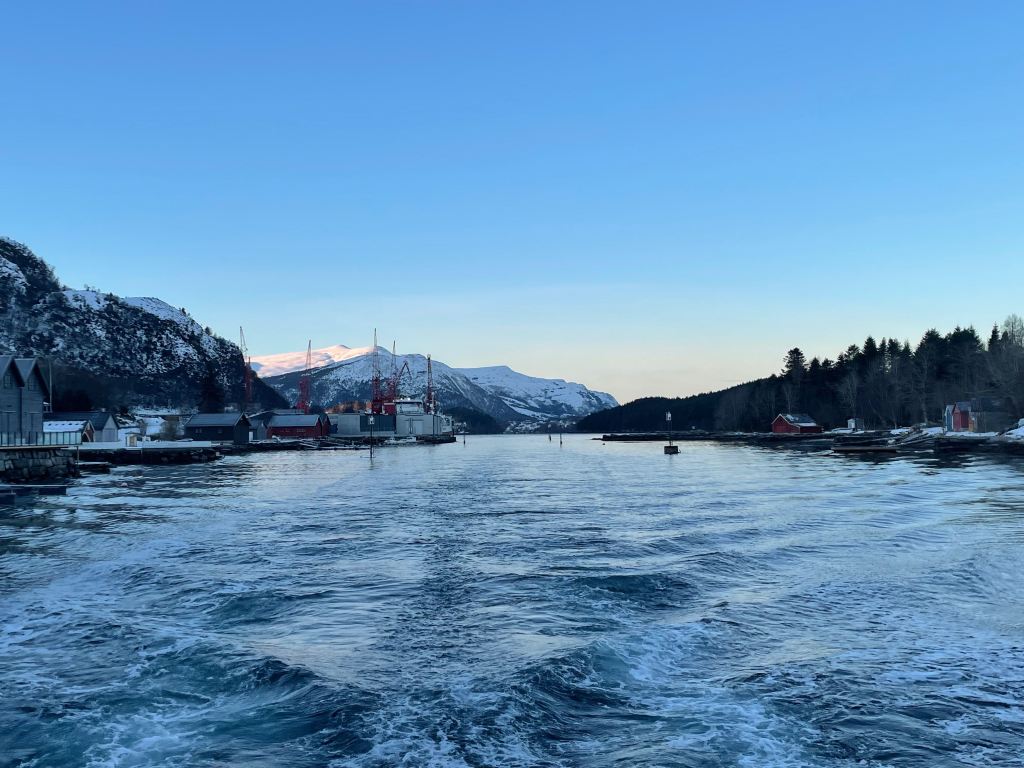
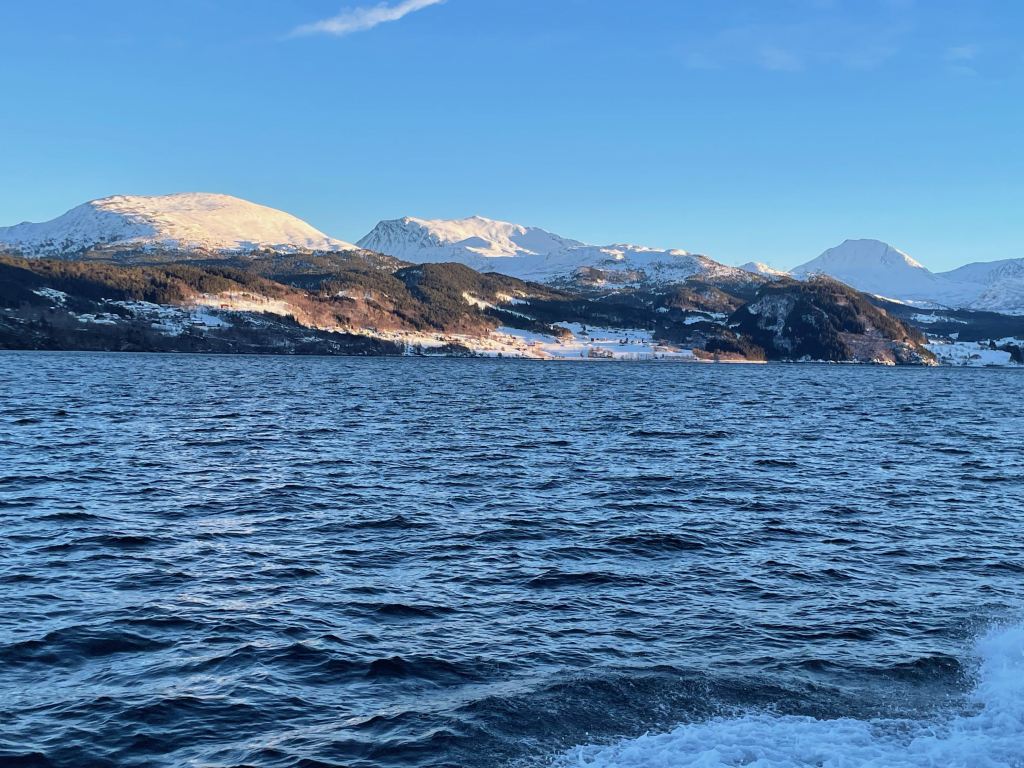
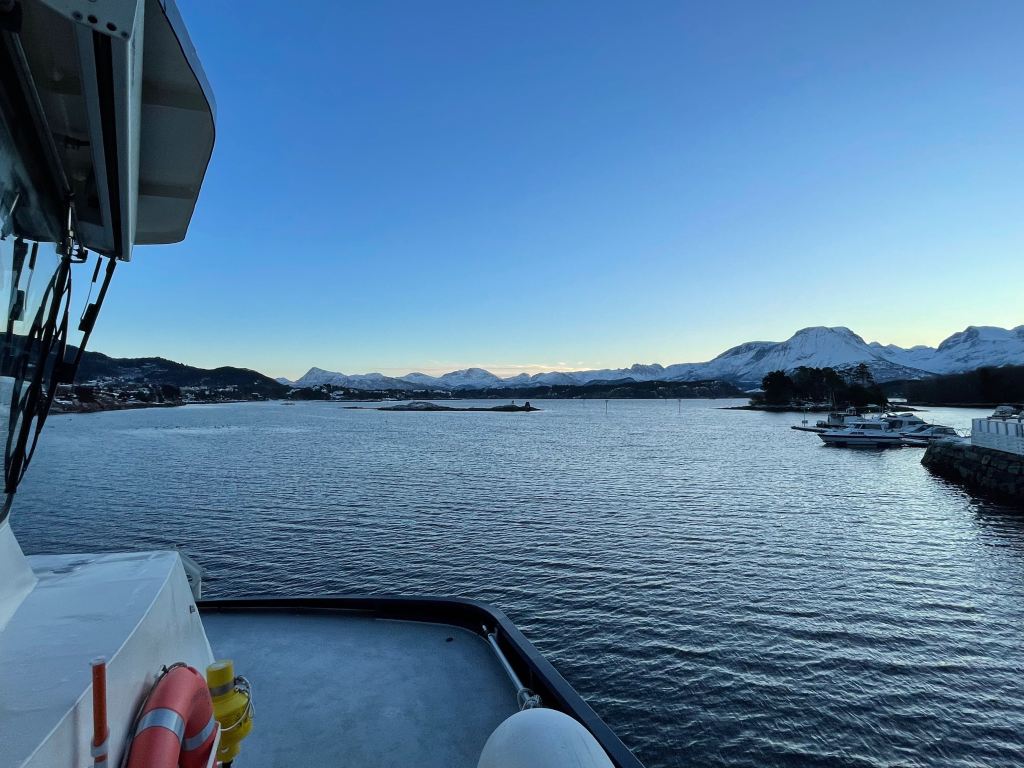
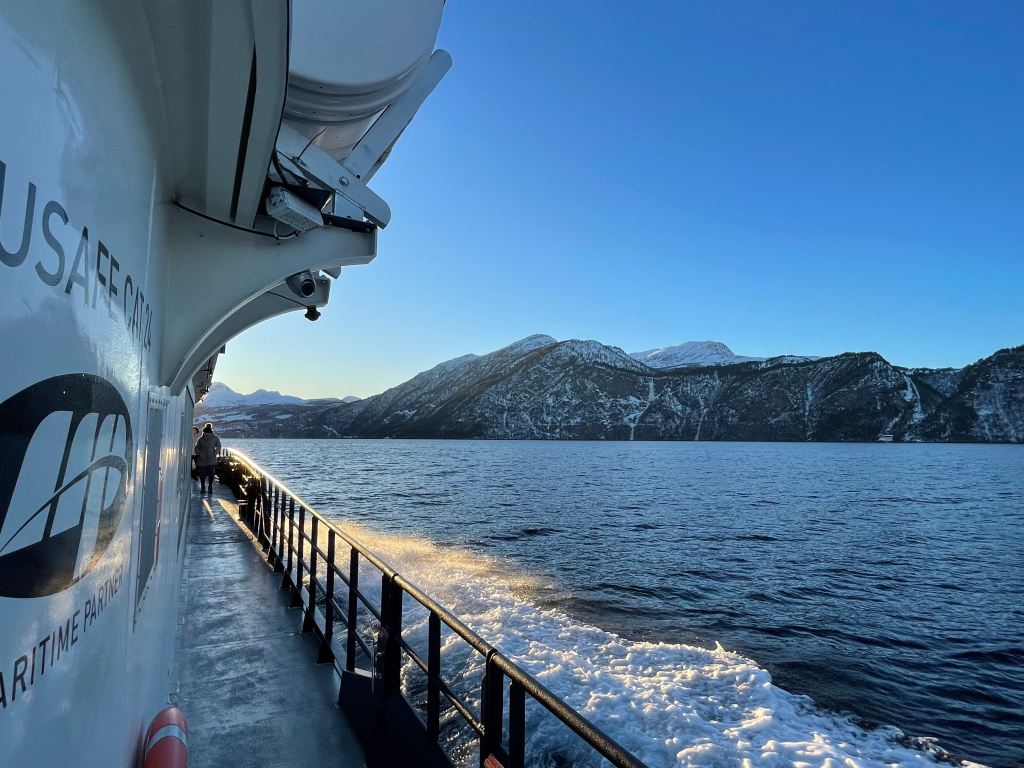
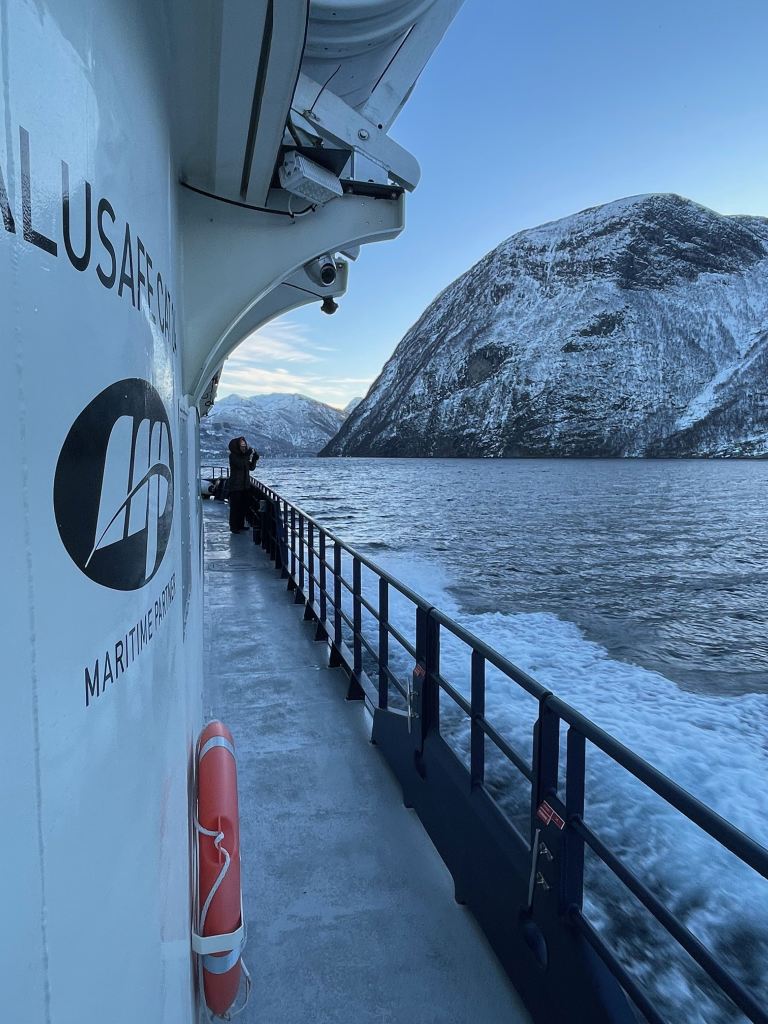
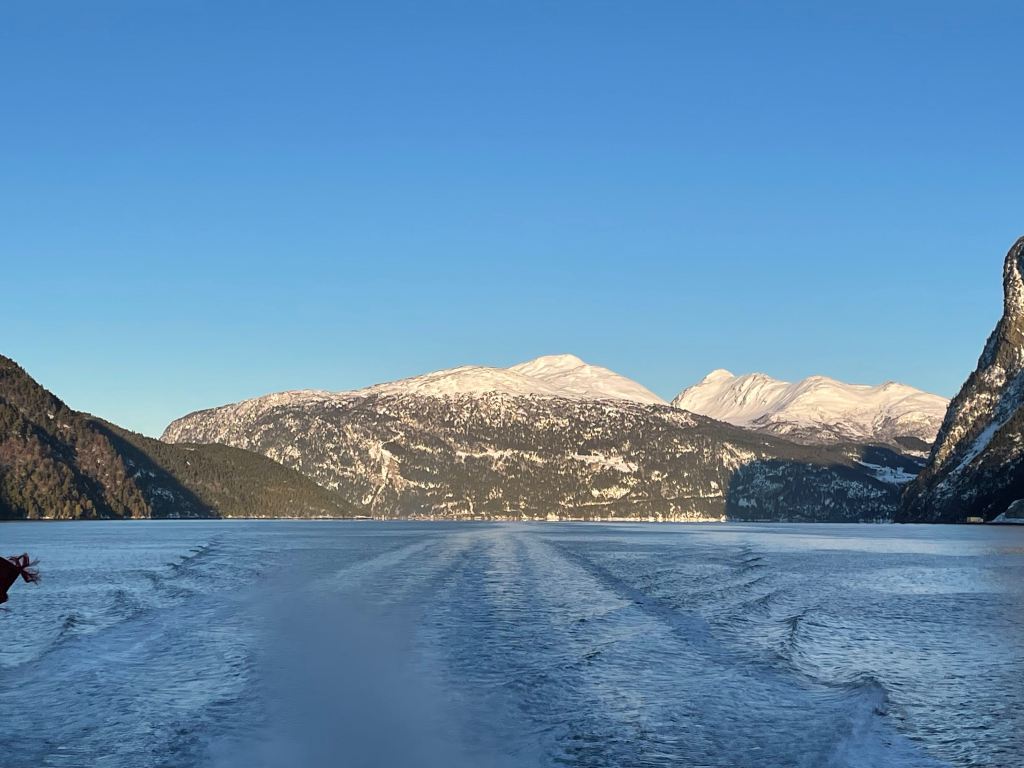
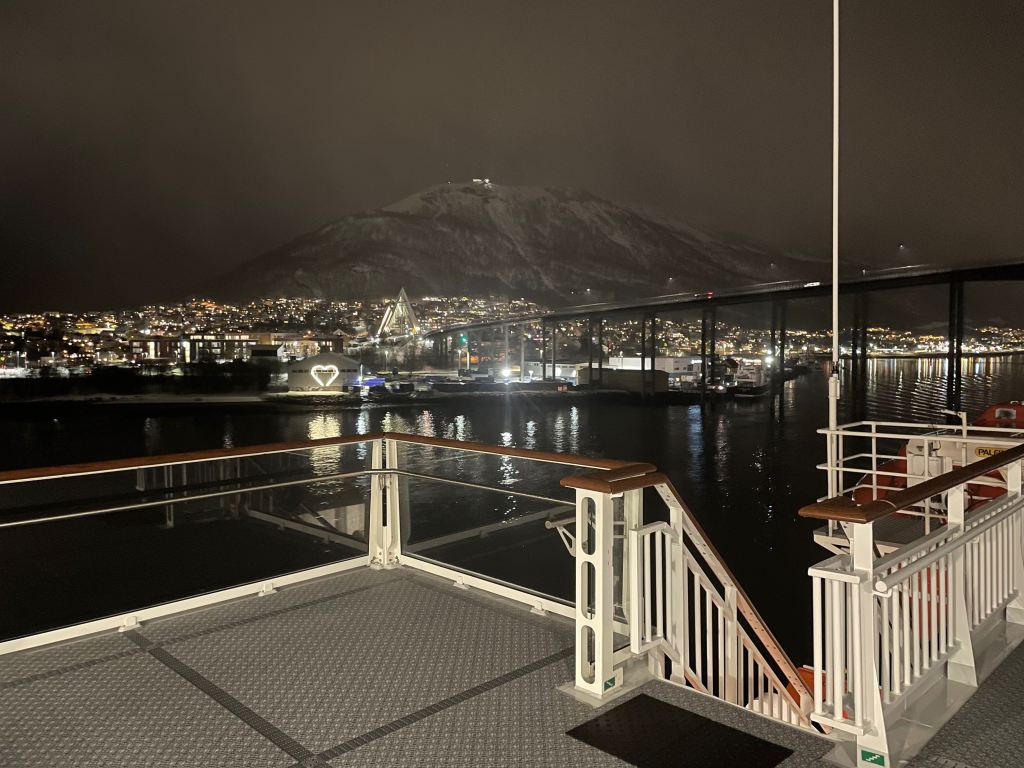
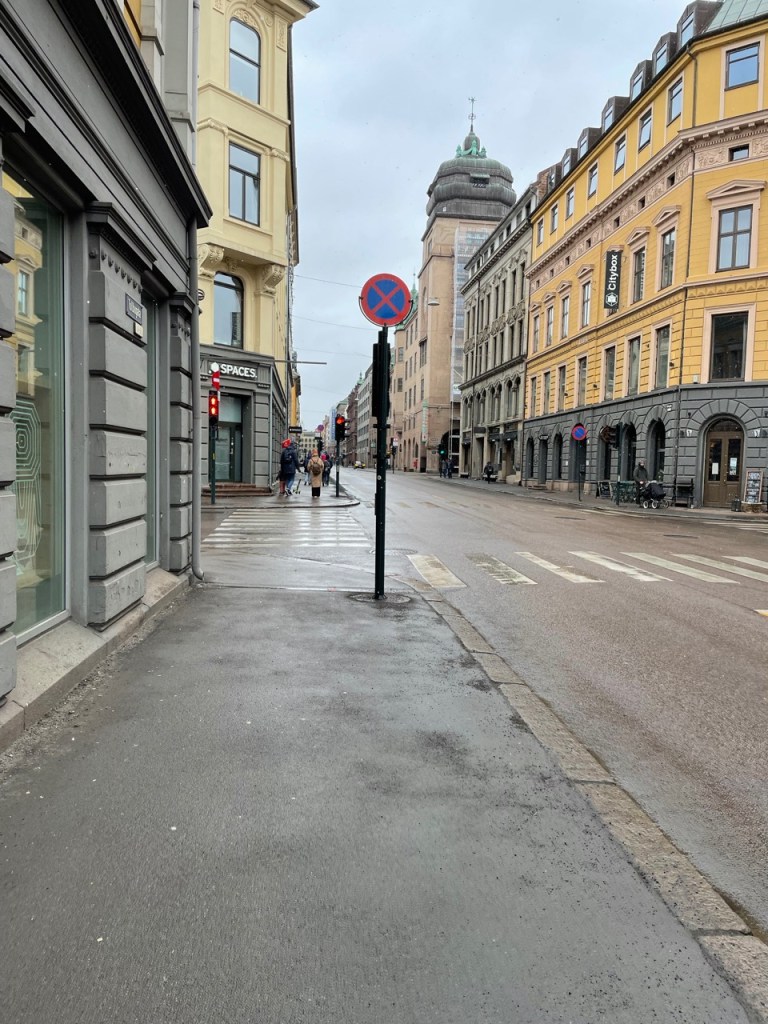
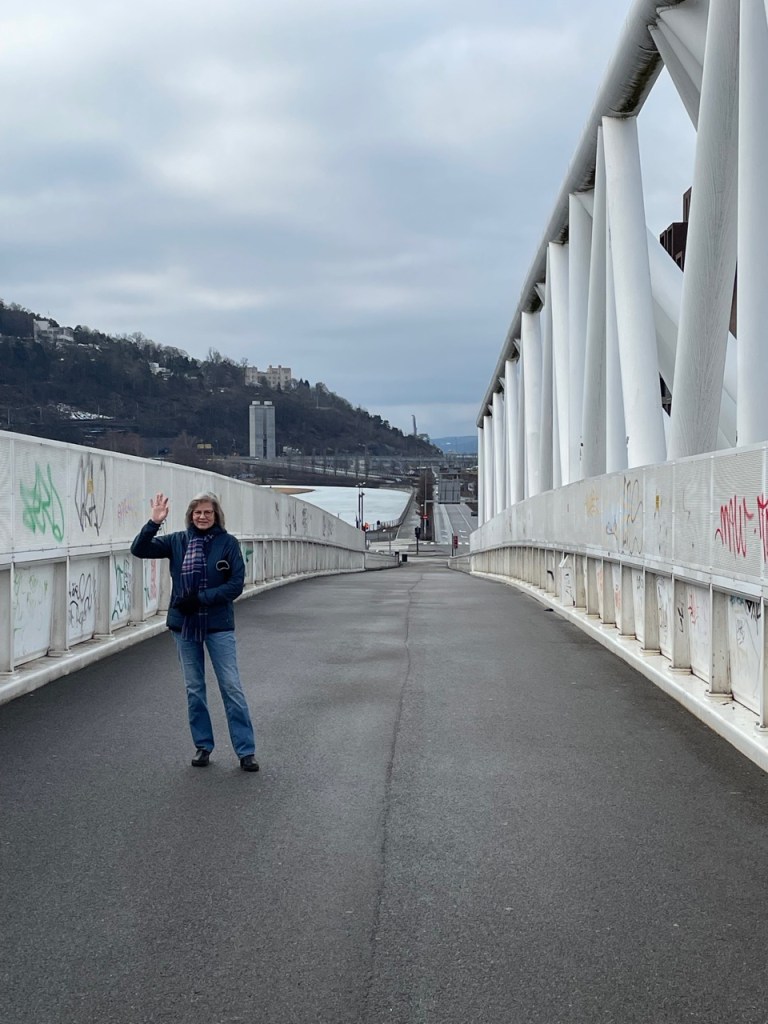
Which Way to the Front? The Norway of Course!

Ever since Vladimir Putin reminded the world that we should put his picture in the dictionary next to the word “asshole,” I’ve wanted to do my part to help the Ukrainian people, who have certainly had enough of his verbal flatulence. Drawing upon my history in the CIA, I realized I could infiltrate the Land Run By The Sphincter simply by sailing north of the Arctic Circle, landing in Norway, and then sneaking in through the lightly defended border between the two countries… with the rest of course being classified. Thus begins our saga.

Way back in 2017 when we moved to Portugal with the intention of seeing as much of Europe as we could, the coast of Norway was definitely not one of the items on our bucket list. Not because we didn’t want to, we just hadn’t really given it much thought. I mean there’s London! Paris! Rome! Vienna! Berlin! Amsterdam! Lisbon! Llanfairpwllgwyngyllgogerychwyrndrobwllllantysiliogogogoch!*

All of which called our name much louder than some silly Norwegian fee-jeeords.

Of course, going to Scandinavia itself certainly was on our list, but we had already checked that off with a visit that included Copenhagen, Stockholm, and Oslo. Not that there was anything wrong with Oslo, but it was easily the least beautiful of the three, so we figured we were done with Norway. But oh nooo, our friends Tim and Susan Darcy spiked our drinks one evening and before we could even say Taumatawhakatangihangakoauauotamateaturipukakapikimaungahoronukupokaiwhenuakitanatahu** we were registered to sail on a Havila Cruise up the coast of Norway, way past the Arctic Circle, and all the way over the top of the country to the Russian border. My CIA handler was very excited.

I only offer that long place name up (in case you missed it, it’s “Taumatawhakatangihangako-auauotamateaturipukakapikima-ungahoronukupokaiwhenuakitanatahu”) because Norway happens to be the proud owner of the shortest possible town name: A. Yup. That’s it. A. Actually, A is an old Norse word meaning “small river.” Seems to me what they were describing would be more like a trickle of melting ice, but hey, when you live that far north sometimes your saliva freezes up before you can get much else out. So “A” it is. But, as enticing as visiting a town called A was, we skipped that and went right to B, as in Bergen.

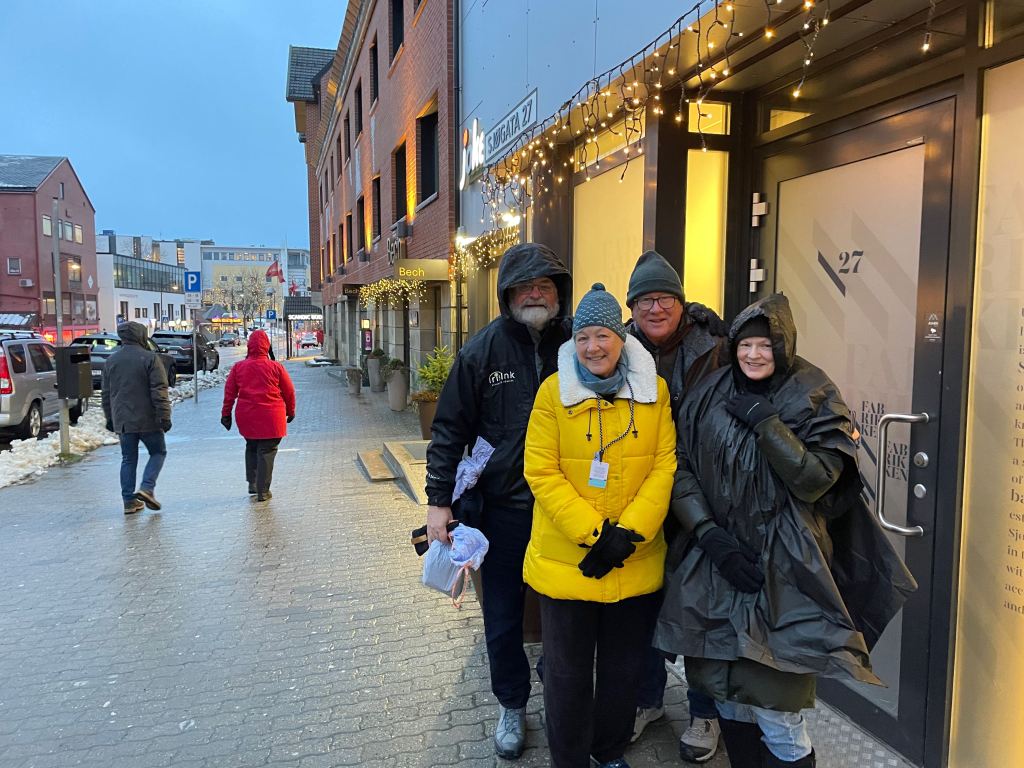
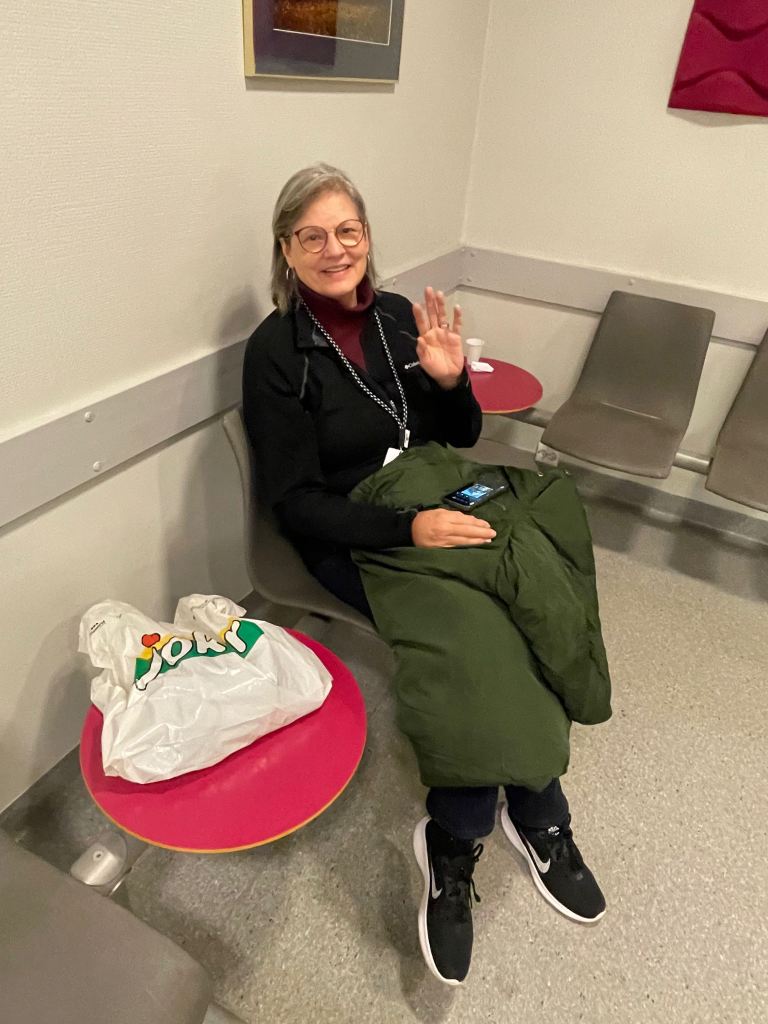
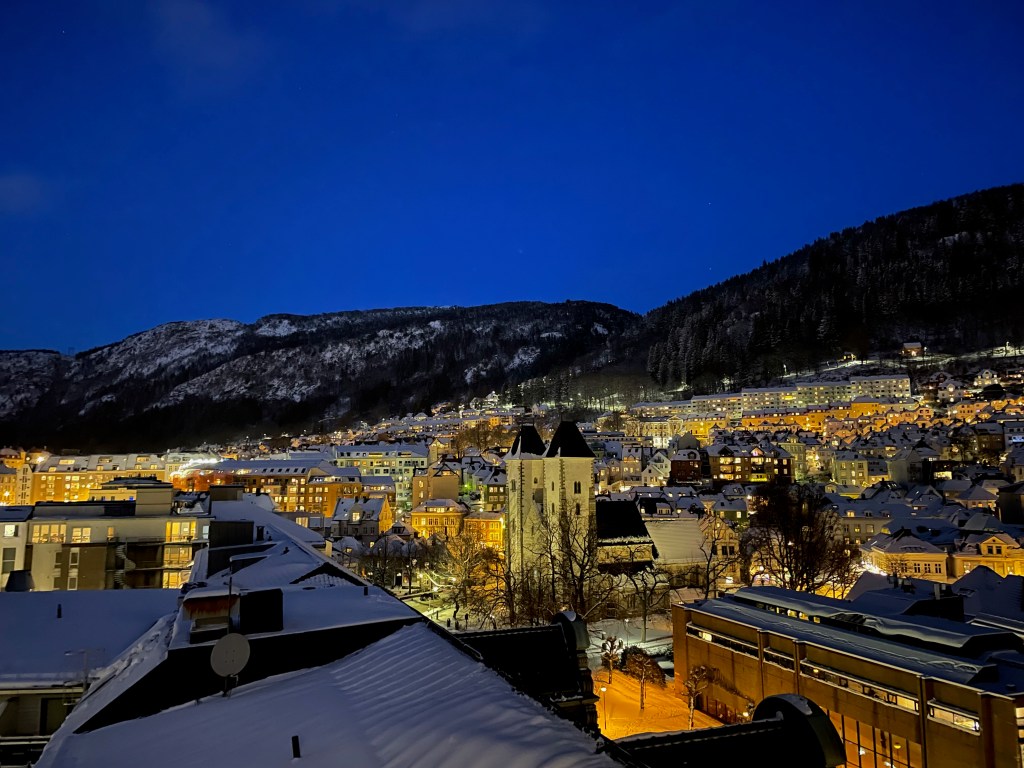
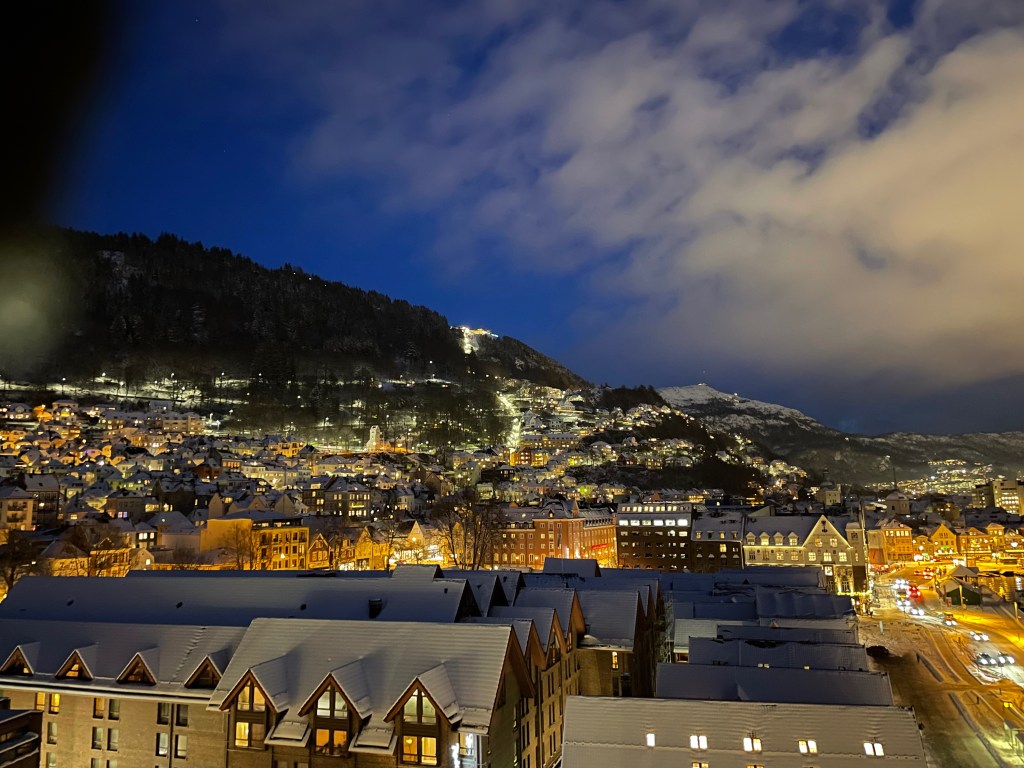
Obviously, as soon as I saw that our cruise ship departs from Bergen, I placed a call to my dear old friend Candice Bergen and asked if we could visit her in January. Of course she said yes enthusiastically (I mean, it was us), so I urged our travel agent to get us to Candy Bergen’s place, stat, and stop with all the questions. In light of the next photos, I wasn’t sure he got us to the right place.

One of the first things we saw as we walked out of the airport is this sign. I have to admit, it made us a little uncomfortable. I mean, what does a pilot think the first time he lands there? “Did I actually land in Bergen?” “Are you sure?” “Are they sure?” “Is anyone sure?” “Does anyone actually know where we are?”

Also, where was Candace?

The first thing we felt was um, a little bit of cold. Here’s our iPhone screen in both celsius and fahrenheit, which we’ve provided to ensure that none of our relatives has a heart attack thinking that we actually ventured into -9°F temperatures. Actually, 15°F is about all I could handle while wearing my standard cruise attire of Bermuda shorts and sandals with socks, so I was grateful that this was about as cold as it got during the entire trip.

That said, what many people don’t realize (including us, pre-cruise) is that the coast of Norway isn’t as cold as commonly thought. Because of the warmth of the Gulf stream (fueled of course by the flatulance from all that spicy Mexican food), Norway is one of the world’s largest exporters of palm trees. Okay, just kidding about at least one of those statements. Anyway, Bergen’s temperature only hovers around freezing for much of the winter. In fact, when we arrived in Bergen there was very little snow on the ground, despite the cold, which was colder than usual.

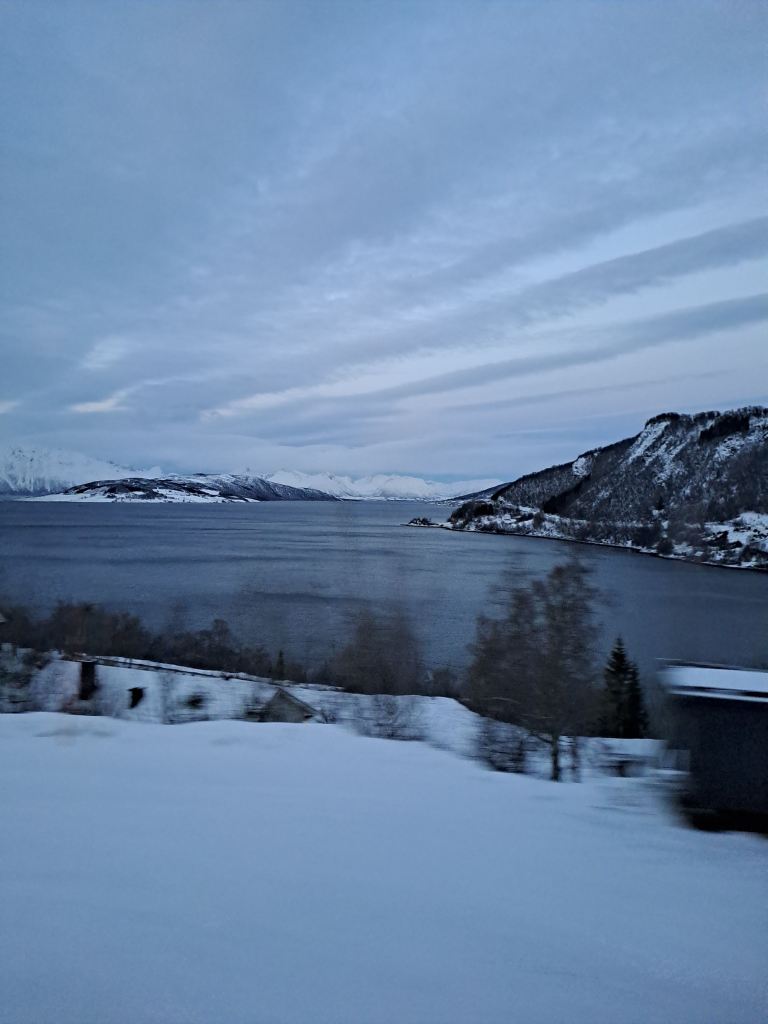
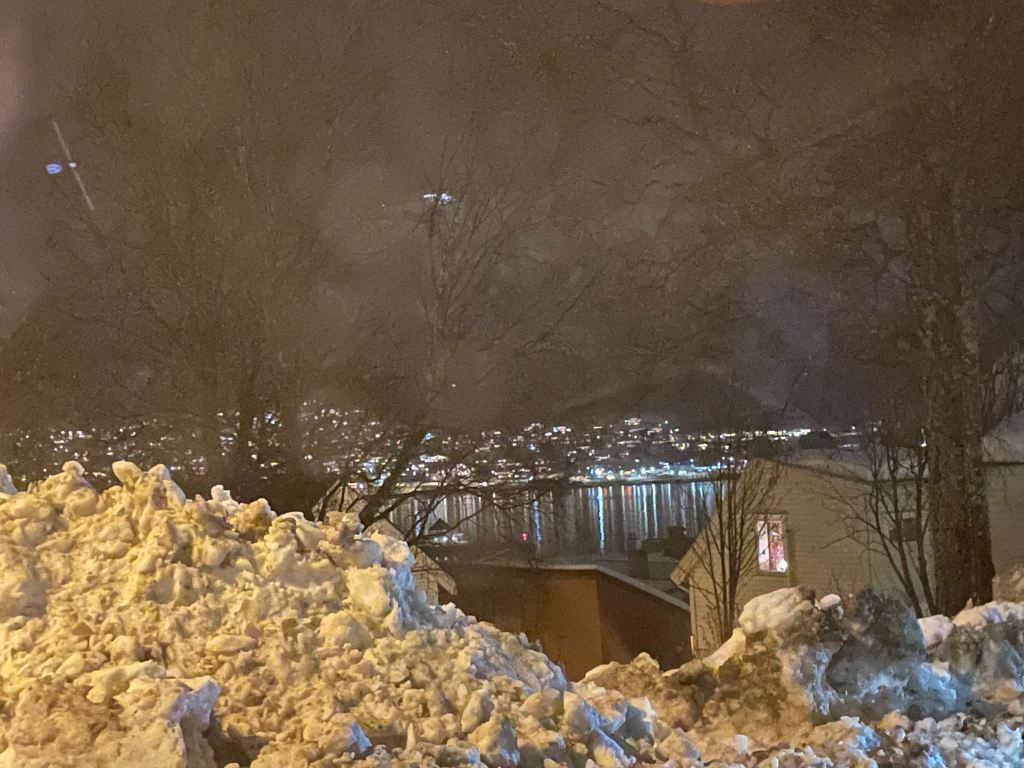
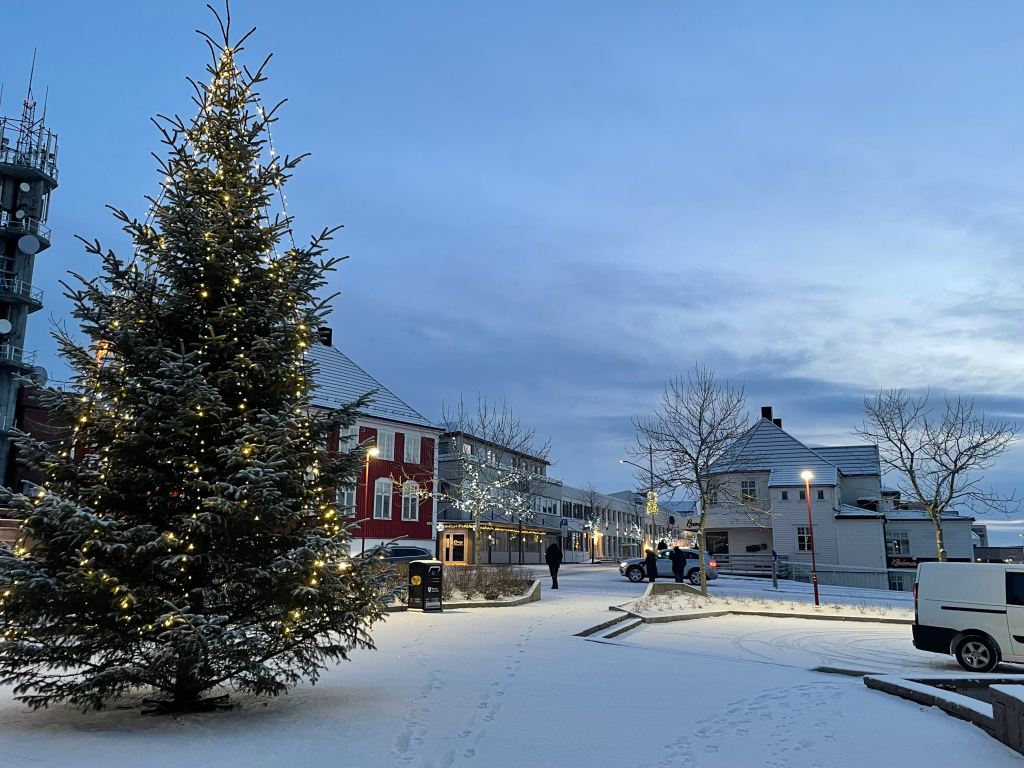
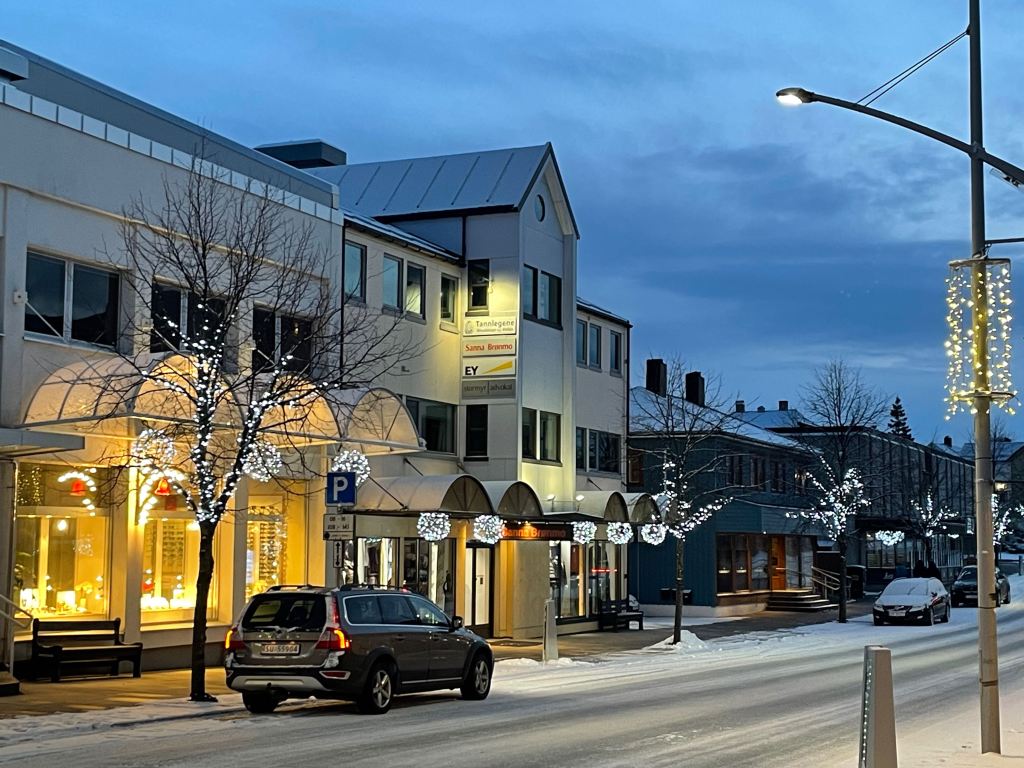
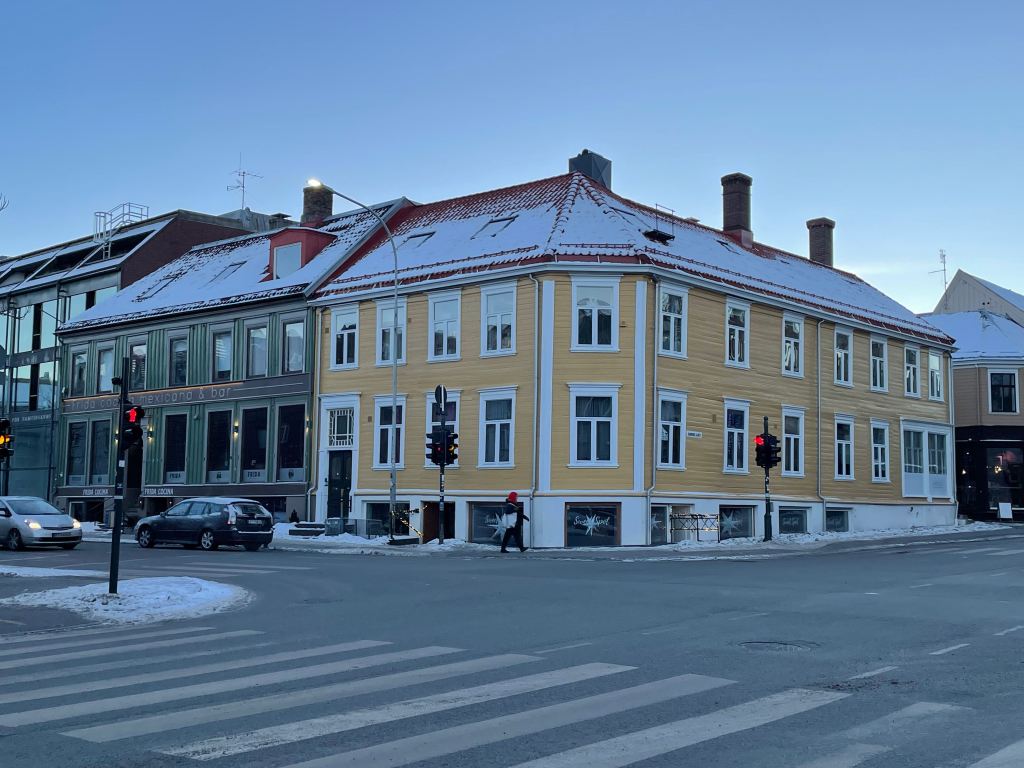
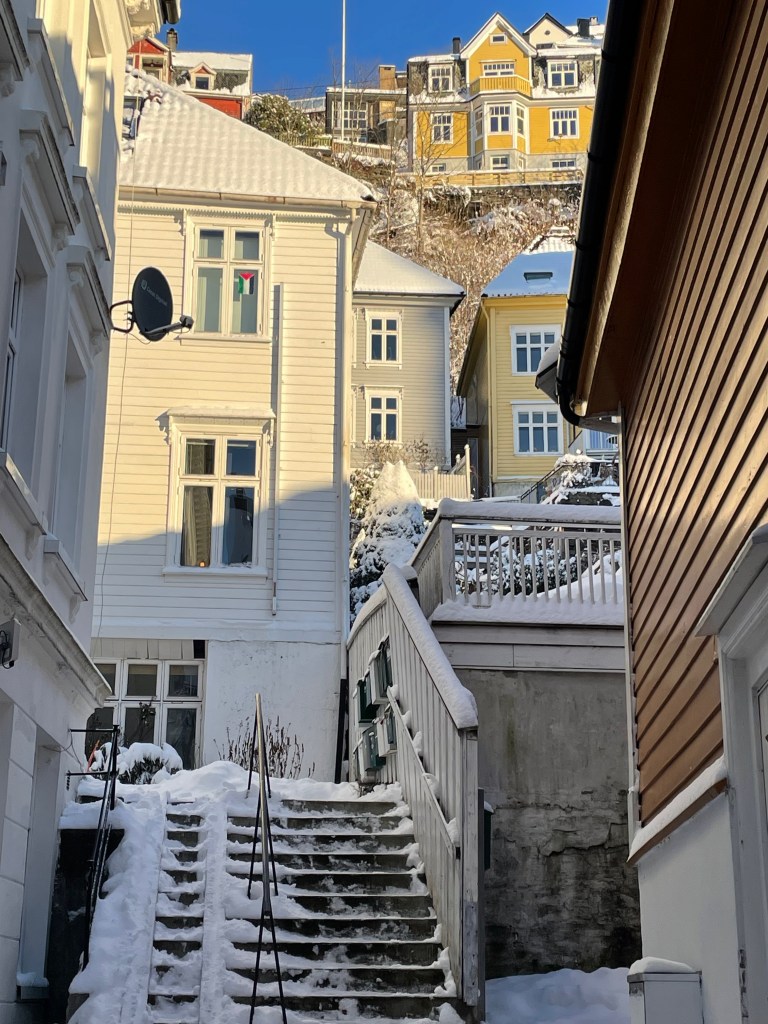
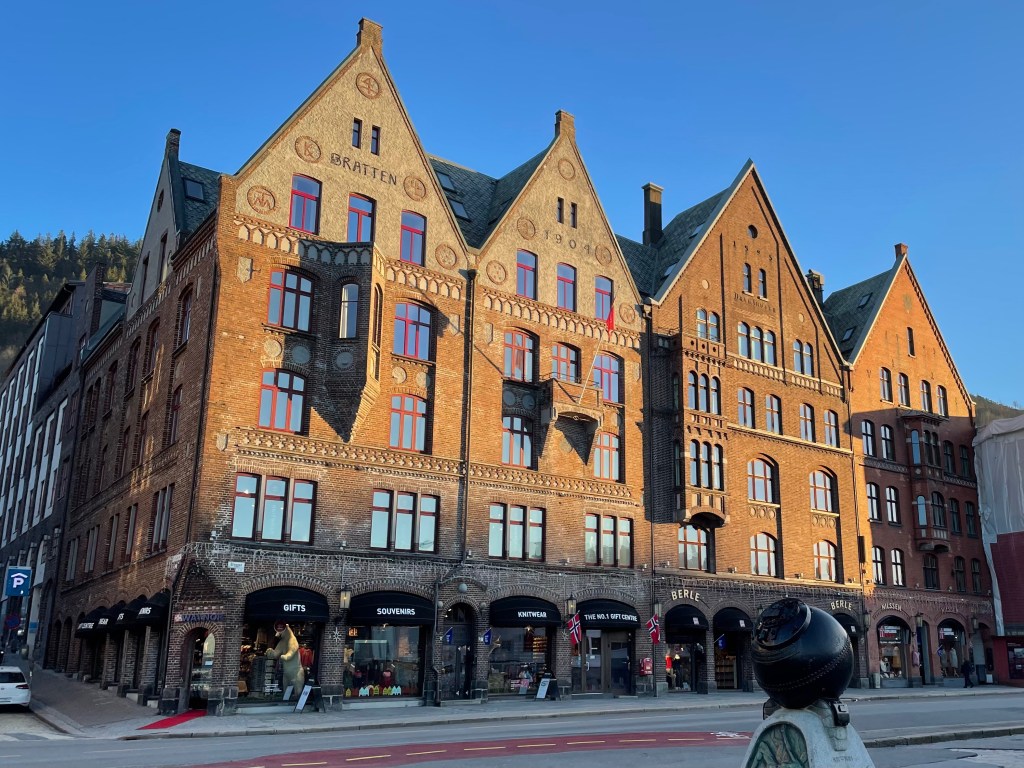
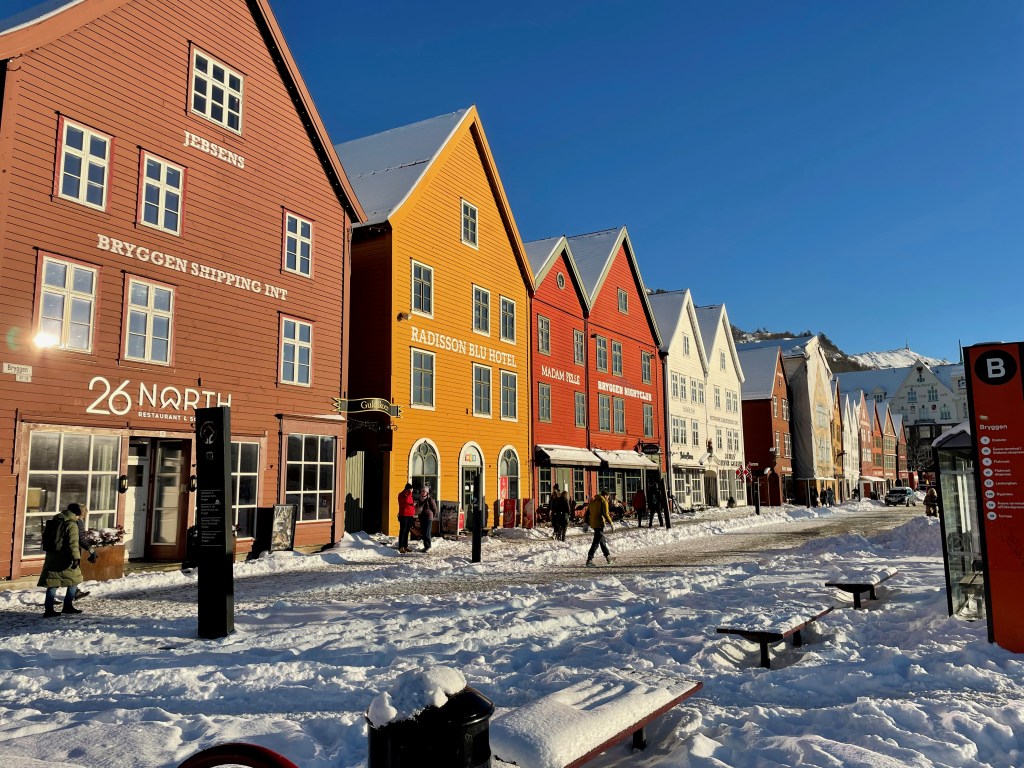
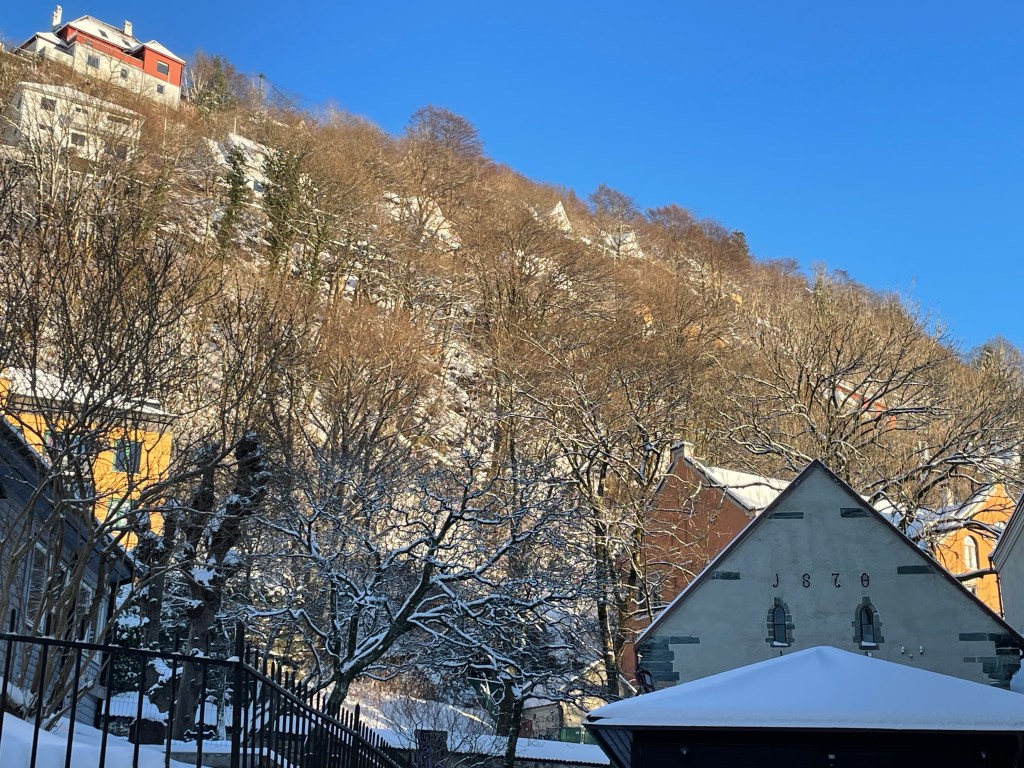
When we returned less than two weeks later, the town was covered in a thick layer of snow, one that we were told was a once-in-every-15-years kind of snowfall. The first picture above was from our initial visit, the second was when we returned after the cruise. The third was of my thumb so I deleted it.

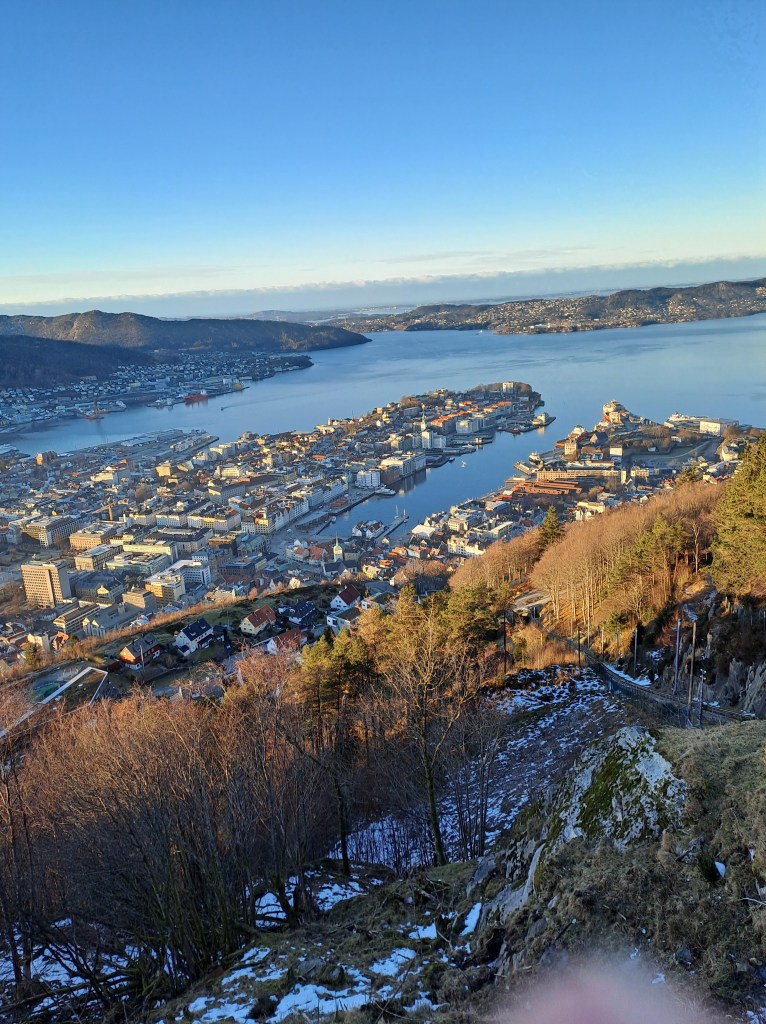
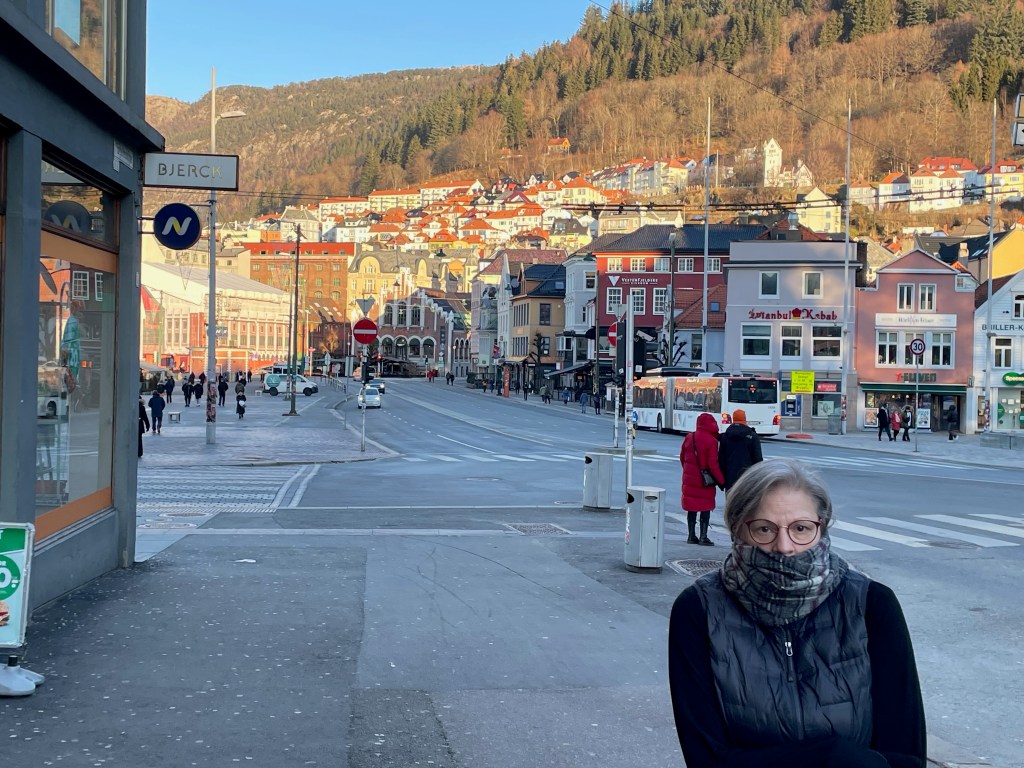
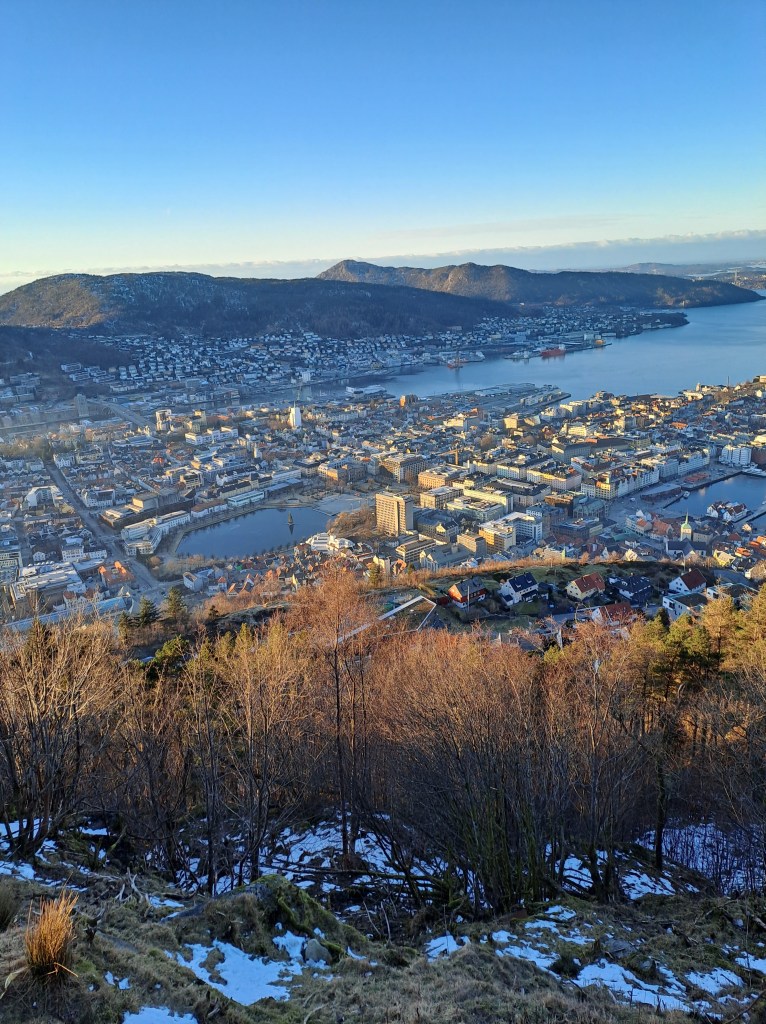
Bergen itself is more of a sprawling city than we imagined, and the downtown area is absolutely charming and delightful. Hills surround Bergen down to the sea, where it sits between two of the biggest fjords in Norway, resulting in Bergen being called “the capital of the fjords.”

Since the city is surrounded by mountains, it’s also called the “city of seven mountains.” The city was founded more or less in 1070 by King Olav Kyrre and was named Bjørgvin, which means “the green meadow among the mountains.” The city center and northern neighbourhoods are on Byfjorden, “the city fjord,” which probably means Bergen is also called “The City on the City Fjord.” I’ll just stick to calling it Bergen the rest of the way, Norwegians obviously give too many names to things.

Bergen has a lot of rain all year, sometimes even featuring more than two months of consecutive rainy days. As a result, it’s known as the rainiest city in Europe especially by those who think of it as the rainiest city in Europe (ironically). While we were treated to a nice snowfall upon our return, the snow usually melts rather quickly. Who knew snow would be such a rare commodity in a Norwegian city!

Bergen has a mild winter climate, albeit with a lot of precipitation: it rains about 200 days out of the year, and that’s in metric! During the height of winter, Bergen can actually end up 20°C (60°F) warmer than Oslo, even though both cities are at about the same latitude. Bergen is ranked as the third warmest city in Norway, but based on some of our pictures, that may be like saying the Mojave desert is the third coolest place in hell.

It may very well be that one of the reasons Bergen is such a charming city is because it didn’t suffer the same brutal fate as many of the Norwegian towns up and down the coastline did during World War II. In fact, on the very first day of the German invasion of Norway in 1940 the Germans occupied Bergen after only a brief skirmish with some Norwegian artillery. Allied bombing raids against naval installations did most of the damage later, resulting in about 100 civilian casualties overall.

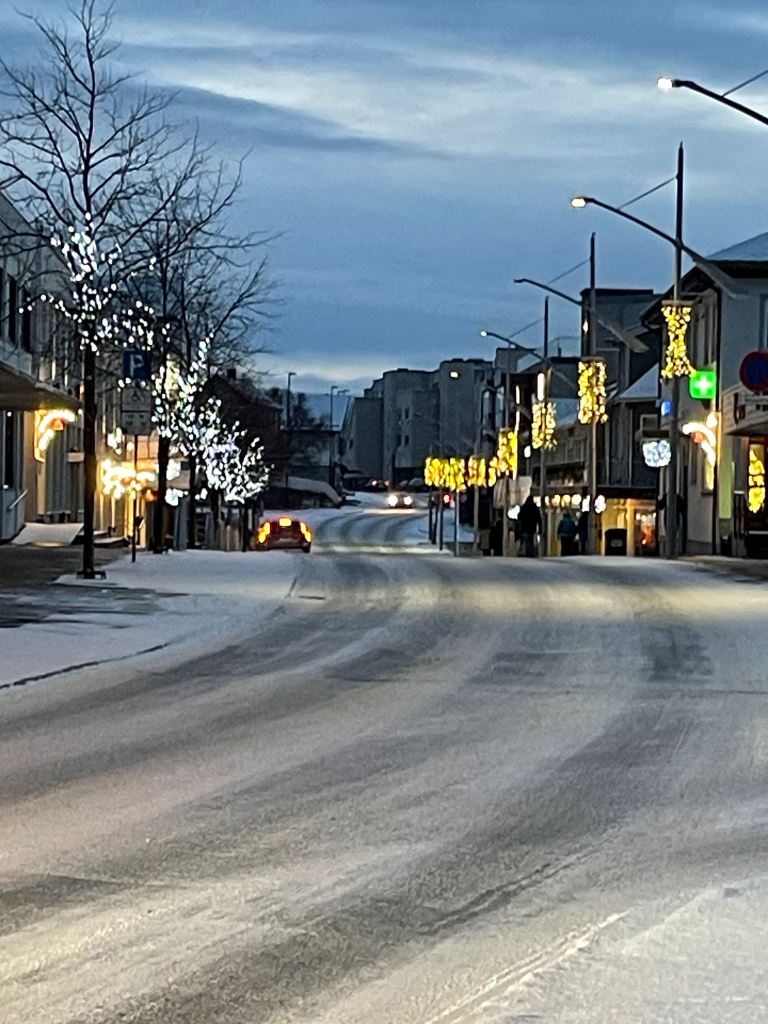
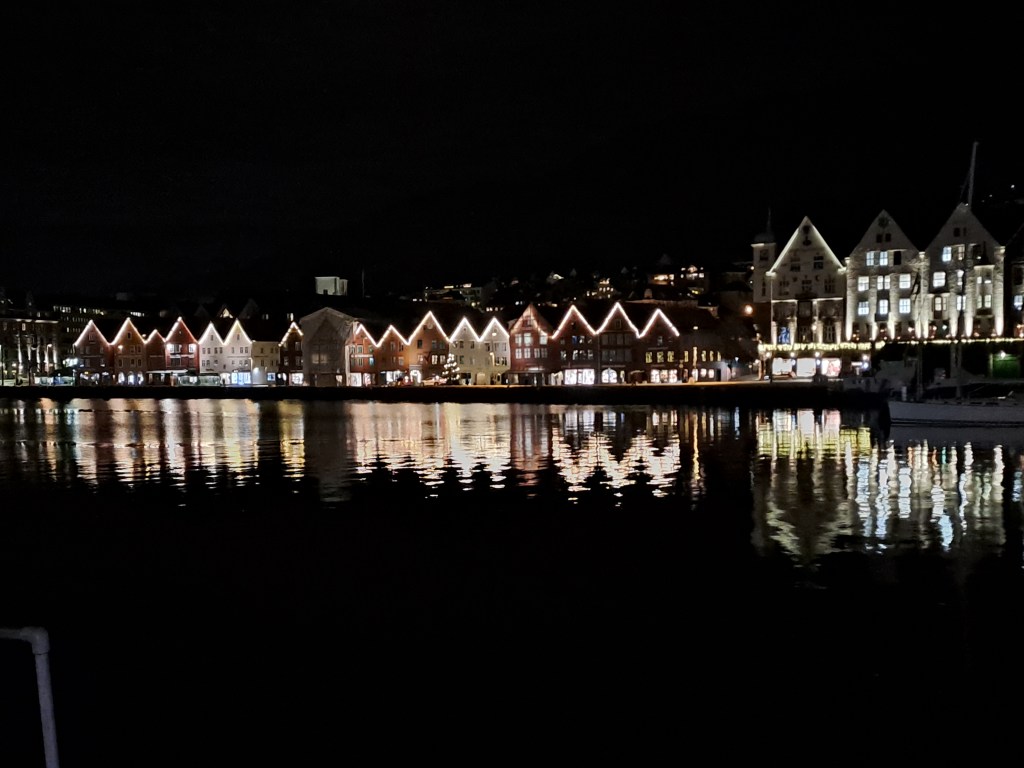
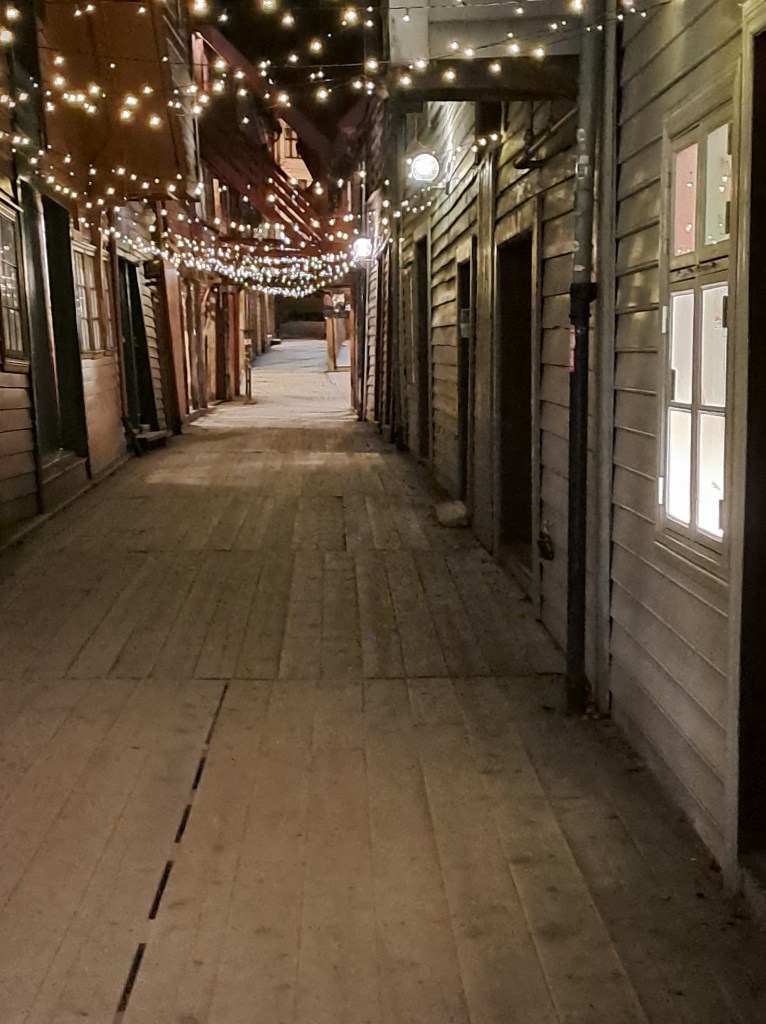
Bergen is known for its street art; the city even covered one piece with protective glass. We didn’t see much of that where we wandered, however, except for the big green troll. Going clockwise from there, we saw plenty of Christmas lights as it was still early January, and a neon sign advertising a big Schlong (I think that’s how you pronounce it). And then, Holy Cow! It’s a 7-11! Anyway, with street names like Ovre Korskirkeallmenningen, I’m not sure there’s any room left for graffiti anyway. Also based on that street name, I’m surprised 7-11 isn’t called 9,832,409-253,130,939,480.

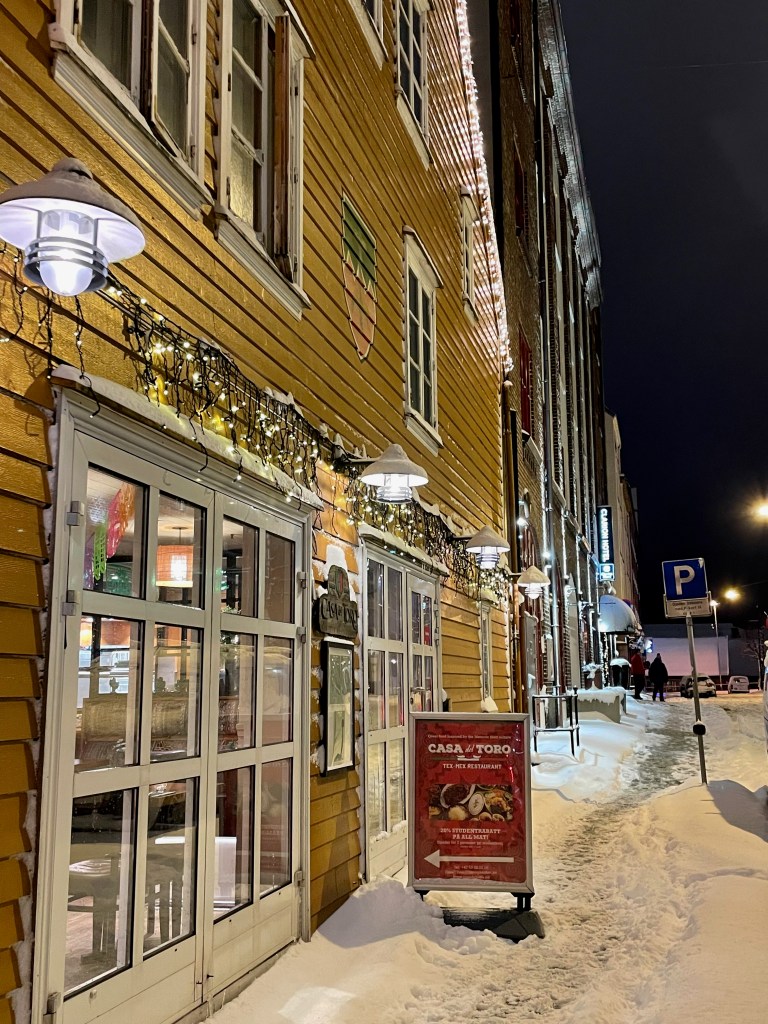
Bergen also happens to be a sister city with Seattle, Washington in the USA. Seattle is the next big city north of Portland, Oregon, where Carolyn and I are from. Both of those cities can feature some beautiful scenery, but it’s hard to beat the charm and beauty of Bergen. Plus, as you can see by the third picture above, Bergen has better Tex-Mex than either Portland or Seattle.

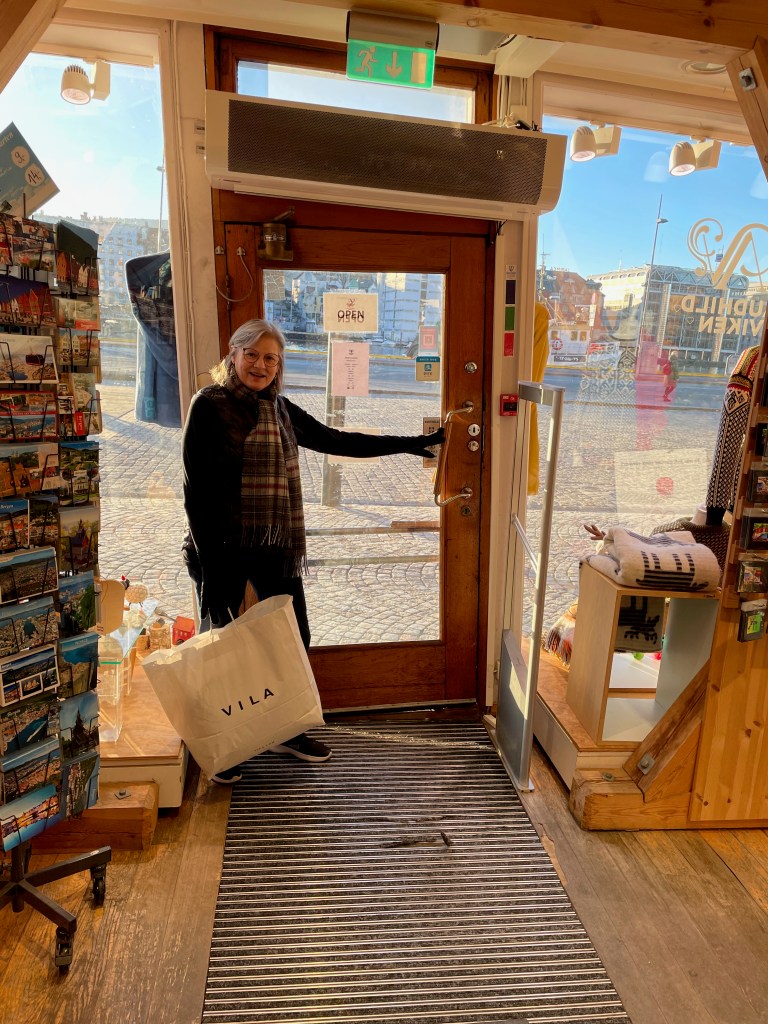
If you look closely at that door, you can see that everything is rather crooked (I promise you it’s not Carolyn who’s cattywampus). This is in an old part of Bergen near the water, so things obviously shift over time. Apparently the Norwegians just roll with the flow. Speaking of which, every single interaction we had with a Norwegian on this entire trip was pleasant and delightful. They are truly a nice people.

Honestly, it took me hours just to whittle the hundreds of photos we took down to what you see here. I still have a folder chock full of other photos. Bergen is simply a very charming city, easily making it onto our mutual top ten best small cities in Europe list. It didn’t quite push Edinborough, Scotland off the top of the list, but it came awfully close!

After spending hours wandering Bergen’s city streets, chilling out in a gigantic chair and being caught sneaking food out of the free buffet were just what the Travel Doctor ordered. Man… an entire trip up and down Norway and Bergen gets one complete entry all on its own. I may need to rename this blog The BaldNorwaySquatch!

Anyway, I believe our visit to Bergen established our “clueless tourists cover” sufficiently enough to allow my covert entry into Russia. More to come as we approach that big event!

*Llanfairpwllgwyngyllgogerychwyrndrob-wllllantysiliogogogoch! is in Wales, and has the world’s longest town name.

**Taumatawhakatangihangakoauauotamateaturipukakapikimaungahoronukupokaiwhenuakitanatahu is in New Zealand, and has the world’s longest place name.

***Ajohsadfiukhjnsdfuclvndasdwerksksdnmfslkdoapqwemxeuvsdfkjsdfdfnasadqqoouedfndfdsmcsaskdsbeedsdsagfealasdl is in my head, and is this blog’s longest word.

****I can’t pronounce any of ’em.

Candace gets me.

It’s An Old Fart Road Trip!

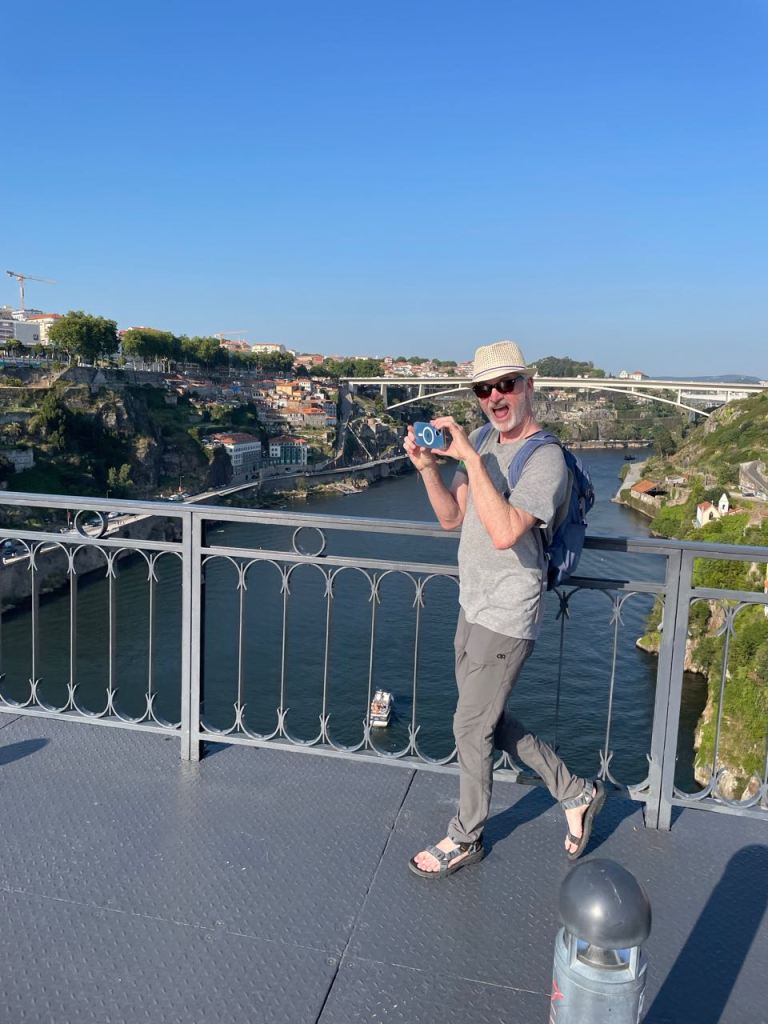
We’ve been honored to have had numerous friends and family over to visit us in Portugal. We don’t actually like all of ’em, but despite that, we always endeavor to show them a good time. For instance, take my friend Jeff Davis here. Please.

Actually, Jeff was a model visitor: he’s very low maintenance, he seemed to enjoy every sight we saw and rarely complained, even when I was beating him over the head with a hammer. I’m not kidding about the hammer, you’ll have to read on for the full details. (I had to put a little enticement in here because this turned out to be a long entry).

I first took him to our cute little castle in Sesimbra. Even though we’ve toured it about thirty-seven times (or however many people it is that have visited us… come to think of it, maybe it’s only two). Anyway, the vista overlooking the beautiful town of Sesimbra is beautiful, and of course it’s always amazing to walk on walls that were built in the 1200s. Going back even further, the castle was erected on a site that was occupied during prehistoric times. Some say that if you listen really closely, you can still hear the echoes of Fred Flintstone’s last Yabba Dabba Do!

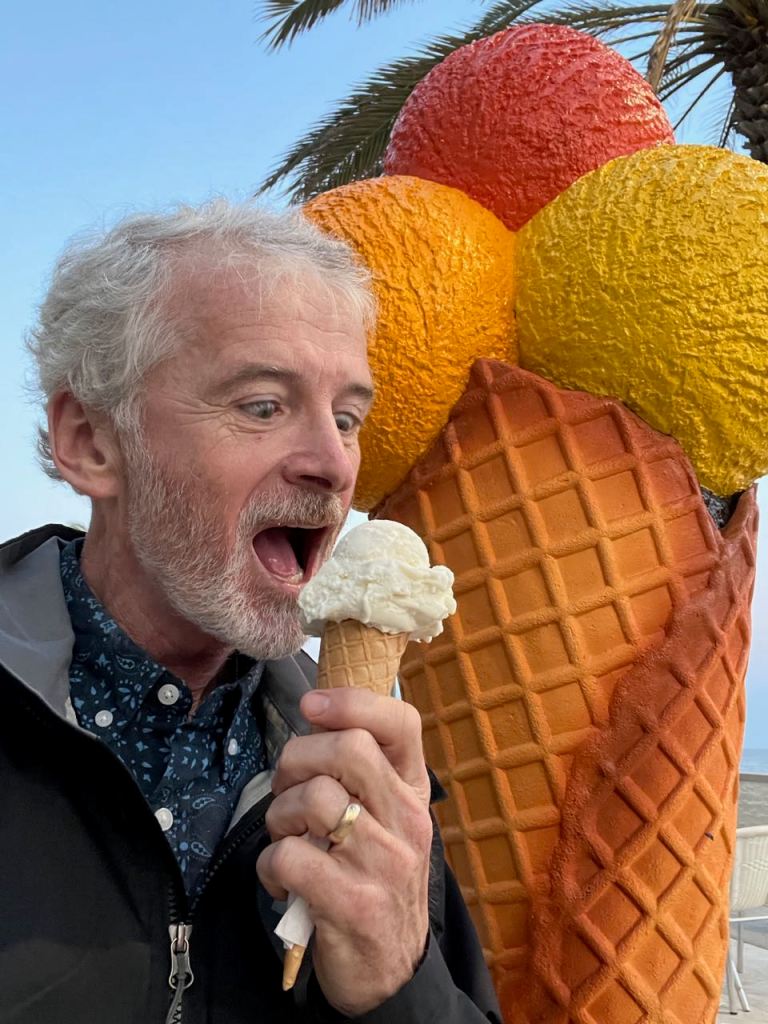
Once Jeff discovered that Portugal actually has electricity and running water, he was all about finding some ice cream. I didn’t have to heart to tell him it was made from cod.

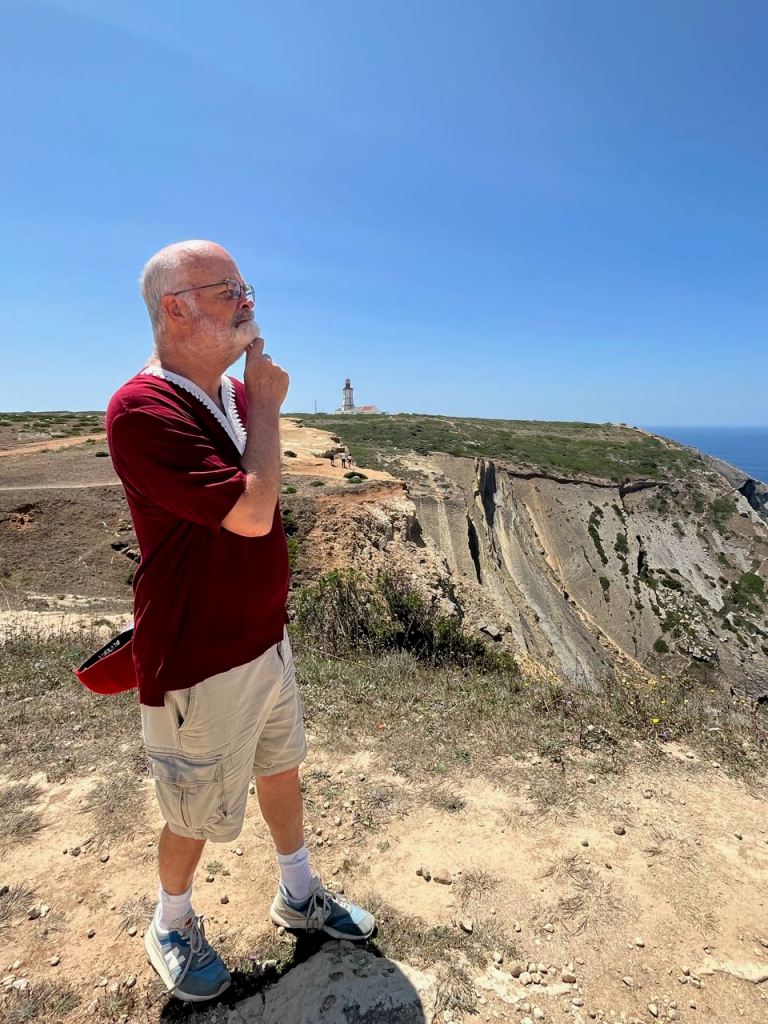
Great thinkers love to contemplate the meaning of the universe whenever they’re near lighthouses. I, on the other hand, was just trying to remember where I put my hat.

After spending 4-1/2 hours mapping out our road trip, we celebrated the completion of our itinerary plans with the traditional Portuguese cod kidney & snail oil slushy. The highway on the map may look like more or less a straight line, but some of those straightaways can seem very daunting when you’re too old to remember why you were there in the first place. Hey… do I get a senior citizen discount on my traffic tickets now?

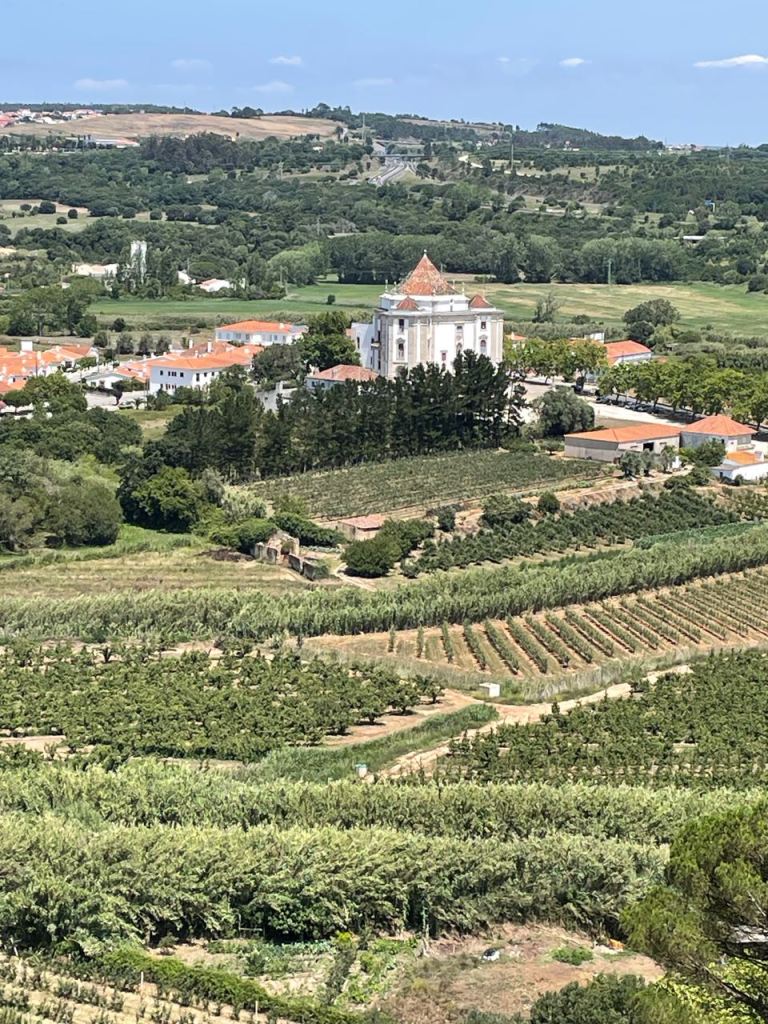
On our drive to Porto, we stopped in the town of Óbidos, with its medieval village and beautiful castle complete with gorgeous views of the countryside.

Jeff was very impressed with the size of the ancient Portuguese heads. Personally, I think this was probably just the top of the queen from a giant chess game, one that must’ve petered out because it took them three days and 15 cubits to make one move.

Anyway, it was all a hoot. And that’s owl I have to say about that.

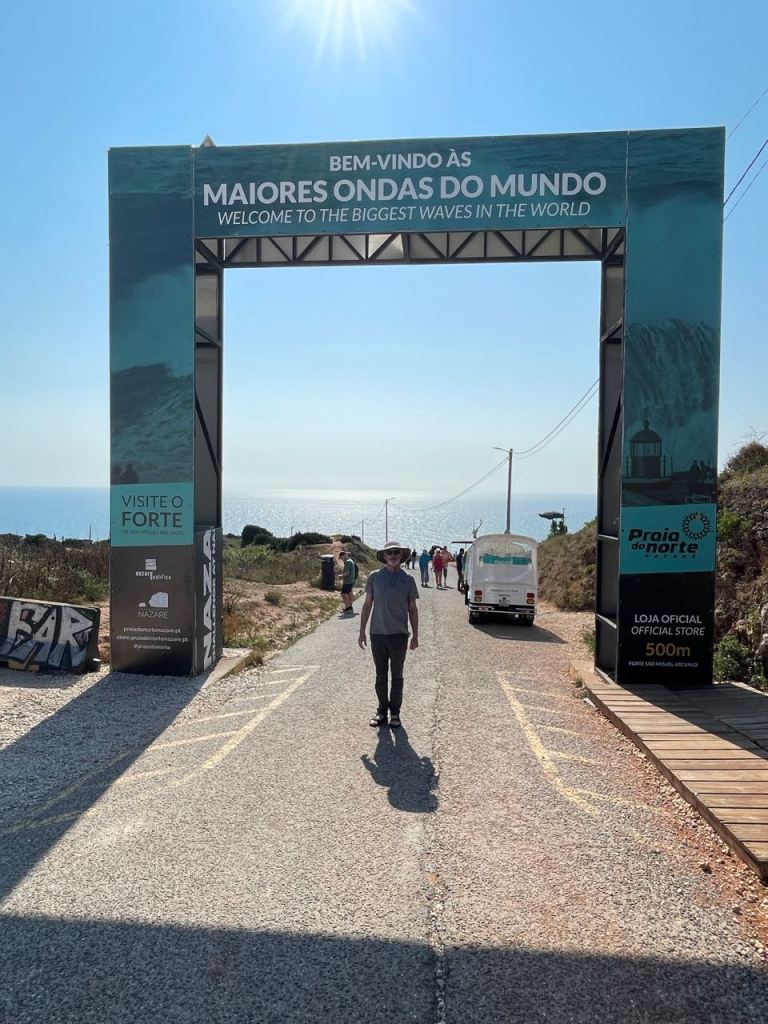
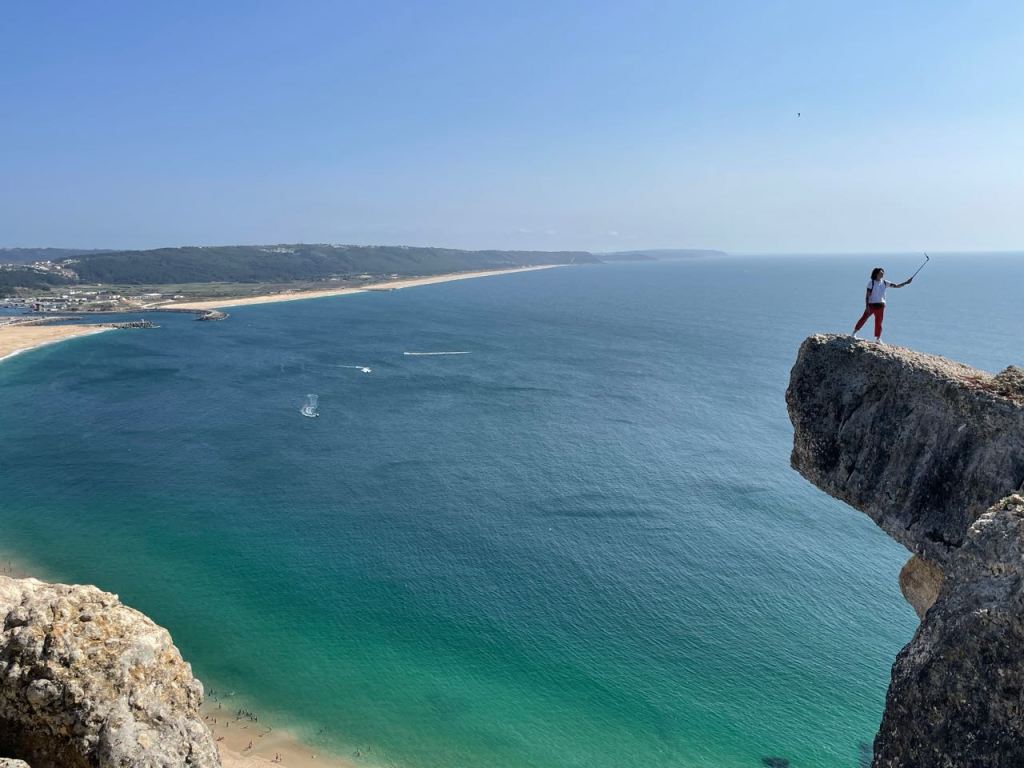
From there we traveled to Nazaré, which has transformed from a sleepy fishing village (that is if you define “sleepy” as “the place where fishermen have to navigate some of the most treacherous beach waters in the world”) to a tourist hotspot largely due to the records set for the tallest surfed waves in the world.

Unfortunately, this sign was the only thing that might have proven it given the fact that the water was almost as smooth as glass while we were there. June is not a good month for waves at Nazaré, apparently.

Fortunately, we did get some excitement by watching a complete idiot taking a selfie on a ledge, clearly on the other side of a sign that said: “Do not cross this boundary unless you want to end up on the Darwin Awards.” Actually there should have been a sign that simply said, “Y’know, if you’re that stupid, do our gene pool a favor and go for it!”

But they never listen, do they? Probably ruined the selfie stick too, pffft.

This hunka-hunka burning love symbolizes manliness and adventure, as illustrated by the white top intimating a deep commitment to truth and justice, the casual stance portraying total fearlessness, and the pronounced bulge making you wonder what disease his junk has. As for the statue, its name is Veado, and you can read all about it by clicking on Veado. I don’t have a link for the hunka-hunka burning love because Jeff (as in the Jeff Davis of 12523 Wilmington Drive in Auburn, Washington) asked for complete anonymity.

I hate to show photos of Nazaré without also displaying the amazing waves they get. You have to realize that even though they break records here (the latest being 26.2 meters, or 86 feet, or 57.2 cubits), the dramatic photos are the result of expert telephotography, something I have no ability to do with my iPhone. Especially since there weren’t any waves, except by those who had the presence of mind to wave goodbye to the falling selfie taker.

Jeff poses by a couple of surfboards showing either how extraordinarily long they are or how extraordinarily short he is. Either way, if you look very closely at the photo on the left you can see that the surfer is using the exact same surfboard that Jeff might have been standing next to had that been the same surfboard. Maybe it was, I dunno, I can’t even read signs in English anymore.

After a harrowing drive on a straight modern freeway we celebrated making it to our final destination alive by whipping out a couple of bottles of Pedras fizzy orange drink. Here’s a little truthful piece of trivia: “Pedras” in Portuguese means “stones.” So I guess because marijuana isn’t technically legal here, you have to get stoned on fizzy orange drinks chased with an espresso. You can tell Jeff is already absolutely hammered.

Anyway, we made it to Orto, whose motto is, “We don’t allow any p here.”

As you can see by the above, Orto is a beautiful Ortuguese city.

This is the inside of a store that sells nothing but sardines. I know you probably think I’m joking because of that one joke I told so far in this blog, but I’m not… only sardines. Mostly in tins with years prominently displayed on them, which doesn’t indicate the year of manufacture (I hope), but the year of someone’s birth, just so your loved one will get all weepy at the thought of you remembering their birth year by buying them a tin of sardines.

When I asked an employee about my birth year she acted surprised and muttered something about a basement no one ever goes to, so I just pretended I meant to ask for the restroom and then wandered over to listen to their free opera singer instead. Actually what’s kinda funny about that picture is that she’s up there singing but not one person in the photo is paying any attention. I guess it’s hard to get excited about much else when you’re surrounded by sardines.

Elsewhere in Porto they cooked up sardines on the sidewalk (well, not actually on the sidewalk, although it was hot enough whereby they probably actually could’ve), but I was leery of trying one because they didn’t have any dates of manufacture stamped on them.

Sardines weren’t the only street food. This guy was serving up the remains of the selfie-taker, promising that the big shark bite wouldn’t affect the flavor.

OMG, everyone says. “Now he’s joking about cannibalism!” But I say, “Hey, even cannibals deserve to have a sense of humor!”

Come to think of it, where’s Jeff?

Oh there he is! Phew! After I double-checked his ribcage, we wandered the city, gazing upon assorted phallic images. “Look honey, this one is ten inches long!”

It turned out that we happened to visit Porto during their biggest celebration of the year: “The Return of the ‘P’.” No, just kiddin’. It was the São João festival (Festival of St. John), which, according to Everything you need to know about São João Festival in Porto, originated as a pagan festivity back in the 14th century as a celebration & thanks to the sun god for a good harvest and abundance. It was later christianised as a celebration to São João by the church, but many of the pagan customs persist even to this day, like the usage of wild leek, basil and bonfires (we missed those). All in all, in its many incarnations, this festival has been celebrated in Porto for about 700 years and it is truly part of the city’s identity.

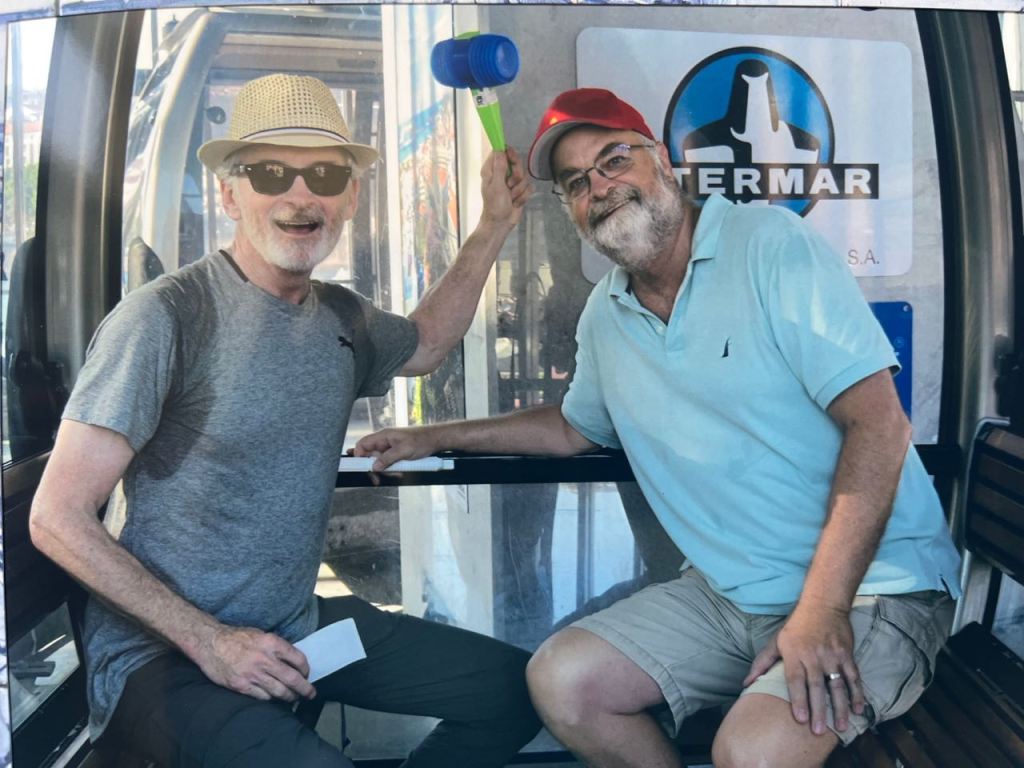
One of the quirky additions to the festival includes a tradition whereby people purchase plastic hammers and bonk everyone on the head with them. And I mean everyone… kids, grannies, quadriplegics, you name it. To test the theory, I even walked up to two cops and bonked them both. Like almost everyone else we bonked, they smiled playfully, and then were very gentle with the handcuffs. Seriously, the Portuguese rock. This was really a fun way to walk around town. Almost no one got irritated at the bonking, well, except a lady with a bouffant hairdo walking into a funeral home. Pffft. I know, right? Anyway, it’s fun to be bonkers.

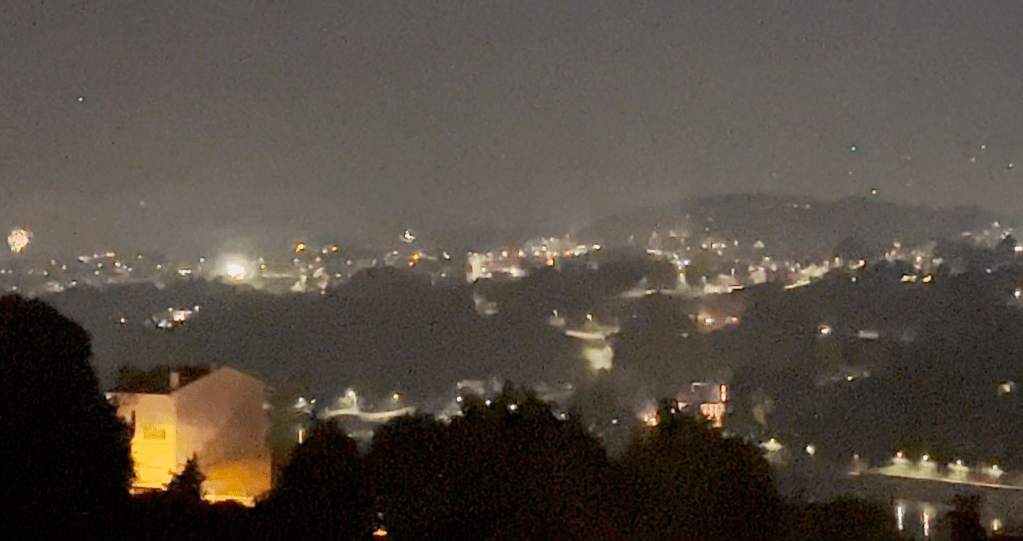
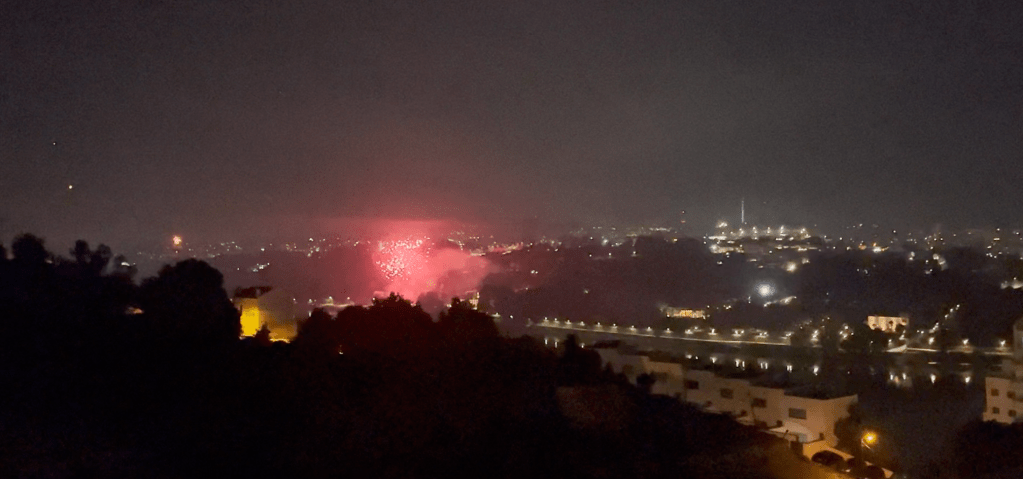
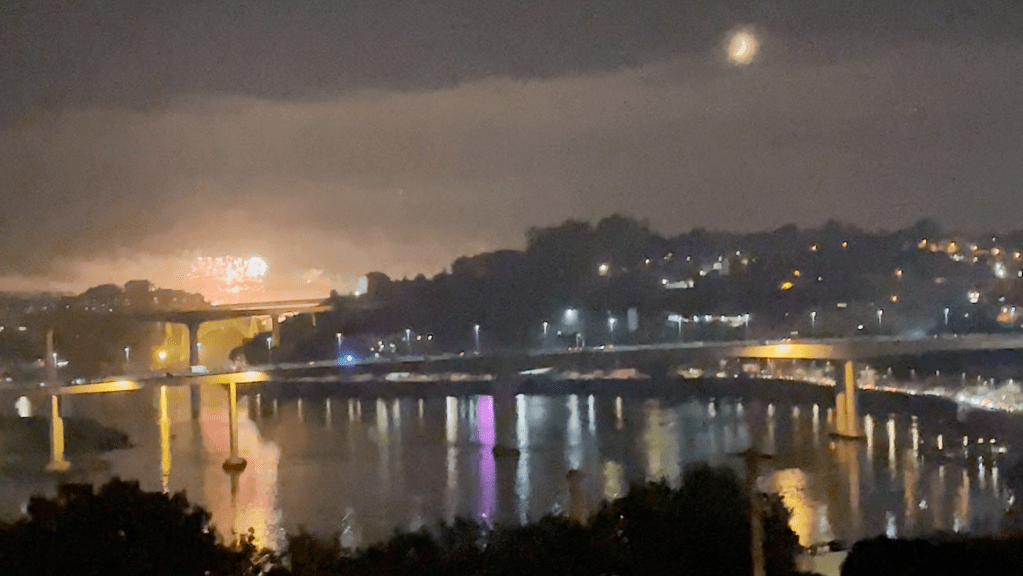
We were fortunate enough to have booked an apartment that overlooked Porto from the other side of the Douro River. I’m not much on fireworks nowadays, but I have to tell you that this was easily the most impressive fireworks display I have ever seen. There were at least half a dozen launch sites we could see, and one of the main ones did their thing for nearly an hour.

The pyrotechnics went on so long that we waxed a little philosophical as to how special St. John must’ve been to deserve all this celebration. Our conversation went like this (I have it on video, but I can’t put that on here because I’m too cheap to pay for the necessary upgrade):

“Saint John must’ve been a helluva dude…”
“Yeah, he was a gooood-looking’ man…”
“And he had him some pretty lips…”

Having too many orange fizzy drinks can mess with your head.

Sadly, not everyone was in a mood to celebrate, especially the folks who live in the building that caught fire. Dunno if it was due to errant fireworks or what, but it’s a good reminder that’s there’s always someone having a worse day than you.

After we recovered from our orange fizzy drink hangovers, we hit the road again, this time visiting the Douro Valley, specifically here, Sebolido (which I only know because that’s what the metadata on the photo says). It was hot as hell, but, as with most Portuguese places, absolutely gorgeous.

Onward we traveled south, next stopping in the city of Coimbra, home to the University of Coimbra, which was first established in Lisbon in 1290 until it moved permanently to Coimbra in 1537. The university is one of the oldest universities in continuous operation in the world, and boasts views like the below. Oh, I mean the ones above.

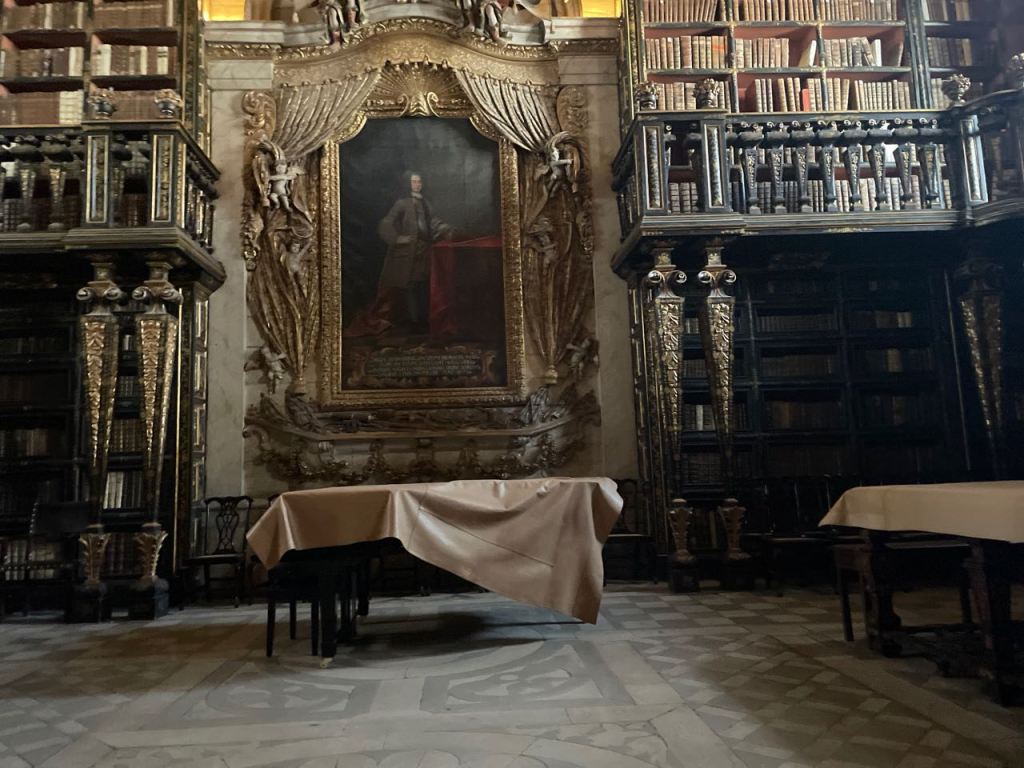
Its university has a huge old library, full of books that I imagine would fall apart if you opened them. I say “imagine” just in case any Portuguese law enforcement personnel ever read this blog.

“Why are we running?” was a common phrase uttered by Jeff throughout our visit.

They have a big “NO PHOTOGRAPHY” sign in the library, which I promptly tried to circumvent by stealthily shooting this shot from my hip like I was pretending to check the time on my iPhone, but I forgot to turn off the stupid camera click sound, which meant the guard was on me like I had just spray painted the Mona Lisa. I promised to behave if he’d just take his boot off my neck. Actually he was reasonably nice about it all and didn’t kick me out, but I was under his watchful gaze during the rest of the visit. It was all worth it because now I have a picture no one else has! See, sometimes a life of crime has its rewards.

Near the university was a science exhibit which we got into free because it was included with our University admission ticket. As you can see, we take our scientific education very seriously… or maybe you just get what you pay for.

Now, it may appear to the casual reader that I put Jeff in constant danger, what with the treacherous castle walls, killer owls, dangerous selfie shots, 100 foot waves, cannibalism, head bonking, house fires, dangerous fireworks, aggressive library cops, and man-sized houseflies, but I absolutely assure you from the bottom of my heart that if I ever find out where his body ended up, I won’t eat him.

We’re looking forward to our next visitors!

Vasa we talkin’ ’bout?

Only one of the most amazing museums we’ve ever seen!

As we meandered around the harbor in Stockholm on our Hop On Hop Off boat, one of the stops included a a sign pointing to something called the Vasa Museum. Now, you have to understand, we have visited approximately 3,413 museums during our time here (give or take), so let’s just say we don’t get all twitterpated at the idea of seeing yet another one.

The Hoppy boat arrives at each stop every hour, so we knew we’d be killing an hour to check it out, but we figured what the heck, let’s peek inside the building and see what’s what and maybe get lunch anyway. Three hours or so later we walked out of that museum, eyes blinking in the sunlight, completely amazed at what we’d just seen. Screw the Hop On schedule, we were hopped up on history at that point, and we completely understood why that is the most visited museum in Sweden.

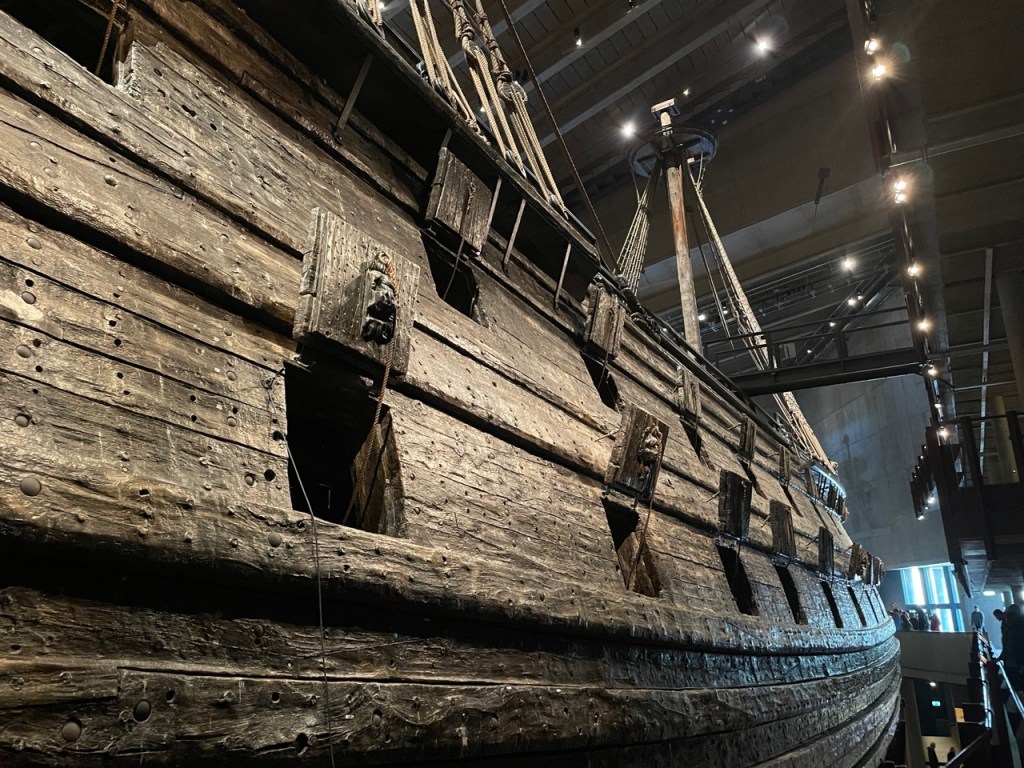
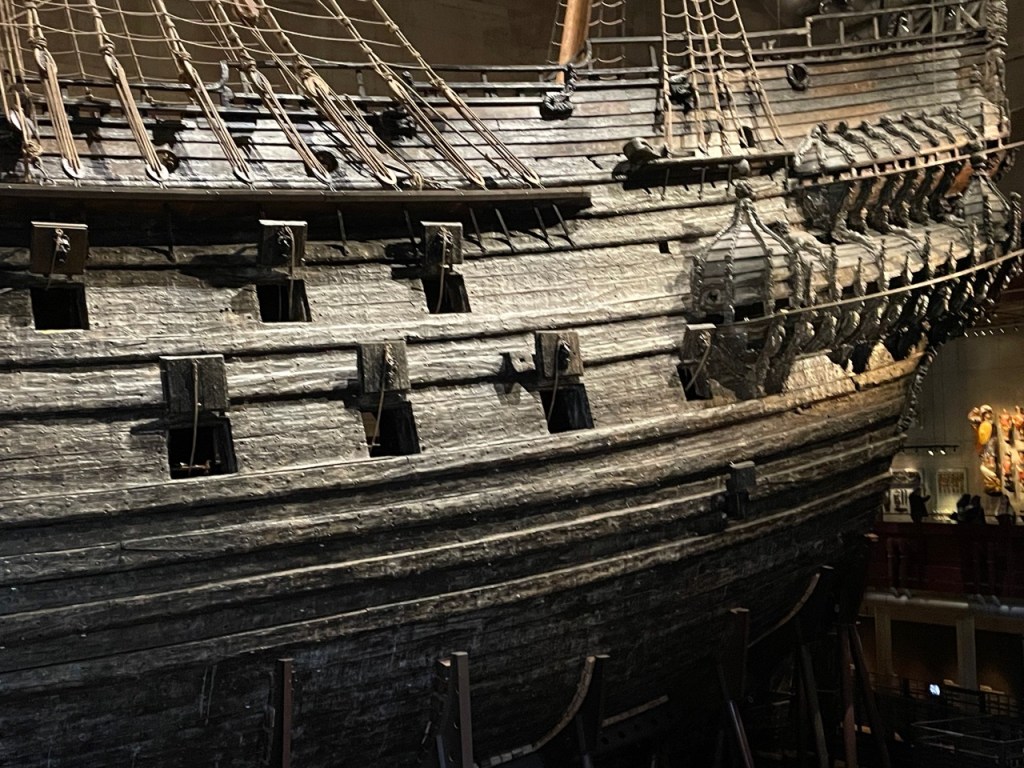
The story is that In 1628, on the 10th of August, Sweden launched a brand new warship named the Vasa. Bristling with cannon and colorfully adorned, she was one of the most powerful vessels in the world at the time. The townsfolk came out to send her off with much fanfare and popping of Swedish meatballs (or whatever they used)… only to watch it sink after traveling a total of 1,300 meters (1,400 yards).

Bummer.

(In fact, I think that’s when the word “bummer” was first used, except in Swedish it’s pronounced “Hølie-shȅit.”)

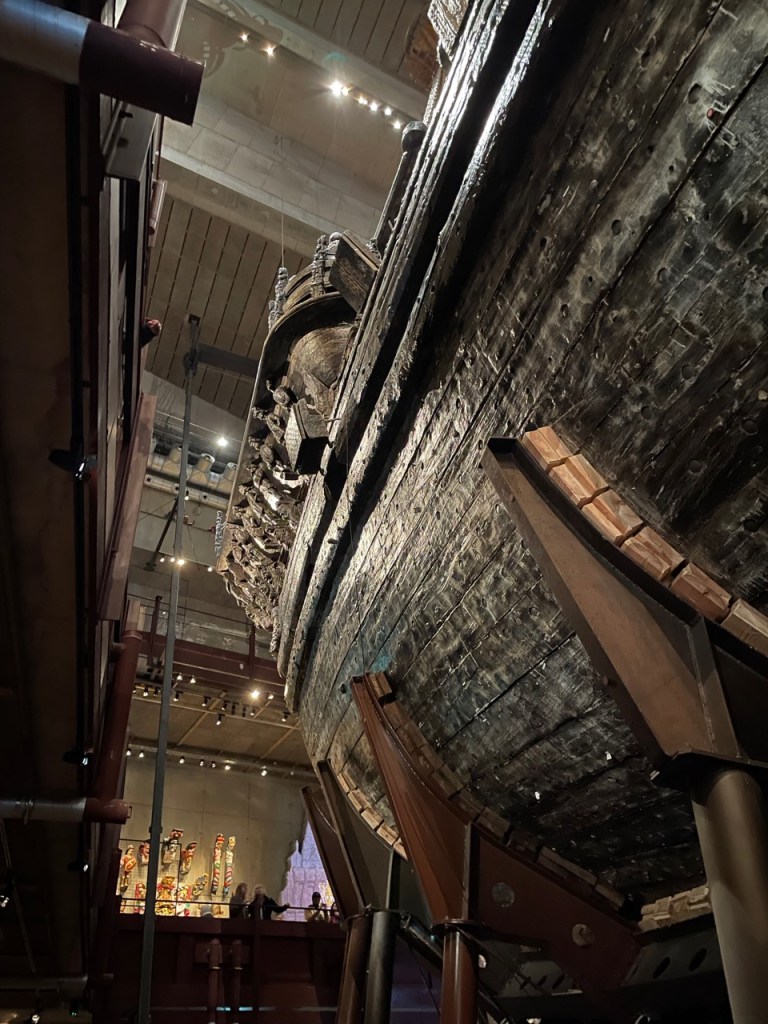
So there it sat for 333 years until they finally figured out how to lift it up out of the water. What they recovered was a nearly complete example of a 17th century warship, plus a few flounders.

They also found thousands of artifacts as well as the remains of at least 15 people, who by then were definitely thoroughly drowned. The Vasa is known as the world’s best preserved 17th century ship, although I gotta think it’s gotta be one of the best preserved ancient vessels ever, other than Keith Richards.

Here’s the ship-building harbor where the Vasa was constructed. I am amazed that they had photography back then. What? Oh. Carolyn is telling me that’s a diorama, apparently so-named because lots of people died-a-rama after it sailed three quarters of a mile.

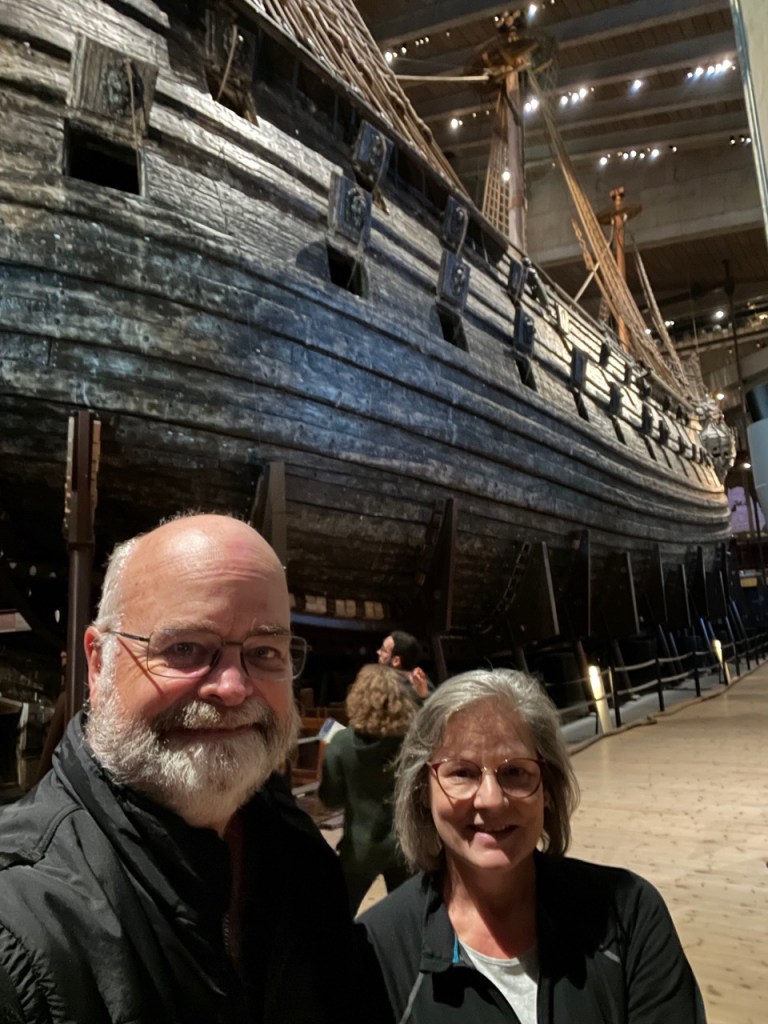
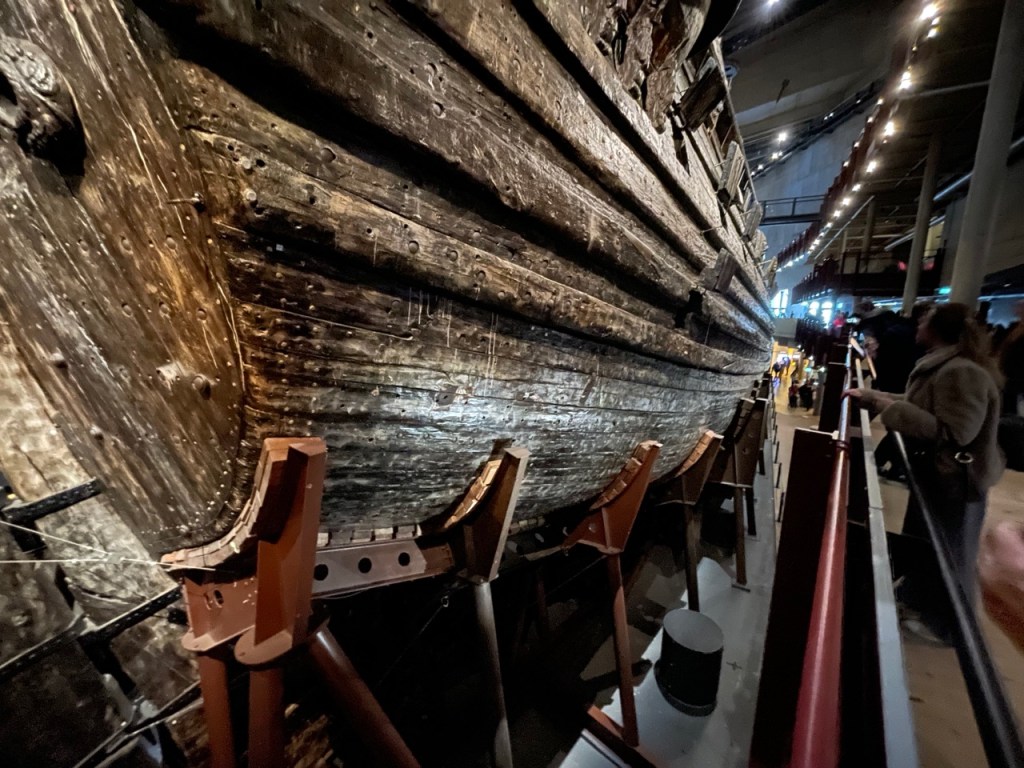
We’ve all seen sailing vessels in the movies (and seeing this made me feel as if they are generally pretty accurate), but it’s really something to see the real thing in real life. The ship is approximately 98% complete and original, and it’s rather huge.

This might give you a little perspective as to its size. It is 69 meters (226 feet) long and 52.5 meters (172 feet) high, which means it traveled only about 19 times its length before it glug-glug-glugged to the bottom of the harbor.

To think of it another way, the ship is 140 cubits long and 106 cubits high, whereas Noah’s Ark was 525 cubits long and essentially the same height, meaning Noah’s Ark would’ve been about 3.75 times longer. Since the Vasa didn’t fare as well as Noah’s Ark seaworthiness-wise (probably smelled about the same though), they would’ve been well-served to have boned up on God’s own measurements before they finished the craft. Anyway, cubits have fallen too far out of fashion, I’m gonna start measuring everything in cubits from now on.

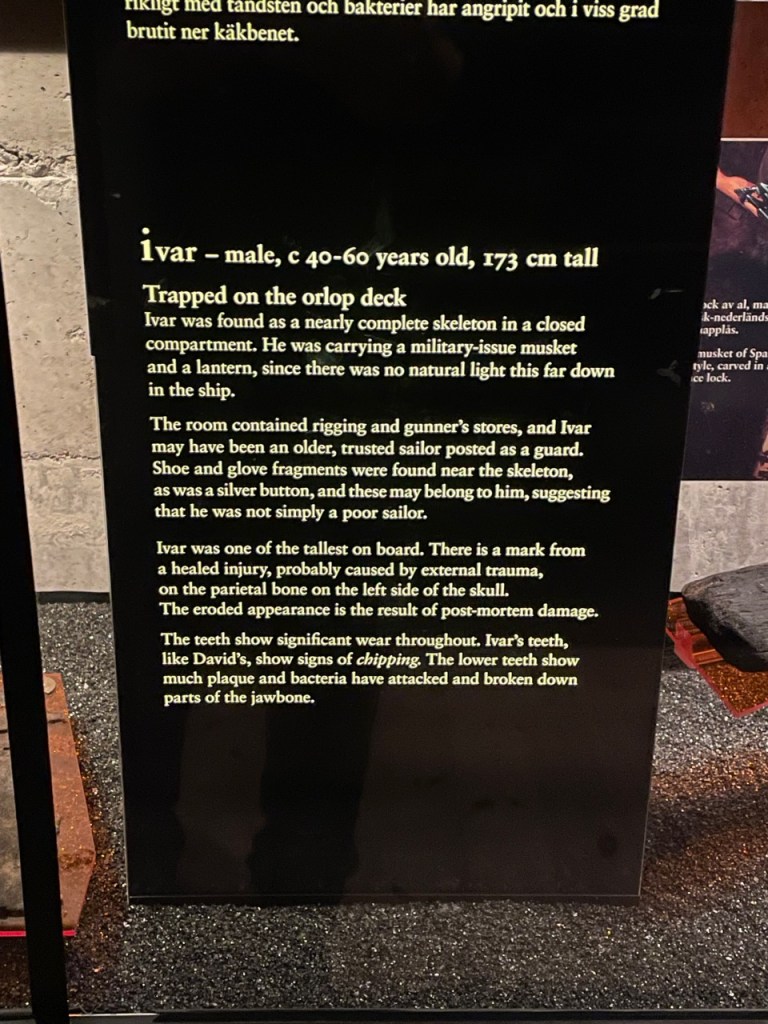
One of the most fascinating parts of the exhibit were the bones of some of the people they found. They note above that this guy was 5’8″ (173 cm or 3.78 cubits) tall, making him one of the tallest on board. Fortunately, basketball hadn’t been invented yet so this didn’t bother them.

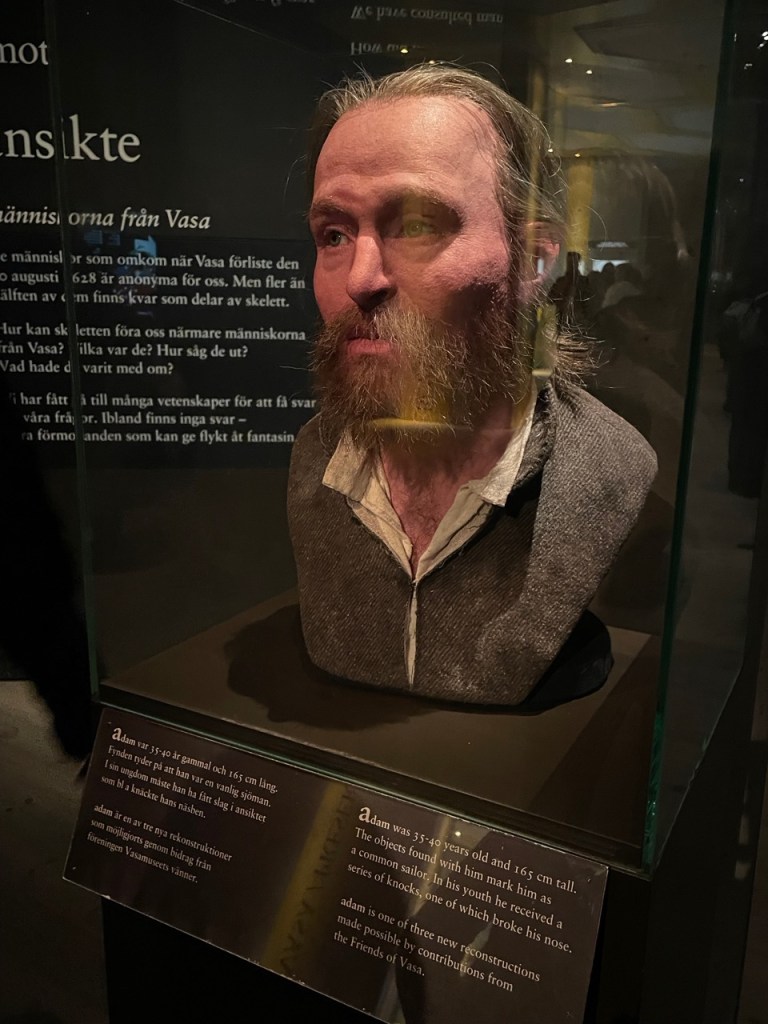
What was striking in the descriptions they provided after analyzing every set of bones with a magnifying glass, a microwave oven and some dental floss (you’d be amazed what you can do with that combination), they determined that, in summary, almost no one alive today with normal aches & pains, diseases, hemorrhoids, swollen cubits, or the heartbreak of psoriasis should complain about any of it, because those guys were beat up all to hell, even in their thirties and forties. Most of them had badly-healed broken bones, horrible teeth, signs of various diseases and probably pretty bad breath too. Just be glad you’re alive today, and weren’t back then.

One of the things we’ve learned during our travels is despite everything historical looking black & white, many of the statues and other decorated things were really quite colorful.

For instance, here is a depiction of an ancient statue portrayed as it probably looked like way back when. The results are quite striking, actually, although the guy on the left looks a lot like the spoiled antagonist in a teen comedy, whereas the guy on the right looks he is spending way too much time inside on his iPad.

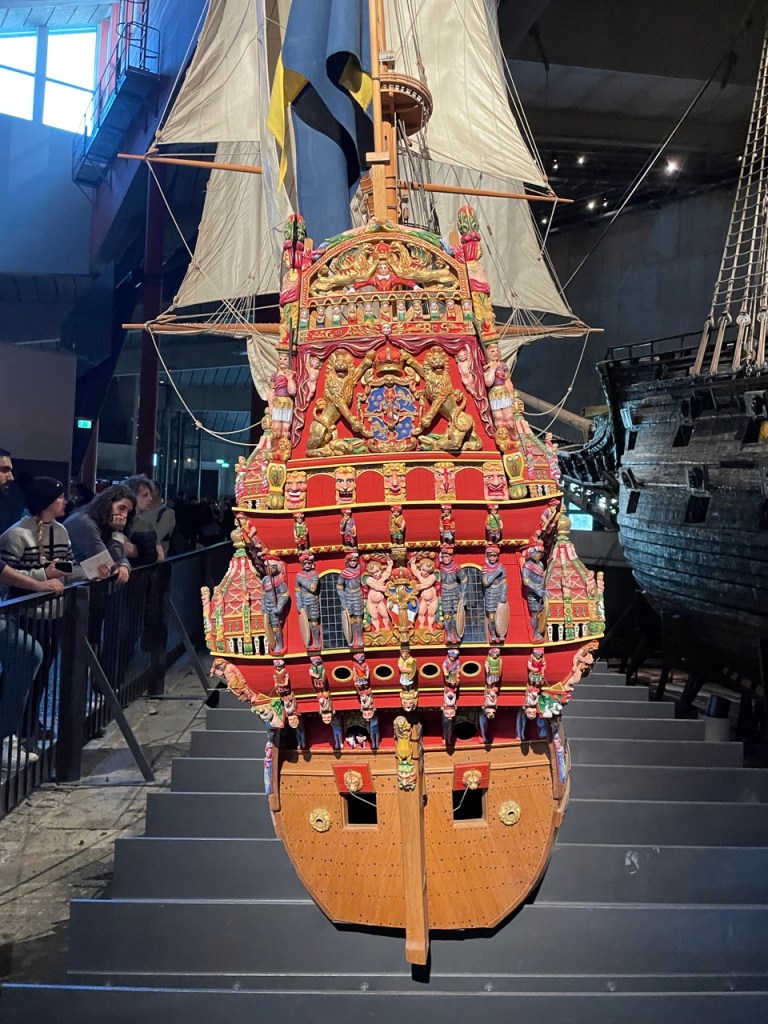
Anyway, this is how they figure the Vasa looked during its maiden voyage, which lasted just a little bit longer than the first time maidens stop being maidens, if you catch my drift, which the Vasa clearly caught too much of, if you catch my drift about drifts.

(Say “drift” quickly ten times and it starts to sound very weird, if you catch my drift about saying drift.)

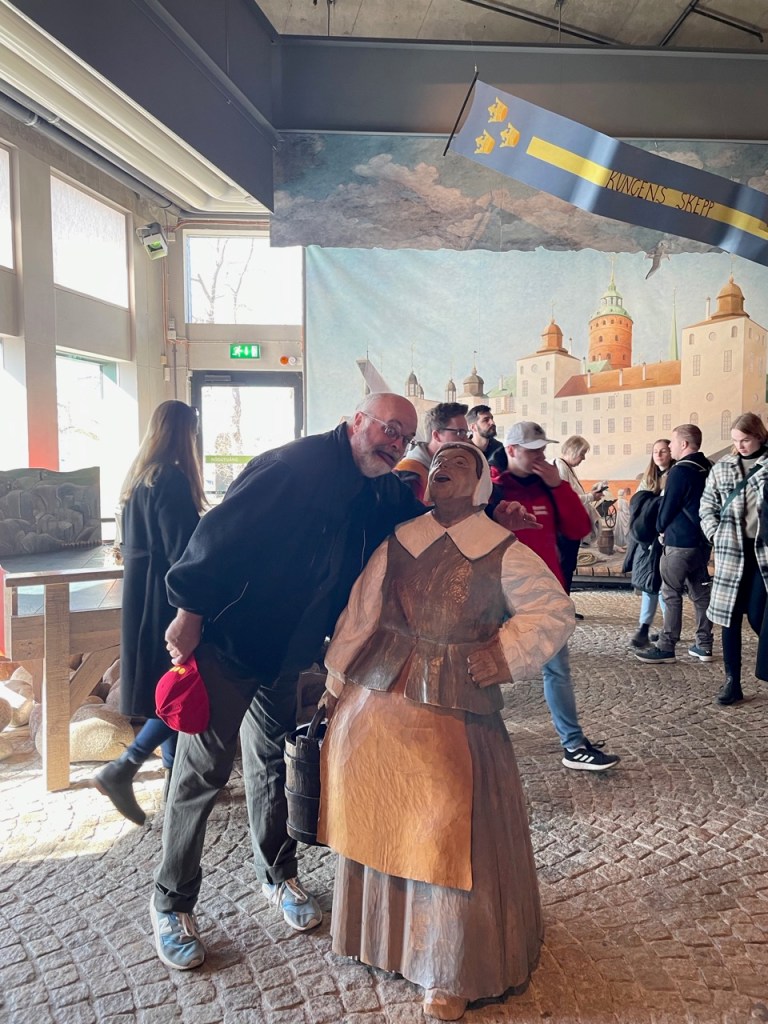
Speaking of maidens, what man could keep his hands off of this beautiful maiden, even old-fartished ones? Although she’s clearly enjoying my pinch on her bum. Cheeky!

We walked around the ship multiple times, snapping photos and marveling at what we were seeing. I mean think about it, in the 1600s, the first permanent English colony on American mainland in Jamestown was established, Galileo showed the Copernican system in which the planets circle the sun was correct (and thus was declared a heretic), William Shakespeare dies, no one knew how long a cubit was, and Joe Biden was born.

In other words, it was a long freakin’ time ago. It truly felt like a time machine to be in the presence of that ship. If you ever get to Stockholm, don’t miss it!

Our Swedish adventure wrapped up shortly thereafter. Here are just some final photos. The above was taken simply so I could ask the question: why do most of the school buses in the U.S. still not have seatbelts? As a bit of trivia, they don’t even have school buses in Portugal and many other countries, maybe because they saw the seatbelt-less buses in the US and said, “What the––?”

I love it when cities provide art just for beauty’s sake. The Stockholm subway system has a whole series of beautiful artworks scattered throughout. We almost rode the subways just to see the art, but we ran out of time so I stole this off the internet. You can read up on it and see more here.

Speaking of beautiful art…

And so we packed our apparently too-long legs into the sardine cans they call air transport (apparently designed for Swedish sailors from the 1600s) and sailed off into the sunset, basking in the memories that the fantastic countries of Denmark, Norway, and Sweden provided.

Who’s more of a meatball, the Swedes or us?

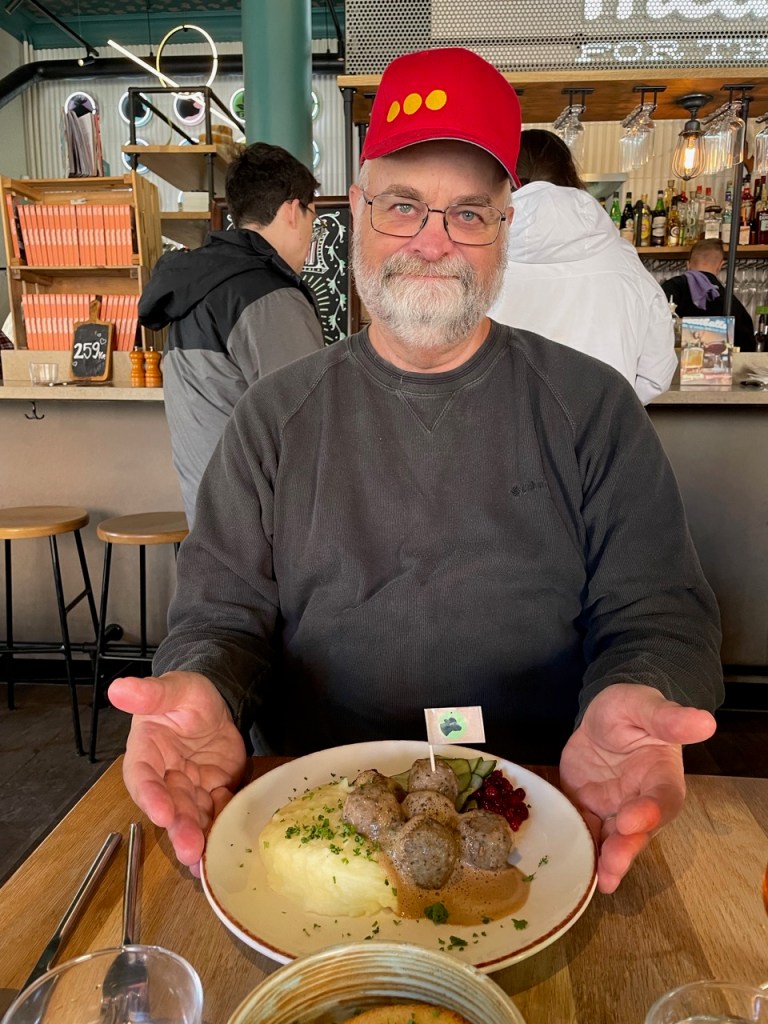
We spent most of our time in Stockholm simply wandering the streets and getting a feel for the city. All that walking of course works up an appetite, and we thought we should probably eat a popular Swedish national dish. When I investigated Swedish foods, I discovered that many Swedes are apparently happy to nominate pizza and hamburgers for the honor of best Swedish cuisine. I guess if you’re eating a lot of reindeer meat, a good old-fashioned pizza is bound to hit the spot. But, there is one food that stands out as distinctly Swedish… I give you Norwegian meatballs, of course!

Huh? What’s that? Oh, sorry, I meant Swedish meatballs. These Scandinavian countries confuse me with their scandimilarities.

I did some digging on the internet and found something of a consensus that a restaurant called Meatballs for the People serves some of the best Swedish meatballs in town, plus they have the coolest restaurant name ever. So we walked to the restaurant, hitting it just at the right time because normally you need reservations. But even though we we appeared very confident, they gave us a table anyway.

(As an aside, the search engines also returned “the original Ikea” as a great place to go for genuine Swedish meatballs. So next time you’re in an Ikea, feel free to revel in the genuineness of their foreign cuisine.)

I was a little excited because they offered reindeer meatballs, something I’ve never eaten. Unfortunately, they only serve the same type of meat per order unless you order some big feast thing, and I just didn’t want to take a chance to ruin my Swedish meatball experience with the meat from one of Santa’s pets being the only option on my plate and tasting like, I dunno, Rudolph’s butt. And so I remain reindeer-meatless in my life so far. I hope to get a second chance when we take our cruise to Norway in January. Stay tuned!

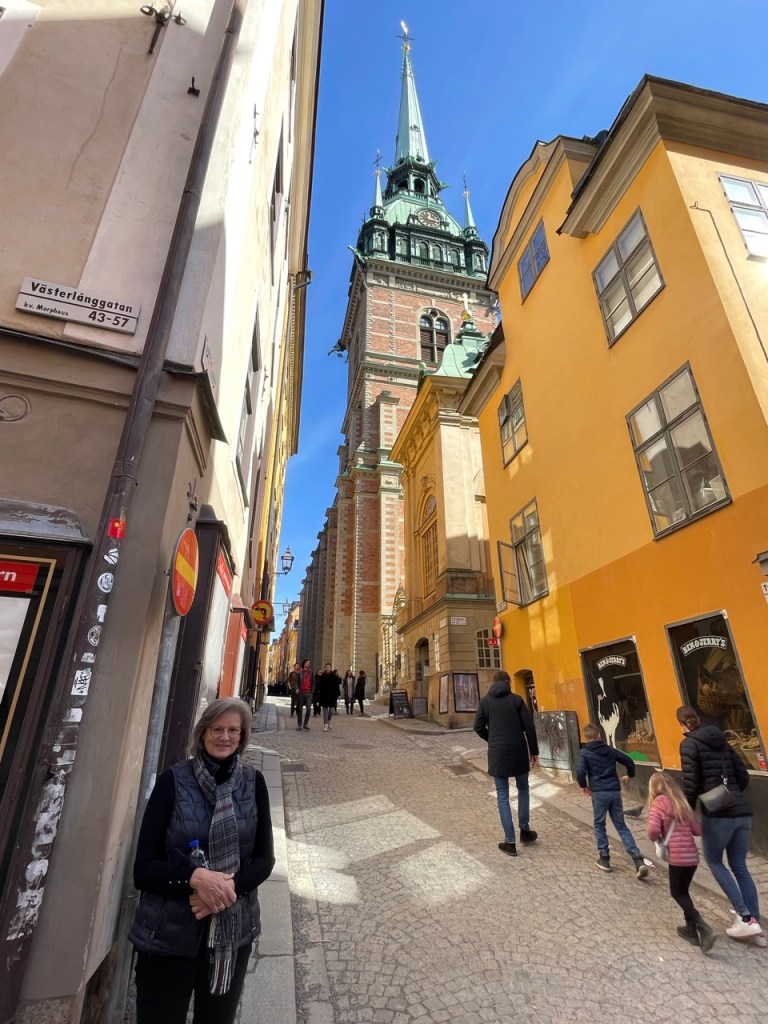
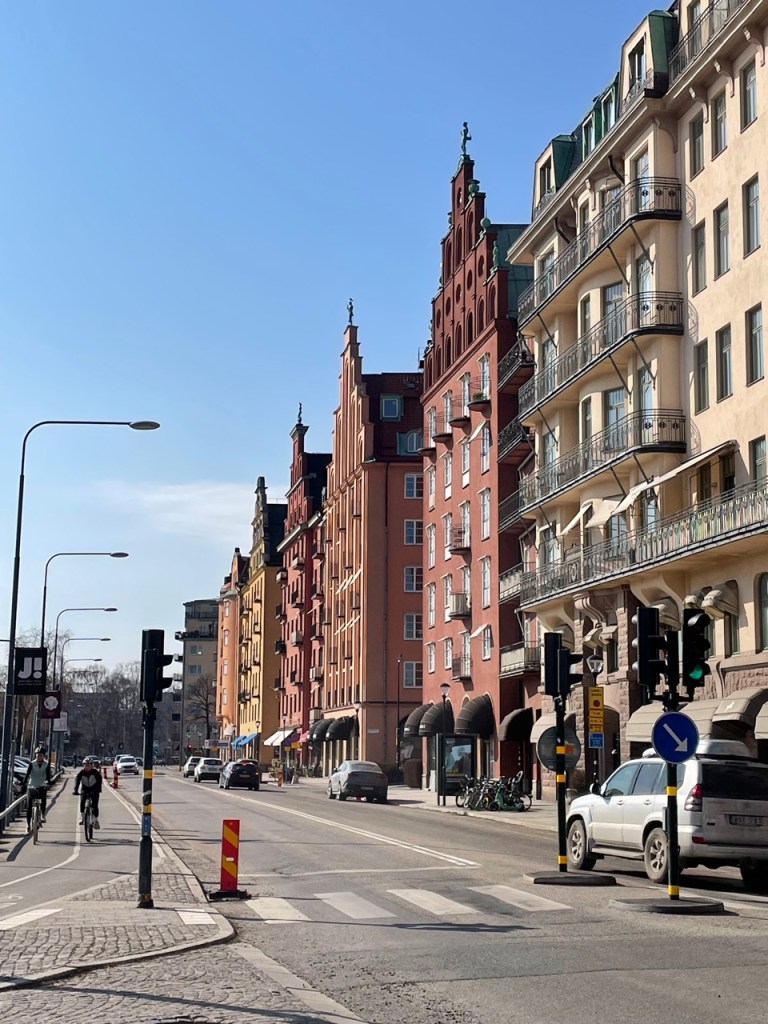
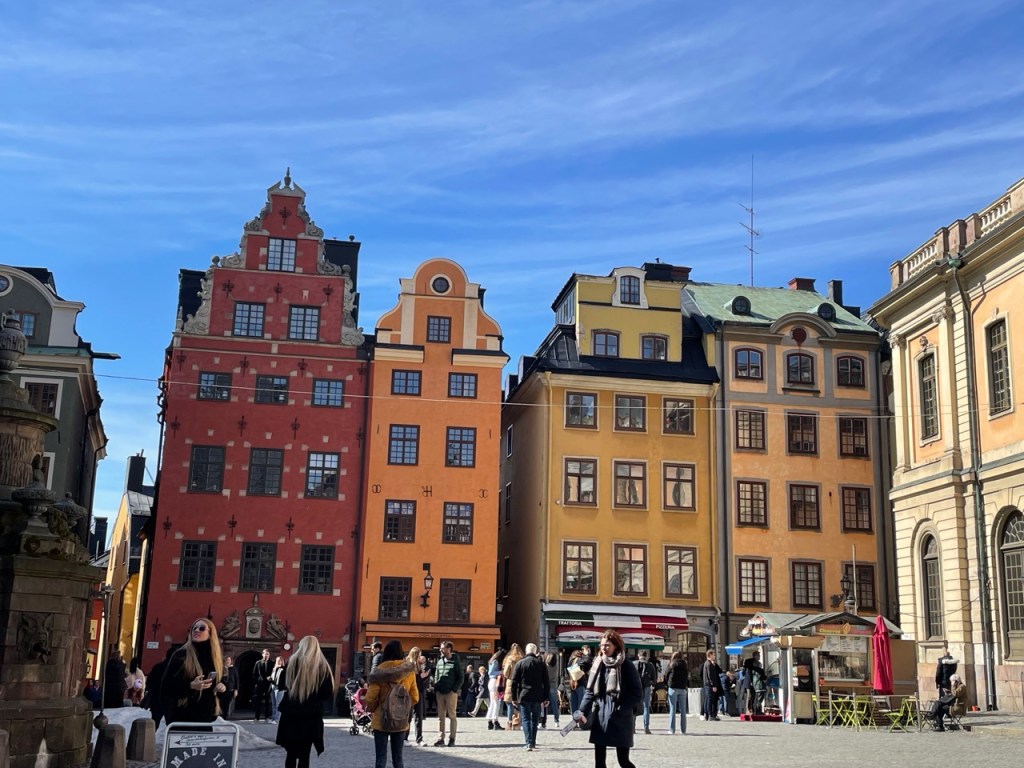
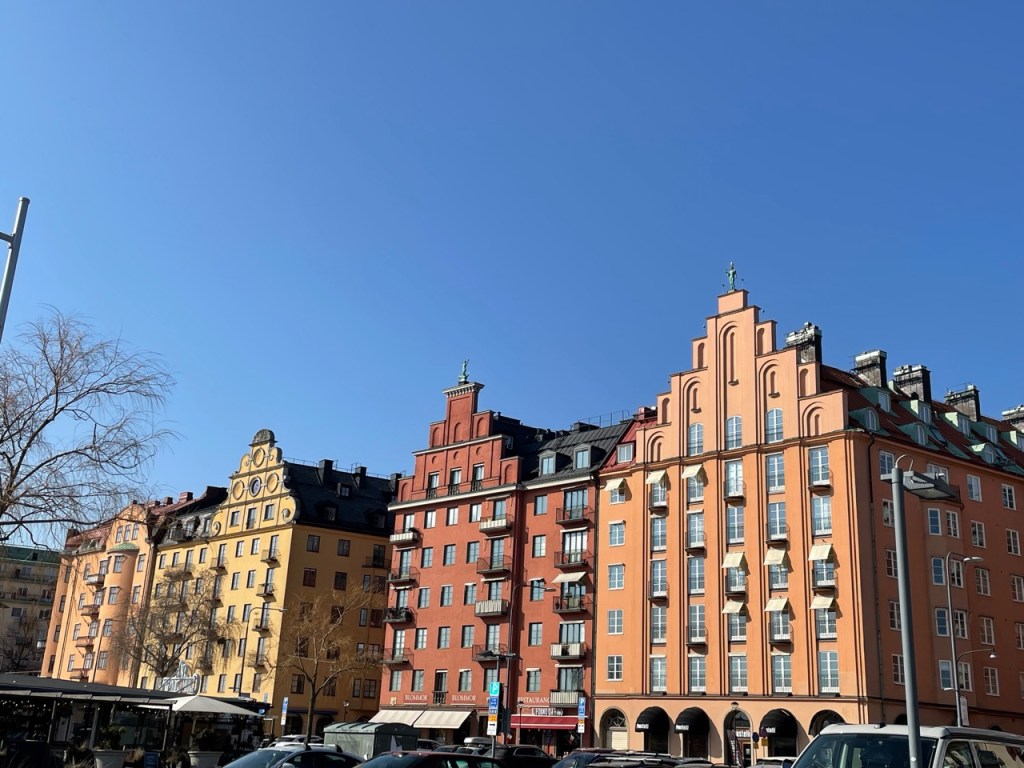
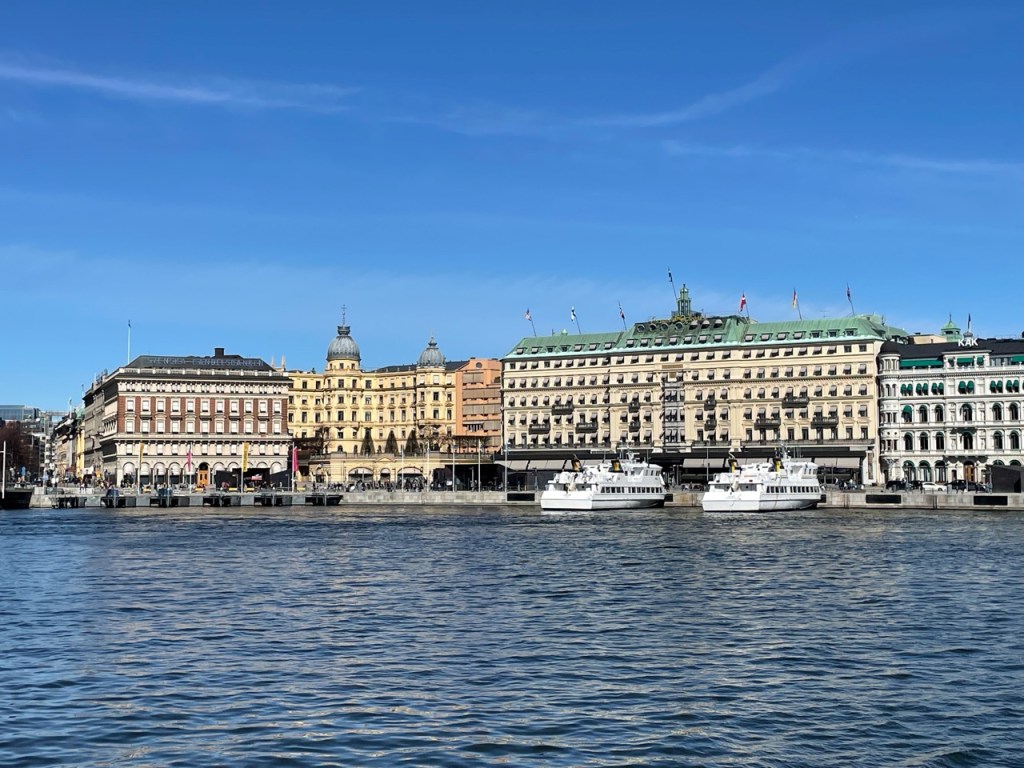
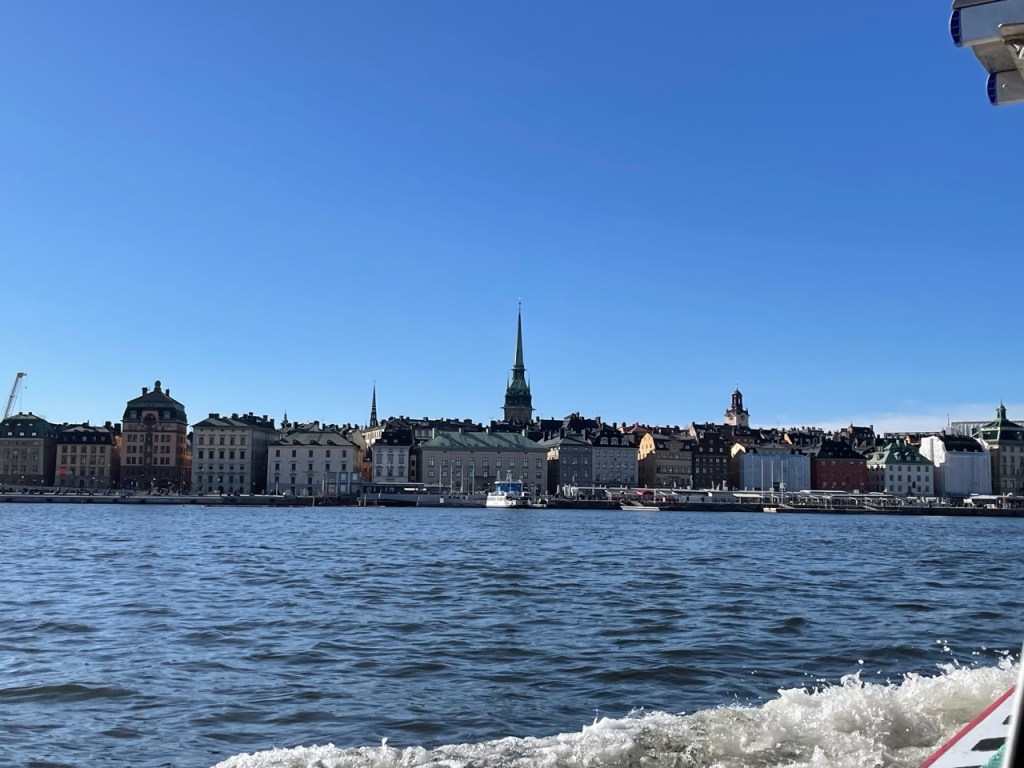
I don’t always do this, but rather than try to identify every damn building we saw in Stockholm, I’m just posting a series of pictures that we took. I think it offers up a good sense of Stockholm in any case. The city is so clean and safe and well taken care of, and hopefully you can see that from these pictures.

To be brutally honest, I now nominate the Scandinavian countries as the ones who most “have their shit together.” After visiting, I realized Bernie Sanders has a point… the US could do a lot worse than emulating these countries. But I wondered, was it only skin deep? Do they make their cities look pretty while underneath it all is a seething caldron of resentment or unhappiness? So I did a little comparison to find out, the results are at the end of this entry.

But how can you not be impressed by a city whose police headquarters looks like this? I almost felt like getting arrested in order to get a free tour of the inside, but Carolyn made me put the eggs down.

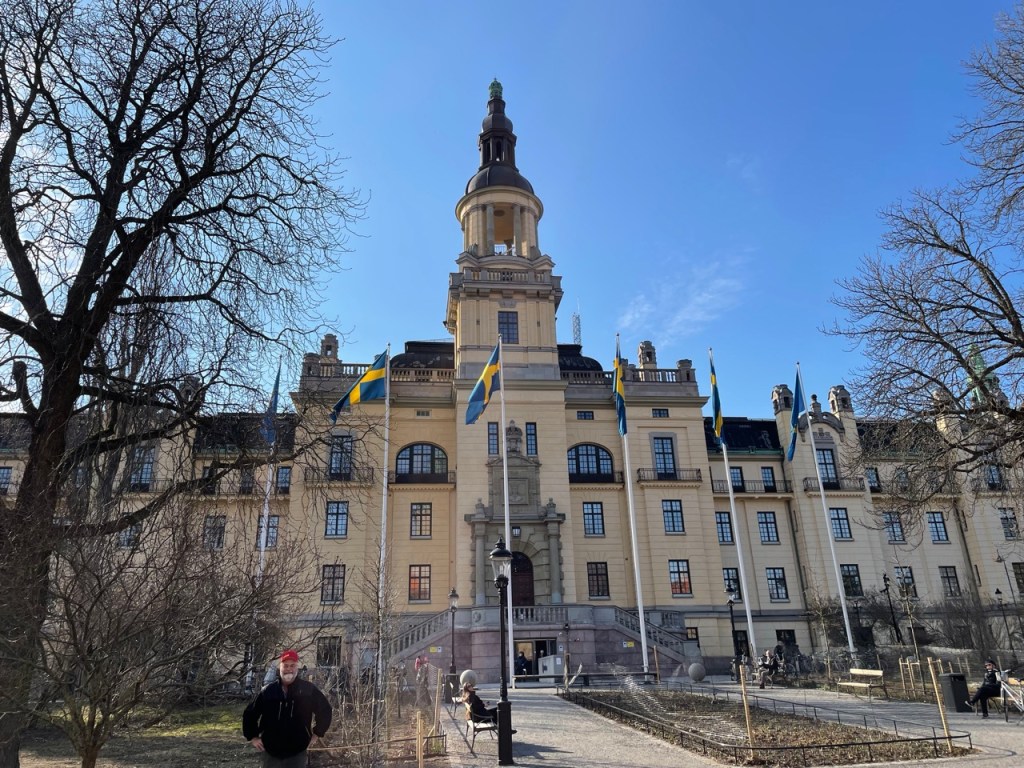
They also have a beautiful City Hall. It was completed in 1923, so it was its 100th birthday year while we were there. This photo was taken from our hotel room, so we didn’t have far to walk to get whatever we needed out of the folks at City Hall. Which was nothing, mostly because Meatballs for the People already took care of the bulk of our needs.

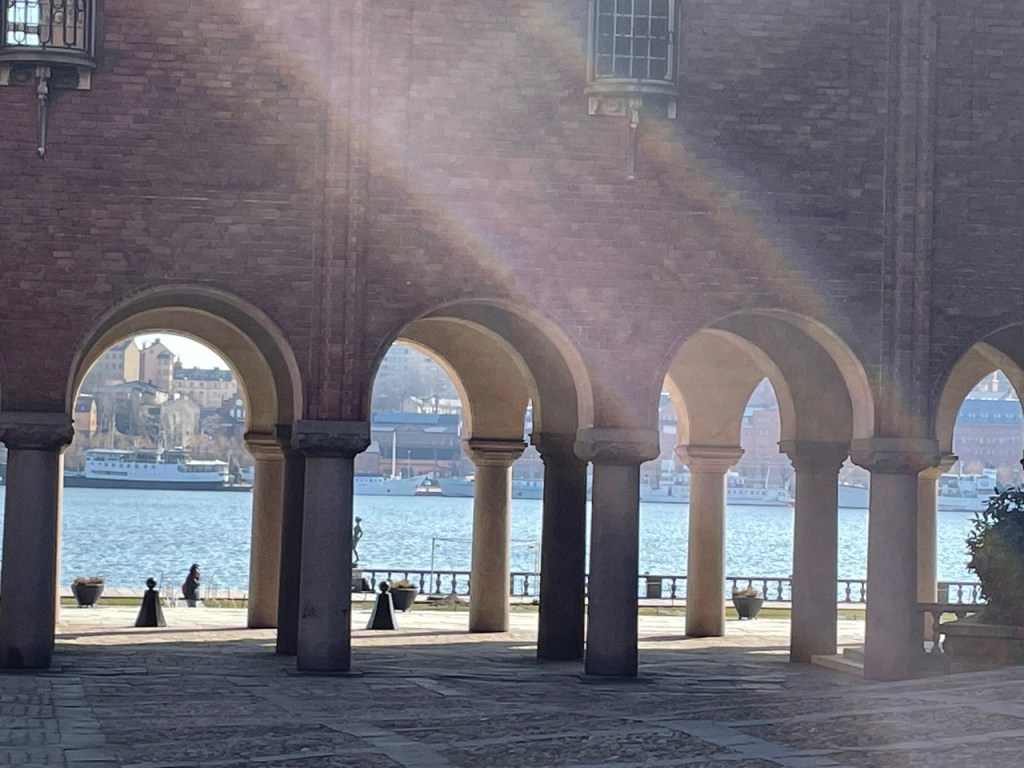
The building has a large courtyard, and is right next to Riddarfjärdenm (pronounced “Riddarfjärdenm”), which is a bay of Lake Mälaren, part of the extensive waterways that help keep Stockholm moist. I was impressed they had a golden statue of me; because of course growing up I was always known as the Golden Child. Ha! The truth is, In a family with seven kids you’re lucky to get noticed unless you burn down the house or something, which is something I rarely did.

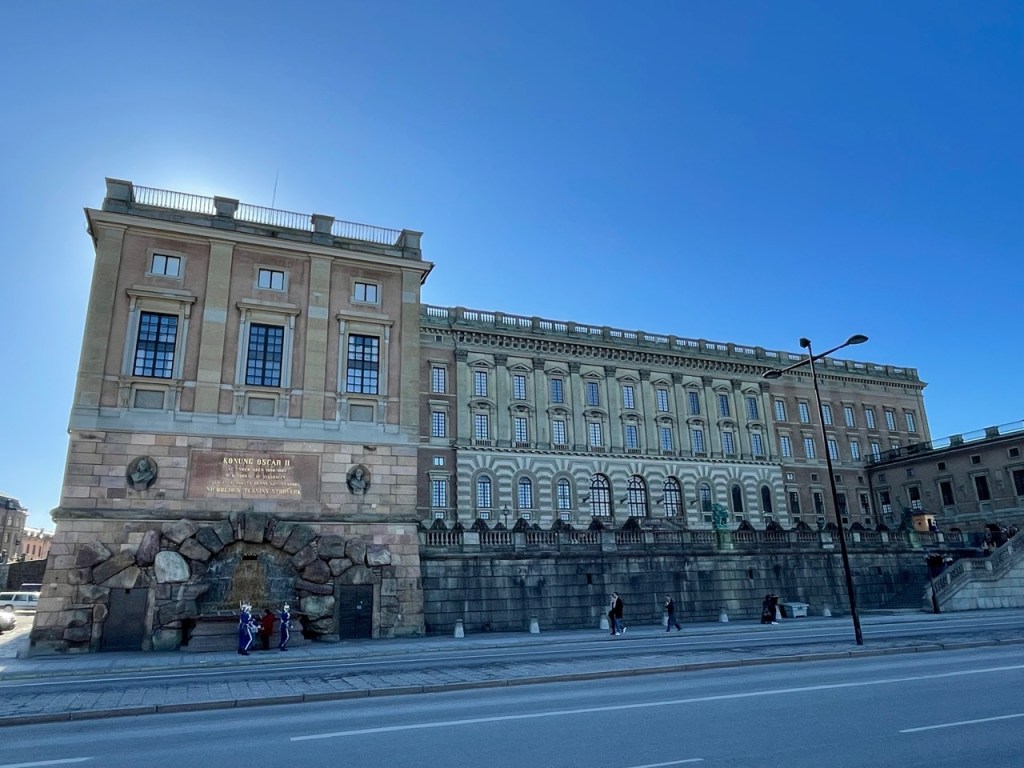
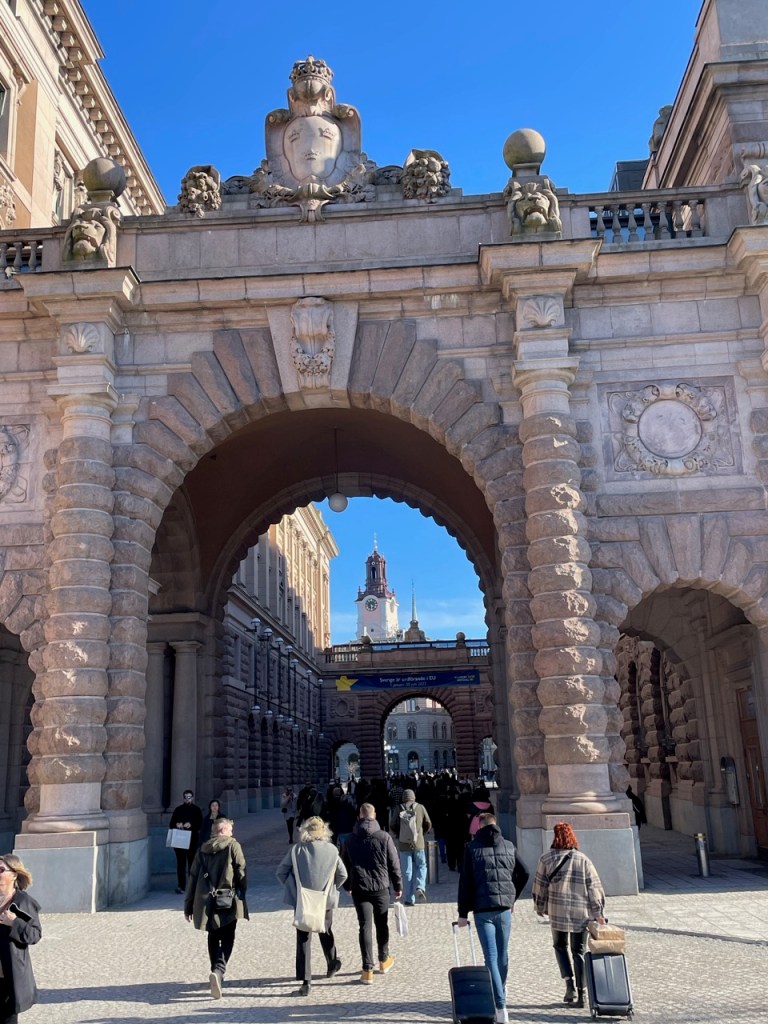
This is the inside and out of the Royal Palace. We didn’t take a tour or anything because there was a line, or it cost money, or we were tired, hellifiremember. Sometimes you just don’t want to see every last little thing, you know? Anyway, this the official residence and major royal palace of the Swedish monarchy, but the royals live in another palace just outside of Stockholm, so the eggs I was planning to throw went to waste.

As we were wandering around we noticed a crowd forming inside a large square. Of course we thought it might be something exciting, although I asked several people in the crowd and no one seemed to know why they were standing there. It reminded me of when I point to the sky open-mouthed and just hold that pose to see how many people gather around gawking upward. But I didn’t need to do that there; everyone was already full of gawk.

Eventually we realized it was the changing of the guard. I don’t know why I always thought that involved diapers.

We’ll finish off this entry with a bunch of signs I thought were amusing.

The Swedish love Eastertime, but for some reason they apparently feel the need to post warnings about the Easter Bunny being a slut. “She’s a slut, don’t accept colored eggs or ice cream from her! She might steal your organs!” says Mr. Snipp Snapp Snut.

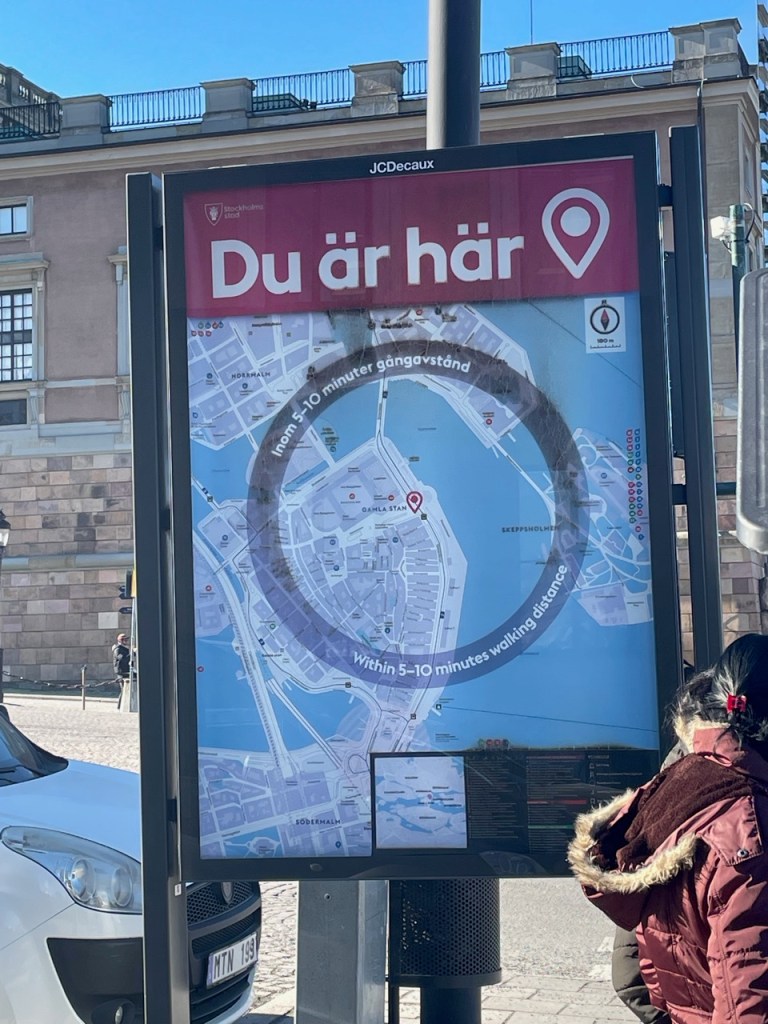
Swedes seem to like everything tidy, and apparently that includes admonitions to do your hair! I’m sure my pronunciation is off, but I’m guessing it sounds like Doo ar har! Actually that might mean “you are here,” which seems redundant to me. Of course I’m here, knucklehead. I’m standing here misreading your damn sign! Stupid Swedes. But if the hair translation is the correct one, I don’t have much of it, so bugger off because you just hurt my feelings.

This one isn’t funny, unless you’re a irredeemable misogynist, but as far as I can tell, the Swedes are so “woke” that they put the lady’s name first in the title. Of course, maybe it’s only in America that it was turned into Romeo & Juliet. Who knows? What I do know is that “woke” essentially means, “alert to racial prejudice and discrimination.” I’m not sure the people who toss woke around as an insult really understand what they’re saying. Which makes it actually kind of amusing, if it weren’t so sad. Y’know what, if you’re tired of being called a racist, stop being one.

The stank of Stockholm is legendary. Dunno why Carolyn’s sticking out her tongue… to taste the stank maybe?

I’ve always kind of thought it odd that Americans generally think of “bastard” as a swear word. It doesn’t seem that much different than “orphan” to me. Although I suppose, “You dumb orphan, you just killed my dog!” doesn’t carry the same derisive gravitas. Anyway, not sure what’s going on here: either the owner’s last name is Bastard, or he is a bastard and damn proud of it, or the beef they serve is all from bastard cows. By the way, because we are a full service blog I searched on “bastard” in Google Translate, but it isn’t a Swedish word. Neither is burgers. Budbee probably is though.

Hasbeens doesn’t translate either. At least they give old farts someplace to go I guess.

Get gassy on the ocean with your own farty magazine!

Everyone in the elevator looked at me funny when I hissed all the way down. I never did find out if Högst was on the elevator, or if it’s just a memorial thing, like maybe Mr. Högst weighed 800 kg but the elevator was able to successfully transport him without plummeting down the shaft and landing in a heap of twisted metal instead, I dunno.

Don’t use the stairs! It’s a trap until you make it to the lobby!

I’m a fan of the rock group Jethro Tull, and apparently the Swedes are too. They gave the group their very own way through customs. As Tull is now a pretty old group, they may be living in the past though. Maybe they should take their aging, locomotive-breathed selves out of there and do a little bungle in the jungle instead.

I think I just lost half my audience.

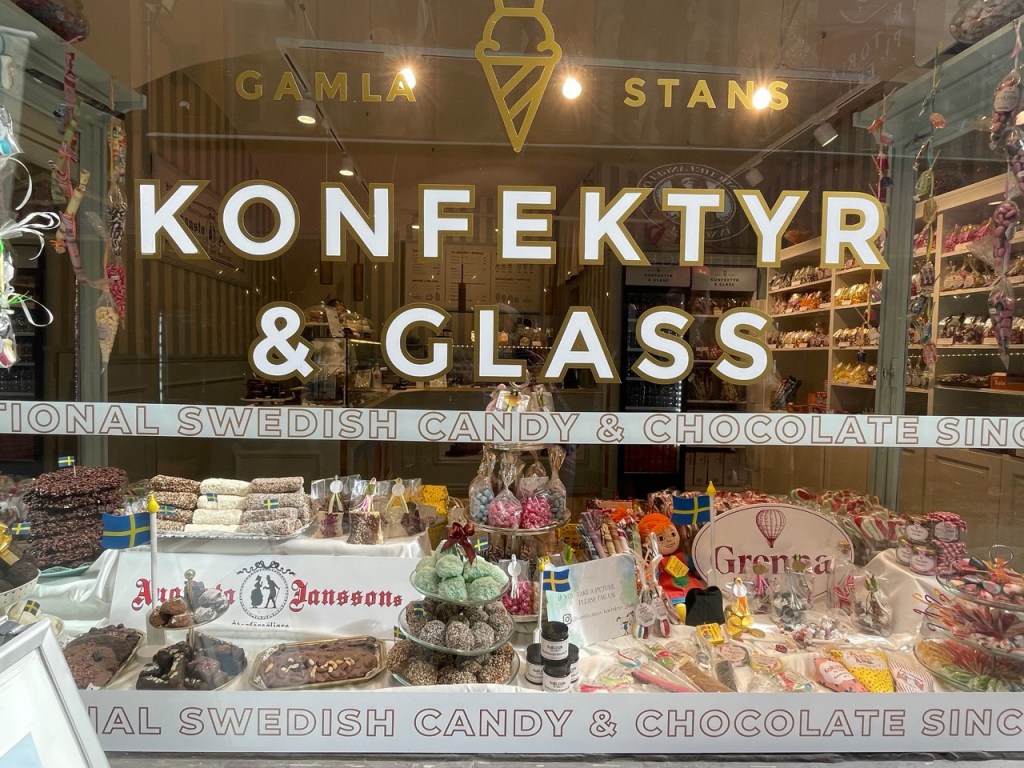
I don’t know about you, but I am not interested in the least in buying confections with glass in it. I hope their licorice wasn’t full of it though, as we had our share of that yummy candy. Our rectums didn’t bleed after we ate them, so I think we’re safe.

Speaking of gross, I guess this is how they motivate their people to keep the city clean. “Our city is gross, clean up all that food you dropped on the street and put it in a bag!” You know a country is pretty wealthy when their litter looks like groceries.

Okay, so earlier I mentioned that I wanted to see if Stockholm’s cleanliness, beauty, safety, and and overall good cheer was genuine or if as soon as every obvious tourist turns a corner they start pummeling each other and calling each other names, like Norwegian meatball.

So I decided to compare Sweden to Texas, because comparing a 10 million person country to a 330+ million person country if probably not fair. I chose Texas because it’s kind of a poster child for right wing governance, and is as close a thing the US has to a state that wants to be its own country. Texas is bigger than Sweden, but not by so much that comparisons fall apart. America, and Texas probably in particular, is all about sacrificing almost everything for a higher GDP. They clearly are ahead of Sweden in that regard, $78,455 to $61,028. Congrats, Texas, all those cows and oil helped you get ahead in GDP! Woohoo! (By the way, I think “The Oily Cow” would make a great name for a restaurant or a rock band.)

Let’s see what that better GDP gets you:


TexasSweden
Population (in round numbers)30 million10 million
Area695,662 km²528,447 km²
2020 murder rates6.6 per 100,0001.24 per 100,000
No. of people killed or wounded during a mass shooting in 20223210
College grad rate31.5%49%
Health CareA recent survey ranked Texas as having one of the nation’s 10 worst health care systems.In an overall ranking of health care system performance in 11 industrialized nations, Sweden ranked 3rd, the US last. And Texas is among the worst in the US. So, like the worst of the worst.
HappinessTexas ranks 21st in the US, and the US ranks 16th in the world.Sweden ranks 7th in the world.
Infant mortality5.3 deaths per 1000 live births 1.7 deaths per 1000 live births
Literacy Rate71.8%. (Texas ranks 49 out of 50 among states in the percentage of the adult population with a high school education; 16% of adults over 25 in Texas don’t have a high school diploma or equivalent.)99%
Cost of LivingThe average cost of living in Sweden ($1385) is 37% less expensive than in the United States ($2213). Sweden ranked 33rd in the list of the most expensive countries in the world vs 5th for the United States.According to the internet, Texas is 81.4% more expensive than Sweden. I guess all those “high taxes” might help make everything else cheaper!
Life Expectancy76.5 years82.4 years
Number of senators named Ted Cruz10
Number of cows12.7 million303,390
GDP Per Capita$78,455$61,028

So while fat cat Texans have it pretty good, for the rest of Texas that higher GDP gets them over 5 times the murder rate, more mass shootings than anyone ever needs, over 50% fewer college graduates per capita, far worse health care (with the ever-present worry of bankruptcy if you get anal cancer), lower happiness, over 3 times as many infant deaths, lower literacy, a higher cost of living, and a shorter life… whew! But they do get a lot more cows!

They can keep their Ted Cruz, though.

Taking Stock(holm) of Sweden

The last leg of our whirlwind tour of Scandinavia brought us to Stockholm. With roughly 10 million people, Sweden has about twice the population of either Norway or Denmark. It’s about the same population as Portugal, even though Portugal is quite a bit smaller in terms of land mass. Sweden is roughly twice the physical size of Great Britain, or just slightly larger than the state of California. Sweden is the fifth largest country in Europe, but has one of the lowest population densities. More than half of Sweden is covered by forest. The rest must be covered in Swedes I suppose.

These are our first views of Sweden from the air. In April, Stockholm averages 10.5 celsius (51°) for the high and 2.7 celsius (37°) for the low, so while it’s not unusual to see snow there, even the coldest months (January and February) have an average high just above freezing, so it’s not like you’re experiencing the same weather as the North Pole, which is just north of Krakow I think. Because, y’know, they’re Polish. I hate that I had to add that.

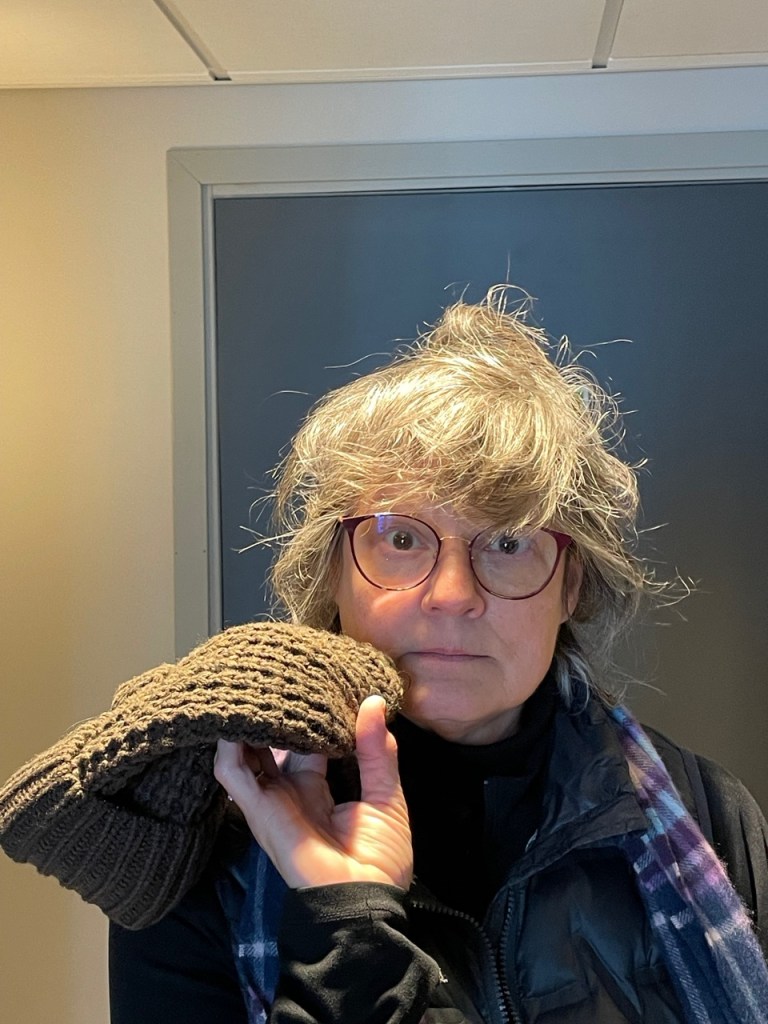
Once again we are warmly greeted by a Scandinavian city with a nice welcome sign. We weren’t sure what to make of Stockholm having nitless possibilities, however. Does that mean they have rampant head lice and being nitless is just a possibility? Whatever is going on, I think it has to do with all the hats. And I can’t even begin to understand “mitless connectivity.” I think it means they don’t need mitts indoors when they’re working on their computers? I guess when you have a cold country you promote what you can.

It’s obvious from just this picture that Swedish hat hair makes for a beautiful home for nits and the subsequent lice. If I were a nit, I’d happily spend the rest of my days just lounging around in that mop. I guess I am a nitwit sometimes sure, but never just a nit.

We put on our big boy and girl panties and used public transportation to get into Stockholm. Then we Google Mapped our walk to the hotel address. We were more than a little shocked to see the state of the hotel. No wonder they advertised great views!

Just kiddin’. That was right next door to our hotel though. They were actively tearing it down as we walked by; we kept a lookout in case a big chunk of concrete came raining down on our heads. The above is the view from our hotel room. We never did see the Northern Lights on this trip, but this deep red sky was pretty impressive in its own right. Sailors were delighted that evening!

Here we are ready to explore the city. That hat is from Christiania, the commune in Copenhagen, Denmark. The three dots represent the three “i’s” in Christiania. Combine that with our four-eyed faces, there are eleven eyes in this picture!

One of the things we like to do in some cities is start our visit with a ride on the Hop On Hop Off bus, or its equivalent. That way we get to see the whole city in one shot, and we can pick out the things we want to come back and see later, or of course just hop off right then and there (I don’t think you have to hop, at least, we’ve never been yelled at for being hopless).

In the case of Stockholm, because it consists of about 30,000 (!) islands and has 57 bridges and 96 beaches, I guess the fact that they have a Hop On Hop Off boat should be no big surprise. What we were surprised about is that the boat tour is only about an hour long, and pretty much everywhere it went (one big circle) it wouldn’t have been all that far for us to walk, so it wasn’t as necessary as we thought. Still, it allowed us to take all those pictures of Stockholm from the water.

As with many European cities, bikes are a big thing here. That is, until there is a massive pileup and all the riders scatter to the wind, as obviously happened in this place. I didn’t see any blood, though, so I think most of them made it out alive.

Who knew that bridges wore nylons?

Eh? What’s that? Oh. I guess they’re pylons not nylons. Nevermind. However, at the minimum, I’m willing to bet this is the first time you’ve ever seen pylons under a Swedish bridge, am I right? Don’t tell me BaldSasquatch.com doesn’t improve your life!

Anyway, I just thought it looked kinda cool, so there you have it.

I hid from Carolyn during our walk next to the Nordstrom River, which must be famous for its nice shopping. Eh? What’s that? It’s not Nordstroms? It’s Norrström? Oh. Well, anyway, Norrström is one of the shortest rivers in Europe, and one of the very few whose name rhymes with a department store while at the same time having an “ö” in its name, even if we have no idea what the dots do. We’re all about exclusivity here at BaldSasquatch.

Time for a snack break! Actually, this is a picture of one of our normal meals-on-the-road. Certainly we go to restaurants, but the truth is, much of the reason we were able to retire early is that we save our pennies by not eating out a lot. And that carries through to our travels. Obviously food is an important component of getting to know any culture, and we eat our share, but we don’t make it the focal point of our visit. Note that we do have some Swedish sweets there in the mix. The Swedes seem to be cuckoo for licorice. The way they offer it is very, very yummy.

In addition, one can learn a lot by going to foreign grocery stores. For some reason I enjoy visiting grocery stores almost everywhere we go. And that’s where you can find some interesting and different foodstuffs. In this case, I saw a display of these toothpaste-looking tubes but with pictures of meat on them. I figured it was possibly very meaty toothpaste, or meat glue, or just something really disgusting. So I bought one. It was actually pretty good, you just squeeze out all that protein goodness on a cracker or a shoe and you’re ready to roll! Besides, who can resist a name like SkinkOst? I just hope it really wasn’t meat glue.

The name of this statue is A Man Adjusting His Glasses While Holding a Newspaper and There’s Nothing Else To It So Take Your Need For Artistic Symbolism Elsewhere You Capitalist Pig! At least I think that’s what the plaque said.

Flowers.

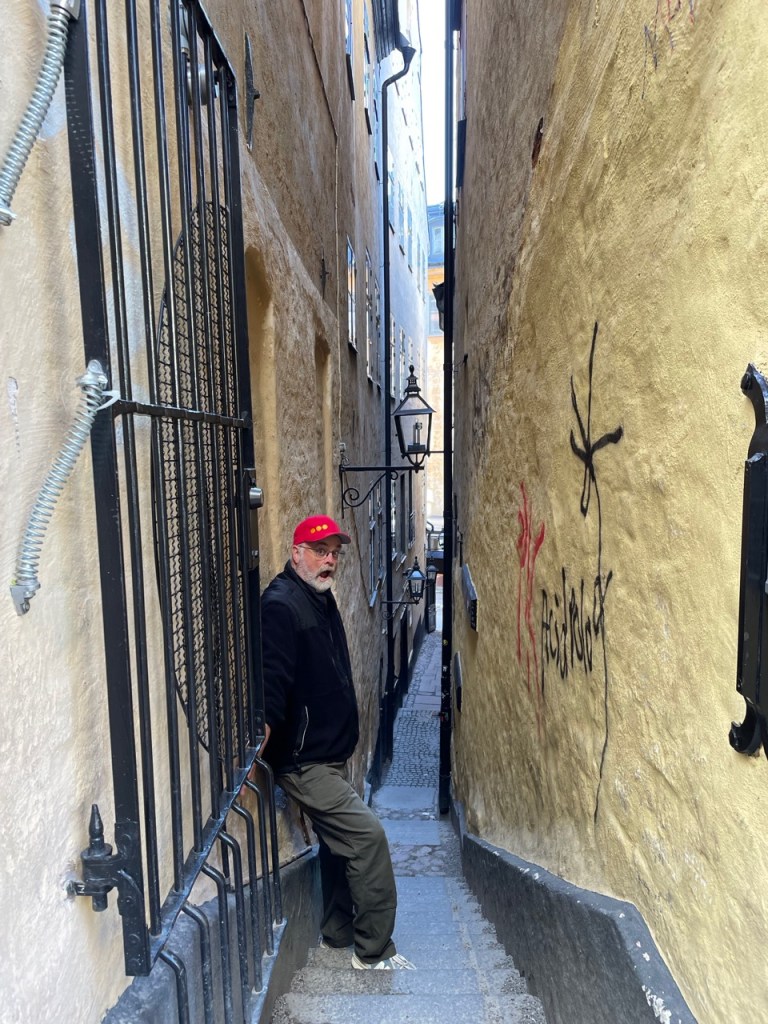
This alley shocked me because there’s not nearly enough room to walk side-by-side with my honeybun while holding hands. So what good is it? They ought to just fill it up with SkinkOst, which I’m sure will harden to a bricklike state, and be done with this skinny-alleyed nonsense.

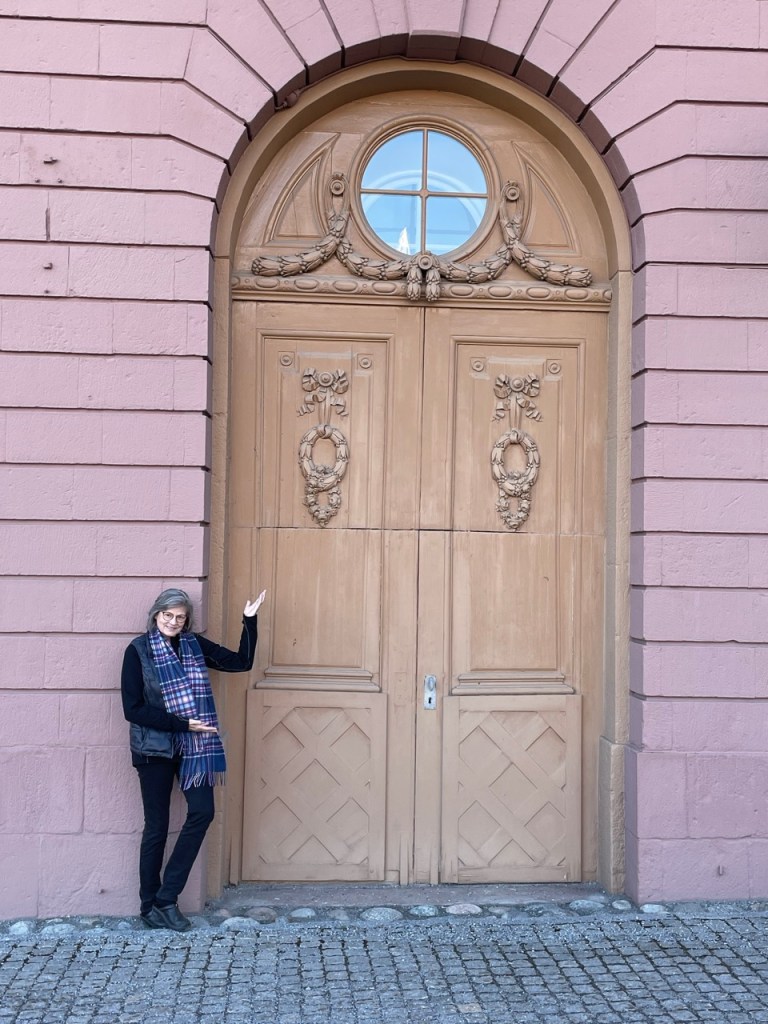
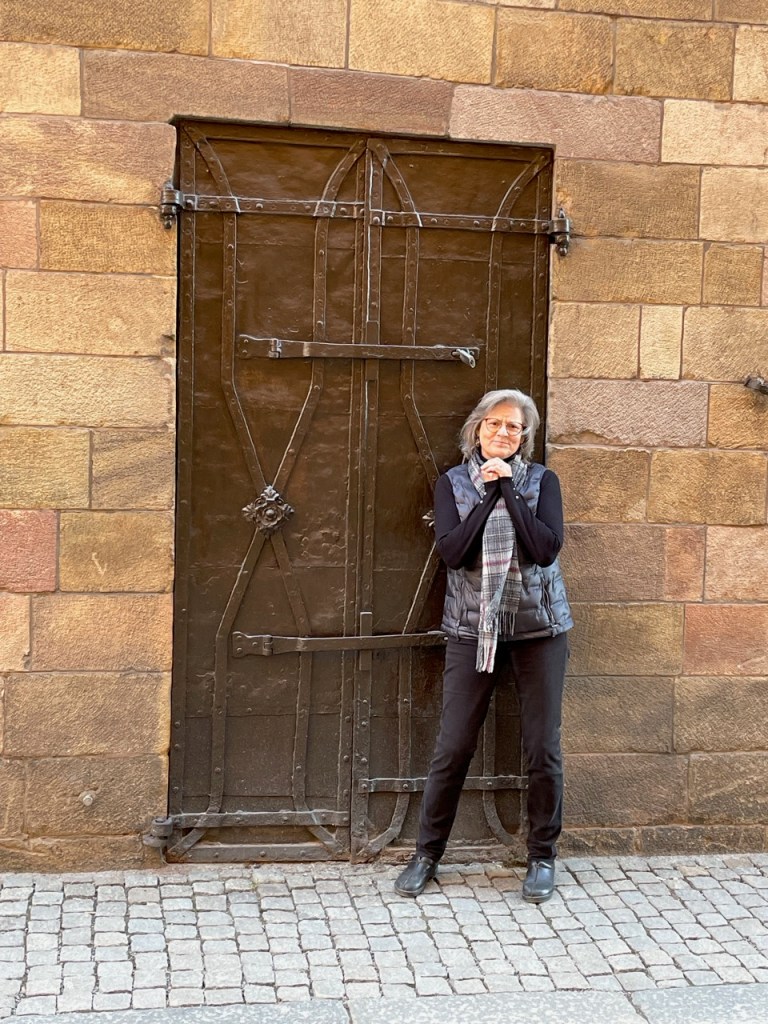
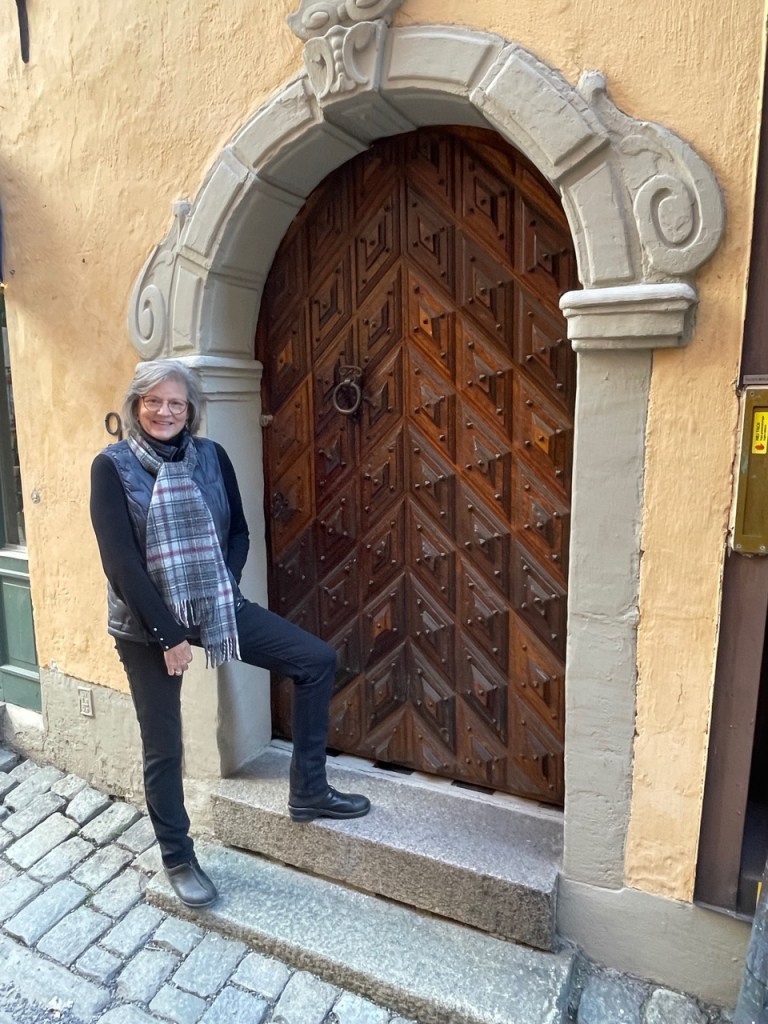
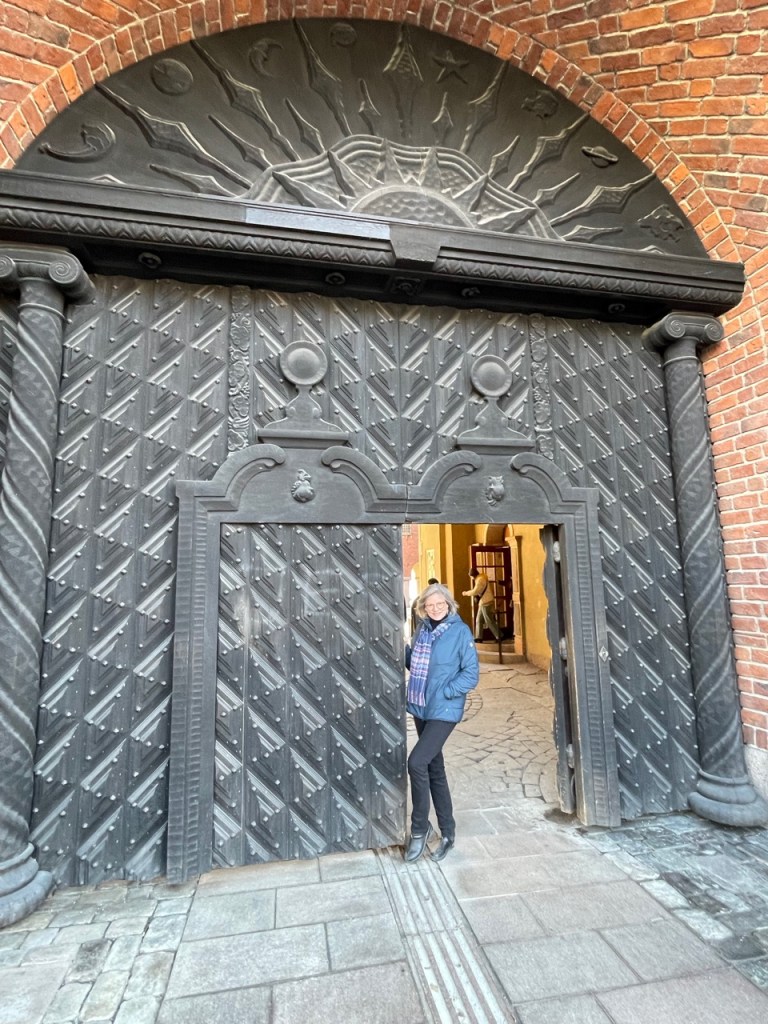
We’ll close this portion of our Stockholm Syndrome- er, tour, with an assortment of Doors of the Day. For those of you who haven’t followed this blog closely for seven years (I mean, who hasn’t?), Carolyn loves doors. So during our first visit to Europe, I finished every day’s blog post with a Door of the Day photo. Now I just take pictures of them when I hear her squealing in delight, and post them randomly. Anyway, there were quite a few in Stockholm, so I put them all together in one gallery, other than the above shot of one with big knockers.

And we’ll finish with this last one below, which was funny because it locked out all the has-beens. We figured we qualified, but still, we couldn’t find the key. Maybe we’re not has-beens after all!

It Was Oslo Week in Norway

There’s something to be said about timing. We ended up traveling to Oslo during Easter weekend. As you might imagine, the Scandinavians make a pretty big deal out of Easter because it signifies the coming of spring, which means the return of the sun! The sun! The sun!

“Ooh Mommy, it burns it burns!” “Gunnar! Where’d you put the SPF 3,000?”

We saw more than a few Scandinavians just sitting on a bench with their face toward the sun and a small smile on their reddening lips. In January and December, Oslo only gets 6-7 hours of daylight. In June it’s almost 19 hours. I’m not sure how flat-earthers explain that. Of course, I don’t know how flat-earthers explain anything.

There’s also something to be said about expectations. We took an overnight ferry from Denmark to Oslo. We were excited to see the fjords, and we were told that a ferry boat would provide the exact same views as a tour boat out of Oslo. So when we woke up on the ship in the morning, we were excited to go to the viewing decks and see the magnificent fjords. This above is what we saw.

I mean, there was nothing wrong with that, but this is kinda what we expected.

And this is what we got.

Yep, expectations vs. reality.

Oh, well, we saw some fjords. We just didn’t realize the grandiose ones were on the other side of the country. On the other hand, we expected it to be cold… and it was. Expectations met! Actually, it wasn’t arctic cold. Upon our arrival, there was just a little bit of snow lazily drifting down. The temperature hovered around freezing but then warmed a little above that for the bulk of our short visit to Oslo. So, the weather was better than expectations. Score!

After we left the ferry, we realized we could make the fifteen minute walk to our hotel, even through the howling blizzard. (Well, I mean, everything is relative, right?) Sharing the bay with the dock where we arrived was a magnificent opera house. (What is it with magnificent opera houses anyway?) In the middle picture, you can see floating saunas with the opera house in the background. Scandinavians love their saunas. The idea is that you roast yourself alive, and then jump into freezing cold water in order to, what, I guess shrink up everything the heat of the sauna made saggy? Needless to say, we didn’t partake. We’re fine with our sags.

I’m not sure what that floating thing is. Maybe it’s leftover construction material from the magnificent opera house? Or a futuristic Chinese junk?

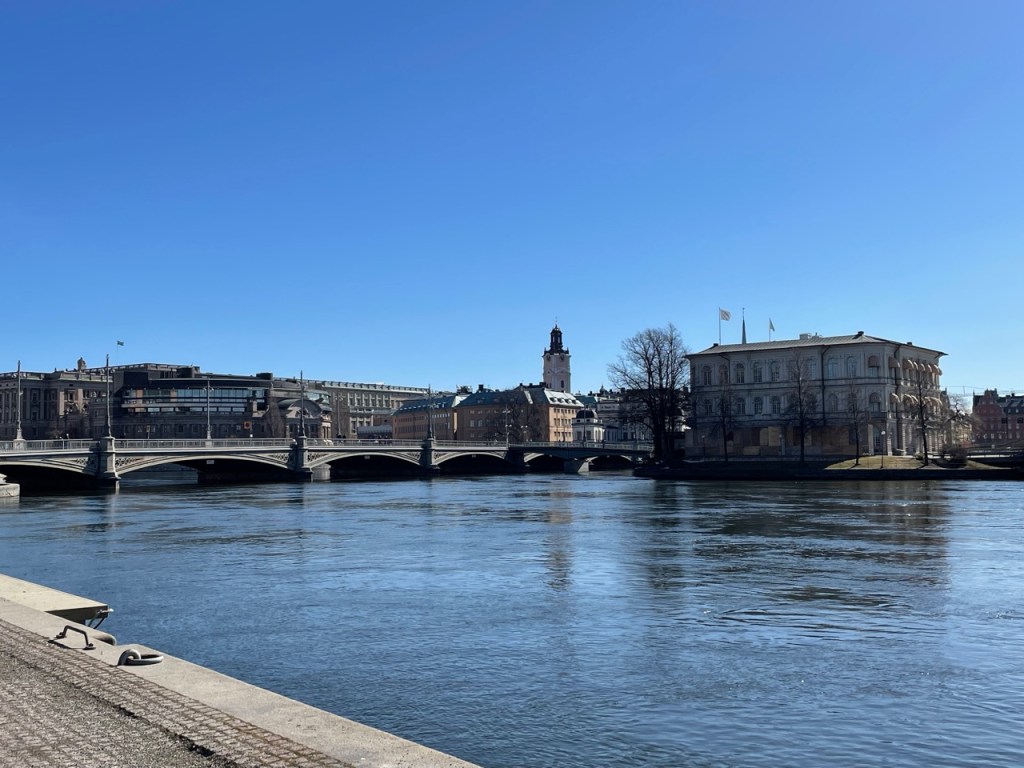
This is the view from our hotel room. I like it when societies make things look interesting or pretty instead of just functional.

It had been a while since we’d seen snow. Notice the only people in the photo of this Easter-stricken city is a group of statues. It was actually kinda nice, because we could wander the downtown streets without worrying about being hit by a car. Or seeing one. It was deader than the height of Covid on Christmas day. I kept an eye out for zombies in case we were actually in an apocalypse but missed the news. Especially since, you know, Norwegian zombies are the worst.

So this is one of the more “interesting” buildings we saw in Oslo. But it’s not all that interesting, and therein lies our Oslovian theme.

It’s a stock exchange building and was constructed in 1828. It is recognized as Norway’s first monumental building. We also noticed it was yellow. You’d get a pretty good idea that a tour was a little short on excitement if the tour guide stopped in front of a building, commented that it was yellow, and then said nothing else and moved on. So here we are.

I wanted so badly to try some reindeer meat. I’ve never had reindeer meat, and you know Santa has to be fat for some reason. In addition to this sign featuring reindeer casserole, we saw signs for reindeer burgers, reindeer Swedish meatballs, and…

… of course a plate of Rudolph. His guts look like noodles. Actually, this is just a picture from the internet, we never saw portions of Rudolph being advertised. Anyway, as luck would have it, in both Oslo and Stockholm, I was never able to coordinate our meals with being near a reindeer meat provider. Next time I’m in Scandinavia, Comet and Blitzen better watch out!

One of the main tourist sites in Oslo is Akershus Fortress. It’s a medieval castle and fortress, constructed somewhere around the late 1290s. It was representative of Oslo in terms of the idea that compared to most other castles we’ve seen, it was just kinda brown and boring and not that much to it. It wasn’t terrible, it was just… a little blah, just like the rest of Oslo.

If you’re blown away by all that scenery, have I got a city for you! I don’t really mean to pick on Oslo, but as you can see… it’s just a city. It’s really hard to say how much the lack of people added to the blasé nature of the place, but given that there were really no sites we were dying to see from any of the guides we read, I think it’s safe to say that Oslo is just kind of an unexciting city. Nothing wrong with that, though, it’s certainly better than Bakhmut!

Besides, I never said this would be an everyplace-we-go-is-amazing blog. However, I will add that we had perhaps the best breakfast buffet I’ve ever been to at the Clarion in Oslo. Maybe Norwegians put all their energy into buffets, I dunno.

Like so many European cities, the bus and train stations are huge, clean, modern, efficient, and good-looking. Even though we’re suburbanites and are kinda lousy at navigating mass transit, even we could figure out how to buy tickets back and forth from the airport.

On top of all that, the toilets in the airport are a perfect little room for one, complete with your own sink. Compare this to a typical line of urinals, or in America, a row of toilet stalls with doors that start halfway up on walls you can peek over. I’ll take a private European restroom any day, thanks.

They even have special farting facilities for the disabled!

As we rode the train to the airport and then took off from Oslo, we realized that we hadn’t really given Norway a fair shake. Like most countries, the country is far more than its biggest city(ies), and Norway certainly offers a ton of impressive and amazing scenery. Just not in Oslo.

After our return to Portugal, we had dinner with some friends who invited us to go on a cruise of Norway in January. The ship meanders up the entire coastline all the way into the Arctic Circle. The cruise company even guarantee a viewing of the Northern Lights (aurora borealis) or you get another cruise for free. So that’ll be a future blog entry, and makes me feel better about our little taste of Norway. While a cruise of the Norwegian coastline was never on our “A” bucket list, seeing the northern lights definitely is, so we’re very much excited for that!

But as far as this particular trip goes, next up is a flight to Stockholm, Sweden, where we complete the Nordic Trifecta! (Sorry Helsinki!)

Copenhagen: The land of Vikings, the World’s Oldest Operating Amusement Park, and a commune in the middle of the city

Our tour of Denmark continued with a visit to a Viking museum, the world’s oldest operating amusement park, a successful commune, ‎⁨an old graveyard, Frederiksborg Castle⁩, ⁨a drive across Denmark, a visit to the town of Frederikshavn⁩, some World War II artifacts, and then a ferry to Norway! Woof! That’s a lot, we better get started!

First up are the Vikings, because I don’t want to make them mad and get stabbed by one of the horns on their helmets. Which was actually never a thing, by the way; that depiction was simply made up during the 1800s. A thousand years from now, I wonder what weird ideas they’ll have about our current civilization. Maybe that a rapist was once elected the President of the United States in the 21st century? Oh right, like they’d ever believe that.

These are the genuine article: actual Viking ships that were pulled out of the water, or perhaps discovered in the basement of some Viking ship hoarder. The museum also built Viking ship reconstructions, so you can sail into the waters just like the Vikings did a thousand years ago. Speaking of which, another Viking myth is that they burned their dead while sending them off into the water on boats. It makes for a good movie scene, but you can rest easy: if you die on the water they won’t burn your corpse out there. They’ll probably just dump you in the ocean so you can feed the fishes. Recycling is big in Denmark.

But truly, it was very cool to see actual Viking ships. For whatever reason, Vikings have an outsized footprint in historical lore, even though a whole bunch of their legend consists of made-up stuff. So it was interesting to learn more about them and see their actual handiwork. I do have to hand it to them: sailing the seas in one of those relatively small ships all the way to England, Iceland, Greenland, and even on to North America is not for the faint of heart!

This is the way the ship would’ve looked once they installed all the tires.

This is an old Viking chimney that’s still operating today! Just kidding. This is actually a regular old smokestack, connected to a plant that burns garbage for fuel. It’s a great example of the Danish placing value in aesthetics by taking a mundane or even ugly object and turning it into art. I think that’s awesome!

Of course, not every sign or object is pretty. Here’s our friend Per (who may not be pretty, but he’s sure handsome!) standing next to a rather cluttered sign forbidding him to fart in Christiania. Unlike the Norwegians and Finns, the Danes hate farting.

But what is Christiania, you ask? It’s actually a fascinating story. The short version is that Freetown Christiania, as it is also known, is essentially a squatter commune in the middle of Copenhagen. It sprung up in 1971 on a military base, and it remains there to this day, a more or less independent little slice of Copenhagen. No cars are allowed, they make their own rules by vote, and cannabis is openly sold. While the latter is not a big deal in the U.S. anymore with about half the states having legalized it, in Denmark cannabis is still illegal. So the Christianit (that’s what the residents are called) post guards around the edge of the commune, and if it ever happens that the Danish police conduct a raid, by the time they get to the Stalls o’ Cannabis, all the sellers and inventory are long gone.

I don’t have a ton of pictures of Christiania because the best place for pictures is where they sell the cannabis (also known as “Pusher Street”), but if you’re caught taking pictures anywhere near there, your phone or camera will most likely end up being smashed to bits, and possibly your face as well. They take the no-photographs prohibition very seriously, and since it’s “their town” they can pretty much do what they want or make sure you don’t do what they don’t want. Or maybe they want you to not do what you aren’t doing when you do it after you’re not doing the other thing they don’t want you to do. I might’ve written that after sampling some of their cannabis.

Anyway, as you look at these pictures, understand that they’re in a location that might otherwise be filled with a multitude of buildings housing condos worth millions apiece. The structures in Christiania range from very basic shacks to sophisticated buildings, and everything in between. All the residents and workers were very pleasant to interact with (I suppose other than the guys who would rip your face off for taking a photo, but I decided not to engage with them for obvious reasons). Christiania is the fourth largest tourist attraction in Denmark, (hopefully it’s ahead of the Little Mermaid), and they sell food, art, and tourist trinkets in addition to the cannabis, so there’s some incentive for treating visitors well, at least the ones who aren’t taking photographs.

The whole thing is of course fairly controversial, because Christiania is sitting on 19 acres of land in the middle of Copenhagen that is worth millions, and yet only has about 1,000 residents. Some Danes want to bulldoze the whole damn thing, others want to leave them alone. In the meantime, it’s an interesting place; perhaps one of the world’s most successful implementations of an actual, functioning, long-term commune.

Up next on our “boys day out” (Carolyn and Pia stayed home to paint their nails, watch chick flicks, eat pizza, and make fun of me and Per) was a visit to the world’s oldest operating amusement park. It opened in 1583, which is 83 years after Portugal discovered and claimed Brazil, 37 years before the pilgrims sailed to America, and slightly before my birthday.

I only took this picture because I got a kick out of both of those words: Motorcykel Parkering. That might be a good name for an actor. Either that, or the sign maker ordered the sign at the same time he was sampling the cannabis in Christiania. Unless it’s in Danish… hmm… I hadn’t thought of that.

While I was excited to see the world’s oldest operating amusement park, I didn’t think it through much further than that, where I might have realized that it’s not very feasible to have any rides from 1583 still operating. At least none I’d get on. They did have this little area showing off some old time stuff like that car, and there’s an interesting history Per regaled me with (the details of which might’ve been lost in either a cannabis or old-brain haze… it must be the latter because I didn’t actually sample any cannabis). The rest of the park is just like any good old-fashioned amusement park.

…. including this “exotic” American Diner with all that crazy American food. I think I gained two kilos just by looking at the menu.

They do have a wooden roller coaster that’s been operating since 1932. The world’s oldest operating roller coaster is in Lakemont Park, Altoona, Pennsylvania, USA, and was opened in 1902. Copenhagen also has a more famous amusement park called Tivoli Gardens, which is so famous I’ve heard the name… but don’t know a thing more about it. Except they also have a very old wooden roller coaster, the Rutschebanen, which opened in 1914. Plus they charge admission just to get in so I preferred Bakken.

Next up is Frederiksborg Castle⁩. It was built as a royal residence for King Christian IV of Denmark-Norway in the early 17th century. Per is making sure we don’t see any naughty bits. But read on if you want to see some other ones.

Frederiksborg Castle is the largest Renaissance complex in the Nordic region. It is quite impressive.

They also designed a Door of the Day especially for Carolyn.

We didn’t really violate our no-more-cathedrals policy here because this chapel is part of the whole complex and you stumble across this view as you wander through the palace. It is kind of a cool looking one in any case.

Speaking of chapels and boobs (okay, maybe I was just thinking about the latter), at the entry to the palace, we were greeted by this unusual sign of a lady playing with two beige balloons while in a bathtub. When Per told me that they had a show going on, I pictured some sort of burlesque performance on a stage. I thought that was a little strange for a palace/museum, but then I remembered we were in Europe, where exposing your breasts doesn’t get you arrested and thrown in solitary confinement for a month.

To which this model gives us her opinion about that. Turns out it was actually an exhibition featuring a photographer who takes very candid and uncensored shots, especially of people with all sorts of body shapes and sizes. Since people never do measure up to the “Hollywood ideal,” it’s a good message to send… everybody’s beautiful! I stopped taking pictures after this one because I didn’t want to look like a typical American male creeper.

Anyone who might be offended by a picture of two of God’s Baby Bottles is probably also very pro-gun, so a picture of this boy with a rifle ought make everything even, no? Of course, he looks like a forty-year-old in a child’s body, but he is armed with sword and gun so I don’t think I’d make fun of him or his dress to his face.

We stopped for lunch and I noticed a couple of things to take pictures of. This house features a sod roof. Which I think means if you don’t like it, you can sod off. I dunno if you have to haul a lawn mower up to the roof to keep it looking trim or not. Also, the nearby dog pooping planter confused me… is that an instruction for a dog to actually poop in the planter, or is that the general vicinity in which poop is expected, or does someone just find the silhouette of a dog pooping pleasurable? It’s gotta be one of those three choices, and I don’t understand any of ’em!

‎⁨We visited Assistens Cemetery⁩, ⁨which is the burial ground for two of Denmark’s most famous citizens: Hans Christian Andersen and Søren Kierkegaard. It was a different cemetery than I’ve ever seen before: very spread out and with some unusual headstones, including that oblong headstone which may be for a famous Danish porn star. I also got a kick out of the one where Professor Holton has a nice big gravestone, but his wife’s just kinda leans against it like an afterthought. Die first if you want the best headstone!

Per and Pia drove us all the way across Denmark (which takes about 4-1/2 hours) to reach Frederikshavn⁩, where we were scheduled to get on a ferry for Oslo. The bridge pictured here is a big deal: half of Denmark’s population used to rely on ferries to get to Copenhagen. The Great Belt Fixed Link opened for traffic in 1998 and changed all that. The system includes a tunnel and two different bridges. The bridge’s 254-meter tall pylons are Denmark’s highest structures, and the 1664 meters between the pylons make it the fifth longest free-spanning bridge in the world.

Once we were in Frederikshavn⁩, we were able to visit our host’s adorable little grandson. We were honored to visit their daughter’s house and meet the little guy; he’s definitely a cutie.

The town was the site of German occupation during the war, where it could harass enemy shipping and control access to Germany from the North Sea. Today, as with everything we saw in Denmark, it was clean, safe, well-kept, and beautiful.

Before we leave you to set sail for Oslo, we offer up a couple of signs that might amuse our English-speaking readers. I wasn’t completely sure what to spill out of Carolyn, so I just asked her to throw up. Better than a middle fart!

This was the very long walk we had to take to get from the parking lot to the ferry for Oslo. Not a walk for the faint of soles!

Denmark- Where every meal includes a Danish

I should be a little embarrassed to admit that when we were planning on visiting Denmark one of the things I most looked forward to was to eat a Danish danish. I mean, right? It’s just like when you have to eat french fries in France, or drink scotch in Scotland, or eat a hot dog in Hotdogistan.

Or of course when you go to Anus, France, you… uh, hey wait a minute. I may need to rethink this entire concept.

It’s sad to say that we haven’t found ourselves in Anus, France yet, but if we ever do, I’m not going to be very inclined to do anything that pertains to its name. And yes, I already know there are lots of crazy place names, including: Pee Pee Township, Ohio, and Titty Hill, England, and Fucking, Australia, and Twatt, Scotland; and Dildo, Canada; and Humptulips, Washington; and Muff, Ireland… the list goes on and on. I don’t know how we’ve missed those during our travels, but now I’m thinking about taking a Crazy Name Tour of Europe.

Llanfairpwllgwyngyllgogerychwyrndrobwllllantysiliogogogoch, Wales, here we come! Actually we may never get out of Wales if it’s a Crazy Name Tour.

In any case, on one of our first mornings our gracious and generous friends and Danish hosts, Pia and Per, went shopping at the Danish Danishes for the Danish shop and came back with this assortment of lovely-looking treats. I silently gave thanks that we weren’t in Anus.

This is what authentic danishes in Denmark actually look like. They were everything I hoped for, except I don’t know why they bought four for me and none for anyone else.

This is what it looked like after we tried as politely as we could to have a taste of each one of ’em. And yes, they were as delicious as they look.

According to Wikipedia, “a Danish pastry is a multilayered, laminated sweet pastry in the viennoiserie tradition. The concept was brought to Denmark by Austrian bakers, where the recipe was partly changed and accommodated by the Danes to their liking, and has since developed into a Danish specialty.” So blame the origins on the Austrians, but the Danes made it all their own.

Since we’re on the subject of food: I’m not normally one to take “food selfies,” but this was such an unusual (for us) meal and had so many instructions and procedures, I just had to do it. The dish in the foreground is smoked eel, which I don’t recall ever eating before, at least sober. But it was absolutely heavenly. The traditional foods we ate included a series of open-faced sandwiches with various meats and fish on them. We were instructed to take a swig of schnapps with each bite. This transformed our mouths into a symphony of tastes and sensations like we’d never experienced before. It truly was one of the most interesting and delicious lunches I’ve ever had.

This is the restaurant that showed us how awesome Danish cuisine can be. We would have never even known about it, nor been able to even get a table, had we not been with Pia and Per. They also corrected my mis-assumption that danishes were commonly served with every meal. Dammit.

These are more likely the type of eateries we might’ve ended up in without our friends. BubbleWow is apparently famous, but it’s hard to imagine feeling “wow” after eating a bubble. Although I desperately wanted to visit the Drunken Flamingo, having never eaten flamingo before, much less one soaked in alcohol, but alas, my argument for going there had only one leg to stand on. Did you know flamingos get their pink color from their food? I really wanted to find out if that restaurant would put some pink in my cheeks. Either set would have been acceptable.

I got a little ahead of myself by plunging right into cuisine instead of sticking with our visit-timeline. This was taken out of our airline window as we came in for the landing into Copenhagen. I’d say that’s a pretty good use of resources since no one’s gonna be building a house next to all those cancer-causing windmills. For those of you who have forgotten or tried to forget, Donald Trump once said about windmills: “They say the noise causes cancer.” Also: “If you have a windmill anywhere near your house, congratulations, your house just went down 75 percent in value.” Well, even if that’s not in any way true, the Danes are asking, “how about the houses near these bad boys, Donald?” Maybe just the fish get cancer now.

These are assorted buildings and monuments in the middle of Copenhagen. The weather actually treated us pretty well for April in Denmark. It stayed above freezing at least, and we didn’t experience much precipitation during the entire trip. We’ll call that a win!

Even though we’ve both gotten sick of seeing the inside of cathedrals, we still poke our heads in once in a while. In this case, we were rewarded with a very pleasant and –especially for a cathedral– a comparatively understated design. 72% of Denmark’s population are registered members of the Evangelical Lutheran Church, although they don’t consider themselves particularly religious.

Here are some more scenes from the old town area. Copenhagen is well known for its canals, cycling culture, strong economy, and happy locals. In fact, it often appears at the top of various “happiest city in the world” lists. Some of the credit for that is surely due to its shorter workdays, free college tuition, and more vacation days (employees are entitled to 25 days (5 weeks) paid leave). Of course, who wouldn’t be happy with a steady diet of danishes, smoked eel, and drunken flamingos?

We stopped inside this charming tea shop. Nothing but tea. If you like the smell of tea, you may never leave this store. If I recall correctly, this particular shop supplies tea to the Danish royals. They have some very special and unusual teas, including frog’s leg tea, caterpillar cocoon tea, hemlock tea, and pulling-your-leg tea.

It isn’t often you get to see public restroom stalls in a travel blog, or any blog for that matter (although it’s probably a kink for someone out there), but I had to take a picture of these because they’re some of the most elegant bathroom stalls I’ve ever seen. The restroom itself is over 100 years old, and is staffed by an attendant (who is generally less than 100 years old) to make sure your bodily functions occur safely and in a clean environment. If it could be said that the cleanliness of public restrooms reflect directly on societies, and it’s not a bad thought, then the Danes must be some of the most cultured of all peoples.

That restroom was right next to the dock where you can board a boat for a tour of Copenhagen. We weren’t sure we’d be able to take a boat trip due to the variables in the weather; it could have easily been below freezing and/or windy. But as it turned out, while it wasn’t exactly warm, we didn’t freeze our patooties off while cruising on the water either. The blue sky followed us all the way from Portugal!

We love the colorful houses that line the canals and we were so delighted that it was warm enough to get these views from the water. Copenhagen is part of a large island, and Denmark consists of 1,419 islands altogether. In fact, the furthest you can be from the coast at any point in Denmark is only 52km (32 miles).

Here are some of the buildings and sites viewable during the boat tour. As you can see, it’s an amazing blend of old and new. Historical and beautiful modern design all at the same time. It’s also clean, safe, and vibrant. Can’t imagine what else you’d want in a city! Plus we’ll throw in a Pia and a Carolyn for good measure!

Of course, even paradise can have its issues. Here is the view of the Little Mermaid statue from the canal tour boat. Almost everyone we talked to about visiting Copenhagen told us to FORGET THE LITTLE MERMAID! Our Danish friends called it the most overrated tourist site in the entire world. I have to admit, however, it wasn’t underwhelming for me at all because I expected to be completely underwhelmed. In fact, I think my whelm is still sitting in the bottom of the canal. Anyway, she was exactly as I expected: just a little statue no one would think about at all but since everyone loves Hans Christian Andersen, well, there you go.

Once back on dry land, we were treated to a little touch of home by walking by the Portuguese embassy. It made us feel comfortable knowing that at least somewhere in the city, someone would be able to understand at least something we were trying to say. Actually, in all seriousness, 86% of Danes speak English; I don’t think we encountered one person who wasn’t pretty much fluent in English.

These are photos taken in and around the royal Palace, which is in the heart of Copenhagen and is the seat of one of the world’s oldest monarchies. It still functions as living quarters for the Danish Royals. We were hoping to see one taking out the trash, but alas.

And we finish this episode with a close-up of the Little Mermaid, because of course we ended up driving right next to it, and you can cheat and park in a restaurant parking lot that is only a hundred meters or so away, so I got the shot. As a result you can rest easy now… you don’t have to travel all the way to Copenhagen just to see the Little Mermaid anymore.

Hans Christian Andersen was a prolific writer, but is best known for his fairy tales, including: The Little Mermaid, The Emperor’s New Clothes, The Ugly Duckling, The Snow Queen, The Nightingale, and many more. His most famous quote was, “I wrote plays, travelogues, novels, fairy tales, and poems, and all I got was this stupid little statue of a mermaid.”

The Isle of Absolut

When Carolyn first told me about the Isle of Skye in Scotland, for some reason I pictured the heavens filled with Skyy vodka bottles (and I swear I’m not an alcoholic, at least when I’m not drinking). But it actually kinda bothered me because my preferred vodka is Absolut, not Skyy, so I wondered if I was betraying the trust of my first vodka love.

On top of that, Skyy is an American vodka and thus is more sour than Absolut, because of course Absolut is sweetish.

(If you didn’t get that joke, speak that sentence very slowly out loud. You won’t laugh in either case, but that’s okay, that’s why we call them Dad Jokes.)

Besides, if Scotland’s gonna fill its sky with any kind of alcoholic drink, it’s surely going to be Scotch, not some foreign vodka. To make matters even more confusing, no one involved seems to know how to spell the word “sky,” so I was really getting all twisted up in knots.

This Scottish journey was really starting to mess with my head, man.

In the end, when I reviewed all of that thinking in regards to the visit, I realized that I had better stop doing so many shrooms right before a road trip, so I took ten minutes to sober up and then we packed up our car in Glasgow and drove on the left (mostly) up north, into the Highlands of Scotland.

My main introduction to the Highlands of Scotland was from The Outlander books by Diana Gabaldon. Despite the inherent believability of those novels (I mean, duh!), I was a little dubious that we could find the sort of Stonehenge-esque rocks that would send us back in time. Still, just in case, I tore the stock market pages out of some old newspapers I “borrowed” from the local library and stuffed them down my pants. You can never be too sure. (As a side note, reverse newspaper print on your ding dong can look a little scary at first glance.)

Along the way we spotted what looked like snow trails on the hills. Turns out they were simply fast-moving streams from a storm that had been blowing in as we arrived. The weather around the Isle of Skye is notoriously unpredictable and tempestuous (kind of like a marriage between Donald Trump and Roseanne Barr). We crossed our fingers that it wouldn’t be foggy and rainy the whole time, otherwise I’d never see the bottles of Skyy in the sky. Or Skye. Whatever.

This is the bridge that connects the Isle of Skye to the mainland. It’s 250 meters long, and in Scottish Gaelic, is called: Drochaid an Eilein Sgitheanaich. My American mouth is definitely not trained to pronounce any word starting with “Sg.”

Before I go to the original comment about this picture, Carolyn is making me say that this bridge isn’t actually on the Isle of Skye, but is before it, leading up to Eilean Donan Castle, which is, coincidentally, also not on the Isle of Skye. All of that may not be obvious because I posted this picture after the picture of the Isle of Skye bridge, which might lead one to think that all the pictures coming after it are actually on the Isle of Skye. But no-o-o-o, for the sake of a stupid joke (still to come– I can tell you’re waiting with bated breath!) I changed the pictorial timeline. So instead of just a dumb joke, you get this long diatribe about where the bridge isn’t, which is probably not as funny, depending on how long I can carry on about it, as the upcoming joke. And of course I’m willing to bet that absolutely no soul who reads this will care one way or another nor would spot the theoretical error. But when we’re 80 and looking back on this, at least now we’ll have that all straight in our heads. Not that we’ll remember it after breakfast. Anyway, on to the original comment:

This is another bridge, obviously older and shorter than the last one, and no I don’t know the name of it in either English or Scottish Gaelic and yes I know that means you’re not gonna leave me a tip.

At least now you can unbate your breath!

Here’s Eilean Donan Castle, with some old dude in the way.

When I met Carolyn, she was an ardent rule follower and wouldn’t have broken the law to save her life. Now look at her. Such a scofflaw. I guess that’s what living on the run with a criminal husband will do to ya.

Of course, who could blame her for taking up this life of crime when her husband doesn’t even know not to look down the barrel of a gun? You’ll poke your eye out with that thing! ––Oh wait, the whole head is gone anyway…

I was oddly relieved to find out the flag was flying at half mast for the then-recently deceased queen. When I first saw it, my stomach jumped thinking it was for me. I swear I’m not gonna look down the barrels of any more guns, drink any more bleach, or take any more pictures in front of signs telling me not to do so. I’m not ready to be half-masted yet. Half-baked maybe, but not half-masted.

When something is closed on the Isle of Skye due to severe weather, you better believe it’s severe. I think the normal daily weather is something like 45 degrees (7 celsius) and rainy, with occasional gusts of wind up to “holy shit!”

Which may be why they named towns Shithein. (I think the sign translates to: “All that’s left is this shit town.”)

One of the island’s attractions was this recreation of a small Scottish village as it might have been a few hundred years ago. We learned about the way they spun wool, had to walk or ride long distances for just about everything, what they did to try and keep warm (which Carolyn was failing miserably at despite her biohazard-looking attire), and the lack of television– even as late as the 1800s. But mostly how glad we are not to have been born anywhere near there at that time. It was a tough life! I mean think about it, no Gilligan’s Island reruns after school? The horror! The horror!

One piece of good news was that I didn’t have to remember to drive on the left so much, because most of the roads in the countryside on the Isle of Skye are only big enough for one vehicle at a time anyway. Much of the drive consisted of moving a few hundred meters, then pulling off the side of the road to let someone pass, and then driving another few hundred meters where we’d hope the other guy would be the one to pull off. It was like leap frog with cars. We could tell who were the residents because they didn’t stop for anybody. Everybody waved at each other though. My arm ended up getting tired from all the waving, not kidding.

The quaint little itsy bitsy village of Portree had the colorful row of houses that always make these kinds of quaint little villages look so… quaint. It is also the largest town on, as well as the capitol of, the Isle of Skye, which has a population of just about 10,000 on the entire island. The population of Portree is listed at 2,310.

This was an old estate with spooky stairs full of fake mice, fake serving wenches, and fake tourists.

Since the Isle of Skye is mostly about the allure of its natural beauty, we’ll finish up this part of our entry with a series of pictures where we did our best to capture its wonder and majesty. We came up a bit short in that regard, but I think you’ll get the idea. There was absolutely stunning scenery everywhere we looked, and despite an occasional squall or windstorm, the weather actually treated us relatively decently for the duration of our visit. And not one bottle of vodka fell from the sky. Okay, perhaps a couple clattered onto the pavement when we opened the car door, but that’s it.

I have absolutely no idea what this road sign means. I suppose I could look it up, but I think it’s funnier not knowing.

On the way back to our “home port” of Edinburgh, we stopped in the city of Inverness. It’s not considered a hot-spot tourist destination, but it’s a nice little city and we enjoyed the one-day visit. We also had a good time with the Scottish waitress who was just so friendly and sparkly we had to take her picture. The restaurant itself was well over a hundred years old (not sure what that is in metric), but the food tasted newer than that.

This is simply an assortment of signs we thought were amusing.

The island outlined in red is the Isle of Skye.

Driving on the left in Scotland led us to Iceland!

After fifty years of doing just about anything, muscle memory (there’s one type of memory that doesn’t fade much with age!) is pretty firmly entrenched. Accordingly, having to drive on the left definitely takes most of whatever brain power I have remaining in my fading cerebellum and puts it to the test.

I do have a secret to navigating UK roads though: I recite “Leftleftleftleftleft” in my head as I get in the car, as I start the car, and pretty much the entire time I’m driving.

Leftleftleftleftleft.

I credit this to avoiding any close calls, other than one time where I almost entered a roundabout without first looking in the direction the cars were actually coming. That was the little fly in my leftleftleftleftleft ointment, because you have to at least look right before you enter the roundabout to go left. Fortunately, I remembered in time, which is good, because if we had crashed there might’ve been nothing leftleftleftleftleft of either of our cars.

So how did we end up in Iceland, you ask? Well, if you look at the picture of Carolyn, you’ll notice a red sign in the background. Iceland. It’s a grocery store in Scotland. Or maybe they just sell frozen water. “I only buy my ice at Iceland,” they probably say in the ad.

The country of Iceland is definitely on our (frozen) bucket list, but for now, this will have to do.

After taking the train from Edinburgh to Glasgow and riding busses around Glasgow, we rented a car to visit the surrounding areas as well as to travel to what was Carolyn’s most anticipated Scottish visit: The Isle of Skye, whose motto is, “Our sky is so big here, we had to add an ‘e’!”

Using a rental car added Scotland to an ever-growing list of European countries in which I’ve received a traffic ticket. Luxembourg, France, Spain, and now Scotland have all caught my scofflawishness on their hidden cameras. Not all were for speeding; the Scottish one had something to with being in a bus lane. I don’t remember that, but maybe the bus lane was on my left and there are actually two flies in my leftleftleftleftleft ointment.

There are a multitude of cute little towns dotting Scotland. One of them is called Oban. Oban is more or less a gateway city to the Scottish Highlands. It’s a holiday destination for many Scots, and is known as the seafood capital of Scotland. We didn’t bother testing that because frankly, there can be no better seafood town than our hometown of Sesimbra, so we try not to embarrass any towns by comparing the seafood.

One site we visited was Dunollie Castle, which is in an area that has been fortified since the Bronze Age, which existed from 3,000 to 5,000 years ago until it was replaced by the Skin Cancer Age.

Get it? No more bronzing? Oh, to hell with ya then.

This is some additional scenery we spotted at various points of our drive up to and back from the Scottish Highlands. As you can see, it is simply gorgeous countryside. As it was reminiscent of the scenery of the Pacific Northwest, it made us feel quite at home. (Except for the Leftleftleftleftleft.)

Another absolutely delightful town was Dunfermline. Northwest of Edinburgh, it has everything you would need in a Scottish town. It’s charming, historic, has at least one Turkish Bar (according to one of the photos above anyway), it isn’t tiny, with a population approaching 80,000, and also has a huge park. (Donated by Andrew Carnegie, as told to us by a kindly old lady who engaged us in a lengthy conversation and must’ve said “Carnegie” a dozen times. She also pronounced it “Car-NEG-ee,” instead of the CARnegie most Americans would use.)

I did get a kick out of the hair salon pictured above: “Rinkadink Beauty.” I don’t think rinkadink means what they think it means. Or maybe they do know and that’s the point. Or maybe the American rinkadink is different from the Scottish one. Gawd this travel stuff is mentally exhausting!

Additionally, we were shocked to discover that Dunfermline is the actual home of the Garden of Eden, as proven by the presence of Adam’s tomb also pictured above.

It’s also right near the Firth of Forth, one of my favorite named places in all the world. A firth is an estuary, but the Scots obviously grew frustrated at trying to think of a word that rhymes with “estuary.” I guess they could’ve used “questuary,” and in fact I’d pay ten euros just to hear a Scot say, “Questuary of Estuary,” or just about anything else for that matter. But Firth of Forth it is.

Dunfermline Abbey and Palace, which was a favorite residence for many Scottish monarchs.

Another charming place is Inveraray, which features Inveraray Castle, which is more of a mansion than a castle, actually, and was used as a location in Downton Abbey. Inveraray is also where we encountered the only grumpy Scot we interacted with during our entire visit. Apparently, bringing dogs into restaurants is perfectly acceptable in Scotland, which wouldn’t bother me unless you bring in a little bitch (I’m assuming female just so I can call it a bitch) with a piercing, sharp bark that just about pierces eardrums. Our table neighbors had such a beast, and after the 3rd or 4th bark (for of course no reason, because that’s what those little yappy dogs do), which literally made me jump in my seat each time, I stood up and asked them as kindly as I could if they could please shut the dog the fuck up. Okay, I didn’t actually say that, I was very nice. But after the meal, when I stood to thank them for keeping the little, ah, bitch quiet, one of the ladies decided to give me a piece of her mind, calling me rude and mean for complaining about their dog. I waited patiently for her rant to end and then I showed them standard American justice (since I didn’t have my AK47) by stabbing her in the face with a fork. Okay, I didn’t actually do that. But I did slash the tires on her car. Okay, I didn’t actually do that either, but boy did I come up with some great comebacks about ten minutes after the encounter!

Another pretty town was St. Andrews, which is also known as the “home of golf.” partly because The Royal and Ancient Golf Club of St Andrews, founded in 1754, is more or less in charge of the rules of the game. You don’t get to have a hole in one unless you go through Scotland first, or are wearing two pairs of pants.

It’s also the home of to the University of St Andrews, the third oldest university in the English-speaking world and one of the top universities in the UK.

Mostly the driving journey through Scotland was full of pretty scenery and a bunch of leftleftleftleftleft. At least we didn’t depart from Scotland, or this life, with the words “deeply regretted” forever above our bones. Hopefully the only reason I’d have something like that on my gravestone is if it was about one of my bad jokes.