
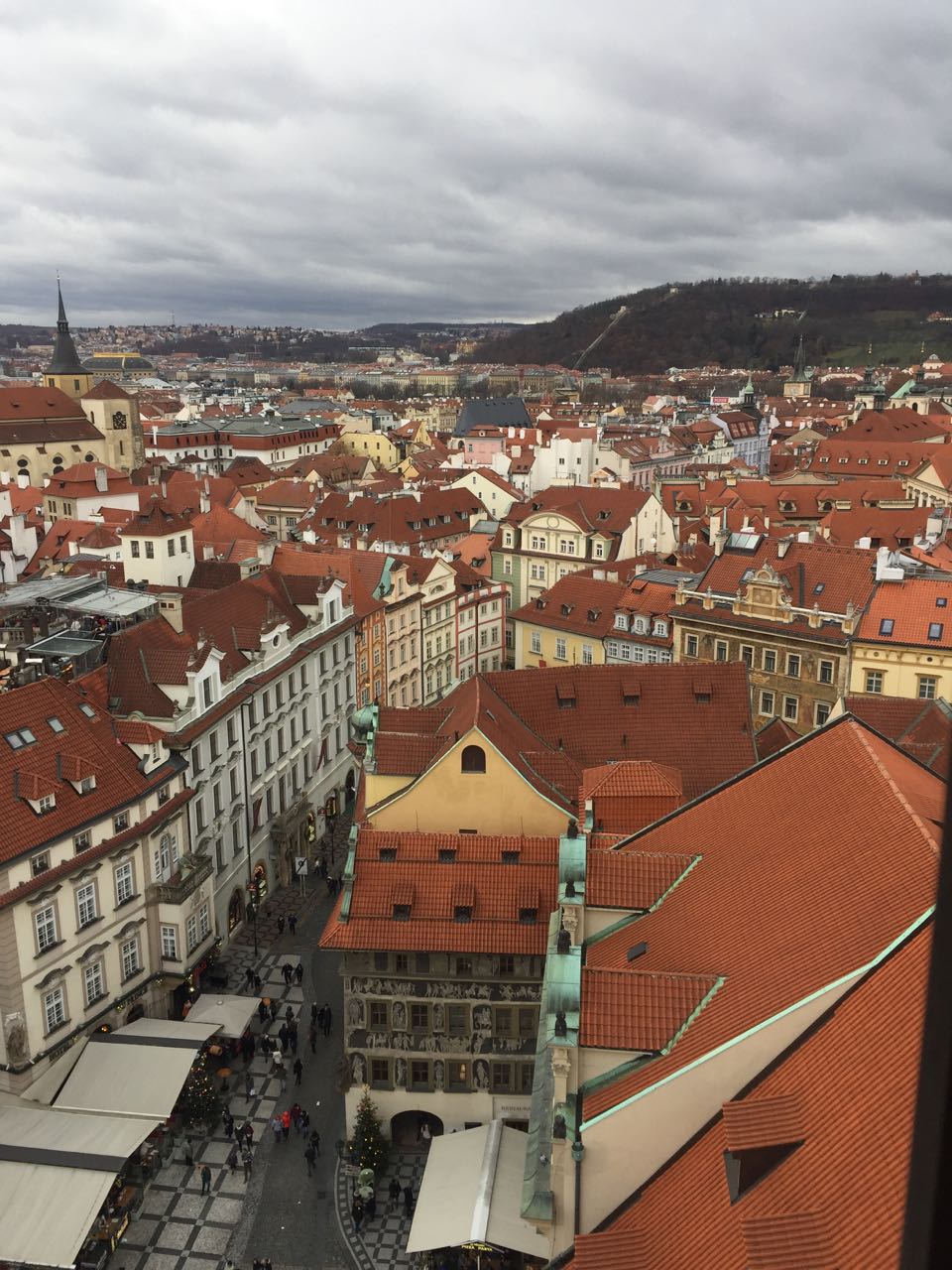
 There’s nothing like seeing a city from above. All the flaws and imperfections disappear, leaving only a panorama of color and beauty.
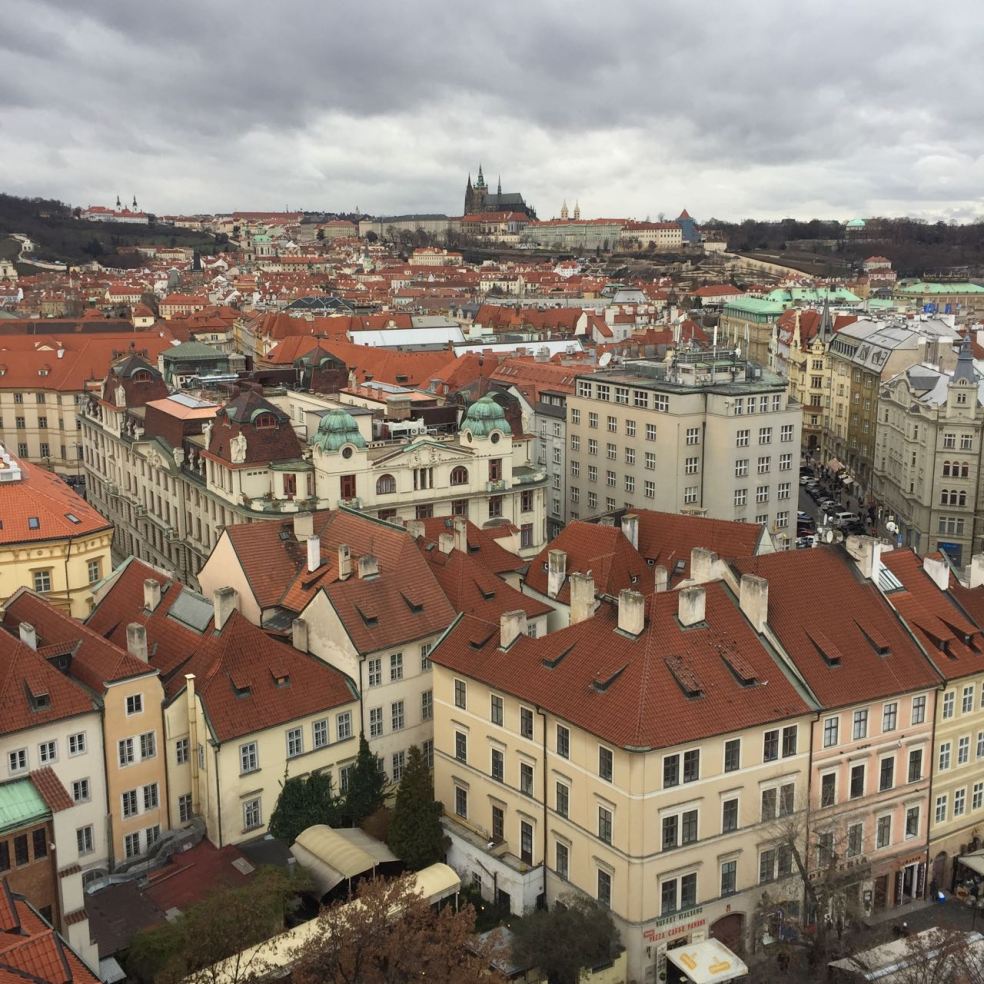
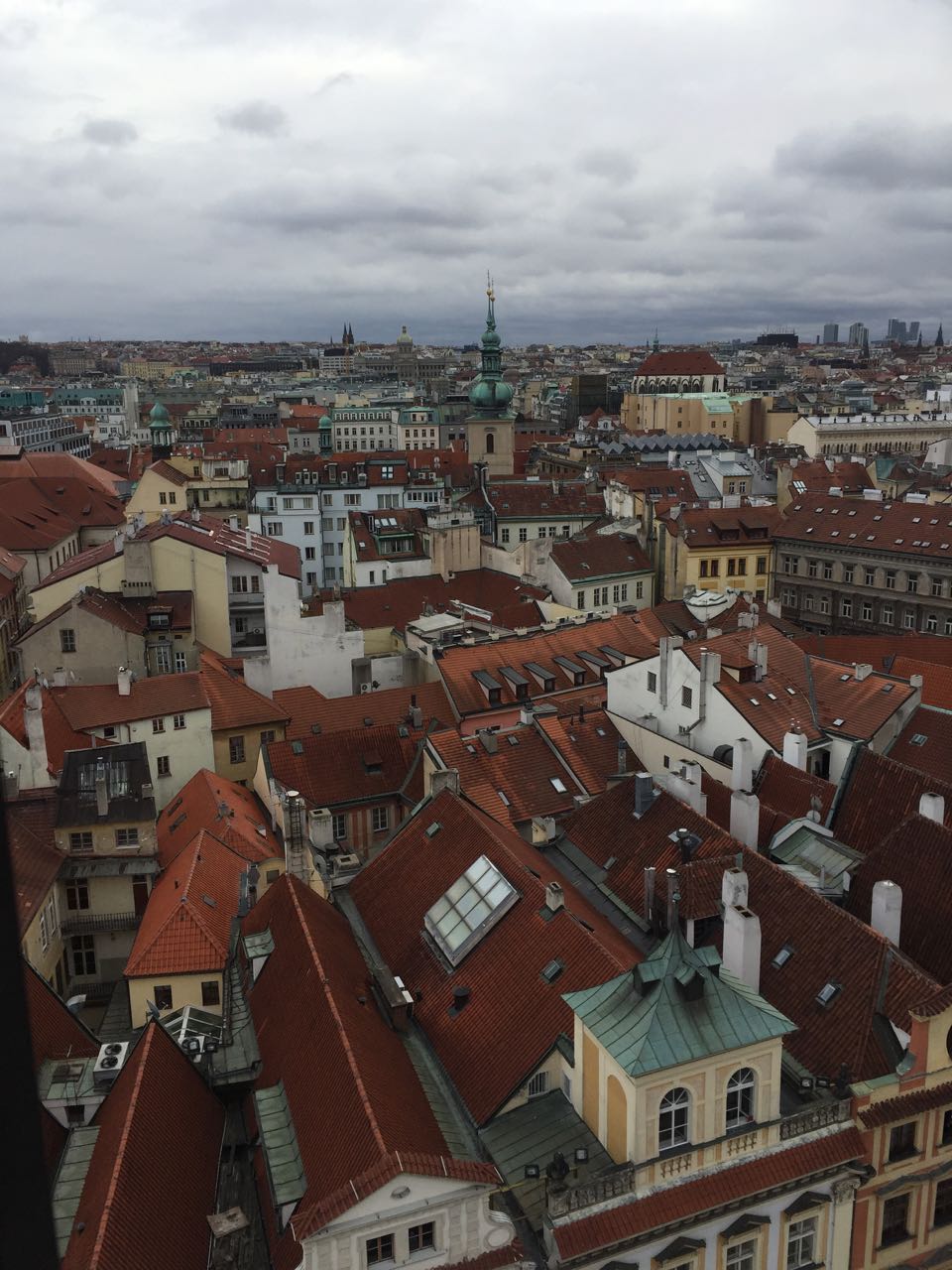
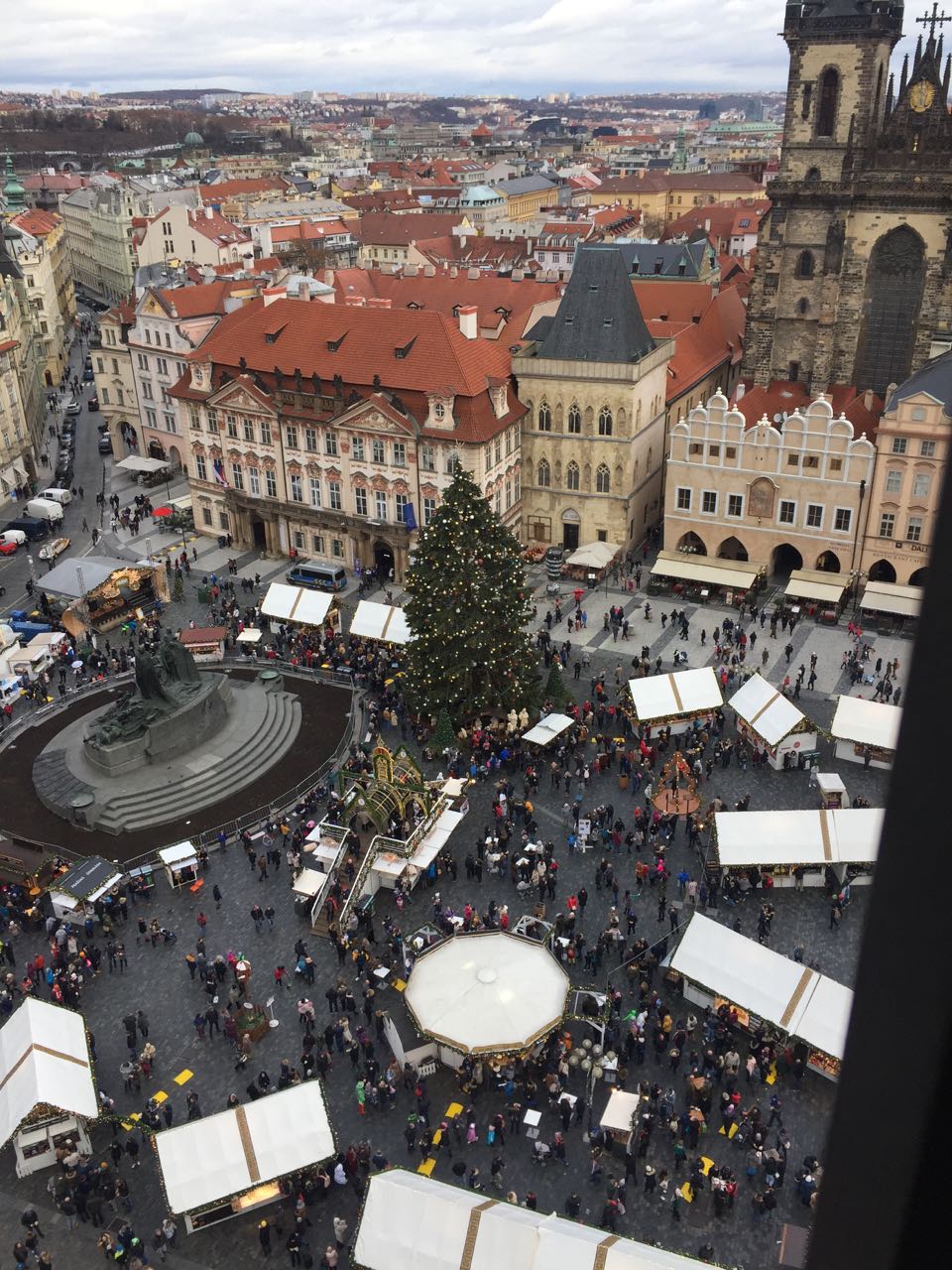
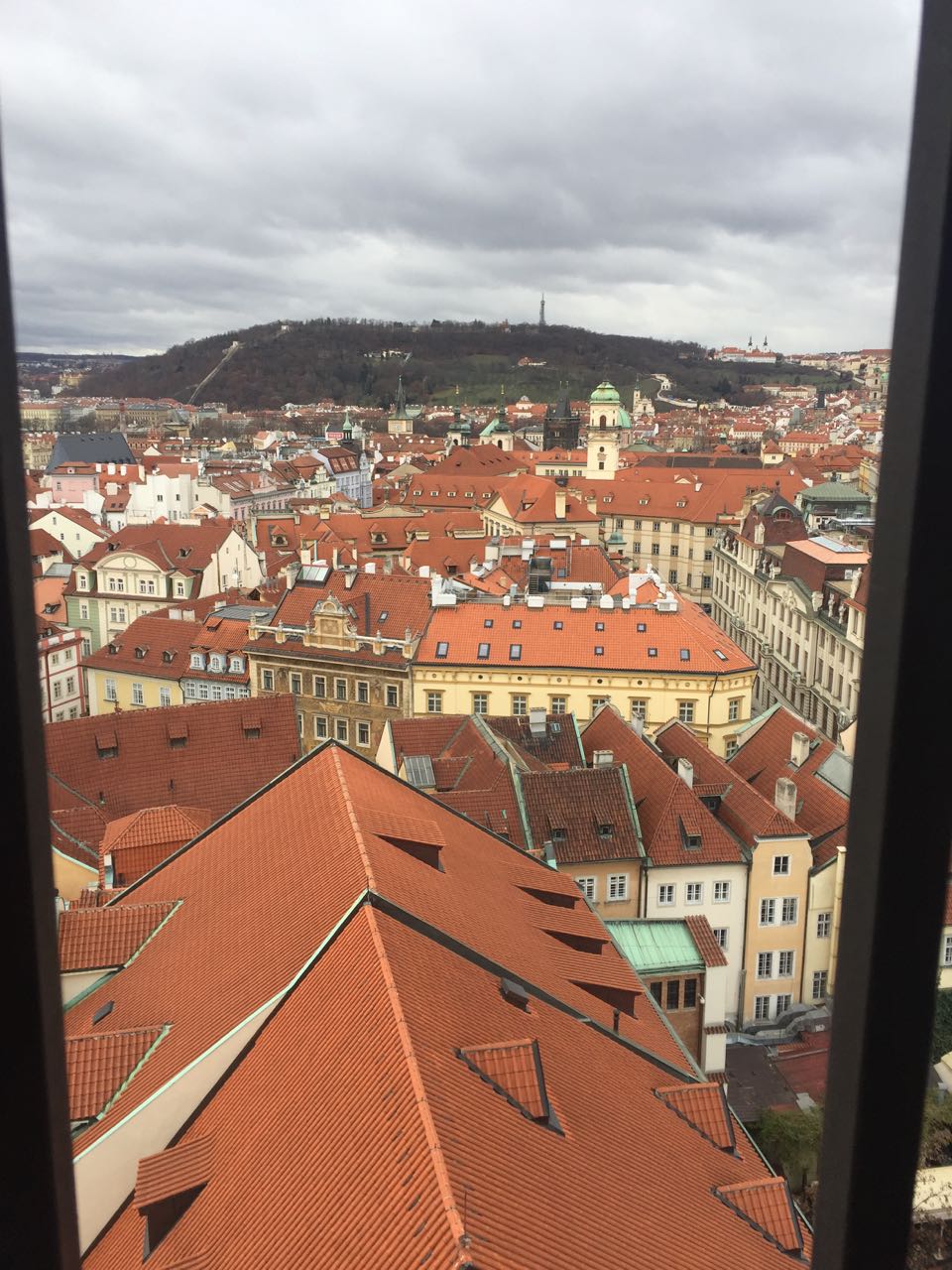
Fortunately the Old Town City hall, which features the previously mentioned Astronomical Clock, offers tourists a ride to its top for some awesome views of Prague.
So we forked over the ten euros and took a gander at a city that had already captured our hearts with its old world beauty and charm.
 Speaking of old… um, anyway, since it was December, things were a little brisk up there, but I snuggled Carolyn up to me with one hand and took photos with the other. I accomplished this particular photo by setting the phone timer to a 3 second delay and then artfully tossing it in front of us. By the 15th try I had the perfect shot, plus a very beat up iPhone. Well, okay, maybe a kind stranger took the shot for us, but I like my story better.
 “Rapunzel, Rapunzel, let down your hair!” Okay, if we had to wait for Carolyn’s hair to grow long enough to escape we’d be long dead. So we settled for, “Elevator, elevator, move up the shaft!”
The rest of the photos of the city landscape below are sans any of the usual jocular commentary.





Not far from the castle was this memorial to the victims of Communism. World War II resulted in a significant number of countries toiling under the yoke of their Soviet overlords, but the Czechs are very happy to be rid of all that. In 1993, Czechoslovakia peacefully dissolved, and the Czech Republic was born.


The history of the Jews in Prague is a troubling one, mostly due to the occupation by Germany during the war. Most Jews were deported and killed. None of the old buildings where they used to live exist today. However, there are synagogues (one of which was used by the Germans as a warehouse during the war). One of the more famous ones is called the Old-New Synagogue. It is the only active synagogue remaining in what used to be the Jewish ghetto.
They charged money to get in, but we didn’t think it was overly interesting (and they didn’t allow photos… the skeptic in me assuming because it wasn’t impressive enough to charge money to see). It is mostly just one fairly small room, which is somewhat sparse besides. But there is a lot of history there that is very meaningful to Jews.
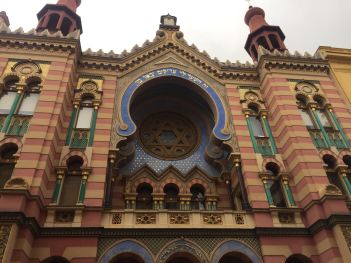 The one that was larger and a bit more interesting was the Jerusalem Synagogue, the front of which is pictured here. In the balcony they had interesting displays with stories of the history of Jews in Prague. It is a sad, solemn thing to go through. We should never forget how easy it is for groups of people to hate other groups of people, usually for no reason whatsoever. Anyone who calls for people to belittle, hate, ostracize, or instill fear about any other group of people should be ridden out of town on a rail. Unfortunately, there is a little too much of that coming back, even in Europe, although that call for fear and bigotry is more marginalized than it is in the US.
By the way, I’d be remiss if I didn’t mention that according to Wikipedia, The Czech Republic is a developed country with an advanced, high income export-oriented social market economy based in services, manufacturing and innovation. The UNDP ranks the country 14th in inequality-adjusted human development. The Czech Republic is a welfare state with a “continental” European social model, a universal health care system, tuition-free university education and is ranked 14th in the Human Capital Index. It ranks as the 6th safest or most peaceful country and is one of the most non-religious countries in the world, while achieving strong performance in democratic governance.
We wrap up our Prague adventure by buying you a spot of metaphorical lunch in a restaurant built inside a former coal mine right in the middle of Prague.
 We got a kick out of these bathroom signs. I give kudos to them for not only making sure everyone understands which gender is supposed to use which room, but doing so without a hint of embarrassment or shame over body parts.
 Czechs drink more beer per capita than anyone, so it’s only appropriate that they insist you either get hammered by beer, or an actual hammer. Otherwise, Praguians (Praguesters? Praguemen? Praguetonians?) generally enjoy a meaty cuisine with lots of sausage and potatoes, not too different from their German neighbors.
 And so we usher you to the exit, with memories of Prague still dancing in our heads, and the results of drinking too much beer still interfering with our dancing.
 Arguably the single biggest must-see in Prague is the Prague Castle, which dates all the way back to the 9th century.


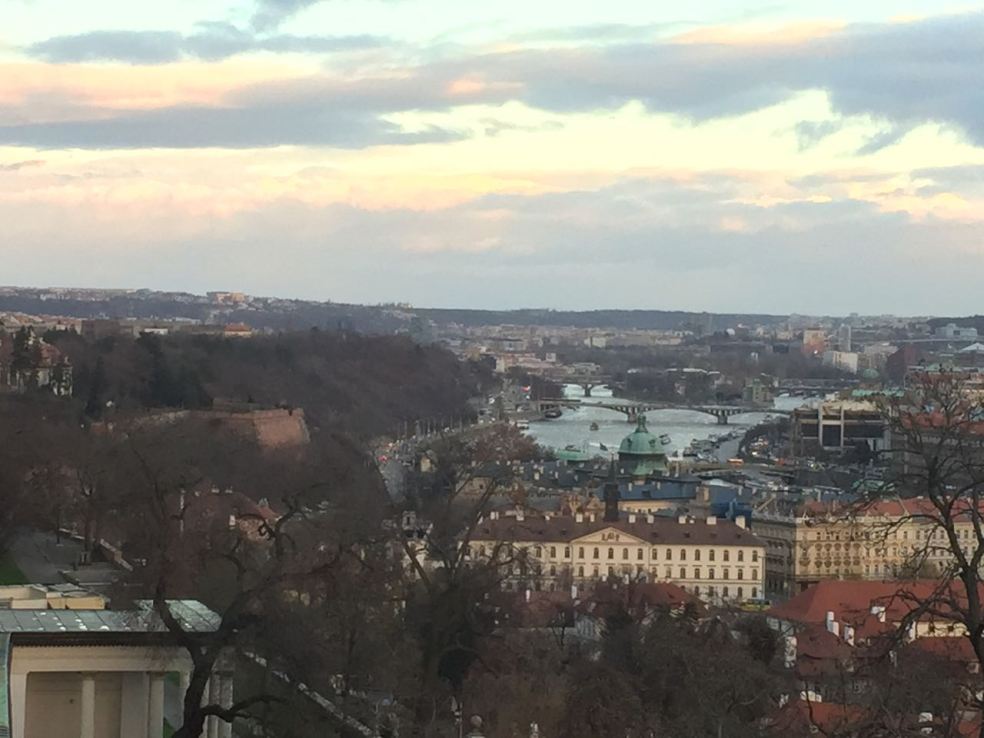 Once you climb the multitudinous stairs to get to the complex, you’re treated to a wonderful view of Prague.
 We were fortunate enough to go there in the afternoon and stay into the night, which meant we were also treated to wonderful evening views.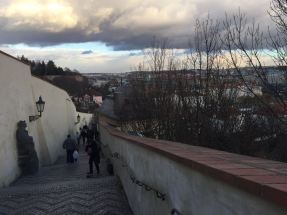
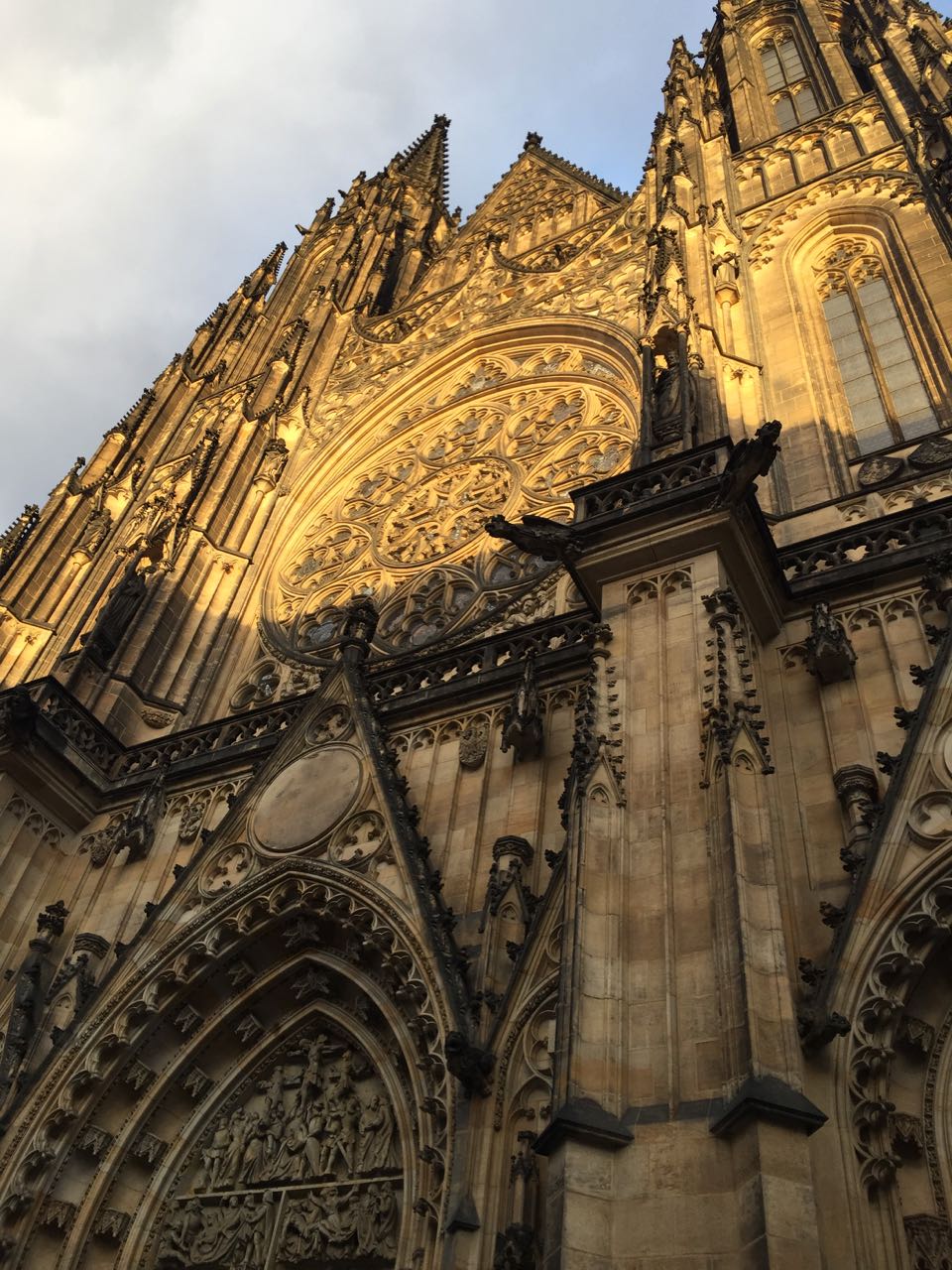 Inside the castle complex is St. Vitus Cathedral, construction of which began in 1344.
 The outside of St. Vitus is both imposing and gothically beautiful. It is easily one of the most impressive churches we’ve seen since we’ve been here.
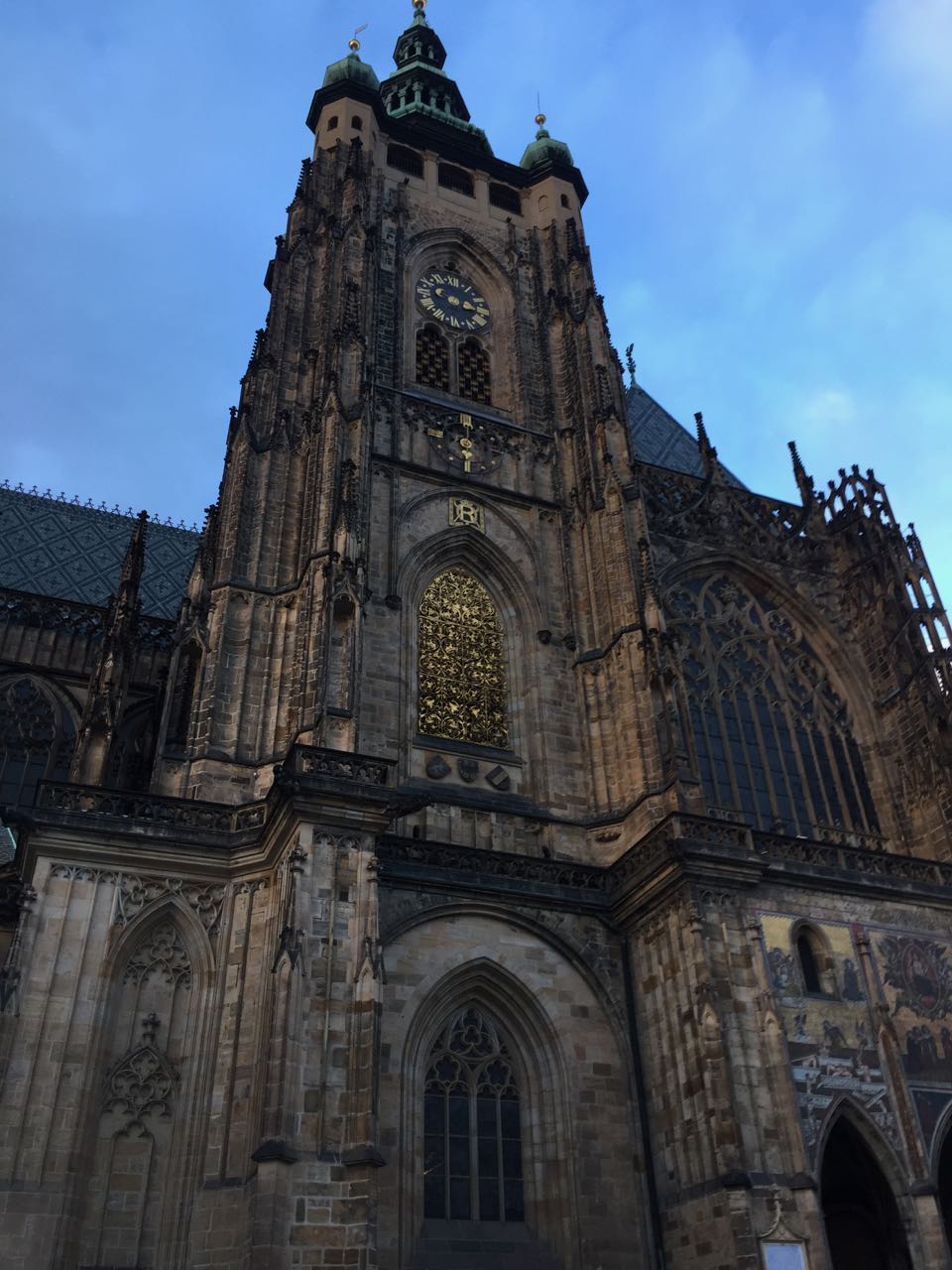 When buying tickets to see whatever you want to see, you’re presented with three choices, or “circuits.” We chose Circuit B after doing rock, paper, scissors. Turned out to be the right one, especially with our limited time budget.
 Amazingly enough, the construction of the Cathedral wasn’t completed until 1929, almost 600 years from when it began.
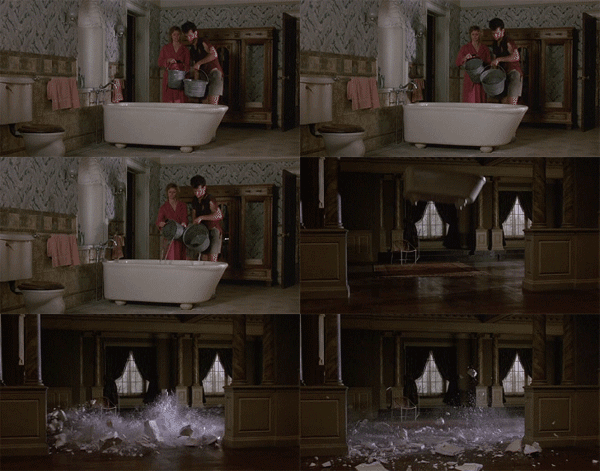 If this had been the focus of The Money Pit, when the foreman was asked when it was going to be finished, instead of “two weeks, two weeks,” he might have said “two centuries, two centuries.”
 There was a lot of controversy over art like this, with critics complaining that the kids would just sit around inside and stare at it instead of going outside to play like they did back when they were kids. The controversy abated once television was invented.
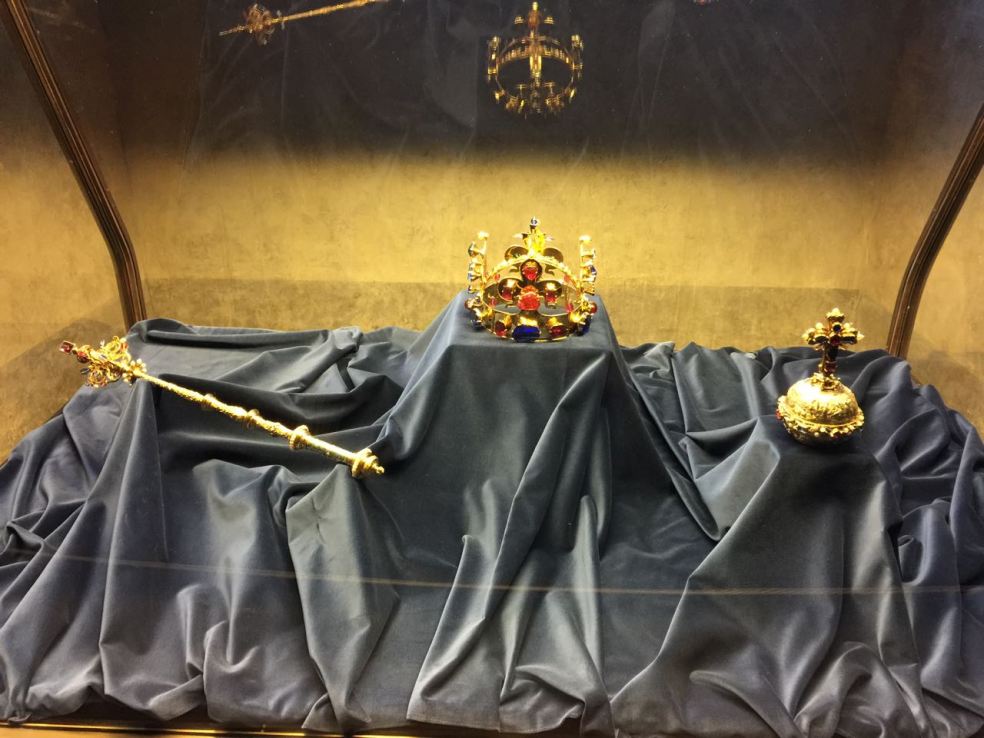 The Czech Crown Jewels. Or more accurately, reproductions of them, not that anyone could tell. The crown was made for Charles IV in 1347, making it the fourth oldest crown in Europe, just after one in Queen Elizabeth II’s mouth.
 This is one of the souvenir shops on an alley called “The Golden Lane,” so-named because goldsmiths used to work there. Apparently one of the job requirements of a goldsmith was to be not much more than five feet tall.
 While the Golden Lane wasn’t particularly impressive, they did have dozens of suits of armor on display as part of the attraction. It’s hard to imagine walking around in one of those things, especially on a hot day. And they hadn’t even invented anti-perspirant yet. And how do you take a leak?
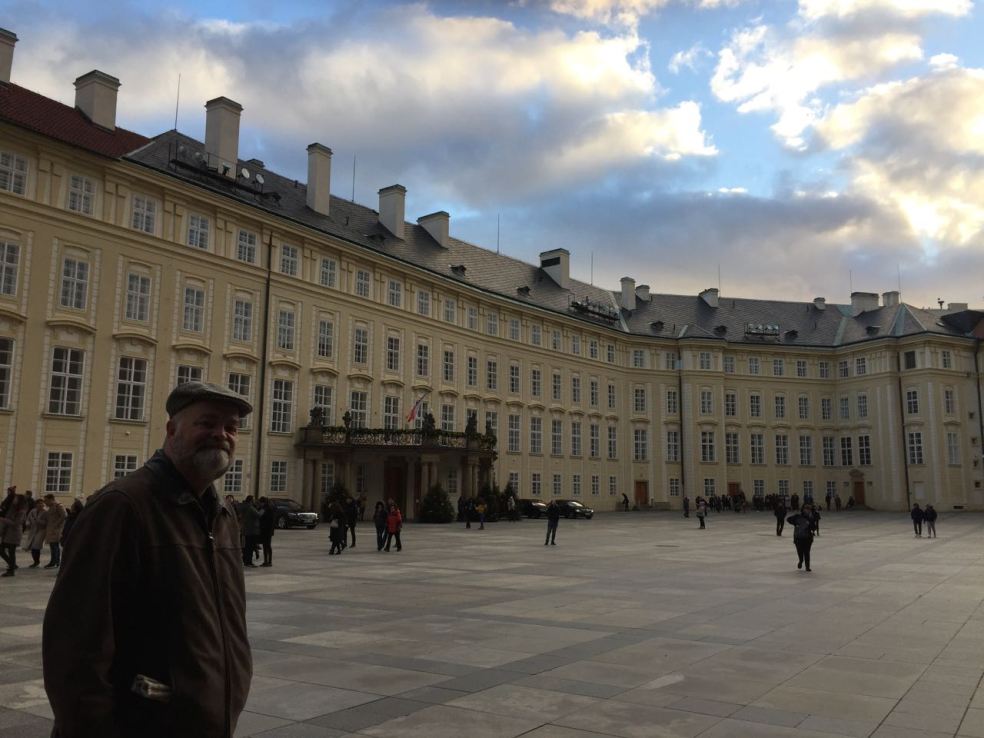 On the grounds is the Rosenberg Palace, which was originally named the Renaissance palace. We peeked inside but most reviews are fairly blah on the place, so we used our limited time for other, more interesting things.
 I can’t remember what this is, although I know it’s a building.
 The changing of the guard. All thoughts of stealing the fake crown jewels abated once I saw their fierce weaponry.
 Another view of Prague from the castle.
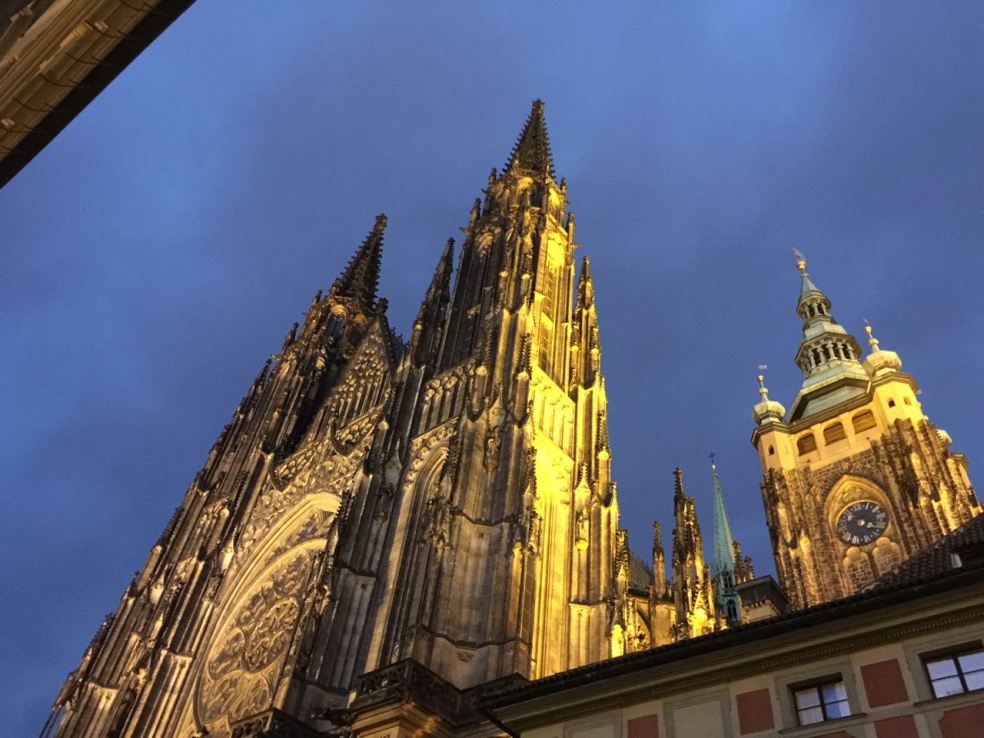 When the sun goes down and the lights come up, the church looks like something from an old horror movie.
 In the end, the castle was certainly a sight to behold. With a little extemporaneous planning we were actually able to see everything we wanted to see without spending the entire day there.
 When I organize the pictures I’ve taken after a trip, I try to put similarly-themed images together. When the organizational dust had settled this time, I discovered I had one folder full of nothing but Prague buildings.
 When we first ventured out of our hotel room, we walked along the Vltava river until we came to the most famous bridge in Prague: Charles Bridge.
 After taking selfies in front of the famous bridge, we trudged through the nasty weather on our way toward the city center, and noticed there were in fact a number of bridges over the river. Eventually we came to one in particular which was really crowded with tourists.
 Oh, that’s the Charles Bridge. Oops. We don’t even know the name of the not-so-famous bridge we were so gleefully snapping pictures of, but what the heck. A rose by any other name…
 The Charles Bridge is pedestrians-only. During the busy season, it’s just one big sea of pedestrians.
 As with any sea, there are occasional buoys –er, boys, floating about.
 As well as some gulls, –er, girls, too.
 Like any proper famous bridge, the Chuckie Bridge has a famous spot you can touch for luck. I figure any bridge that keeps me from touching the water beneath is plenty lucky already. Plus I have a hard time believing that touching something that a hundred thousand people before you have already put their germs on will bring you any kind of good luck. Or maybe they’re just referring to the fact that you’re damn lucky if you don’t catch something from it.
 The construction of the Charles Bridge started in 1357 and finished in the beginning of the 15th century. It was originally and cleverly called Stone Bridge, or also, and just as cleverly, Prague Bridge. But it has been known as “Charles Bridge” since 1870 (King Charles IV began the thing), which, while not the cleverest of names, certainly is much more clever than the first two.
 baldsasquatchdotcom