

We were excited to visit Prague, since it felt to us like it would be one of the more “exotic” cities we’ve visited since we’ve been here. Truth be told, the only reason we thought it exotic is because neither of us really knew a whole lot about the Czech Republic, except that it used to be named Czechoslovakia, it is the most easterly we’ve ever gone in Europe so far, and that the Czechs drink more beer per capita than anyone in the world.
Also, while most EU countries use the euro, Bulgaria, Croatia, Denmark, Hungary, Poland, Romania, Sweden, and the United Kingdom join the Czech Republic in using their own homespun currency, which is the koruna, which sounds Hawaiian, but it’s clearly not because there is no documented evidence that any Czech has ever met any Hawaiian. Not that I’ve seen anyway.
The exchange rate for the Czech koruna is about .039 korunas to the euro, so when you turn 100 euros into korunas you end up with 2,566 korunas. Suddenly, we felt very rich!

We thought money might even fall from heaven for us, so we looked up to the sky hoping to see the korunas floating down toward our wallets, but alas, it was only rain. That and some rather scary greeters at the door of this residence.
After figuring out the math so we could get within 50 euros of knowing what everything cost, we discovered Prague was actually very affordable. Uber, our main mode of transport, was particularly inexpensive, with most car rides costing only a couple of euros, or 4 million korunas.
Just kiddin’. 2 euros is about 51 korunas.
Anyway, restaurant fare was reasonable, as well as the things we saw and purchased in grocery stores, etc. Suffice it to say, visiting Prague won’t break the bank like it does in London, Singapore, New York, Paris, or Sesimbra, Portugal. The latter is only because if you visit us, we pretend everything costs more so when we split the checks, so we actually make money on the dining experience.
Hey, 1.5 liters of bottled water costs 17 cents here, which used to seem damned cheap compared to that of the US, where marketing has become so sophisticated that they can even make water sound like the Elixir of the Gods. Just one more reason I love Portugal… they still regard water as just plain ol’ water. But now we’re used to the prices, so when I go into a store and see it for 18 cents instead of 17, I pitch a fit and scramble for coupons. Except Portugal doesn’t use coupons like the US does. But that’s okay, having senior moments means you forget what you were looking for long before you realize that what you were looking for doesn’t actually exist.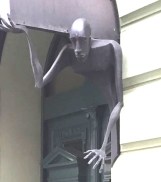
As an aside, it’s hard to make out the weird statue thing in the picture above, so to the right is the photo zoomed, cropped, and lightened in order to see it better. Seems like an odd way to greet people living there, or maybe it just creeps out would-be burglars, I dunno.
Anyway, Prague is statistically cheaper than any major city we’ve visited over here so far. It’s listed on one site as even cheaper than Lisbon. Prague comes in at 67th cheapest, while Lisbon is 78th. Zurich, Venice, New York, San Francisco, and Boston round out the top five most expensive cities to visit in the world. If you want to go cheap, head to Vietnam. Different sites give different results, and your own results may vary of course. Frankly, we know how to travel pretty cheaply, so even though Venice comes in at the second most expensive on that particular list, we missed most of that because we didn’t overnight in the city or take a 100 euro gondola ride.
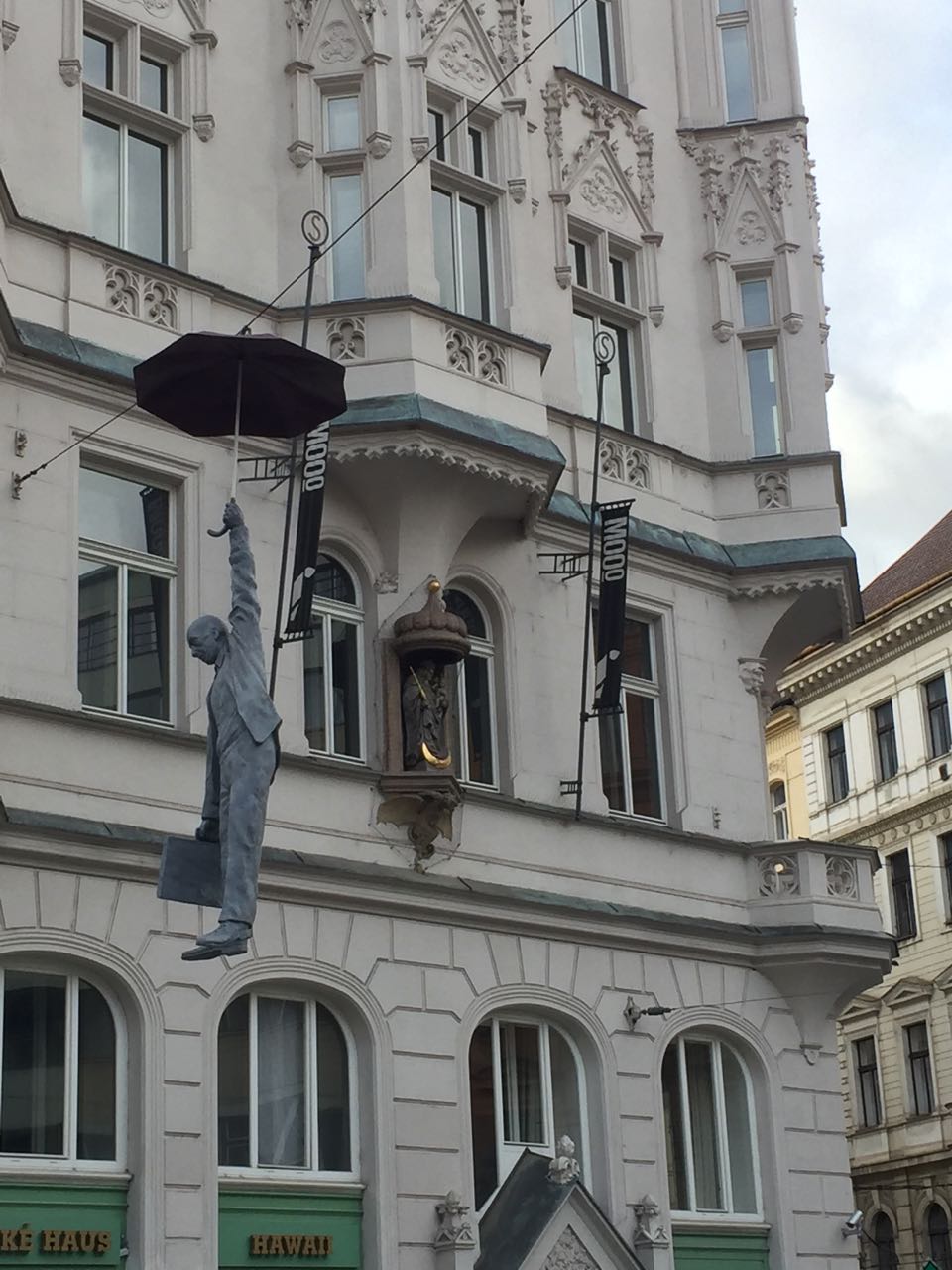 The statue above is of a guy doing a Mary Poppins over the street. It’s a piece of art that serves the purpose of reminding you to look up while walking around Prague, because if there doesn’t happen to be any floating statues above you, there’s likely to be some amazing architecture instead.
Actually, the Mary Poppins Man didn’t even make this “Top Ten Strangest Statues in Prague” list. Out of that entire list, we only saw one of them in person (to be discussed later). Which makes me realize anytime we go into a new city now, we have to first Google “Top Ten Strangest Statues in (insert city name here). Which makes me wonder, what other strange things are we missing? At this rate, we’d probably overlook The Church of Elvis in Portland if we were tourists. We need to do more research on oddities the next time we go anywhere…
 … like this gorilla made out of colored pencils. It’s the lead decor for a stationary store. Great. Now we have to Google “statues made out of pencils” everywhere we go.
 Not content with making gorillas out of pencils, the Praguesters enjoy creating delightful artwork out of their food too. I’m sure it tastes a lot better than taking a bite out of a Van Gogh.
 Here I’m tickling the chin of Louis de Funes, who is a famous French actor. But he was apparently so short he only got small roles. Ha ha! Maybe he’s there to show us how fleeting or regional fame can be, because I’m willing to bet no American reading this has ever heard of him, even though one of the films he was in was nominated for a Golden Globe in 1974. Of course, I personally have no idea who or what has ever won a Golden Globe. Until now. But it was the movie, not him. Which I don’t remember anymore. So I guess my comment is still correct. Wait, what was I talking about?
Anyway, I guess he’s famous in many countries including the Czech Republic and other countries in that area of Europe and even Russia, but he’s almost unknown in the English-speaking world. He’s dead now, so I don’t think he can improve his fame much beyond the above picture in my blog, which may double his current fame in America. This was in front of a candy store-slash-wax museum. Prague has no shortage of touristy places to visit, even if they have to use an obscure dead actor who was famous in one part of the world fifty years ago to promote their store.
 They also have a famous piece of artwork of a bunch of sitting seagulls on the Vltava River, which is the river that runs through Prague. Oh. Carolyn just chimed in and said this isn’t artwork, these are real live birds. My bad. I think they’re waiting in line because, being birds and therefore stupid, believed a rumor that this is the line to get into the new Star Wars land in Disneyland. Stupid birds. We all know that line starts in Sacramento.
 You don’t have to be well-read to visit Prague, but it pays to be, well, red. These exotic old cars trundle about Prague carrying shivering tourists, because even when it was close to freezing, they had no tops. Sheesh. We only go around topless in these big cities during the summer.
 There is a mildly humorous story associated with this picture in front of a church. Unfortunately, we don’t have the funny photo to go with it, so you’ll have to settle for the story. As I stood up there to strike a pose, some people came out of the church and stood near me, pausing before going down the steps. Carolyn was trying to maneuver me into better position, so she was waving her hand and telling me to go this way and that and stop and whatnot. A gentleman standing in front of me thought she was telling him what to do, and lo and behold, he obeyed her commands, moving this way and that, and then dutifully standing still for the shot. I stood behind him chuckling, and even Carolyn didn’t realize at first that’s what was happening. Finally the man’s wife yanked him to the side with a laugh. After all that, we didn’t even get any pictures better than the above.
 So we finish this first Prague Blog entry with a Door of the Day for Carolyn. But this was just a taste of what Prague had to offer. It is a truly magnificent city, perhaps mostly because it was pretty much the only major city in Europe that wasn’t extensively bombed during World War II, so the old great buildings still stand in all their original splendor.

 In February of 1945 the US and England dropped almost 1,500 tons of high explosives bombs and over 1,100 tons of incendiary bombs on Dresden, creating a hellacious firestorm and pretty much destroying the entire inner city. The bombing remains controversial to this day.
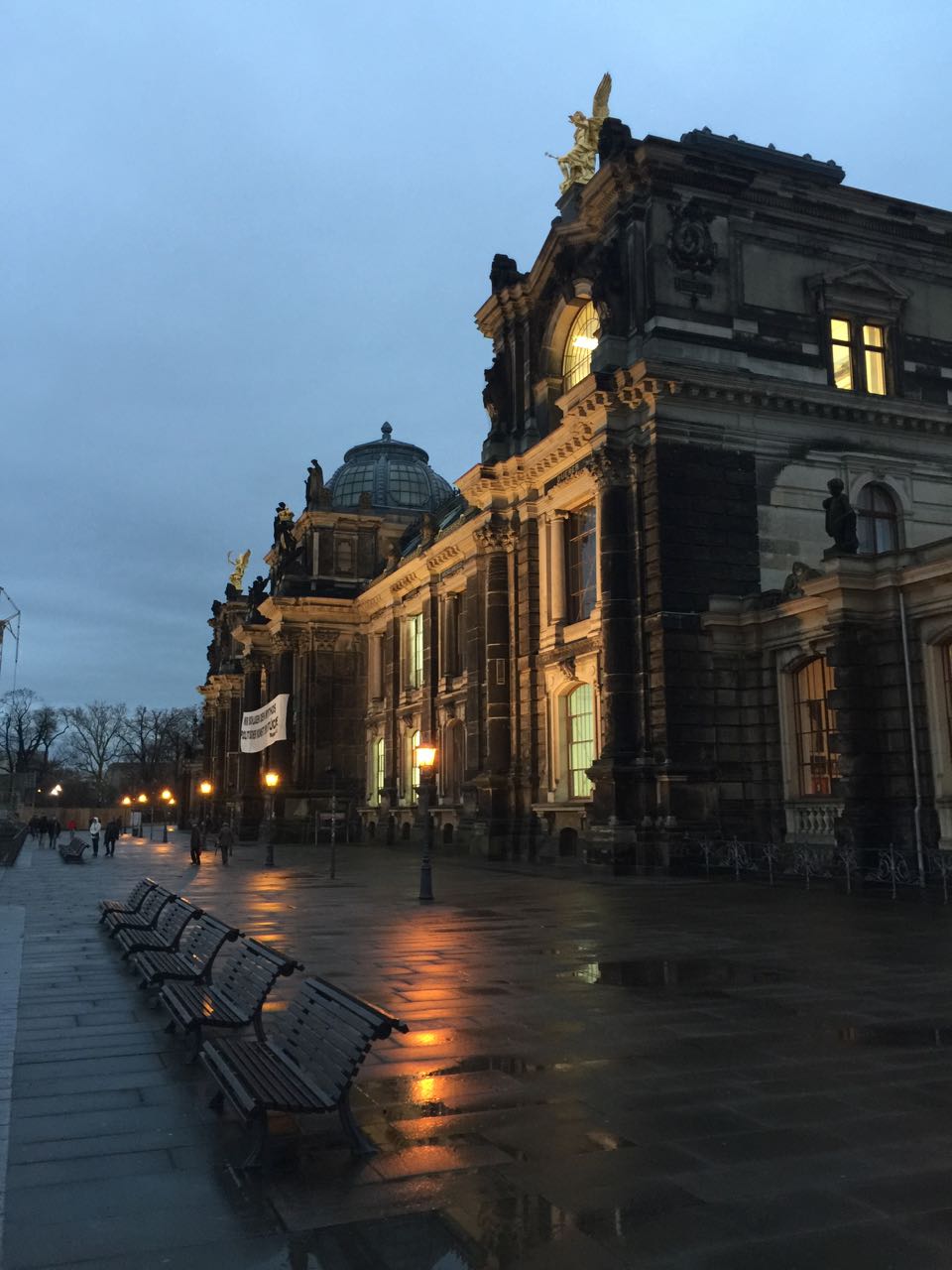 This is an area called Brühl’s Terrace in the inner city. It is a popular location for taking walks, people watching, and debating with your travel companions as to how you pronounce the ü. I argued for Ooh-dot-dot.
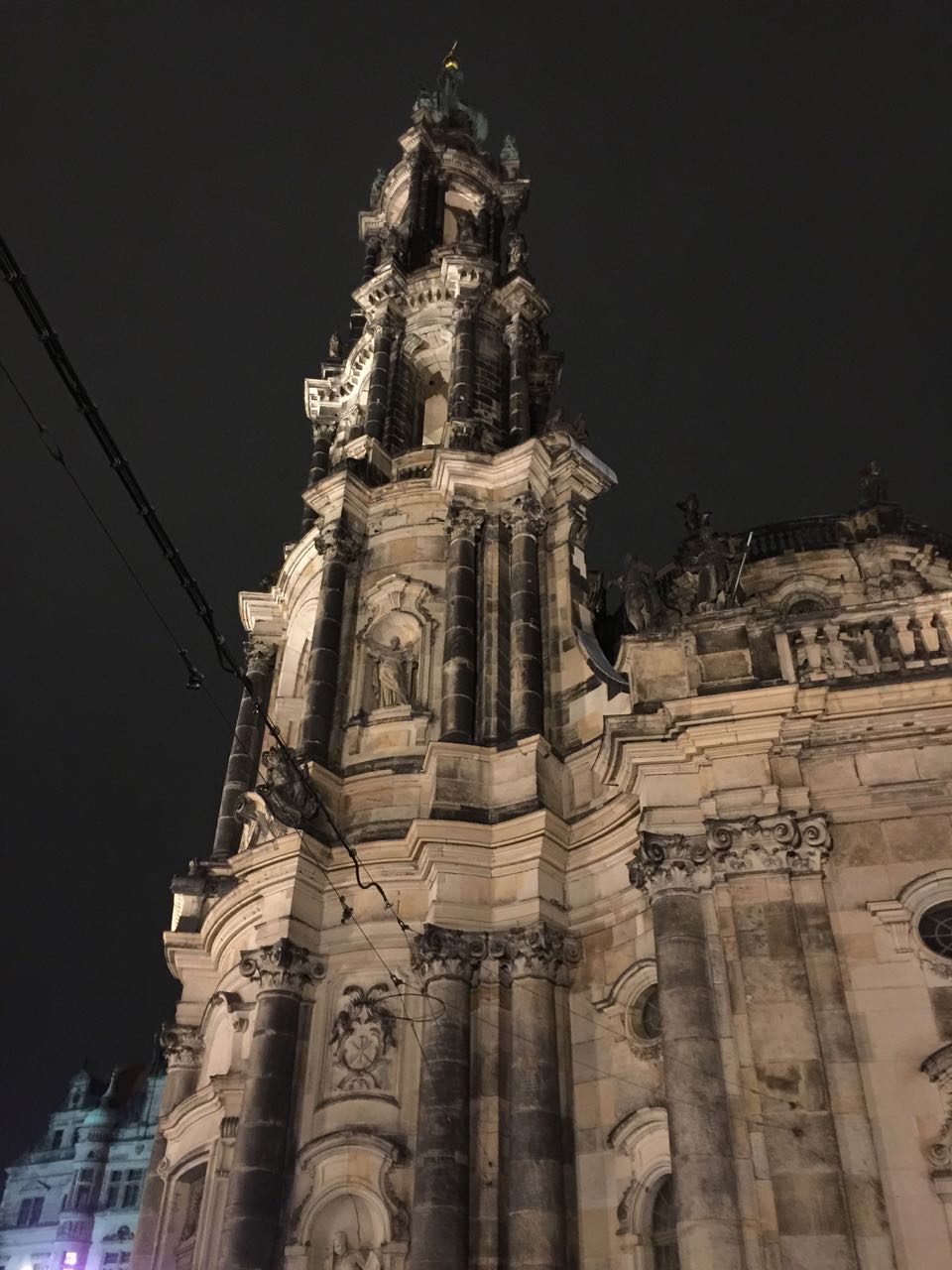 This is Catholic Church of the Royal Court of Saxony, aka The Dresden Cathedral. The church was badly damaged during the bombing (which will be a common theme here). The East German government restored much of it, and after reunification it was restored more fully. It was originally completed in 1751.
 Not to be outdone by the Catholics, the Lutherans have the Frauenkirche of Dresden, which is now one of the most important churches in Germany. It was mostly destroyed by the firestorm as well. It remains an important symbol because the Communists wanted to turn it into a parking lot. The Germans simply wouldn’t allow that, but the church wasn’t fully rebuilt until after the German reunification.
 The Semperoper is the opera house of the Saxon State Opera, and was originally built in 1841. Only an empty shell was left after the Dresden firestorm. Exactly 40 years later, on February 13th, 1985, the opera’s reconstruction was completed. Of course, I’m not sure anyone bothered to ask who listens to opera anymore, but it’s an impressive building nonetheless.
 When we saw this building with that big slogan, I didn’t know if was some propaganda relic from East Germany’s past or an advertisement for a pub. I translated it with Google Translate, and this is what it apparently says: “A life without joy is like a long journey without a guesthouse.”
 We couldn’t tell the date of construction of apartments like this, but the blocky style is certainly reminiscent of the Communist approach to architecture, i.e. bo-ring…
 I’m pretty sure this was built after the reunification because it actually has some artistic design to it. I don’t think it’s an atomic plant, however. We didn’t think so because we didn’t grow a third eye or anything after walking by it. Yet anyway.
 The inner city of Dresden at night.
 This is a Christmas tree in the Wiener Platz, which is an important transportation hub of Dresden, especially for sausages. Otherwise, why would they call it Wiener Platz? Duh!
 This monument, dubbed “The Golden Horseman,” is a statue of Augustus the Strong (1670-1733) and is covered with gold leaf. Augustus’ great physical strength earned him the nickname by breaking horseshoes with his bare hands (!) and engaging in fox tossing by holding the end of his sling with just one finger while two of the strongest men in his court held the other end.
 Carolyn freezing in front of the Katholische Hofkirche.
 A wide angle view of the inner city square.
 A view of the Frauenkirche of Dresden as seen through the Fürstenzug on Augustusstraße (talk about a mouthful!). The Fürstenzug (Procession of Princes) is a large mural of a mounted procession of the rulers of Saxony, and is one of the largest porcelain tile artworks in the world.
 It was originally painted between 1871 and 1876 to celebrate the 800th anniversary of the Wettin Dynasty, Saxony’s ruling family. In order to make the work weatherproof, it was replaced with approximately 23,000 Meissen porcelain tiles between 1904 and 1907. Apparently those are the things to use for construction if you anticipate a fire bombing, because the damage to it was minimal.
 According to Google Translate, that sign says, “A tribe of horses whose career extends to our days in the gray past, he went on to say with our people.” Apparently any kind of writing on walls is essentially graffiti, which is almost always unintelligible.
 The view across the river Elbe.
 More inner city Dresden. The whole area is easily walked in less than an hour, but only can be fully appreciated with a day or two of exploration.
 I thought it a good idea to reach out between nations and hug a Pole.
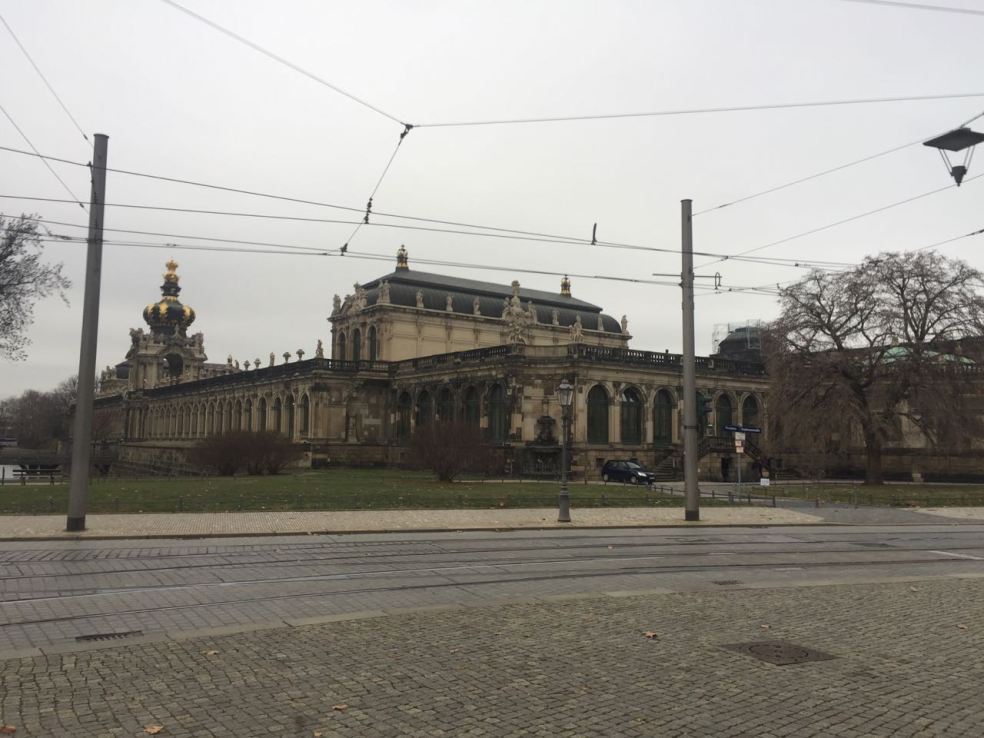 This is the outside of the Zwinger, which is a palace in Dresden. Zwinger is actually a term for what is essentially a killing ground: an open area between two defensive walls that was used for defensive purposes during the Middle Ages.
 This Zwinger was eventually walled in, and is now a museum complex that contains the Gemäldegalerie Alte Meister (Old Masters Picture Gallery), the Dresden Porcelain Collection (Dresdener Porzellansammlung) and the Mathematisch-Physikalischer Salon (Royal Cabinet of Mathematical and Physical Instruments).
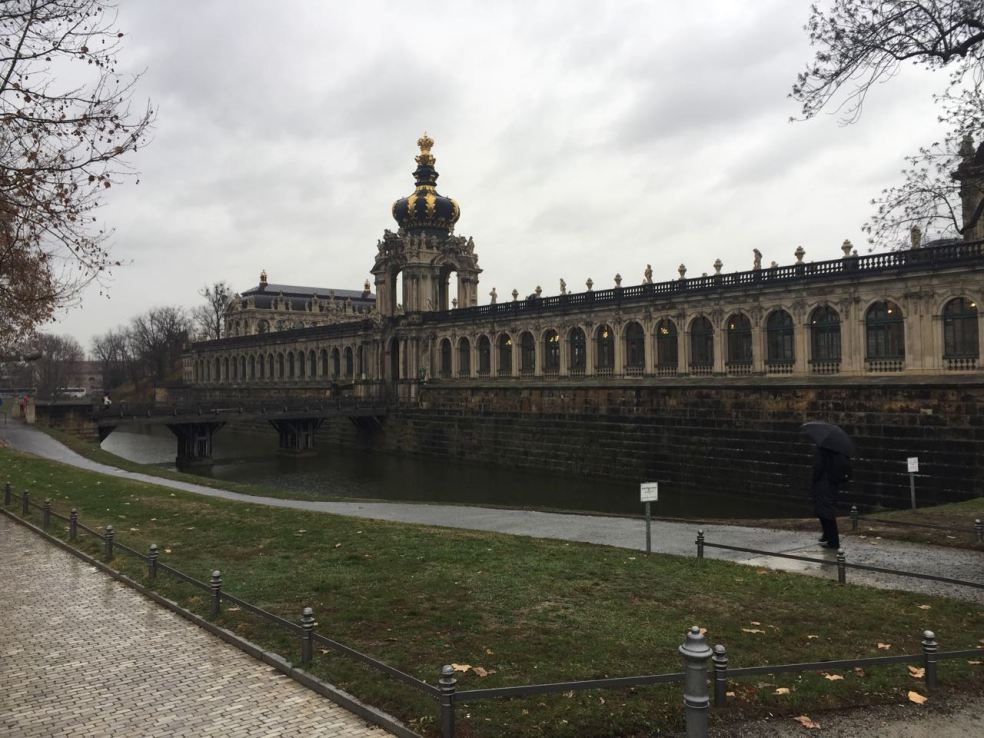 It was of course largely destroyed in the bombing, but like much of the rest of inner city Dresden, has been rebuilt to its former glory.
 We also went into a museum called “The Green Vault” that houses the largest collection of treasures in Europe. It was founded by Augustus the Strong, and so I would’ve expected some broken horseshoes or a video of fox tossing, but no.

 We were flummoxed when we found out our train to Prague was delayed by about half an hour. I’d read that German trains are on time 99% of the time! What the hell’s going on here?


 So that’s Dresden. It only gets one entry because the area wasn’t huge and there was only so much to see. Plus we already covered the Christmas markets in a previous blog, and that was some of the reason we went there.
 Not every visit to a new city has to be filled with sights unique to the area. Museums of every kind abound in most cities, and many of them are just as interesting as the museums you might want to visit in your hometown, especially when you have a hankering to see some dinosaur bones.
 The Guinness World Record Certificate confirms that this is the tallest mounted dinosaur skeleton in the world. That’s just his big toe, I think. It kinda looks like a wooden Dutch shoe, doesn’t it?
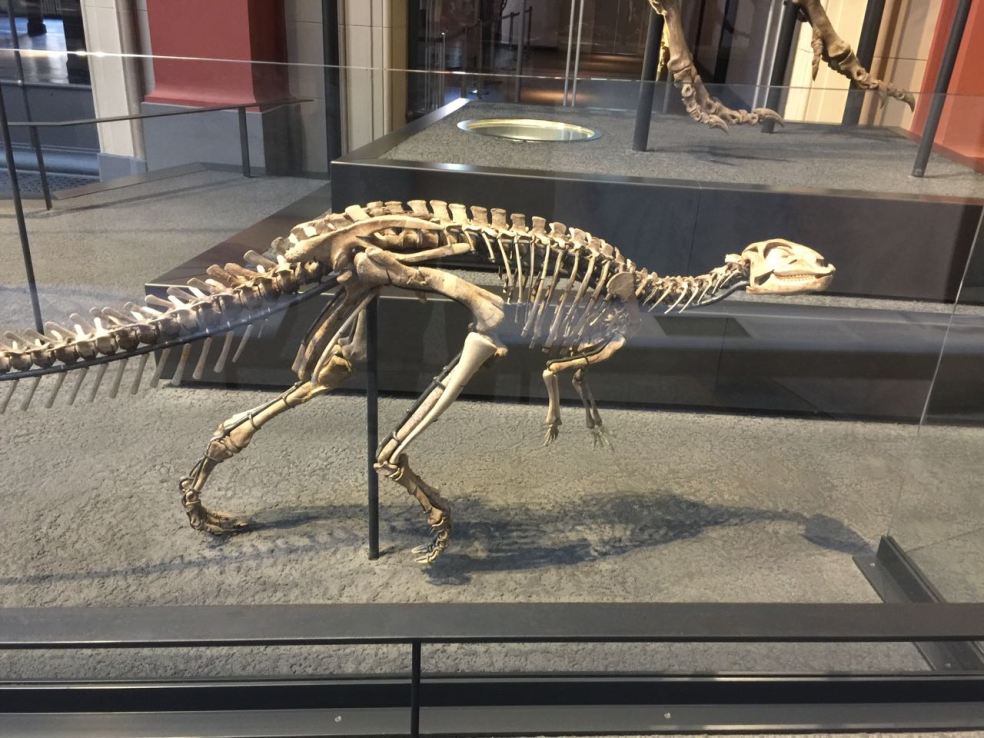 No, this isn’t the tallest one. This was the dinosaur version of “it tastes like chicken.”
 This is the dinosaur version of
  Speaking of caring for pets, the guy who made the Arc Encounter in Kentucky thinks Noah put two of these in a boat. (As well as I guess two each of the other 700 plus species of dinosaur we’ve found so far.) And then sailed with them for over a year.
 Is it any wonder that someone invented dragons after coming across a dinosaur skull like this?
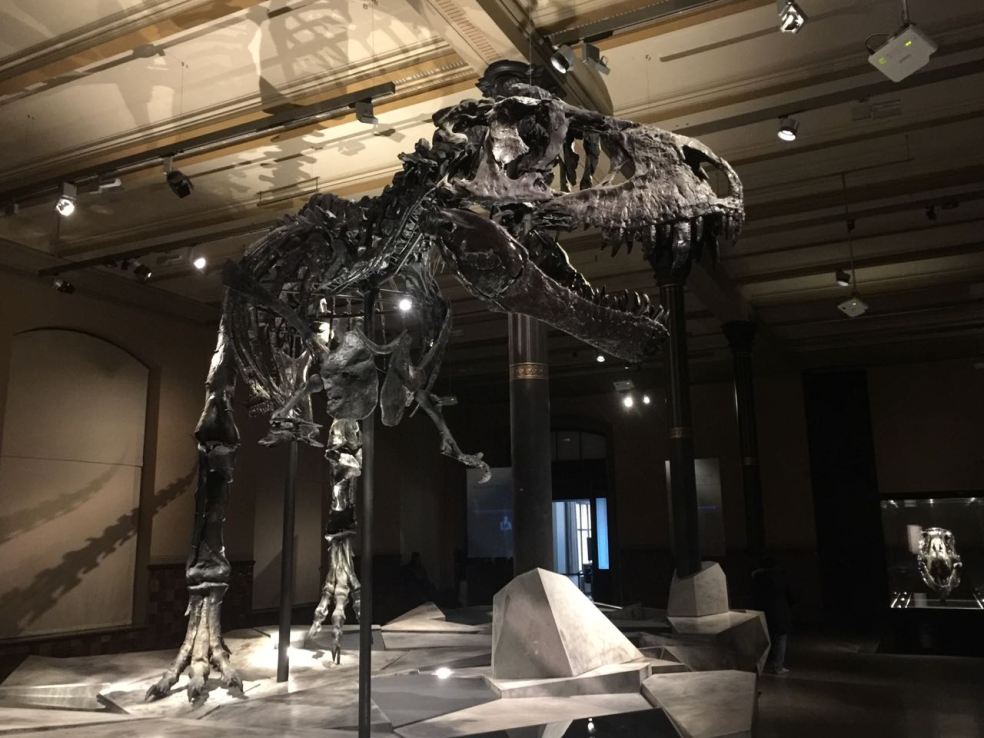 A battle between a Tyrannosaurus Rex and a dragon would have been epic. My money would be on the dragon, because the Tyrannosaurus Rex was around before flame throwers were invented and so hadn’t evolved any defenses. Duh.
 The Tyrannosaurus Rex had the strongest bite in history. This was problematic for them when they tried kissing, which may be why we don’t see any more little Tyrannosauruses running around.
 It’s pretty obvious we’ve evolved only so far.
 Okay, so we stand taller. But some of us actually believe that dinosaurs were on Noah’s Ark, so I’m not sure where that’s gotten us.
 This exhibit proves that it only takes two macaws to lift a cheetah from the ground. It’s a well known fact that they do that and then dash the hapless cats onto the rocks for a fine feast of flattened feline. At least I think that’s what the plaque in German said.
 This guy got so hammered the next morning he woke up in a jar.
 These two walked into a prohibited room and were never heard from again.
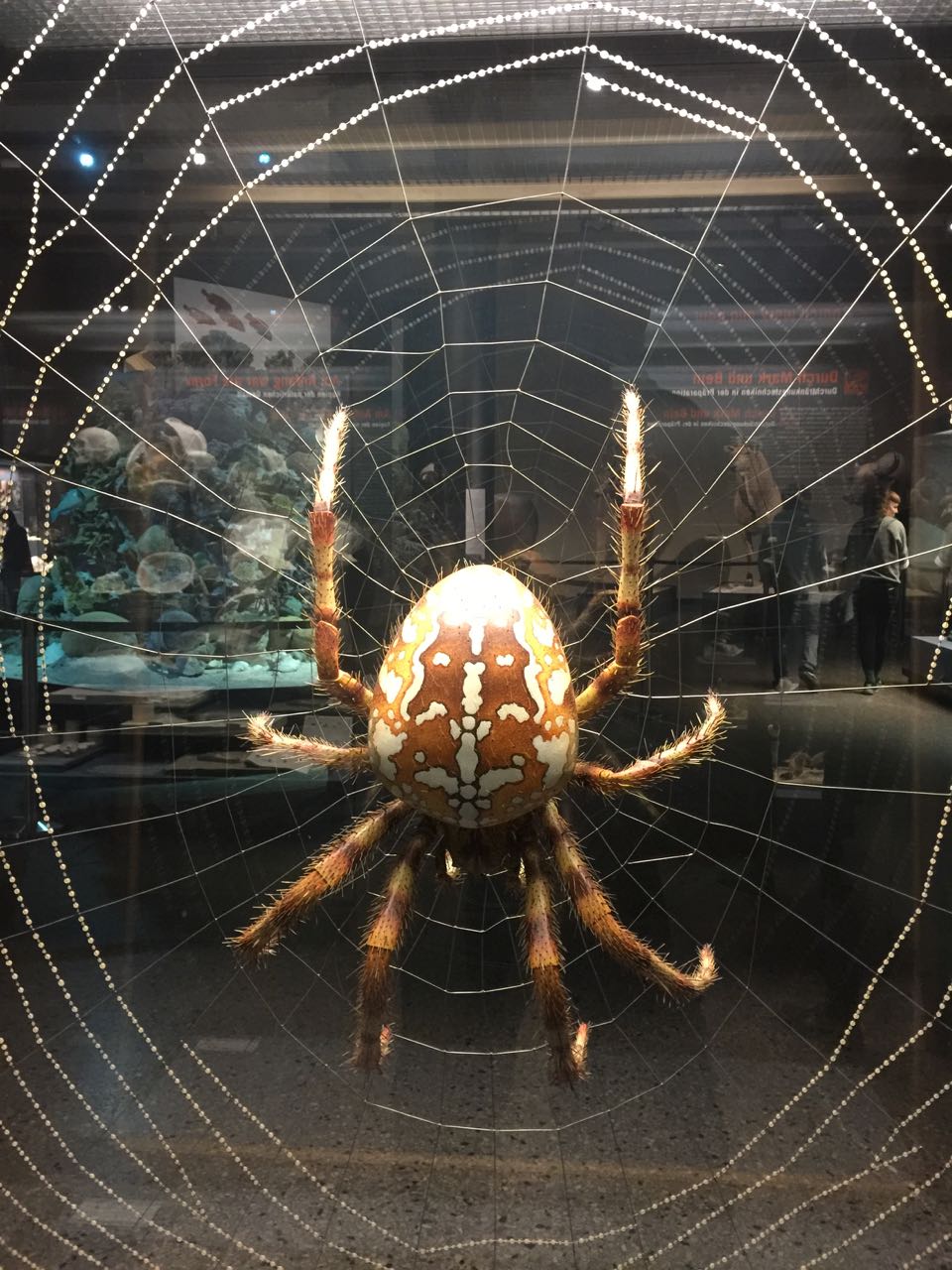 I steered Carolyn clear of the view of this cute little (well, three feet worth of little) arachnid because I felt had she seen it, the ensuing scream might have set off all sorts of alarms and we might have found ourselves surrounded by German police officers with automatic weapons. Crisis averted.

 Written on the building is “Dem deutschen Volke,” which means “To the German people.” This building was made particularly famous (or perhaps notorious) when in 1933 it was set on fire, allowing the Nazis to use it as a pretext to arrest and kill anybody they felt like arresting and killing.


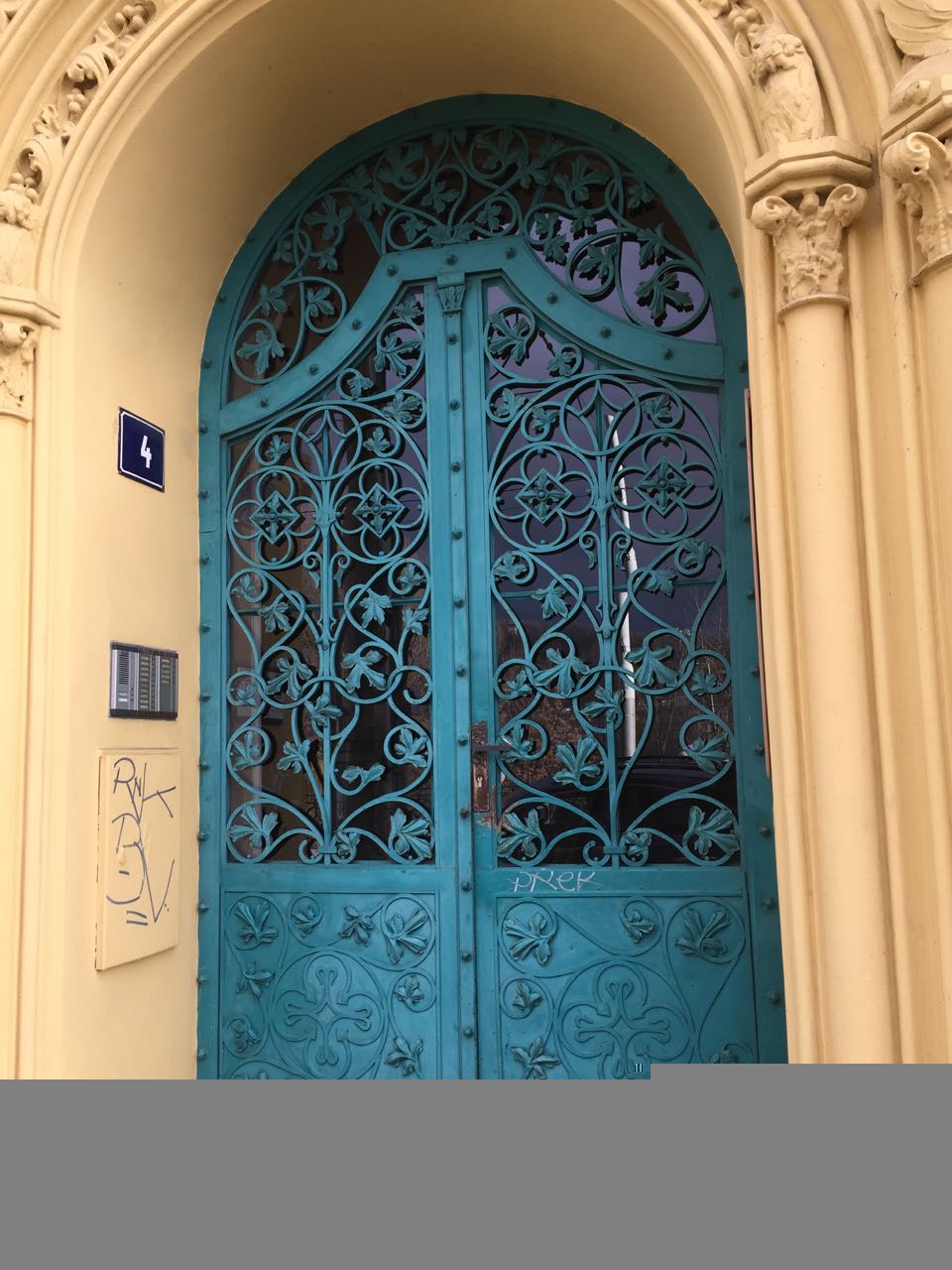 And we’ll finish up this entry with a Door of the Day.
 Regardless of that genius idea, it just goes to prove that just about anything can be a thing. So now I’m thinking of opening a store with nothing but platypuses in them. Statues of platypuses.
 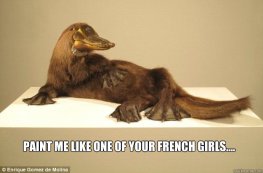 Chocolate-shaped platypuses. Sheets and blankets with images of platypuses cavorting around, topped with a pillow-shaped platypus. And of course two pairs of panties, one with a red platypus and one with a green one.
 Okay, is it the best, or the worscht? We had to give them points for their clever name, and as a result this became the first meal we had in Germany. It was the best bestworscht we’d ever had up to that point, but I’m still not sure if that’s a good thing.
 The Germans are so thoughtful that they put farting stations around town. So apparently this is where you fart, and that little device either sucks up the fumes, or gives you a stink-o-rating. I’m not sure which because the numbers on the device were in metric. I tried to convince Carolyn to give it a go, but she was too shy. I wasn’t shy, but alas, I wasn’t gassy either.
 I’m pretty sure this sign on a pharmacy window translates to: “Well, you were my friend, but so long brave wart!”
 Again, the Germans are so efficient (as well as hyper aware that if you have “germ” in your country’s name, you need to work extra hard to prevent the spread of more of them) that they even have a place for you to “dak,” which I’m sure is the German word for the sound you make when you sneeze, and then they offer a polite “gesundheit” ahead of time. I tried to take advantage of the offer, but I’m not allergic enough to Christmas trees. I coughed, but nothing happened. Bummer.
 Germany also has strict truth-in-advertising laws, so if your Pelchen is crap, well, you’re gonna have to call it krappelchen. This is a river in Dresden, btw.
 By the same token, if your shampoo is bad, there’s no hiding behind fancy marketing.
 “He’d step over ten naked women to get at a pint.” A sign we got a kick out of in an Irish pub we went to, because of course you always have to go to an Irish pub if you’re visiting Prague, where this was. Never did see the ten naked women though.
 As with most big cities, there is graffiti. I’ve always wondered the words mean, and in fact have found it interesting that for the most part, they use pretty much the same lingo, which is just as unintelligible in Europe as it is in the states. Except this one. I guess boobs are universal.
 This is the Berlin Cathedral (“Berliner Dom”). It was built on a site that had various churches on it since the 1400s. The current building was finished in 1905. It at least gives the Germans something to crow about.
 In 1944, an Allied combustible bomb dropped into the dome. The resulting fire could not be extinguished, and so da dome dum-dum-DUM-dummed. In 1975, reconstruction began, restoring it to its former glory.
 A climb to the top of the dome reveals some impressive views of Berlin.
 A climb to the bottom reveals some rather cryptic things.
 They always have fences around tombs because so many people are dying to get in.
 The original church on the site was built in the 1890s. It was badly damaged in a bombing raid in 1943. The present building, which consists of a church with an attached foyer and a separate belfry with an attached chapel, was built between 1959 and 1963. The damaged spire of the old church has been retained and its ground floor has been made into a memorial hall. (per Wikipedia)
 Either this tower is needed to relieve all the gasses from too much bestworscht, or maybe the lack of a huge offgassing tower is what really blew up the dome of the church.
 As you can tell from this photo, this particular building goes all the way to the top.
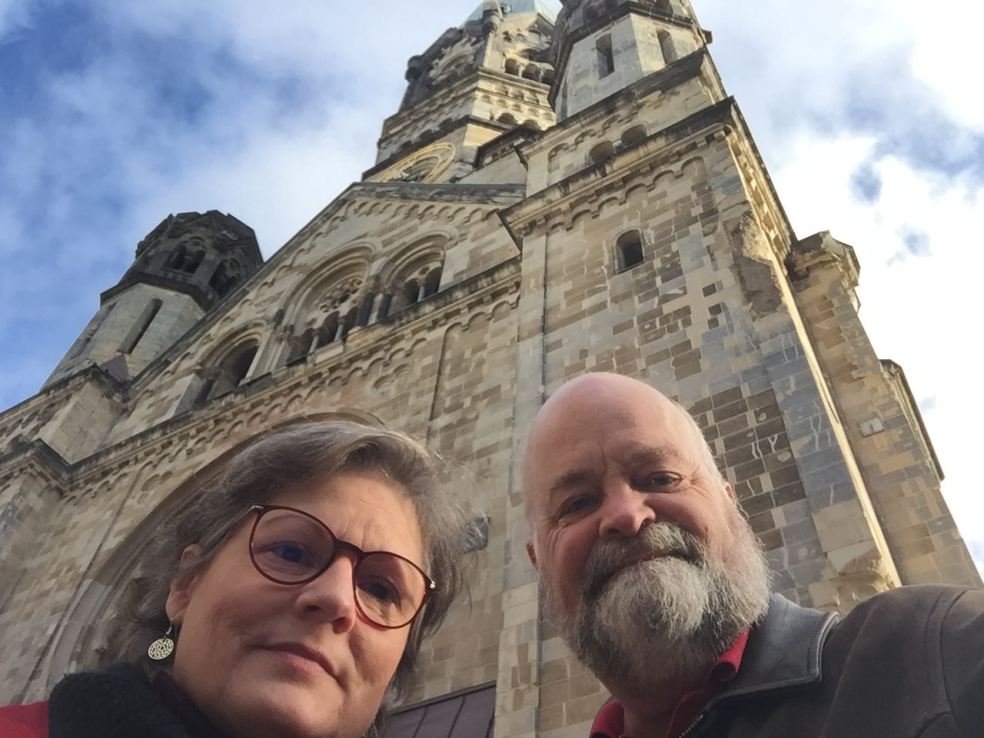 The Memorial Church today is a famous landmark of western Berlin, and is nicknamed by Berliners “der hohle Zahn”, meaning “the hollow tooth”. After all the food we ate, I think we both ended up with hollow teeth ourselves.
 I found an unwrapped wife under the Christmas tree, and so decided to take her home. I did almost opt for the blue present instead, but ultimately stuck with the red one. After that comment, she’ll be shopping for the red Ampelmann panties for sure. Ha!
 As with many of the Christmas markets, this one was built in and around the grounds of a famous building, in this case the Kaiser Wilhelm Memorial Church. But you already knew that because you’re taking notes, right?
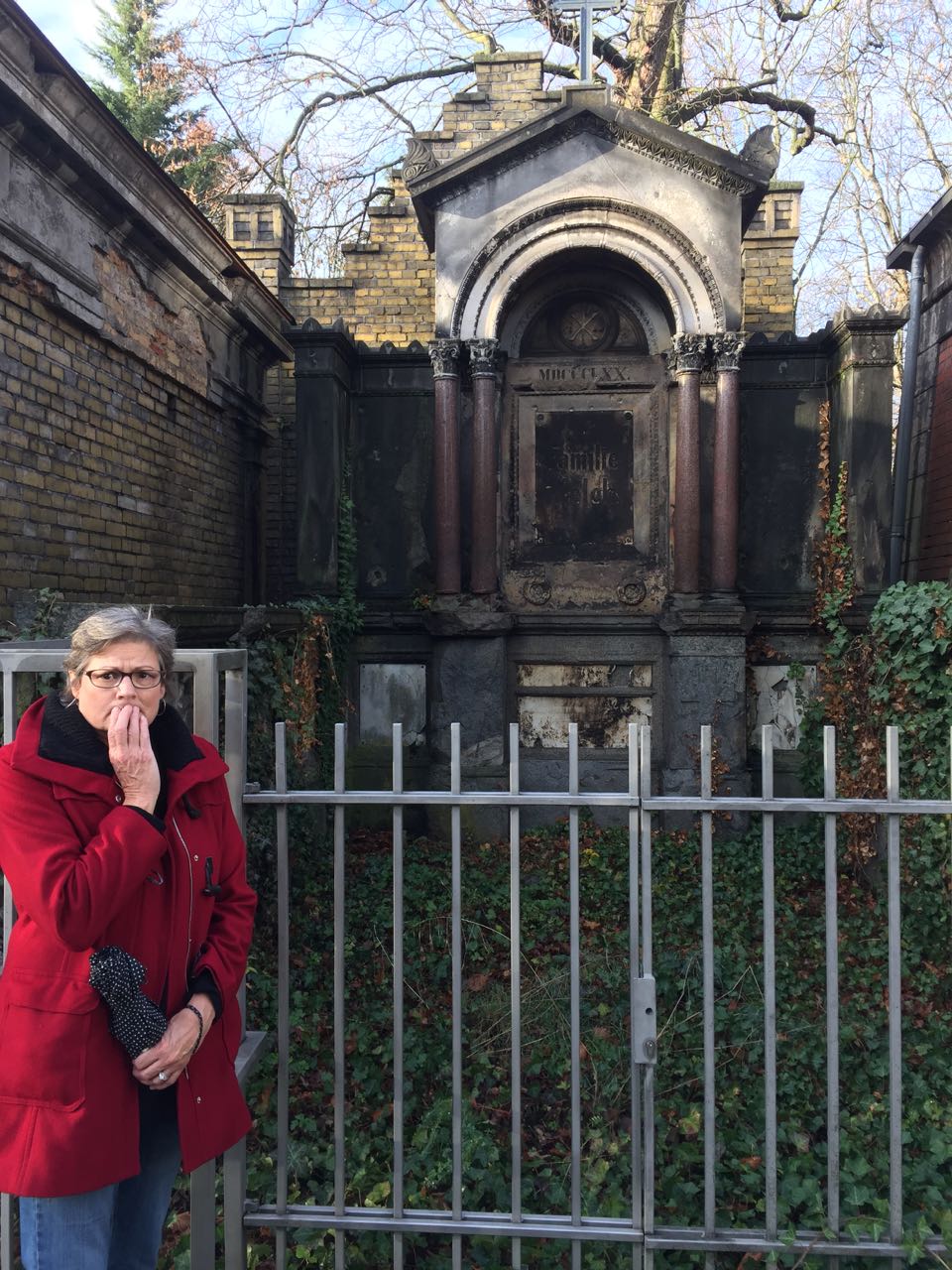 We close this blog entry with a very grave photo.
 baldsasquatchdotcom